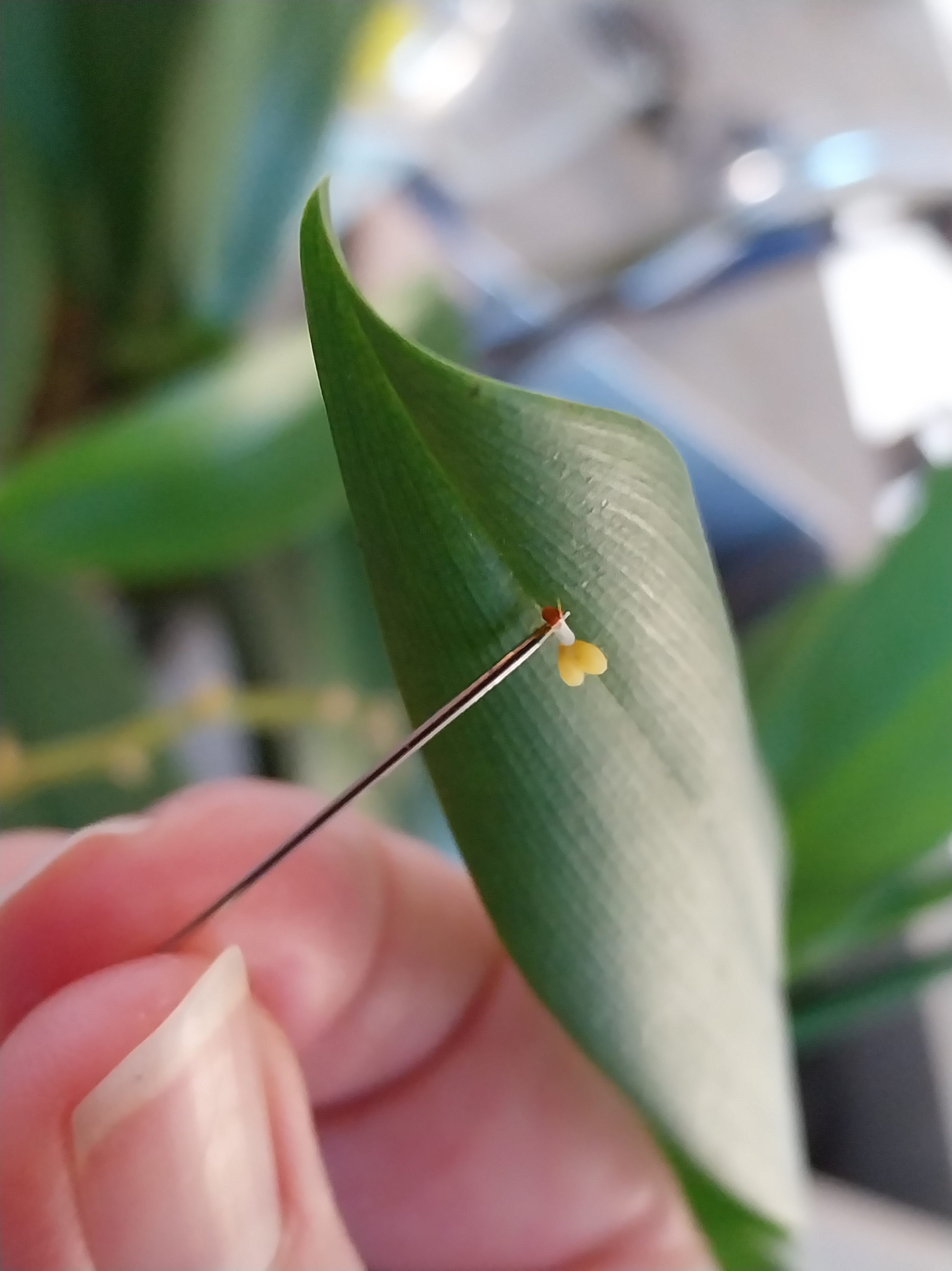
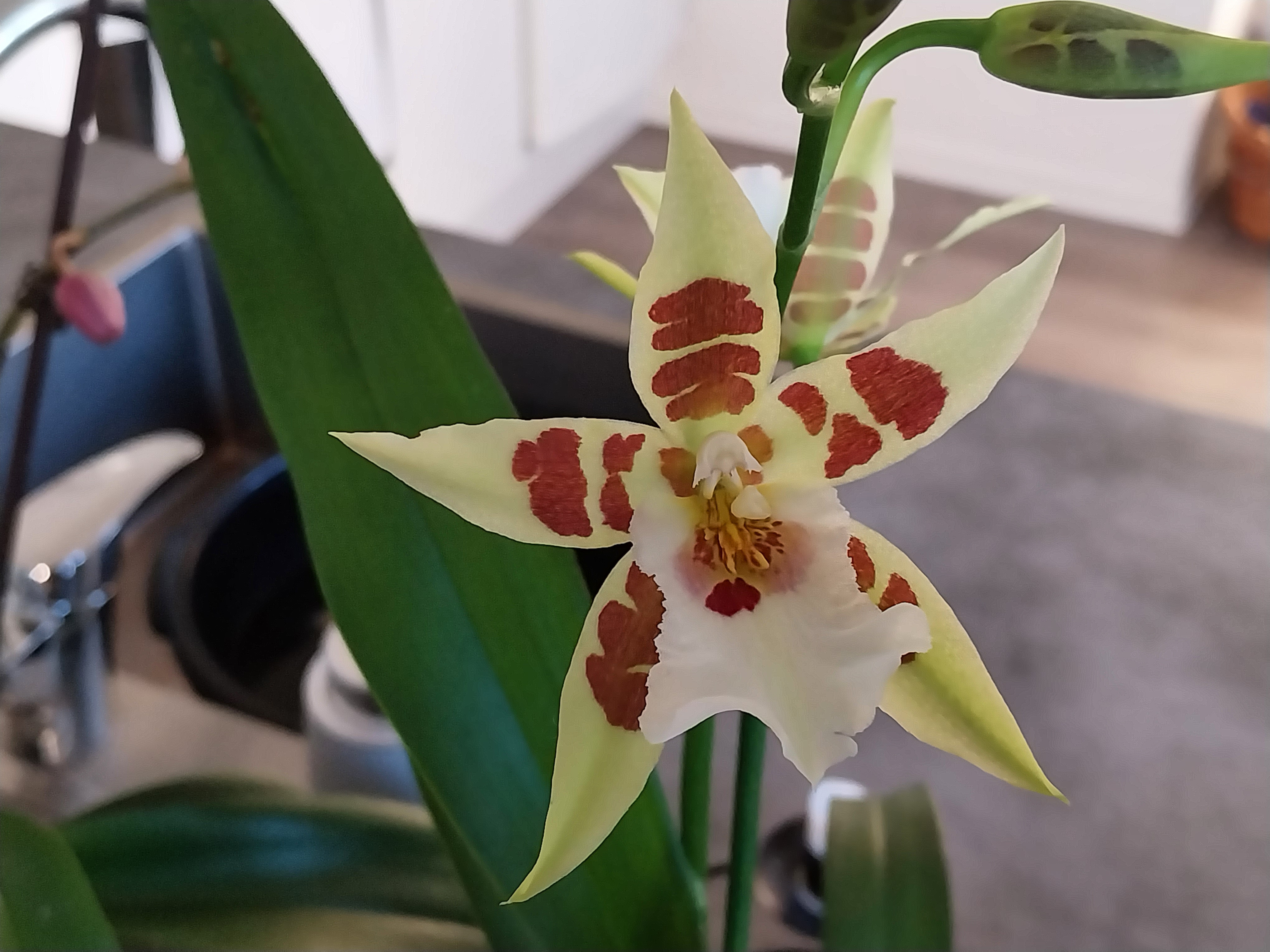
The other day Karin bought a Miltonia orchid to add to the ever-expanding collection of orchids she’s accumulating. It’s nowhere near as large as the collection she accumulated in our old place in the UK – part of it is pictured in this old post of mine – but it’s only a matter of time. This morning I showed her how to extract orchid pollen from the flower and her squeals of delight were something to hear!
As you can see in the image above, these orchids package their pollen into discrete structures that we term “pollinia” – two of them in this case, though the form and number of pollinia vary between different groups of orchids. The pollinia plus the sticky organ that attaches them to a pollinator is collectively termed a “pollinarium”. The only other plants that present their pollen in this way are my beloved asclepiads in the family Apocynaceae. The orchids and the asclepiads are only very distantly related to each other so this is a clear example of convergent evolution, where both plant groups have come up with the same solution to a problem. In this case, the problem is probably that bees collect a lot of pollen which has a reproductive cost for plants. Packaging the pollen in this way prevents bees from stealing it, amongst other advantages.
If you want to look at this yourself, you’ll find the pollinaria tucked under the front of the central “column” of the flower, which comprises the fused male and female reproductive parts. Just take a fine needle and gently stroke the underside of the column. In the image below, taken just after we extracted the pollinarium, you can see the “anther cap” which covered them lying just below the column.
It’s possible to learn a lot about botany from studying even common houseplants such as these!
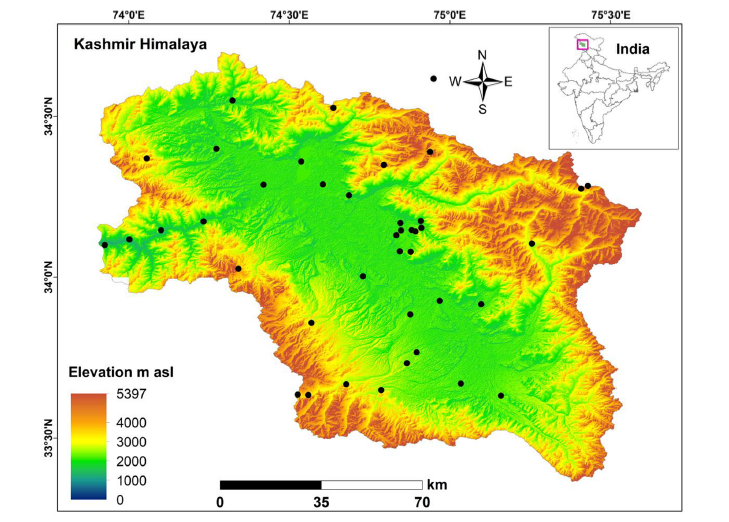
Although we sometimes like to think that we have a “global” perspective on plant-pollinator interactions, in truth there are large parts of the world where we have little or no information. That’s especially true of biodiversity hotspots. One such hotspot is the Kashmir Himalaya, a relatively small area (just 135 km long by 32 km wide) that nonetheless contains an estimated 2,000 species of flowering plant, more than 150 of which are endemic to the area. In addition, over 1,280 insect pollinator species have been described, including at least 29 species of bumblebees and as many as 40 species of butterflies.
Recently I’ve been collaborating with Dr Zubair Rather from the University of Kashmir and his colleagues on a data set that represents the first network analysis of plant-pollinator interactions from the region. The network is presented at a large spatial scale – what is often termed a “meta-network”. As Dr Kit Prendergast and I noted in our recent paper, scale matters when it comes to analysing these sorts of networks. Nonetheless (to quote the current paper):
“meta-networks represent the “backbone” of plant-pollinator interactions to which smaller, local networks are attached”
Even at this very large scale we’re seeing some fascinating patterns emerging with respect to the plants, for example the importance of cultivated apples in supporting the wider network of flower visitors. Also notable, and I believe demonstrated for the first time, is the fact that both the indigenous Asian Honeybee (Apis cerana) and the introduced Western Honeybee (A. mellifera) utilise exactly the same, extremely broad array of plants from which to collect nectar and pollen.
Our Kashmir meta-network is, hopefully, the starting point for further work on plant-pollinator interactions in this fascinating and diverse part of the world. The paper is published in a special issue of the journal Flora that’s dedicated to the importance of natural history when considering the ecology and evolution of plant-pollinator relationships. The special issue is a celebration of the work of Professor Marlies Sazima and is edited by Dr Pedro Bergamo.
Here’s the reference with a link to download a free copy which should be valid up to and including 23rd January 2023:
Plant-pollinator studies are increasingly using network analysis to investigate the structure and function of such communities. However, many areas of high biodiversity largely remain unexplored in this way. Our study describes a plant-pollinator meta-network from an understudied biodiversity hotspot, the Kashmir Himalaya, where we specifically investigate plant-pollinator network nestedness and modularity, as well as the influence of alien species and the impacts of simulating species extinctions on network structure. Natural history observations were used to document the meta-network between 230 plant and 80 pollinator species forming 1958 (11% of the possible) interactions. Among the plants Malus domestica and among the pollinators Apis mellifera and A. cerana formed the largest number of interactions with significant influence over the whole network. Network cumulative degree distribution depicted a higher number of degree levels in pollinators than plants. A moderately high number of realized interactions were revealed, thereby indicating potential structural and functional stability in the network. Eight strongly defined modules were observed in the network which varied in their composition. For example, the Ephedra module exclusively comprised of native species whereas the Apis module comprised of all the four different types of interacting species (i.e. native and alien plants and pollinators) and also integrated the highest number of alien species. In the network overall, 40% of interactions were by alien species, reflecting how well these were integrated. Extinction simulations suggested that the network would collapse more quickly when the most connected pollinators are removed, rather than the most connected plant species. Our study is the first assessment of a plant-pollinator network from this Himalayan biodiversity hotspot; and will help to inform the ecological and economic implications of plant-pollinator interactions in an era of global biodiversity crisis.
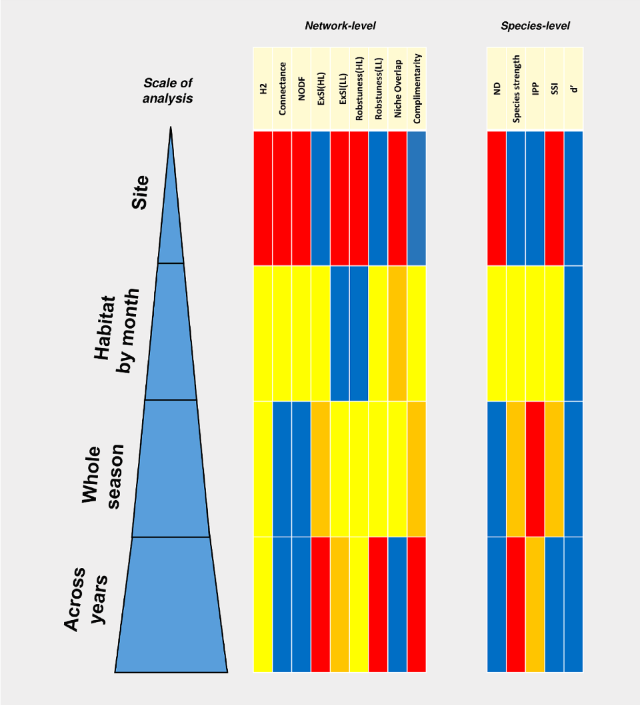
It’s long been recognised that the scale at which we study the natural world – over long or short time periods, or across small areas or whole regions – affects the conclusions that we draw about ecological patterns and processes. This is certainly true of plant-pollinator interactions. For example, a widely distributed plant can have very different pollinators at the extremes of its range, and pollinators like bees may vary their focus on nectar and pollen sources from year to year.
The analysis of these interactions as networks of actors has become increasingly popular in the last couple of decades. However there is no consensus about how frequent sampling should be, or the geographical scale over which networks should be studied. In fact all scales (from regional “meta-networks” down to single-season, single-site, single taxon observations) are relevant, depending on the questions being asked or the hypotheses posed.
But it’s important that we acknowledge that conclusions drawn at one scale may not apply at other scales.
That’s the take home message from a paper published this week which is the latest output from the PhD work of Australian bee expert Kit Prendergast. We have collaborated on several papers based on her data and this is actually my 100th peer-reviewed publication: a proud milestone for me and one which I’m glad to share with a wonderful early career researcher like Kit!
Here’s the reference with a link to a read-only version of the paper:
Bipartite networks of flowering plants and their visitors (potential pollinators) are increasingly being used in studies of the structure and function of these ecological interactions. Whilst they hold much promise in understanding the ecology of plant– pollinator networks and how this may be altered by environmental perturbations, like land-use change and invasive species, there is no consensus about the scale at which such networks should be constructed and analysed. Ecologists, however, have emphasised that many processes are scale dependent. Here, we compare network- and species-level properties of ecological networks analysed at the level of a site, pooling across sites within a given habitat for each month of surveys, and pooling across all sites and months to create a single network per habitat type. We additionally considered how these three scales of resolution influenced conclusions regarding differences between networks according to two contrasting habitat types (urban bushland remnants and residential gardens) and the influence of honey bee abundance on network properties. We found that most network properties varied markedly depending on the scale of analysis, as did the significance, or lack thereof, of habitat type and honey bee abundance on network properties. We caution against pooling across sites and months as this can create unrealistic links, invalidating conclusions on network structure. In conclusion, consideration of scale of analysis is also important when conducting and interpreting plant–pollinator networks.
Within the last decade there’s been a growing awareness of the importance of urban environments for supporting populations of pollinators, especially bees. Indeed, I devoted a whole chapter of my book Pollinators & Pollination: Nature and Society to the topic, though even then I was only able to scratch the surface of the research that’s been done. Since then there’s been some important studies published and this 2020 review by Kath Baldock provides a good starting point for the topic, whilst a recent pre-print by Pietro Maruyama and colleagues emphasises how little we know about pollinators in tropical cities.
One of the most detailed studies of urban solitary bees in a British town was conducted by Muzafar Sirohi when he was a PhD researcher in my department in Northampton. The first paper from that work, documenting the diversity and abundance of bees, came out in 2015, but since then commitments to other projects, plus Muzafar’s return to his university in Pakistan, have meant that we’ve struggled to find the time to publish more. Hopefully that’s changing and the second publication from Muzafar’s thesis is now out, with a third in progress.
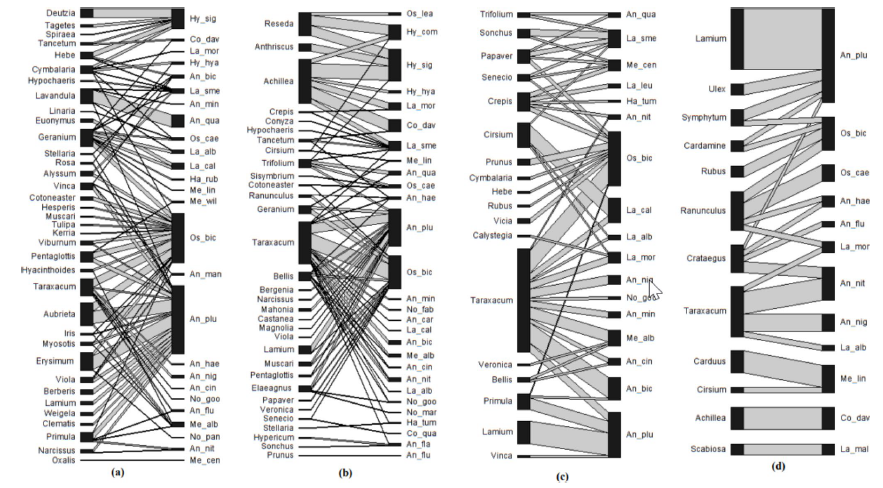
This new paper uses a network approach to study the use of flowers by these bees; here’s the reference with a link to a read-only copy of the paper, followed by the abstract.
Biodiversity is declining through human activities and urbanisation is often seen as a particular concern. Urban settings, however, provide diverse microclimatic conditions for plants and pollinating insects, and therefore may be significant habitats for the conservation of solitary and primitively eusocial bees, a major group of pollinators. This study analysed the interactions between these bees and the plants on which they forage, using a network approach. We compared urban habitats (gardens, roadsides, and open vegetation) in a large British town with nearby nature reserves. One native plant Taraxacum officinale (dandelion) was a core generalist species visited in all habitat types. Other core plant species restricted to particular habitats include species of Geranium, Bellis, Crepis, and Ranunculus. Two generalist bee species, Anthophora plumipes and Osmia bicornis were the core visitor species within the networks. The networks were comparatively more nested in urban habitat types than nature areas, suggesting more frequent interactions between generalist and specialist species in urban areas. Network connectance, network level specialisation (H2’ index), and plant generality (network level) were not significantly different in urban and nature areas. However, visitor generality was found to be significantly higher in urban gardens than in nature areas. Careful management of common urban vegetation would be beneficial for supporting urban wild pollinators.
One of the projects with which I’ve been involved over the past few years has been a collaboration with researchers at Imperial College and the Natural History Museum, alongside regional collections in the UK, to assess how museum specimens of bumblebees (Bombus spp.) can be used to look at long-term ecological changes in pollinator populations. The first two papers from that project were published in August but because of my trip to Kenya I’ve only now been able to post about them.
The details of the papers (both of which are open access and free to download) are below, followed by the official press release:
Arce, A., Cantwell-Jones, A., Tansley, M., Barnes, I., Brace, S., Mullin, V., Notton, D., Ollerton, J., Eatough, E., Rhodes, M., Bian, X., Hogan, J., Hunter, T., Jackson, S., Whiffin, A., Blagoderov, V., Broad, G., Judd, S., Kokkini, P., Livermore, L., Dixit, M., Pearse, W. & Gill, R. (2022) Signatures of increasing environmental stress in bumblebee wings over the past century: Insights from museum specimens. Journal of Animal Ecology 00, 1– 13. https://doi.org/10.1111/1365-2656.13788
Mullin, V. E., Stephen, W., Arce, A. N., Nash, W., Raine, C., Notton, D. G., Whiffin, A., Blagderov, V., Gharbi, K., Hogan, J., Hunter, T., Irish, N., Jackson, S., Judd, S., Watkins, C., Haerty, W., Ollerton, J., Brace, S., Gill, R. J., & Barnes, I. (2022). First large-scale quantification study of DNA preservation in insects from natural history collections using genome-wide sequencing. Methods in Ecology and Evolution, 00, 1– 12. https://doi.org/10.1111/2041-210X.13945
OFFICIAL PRESS RELEASE: Museum collections indicate bees increasingly stressed by changes in climate over the past 100 years
• An analysis of bumblebee wings from a network of UK museums shows signs of stress linked to increasingly hotter and wetter conditions. • As well as revealing what is linked to stress in bees in the past, the study can help predict when and where bees will face most stress and potential decline in the future. • Bumblebees and other insect pollinators have faced population declines in recent years. • The researchers have also for the first time used ancient DNA techniques to sequence bumblebee genomes dating back over 100 years. Scientists from Imperial College London and the Natural History Museum today published two concurrent papers analysing UK bumblebee populations.
The first investigated the morphology (body shapes) of bee specimens dating back to 1900. Using digital images, the group first investigated the asymmetry in bumblebee wings as an indicator of stress. High asymmetry (very differently shaped right and left wings) indicates the bees experienced stress during development – an external factor that affected their normal growth.
Studying four UK bumblebee species, the group found evidence for stress getting higher as the century progressed from its lowest point around 1925. Further analysis showed that each bee species displayed a consistently higher proxy of stress in the latter half of the century.
Learning from the past to predict the future By taking the climate conditions during the year of collection – namely annual mean temperature and annual rainfall – the team found that in hotter and wetter years bees showed higher wing asymmetry. The study is published today in the Journal of Animal Ecology.
Author Aoife Cantwell-Jones, from the Department of Life Sciences (Silwood Park) at Imperial, said: “By using a proxy of stress visible on the bee’s external anatomy and caused by stress during development just days or weeks before, we can look to more accurately track factors placing populations under pressure through historic space and time.”
Author Dr Andres Arce, now at the University of Suffolk, stated: “Our goal is to better understand responses to specific environmental factors and learn from the past to predict the future. We hope to be able to forecast where and when bumblebees will be most at risk and target effective conservation action.”
Senior author Dr Richard Gill, from the Department of Life Sciences (Silwood Park) at Imperial, said: “With hotter and wetter conditions predicted to place bumblebees under higher stress, the fact these conditions will become more frequent under climate change means bumblebees may be in for a rough time over the 21st century.”
DNA from a single leg As well as measuring the wing shapes of bees, in a second parallel study the team successfully sequenced the genomes of over a hundred bumblebee museum specimens dating back more than 130 years. In a pioneering advance, ancient DNA methods typically used for studying woolly mammoths and ancient humans, were for the first time used on an insect population.
Scientists from the Natural History Museum and the Earlham Institute quantified DNA preservation using just a single bee leg from each of the bees studied to create a baseline genome for each of the four species.
From these developments, published today in Methods in Ecology & Evolution, the researchers can now look to determine how the reported stress may lead to genetic diversity loss.
In conjunction with providing a new reference genome, the team will now use this data to study how bee genomes have changed over time, gaining an understanding of how whole populations have adapted – or not – to changing environments.
The value of museum collections Focusing on bumblebee collections, the team worked with curators from the Natural History Museum London, National Museums Scotland, Oxford University Museum of Natural History, World Museum Liverpool, and Tullie House Museum Carlisle.
Author Dr Victoria Mullin, from the Natural History Museum, said: “Museum insect collections offer an unparalleled opportunity to directly study how the genomes of populations and species have been affected by environmental changes through time. However, they are a finite resource and understanding how best to utilise them for genetic studies is important.”
Senior author Professor Ian Barnes, from the Natural History Museum, said: “One of the main problems with museum collections is that the quality of DNA can be very variable, making it difficult to predict which type of analyses we should do. We now have a much better idea about DNA preservation in insect collections, which is a massive boost to our ongoing work to understand the history and future of insect populations.”
Dr Gill concluded: “These studies showcase the value of leveraging museums specimens to go back in time and unlock the past’s secrets. But what we have done is just the beginning, and by continuing our work with these vital public collections and collaborating with curators we can only discover more. All this work was part of a Natural Environment Research Council-funded project and could not have been achieved without the commitment, hard work, and diligence of the museum curators, and our other collaborators”.
Most of us have at some time stared in fascination at the life contained within the pools that form on rocky shores at low tide. But none of us realized that a whole new class of ecological interaction was taking place!
The 12,000 or so described (and many un-named) seaweeds are incredibly important organisms. Their diverse and abundant photosynthesizing fronds make them one of the main primary producers in coastal seas, creating food and habitat for a huge range of animals. Not only that, but some – the coralline seaweeds – lock up vast amount of CO2 as calcium carbonate and help to create reef systems in the same way as coral.
Although scientists have studied seaweeds for hundreds of years, many aspects of their ecology are still unknown. Their detailed mode of reproduction, for example has only been studied in a small proportion of species.
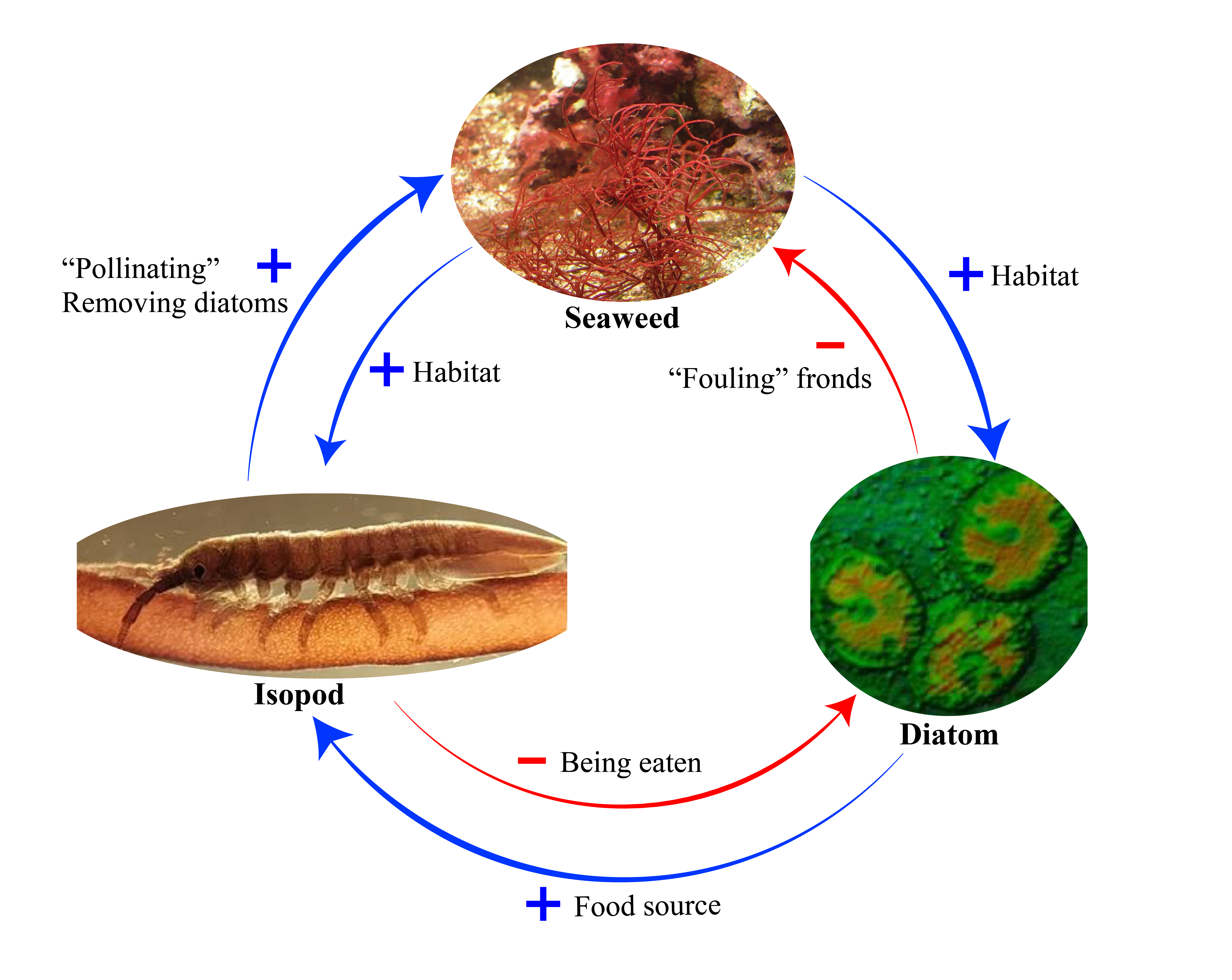
In a newly published study in the journal Science, French PhD researcher Emma Lavaut and her colleagues have shown that small isopod crustaceans – relatives of woodlice and sea slaters – facilitate the movement of the equivalent of seaweed sperm (termed “spermatia”) from male to female reproductive structures in just the same way that bees and other pollinators move pollen between flowers, so fertilizing female gametes.
Your read that correctly: some seaweeds have pollinators!
It’s an incredible finding! And the implications of this are enormous: Emma and her colleagues have added a whole new branch of life to the examples of sedentary (fixed-place) organisms that require a third party to enable their reproduction. In addition to being a fascinating biological discovery, it has significant environmental and sustainability implications.
Seaweeds are a diverse group of macroalgae that appeared more than one billion years ago, at least 500 million years before the evolution of what we think of as “true” plants, such as the flowering plants, conifers, cycads, ferns and mosses. Sexual reproduction in the brown and green seaweeds, which include kelps, wracks and sea lettuces, involves spermatia that are mobile and use a flagellum to swim through the water to seek out female reproductive structures. However, Emma studied a seaweed, Gracilaria gracilis, which belongs to the Rhodophyta or red seaweeds, and none of the species in this group have these swimming sperm equivalents.
Sexual reproduction in the red seaweeds has therefore always been something of a mystery. Three quarters of species have separate male and female individuals and so they cannot mate with themselves. It was assumed that the gametes were just released into water currents that haphazardly transported them to the female reproductive organs, much as wind pollinated grasses and pine trees release their vast clouds of pollen on land. The authors of this new study, however, point out that most sexual reproduction by these red seaweeds takes place in the relatively still waters of rock pools, a habitat that they mimicked in the laboratory in a series of elegant aquarium experiments.
The isopod crustaceans are attracted to the seaweed because they provide a habitat away from predators and a supply of food: they graze on the microalgae that colonise the seaweed’s fronds. Picking up spermatia and moving them between fronds is a side-effect of this activity by the small invertebrates. As you can see from the illustration above, the isopods and the seaweed are engaged in a “double mutualism“: a plus sign (+) indicates a positive effect of one species on another, while a minus sign (-) indicates a negative impact.
What I find especially fascinating about this research is that both the seaweed (Gracilaria gracilis) and the isopod (Idotea balthica) were originally described as species more than 200 years ago. They also have an extremely wide distribution. The isopod is found around the coasts of Europe and down the eastern seaboard of the Americas. The seaweed is pretty much found globally. These are not rare, unusual species, yet the interaction between them has only just been discovered! This is a point that I made in my recent book Pollinators & Pollination: Nature and Society: quite often, species that are well known interact in previously undocumented ways because no one has had the time or inspiration to look closely at them.
Although the idea that small sea creatures might be helping seaweeds to reproduce sounds very fanciful, there is a precedence for this discovery. Back in 2016, in a paper published in Nature Communications, a group of Mexican researchers led by Brigitta van Tussenbroek showed that a species of seagrass is pollinated by a diverse assemblage of small crustaceans and polychaete worms. Seagrasses are flowering plants, not seaweeds, but clearly this type of mutually beneficial relationship can exist between different species in the oceans.
Rhodophyta are the most diverse group of seaweeds, with more than 7,000 known species. They are especially abundant on coastal shores, oceanic habitats that are under huge pressure from infrastructure development, pollution, and climate change. At the same time, these seaweeds are economically important and millions of tonnes of them are collected every year as food, as nutritional and pharmaceutical supplements, and to produce agar. In order to conserve these seaweed populations, we need to better understand their ecology and their environmental requirements.
The work by Emma Lavaut and colleagues suggests that interactions with their “pollinators” may be a critical aspect of this understanding. In the same way that “Save the Bees” has been a rallying call for conserving interactions between species on land, we may soon hear this message echoed in “Save the Isopods”. At the very least, I have to add a new section to the second edition of my book!
Full disclosure: I was one of the reviewers of the original manuscript submitted to Science by Emma and her co-authors. It’s a rare privilege to review a study and think: “Wow! This is a game-changer!” and including this paper it’s happened to me only a handful of times. The editors at Science kindly invited my colleague Dr Zong-Xin Ren and myself to write a Perspective piece about the work and we were delighted to do so.
Image credits: Isopod and diatom images from Lavaut et al (2022). Gracilaria image by Emoody26 at English Wikipedia CC BY 3.0 https://commons.wikimedia.org/w/index.php?curid=3455016. Design by Shijia Wen and Jeff Ollerton.
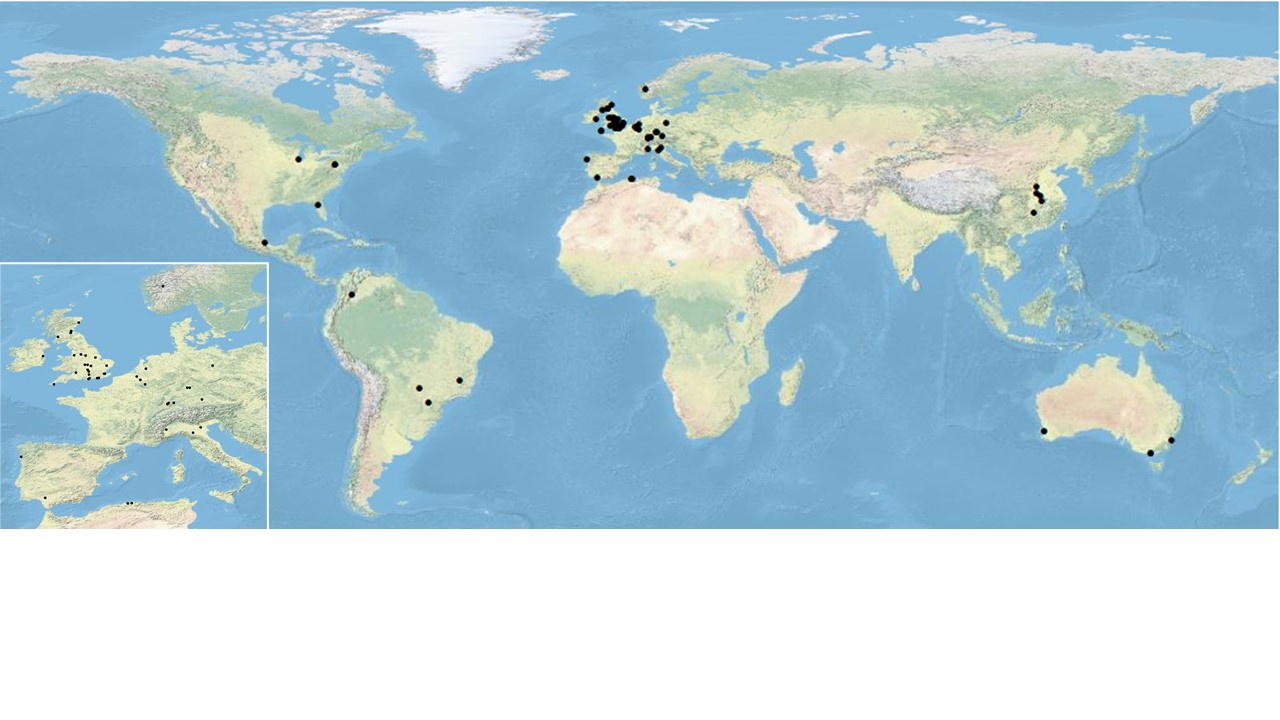
During the lockdown period of the COVID-19 pandemic in 2020, many pollination ecologists were stuck at home: universities and research institutes were closed and restrictions on travel meant that it was not possible to get out and do field work. In order to keep active and motivated, and to turn adversity into an opportunity, an ad hoc network of more than 70 researchers from 15 different countries (see the map above) decided to collect standardised data on the plant-pollinator networks in their own gardens and nearby public spaces.
When combined with information about location, size of garden, floral diversity, how the garden is managed, and so forth, this would provide some useful data about how gardens support pollinators. For those with kids at home it could also be a good way of getting them out into fresh air and giving them something to do!
The resulting data set of almost 47,000 visits by insects and birds to flowers, as well as information about flowers that were never visited, is freely available and will be an invaluable resource for pollination ecologists. For example, analysing the links between ornamental flowers that share pollinators with fruits and vegetables such as apples and beans, will allow us to make recommendations for the best plants to grow in home gardens that can increase yields of crops.
There’s an old saying about turning adversity into a positive outcome: “When life gives you lemons, make lemonade”, and the researchers were pleased to find that there’s one record of Citrus limon in the data set!
The paper describing the data set has just been published in the Journal of Pollination Ecology and you can download a PDF of the paper and the associated data for free by following this link.
Sincere thanks to all of my co-authors for their commitment to the project!
In my recent book Pollinators & Pollination: Nature and Society I discussed the current state of our knowledge of how populations of pollinators have changed over time. Although we have some quite detailed data for particular, often charismatic, species or for certain geographic localities or regions, for most species we know almost nothing. As I wrote in the chapter “The shifting fates of pollinators”:
“For most pollinators we are ‘data deficient’, in other words, we don’t know how their populations are performing. They could be doing well, but they may not be”
This is particularly true for those regions for the world that hold the greatest terrestrial biodiversity: the tropics. For the vast majority of species in the tropics we know precious little about trends in their populations and how their distributions have changed over time in the face of wide-scale land transformation and recent climatic shifts. Filling in some of the gaps in our knowledge of Neotropical pollinator distributions is one of its aims of SURPASS2, a collaboration between South American and UK ecologists, and one of several research and outreach projects with which I’m involved.
In a new study that’s come out of that work, led by Rob Boyd from the UK Centre for Ecology and Hydrology, we’ve used the GBIF database to look at the changing distributions of four important groups of pollinators: bees, hoverflies, leaf-nosed bats and hummingbirds. In particular we were interested in understanding the kinds of biases that come with such publicly available data, and whether recent efforts to add data to GBIF has improved our understanding of trends.
Our overall conclusion is that there are significant limitations and biases inherent in all of these data sets even for groups like hummingbirds which one would imagine are well documented by scientists and bird-watching naturalists. In addition, having more data does not necessarily help matters: it can introduce its own biases.
The paper is open access and feely available; here’s the reference with a link:
Aim Aggregated species occurrence data are increasingly accessible through public databases for the analysis of temporal trends in the geographic distributions of species. However, biases in these data present challenges for statistical inference. We assessed potential biases in data available through GBIF on the occurrences of four flower-visiting taxa: bees (Anthophila), hoverflies (Syrphidae), leaf-nosed bats (Phyllostomidae) and hummingbirds (Trochilidae). We also assessed whether and to what extent data mobilization efforts improved our ability to estimate trends in species’ distributions.
Location The Neotropics.
Methods We used five data-driven heuristics to screen the data for potential geographic, temporal and taxonomic biases. We began with a continental-scale assessment of the data for all four taxa. We then identified two recent data mobilization efforts (2021) that drastically increased the quantity of records of bees collected in Chile available through GBIF. We compared the dataset before and after the addition of these new records in terms of their biases and estimated trends in species’ distributions.
Results We found evidence of potential sampling biases for all taxa. The addition of newly-mobilized records of bees in Chile decreased some biases but introduced others. Despite increasing the quantity of data for bees in Chile sixfold, estimates of trends in species’ distributions derived using the postmobilization dataset were broadly similar to what would have been estimated before their introduction, albeit more precise.
Main conclusions Our results highlight the challenges associated with drawing robust inferences about trends in species’ distributions using publicly available data. Mobilizing historic records will not always enable trend estimation because more data do not necessarily equal less bias. Analysts should carefully assess their data before conducting analyses: this might enable the estimation of more robust trends and help to identify strategies for effective data mobilization. Our study also reinforces the need for targeted monitoring of pollinators worldwide.
——————————————————–
SURPASS2 has been a hugely productive project as you’ll see if you look at the Publications page of the website. There’s much more to come and I’ll report on those research papers as they appear.
Join me this Thursday at a free online talk organised by Buglife where I’ll be giving an introduction to how flowers function and the ways in which their behaviour manipulates pollinators to ensure reproduction. I’ll be covering:
What are flowers and where did they come from?
How flowers function and reward pollinators.
Some case studies from my own research on flower and pollinator behaviour.
Why is it important that we understand floral biology?
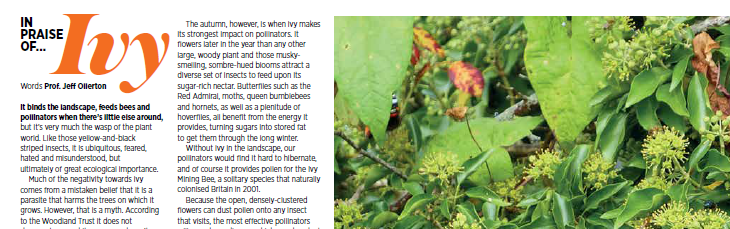
Although it can be invasive and an environmental nuisance in parts of the world where it’s introduced, common or European ivy (Hedera helix) is clearly one of the most vital plants across its native range of Europe, southern Scandinavia and the Mediterranean. Its clinging stems bind the landscape and provide habitat for a diversity of creatures. By offering nectar at a time when there’s few other plants in flower, and berries at a crucial point in the winter, ivy bridges a food gap for both nectar feeding insect and fruit eating birds and mammals.
Ivy is a very popular subject for student research because it’s in flower at the start of the university academic year. In the past I’ve had several students carry out their final year projects using ivy to test ideas about pollinator effectiveness and plant reproductive success. Because the open, densely-clustered flowers can dust pollen onto any insect that visits, the most effective pollinators will vary depending on which are abundant at any time and place, and include various types of flies and bees, plus those much-misunderstood wasps!
Perhaps we should leave the final word on ivy to the Northamptonshire ‘Peasant Poet’ John Clare who wrote ‘To the Ivy’ in the early 19th century:
Jacobs, J.H., Clark, S.J., Denholm, I., Goulson D., Stoate, C. & Osborne J.L. (2010) Pollinator effectiveness and fruit set in common ivy, Hedera helix (Araliaceae). Arthropod-Plant Interactions 4: 19–28
Ollerton, J. (2021) Pollinators & Pollination: Nature and Society. Pelagic Publishing, Exeter, UK
Ollerton, J., Killick, A., Lamborn, E., Watts, S. & Whiston, M. (2007) Multiple meanings and modes: on the many ways to be a generalist flower. Taxon 56: 717-728



 Prof. Jeff Ollerton - ecological scientist and author