Tag Archives: Pollinators

Claims that only 10% – and not 75% – of crops are pollinator dependent are misleading and dishonest

Earlier this week the Genetic Literacy Project site posted an essay entitled ‘10% — not 75% — of crops pollinator-dependent: Our World in Data debunks claims that global food supply is imminently endangered by ‘disappearing’ insects‘. That click-bait title is hugely misleading, some of the purported ‘facts’ are incorrect, and indeed the whole thing reeks of dishonesty and bad faith.

First the misleading title. This ‘debunks’ claim actually compares two different things: 75% of CROPS being dependent on pollinators versus 10% of crop YIELD. However, even if we focus on the 10% claim, a small increase in yield can be the difference between profit and bankruptcy for small-scale farmers. And most of the world’s farmers are small-scale and living on the borderline between loss and break-even. In addition, there’s no acknowledgement of the food production from home gardens, allotments, and community gardens, which is significant but largely unquantified.

Next, by focusing on yield and comparing, say, wind-pollinated wheat with insect-pollinated apples, the article takes no account of the fact that many of these crops that depend to some extent on pollinators mainly provide essential vitamins and minerals – not calories – to diets. When I tweeted about this earlier in the week, one person commented that they describe the insect-pollinated foods as ‘an important source of flavour and colour in our diets, rice and wheat are all well and good, but you do kinda need something more than grey slop to live’. Another said: ‘I’m so glad you mentioned this. I’m sick of reading articles that praise innovations to increase calories, when what we need is better nutrition from vitamins, minerals & fibres’.

Both great points, and well made.

That essay was also factually incorrect when it described roots crops such as carrots or some of the leafy cabbages and lettuces as not requiring pollinators. Many varieties of these crops ARE pollinator dependent: how do they think we get the seed for the next year’s crop?! And there are many crops and varieties that have not been evaluated for their dependency on pollinators: the 75% figure actually refers to the 115 most productive crop plants (Klein et al. 2007).

When I tweeted about the essay I commented that I was very disappointed by ‘Our World in Data’ – they are usually better than this when it comes to the facts. What I hadn’t appreciated at the time was that in fact the Genetic Literacy Project had highjacked the original piece by Hannah Ritchie and reworked it to give it a very different slant*.

This is where it starts to get dishonest and in fact the Genetic Literacy Project (GLP) has form in this area. The Sourcewatch site describes the GLP as ‘a corporate front group that was formerly funded by Monsanto’ with a remit to ‘shame scientists and highlight information helpful to Monsanto and other chemical producers’. In other words it’s heavily tied to Big Agriculture which, of course, would like us to believe that there’s not an issue with declining pollinators, that pesticides and agricultural intensification are our friends, and that Everything Is OK. Read the full account here.

Frankly, the GLP is so tainted that I’d not believe anything that they publish.

Pollinator decline and the role of pollinators in agriculture are complex issues. If you’d like to know more about the importance of pollinators to agriculture, complete with some accurate and objective facts, then there’s a whole chapter devoted to the topic in my book Pollinators & Pollination: Nature and Society.

*Note that I’ve been communicating with Hannah about the root and leaf crop issue and she accepts that this needs to change in the original. She’s also asked the Genetic Literacy Project to take down their version as it contravenes copyright.

Reference

Klein, A.-M., Vaissière, B.E., Cane, J.H. et al. (2007) Importance of pollinators in
changing landscapes for world crops. Proceedings of the Royal Society of London B
274: 303–313.

What to do if you have beewolves nesting in your garden? Leave them alone!

Earlier today we had a message from the owner of the AirBnB that we are staying in to let us know that he’s expecting a guy to come and spray pesticide around the house to kill the ‘invasive’ beewolves. The European beewolf (Philanthus triangulum) is a type of wasp in the family Crabronidae that is only distantly related to the typical wasps that you find trying to share your barbecue and beer. As its name suggests, it preys upon bees, but it’s actually a pollinator itself and visits a range of flowers.

I immediately got back to our host and pointed out that beewolves are gentle insects, completely harmless, and less dangerous than the pesticide the company would use to kill them, and that he was wasting his money. He informed us that the pest control company had told him that he needed to control them other wise he’d be ‘over-run’ with them next year!

When I explained to him that this was nonsense, and that the beewolves cause no damage to people or property, he promised to get back to the company to cancel the order, and thanked me for the information. I’m hoping that I’ve made a convert to the cause of insect conservation!

It maddens me that pest control companies are preying on people’s fear of insects to make money in this way. Insects are subjected to enough assaults by human activities without making up spurious reasons for poisoning them.

So if you are lucky enough to have beewolves in your garden, please treat them with respect and watch their fascinating behaviour:

The largest West African flower: Pararistolochia goldieana!

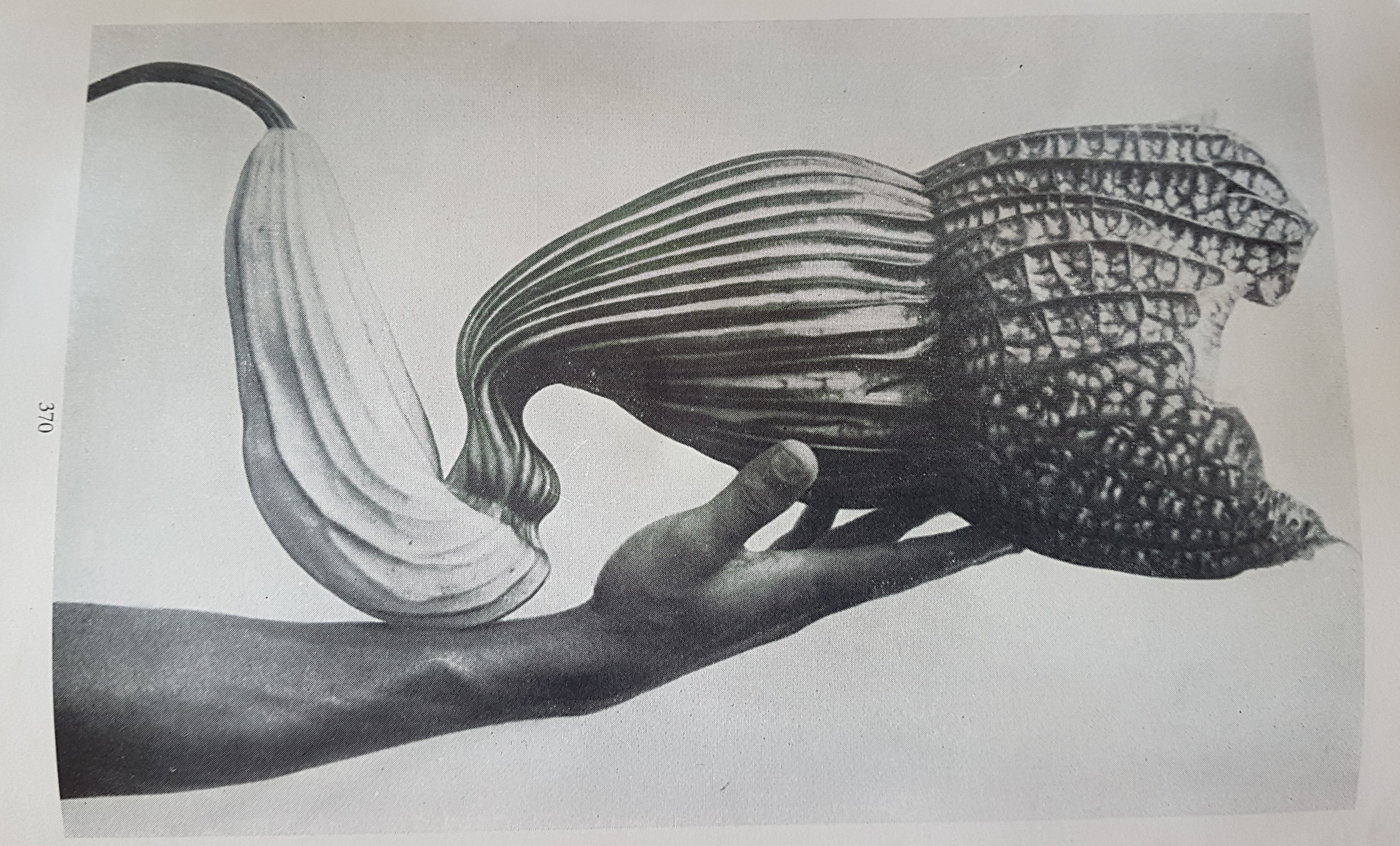
Some years ago, browsing in a second hand bookshop, I happened across a copy of an old magazine from 1950 called Nigeria. Published by the then colonial government, it was a miscellaneous collection of articles about the culture, geography and natural history of that fascinating West African country. Although aspects of the contents are problematical by modern standards, I bought it because of a short article about a wild plant with enormous flowers and a remarkable pollination strategy. In particular, the spectacular photograph of a man holding a flower that’s the length of his forearm grabbed my attention: who couldn’t love a flower like that?!

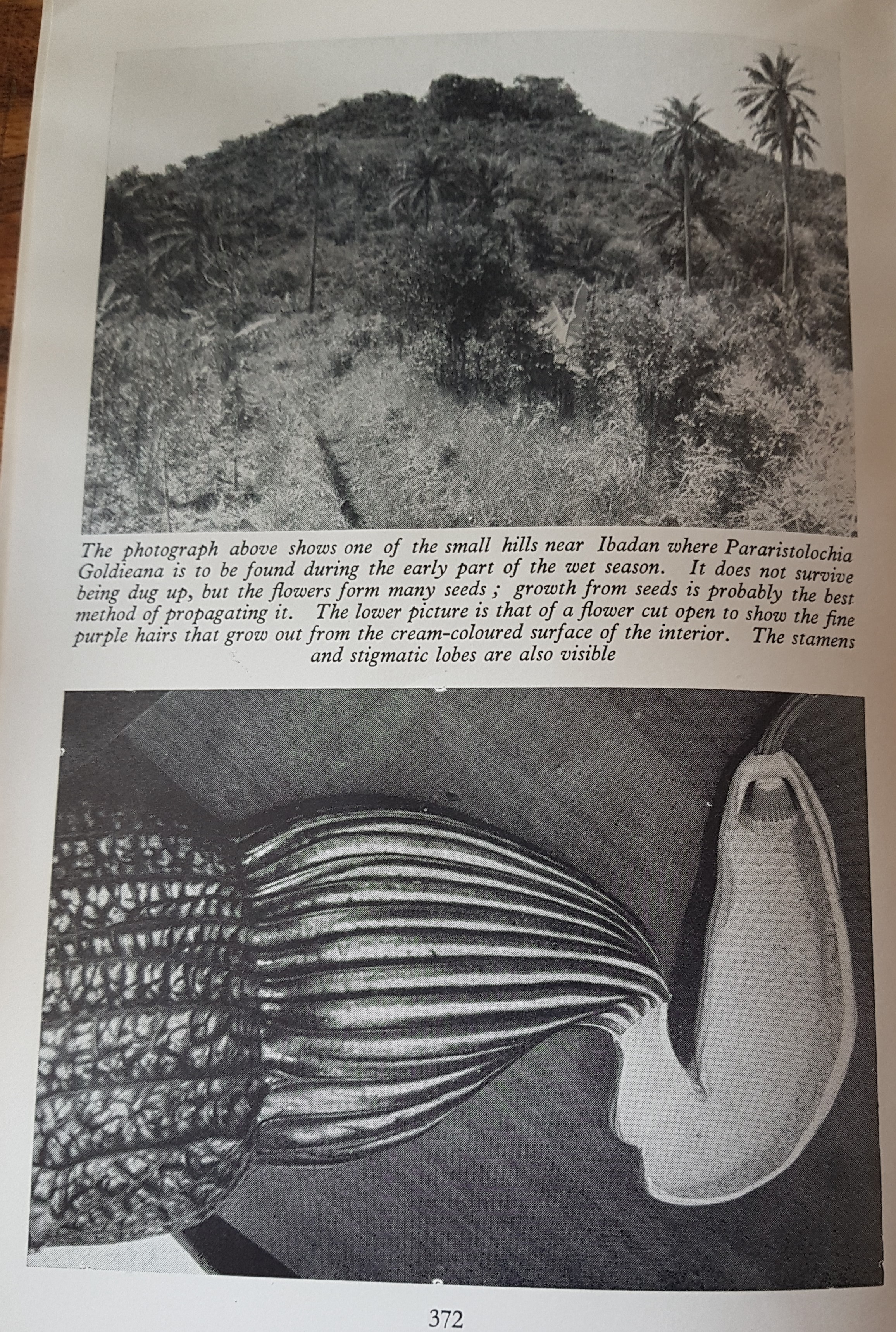
The plant is Pararistolochia goldieana, a vine found in the forests of this region, as described in the introductory text:

These types of flowers are pollinated by flies, a common strategy in the Birthwort family (Aristolochiaceae) to which the plant belongs. This strategy of fly pollination in which flies are deceived into visiting the flowers by their stink and colour, and temporarily trapped in the enclosed chamber, is something that I explore in detail in my book Pollinators & Pollination: Nature and Society, particularly in the genus Ceropegia. Those plants show convergent evolution with the pollination systems of Aristolochiaceae, though they are unrelated.

Pararistolochia goldieana has a wide distribution across West Africa, including Cameroon, Equatorial Guinea, Nigeria, and Sierra Leone. The IUCN Red List categorises it as ‘Vulnerable’ due to habitat loss. The population where these photographs were taken is described on the final page of the article:

The city of Ibadan is one of the largest in Nigeria and has grown enormously, ‘from 40 km2 in the 1950s to 250 km2 in the 1990s‘. I wonder if this forest, and its botanical treasures, still exists?

During field work in Gabon in the 1990s I was fortunate enough to encounter a species of Pararistolochia in the rainforest of Lopé National Park. It was a different species to P. goldieana, with rather smaller but no less spectacular flowers, and it stank to high heaven! We knew it was there long before we saw it. I collected some flies from the flowers and had them identified, though I’ve never published the data: it’s available if anyone is working on a review of pollination in the family.

This 1950 article is anonymous, so I don’t know who to acknowledge for the amazing images. However the botanist R.W.J. Keay was working on a revision of the family for the Flora of West Tropical Africa project at the time, so it may have been written by him.

A spectacular new plant has been named to honour a colleague: meet Ceropegia heidukiae!

Finding organisms that have not previously been described by scientists is not unusual; every year, hundreds of ‘new’ species enter the taxonomic literature, a testament to how little we still understand about the Earth’s biodiversity. The majority of these species are insects, because that’s the most diverse group of organisms on the planet. But new species of plants and fungi also turn up regularly: for example in 2020, botanists and mycologists at Kew named 156, including some from Britain.

So although discovering undescribed species is not uncommon, any field biologist will tell you that it’s an exciting moment to spot something that you’re never seen before and which could turn out to be new. That was certainly the case when my colleague Dr Annemarie Heiduk’s attention was drawn to a South African plant that was clearly something special. As Anne said to me this week:

‘I will never ever forget the very moment when I spotted it and immediately knew it was something no-one has ever seen before. And I was so lucky to find it in flower. I cannot describe how beautiful it looked sticking out of the surrounding grass vegetation. It is certainly one of a kind and I really know how lucky I was to have found it. Not once did it ever cross my mind that I will discover a novel Ceropegia species, let alone one that is so distinct!’

So it was that last year Anne discovered the plant that was to be named in her honour: Ceropegia heidukiae. The species has been described by David Styles and Ulrich Meve in the journal Phytotaxa (from where the image above was taken). There’s also an account of the species on the Pollination Research Lab blog, with further photographs and information about the plant.

Anne has been honoured in this way not just because she discovered the plant, but also because, to quote the paper, she:

‘is a pollination ecologist who with her research on the floral chemistry and deceptive pollination strategies of Ceropegia trap flowers has acquired recognition as an expert in this field’

Anne tells me that she has already collected pollinator and floral scent data for this new species, so we can look forward to seeing that published in the near future. I described the fascinating pollination ecology of Ceropegia, including some of Anne’s earlier work, in my recent book. This is a genus of plants that has intrigued me since I first saw photographs of them and started growing them as a teenager, 40 years ago. Since then I’ve published several papers about their pollination strategies, and how they compare with the family Apocynaceae as a whole: see the following links for some examples:

https://jeffollerton.co.uk/2017/09/03/fly-pollination-in-the-trap-flower-genus-ceropegia-a-new-study-just-published/

https://jeffollerton.co.uk/2018/08/21/the-evolution-of-pollination-systems-in-one-of-the-largest-plant-families-a-new-study-just-published-download-it-for-free/

So, a big congratulations to Anne, and to David and Ulrich – it’s an amazing plant! I wonder what else is still waiting to be discovered in the stunning grasslands of South Africa?

Protecting British Pollinators event TOMORROW – 25th March

I meant to post about this earlier but it’s been a really busy few weeks, so apologies if this is late in the day for any of you. Tomorrow morning there’s a webinar being run by the Public Policy Exchange entitled: “Protecting British Pollinators”. There’s an interesting set of speakers and I’ve been asked to provide the opening introduction and to chair the event.

Here’s the link for more details and booking information:

https://www.publicpolicyexchange.co.uk/event.php?eventUID=LC25-PPE

It should be a good meeting, hope to see some of you there.

Pollinators are allies in the fight against climate change: a new commentary just published in New Scientist

Over the past few months I’ve been thinking a lot about the relationship between the “Climate Emergency” (CE) and the “Ecological Emergency” (EE), and how they overlap considerably in terms of causes and solutions, but that the priorities of the CE often trump those of the EE. One of the outcomes of this has been a commentary that’s been published in New Scientist this week. It’s free to access – here’s the link:

https://www.newscientist.com/article/mg24933260-100-pollinators-are-our-secret-weapon-in-the-fight-against-global-warming/

It’s extracted from a much longer article that discusses the role of pollinators in relation to climate change. Hopefully that will be published in the not too distant future.

The other thing that’s happened this week is that, in my role as Visiting Professor of Biodiversity at the University of Northampton, I was asked to take part in a webinar that’s one of a series being produced in support of the Levelling Up Goals. The LUGs, modelled on the UN’s Sustainable Development Goals (SDGs) have cross-party support in Parliament and aim to bring economic prosperity to those parts of the country that have lagged behind in recent decades. The “Green Economy” is seen as central to this.

The webinar was recorded and you can view it here: https://www.fit-for-purpose.org/engage/how-to-level-up-harness-the-energy-transition

It was interesting and I learned quite a bit, for example about how the government is investing the state pension pot in sustainable energy projects. The format of the webinar, however, with the chair asking individuals a question and each of us responding, was a little frustrating as there was no real opportunity to counter statements being made, particularly by the MP for Hexham.

Yesterday Karin and I had out first COVID-19 vaccination; today we both feel a little under the weather, but it will pass. It’s certainly better than the alternative!

Finally, a physical copy of my book!

Yesterday I was delighted to finally receive an advance copy of my book Pollinators & Pollination: Nature and Society! It’s been over three years in the writing and production, much longer than I had anticipated. But, as I describe in its pages, the book is the culmination of >50 years of experience, study and research. So perhaps three years isn’t so bad…

If you’re interested in buying a copy you can order it direct from Pelagic Publishing and from most of the large online booksellers. Let me know what you think.

SCAPE 2020 by the numbers

Last Friday to Sunday I hosted the annual Scandinavian Association for Pollination Ecology (SCAPE) conference virtually. This is my first opportunity to report back as I took some time off and then tried to catch up with other tasks.

Running any scientific conference is hard work, and virtual ones are no exception! On Monday I was exhausted after a marathon long weekend of three 10-hour days in front of a computer chairing sessions, queuing up speakers and their talks, and generally making sure things ran as smoothly as possible. Of course before that there were literally weeks of preparation, and since then I have been doing follow up work of responding to emails, sending out certificates and receipts, etc.

It’s been quite a job and I couldn’t have done it with the help of my wife Karin (especially for the loan of her office space in the garden) and also Yannick Klomberg who was working on the website, dealing with the posters, etc., all on top of having a week old baby and his partner to look after! In addition I’m grateful to Paul Egan who ran the SCAPE Twitter account, and the session Chairs, keynote speakers, and participants who contributed to a really amazing conference. Our technical support crew from the University of Northampton were great too.

It was the largest SCAPE meeting so far held, no doubt because it was the first to be carried out virtually, with 352 participants from 41 countries listening to and chatting about 92 talks and viewing 39 posters. We also ran several well-attended evening discussion and poster sessions.

Long-standing SCAPEr Marcos Mendez kept a log of the number of participants in each of the sessions and I’ve graphed the data below, showing the broad themes of each group of sessions:

It’s pleasing to see that attendance was reasonably consistent over the course of the long weekend and that there was interest across the full spectrum of themes. The one downward blip was in session 5, which I can only surmise was due to it being the final session on Friday between 17:25 and 18:25.

As is traditional at SCAPE we announced the host of next year’s meeting at the very end. I’m delighted to announce that SCAPE 2021, the 35th annual meeting, will be held for the first time in Poland, where Marcin Zych will be the host. “Wider Scandinavia” just got wider….

Cockroaches as pollinators: a new example just published

When you think of the word “pollinator” what comes to mind? For most people it will be bees, particularly the western honeybee (Apis mellifera). Some might also think of hoverflies, butterflies, moths, bats, hummingbirds…..but cockroaches?! The first published example that I know of which demonstrated that the flowers of a plant are specialised for cockroach pollination is from the mid-1990s. Since then only a handful of well documented cases have come to light, but there are undoubtedly more out there waiting to be discovered, particularly in the wet tropics. Most of the c. 4,600 species of cockroaches are nocturnal, and cockroach-pollinated flowers tend to open at night, which is one reason why they are under documented.

In a new study, published this week in the American Journal of Botany, a team of Chinese, German and British biologists has shown that a species of Apocynaceae from China is the first known example of cockroach pollination in that large family. Here’s the reference with a link to the study; if anyone wants a copy please email me:

Xiong, W., Ollerton, J., Liede-Schumann, S., Zhao, W., Jiang, Q., Sun, H. Liao, W. & You, W. (2020) Specialized cockroach pollination in the rare and endangered plant Vincetoxicum hainanense (Apocynaceae, Asclepiadoideae) in China. American Journal of Botany (in press)

The abstract for the paper follows:

Premise

Species of Apocynaceae are pollinated by a diverse assemblage of animals. Here we report the first record of specialized cockroach pollination in the family, involving an endangered climbing vine species, Vincetoxicum hainanense in China. Experiments were designed to provide direct proof of cockroach pollination and compare the effectiveness of other flower visitors.

Methods

We investigated the reproductive biology, pollination ecology, pollinaria removal, pollinia insertion, and fruit set following single visits by the most common insects. In addition, we reviewed reports of cockroaches as pollinators of other plants and analyzed the known pollination systems in Vincetoxicum in a phylogenetic context.

Results

The small, pale green flowers of V. hainanense opened during the night. The flowers were not autogamous, but were self‐compatible. Flower visitors included beetles, flies, ants and bush crickets, but the most effective pollinator was the cockroach Blattella bisignata, the only visitor that carried pollen between plants. Less frequent and effective pollinators are ants and Carabidae. Plants in this genus are predominantly pollinated by flies, moths and wasps.

Conclusions

Globally, only 11 plant species are known to be cockroach‐pollinated. Because their range of floral features encompass similarities and differences, defining a “cockroach pollination syndrome” is difficult. One commonality is that flowers are often visited by insects other than cockroaches, such as beetles, that vary in their significance as pollinators. Cockroach pollination is undoubtedly more widespread than previously thought and requires further attention.

Just published: An empirical attack tolerance test alters the structure and species richness of plant–pollinator networks

The latest paper from Paolo Biella‘s PhD work, on which I collaborated and that I’ve discussed before on the blog, has just been published in the journal Functional Ecology. It’s entitled “An empirical attack tolerance test alters the structure and species richness of plant–pollinator networks“. The paper presents more of Paolo’s work showing how the experimental removal of the floral resources provided by the more generalised plants in a community can significantly (and negatively) affect the patterns of interaction between flowers and pollinators that we observe. It’s another piece of evidence that demonstrates how important it is to not neglect the common plants that attract a lot of flower visitors when considering how to manage a habitat.

If anyone has trouble accessing the PDF, drop me a line and I will send it to you.

Here’s the reference:

Biella, P., Akter, A., Ollerton, J., Nielsen, A. & Klecka, J. (2020) An empirical attack tolerance test alters the structure and species richness of plant-pollinator networks. Functional Ecology DOI: 10.1111/1365-2435.13642

Here’s the abstract:

Ecological network theory hypothesizes that the structuring of species interactions can convey stability to the system. Investigating how these structures react to species loss is fundamental for understanding network disassembly or their robustness. However, this topic has mainly been studied in‐silico so far.

Here, in an experimental manipulation, we sequentially removed four generalist plants from real plant–pollinator networks. We explored the effects on, and drivers of, species and interaction disappearance, network structure and interaction rewiring. First, we compared both the local extinctions of species and interactions and the observed network indices with those expected from three co‐extinction models. Second, we investigated the trends in network indices and rewiring rate after plant removal and the pollinator tendency at establishing novel links in relation to their proportional visitation to the removed plants. Furthermore, we explored the underlying drivers of network assembly with probability matrices based on ecological traits.

Our results indicate that the cumulative local extinctions of species and interactions increased faster with generalist plant loss than what was expected by co‐extinction models, which predicted the survival or disappearance of many species incorrectly, and the observed network indices were lowly correlated to those predicted by co‐extinction models. Furthermore, the real networks reacted in complex ways to plant removal. First, network nestedness decreased and modularity increased. Second, although species abundance was a main assembly rule, opportunistic random interactions and structural unpredictability emerged as plants were removed. Both these reactions could indicate network instability and fragility. Other results showed network reorganization, as rewiring rate was high and asymmetries between network levels emerged as plants increased their centrality. Moreover, the generalist pollinators that had frequently visited both the plants targeted of removal and the non‐target plants tended to establish novel links more than who either had only visited the removal plants or avoided to do so.

With the experimental manipulation of real networks, our study shows that despite their reorganizational ability, plant–pollinator networks changed towards a more fragile state when generalist plants are lost.