Category Archives: Evolution

Fake figs, fooled wasps, and another extraordinary Apocynaceae pollination system

One of the things I love about working on the milkweed and dogbane family (Apocynaceae) is that it has an apparently inexhaustible capacity to produce strange and wonderful interactions with animals. Just when you think that the family’s pollination biology has yielded most of its surprises, along comes something like this.

A paper just out in New Phytologist, led by Aroonrat Kidyoo, describes the pollination of Heterostemma ficoides, an unusual climbing plant from northern Thailand. The title rather neatly gives away the story: “Fake figs, fooled fig wasps and rewarded phorid flies: brood-site mimicry and mutualism in Heterostemma ficoides (Apocynaceae)”.

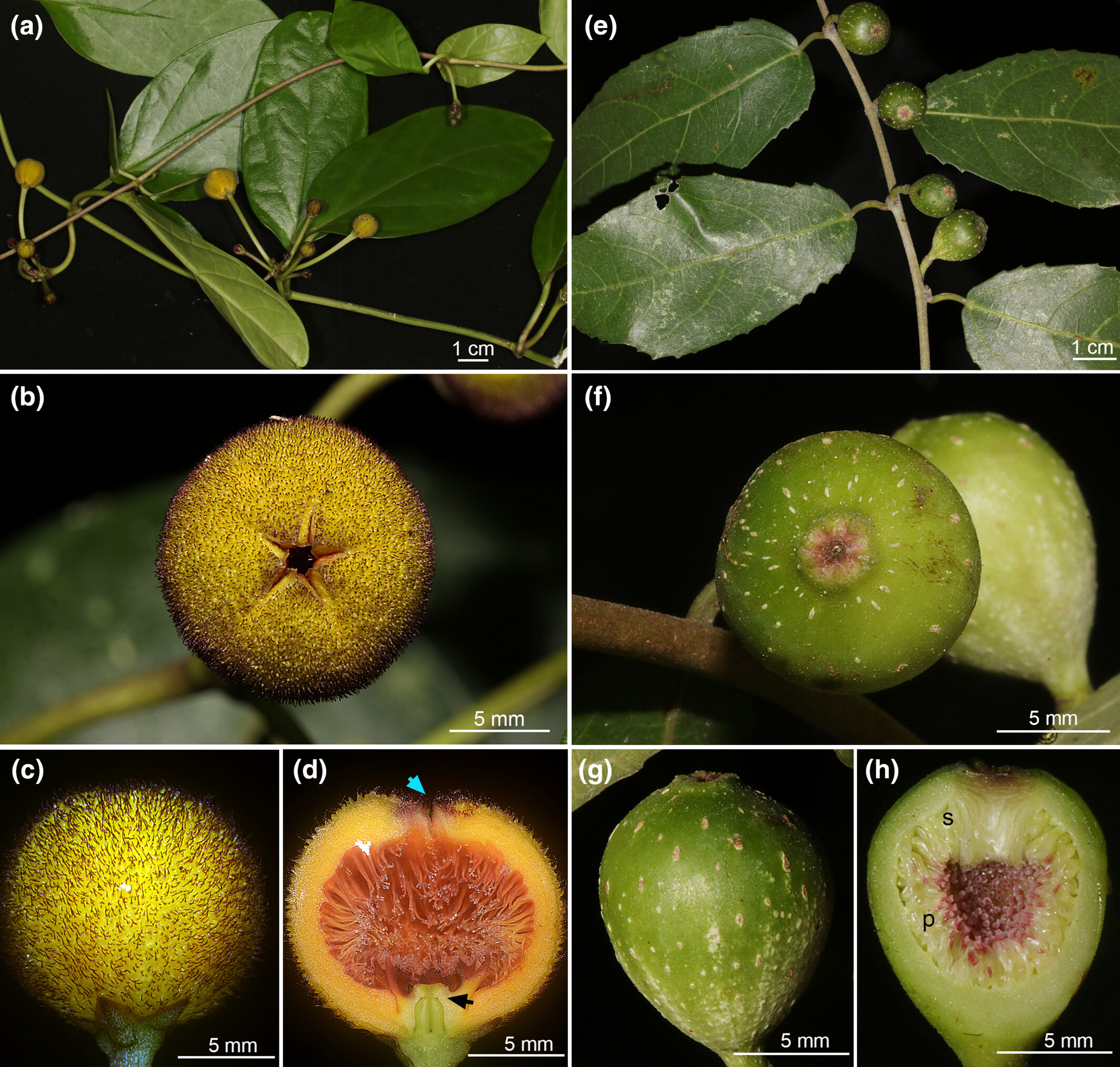
And “fake figs” is not journalistic exaggeration, as you can see from the photos above, which are taken from the paper. The flowers of H. ficoides are globose, fleshy structures, about 1.5–2 cm across, with a small opening at the top. Superficially they look remarkably like the enclosed inflorescences (the syconia) that we normally call figs. Indeed, when the species was first described in 2019, its resemblance to a fig was obvious enough to inspire the name ficoides: fig-like. But looking like a fig is only the beginning of the story.

Fooling one of nature’s most specialised pollinators

The relationship between figs (Ficus) and their tiny agaonid wasps is one of the classic examples of an intimate plant–pollinator mutualism. Female fig wasps locate receptive figs using their scent, squeeze through the tiny opening or ostiole, and pollinate the enclosed flowers while attempting to reproduce inside. These relationships can be remarkably specific, in some cases representing rare examples of one-to-one plant-pollinator interactions.

So it was genuinely surprising to discover female Kradibia fig wasps entering flowers of Heterostemma ficoides. These wasps normally pollinate Ficus heterophylla, not an Apocynaceae, and the authors believe that nothing comparable, i.e., a fig wasp being fooled into visiting a completely unrelated flowering plant, has previously been documented. I have to concur, this relationship is (so far) unique.

The authors have neatly demonstrated that the deception of these wasps is not simply visual. The chemical bouquet produced by H. ficoides is closer to that of receptive Ficus heterophylla figs than it is to the flowers of its relative H. siamicum. More importantly, behavioural experiments showed that Kradibia wasps were significantly attracted to the scent of open H. ficoides flowers, though not to unopened flower buds. In other words, the plant seems to switch on its misleading olfactory advertisement at just the right time.

Once inside, however, the wasps discover that they have made a serious mistake. They wander around probing the inner surface, searching for egg-laying opportunities that simply aren’t there. Some die inside the flower, although more than 80% of observed individuals managed to get out again, and often went on to visit another Heterostemma flower.

In the process, pollen can be transferred between flowers, but as in other members of the Asclepiadoideae, Heterostemma does not dust its visitors with loose pollen grains. Instead, pollen is packaged into pollinia which become attached to the legs of the fig wasps.

So from the fig wasp’s perspective this is straightforward deception: the plant promises a breeding site that doesn’t exist, and the flowers get pollinated in return. But that is only half of the system.

The flies are not being fooled by the fake fig

The most important pollinator of H. ficoides appears to be a tiny phorid fly in the genus Megaselia, and its relationship with the plant is quite different. Female Megaselia enter the flowers and lay their eggs there. Mating may even take place on the flower beforehand. Their larvae then develop inside the fallen flowers, eventually completing their development in the decomposing floral tissue on the forest floor. For these flies the promise made by the flower is therefore an honest one: this really is a brood site.

Pollinaria become attached to the flies’ mouthparts, then the flies carry them to another flower, where pollen can be deposited. Interestingly, Megaselia are also important pollinators of some species of the related Ceropegia in Africa (both genera are members of the tribe Ceropegieae).

This creates an ecological combination that is one of the most distinct examples of a “bimodal pollination system” that I’m aware of, in which the same flower operates simultaneously as a brood-site mutualism and as a brood-site deception, involving two completely distinct groups of insects.

Back to our 2019 Apocynaceae review

For me, there is a satisfying connection here with the large review of Apocynaceae pollination systems that we published in Annals of Botany in 2019: The diversity and evolution of pollination systems in large plant clades: Apocynaceae as a case study. Aroonrat Kidyoo, lead author of this new study, was also one of the large international team involved in that paper.

We assembled usable pollination information for 567 species (a bit more than 10% of the family) and found an extraordinary diversity of interactions. About 73% of the species for which we had information were associated predominantly with a single broad pollinator group, whether bees and wasps, butterflies and moths, flies, beetles or birds. However, about 7% of the species had distinct bimodal pollination systems, such as bee + butterfly. Whether this is an unusually high proportion for such a family is currently unclear as there are few comparative statistics.

One of our broader conclusions from the study was that this interaction diversity was not randomly scattered across the Apocynaceae evolutionary tree. Pollination systems show strong phylogenetic structure and some transitions between pollinator types have occurred much more readily than others. The new Heterostemma study puts some wonderfully detailed natural history onto that much larger evolutionary picture.

Aroonrat and her colleagues suggest that Heterostemma ficoides may represent a shift away from the more open, nectar-producing flowers found in other parts of the genus. In section Oianthus, to which H. ficoides belongs, the flowers have become progressively more closed. In the extreme case represented here, the result is a globose chamber entered through a small opening, nectar production has apparently disappeared, and the plant has moved towards brood-site pollination by flies and deception of fig wasps.

Whether that evolutionary scenario survives a proper phylogeny and detailed pollination studies of the remaining species is an obvious question for the future. As the authors themselves acknowledge, both are currently lacking. But it is exactly the sort of transition that our 2019 study suggested we should be looking for.

And what does any of this have to do with eating Apocynaceae?

Quite a lot, in a roundabout way. Earlier this year my colleagues and I published another large synthesis of the family, this time asking a very different question: which Apocynaceae do people eat?

We documented 440 edible species, spread widely across the evolutionary tree of the family. That sounds like a lot, although statistically Apocynaceae are actually under-represented among the world’s food plants, probably in part because the family is so well endowed with toxic and pharmacologically active chemistry.

One point that emerged strongly from that work was that our knowledge of how those useful plants reproduce is remarkably incomplete. Many edible Apocynaceae are harvested for their fruits and seeds, which of course ultimately means that successful reproduction matters. Yet for most of those species we still know little or nothing about their pollinators.

That matters if we are serious about conserving wild food plants or developing some of them as future crops. You cannot fully understand the biology of a fruit-producing plant without understanding how the flowers get pollinated in the first place.

There are no Heterostemma species documented in our edible-plant study (though it appears that we missed one – see the comment below), so H. ficoides is not some promising new food species. But that isn’t my point. Rather, this new research is a reminder of just how much biological complexity can lie behind the production of an Apocynaceae seed. And we still know the pollination biology of only a fraction of this enormous family.

That, perhaps, is the broader lesson from all three papers. Large databases and family-wide syntheses are valuable because they reveal general patterns and, equally importantly, the gaps in our knowledge. But filling those gaps still depends on researchers spending time watching individual plants and individual insects, dissecting flowers, rearing larvae and asking exactly what the animals are doing. Sometimes what they find is stranger than anyone would have predicted.

Monkey business at the SCAPE conference

I’d like to tell you about a dream that I had last night. As far as I can recall this is the first time I’ve mentioned my dreams in about 14 years of regular blogging. I dream almost every night: vivid, highly immersive, realistic, often weird, sometimes scary, frequently funny dreams that, each morning, I can usually recall in some detail. That’s always been the case, ever since I was a small child.

If I drink beer or eat blue cheese my dreams become stronger and weirder, presumably because of the chemicals produced by the hops (which belong to the same plant family as cannabis) or the fungi. But regardless of what I ingest, I’m almost guaranteed to dream.

Last night’s dream involved the SCAPE meeting. In the dream, some colleagues had submitted the abstract for a talk at the conference and, when I checked it, I discovered that it was full of spelling and grammatical errors. So I did what I normally do – I started to revise the document. Suddenly, I found myself at the said conference and my colleagues were telling me not to change anything because it had been written by the first author – a gorilla* called Merrill.

I started to argue that, regardless of our semi-literate co-author, we ought to make some corrections, when Merrill looked at me with his big, dark, doleful eyes. So I reached over and scratched his head, which he seemed to enjoy. I can still recall the texture of his short, wiry hair under my fingers, because at that exact moment I woke up thinking…..WTF?!

Dreams such as this often have some basis in things I’ve seen or read about or done, so I spent the morning thinking about what could have prompted it. And I believe that I know what it was. There’s been a lot of discussion recently about scientific paper authorship and responsibility – not least in the context of AI – and I’ve seen stories about research papers with non-humans, such as pets, as co-authors. So was my brain sublimating these ideas into a fantasy about having a gorilla as a co-author? Who knows. It was an amusing way to spend my sleeping hours, though.

*Before anyone comments that “gorillas are apes, they’re not monkeys, the title of your post is incorrect”, I’d like to point out that, phylogenetically speaking, apes (including ourselves) ARE monkeys in the sense that they (we) are nested within that larger grouping of primates.

A new review gives us a deeper understanding of the evolution of plant-pollinator interactions

If you’ve read my book Birds & Flowers: An Intimate 50 Million Year Relationship, you’ll know that I spend a few pages discussing the long-standing paradigm of how interactions between plants and their pollinators evolve and result in the formation of new plant species. This is referred to as the Stebbins (or Grant-Stebbins) Most Effective Pollinator Principle (MEPP). The MEPP is fairly straightforward and intuitive: flowers evolve their colour, shape, scent, rewards, and so forth as adaptations to the type of flower visitor that successfully moves the most pollen between flowers.

However, the MEPP is not the only Principle in town – there’s also Aigner’s Least Effective Pollinator Principle (LEPP) which is not so intuitive. In the LEPP, flowers can adapt to pollinators that are less successful at pollination, as long as those adaptations do no interfere with the pollination services provided by other flower visitors.

As I note in Birds & Flowers, we don’t know which of these Principles is more frequent in nature, because the LEPP has been much less intensively studied than the MEPP. That’s in part because it’s less well known, but also because the field work and experimental procedures required to test the LEPP are much more challenging.

Hopefully this is about to change with the publication of a brilliant critical review of the MEPP by pollination ecologists Kathleen Kay and Bruce Anderson published in the journal Annals of Botany, entitled: Beyond the Grant–Stebbins model: floral adaptive landscapes and plant speciation. The paper is open access – follow that link and you can download a copy.

Kathleen and Bruce discuss not just the MEPP v the LEPP, but also other ways in which flowers can evolve, framed around the idea of floral evolution as movement across an “adaptive landscape,” where plants are not shaped only by one pollinator but by the need to maximise overall reproductive success. This perspective allows us to explore how flowers evolve when influenced by multiple pollinators, how transitions between floral forms take place, and how speciation occurs through a combination of factors beyond pollination alone. It emphasises that pollinators are important drivers of floral change, but speciation is more likely when divergence happens across several aspects of a plant’s ecology, not just through its flowers.

It’s a great review and well worth your time reading in detail. Perhaps my favourite line in the paper comes from the abstract: “The Grant–Stebbins model, while inspiring decades of empirical studies, is a caricature of pollinator-driven speciation and explains only a limited range of adaptive outcomes.” This is something that many of us have been arguing for years: the natural world is extremely complex, so we should not expect these ecologically critical interactions between flowers and their pollinators to have simple origins or ecologies.

Evolutionary implications of a deep-time perspective on insect pollination – a new review just published

When we think of pollination, we often picture bees buzzing around flowers or butterflies flitting from bloom to bloom. This relationship between plants and pollinators is one of the most well-known interactions in nature. But insect pollination didn’t begin with the colorful flowers we see today. In fact, pollinators were at work millions of years before flowering plants (angiosperms) even existed. In a new review led by Spanish researchers David Peris and Ricardo Pérez-de la Fuente, to which I added a modern ecological perspective, we explored this topic and why it’s relevant to our current understanding of plant-pollinator relationships.

Despite centuries of research on pollination, the fossil record of pollinating insects has only gained serious attention in the past few decades. What palaeontologists have uncovered is reshaping our understanding of pollination’s origins. It turns out that insects were pollinating plants long before flowers evolved—playing a crucial role in the reproduction of ancient gymnosperms, the group of seed-producing plants that includes conifers, cycads, and ginkgos.

Most people assume that insect pollination began with flowering plants, but the evidence tells a different story. Fossilised insects with specialised body structures for carrying pollen—such as hairy bodies or mouthparts adapted for nectar-feeding—have been found in deposits dating back hundreds of millions of years. These early pollinators likely visited gymnosperms, helping them reproduce in a world that looked vastly different from today’s landscapes.

Ancient pollination was driven by a diverse range of insects, many of which are now extinct. The fossil record reveals that various insect groups—including beetles, flies, wasps, and even some long-lost relatives of modern lacewings—were already acting as pollinators long before the first flower bloomed. This means that pollination as an ecological process has far deeper evolutionary roots than many realise.

As plants evolved, so did their pollinators. The rise of flowering plants during the Cretaceous period (around 100 million years ago) transformed pollination systems, leading to the incredible diversity of plant-pollinator relationships we see today. Many of the insect groups that once dominated pollination in prehistoric times have since declined or disappeared, replaced by the bees, butterflies, and other familiar pollinators that thrive in modern ecosystems.

Understanding this long history is essential—not just for scientists, but for anyone interested in biodiversity and conservation. When we focus only on present-day pollinators and plants, we miss a crucial part of the story. The fossil record helps us see how pollination has changed over time, which in turn can offer insights into how today’s ecosystems might respond to environmental pressures such as climate change and habitat loss.

Recognising the ancient history of insect pollination isn’t just an academic exercise—it has real-world implications. If we understand how pollination evolved and adapted to past environmental changes, we can better predict how it might shift in the future. Conservation efforts that aim to protect pollinators today can benefit from a long-term perspective, ensuring that we’re not just responding to recent trends but also considering deep-time ecological processes.

So the next time you see a bee visiting a flower, remember—you’re witnessing the latest chapter in a story that began hundreds of millions of years ago. The relationship between plants and pollinators is far older, more complex, and more fascinating than we ever imagined.

Here’s the reference with a link to the paper. It should be open access, but if you have problems obtaining it, send me a message via my Contact page:

Peris, D., Ollerton, J., Sauquet, H., Hidalgo, O., Peñalver, E., Magrach, A., Álvarez-Parra, S., Peña-Kairath, C., Condamine, F.L., Delclòs, X. & Pérez-de la Fuente, R. (2025) Evolutionary implications of a deep-time perspective on insect pollination. Biological Reviews (in press)

What are the limits to pollinator diversity? A new article poses the question

The most globally significant groups of pollinators are well known and have been studied for a long time: bees and wasps, flies, butterflies and moths, birds, bats and beetles are all familiar to those of us with an interest in pollination ecology. However, every few years a new type of pollinator or a novel pollination system is described from nature or from the fossil record, or we add further examples of previously neglected pollinator groups such as cockroaches.

This begs the question: how much is there still to discover? How close are we to describing the full diversity of animals that act as pollen vectors? Can looking at the past help us to predict what we might find in the future? That’s the topic of a Perspective article that I was invited to write for the special issue of the Journal of Applied Entomology on the theme of  The Neglected Pollinators that I mentioned last month. It’s a subject that I’ve thought about a lot over the last few decades and it was great to get an opportunity to air some ideas and speculation.

The article is open access and you can download a copy by following the link in this reference:

Ollerton, J. (2024) What are the phylogenetic limits to pollinator diversity? Journal of Applied Entomology (in press)

Here’s the abstract:

Although huge progress has been made over the past 200 years in identifying the diversity of pollinators of angiosperms and other plants, new discoveries continue to be made each year, especially in tropical areas and in the fossil record. In this perspective article I address the following questions: Just how diverse are the pollinators and what are the phylogenetic limits to that diversity? Which other groups of animals, not currently known to regularly engage with flowers, might be found to be pollinators in the future? Can we predict, from the fossil record and from discoveries in under-researched parts of the world, which animal groups might turn out in the future to contain pollinators? I also discuss why adding to our knowledge of plant–pollinator interactions is important, but also stress that an incomplete knowledge may not be a bad thing if it means that remote, inaccessible and relatively pristine parts of the world remain that way.

Speaking at Oxford Ornithological Society – 11th September

Later this month I’ve been invited by the Oxford Ornithological Society to give a talk about my new book Birds & Flowers: An Intimate 50 Million Year Relationship. The talk will summarise the main themes from the book, particularly the sheer diversity of birds that can act as pollinators, what it means for the ecology and evolution of flowers, why the conservation of such interactions matters, and the cultural significance of bird-flower interactions. I’ll also deal with the question of why Europe is so odd when it comes to the question of birds as pollinators.

The talk is on Wednesday 11th September at Exeter Hall, Kidlington, starting at 7.45 pm; it’s free to society members, and non-members are invited to make a donation. Do come along if you’re in the area!

More details here: https://www.oos.org.uk/programme.php

I’ll bring a few copies of Birds & Flowers and Pollinators & Pollination: Nature and Society if anyone wants to buy a signed book.

Also in the diary are talks at South Leicester Birdwatchers (13th November) and Northamptonshire Bird Club (5th March).

If you represent a birding club or natural history society and wish to book me for a talk, please get in touch via my Contact page.

A doubly-parasitic orchid? – China Diary 5

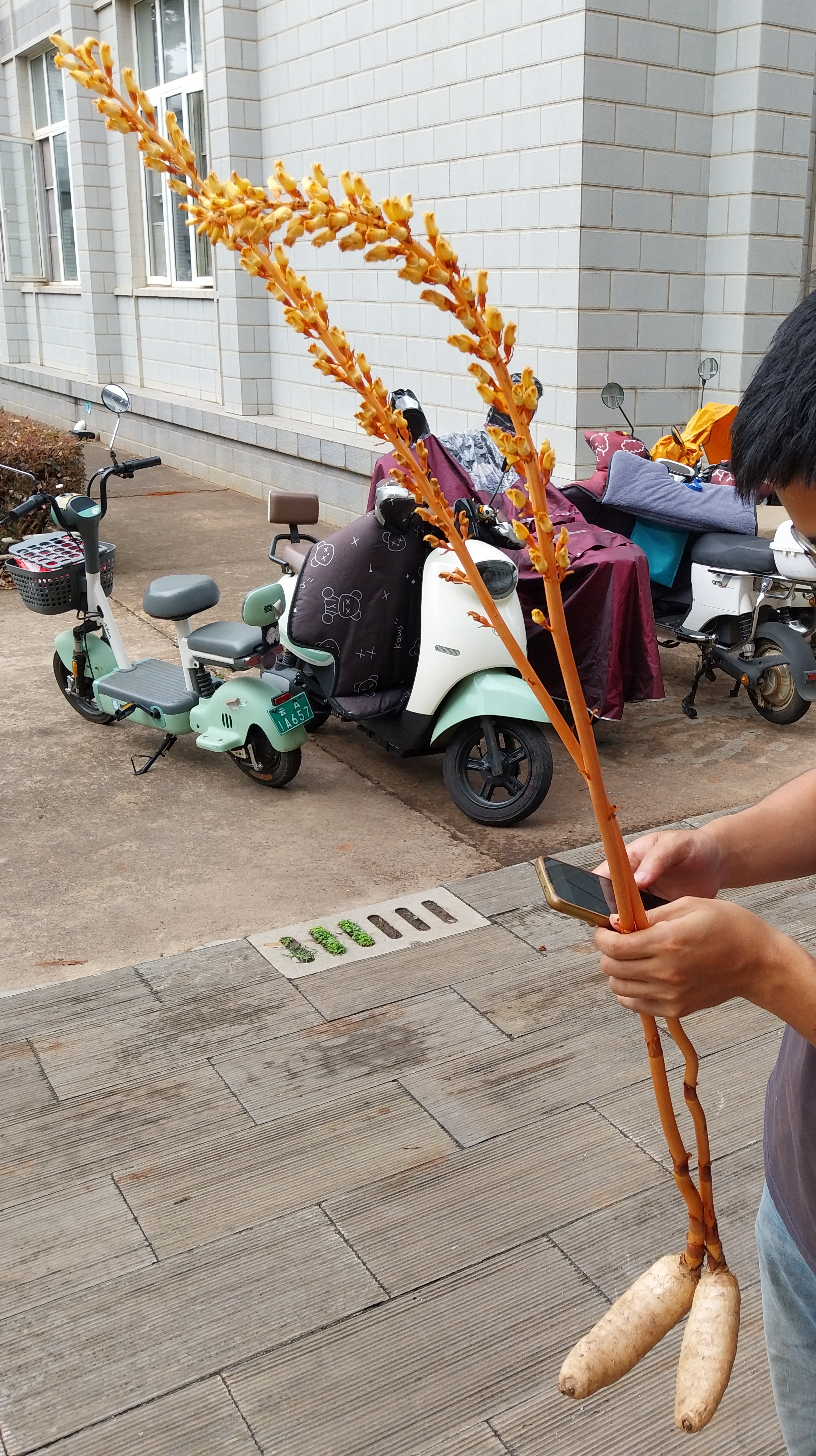
Walking into Kunming Institute of Botany yesterday morning, I passed a young guy who was carrying what I initially thought was a species of Orobanchaceae. I’ve a long-standing interest in the pollination ecology of these intriguing parasitic plants, so I stopped to have a chat. Turns out they were in fact orchids! Specifically, they were specimens of Gastrodia elata, one of the “potato orchids“, so named because those fat tubers are edible. They are widely used in South China – where they are known as Tianma, 天麻 – both as a food and medicinally. The tubers are eaten before the flowers are produced, and originally they were collected from the wild. But in the 1960s a Chinese botanist named Xuan Zhou discovered how to cultivate them and they are now grown in specialist nurseries. A fascinating account of the life of Xuan Zhou – “The Father of Gastrodia” – was published in the journal Plant Diversity last year, shortly after he died.

These orchids do not produce green leaves or stems, therefore they cannot photosynthesise. Instead, they gain all of their energy from a parasitic symbiotic relationship with a fungus – they are what is termed “myco-heterotrophic“. Most myco-heterotrophic plants have evolved from ancestors that were involved in mutualistic mycorrhizal relationships with fungi, in which the plant provides sugars to the fungus in return for mineral nutrients and water. In the case of Gastrodia elata, the fungus concerned is the non-mycorrhizal, wood-rotting Armillaria mellea. In the west we know this as Honey Fungus, a disease of trees and shrubs and the bane of many a gardener. This is also edible, incidentally, but best dried before cooking (and some have an intolerance to it, so take care).

I tweeted the photograph in a short thread just after taking it, and Stewart Nicol pointed me to a study of the orchid’s floral biology and pollination ecology in Japan by Naoto Sugiura. Turns out that, at least in the population which Naoto studied, the plant produces no nectar and deceives its pollinators, which are small bees, into visiting the flowers.

That’s why I’ve used the phrase “doubly-parasitic*” in the title of this post – the plant, it appears, parasitically exploits both the fungus from which it gains energy and the pollinators that ensure its reproduction. It’s (almost, but not quite) the flip side of “double mutualism” in which species provide two benefits for one another, e.g. the same bird is both a pollinator and a seed disperser of a particular plant, a phenomenon that I discussed in my recent book Birds & Flowers: An Intimate 50 Million Year Relationship.

But note the question mark in the title of this post. There’s an enormous amount that we don’t know about these myco-heterotrophic interactions and how they remain stable over the evolutionary history of the plant and the fungus. In order to be considered a parasite, by definition, an organism must have a negative impact on the reproductive fitness of its host. Do these orchids negatively impact either the fungus or the bees that pollinate it? As yet we don’t know. And I was intrigued by this comment from a 2005 review of ‘The evolutionary ecology of myco-heterotrophy‘ by Martin Bidartondo:

“no successful plant lineage would be expected to cheat both mycorrhizal fungi (by failing to provide photosynthates) and deceive insect pollinators (by failing to provide nectar or other rewards) due to the evolutionary instability inherent to specializing on two lineages.”

At first glance it appears that Gastrodia elata is a plant lineage that has done just that, though I’d like to see more work carried out on this system. Specifically, are all populations of the orchid bee pollinated and are all rewardless? And does this orchid really provide no benefit to the fungus, perhaps by synthesising secondary compounds that protect the Armillaria from infection by bacteria or being eaten by invertebrates. So many questions to be answered about this fascinating species interaction!

*With thanks to my wife Karin Blak for inspiring that phrase.

A new review of ‘Birds & Flowers’ in the Journal of Pollination Ecology

The reviews of Birds & Flowers: An Intimate 50 Million Year Relationship are starting to appear in blogs, magazines and journals. The latest, by Diane Campbell, has just been published in the Journal of Pollination Ecology and I’m so pleased that it was positive! I’ve only met Diane a couple of times at conferences but I have a lot of respect for her work. The review is fair and balanced, and gratifyingly enthusiastic, for example:

In this delightful book, [Ollerton] describes the ways that birds and flowers interact. As in his previous book, Pollinators & Pollination: Nature and Society, [he] takes a deeply personal approach to the subject. He combines anecdotes from his research travels around the world, to mountains of Kenya and Tanzania, the Andes of Peru, Brazil, and Nepal, among other places, with his contributions to, and masterful knowledge of, the recent literature…

The review is free to read and download from Journal of Pollination Ecology. I’m so glad that people are enjoying the book – if you’ve bought or borrowed a copy, please do leave a comment and let me know what you think.

The flower that’s pollinated by birds, bees….and the wind!

In my new book Birds & Flowers: An Intimate 50 Million Year Relationship I spend a bit of time discussing the idea of the bird pollination syndrome that we refer to as ‘ornithophily’, its limitations, and the fact that it has two distinct meanings that are often conflated. One of the problems with ornithophily, and indeed all of the syndromes, is that historically it’s sometimes blinkered scientists to the extent that they only look at the flower visitors that are “right” for the syndrome, ignoring the rest or dismissing them as “secondary pollinators”, a term I dislike.

Why do I dislike that term? Because it fails to capture the complexity of flower-pollinator interactions and relegates an important component of plant reproduction to a subsidiary role. I could go on about this at some length, but if you’re interested in discovering more, look at pages 62-65 of Birds & Flowers. There I contrast the classical Most Effective Pollinator Principle with the equally valid (but much less well studied) Least Effective Pollinator Principle, with a segue into one of my favourite tracks from Led Zeppelin’s second album: What is and What Should Never Be.

But back to the real subject of this post – a flower that corresponds to the classical bird pollination syndrome BUT is also pollinated by bees and (very surprisingly) wind! It’s such an interesting paper by Brazilian ecologists Amanda Pacheco, Pedro Bergamo & Leandro Freitas – here’s the reference and a link to the study:

Pacheco, A., Bergamo, P.J. & Freitas, L. (2024) An unexpected case of wind pollination: ambophily in an ornithophilous tropical mountaintop Orobanchaceae. Plant Systematics and Evolution 310, 9. https://doi.org/10.1007/s00606-024-01890-6

For over 100 years the classical pollination syndromes have acted as a framework for understanding the ecology and evolution of plant-pollinator interactions. But we’ve long known that while they can be a useful shorthand, they do not fully reflect the complexity of how pollination systems evolve. That shouldn’t surprise us because, as I point out in my two recent books, we have data (of any quality) on no more than 10% of the 350,000 or so species of flowering plants!

In addition, those plants for which we do have good data are NOT a random subset of the flowering plants: they have been specifically chosen by researchers because they look to be good systems with which to address particular ecological or evolutionary questions.

Which is fine, but we MUST recognise that this imposes significant restrictions on our understanding of the biodiversity of plant-pollinator interactions. The authors of this paper expressed it very well when they wrote that assumptions about:

“predictability may cause researchers to take for granted that only birds pollinate ornithophilous flowers, hindering research on the contribution of other vectors.”

To which I’d add: it also hinders our understanding of how these interactions evolve over long time scales and across multiple populations.

An obvious question is: how frequent are these sorts of complex pollination systems, involving different pollen vectors of an apparently specialised flower? The answer is that we simply don’t know, because most researchers would have not gone into this level of detail. So a huge congratulations to the authors for a great study – I hope it stimulates others to look beyond the ‘expected’ pollinators of flowers.

Photos: Nathália Susin Streher from the original paper.

Read my author interview and get a 25% discount off ‘Birds & Flowers’, ‘Pollinators & Pollination’ and other books from Pelagic Publishing!

I recently did a short interview with Pelagic Publishing’s marketing person, Sarah Stott, which you can read here: https://pelagicpublishing.com/blogs/news/birds-and-flowers-author-interview.

On that page you can sign up to Pelagic’s newsletter (which I STRONGLY recommend, because they produce some great natural history and science books, and not just mine!) and by doing so you can receive a 25% discount on all orders.

What are you waiting for?