Category Archives: Moths

Want to conserve birds and mammals? Then conserve their insects – our new paper in Nature Reviews Biodiversity sets out the details

It’s sometimes easy to forget quite how much of the living world depends upon insects.

That might seem an odd thing for someone who has spent much of his career studying insects and their relationships with plants to say. But conservation, ecological research, and public interest are still disproportionately focused on vertebrates: the birds, mammals, reptiles, amphibians and fishes that most people think of when they hear the word “wildlife”.

Yet those animals exist within ecological networks in which insects are frequently central players, not walk-on extras. A new review that I’ve co-authored with Rob Cooke, Eliza Grames, Chris Elphick and 18 other colleagues, published in Nature Reviews Biodiversity, tries to bring together what we know about those relationships – if you follow this link it’s free to read:

Cooke, R., Grames, E.M., Ollerton, J. et al. (2026) The importance of insect biodiversity for vertebrates. Nature Reviews Biodiversity DOI: 10.1038/s44358-026-00201-w.

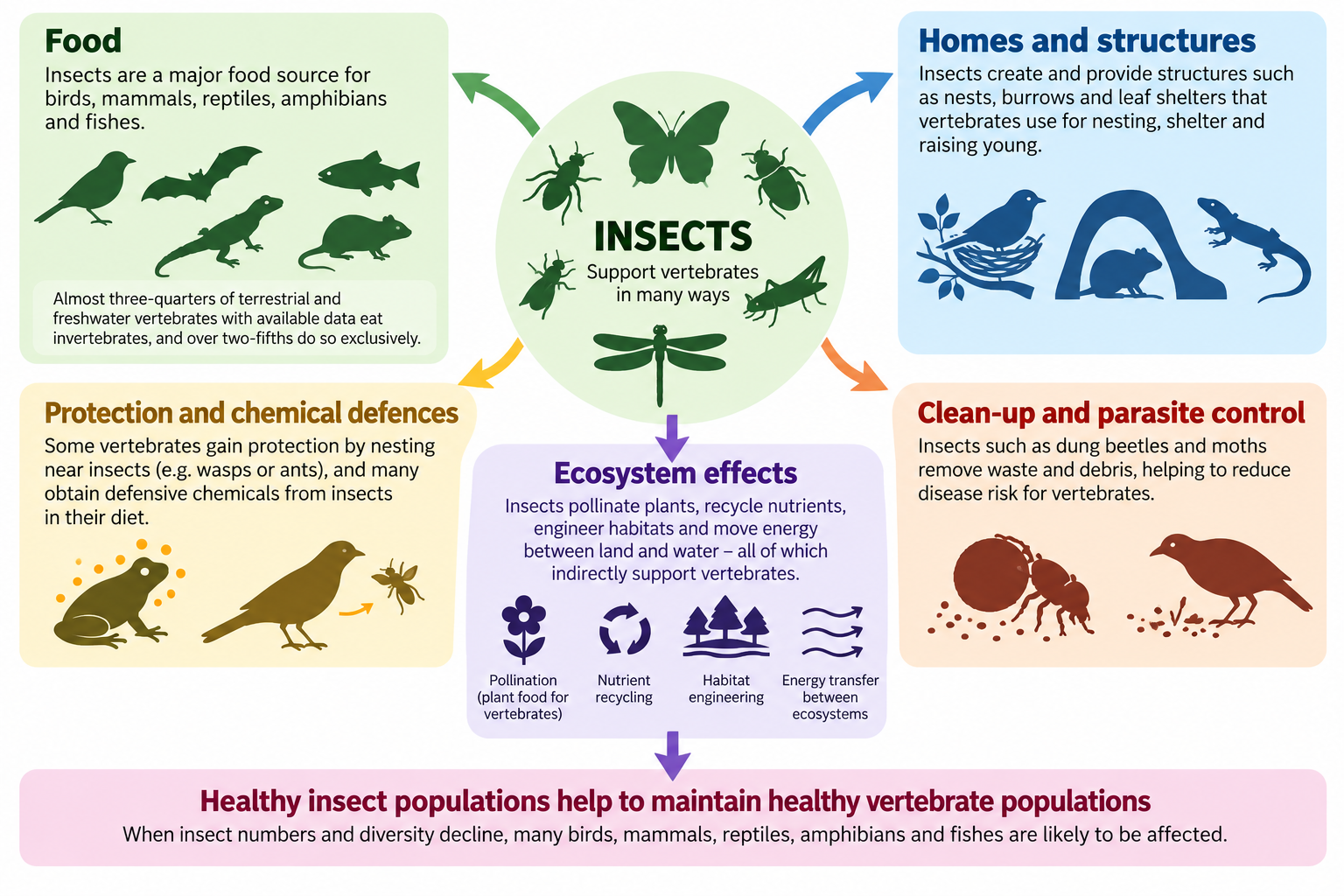
The starting point is food, and the numbers are striking. We assembled diet information for 19,750 species of terrestrial and freshwater vertebrates. Of those for which data are available, 73% eat invertebrates and 44% eat them exclusively. That alone ought to give us pause when thinking about the consequences of insect declines.

But one of the things that I particularly enjoyed about writing this review is exploring with colleagues how food is only the beginning of the story. All of us involved in it, I think, learned just as much as we contributed.

Much more than something to eat

The relationships between insects and vertebrates are extraordinarily varied, and some are wonderfully unexpected. Termite mounds and ant nests provide nesting sites, refuges and places to lay eggs for mammals, birds, reptiles and amphibians. Some bats use cavities created by beetle larvae. Birds incorporate insect and spider silk into their nests. Other birds deliberately nest close to wasps or ants, apparently gaining protection from predators.

Then there are the chemical relationships. Poison frogs obtain many of their defensive alkaloids from the insects and other arthropods that they eat. Some snakes acquire defensive toxins from fireflies. Birds, mammals, reptiles and amphibians engage in various forms of “anting” or anointing, applying ants and other invertebrates to their bodies, probably for a variety of functions including parasite control.

Insects can even provide sanitation services. Beetles remove vertebrate dung and can thereby reduce the survival of parasites, while moths living in the nests of some birds consume faeces and other organic debris. There is fossil evidence that similar relationships involving feather-feeding beetles occurred in dinosaur nests during the Cretaceous.

One of the figures in the paper brings together examples from around the world, and is worth spending some time exploring. There are chimpanzees applying insects to wounds, parrots nesting in termite mounds, geckos “milking” honeydew from planthoppers, frogs sheltering in ant nests, herons using insects as fishing bait, and much more. Ecological interactions are rarely dull!

Insects connect ecosystems

There is also a much bigger ecological story within this review, because insect relationships with vertebrates move enormous quantities of energy and nutrients through ecosystems. Aquatic insects emerge from streams and lakes and become food for terrestrial animals; terrestrial insects fall into rivers and feed fishes. In some forest birds, aquatic insects can provide more than a quarter of their energy budget, rising seasonally to 50–90%. Conversely, terrestrial invertebrates can provide approximately half of the annual energy budget of freshwater fishes.

And then there are the indirect effects. As readers of this blog will know, a lot of my research and writing is related to plant pollination, but insect pollination doesn’t just matter to plants. When an insect pollinates a plant whose fruits or seeds are subsequently eaten by a bird or mammal, the insect is indirectly supporting that vertebrate too.

One striking example concerns figs. Fig trees depend upon their tiny agaonid wasp pollinators, while figs themselves are eaten by at least 1,274 species of birds and mammals. Remove the wasps and the consequences potentially propagate far beyond the insects and plants themselves.

This is something I’ve discussed from a different direction in my book Birds & Flowers, where the focus is largely on birds as pollinators rather than insects supporting birds, though all nectar-feeding birds also consume insects. But the broader lesson is the same: species do not exist independently of the ecological relationships that sustain them. I’ve written previously about some of the extraordinary diversity of these pollination relationships on this blog, including in my post on the limits to pollinator diversity.

What happens if the insects disappear?

This brings us to the more difficult question addressed by the review. There is now substantial evidence that insect abundance, biomass and diversity are changing, although, as I’ve argued on this blog before, the magnitude, geography and taxonomic extent of those changes need to be discussed carefully rather than reduced to simplistic claims of an impending “insect apocalypse”.

Nevertheless, widespread changes in insect populations inevitably raise the question of what happens to the vertebrates that depend upon them. Here the evidence becomes surprisingly patchy.

There are good reasons to expect effects: a meta-analysis of 125 studies, for example, found strong positive relationships between insect prey availability and bird reproductive success and chick condition. European insectivorous birds declined by 13% between 1990 and 2015 while omnivorous bird populations remained stable. There are also examples involving bats, small mammals and other groups.

But demonstrating that declining insects actually caused a particular vertebrate population to decline is much harder. Insects and vertebrates can respond simultaneously to habitat destruction, pesticides, climate change and other pressures, making cause and effect difficult to disentangle.

That’s an important distinction. Ecology is full of plausible stories; demonstrating the causal links is another matter. There are nevertheless cases where dependence on particular insects is difficult to ignore. The Critically Endangered Mountain Pygmy Possum in Australia depends heavily on Bogong Moths, whose numbers have crashed. The probable extinction of the Eskimo Curlew has likewise been linked partly to the disappearance of the Rocky Mountain Locust, formerly an important component of its diet.

A surprisingly large gap in our knowledge

Perhaps the thing that surprised me most while working on this review was how poorly documented many insect–vertebrate interactions remain. Even something as apparently straightforward as “what insects does this bird eat?” often turns out not to have a satisfactory answer. Studies may report prey simply as “invertebrates”, “arthropods”, or “insects”, with little or no taxonomic resolution. Birds are much better studied than most other vertebrates, yet detailed quantitative diet information is still available for only a small fraction of species.

Non-feeding relationships are even more scattered through the literature. This is part of what ecologists call the “Eltonian Shortfall“: our incomplete knowledge of who interacts with whom in nature.

One conclusion of the review is therefore that we need much better ways of recording these interactions: common data standards, better taxonomic resolution, long-term monitoring, experiments, larger databases, and greater collaboration between entomologists and vertebrate ecologists. Citizen science, computer vision, metabarcoding and environmental DNA all have potentially important roles to play.

There is also a plea here for something rather unfashionable: natural history. Observations of animals eating, nesting, sheltering, grooming and otherwise interacting with insects are not trivial anecdotes. Properly documented and brought together, they are the raw material from which larger ecological patterns emerge.

Conserving relationships, not just species

For me, one of the broader messages from this review is that conservation needs to pay much more attention to what I’ve referred to in the past as the “biodiversity of species interactions“.

We naturally talk about conserving species and habitats. But an ecosystem is not merely a list of species occupying the same place. It is also the vast network of feeding, pollination, seed dispersal, decomposition, competition, parasitism, facilitation and other interactions connecting those species.

Lose enough of those connections and an ecosystem can change profoundly even before many species have disappeared. That has a very practical implication: insect conservation is also vertebrate conservation. If we want landscapes that support healthy populations of birds, bats, amphibians, fishes and other vertebrates, maintaining abundant and diverse insect communities is not an optional extra. It is part of the ecological infrastructure upon which those animals depend. And, as our review makes abundantly clear, we have probably only begun to understand the full extent of that dependence. That’s why nature conservation policies and regulations, such as Biodiversity Net Gain (BNG) in England for instance, need to look carefully at their implications for insects and other invertebrates.

Finally, I’d like to thank all of the contributors to this paper for working so diligently on the review. It’s an output from the Vertebrates and Insects Working Group, which was formed by the Status of Insects Research Coordination Network – check out the website and get involved!

Join me for “Pollinator Conservation: Threats and Opportunities” in Bedfordshire on Tuesday 15th September

Bedfordshire Natural History Society (BNHS) has invited me to give a talk on the theme of “Pollinator Conservation: Threats and Opportunities” at Maulden Village Hall (MK45 2DP) on Tuesday 15th September. It starts at 8pm and non-members are encouraged to attend.

More details are available at the BNHS web site.

I’ll have signed copies of my books available to purchase, so if you’re in the area, please do come along.

Press release: Europe risks a crisis if it fails to halt pollinator loss, researchers warn

NOTE FROM JEFF: This press release came out at the start of the week and I am involved in two of the EU-funded projects that are mentioned, Butterfly and ProPollSoil, and I’m a co-author of the White Paper.

For immediate release

University of Bergen Brussels office, Rue Guimard 1040, Brussels, Belgium, 22 June 2026

Eight EU-funded research consortia warn that Europe risks a crisis if it fails to halt pollinator loss. Their solution: a roadmap to reverse wild pollinator decline and protect managed bees.

A new White Paper from eight major EU-funded pollinator projects warns that the resilience of Europe’s vital societal functions and food security are at stake if the EU fails to halt and reverse wild pollinator declines, and to support managed pollinators. Behind the report is an interdisciplinary team of 135 leading researchers with expertise ranging from ecosystem ecology, pollinator ecology, ecological economics, social science, environmental history, behavioural psychology, political science, and environmental law. The report flags the EU’s siloed governance structures and resulting policy incoherence as the major barrier to pollinator restoration. It states that the EU and its Member States urgently need to act by making Pollinator Stewardship an explicit and measurable top-priority across policies on agriculture, environment, chemicals, research and innovation, trade, finance, planning, legislation, and education.

The report diagnoses the looming pollinator crisis as arising from a dysfunctional relationship between humans and nature. Seeing humans as separate from and superior to nature, and thinking of nature as an object for human use as a resource, reinforces institutional structures that exploit nature for short-term individual and material gain. This leads to unsustainable agricultural practices that risk jeopardising the resilience of the ecosystems on which humanity critically depends.

There is more at stake than food security, the report warns. Indeed, many of Europe’s economic supply chains and sectors depend on pollination of flowering plants. Think of medicinal plants, food supplements, biomass energy crops, biomaterials, textiles, fodder, cosmetics, decoration, art, culture, and tourism.

The report also highlights the low pollinator literacy of key societal actors whose daily actions can make the difference for pollinators. It advocates mandating ecoliteracy in the education of professionals in all key sectors that affect pollinators and their habitats.

According to the report’s lead author, Professor Jeroen van der Sluijs, many people whose actions affect pollinators and their habitat are already doing their best to help save the bees. But most lack the literacy to understand how their practices cascade into pollinator loss.

“Many farmers plant wildflower strips along their fields, but almost no one knows that some moths are more effective pollinators than honeybees. These little creatures of the night, clothed in velvet and moonlit dust, need host plants for their larvae, not only flowers. Host plants for pollinating hoverflies, beetles and moths are missing in most seed-mixtures for flower strips.”

Avoiding a scenario in which Europe is hit by a pollination crisis requires addressing the EU’s functioning and moving away from its siloed governance structures. This requires addressing fragmented responsibilities across sectors, top-down policy design, and weak coordination among administrations that currently hinders effective pollinator restoration. According to the authors, the conflict between short-term production goals and the need to maintain pollination services as a public good must be solved as soon as possible.

The report ends with a detailed roadmap of 15 urgent, evidence-informed recommendations for action that, when fully implemented, can reverse pollinator decline in Europe.

Full White Paper: https://zenodo.org/records/20715669

Surveying for Pollinators: join me for an online live webinar on 2nd October!

On Thursday, October 2 at 6:30pm, I’m running an online webinar on the theme of Surveying for Pollinators. Follow that link for more details and to book a ticket.

Here’s an overview of what I’ll be covering:

Pollinators like bees, butterflies, hoverflies and even beetles play a vital role in keeping our ecosystems thriving. They help plants reproduce, support biodiversity, boost food production, and contribute billions to the global economy. Beyond their ecological importance, they’re also excellent indicators of environmental health — when pollinators are doing well, nature usually is too.

But how do we actually find out what’s happening with pollinators?

In this webinar, we’ll explore the fascinating world of pollinator surveys — from simple, hands-on methods anyone can try, to more advanced techniques used by experienced entomologists and ecologists. You’ll get an overview of popular approaches, including:

  • Flower-Insect Timed Counts – A quick and accessible method inspired by the UK Pollinator Monitoring Scheme (PoMS).
  • Transect Walks – Great for spotting pollinators along a fixed route and comparing habitats.
  • Plant-focused sampling – for when you really want to delve deep into the pollinators of a species.
  • Trapping methods – including pan traps, vane traps, Malaise traps, and moth traps.
  • Camera Traps – A non-intrusive way to capture who’s visiting flowers when you’re not looking.

We’ll break down the pros and cons of each technique, which approaches are best suited to the question being asked, what to consider before starting your own survey, and how your efforts can feed into national monitoring schemes like PoMS, the UK Butterfly Monitoring Scheme, and BeeWalk.

Whether you’re a curious beginner, a budding citizen scientist, a research student, or a conservation professional, this session will give you the knowledge and tools to design a pollinator survey that fits your goals — and helps protect the buzz behind biodiversity.

The 90-minute event will consist of a 1-hour presentation followed by a Q&A with the tutor using questions provided by the live audience.

The presentations will be recorded and shared with those who booked, alongside Q&A transcripts and relevant links following the event via a password-protected website.

Mindful Mow May!

As April comes to a close, many people with gardens will be considering having a No Mow May in which, to quote Plantlife (who have trademarked the phrase!), you ‘pack away the lawnmower, let wildflowers grow freely and help nature’. On the face of it this is a positive thing and (hopefully) it gets people thinking a bit more about the impact of gardening practices on wildlife. However, I do worry that its message is too simplistic, as I’ll explain in the rest of this post. Let me say at the outset that I’m using the word ‘mindful’ in its sense of ‘paying attention to’, rather than in relation to mental health mindfulness. Though there are certainly connections between lawns and both meanings of this word, for example mindfully watching pollinators in your garden.

I’ve previously written about the garden that Karin and I developed in Northampton, including a ‘defence’ of its lawn. During the lockdown spring and summer of 2020, when I coordinated a loose consortium of scientists to collect standardised data on the flowers and pollinators in their own garden, our lawn was one of the areas that I surveyed. In that year, as every year, we had no intention of not mowing the lawn, but of mowing it in a mindful way that left some flowering patches of the main nectar sources: Dandelion (Taraxacum officinale), White Clover (Trifolium repens), and Daisy (Bellis perennis). It also allowed a patch of Common Ragwort (Jacobaea vulgaris), and the Cinnabar Moths (Tyria jacobaeae) that depend on it, to come back year after year.

In the graph below you can see the nectar production of dandelions, clovers and daisies over the course of the late spring to late summer. For each species, I have multiplied the number of flower heads I counted by the average amount of nectar sugar per flower head from the data collected by the Agriland project. Clover produces 48.97 micrograms of sugar per day, by far the highest amount of the three. Daisy produces the least, just 0.84 micrograms, and dandelion is in the middle with 22.57 micrograms.

Because these species vary in their peak flowering, there’s a continuous supply of nectar in the lawn over this time period and mowing does impact the immediate availability of nectar. Using green shading, I’ve marked the two days when I know for certain the lawn was mown and you can see that there’s an immediate drop in the nectar. Here you can also seen that both dandelions and daisies re-flower quite soon afterwards – it’s not a permanent effect by any means. The same is probably true of clover later in the season, but unfortunately I didn’t record the exact mowing dates.

The important thing to appreciate here is that without mowing, these three species would probably disappear from the lawn because all require that grasses are suppressed in order for them to flourish. Not only that, but most ground-nesting bee species need either very short turf or bare soil in which to nest. And most bees, at least in the UK, are ground-nesting.

The image at the top of this post is from my book Pollinators & Pollination: Nature and Society, and it shows two views of the same grassy, south-facing bank in Kettering, Northamptonshire. I included it because it’s a nice example of the mindful approach to lawn mowing that I am describing: bees are able to nest in the low-cut turf and collect the nectar and pollen from the flowers in the unmown areas. Later in the season that unmown area will be cut. This is referred to as ‘matrix mowing’, which is to say that by cutting some areas and leaving others, you create a matrix of different lawn lengths that has a greater overall benefit than is obtained by either cutting everything at the same time or cutting nothing for a whole month. It’s even better if you have the space to leave some patches unmown for a year or two. That way you create longer grassy areas in which insects can over winter and some bumblebees can nest.

It’s worth mentioning at this point that I know of only one published study that’s assessed the impact on No Mow May on pollinators, and that study was retracted shortly after it appeared. If I’ve missed other studies please do let me know in the comments.

I’ll finish with the Royal Horticultural Society, which was in the news recently with an announcement that it’s collaborated with gardener Monty Don to come up with ‘hard-wearing flower lawn that is good for pollinators, dogs and people’. This is hardly rocket surgery, it’s the sort of diverse, low-input, low maintenance lawn that many of us have been advocating for years, but if it brings these ideas to popular attention, so much the better.

So, consider engaging in Mindful Mow May* (and April, and June, and all the other months!) As always, feel free to comment below or get in touch with me via my Contact page.

*In the past I’ve also used the term “Matrix Mow May” which amounts to the same thing – being mindful of exactly where is mown and where is not.

Biodiversity Net Gain and pollinators: catch up with my talk on YouTube

Yesterday I delivered a webinar for the Biological Recording Company on the topic of what Biodiversity Net Gain (BNG) could mean for pollinator conservation. It’s a topic that clearly has a lot of resonance for the ecology community: almost one thousand people (994 to be precise) booked to attend, of which 380 actually watched. That’s a fairly typical ratio for free webinars, in my experience – many people book a place in the expectation that they will receive a link to watch the recording later.

The talk was indeed recorded and can be viewed by following this link to YouTube. There was a Q&A session afterwards which is not part of the recording but the questions and my answers have been transcribed and can be viewed on the Biological Recording Company’s blog, together with links to all of the references and data sources that I cited. Here’s the link to the blog.

I had a lot of really positive feedback during and after my talk, plus some extremely useful comments about where my interpretation of BNG was incorrect (or at least didn’t tell the whole story). As I stressed during my talk, BNG is a journey not an end point and we are all at the start of that journey! It’s going to be fascinating and important to see whether BNG can positively impact declining pollinator populations.

What are the limits to pollinator diversity? A new article poses the question

The most globally significant groups of pollinators are well known and have been studied for a long time: bees and wasps, flies, butterflies and moths, birds, bats and beetles are all familiar to those of us with an interest in pollination ecology. However, every few years a new type of pollinator or a novel pollination system is described from nature or from the fossil record, or we add further examples of previously neglected pollinator groups such as cockroaches.

This begs the question: how much is there still to discover? How close are we to describing the full diversity of animals that act as pollen vectors? Can looking at the past help us to predict what we might find in the future? That’s the topic of a Perspective article that I was invited to write for the special issue of the Journal of Applied Entomology on the theme of  The Neglected Pollinators that I mentioned last month. It’s a subject that I’ve thought about a lot over the last few decades and it was great to get an opportunity to air some ideas and speculation.

The article is open access and you can download a copy by following the link in this reference:

Ollerton, J. (2024) What are the phylogenetic limits to pollinator diversity? Journal of Applied Entomology (in press)

Here’s the abstract:

Although huge progress has been made over the past 200 years in identifying the diversity of pollinators of angiosperms and other plants, new discoveries continue to be made each year, especially in tropical areas and in the fossil record. In this perspective article I address the following questions: Just how diverse are the pollinators and what are the phylogenetic limits to that diversity? Which other groups of animals, not currently known to regularly engage with flowers, might be found to be pollinators in the future? Can we predict, from the fossil record and from discoveries in under-researched parts of the world, which animal groups might turn out in the future to contain pollinators? I also discuss why adding to our knowledge of plant–pollinator interactions is important, but also stress that an incomplete knowledge may not be a bad thing if it means that remote, inaccessible and relatively pristine parts of the world remain that way.

Butterflies, bumblebees and hoverflies can be equally effective pollinators of some plants says a new study

Just after I arrived in Northampton in 1995, I set about looking for suitable local sites for conducting pollination ecology field work for myself and students. The campus on which we were situated at the time was adjacent to an urban park – Bradlaugh* Fields – parts of which were designated as local nature reserves. In the intervening years, data from that area have made their way into a wide range of published studies, including:

I still have data collected during that time that have never been published, but good data are hard won and they may see the light of day at some point. Case in point is that we’ve just published a paper based on data from Bradlaugh Fields, the first of which were collected in 2001!

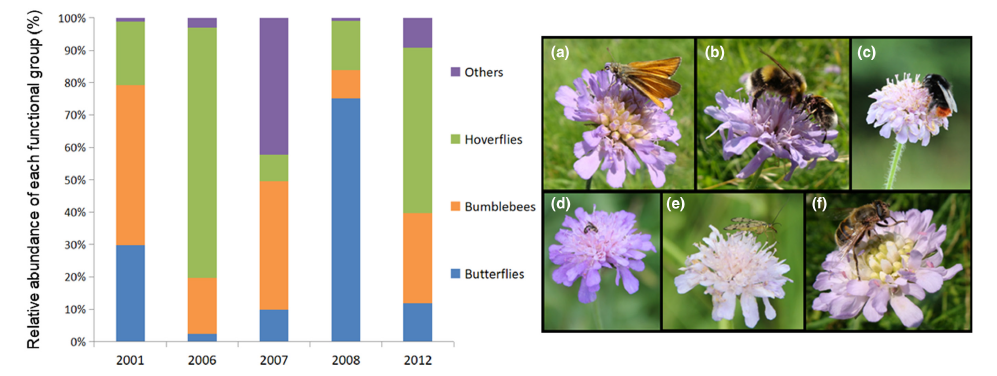
In this paper we’ve tested how effective hoverflies, butterflies and bumblebees are at pollinating the flowers of a common generalist grassland plant, colloquially called Field Scabious (Knautia arvensis). The expectation was that bumblebees, being generally larger, hairier and more flower-focused than the other groups, would be the most effective at transferring pollen to stigmas. To our surprise, they were not: hoverflies and butterflies performed just as well! In fact we argue that butterflies may be MORE important as pollinators of this plant because they fly further distances between individual plants, rather than hopping between the inflorescences of the same plants, as bumblebees tend to do.

Crucially, the importance of these different groups of pollinators varies enormously as the relative abundance of the insects visiting the flowers differs between seasons. In some years butterflies dominate as pollinators, in other years bumblebees or hoverflies. This is driven, we think, both by fluctuations in the populations of these insects and by the availability of other, more preferred flowers that may bloom at the same time.

The paper is part of a special issue of the Journal of Applied Entomology devoted to The Neglected Pollinators. It’s open access and you can download a copy by following the link in this reference:

Ollerton, J., Coulthard, E., Tarrant, S., Woolford, J., Ré Jorge, L. & Rech, A.R. (2024) Butterflies, bumblebees and hoverflies are equally effective pollinators of Knautia arvensis (Caprifoliaceae), a generalist plant species with compound inflorescences. Journal of Applied Entomology (in press)

Here’s the abstract:

Plant-pollinator interactions exist along a continuum from complete specialisation to highly generalised, that may vary in time and space. A long-held assumption is that large bees are usually the most effective pollinators of generalist plants. We tested this by studying the relative importance of different groups of pollinators of Knautia arvensis (L.) Coult. (Caprifoliaceae: Dipsacoideae). This plant is suitable for such a study because it attracts a diversity of flower visitors, belonging to different functional groups. We asked whether all functional groups of pollinators are equally effective, or if one group is most effective, which has been documented in other species with apparently generalised pollination systems. We studied two subpopulations of K. arvensis, one at low and one at high density in Northampton, UK. To assess pollinator importance we exposed unvisited inflorescences to single visits by different groups of pollinators (butterflies, bumblebees, hoverflies and others) and assessed the proportion of pollinated stigmas. We then multiplied the effectiveness of each pollinator group with their proportional visitation frequency in five different years. For each group we also compared time spent on flowers and flight distance between visits. The relative importance of each pollinator group varied between years, as did their flight distances between flower visits. Butterflies were the best pollinators on a per visit basis (in terms of the proportion of stigmas pollinated) and flew further after visiting an inflorescence. Different measures and proxies of pollinator effectiveness varied between taxa, subpopulations, and years, and no one group of pollinators was consistently more effective than the others. Our results demonstrate the adaptive value of generalised pollination strategies when variation in relative abundance of different types of pollinators is considered. Such strategies may have buffered the ability of plants to reproduce during past periods of environmental change and may do so in the future.

*Named after the estimable local MP and radical Charles Bradlaugh – see my blog post When Charles collide: Darwin, Bradlaugh, and birth control for Darwin Day 2016

New study just published: The effect of elevation, latitude, and plant richness on robustness of pollination networks at a global scale

During the 2020 lockdown caused by the COVID-19 pandemic, I coordinated an international network of pollination ecologists who used standardised methods to collect data in their gardens. I blogged about it at the time – see here and here for instance – and also put up a post when the data paper from that work was published.

Several research groups are now working with that huge data set and interrogating it for answers to a wide range of questions. The first group to actually publish a paper from the data is a largely Chinese set of researchers from the Key Laboratory of Plant Resources, Conservation and Sustainable Utilization, at the South China Botanical Garden in Guangzhou, assisted by Kit Prendergast and myself.

In this paper we’ve considered how robust these plant-pollinator networks are to simulated extinctions of species, and how this is affected by the elevation, latitude, and plant species diversity of the network.

Here’s the full reference with a link to the study:

Wang, X.-P., Ollerton, J., Prendergast, K.S., Cai, J.-C., Tong, M.-Y., Shi, M.-M., Zhao, Z.-T., Li, S.-J. & Tu, T.-Y. (2024) The effect of elevation, latitude, and plant richness on robustness of pollination networks at a global scale. Arthropod-Plant Interactions (in press) https://doi.org/10.1007/s11829-024-10056-7

If you can’t access it and need a PDF, please send me a request via my Contact page.

Here’s the abstract:

Plant-pollinator interactions play a vital role in the maintenance of biodiversity and ecosystem function. Geographical variation in environmental factors can influence the diversity of pollinators and thus, affect the structure of pollination networks. Given the current global climate change, understanding the variation of pollination network structure along environmental gradients is vital to predict how global change will affect the ecological interaction processes. Here, we used a global plant-pollinator interaction data collection by the same sampling method at the same period to explore the effects of elevation, latitude, and plant richness on the structure and robustness of pollination networks. We analyzed a total of 87 networks of plant-pollinator interactions on 47 sites from 14 countries. We conducted a piecewise structural equation model to examine the direct and indirect effects of elevation, latitude, and plant richness on the network robustness and analyzed the function of network structure in elucidating the relationship between robustness and these gradients. We found that plant richness had both positive effects on robustness under random and specialist-first scenarios. Elevation, latitude, and plant richness affected network connectance and modularity, and ultimately affected network robustness which were mediated by nestedness under specialist-first and random scenarios, and by connectance under the generalist-first scenario. This study reveals the indirect effects of elevation, latitude, and plant richness on pollination network robustness were mediated by nestedness or connectance depended on the order of species extinctions, implying that communities with different pollination network structures can resist different extinction scenarios.

Reusing Plant-Pollinator Datasets – a free WorldFAIR webinar on 18th April

A message from Dr Debora Drucker, WorldFAIR Agricultural Biodiversity Case Study Lead:

Registration is open to our contribution to the WorldFAIR webinar series – “Reusing Plant-Pollinator Datasets: a Global Perspective with Guidelines and Recommendations inspired by Pilot Studies from Africa, the Americas and Europe”.

It will be held on April 18 at 2:00 pm – 3:00 pm (Times in UTC) – https://worldfair-project.eu/event/the-worldfair-webinar-series-reusing-plant-pollinator-datasets-a-global-perspective-with-guidelines-and-recommendations-inspired-by-pilot-studies-from-africa-the-americas-and-europe/

We will present results from Deliverables 10.2 & 10.3, with focus on our pilot studies:

Drucker, D., Salim, J. A., Poelen, J., Soares, F. M., Gonzalez-Vaquero, R. A., Ollerton, J., Devoto, M., Rünzel, M., Robinson, D., Kasina, M., Taliga, C., Parr, C., Cox-Foster, D., Hill, E., Maues, M. M., Saraiva, A. M., Agostini, K., Carvalheiro, L. G., Bergamo, P., Varassin, I.; Alves, D. A., Marques, B., Tinoco, F. C., Rech, A. R., Cardona-Duque, J., Idárraga, M., Agudelo-Zapata, M. C., Marentes Herrera, E. Trekels, M. (2024). WorldFAIR (D10.2) Agricultural Biodiversity Standards, Best Practices and Guidelines Recommendations (Version 1). Zenodo. https://doi.org/10.5281/zenodo.10666593

Drucker, D. P., Salim, J. A., Poelen, J., Soares, F. M., Gonzalez-Vaquero, R. A., Devoto, M., Ollerton, J., Kasina, M., Carvalheiro, L. G., Bergamo, P. J., Alves, D. A., Varassin, I., Tinoco, F. C., Rünzel, M., Robinson, D., Cardona-Duque, J., Idárraga, M., Agudelo-Zapata, M. C., Marentes Herrera, E., Taliga, C., Parr, C.S., Cox-Foster, D., Hill, E., Maués, M.M. Agostini, K. Rech, A.R., Saraiva, A. (2024). WorldFAIR (D10.3) Agricultural biodiversity FAIR data assessment rubrics (Version 1). Zenodo. https://doi.org/10.5281/zenodo.10719265

We reserved a good amount of time for Q&A – I hope to see you there and have a nice discussion!