Bedfordshire Natural History Society (BNHS) has invited me to give a talk on the theme of “Pollinator Conservation: Threats and Opportunities” at Maulden Village Hall (MK45 2DP) on Tuesday 15th September. It starts at 8pm and non-members are encouraged to attend.
In my book Birds & Flowers, I included a chapter called “The curious case of Europe”. The point of that chapter was simple enough: compared with much of the rest of the world, Europe appears to be oddly deficient in bird pollination. There are no hummingbirds, no sunbirds, no honeyeaters, and very few native plants that obviously look as though they have evolved with birds as their main pollinators. And it Britain, it appears that bird pollination is totally absent.
But “appears” is doing a lot of work there.
For decades, European bird–flower interactions have tended to be treated as marginal curiosities: Blue Tits taking nectar from willow catkins, warblers dusted with pollen, finches messing about in blossom. Interesting natural history, certainly, but not necessarily pollination. The assumption has usually been that insects do the serious work, and birds are at best incidental visitors.
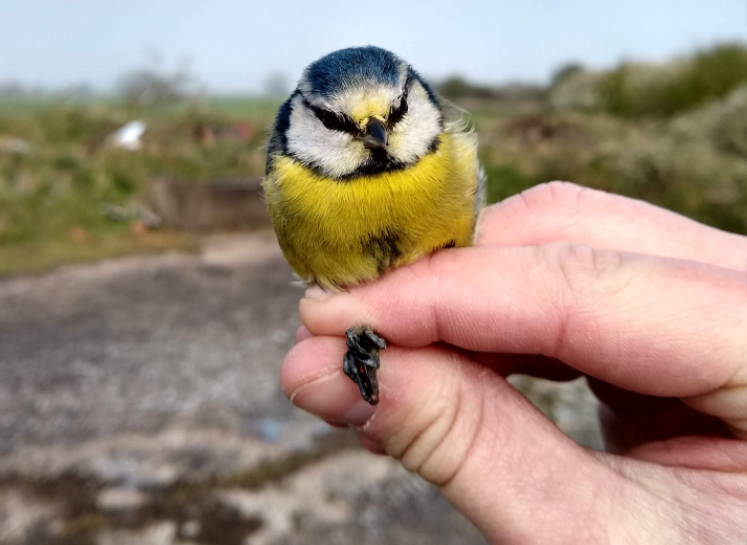
A new paper in Journal of Ecology called “Generalist passerine birds perform a functional role as pollinators in temperate Europe“, by Sandra Anderson, George Perry and Rose Thorogood challenges that assumption in a very useful way. Working at Wicken Fen in Cambridgeshire, they found that pollen transport by passerine birds was widespread. Most of the birds they sampled carried pollen, and several species — including Blue Tit, Blackcap, Chiffchaff, Wren, Redpoll and Bullfinch — regularly carried meaningful loads.
More importantly, they tested whether this mattered to the plants. By excluding birds from flowers while allowing insects access, they showed that fruit-set was reduced in several early-flowering woody plants, including Blackthorn (Prunus spinosa), Hawthorn (Crataegus monogyna) and Buckthorn (Rhamnus cathartica). In other words, the birds were not just getting dusty faces. They were contributing to plant reproduction.
I should say that I was one of the reviewers of this paper, so I have followed its development with particular interest. What I like about it is that it does not try to claim that Europe secretly has a hidden flora of classic “bird flowers”. These are not red tubular blossoms adapted to hummingbirds or sunbirds. They are familiar, open, pale, spring-flowering shrubs and trees. Nor are the birds specialised nectar-feeders. They are generalist passerines making use of seasonal resources.
That is precisely why the paper is interesting. It shifts the question from “does this look like bird pollination?” to “does bird visitation actually function as pollination?” That distinction matters. Pollination syndromes can be useful, but they can also blind us to interactions that do not fit the textbook categories.
The seasonal context is also important. These interactions peak early in spring, when willows, blackthorn and other woody plants are flowering, temperatures are still cool, insects may be unreliable, and birds are preparing to breed or arriving from migration. Under those conditions, even occasional bird visits could be valuable to plants needing pollen moved between individuals.
For me, this paper strengthens the argument I made in “The curious case of Europe”: Europe is not devoid of bird–flower interactions; rather, we have been looking for the wrong kind of bird pollination. Instead of obvious “ornithophilous” specialisation, we may have overlooked a more diffuse, opportunistic, generalist system involving common birds and common spring-flowering woody plants.
That may not be as spectacular as a hummingbird hovering at a tropical flower, but ecologically it is just as revealing.
When most people think about pollinators, they picture bees visiting flowers. But for many species, a large part of life happens elsewhere: in the soil. Many pollinators do not just feed above ground, they also nest, shelter or develop below it
Discovering more about this aspect of pollinator life histories is the focus of ProPollSoil, a major new European research project exploring the links between soil health and pollinator health that kicked off last year. I’m excited to be part of it because the soil component of pollinator ecology and conservation is important but often overlooked.
As part of ProPollSoil, we are asking the public to help us find and document ground-nesting bees through a citizen science initiative called EuroBeeSoil. If you spot a bee nest in soil, sand, a lawn, a path edge or a sunlit bank, you can photograph it and upload your record to iNaturalist.
It’s a simple idea, but potentially a very powerful one. These observations will help us understand where bees are nesting, what kinds of soils they use, and how we can better conserve them.
We often talk about pollinator-friendly flowers. But bees need more than food, they also need somewhere to live. For many species, that means the ground beneath our feet.
So please follow this link and consider how you might take part if you can. You do not need to be a bee expert. You just need to look down a little more often.
The diversity of life on Earth, and the interactions between the species that make up that diversity, are fundamentally important to the functioning of ecosystems and to human well-being. Yet these connections are often poorly appreciated, despite the fact that biodiversity supports everything from food production and clean water to climate resilience and human health.
At the end of March and the end of May I will be presenting two lunchtime webinars which explore this as part of the Biological Recording Company’s Skills for Ecology series. These talks will look at how biodiversity in general, and plant–pollinator interactions in particular, connect to the United Nations Sustainable Development Goals (UN SDGs), showing why the conservation of nature is central to a just, healthy, and sustainable future.
The Golden Lotus (Musella lasiocarpa) is one of China’s most iconic plants — a striking member of the banana family (Musaceae) that seems to bloom forever. Its brilliant yellow, lotus-like bracts have long made it a favourite of subtropical gardeners, though it also has utility as a food and fibre crop, and is associated with Chinese Buddhism. As you can see above it often features stylistically in Chinese temples, and in my visits to Yunnan we frequently encounter it during fieldwork on farms, planted to support terraced fields:
But despite its fame, one mystery has lingered for decades: what actually pollinates it?
Until now, Musella was thought to rely mainly on insects, particularly bees, for pollination. That assumption made it something of an outlier within the banana family, where most species are pollinated by birds or bats. But a new study, in which I was involved as part of an international team of predominantly Chinese and Brazilian researchers, has turned that view on its head.
By combining careful field observations with citizen science records, our team found that the Golden Lotus is regularly visited by an impressive diversity of birds — twelve species from five different families. As I documented in my recent book Birds & Flowers: An Intimate 50 Million Year Relationships, many of these visitors, such as bulbuls and sunbirds, are known nectar-feeders, and their behaviour at the flowers suggests that they are acting as effective pollinators. This discovery significantly expands what we know about the pollination ecology of the Golden Lotus, and places it firmly within the broader pattern of bird pollination that characterises much of the banana family.
Interestingly, the plant’s features — large, robust, vividly coloured bracts, abundant accessible nectar, and long-lived blooms — make perfect sense in this new light. These are traits that favour bird pollination rather than the short, concentrated visits typical of bees.
But the significance goes beyond one species. Bird pollination plays a vital, and often overlooked, role in China’s native flora, linking ecosystems from tropical rainforests to mountain valleys. Understanding these relationships is important not only for biodiversity conservation but also for horticulture — helping gardeners and landscape designers to create spaces that attract and sustain pollinators of all kinds.
The Golden Lotus has always been celebrated for its beauty and longevity. Now, we can add another layer to its story: a reminder that even the most familiar plants can still surprise us, and that nature’s partnerships are often more complex — and more colourful — than we imagine.
Here’s the reference with a link to the paper, which is open access:
Pollinators such as wild bees, butterflies, and hoverflies are in trouble worldwide. A major new study, published in Science and led by Gabriella Bishop and other scientists at Wageningen University & Research, shows that the oft-quoted figure of 10% semi-natural habitat in farmland landscapes is far too little to safeguard pollinators. Instead, the evidence points to a need for somewhere between 16% and 37% habitat cover, depending on the type of pollinator, if we are serious about halting declines. Suitable habitats include hedgerows, patches of woodland, species-rich grasslands, and flowering margins, and as a general rule, hoverflies need less of it whilst bumblebees and butterflies require more.
I was fortunate to play a part in this global assessment, contributing an unpublished dataset collected with my former PhD student, Sam Tarrant, who studied plant-pollinator interactions on restored landfill and established grassland sites. Seeing those data joined with dozens of other studies from around the world underlines something we have known for years: no single dataset, however carefully gathered, can give us the whole picture. To really understand what is happening to biodiversity—and to design conservation solutions that work—we need these kinds of global, mega-author syntheses that draw together evidence from many landscapes, taxa, and approaches.
The message from this analysis is stark but hopeful. More habitat means more pollinators, across all groups. Richer habitats with abundant flowers give an additional boost, but the overriding priority must be to increase the sheer area of natural habitat in farmed landscapes. Small-scale fixes like wildflower strips offer short-term benefits, but without enough space they can’t deliver recovery at scale. Long-term, secure habitat creation—on the order of decades, not seasons—is what pollinators, farmers, and ecosystems need.
Although the policy debate in Europe provided the backdrop for this study, the lessons (and the data) are global. Wherever agriculture dominates, the health of pollinator populations—and by extension our food security and biodiversity—depends on our willingness to give these insects the space and quality of habitat they require.
Looking ahead, we need to think bigger and work together. That means more international collaborations, more sharing of data, and more commitment to long-term solutions that transcend borders. The image at the start of this post is from my trip back to China in July this year. I deliberately chose it because, as you’ll see from the map below which is taken from the paper, there was no suitable data available for the study from that country. Or from Africa. Or Australasia. Or from most of tropical South America. That shows that as pollination ecologists we need to coordinate more in advance on these types of syntheses, and maximise the value of the kinds of data that we collect. The main take away from this study, however, is that if we want to reverse the declines in biodiversity, scientists, policymakers, businesses, farmers, and citizens all have a role to play. Pollinators remind us that nature is interconnected and global—our conservation efforts must be, too.
Here’s the full reference with a link to the study:
Biodiversity in human-dominated landscapes is declining, but evidence-based conservation targets to guide international policies for such landscapes are lacking. We present a framework for informing habitat conservation policies based on the enhancement of habitat quantity and quality and define thresholds of habitat quantity at which it becomes effective to also prioritize habitat quality. We applied this framework to insect pollinators, an important part 5 of agroecosystem biodiversity, by synthesizing 59 studies from 19 countries. Given low habitat quality, hoverflies had the lowest threshold at 6% semi-natural habitat cover, followed by solitary bees (16%), bumble bees (18%), and butterflies (37%). These figures represent minimum habitat thresholds in agricultural landscapes, but when habitat quantity is restricted, marked increases in quality are required to reach similar outcomes.
If you’ve read my book Birds & Flowers: An Intimate 50 Million Year Relationship, you’ll know that I spend a few pages discussing the long-standing paradigm of how interactions between plants and their pollinators evolve and result in the formation of new plant species. This is referred to as the Stebbins (or Grant-Stebbins) Most Effective Pollinator Principle (MEPP). The MEPP is fairly straightforward and intuitive: flowers evolve their colour, shape, scent, rewards, and so forth as adaptations to the type of flower visitor that successfully moves the most pollen between flowers.
However, the MEPP is not the only Principle in town – there’s also Aigner’s Least Effective Pollinator Principle (LEPP) which is not so intuitive. In the LEPP, flowers can adapt to pollinators that are less successful at pollination, as long as those adaptations do no interfere with the pollination services provided by other flower visitors.
As I note in Birds & Flowers, we don’t know which of these Principles is more frequent in nature, because the LEPP has been much less intensively studied than the MEPP. That’s in part because it’s less well known, but also because the field work and experimental procedures required to test the LEPP are much more challenging.
Kathleen and Bruce discuss not just the MEPP v the LEPP, but also other ways in which flowers can evolve, framed around the idea of floral evolution as movement across an “adaptive landscape,” where plants are not shaped only by one pollinator but by the need to maximise overall reproductive success. This perspective allows us to explore how flowers evolve when influenced by multiple pollinators, how transitions between floral forms take place, and how speciation occurs through a combination of factors beyond pollination alone. It emphasises that pollinators are important drivers of floral change, but speciation is more likely when divergence happens across several aspects of a plant’s ecology, not just through its flowers.
It’s a great review and well worth your time reading in detail. Perhaps my favourite line in the paper comes from the abstract: “The Grant–Stebbins model, while inspiring decades of empirical studies, is a caricature of pollinator-driven speciation and explains only a limited range of adaptive outcomes.” This is something that many of us have been arguing for years: the natural world is extremely complex, so we should not expect these ecologically critical interactions between flowers and their pollinators to have simple origins or ecologies.
The event takes place in the Wilkinson Room, St. John’s Church, Hills Road. Doors open at 7pm and the talk begins at 7.30pm. There’s a £2.00 charge for non-members – more details can be found by following this link.
Regular readers of my blog may recall that I have an obsession with something of an interest in Common Elder (Sambucus nigra) that goes back to my childhood, as I recounted in an article for British Wildlife back in 2022. In that article I mentioned that the larger hollow trunks and branches of elder “can offer nesting opportunities for birds and small mammals”, but didn’t go into detail. The mammals I was thinking of at the time were small rodents, but following a long country walk with Karin recently I wondered whether bats might also make use of these hollows as roosts for breeding and/or hibernation.
“There are no positive results which match your query. This does not mean that bats won’t use the feature type in the species and habitat you have selected, but current data suggests that survey effort may be better focused on features which have a proven occupation”.
The BTHK relies on bat surveyors adding their observations, but clearly no one has submitted records of bats in elder, despite the fact that we know they occur. This concerns me for two reasons.
Firstly, of all of our smaller native woodland edge and hedgerow trees, elder is (in my experience) the one most likely to have significant cavities in their trunks and branches. The specialists in the Facebook Group introduced me to the phrase “if they fit, they sit”, meaning that almost any cavity might contain bats, even quite low to the ground: one respondent mentioned that a friend had found two Common Pipistrelles during an autumn survey, in a dead elder stem less than ten centimeters in diameter at about one metre above ground level.
Secondly, it’s not unusual for old elder trees to be cut right to the ground or even removed completely during work on hedgerows. It’s a neglected, even despised native British tree that, as I noted in that British Wildlife article, is:
“generally considered by naturalists, when it is considered at all, as rather boring, so commonplace that we hardly give it a second glance…[and by some as]…’barely a tree at all, more of a weed'”
Another respondent mentioned that tubular structures, such as elder branches, are less likely to be identified as active bat roosts in the absence of bats, as they provide limited shelter and often lack droppings, which tend to fall out, leaving minimal evidence. I’m sure that’s not the whole story, however, I think it’s more likely that small trees generally are overlooked when it comes to habitat for bats: the BTHK has a single entry for Common Hawthorn (Crataegus monogyna) and nothing for Blackthorn (Prunus spinosa), for instance.
In addition to bats, another respondent noted that Willow Tits (Poecile montanus), a species experiencing significant decline and now red-listed in the UK, often nest in elder trunks, where they excavate cavities in decaying wood. That’s yet another reason why we should pay more attention to this most interesting of trees!
My thanks to all of the British Ecologists who replied to my query. As always, feel free to comment or get in touch via my Contact page.
UPDATE: After I posted this on Bluesky, Richard Broughton, author of The Marsh Tit and the Willow Tit, pointed out that elder is also a significant nesting site for Marsh Tits (Poecile palustris), another red-listed species. To quote Richard’s comment:
“Elder is prob[ably] the very best cavity-bearing shrub, far better than hawthorn, hazel, blackthorn (very poor). Important nesting shrub for Marsh Tits & Willow Tits, but only if left to develop old trunks and cavities, not cut. Like Hazel, they self-coppice without management, with new growth from base….in Wytham Marsh Tit studies Elder was the main nest tree/shrub. Though it’s not common/available in woods everywhere. It develops *really* good hollow nest cavities for the small hole-nesting guild, and also very amenable for Willow Tits to excavate. Prob[ably] important in hedges, where holes rare.”
Richard kindly shared a scan from his book showing that for Willow Tits, elder ranks second (after willow and birch) and for Marsh Tits it ranks second after Ash.
When we think of pollination, we often picture bees buzzing around flowers or butterflies flitting from bloom to bloom. This relationship between plants and pollinators is one of the most well-known interactions in nature. But insect pollination didn’t begin with the colorful flowers we see today. In fact, pollinators were at work millions of years before flowering plants (angiosperms) even existed. In a new review led by Spanish researchers David Peris and Ricardo Pérez-de la Fuente, to which I added a modern ecological perspective, we explored this topic and why it’s relevant to our current understanding of plant-pollinator relationships.
Despite centuries of research on pollination, the fossil record of pollinating insects has only gained serious attention in the past few decades. What palaeontologists have uncovered is reshaping our understanding of pollination’s origins. It turns out that insects were pollinating plants long before flowers evolved—playing a crucial role in the reproduction of ancient gymnosperms, the group of seed-producing plants that includes conifers, cycads, and ginkgos.
Most people assume that insect pollination began with flowering plants, but the evidence tells a different story. Fossilised insects with specialised body structures for carrying pollen—such as hairy bodies or mouthparts adapted for nectar-feeding—have been found in deposits dating back hundreds of millions of years. These early pollinators likely visited gymnosperms, helping them reproduce in a world that looked vastly different from today’s landscapes.
Ancient pollination was driven by a diverse range of insects, many of which are now extinct. The fossil record reveals that various insect groups—including beetles, flies, wasps, and even some long-lost relatives of modern lacewings—were already acting as pollinators long before the first flower bloomed. This means that pollination as an ecological process has far deeper evolutionary roots than many realise.
As plants evolved, so did their pollinators. The rise of flowering plants during the Cretaceous period (around 100 million years ago) transformed pollination systems, leading to the incredible diversity of plant-pollinator relationships we see today. Many of the insect groups that once dominated pollination in prehistoric times have since declined or disappeared, replaced by the bees, butterflies, and other familiar pollinators that thrive in modern ecosystems.
Understanding this long history is essential—not just for scientists, but for anyone interested in biodiversity and conservation. When we focus only on present-day pollinators and plants, we miss a crucial part of the story. The fossil record helps us see how pollination has changed over time, which in turn can offer insights into how today’s ecosystems might respond to environmental pressures such as climate change and habitat loss.
Recognising the ancient history of insect pollination isn’t just an academic exercise—it has real-world implications. If we understand how pollination evolved and adapted to past environmental changes, we can better predict how it might shift in the future. Conservation efforts that aim to protect pollinators today can benefit from a long-term perspective, ensuring that we’re not just responding to recent trends but also considering deep-time ecological processes.
So the next time you see a bee visiting a flower, remember—you’re witnessing the latest chapter in a story that began hundreds of millions of years ago. The relationship between plants and pollinators is far older, more complex, and more fascinating than we ever imagined.
Here’s the reference with a link to the paper. It should be open access, but if you have problems obtaining it, send me a message via my Contact page: