
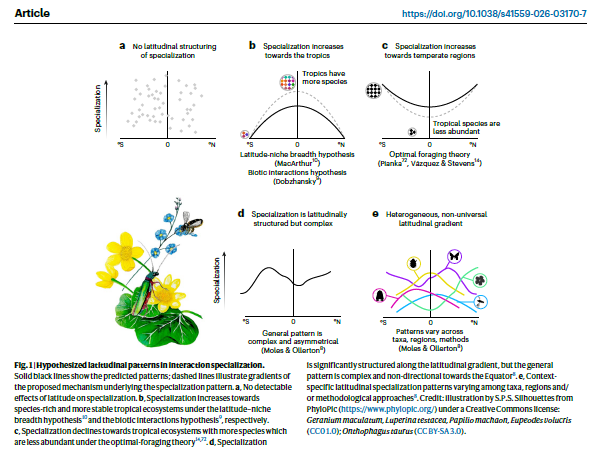
Some scientific questions have a habit of following you around for much of your career. Back in 2002, Louise Cranmer and I published a paper in the journal Oikos asking a deceptively simple question: are tropical plants more specialised in terms of their pollinators?
At the time there was a widespread assumption in ecology that interactions between species become increasingly specialised as you move from the poles towards the tropics. It’s an attractive idea which had some (quite vague) theoretical support. Tropical ecosystems contain more species, have experienced relatively stable climates over long periods of evolutionary time, and seem like just the sort of places where tightly specialised interactions ought to evolve.
The trouble was that the evidence wasn’t especially convincing, in part because it hadn’t actually been well studied. In preparing the 2002 paper, Louise and I found only a handful of empirical studies that had addressed the question, not just for plants and pollinators, but for ALL kinds of interactions.
The question of tropical specialisation has subsequently cropped up repeatedly in my research. In 2014, Angela Moles and I went considerably further and asked whether the broader claim that species interactions are stronger and more specialised in the tropics might actually be a “zombie idea” – one of those scientific notions that persists despite accumulating evidence that the reality is considerably more complicated. That guest post on the Dynamic Ecology blog was then written up as an invited paper for Biotropica see: Tropical Zombies: Moles & Ollerton (2016) is now published.
Twenty-four years after that first Oikos paper, we can now address the question with a dataset that Louise and I could scarcely have imagined in 2002. A huge international collaboration led by Sailee Sakhalkar and Robert Tropek has just published “Global patterns in plant–pollinator specialization” in Nature Ecology & Evolution.
I’m delighted to be one of the co-authors and I find the answer to the question that we posed 24 years ago to be fascinating.
More than 110,000 interactions
The scale of the new study is worth emphasising. It assembled 3,415 quantitative plant-pollinator networks from 162 studies, covering 110,571 pairwise interactions between 5,343 pollinator species and 6,126 plant species. The data span almost all of the world’s terrestrial biogeographic regions, from 43.6°S to 81°N and from sea level to more than 4,000 metres elevation.
That makes this the most comprehensive attempt yet to examine the geography of specialisation in plant-pollinator interactions. But simply throwing thousands of networks into a statistical analysis would potentially create as many problems as it solves. Different researchers study pollination networks in very different ways. Some attempt to sample whole communities, while others concentrate on particular groups such as bees, hummingbirds or particular plants.
So an important feature of this study was that we explicitly separated these different types of datasets and accounted for sampling completeness and methodological differences. We also looked separately at different functional groups of pollinators rather than assuming that bees, beetles, butterflies, moths, flies and birds should all behave in the same way. That turned out to be important in ways that we could not predict.
So, are interactions more specialised in the tropics?
The short answer is no, not in any simple sense. There is geographical structure to plant-pollinator specialisation. But there is no straightforward increase in specialisation as you approach the Equator – nor, for that matter, a straightforward decrease. Instead, the patterns are distinctly nonlinear.
Network-level specialisation and pollinator specialisation tended to peak at relatively low northern latitudes, at around 20°–30°N, close to the tropical-subtropical boundary. I find this particularly interesting as I think the subtropics have been a bit neglected as a focus of ecological research: no one ever refers to themselves as a “subtropical ecologist” and there is no Journal of Subtropical Ecology. Yet the subtropics are not simply a transitional zone between the tropical and temperate worlds. They encompass an extraordinary range of ecosystems, including deserts, Mediterranean-type vegetation, subtropical forests, and some major centres of biodiversity and endemism. This includes the distinctive habitats in Yunnan that I’m exploring during my visits to China. Perhaps we need to start thinking of the subtropics as an important biogeographical region in their own right, rather than as the ecological space between two better-studied zones?
Plant specialisation showed a different and weak hemispherically asymmetric pattern. And once individual pollinator groups were examined separately, the picture became more complicated still. Hoverflies, for example, came closest to the traditional expectation of increasing specialisation towards the Equator. Birds showed something closer to the opposite pattern, while moths did something much more complicated.
In other words, there isn’t a latitudinal specialisation gradient. There are several overlapping geographical patterns whose shapes depend upon what organisms you study and what measure of specialisation you are considering.
That conclusion feels satisfying given the arguments Angela Moles and I made ten years ago. We suggested that attempts to find a universal latitudinal gradient could obscure the fact that different groups of organisms have different evolutionary histories, physiologies and ecologies. That is very close to what emerges from this much larger analysis.
Perhaps latitude was never really the interesting variable
One of the most intriguing results is what happens when we stop asking about latitude itself. We compared latitude with a suite of possible explanatory variables, including temperature, precipitation, environmental productivity, and plant and pollinator diversity. Climate generally did a better job of explaining specialisation than latitude, biodiversity or productivity. Again, however, there wasn’t a single climatic rule.
At the whole-network level, specialisation generally declined as mean annual temperature increased, which was not expected at all and runs counter to the argument that the tropics are always more specialised. Precipitation produced strongly nonlinear relationships, and plants and different pollinator groups responded differently. Birds, insects and even different groups of insects could show contrasting responses to the same climatic gradient.
There are some plausible biological explanations for these patterns. Warmer conditions may extend flowering periods and pollinator activity, creating more opportunities for species to encounter alternative partners and therefore encouraging generalisation. Colder or more seasonal environments might compress flowering and pollinator activity into shorter periods, producing tighter temporal matching between species. Rainfall adds another layer of complexity because it can influence flowering but also directly constrain pollinator activity.
These are hypotheses rather than demonstrated mechanisms, however. As we stress in the paper, these are correlational global patterns and climate covaries strongly with latitude. The results shouldn’t therefore be interpreted as demonstrating simple causal effects of temperature or rainfall.
Specialisation depends on how you look at it
There’s another connection here to research I’ve discussed previously on the blog. In work with Danish and Brazilian colleagues, for example, we showed that the apparent specialisation of plants and pollinators depends partly on the spatial scale at which interactions are examined – see Local and regional specialization in plant–pollinator networks. More recently I’ve written about why scale matters when analysing plant-pollinator networks.
And earlier this year, our global analysis of plant-pollinator interactions in gardens found that the factors explaining species richness were not necessarily those explaining interaction specialisation: Global drivers of plant-pollinator interaction specialization in gardens.
There’s also a nice connection to another study that I wrote about here in 2022. With Pablo Gorostiague and Pablo Ortega-Baes, I looked specifically at whether cactus pollination systems become more specialised towards the tropics. Our answer was yes and no: tropical cacti were visited by somewhat fewer pollinator species, but there was no latitudinal pattern in the number of functional pollinator groups that they used. As I wrote at the time, the answer depended on what we meant by “specialised”: Are cactus pollination systems more specialised in the tropics? A new study suggests yes…and no!
All of these studies point towards a similar conclusion: “specialisation” is not a single, fixed property of an ecological community. What we detect depends upon biological scale, geographical scale, the organisms being considered, and how the interactions have been sampled. That doesn’t make specialisation meaningless. Quite the opposite, it means we need to be precise about what sort of specialisation we’re talking about and at what scale.
The new global study puts that result into a much broader context. Different groups really can display different geographical patterns of specialisation, so studies focused on a particular lineage aren’t necessarily contradicting one another when they produce different answers. They may simply be measuring different pieces of a much larger ecological puzzle.
Why does any of this matter?
Specialisation is not just an esoteric property of ecological networks. It affects how plants and pollinators partition resources, how species coexist, how communities are assembled, and potentially how ecological systems respond when species disappear.
That becomes especially important in a changing climate. Our results suggest that changing temperature and rainfall regimes could restructure plant-pollinator networks, but they are unlikely to do so uniformly. Different pollinator groups and different parts of the world may respond in very different ways. Highly specialised interactions may also be particularly vulnerable to changes in phenology or the loss of interaction partners. Predicting the consequences therefore requires us to move beyond simple statements about “tropical” and “temperate” ecosystems.
For me, though, there is also a broader lesson here about how science progresses. In 2002, Louise Cranmer and I questioned whether the available evidence really supported the assumption that tropical plant-pollinator interactions were more specialised. Fourteen years later, Angela Moles and I argued that the wider claim about stronger and more specialised tropical interactions might be a zombie idea. Now, with more than 110,000 plant-pollinator interactions available for analysis, the answer is much clearer. Latitude matters; climate matters; the identity of the organisms matters; and ecology, as usual, refuses to obey a simple rule.
My particular thanks to Sailee and Rob for the monumental efforts they made to pull this work together, and cudos to all of the co-authors who helped to make the study possible.


Pingback: Moths, wasps, hummingbirds and nectar: exploring the pollination ecology of Apocynaceae in Argentina | Prof. Jeff Ollerton – ecological scientist and author