
Back in October 2021, I wrote a post about tracking down a rather elusive plant on the Danish coast. Karin and I had been cycling around the Odsherred region when I spotted the distinctive yellowing autumn foliage of Vincetoxicum hirundinaria growing close to the little fishing harbour at Klint.
I was particularly pleased to find it because Vincetoxicum is a genus of plants that I’ve been interested in for many years. It’s part of the milkweed and dogbane family, Apocynaceae, and belongs to the subfamily Asclepiadoideae, a group with some of the most extraordinarily complex flowers in the plant kingdom.
At the end of that post I asked a question: what was pollinating those flowers on the exposed Danish shoreline? At the time there were surprisingly few published records of pollinators for this widespread European species.
Five years later, I’m delighted to say that a new paper just published in AoB PLANTS, led by my Chinese colleague Wujian Xiong, and to which I’ve contributed, goes a considerable way towards answering that question. Not specifically for the Danish population, but for several populations studied in and around Salzburg, Austria. And the answer is rather more complicated, and interesting, than we might have expected.
A very specialised flower with remarkably unspecialised tastes
The flowers of Vincetoxicum hirundinaria are small, pale cream or ivory-coloured, and about 12 mm across. Like other members of the Asclepiadoideae, they have a highly specialised mechanism for transferring pollen.
Rather than producing individual loose pollen grains, the pollen is packaged into structures called pollinia, which are joined together by a central attachment mechanism to form a pollinarium. When an insect visits a flower, part of its body can become caught in a narrow guiding structure. As it pulls away, a pollinarium may become attached to its mouthparts, legs or other appendages. If all goes well, the insect carries that pollen to another flower and deposits it into a specialised receptive chamber.
It’s an extraordinarily precise mechanism, and one might reasonably expect that only a rather narrow range of insects could operate it successfully.But that’s not what we found.
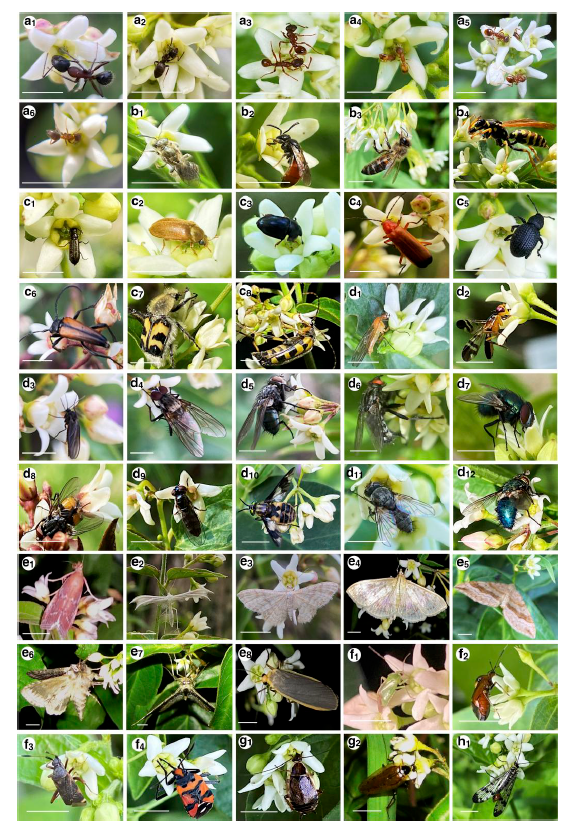
Over 50 hours of observations, Wujian recorded almost 3,000 visits to the flowers, involving 81 species or morphospecies of insects from seven different orders. These included bees, wasps, ants, flies, beetles, moths, bugs, scorpionflies and cockroaches.
Of those 81 types of flower visitor, 37, representing five insect orders, were found carrying pollinaria. These included 15 types of flies, seven bees and wasps, seven moths, six ants, one beetle and one cockroach. That’s a remarkably diverse assemblage for a plant with such specialised floral structures. Indeed, it’s the most diverse pollinator assemblage so far documented for any member of Vincetoxicum.
What makes this particularly interesting is that the pollinaria were attached to different parts of the insects’ bodies. In flies they might be on the proboscis or legs; in bees and wasps on the mouthparts; in moths on the proboscis; and in cockroaches on the labial palps.
In other words, the same elaborate floral mechanism can operate with insects that differ enormously in their anatomy, size and behaviour.
Another chapter in the story of cockroach pollination
There’s a particularly satisfying connection here with another paper that Wujian and I published back in 2020. That study demonstrated specialised cockroach pollination in the rare and endangered Chinese species Vincetoxicum hainanense. Its small flowers open at night, produce an unpleasant scent reminiscent of rotting fruit, and are principally pollinated by a particular species of cockroach, Blattella bisignata.
It was the first documented example of specialised cockroach pollination in the Apocynaceae, and one of only a handful of well-studied examples from anywhere in the world. Now we have another species of Vincetoxicum that is visited and potentially pollinated by cockroaches, but in this case they are just one component of a much more diverse assemblage.
The contrast between the two species is striking. They share the same basic type of highly specialised floral architecture, yet one has a relatively narrow pollination system while the other is much more generalised. Clearly, floral complexity doesn’t necessarily translate into ecological specialisation.
Day and night, and the importance of place
Another interesting finding concerns when the flowers are available to pollinators. The flowers of V. hirundinaria open in the late afternoon, between about 4pm and 6pm, and remain open for an average of six days. They produce nectar and a strong, sweet scent that we describe in the paper as reminiscent of red wine.
That long floral lifespan means that they are potentially accessible to both daytime and nocturnal insects. But the relative importance of those insects varied considerably between the study populations. At most sites, pollen removal and deposition took place during the day, with bees, wasps and other diurnal insects playing the main roles. However, at the higher-elevation Gaisberg site, nocturnal moths and cockroaches were much more prominent, and pollen transfer during the night was particularly effective.
It’s a useful reminder that a plant doesn’t necessarily have one fixed set of pollinators across its geographical range. The animals available to visit flowers can change with location, habitat, season and time of day. This connects with some of the arguments that I’ve made recently about geographical variation in plant–pollinator specialisation. Ecological specialisation isn’t always an intrinsic, unchanging characteristic of a species, it can depend very much on the circumstances in which that species is studied.
But not every visitor is a useful pollinator
There’s a rather darker side to this story, however: the flowers of Vincetoxicum hirundinaria can be surprisingly dangerous places for small insects. We recorded 16 types of flies that became trapped by the flowers, often fatally, when their mouthparts became lodged in the structures associated with the pollinarium. Some were simply too small or weak to pull themselves free.
This phenomenon is known from other milkweeds, including the notorious moth-catching vine Araujia sericifera. However, the extent of insect trapping that we observed in V. hirundinaria was quite remarkable. There’s an important distinction here between attracting an insect to a flower and actually using it to transfer pollen successfully, even for those species that don’t get trapped.
Ants, for example, accounted for about a quarter of all recorded flower visits, but only 3.5% of the sampled ants carried pollinaria. In contrast, between 40% and 60% of individuals in several other insect groups carried pollinaria.
Even carrying a pollinarium doesn’t necessarily mean that an insect will successfully deposit pollen into another flower. That requires the insect to visit a suitable flower and position its body in just the right way. I’ve discussed this issue before in relation to what we actually mean by a pollination system. Counting floral visitors is relatively straightforward. Demonstrating that those visitors contribute to successful plant reproduction is much more difficult.
In the present study, the evidence for functional generalisation is strong in terms of the diverse insect groups capable of removing and transporting pollinaria. However, we cannot yet say precisely how much each group contributes to successful pollen deposition and seed production.
Indeed, overall pollen transfer efficiency was quite low. At most sites only about 3–9% of the pollen removed from flowers was successfully transferred to another flower’s receptive structures during the day. At Gaisberg, nocturnal pollen transfer efficiency averaged around 11%. Nor did the plants produce many fruits. Only 2% of naturally pollinated flowers produced mature fruits, compared with 14% following experimental cross-pollination. The plants were also self-incompatible in the populations we studied, meaning that pollen transferred between flowers of the same individual wouldn’t result in successful reproduction.
So despite attracting a remarkably diverse range of insects, V. hirundinaria appears to have substantial limitations on its reproductive success. Pollination isn’t simply a numbers game.
Back to the bigger picture
Readers of this blog will know that the diversity and evolution of pollination systems in Apocynaceae has been a major theme of my research for many years. In our large international review published in 2019, we brought together information on the pollinators of 567 species and showed that the family encompasses everything from extremely specialised relationships to highly generalised systems involving many different kinds of animals.
More recently, I’ve written about the extraordinary pollination biology of Heterostemma ficoides, which deceives fig wasps while providing genuine breeding opportunities for tiny flies. And only last week I discussed our new study of eleven co-occurring Apocynaceae species in Argentina, showing how very different flowers can share overlapping assemblages of visitors.
The new Vincetoxicum study adds another piece to this evolutionary and ecological puzzle. It demonstrates that even one of the most mechanically sophisticated types of flower can function with a very wide range of potential pollinators. Floral specialisation and pollinator specialisation are not the same thing, and we shouldn’t assume that one necessarily predicts the other.
But it also raises some intriguing questions. Why do the flowers attract so many insects that seem poorly suited to pollinating them? Is this simply an unavoidable consequence of producing nectar and scent signals that appeal to many different animals? Or might the presence of trapped insects actually reduce reproductive success by blocking access to the flowers’ reproductive structures?
And, returning to where I started, what exactly is pollinating those plants on the Danish shoreline at Klint? Are they visited by the same diversity of insects as the Austrian populations, or has their rather exposed coastal environment resulted in a very different assemblage? I still don’t know the answer to that question. But it would be fascinating to find out.
One of the things I enjoy most about working on the Apocynaceae is that each new study seems to reveal another layer of complexity in this extraordinary family. Almost 40 years after I began studying their flowers and pollinators, they continue to surprise me. My thanks to Wujian and all of our colleagues for helping to unravel another part of that story.
Here’s the full reference, with a link to the open-access paper:
Xiong, W., Ollerton, J., Liede-Schumann, S., Meve, U., Wagner, H.C., You, W., Mu, J. & Dötterl, S. (2026) Generalized pollination of morphologically specialized Vincetoxicum hirundinaria (Apocynaceae, Asclepiadoideae). AoB PLANTS 18(5): plag048. https://doi.org/10.1093/aobpla/plag048
Images above (c) Wujian Xiong

