
In my book Birds & Flowers, I included a chapter called “The curious case of Europe”. The point of that chapter was simple enough: compared with much of the rest of the world, Europe appears to be oddly deficient in bird pollination. There are no hummingbirds, no sunbirds, no honeyeaters, and very few native plants that obviously look as though they have evolved with birds as their main pollinators. And it Britain, it appears that bird pollination is totally absent.
But “appears” is doing a lot of work there.
For decades, European bird–flower interactions have tended to be treated as marginal curiosities: Blue Tits taking nectar from willow catkins, warblers dusted with pollen, finches messing about in blossom. Interesting natural history, certainly, but not necessarily pollination. The assumption has usually been that insects do the serious work, and birds are at best incidental visitors.
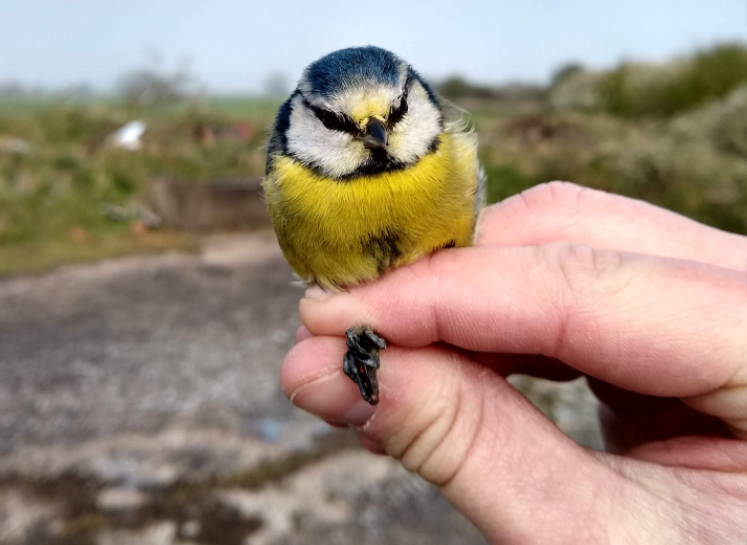
A new paper in Journal of Ecology called “Generalist passerine birds perform a functional role as pollinators in temperate Europe“, by Sandra Anderson, George Perry and Rose Thorogood challenges that assumption in a very useful way. Working at Wicken Fen in Cambridgeshire, they found that pollen transport by passerine birds was widespread. Most of the birds they sampled carried pollen, and several species — including Blue Tit, Blackcap, Chiffchaff, Wren, Redpoll and Bullfinch — regularly carried meaningful loads.
More importantly, they tested whether this mattered to the plants. By excluding birds from flowers while allowing insects access, they showed that fruit-set was reduced in several early-flowering woody plants, including Blackthorn (Prunus spinosa), Hawthorn (Crataegus monogyna) and Buckthorn (Rhamnus cathartica). In other words, the birds were not just getting dusty faces. They were contributing to plant reproduction.
I should say that I was one of the reviewers of this paper, so I have followed its development with particular interest. What I like about it is that it does not try to claim that Europe secretly has a hidden flora of classic “bird flowers”. These are not red tubular blossoms adapted to hummingbirds or sunbirds. They are familiar, open, pale, spring-flowering shrubs and trees. Nor are the birds specialised nectar-feeders. They are generalist passerines making use of seasonal resources.
That is precisely why the paper is interesting. It shifts the question from “does this look like bird pollination?” to “does bird visitation actually function as pollination?” That distinction matters. Pollination syndromes can be useful, but they can also blind us to interactions that do not fit the textbook categories.
The seasonal context is also important. These interactions peak early in spring, when willows, blackthorn and other woody plants are flowering, temperatures are still cool, insects may be unreliable, and birds are preparing to breed or arriving from migration. Under those conditions, even occasional bird visits could be valuable to plants needing pollen moved between individuals.
For me, this paper strengthens the argument I made in “The curious case of Europe”: Europe is not devoid of bird–flower interactions; rather, we have been looking for the wrong kind of bird pollination. Instead of obvious “ornithophilous” specialisation, we may have overlooked a more diffuse, opportunistic, generalist system involving common birds and common spring-flowering woody plants.
That may not be as spectacular as a hummingbird hovering at a tropical flower, but ecologically it is just as revealing.
The photo above is from Birds & Flowers and shows pollen on the face of a Eurasian Blue Tit in the early spring. Bird mist-netted under licence in Northamptonshire, UK. (© Lynne Barnett)


It looks normal and the reply box is working as usual. What I was going to say is that the surprise for me is not that British birds pollinate, but that it has taken this long for scientists to notice. 🙂