Category Archives: Biodiversity Net Gain

Want to conserve birds and mammals? Then conserve their insects – our new paper in Nature Reviews Biodiversity sets out the details

It’s sometimes easy to forget quite how much of the living world depends upon insects.

That might seem an odd thing for someone who has spent much of his career studying insects and their relationships with plants to say. But conservation, ecological research, and public interest are still disproportionately focused on vertebrates: the birds, mammals, reptiles, amphibians and fishes that most people think of when they hear the word “wildlife”.

Yet those animals exist within ecological networks in which insects are frequently central players, not walk-on extras. A new review that I’ve co-authored with Rob Cooke, Eliza Grames, Chris Elphick and 18 other colleagues, published in Nature Reviews Biodiversity, tries to bring together what we know about those relationships – if you follow this link it’s free to read:

Cooke, R., Grames, E.M., Ollerton, J. et al. (2026) The importance of insect biodiversity for vertebrates. Nature Reviews Biodiversity DOI: 10.1038/s44358-026-00201-w.

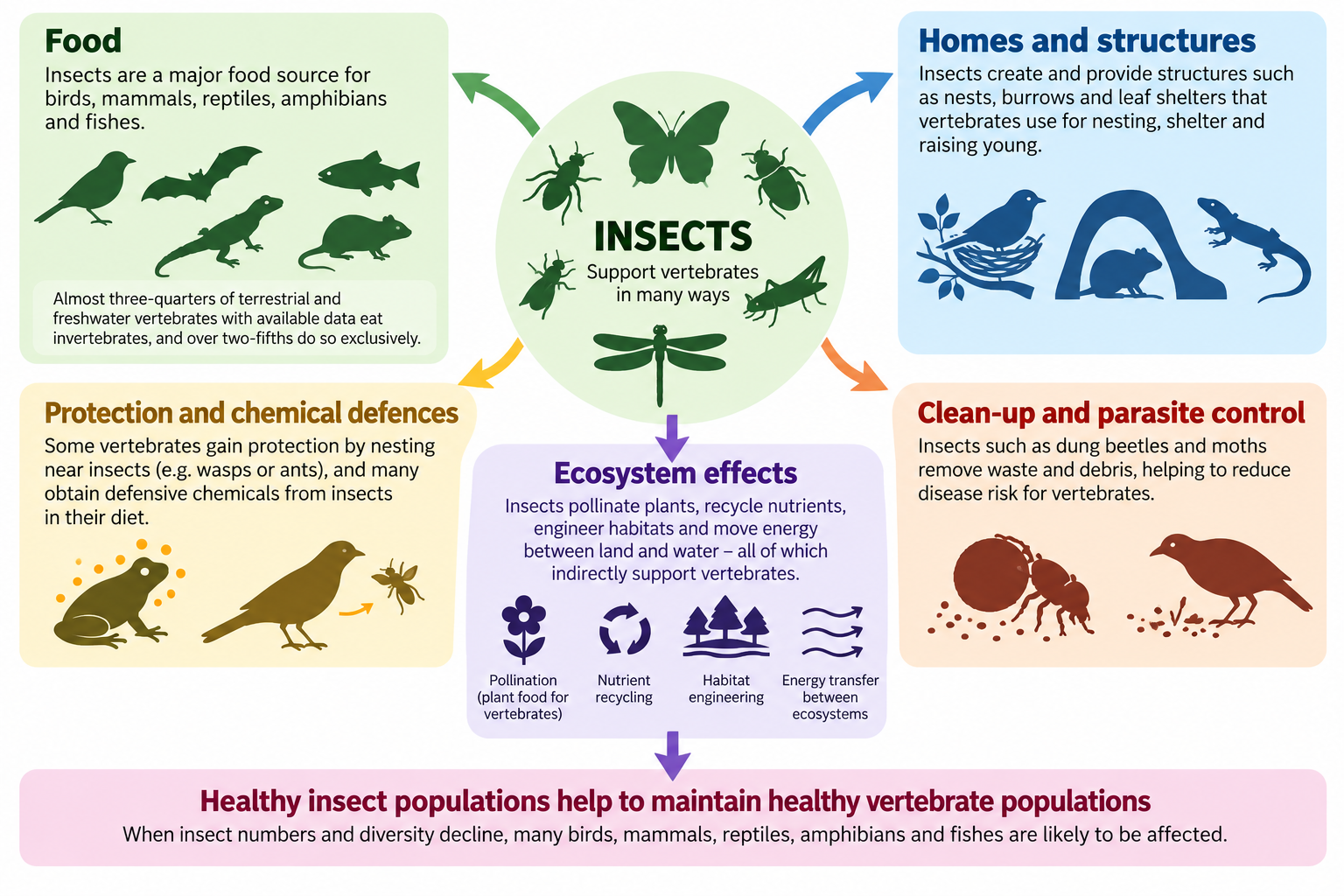
The starting point is food, and the numbers are striking. We assembled diet information for 19,750 species of terrestrial and freshwater vertebrates. Of those for which data are available, 73% eat invertebrates and 44% eat them exclusively. That alone ought to give us pause when thinking about the consequences of insect declines.

But one of the things that I particularly enjoyed about writing this review is exploring with colleagues how food is only the beginning of the story. All of us involved in it, I think, learned just as much as we contributed.

Much more than something to eat

The relationships between insects and vertebrates are extraordinarily varied, and some are wonderfully unexpected. Termite mounds and ant nests provide nesting sites, refuges and places to lay eggs for mammals, birds, reptiles and amphibians. Some bats use cavities created by beetle larvae. Birds incorporate insect and spider silk into their nests. Other birds deliberately nest close to wasps or ants, apparently gaining protection from predators.

Then there are the chemical relationships. Poison frogs obtain many of their defensive alkaloids from the insects and other arthropods that they eat. Some snakes acquire defensive toxins from fireflies. Birds, mammals, reptiles and amphibians engage in various forms of “anting” or anointing, applying ants and other invertebrates to their bodies, probably for a variety of functions including parasite control.

Insects can even provide sanitation services. Beetles remove vertebrate dung and can thereby reduce the survival of parasites, while moths living in the nests of some birds consume faeces and other organic debris. There is fossil evidence that similar relationships involving feather-feeding beetles occurred in dinosaur nests during the Cretaceous.

One of the figures in the paper brings together examples from around the world, and is worth spending some time exploring. There are chimpanzees applying insects to wounds, parrots nesting in termite mounds, geckos “milking” honeydew from planthoppers, frogs sheltering in ant nests, herons using insects as fishing bait, and much more. Ecological interactions are rarely dull!

Insects connect ecosystems

There is also a much bigger ecological story within this review, because insect relationships with vertebrates move enormous quantities of energy and nutrients through ecosystems. Aquatic insects emerge from streams and lakes and become food for terrestrial animals; terrestrial insects fall into rivers and feed fishes. In some forest birds, aquatic insects can provide more than a quarter of their energy budget, rising seasonally to 50–90%. Conversely, terrestrial invertebrates can provide approximately half of the annual energy budget of freshwater fishes.

And then there are the indirect effects. As readers of this blog will know, a lot of my research and writing is related to plant pollination, but insect pollination doesn’t just matter to plants. When an insect pollinates a plant whose fruits or seeds are subsequently eaten by a bird or mammal, the insect is indirectly supporting that vertebrate too.

One striking example concerns figs. Fig trees depend upon their tiny agaonid wasp pollinators, while figs themselves are eaten by at least 1,274 species of birds and mammals. Remove the wasps and the consequences potentially propagate far beyond the insects and plants themselves.

This is something I’ve discussed from a different direction in my book Birds & Flowers, where the focus is largely on birds as pollinators rather than insects supporting birds, though all nectar-feeding birds also consume insects. But the broader lesson is the same: species do not exist independently of the ecological relationships that sustain them. I’ve written previously about some of the extraordinary diversity of these pollination relationships on this blog, including in my post on the limits to pollinator diversity.

What happens if the insects disappear?

This brings us to the more difficult question addressed by the review. There is now substantial evidence that insect abundance, biomass and diversity are changing, although, as I’ve argued on this blog before, the magnitude, geography and taxonomic extent of those changes need to be discussed carefully rather than reduced to simplistic claims of an impending “insect apocalypse”.

Nevertheless, widespread changes in insect populations inevitably raise the question of what happens to the vertebrates that depend upon them. Here the evidence becomes surprisingly patchy.

There are good reasons to expect effects: a meta-analysis of 125 studies, for example, found strong positive relationships between insect prey availability and bird reproductive success and chick condition. European insectivorous birds declined by 13% between 1990 and 2015 while omnivorous bird populations remained stable. There are also examples involving bats, small mammals and other groups.

But demonstrating that declining insects actually caused a particular vertebrate population to decline is much harder. Insects and vertebrates can respond simultaneously to habitat destruction, pesticides, climate change and other pressures, making cause and effect difficult to disentangle.

That’s an important distinction. Ecology is full of plausible stories; demonstrating the causal links is another matter. There are nevertheless cases where dependence on particular insects is difficult to ignore. The Critically Endangered Mountain Pygmy Possum in Australia depends heavily on Bogong Moths, whose numbers have crashed. The probable extinction of the Eskimo Curlew has likewise been linked partly to the disappearance of the Rocky Mountain Locust, formerly an important component of its diet.

A surprisingly large gap in our knowledge

Perhaps the thing that surprised me most while working on this review was how poorly documented many insect–vertebrate interactions remain. Even something as apparently straightforward as “what insects does this bird eat?” often turns out not to have a satisfactory answer. Studies may report prey simply as “invertebrates”, “arthropods”, or “insects”, with little or no taxonomic resolution. Birds are much better studied than most other vertebrates, yet detailed quantitative diet information is still available for only a small fraction of species.

Non-feeding relationships are even more scattered through the literature. This is part of what ecologists call the “Eltonian Shortfall“: our incomplete knowledge of who interacts with whom in nature.

One conclusion of the review is therefore that we need much better ways of recording these interactions: common data standards, better taxonomic resolution, long-term monitoring, experiments, larger databases, and greater collaboration between entomologists and vertebrate ecologists. Citizen science, computer vision, metabarcoding and environmental DNA all have potentially important roles to play.

There is also a plea here for something rather unfashionable: natural history. Observations of animals eating, nesting, sheltering, grooming and otherwise interacting with insects are not trivial anecdotes. Properly documented and brought together, they are the raw material from which larger ecological patterns emerge.

Conserving relationships, not just species

For me, one of the broader messages from this review is that conservation needs to pay much more attention to what I’ve referred to in the past as the “biodiversity of species interactions“.

We naturally talk about conserving species and habitats. But an ecosystem is not merely a list of species occupying the same place. It is also the vast network of feeding, pollination, seed dispersal, decomposition, competition, parasitism, facilitation and other interactions connecting those species.

Lose enough of those connections and an ecosystem can change profoundly even before many species have disappeared. That has a very practical implication: insect conservation is also vertebrate conservation. If we want landscapes that support healthy populations of birds, bats, amphibians, fishes and other vertebrates, maintaining abundant and diverse insect communities is not an optional extra. It is part of the ecological infrastructure upon which those animals depend. And, as our review makes abundantly clear, we have probably only begun to understand the full extent of that dependence. That’s why nature conservation policies and regulations, such as Biodiversity Net Gain (BNG) in England for instance, need to look carefully at their implications for insects and other invertebrates.

Finally, I’d like to thank all of the contributors to this paper for working so diligently on the review. It’s an output from the Vertebrates and Insects Working Group, which was formed by the Status of Insects Research Coordination Network – check out the website and get involved!

Is Biodiversity Net Gain a missed opportunity for invertebrate conservation? A new open access study suggest ways to improve it

The UK has set ambitious targets under the Global Biodiversity Framework 2030, aiming to halt and reverse biodiversity loss. One of the key policies designed to help achieve this is Biodiversity Net Gain (BNG), a requirement in England that ensures new developments (such as housing projects) result in a 10% increase in biodiversity. On the surface, this sounds like a positive step—but is it really working for all species?

In a newly published paper that I co-authored, led by University of Oxford PhD student Natalie Duffus, we suggest that BNG may be falling short for some of the most vital, yet overlooked, members of our ecosystems: invertebrates. This group includes insects, spiders, and other arthropods—organisms that play critical roles in pollination, pest control, and nutrient cycling but are also experiencing dramatic population declines worldwide.

The Problem with a Habitat-Focused Approach

The way BNG is currently applied focuses heavily on habitats rather than species, meaning that while new green spaces may be created, they may not necessarily provide the right conditions for invertebrates to thrive. In some cases, BNG could even make things worse by fragmenting existing habitats or failing to account for the complex ecological needs of different species.

For instance, many invertebrates rely on very specific plants, soil conditions, and microhabitats that a broad-brush approach to habitat restoration may not support. Simply increasing the area of green space does not guarantee it will be suitable for pollinators, decomposers, or predatory insects that help keep ecosystems functioning. It’s an issue that I highlighted in October 2023 when I wrote a report about BNG and pollinators.

How Can BNG Be Improved?

Rather than being a one-size-fits-all approach, BNG could be better aligned with evidence-based conservation strategies, such as the National Pollinator Strategy. By integrating more targeted actions—including planting native wildflowers, preserving deadwood for beetles, or ensuring hedgerows and wetlands remain intact—BNG could deliver real benefits for invertebrates.

Additionally, better monitoring and evaluation are needed to track whether biodiversity is genuinely improving under BNG policies. This would help policymakers refine their approach and ensure conservation efforts support the widest possible range of species, not just the most obvious or easily monitored ones.

Lessons for Global Conservation

With many countries looking to adopt biodiversity offsetting schemes like BNG, England’s experience offers valuable lessons. If BNG is to be truly effective, it must take a more holistic, species-specific approach—one that recognizes the essential role of invertebrates and actively works to protect and enhance their populations.

If done right, BNG could be a game-changer for conservation. But if we fail to consider the full picture, it risks becoming a well-intentioned policy that does little to halt biodiversity loss where it matters most.

Here’s the full reference with a link to the paper – it’s open access and can be downloaded for free:

Duffus, N.E., Lewis, O.T., Grenyer, R., Comont, R.F., Goddard., D., Goulson, D., Ollerton, J., Townsend, M.C., Webb, J.A., Wilson, R.I. & zu Ermgassen, S.O.S.E. (2025) Leveraging Biodiversity Net Gain to address invertebrate declines in England. Insect Conservation and Diversity (in press)

Biodiversity Net Gain and pollinators: catch up with my talk on YouTube

Yesterday I delivered a webinar for the Biological Recording Company on the topic of what Biodiversity Net Gain (BNG) could mean for pollinator conservation. It’s a topic that clearly has a lot of resonance for the ecology community: almost one thousand people (994 to be precise) booked to attend, of which 380 actually watched. That’s a fairly typical ratio for free webinars, in my experience – many people book a place in the expectation that they will receive a link to watch the recording later.

The talk was indeed recorded and can be viewed by following this link to YouTube. There was a Q&A session afterwards which is not part of the recording but the questions and my answers have been transcribed and can be viewed on the Biological Recording Company’s blog, together with links to all of the references and data sources that I cited. Here’s the link to the blog.

I had a lot of really positive feedback during and after my talk, plus some extremely useful comments about where my interpretation of BNG was incorrect (or at least didn’t tell the whole story). As I stressed during my talk, BNG is a journey not an end point and we are all at the start of that journey! It’s going to be fascinating and important to see whether BNG can positively impact declining pollinator populations.

Biodiversity Net Gain and pollinators – join me for a FREE webinar next Monday!

Biodiversity Net Gain is generating a lot of attention in the UK at the moment, some of it positive*:

“when designed and delivered well, BNG can secure benefits for nature, people and places, and for the economy”

“[BNG is] a game-changer for health and wellbeing”

And some of it extremely negative*:

“Biodiversity Net Gain is a lie but most people without enough ecological knowledge cannot see this & are fooled by the lie”

“[BNG is] a horrible legalistic contrivance, and it means nothing”

Regardless of how you feel about BNG, it’s here to stay, at least for the foreseeable future, and so we need to explore it and understand how (or whether) it can positively improve the state of nature in Britain.

Although I don’t pretend to be an expert on BNG**, I have thought a lot about how it might impact the group that I do have some expertise in, pollinators, and the implications for the pollination services that they provide to wild and crop plants.

Last October I produced a short report that considered the implications of BNG for insect pollinators – you can download a copy from the original blog post, though do be aware that some of the dates I mentioned were later revised by the then government and I have yet to revise the document.

As a follow up to this I have been invited by the Biological Recording Company to lead a one-hour webinar discussing this topic on Monday 28th October at 1pm. It’s free to attend and you can book a ticket by following this link. There’ll be a short presentation (30 minutes or so) followed by a live Q&A.

I hope that some of you can join me!

——————————————————————

*Real quotes, culled from reports and social media.

**Indeed, it’s such a new approach to development and nature conservation, can anybody consider themselves an expert?

Leveraging Biodiversity Net Gain to address invertebrate declines in England – a new pre-print is available

Back in October I posted about a report I’d written that considered Biodiversity Net Gain (BNG) and what it could mean for pollinators. The report generated some interest and has helped to inform a study by University of Oxford PhD researcher Natalie (Nat) Duffus that has just been posted as a pre-print entitled “Leveraging Biodiversity Net Gain to address invertebrate declines in England” – here’s the link to it: https://ecoevorxiv.org/repository/view/6667/

In this work, Nat has asked a group of us who are interested in this topic to assess the limitations of the current BNG system and how it might be improved to better support invertebrate populations. Please do read the study and comment either on the blog or directly on the pre-print. We’re interested in people’s views on this and whether we have missed anything important.

Here’s the abstract:

Meeting ambitions such as the Global Biodiversity Framework 2030 targets will require multiple conservation mechanisms that benefit the widest possible range of habitats and species. Using England as a case study, here we evaluate the likely impact of a novel and ambitious ecological compensation policy, Biodiversity Net Gain (BNG), on terrestrial insects, spiders, and other arthropods (‘invertebrates’), a functionally important but rapidly declining component of biodiversity. Current implementation of BNG in England sets out to provide a 10% uplift in biodiversity when infrastructure development (such as housebuilding) occurs. However, BNG is a habitat-driven approach, which risks overlooking important considerations relevant to invertebrate conservation, threatens to further reduce the size and quality of their habitats, and may increase habitat fragmentation. BNG – as currently implemented – therefore represents a missed opportunity to use a universally applied policy to benefit invertebrates and other functionally important components of biodiversity. We suggest ways forward to realign BNG with what we know to be crucial for successful invertebrate conservation, and with other policy mechanisms such as the National Pollinator Strategy. This will ensure that appropriate habitats and conditions for invertebrates are retained, enhanced, and created at a landscape scale, and that BNG is optimised to contribute to broader national conservation targets. As biodiversity accounting and offsetting schemes such as BNG are increasingly adopted around the world, the experience of BNG in England provides valuable insights into how ecological compensation programmes could be better designed, implemented, and monitored to ensure that benefits for a wide variety of taxa are achieved.

Biodiversity Net Gain and what it could mean for pollinators – read the new report

Biodiversity Net Gain (or BNG) promises to transform the way that we approach nature conservation in the UK. I’ve been giving a lot of thought to what this might mean for insect pollinators and have produced a new report that summarises the opportunities that BNG presents and how we can make the most of them. You can download a copy of that report by following this link.

This is meant to be a working document and as BNG progresses, and our understanding of its impacts on pollinators increases, I will update it. In the meantime, please do feel free to comment.