
Sometimes, science does not go the way you plan.
That is usually framed as failure: the experiment did not work, the results were inconclusive, the story was unclear. But science can also advance when we go back to old data and ask a different question. That is exactly what happened with a study of Field Scabious, Knautia arvensis, a familiar wildflower of meadows and grasslands.
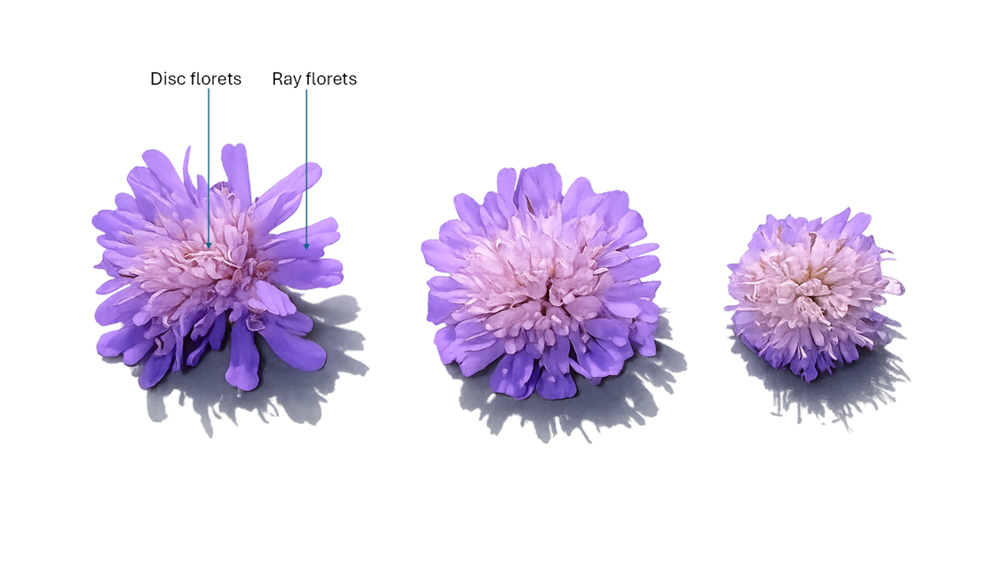
Back in 2001, I carried out an experiment to test the function of the showy outer florets around the edge of the flower head. These enlarged “ray florets” look as though they ought to be important in attracting pollinators. The idea was simple: trim them in different ways and see whether pollinating insects responded – you can see the results of that trimming in the photo above.
The answer, at the time, was baffling. Bumblebees, hoverflies and butterflies (all of which are effective pollinators of this plant) did not seem to care very much. Visitation rates by the insects hardly changed, and neither did seed set. But seed weight did change, as did the amount of sugar being produced by the trimmed flower heads. At the time I could not make sense of this in relation to the question I had asked, so the data were archived and left alone.
But not forgotten.
Fast forward 25 years, and I was chatting about this data set with colleagues when I was at the Kunming Institute of Botany in China. That got me reading some more recent work about florivory -the damage done to flowers by animals – and I realised that this old experiment might make more sense if viewed from another angle. Perhaps I had not really been testing floral attraction at all. Perhaps, without intending to, I had carried out a simulated florivory experiment.
Seen in that light, the results became much more interesting.
Cutting the ray florets did not stop pollinators from visiting. Nor did it reduce the number of seeds produced. But it did change the plant’s internal economics. Nectar quality declined in the most heavily cut flowers, and the seeds that those flower heads produced were consistently lighter. In other words, the flowers still functioned well enough to get pollinated, but the plant appeared to invest less in rewards for pollinators and less in each of its offspring.
That matters because lighter seeds may have poorer prospects later in life, even if the plant initially appears to reproduce successfully. The damage did not cause total reproductive failure. Instead, it produced a subtler effect: hidden costs that only become visible when you look beyond simple seed counts.
Newly contexualised in this way, we wrote up this work, being completely honest about the history of the study, submitted it to the Journal of Pollination Ecology, where it received very positive reviews. It’s now been published and you can download a copy by following the link in the reference:
I like this study because it tells two stories at once. One is ecological: florivory may not always reduce pollinator visits, but it can still alter plant reproduction in potentially important ways. The other is about how science actually works. Not every good paper begins with a perfect hypothesis and a clean result. Sometimes the value lies in returning to an awkward, neglected dataset and realising that it was trying to tell you something different all along.
Science does not always go the way you plan. But occasionally that is when it becomes most revealing.


Hello Jeff,
It’s an interesting experiment and I read your account with interest. From an entomological point of view there may be a deeper reason behind the lack of measurable response from insects to altered floral arrays.
The primary insect sensory capability is olfactory rather than visual. As visual creatures, we humans are swayed by the large eyes of insects into thinking that visual function leads, but this is not the case. The olfactory capability of insects is lodged in the antennae and is 1000s of times more receptive that human perception. The eyes of insects are largely close-range guidance systems – hence nectar guides become important only close up, but even if they weren’t there, insects, led by olfaction would go to the flowers to pollinate them.
The real question I suppose, is why have flowers invested in such elaborate variety of shape, colour and form, if the insects pollinating them are driven by olfaction not vision. Clearly the investment is worth while especially as many nectar guides are in the UV light range corresponding to insect visual acuity, but in truth scent production is probably more important.
To really test the effect of altered floral arrays, the scent of the flower would need to be obscured and that is a tricky thing to do. An interesting observation is that many modern horticulturally produced varieties of garden plants appear to lack scent and I’ve noticed that these appear not to attract insect pollinators as much. It may be worth testing experimentally.
Cheer,
Andrew
Thanks for the comment Andrew. I agree, odour perception is amazingly important over longer distances and visual acuity only becomes more important at close range.
But there’s another aspect of flowers/inflorescences that also important: morphology, i.e. shape, size, and orientation.
To quote the paper: “Different pollinator groups vary markedly in their sensory capabilities, foraging behaviour, and modes of flower handling, and may therefore differ in how they perceive and respond to floral traits such as enlarged or visually conspicuous ray florets.”
So our experiment was not (just) a test of how the insects respond to visual stimuli, i.e. the size of the flower head, but how they respond to the overall layout of the flower heads, for example by spending less time on flower heads without the ray florets.
Thanks Jeff,
Yes, I agree. It’s a very complex and interwoven evolutionary history, full of variation and lots of questions. Interesting topic, thanks for posting.
Hi Jeff! Thanks for sharing your story. It’s always interesting to learn about how science and scientists work and progress. I find it fascinating how plants adapt to changes in the amount of sources and sinks when they reproduce. There’s so much to discover there…
Cheers!
Thank you Pablo, I’m glad that you enjoyed it!
Fascinating read. I love how science has a way of revealing new stories from old observations. What might seem like a settled experiment can suddenly offer fresh insights when viewed through a different lens. It’s a great reminder that curiosity never goes out of style, and nature still has plenty of secrets left to share.
As far as I watch various pincushions and their visitors in the meadow areas of my garden, I would think, it might be both, generating energy but also practically offering landing places for insects of all sizes. I regularily see them with several wild bees species and false blister beetles etc. but also with bumble bees and bigger beetles up to green rose chafers, which need all the place for the balance. So I think, the more species find them comfortable, the better the pollination and seeds in the end.
I love this flowers
Very nice
I was very interested to read this article, sincerely
Luca C.
The data plainly show that Field Scabious possesses an intelligent conservation protocol.
When the flower detects unauthorized perimeter modification, it does not panic and cease operations. Instead, it enters a fiscally responsible reproductive mode: maintaining pollinator services while reducing nectar expenditures and issuing lighter, more efficient seeds.
This is not damage response. This is botanical budget discipline.
The so-called ‘hidden cost’ is actually evidence of adaptive austerity.
An interesting read
I know nothing about this field but it made sense
The questions we ask have to colour the treatment of the data we get
Thank you
Can’t wait to read the paper! I hope I can transfer some of the knowledge to my burgeoning garden.
Interesting read. Something new to think about. I’ll have to take a fresh look at the flowers in my garden.
Pingback: Want to conserve birds and mammals? Then conserve their insects – our new paper in Nature Reviews Biodiversity sets out the details | Prof. Jeff Ollerton – ecological scientist and author