There’s currently a lot of interest in ChatGPT and over the past week, like many others, I have been playing around with this artificial intelligence (AI) system and testing its knowledge and creative powers. The latter are really very impressive: I asked it to write a couple of limericks about Karin and my professions, and about our move to Denmark, and it produced a decent stab at those.
I also probed its knowledge about topics with which I’m familiar, mainly pollinators and pollination of course, and it produced some good answers. When I highlighted some errors it had made, ChatGPT went back and revised its answers, and politely thanked me in the process. If I were a student I would not rely on it to write accurate essays, but so far so good(ish).
This morning, however, I had a very odd experience. I was trying to track down something attributed to Erasmus Darwin (Charles’s grandfather) and I asked ChatGPT: “What did Erasmus Darwin say about birds visiting flowers?”
This is the answer that came back:
Erasmus Darwin was a naturalist, physician, and poet who wrote about a wide range of topics, including birds and flowers. In his 1794 poem “The Loves of the Plants,” he describes how different species of birds visit flowers in search of nectar:
“Birds of each hue, from the gay parrot’s beak To the goldfinch, painted in tiny streak, Sip nectar from the cups that bloom and bow With every breeze, and nod and dance below.”
Now, the first part of this, about Erasmus’s life, is true. It’s also true that he wrote a poem with that title, though it was published in 1791, not 1794.
But, when I double-checked those attributed lines against the published version of the poem that’s on Project Gutenberg, I discovered that they did not exist. ChatGPT had made them up!
As I said, this AI is pretty creative and will certainly write a poem for you on any topic you care to request. But I didn’t ask it for that, I had made a factual query. And ChatGPT had just invented some poetry and claimed it as fact, unless of course those really are Erasmus’s lines and I’ve missed their source (please correct me if I have).
Now as a scientist and writer I try to be rigorous when quoting and citing sources, and if I hadn’t double-checked this I might have taken it at face value. And one could argue that my initial question – “What did Erasmus Darwin say…?” – was a little ambiguous. But nonetheless, I was not expecting an AI to try to pass off something it had created as fact.
Has anyone else experienced anything like this when using ChatGPT? It’s a fun, creative tool. But as far as I can tell, it also has a very human ability to lie.
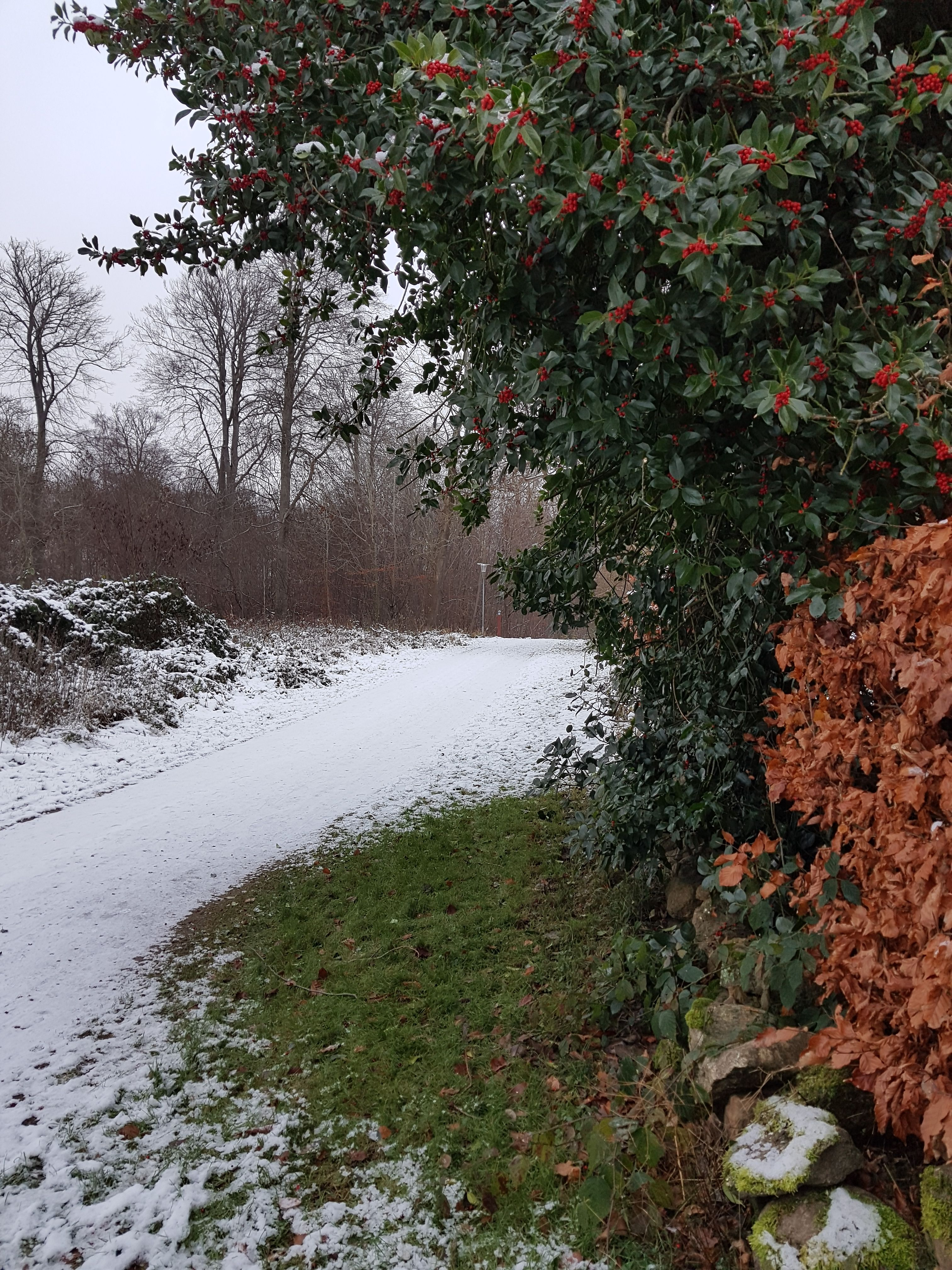
Yesterday, Karin and I took a winter walk through one of the local woodlands, our feet crunching on the iced-over crust which is all that remains of last week’s snowfall. No doubt more snow is on its way as we approach the deepest part of winter here in Denmark. But seeing this holly tree reminded us that some parts of the woodland might remain snow-free no matter what the conditions.
Although I’m no meteorologist (and any who are reading this can correct me if I’m wrong), I suspect that two things are going on here. Firstly, the tree is sheltering the ground and reducing the amount of snow that falls below it. That umbrella effect is fairly obvious. But secondly, and more subtly, the small amount of warmth that there is in the soil is being prevented from radiating off into space by the presence of the holly leaves. So the warmer soil and surface layer of vegetation melts any snow that manages to make it through or under the holly’s canopy.
In both of these ways, the evergreen holly is affecting the microclimate of this part of the woodland. That in turn adds to the ecological heterogeneity of the habitat, proving greater access to food for animals, affecting the phenology of the ground flora, reducing local soil moisture, and so forth. All of these, in turn, will potentially lead to greater diversity of species with the local area.
On this blog and in my book Pollinators & Pollination: Nature and Society I’ve often written about evergreen trees, shrubs and climbers such as ivy, holly and mistletoe, including both their cultural associations (especially with Christmas) and their ecological importance. As so often is the case, the English poet John Clare thought about all of this two centuries ago. The quote I used in the title of this post is from his poem Winter Walk:
The holly bush, a sober lump of green, Shines through the leafless shrubs all brown and grey, And smiles at winter be it e’er so keen With all the leafy luxury of May. And O it is delicious, when the day In winter’s loaded garment keenly blows And turns her back on sudden falling snows, To go where gravel pathways creep between Arches of evergreen that scarce let through A single feather of the driving storm; And in the bitterest day that ever blew The walk will find some places still and warm Where dead leaves rustle sweet and give alarm To little birds that flirt and start away
John Clare (1793-1864)
This might be my last post of the year, and so it only remains for me to wish a Glædelig Jul and Merry Christmas to all of my readers!
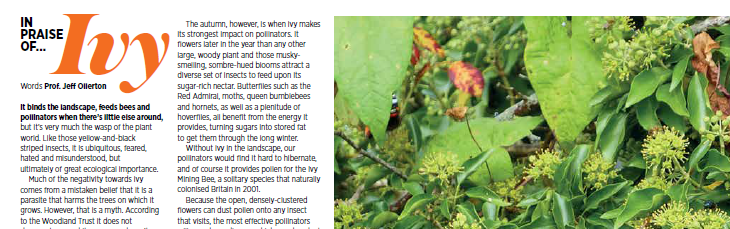
Although it can be invasive and an environmental nuisance in parts of the world where it’s introduced, common or European ivy (Hedera helix) is clearly one of the most vital plants across its native range of Europe, southern Scandinavia and the Mediterranean. Its clinging stems bind the landscape and provide habitat for a diversity of creatures. By offering nectar at a time when there’s few other plants in flower, and berries at a crucial point in the winter, ivy bridges a food gap for both nectar feeding insect and fruit eating birds and mammals.
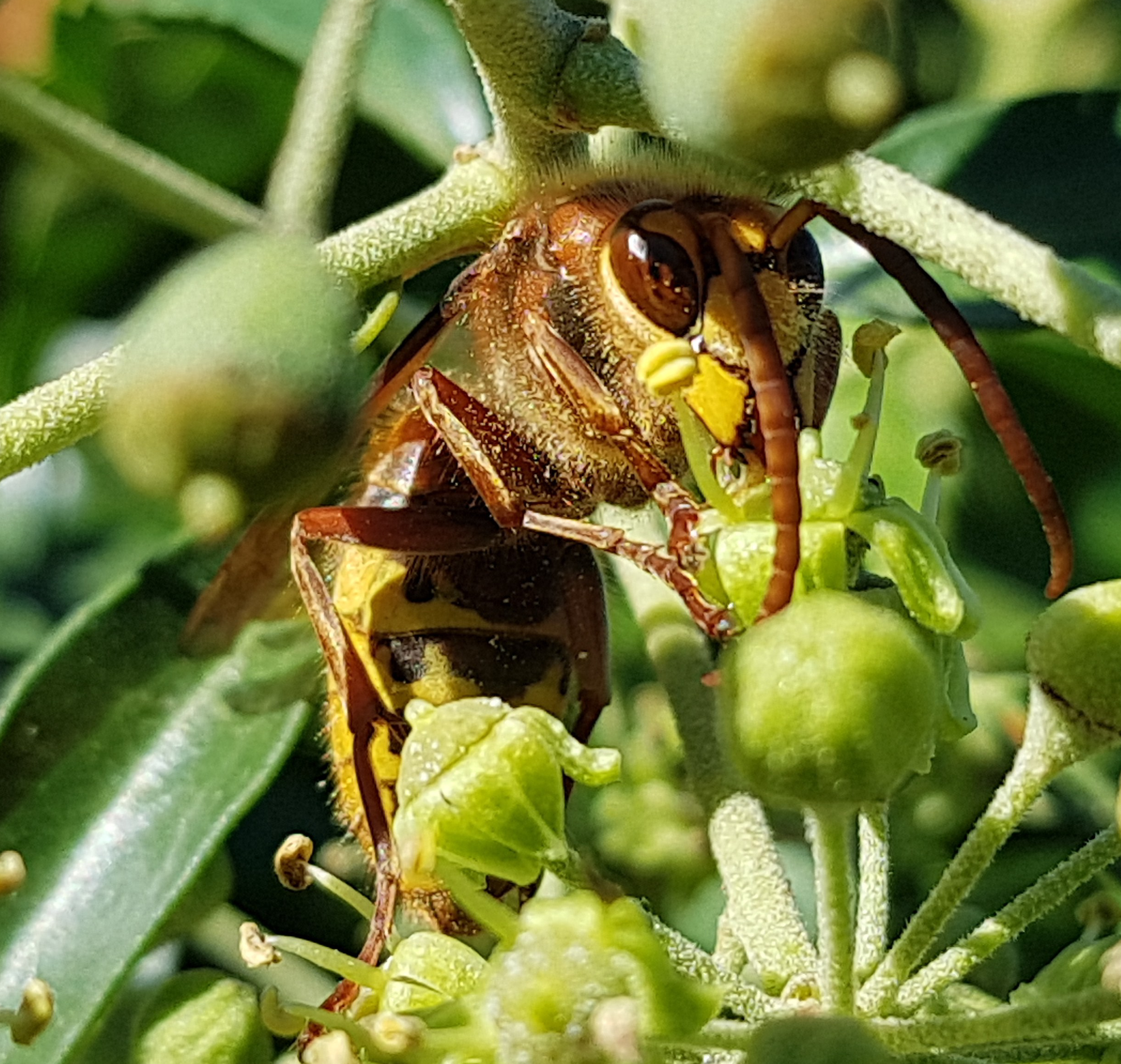
Ivy is a very popular subject for student research because it’s in flower at the start of the university academic year. In the past I’ve had several students carry out their final year projects using ivy to test ideas about pollinator effectiveness and plant reproductive success. Because the open, densely-clustered flowers can dust pollen onto any insect that visits, the most effective pollinators will vary depending on which are abundant at any time and place, and include various types of flies and bees, plus those much-misunderstood wasps!
Perhaps we should leave the final word on ivy to the Northamptonshire ‘Peasant Poet’ John Clare who wrote ‘To the Ivy’ in the early 19th century:
Jacobs, J.H., Clark, S.J., Denholm, I., Goulson D., Stoate, C. & Osborne J.L. (2010) Pollinator effectiveness and fruit set in common ivy, Hedera helix (Araliaceae). Arthropod-Plant Interactions 4: 19–28
Ollerton, J. (2021) Pollinators & Pollination: Nature and Society. Pelagic Publishing, Exeter, UK
Ollerton, J., Killick, A., Lamborn, E., Watts, S. & Whiston, M. (2007) Multiple meanings and modes: on the many ways to be a generalist flower. Taxon 56: 717-728
On a trip to the Royal Botanic Gardens Sydney yesterday Karin and I came across an interesting colonial-era statue in which a colony of feral, non-native honey bees had taken up residence. These bees are yet another alien invasive species that can create conservation problems in parts of the world where they don’t belong naturally. But it was funny enough to inspire a bit of Ogden Nash-style poetry on Twitter; you need to watch the video to fully appreciate it:
Sir John Robertson Kay-See-Emm-Gee Turned his head Into a home for bees The people came From far and near To watch the honey Dribble out of his ear pic.twitter.com/A3tz5Pz5kR
— Prof. Jeff Ollerton – @JeffOllerton@ecoevo.social (@JeffOllerton) January 13, 2020
I have to confess that I forgot completely about Valentine’s Day, it’s not a celebration that I generally pay much attention to, as expressions of love are something that everyone should be doing all the time, surely?
Anyway, this bastardised version of “Roses are red” is for my wife Karin:
Some bees are red
Others are blue
There’s twenty thousand species
Of every hue
Some flies are yellow
Some wasps are cerise
Many of them pollinate
Better than bees
Not all of the poetry that I write – such as these pieces – is serious and high-minded, some of it is whimsical, funny, or just plain dumb. Today I taught a morning class on flower structure and pollination, so in its honour here’s an example of the latter:
A Bad Botanical Pun
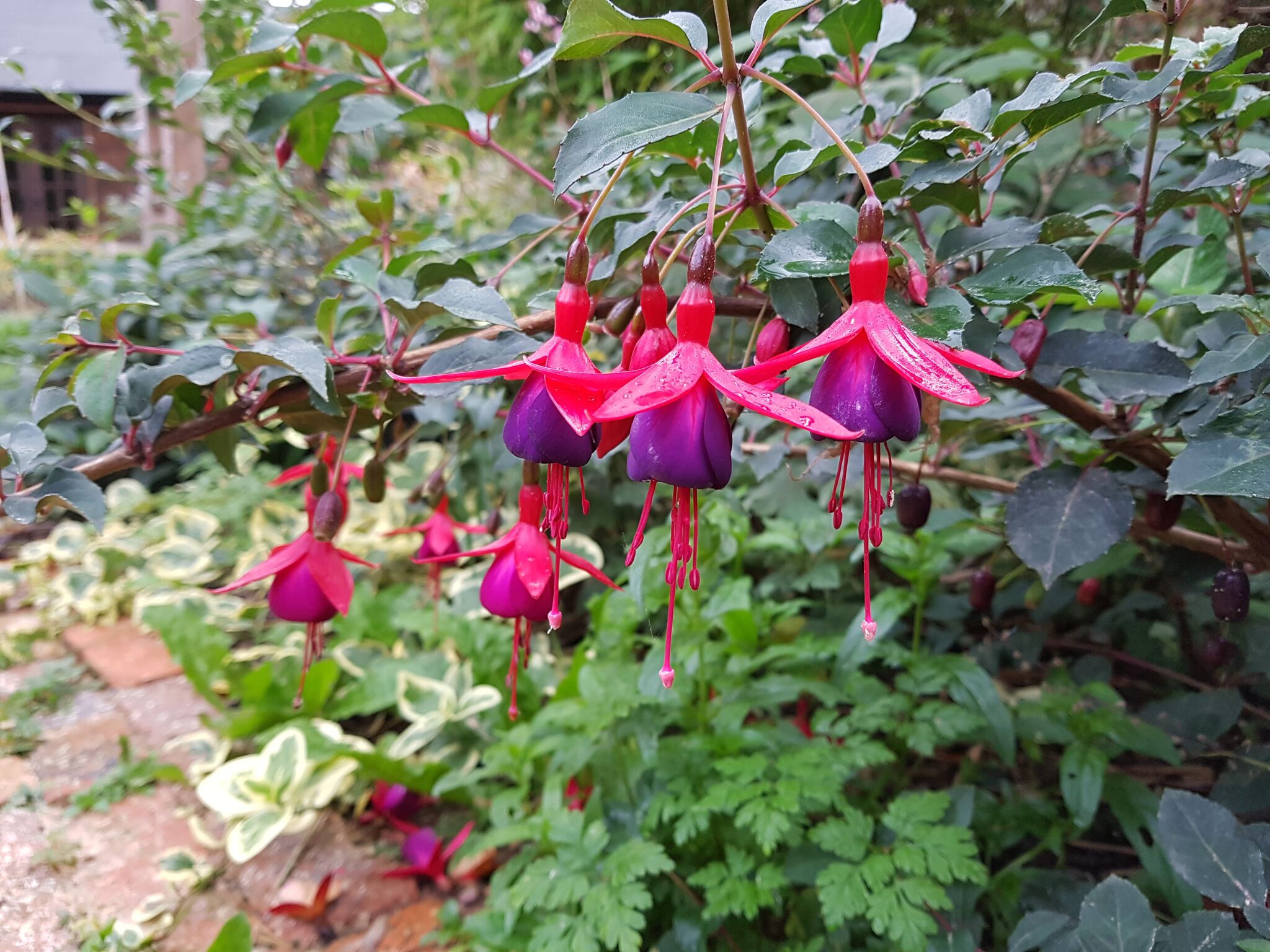
“Don’t become a gardener – there’s no fuchsia in it!”
Not a great pun, but I’ve heard worse.
However, it may be pedantic, but I have to point out
That the genus Fuchsia was named in honour of Leonard Fuchs
(A sixteenth century Bavarian botanist, as you ask).
His name is pronounced as a definite, Germanic “fucks”,