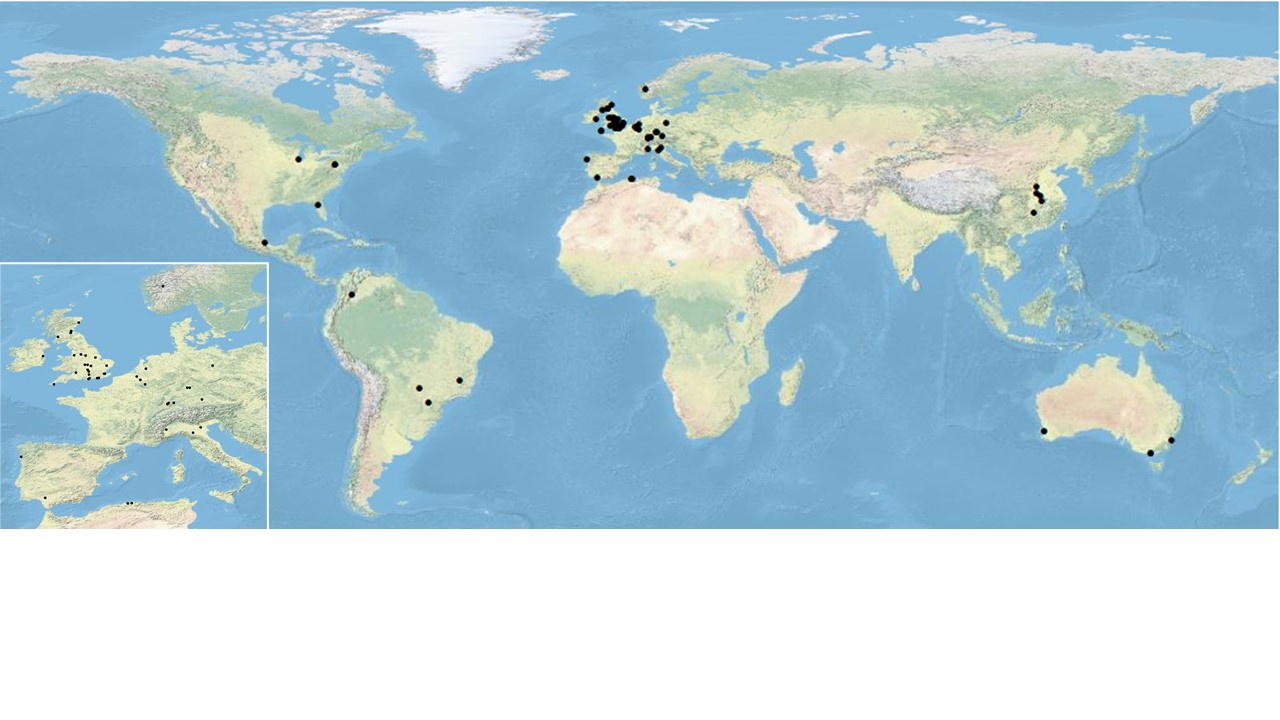
During the lockdown period of the COVID-19 pandemic in 2020, many pollination ecologists were stuck at home: universities and research institutes were closed and restrictions on travel meant that it was not possible to get out and do field work. In order to keep active and motivated, and to turn adversity into an opportunity, an ad hoc network of more than 70 researchers from 15 different countries (see the map above) decided to collect standardised data on the plant-pollinator networks in their own gardens and nearby public spaces.
When combined with information about location, size of garden, floral diversity, how the garden is managed, and so forth, this would provide some useful data about how gardens support pollinators. For those with kids at home it could also be a good way of getting them out into fresh air and giving them something to do!
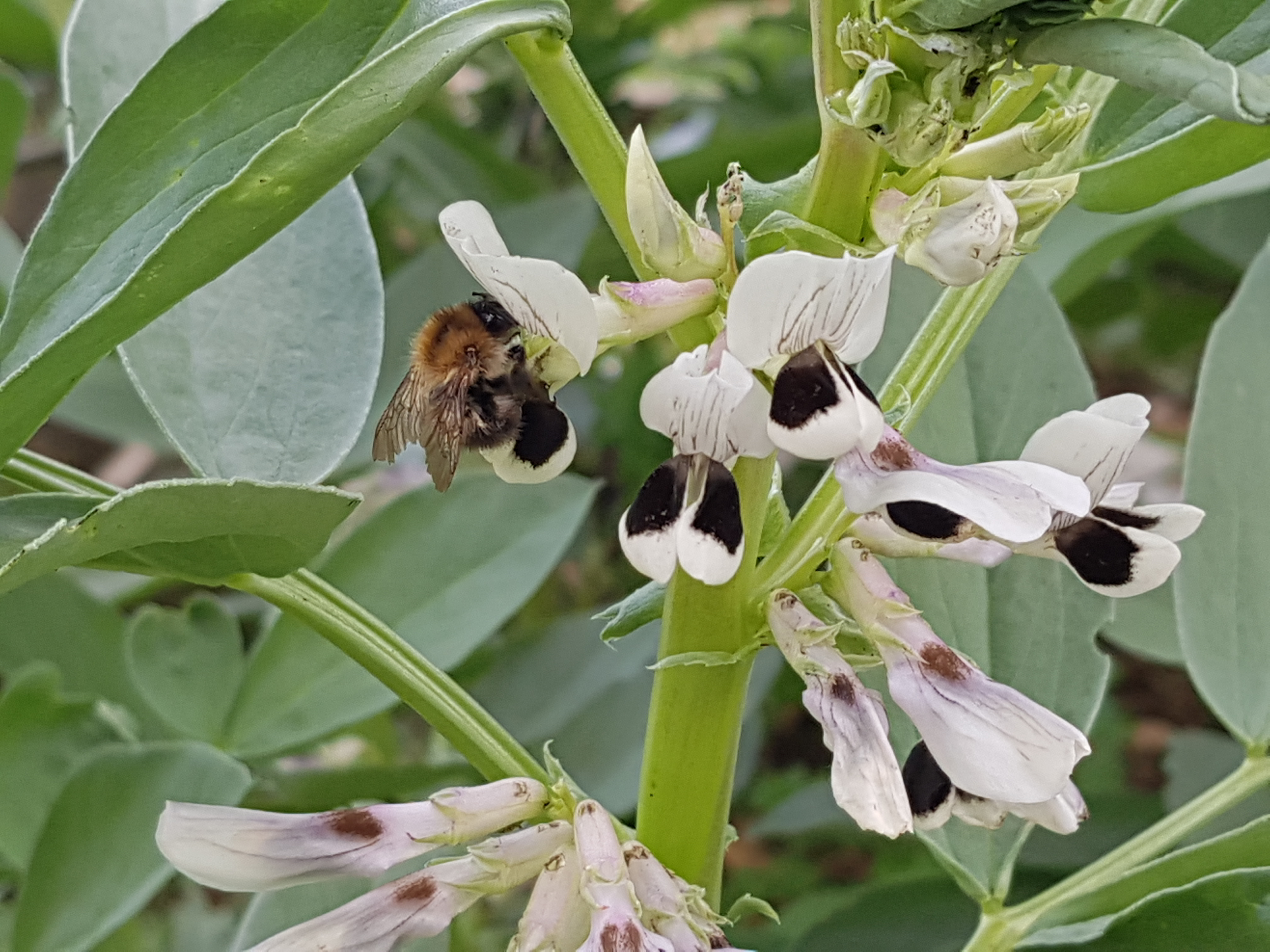
The resulting data set of almost 47,000 visits by insects and birds to flowers, as well as information about flowers that were never visited, is freely available and will be an invaluable resource for pollination ecologists. For example, analysing the links between ornamental flowers that share pollinators with fruits and vegetables such as apples and beans, will allow us to make recommendations for the best plants to grow in home gardens that can increase yields of crops.
There’s an old saying about turning adversity into a positive outcome: “When life gives you lemons, make lemonade”, and the researchers were pleased to find that there’s one record of Citrus limon in the data set!
The paper describing the data set has just been published in the Journal of Pollination Ecology and you can download a PDF of the paper and the associated data for free by following this link.
Sincere thanks to all of my co-authors for their commitment to the project!
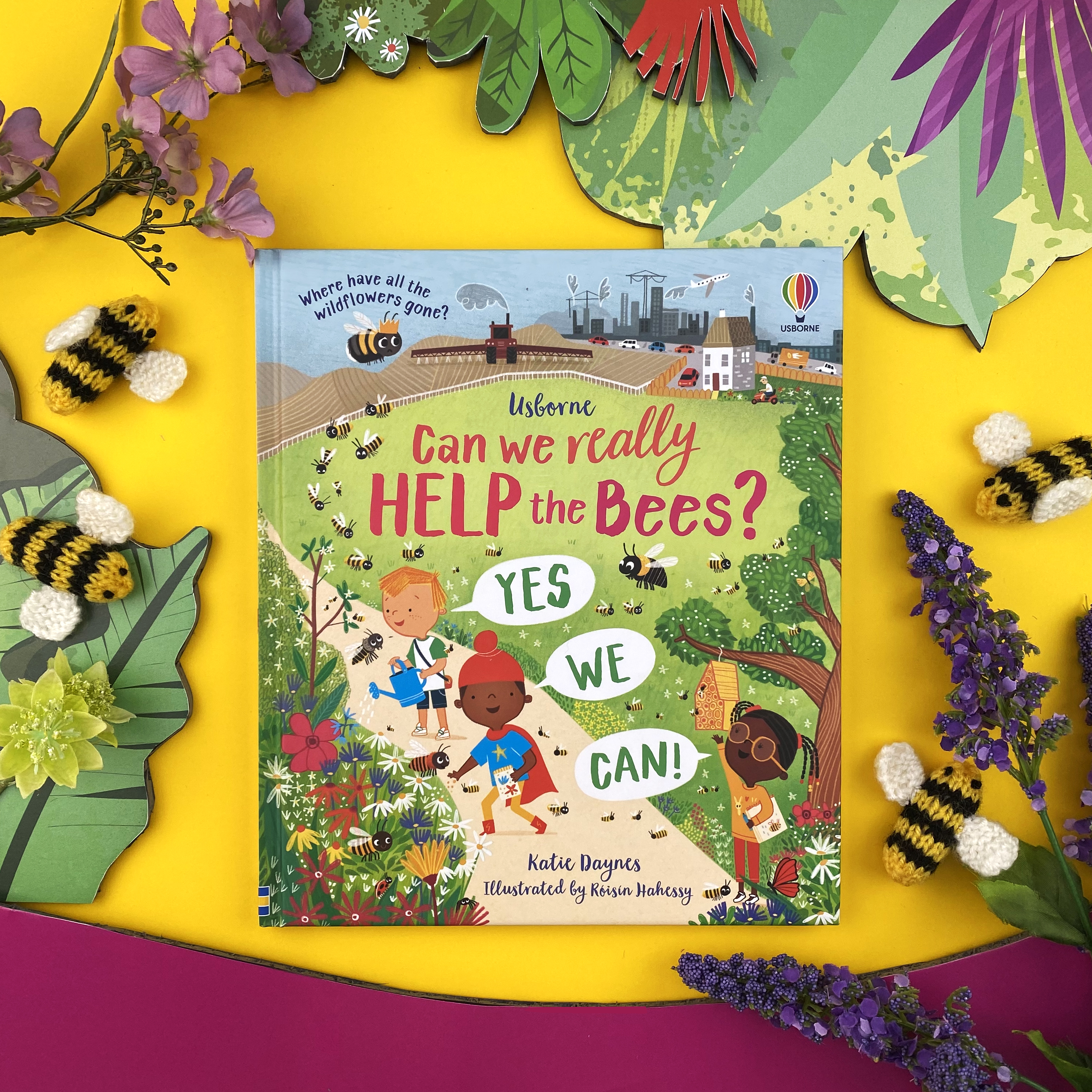
One of the projects with which I’ve been involved over the last year has been advising on a new book for children about bees and other pollinators, called Can We Really Help The Bees? Written by Katie Daynes and wonderfully illustrated by Róisín Hahessy, it tells the story of what happens when a swarm of bees comes to the window to let a group of children know that they, and their friends the other pollinators, are in trouble. Can they help? Yes they can!
It’s been a real pleasure working with Katie and Róisín on this project for Usborne Publishing and seeing the ideas, text, and illustrations evolve over time. I’ve written a short post over at the Usborne blog with some ideas about how to get children involved in helping the pollinators, and I think that it’s worth repeating one of the things that I wrote: everyone can make a difference to the wildlife around us and no one is too young to be involved!
Because of my involvement with Can We Really Help The Bees? I wasn’t able to include it on my curated list of the best books about bees and other pollinators at the Shepherd site. But it definitely should be on there and is highly recommended!
In my recent book Pollinators & Pollination: Nature and Society I discussed the current state of our knowledge of how populations of pollinators have changed over time. Although we have some quite detailed data for particular, often charismatic, species or for certain geographic localities or regions, for most species we know almost nothing. As I wrote in the chapter “The shifting fates of pollinators”:
“For most pollinators we are ‘data deficient’, in other words, we don’t know how their populations are performing. They could be doing well, but they may not be”
This is particularly true for those regions for the world that hold the greatest terrestrial biodiversity: the tropics. For the vast majority of species in the tropics we know precious little about trends in their populations and how their distributions have changed over time in the face of wide-scale land transformation and recent climatic shifts. Filling in some of the gaps in our knowledge of Neotropical pollinator distributions is one of its aims of SURPASS2, a collaboration between South American and UK ecologists, and one of several research and outreach projects with which I’m involved.
In a new study that’s come out of that work, led by Rob Boyd from the UK Centre for Ecology and Hydrology, we’ve used the GBIF database to look at the changing distributions of four important groups of pollinators: bees, hoverflies, leaf-nosed bats and hummingbirds. In particular we were interested in understanding the kinds of biases that come with such publicly available data, and whether recent efforts to add data to GBIF has improved our understanding of trends.
Our overall conclusion is that there are significant limitations and biases inherent in all of these data sets even for groups like hummingbirds which one would imagine are well documented by scientists and bird-watching naturalists. In addition, having more data does not necessarily help matters: it can introduce its own biases.
The paper is open access and feely available; here’s the reference with a link:
Aim Aggregated species occurrence data are increasingly accessible through public databases for the analysis of temporal trends in the geographic distributions of species. However, biases in these data present challenges for statistical inference. We assessed potential biases in data available through GBIF on the occurrences of four flower-visiting taxa: bees (Anthophila), hoverflies (Syrphidae), leaf-nosed bats (Phyllostomidae) and hummingbirds (Trochilidae). We also assessed whether and to what extent data mobilization efforts improved our ability to estimate trends in species’ distributions.
Location The Neotropics.
Methods We used five data-driven heuristics to screen the data for potential geographic, temporal and taxonomic biases. We began with a continental-scale assessment of the data for all four taxa. We then identified two recent data mobilization efforts (2021) that drastically increased the quantity of records of bees collected in Chile available through GBIF. We compared the dataset before and after the addition of these new records in terms of their biases and estimated trends in species’ distributions.
Results We found evidence of potential sampling biases for all taxa. The addition of newly-mobilized records of bees in Chile decreased some biases but introduced others. Despite increasing the quantity of data for bees in Chile sixfold, estimates of trends in species’ distributions derived using the postmobilization dataset were broadly similar to what would have been estimated before their introduction, albeit more precise.
Main conclusions Our results highlight the challenges associated with drawing robust inferences about trends in species’ distributions using publicly available data. Mobilizing historic records will not always enable trend estimation because more data do not necessarily equal less bias. Analysts should carefully assess their data before conducting analyses: this might enable the estimation of more robust trends and help to identify strategies for effective data mobilization. Our study also reinforces the need for targeted monitoring of pollinators worldwide.
——————————————————–
SURPASS2 has been a hugely productive project as you’ll see if you look at the Publications page of the website. There’s much more to come and I’ll report on those research papers as they appear.
First the misleading title. This ‘debunks’ claim actually compares two different things: 75% of CROPS being dependent on pollinators versus 10% of crop YIELD. However, even if we focus on the 10% claim, a small increase in yield can be the difference between profit and bankruptcy for small-scale farmers. And most of the world’s farmers are small-scale and living on the borderline between loss and break-even. In addition, there’s no acknowledgement of the food production from home gardens, allotments, and community gardens, which is significant but largely unquantified.
Next, by focusing on yield and comparing, say, wind-pollinated wheat with insect-pollinated apples, the article takes no account of the fact that many of these crops that depend to some extent on pollinators mainly provide essential vitamins and minerals – not calories – to diets. When I tweeted about this earlier in the week, one person commented that they describe the insect-pollinated foods as ‘an important source of flavour and colour in our diets, rice and wheat are all well and good, but you do kinda need something more than grey slop to live’. Another said: ‘I’m so glad you mentioned this. I’m sick of reading articles that praise innovations to increase calories, when what we need is better nutrition from vitamins, minerals & fibres’.
Both great points, and well made.
That essay was also factually incorrect when it described roots crops such as carrots or some of the leafy cabbages and lettuces as not requiring pollinators. Many varieties of these crops ARE pollinator dependent: how do they think we get the seed for the next year’s crop?! And there are many crops and varieties that have not been evaluated for their dependency on pollinators: the 75% figure actually refers to the 115 most productive crop plants (Klein et al. 2007).
When I tweeted about the essay I commented that I was very disappointed by ‘Our World in Data’ – they are usually better than this when it comes to the facts. What I hadn’t appreciated at the time was that in fact the Genetic Literacy Project had highjacked the original piece by Hannah Ritchie and reworked it to give it a very different slant*.
This is where it starts to get dishonest and in fact the Genetic Literacy Project (GLP) has form in this area. The Sourcewatch site describes the GLP as ‘a corporate front group that was formerly funded by Monsanto’ with a remit to ‘shame scientists and highlight information helpful to Monsanto and other chemical producers’. In other words it’s heavily tied to Big Agriculture which, of course, would like us to believe that there’s not an issue with declining pollinators, that pesticides and agricultural intensification are our friends, and that Everything Is OK. Read the full account here.
Frankly, the GLP is so tainted that I’d not believe anything that they publish.
Pollinator decline and the role of pollinators in agriculture are complex issues. If you’d like to know more about the importance of pollinators to agriculture, complete with some accurate and objective facts, then there’s a whole chapter devoted to the topic in my book Pollinators & Pollination: Nature and Society.
*Note that I’ve been communicating with Hannah about the root and leaf crop issue and she accepts that this needs to change in the original. She’s also asked the Genetic Literacy Project to take down their version as it contravenes copyright.
Reference
Klein, A.-M., Vaissière, B.E., Cane, J.H. et al. (2007) Importance of pollinators in changing landscapes for world crops. Proceedings of the Royal Society of London B 274: 303–313.
My first (and hopefully not my last) article for the magazine British Wildlife has just appeared in the April issue. Entitled ‘Pollinators and pollination: myths, misunderstandings and much more to discover’ you can get a preview here: https://www.britishwildlife.com/article/volume-32-number-5-page-316-323
The article focuses on some of the myths and misunderstandings that I dealt with in my book Pollinators & Pollination: Nature and Society. It also points out that, even in a place like Britain with a long tradition of natural history study, there’s still much for the patient observer to discover. If you’re interested in a PDF, drop me a line via the Contact page.
There’s still a few hours left in which to register to attend the SCAPE 2020 pollinators and pollination conference. Follow the links on the website: https://scape-pollination.org/
The programme is more or less finalised and is shown below. We have an amazing range of topics being presented from both established and early career researchers, including two keynote lectures, plus posters. It’s going to be a very exciting weekend of science!
PROGRAMME
Talk types:
K = Keynote
ST = Standard (10 minutes talk + 5 for questions)
F = Flash talk (5 minutes, no questions)
Friday 6th November – all timings are GMT (London) time
Timing
Type
Name
Title
Ref
09.00 –09.15
Jeff Ollerton
Open conference and welcome
09.15 –10.15
K
Lynn Dicks
Understanding the risks to human well-being from pollinator decline
K.01
10.15 –10.30
Comfort break
Time to top up your coffee
Session 1
Chair:Jeff Ollerton
Agriculture – 1
10.30 – 10.45
ST
Ke Chen
Indirect and additive effects of arbuscular mycorrhizal fungi on insect pollination and crop yield of raspberry under different fertilizer levels
1.01
10.45 – 11.00
ST
Julia Osterman
Enhancing mason bee populations for sweet cherry pollination
1.02
11.00 – 11.15
ST
Idan Kahnonitch
Viral distributions in bee communities: associations to honeybee density and flower visitation frequency
1.03
11.15 – 11.30
ST
Anna Birgitte Milford
Who takes responsibility for the bees?
1.04
11.30 – 11.45
ST
Emma Gardner
Boundary features increase and stabilise bee populations and the pollination of mass-flowering crops in rotational systems
1.05
11.45 – 12.00
ST
Stephanie Maher
Evaluating the quantity and quality of resources for pollinators on Irish farms
1.06
12.00 –12.05
F
Thomas Timberlake
Pollinators and human nutrition in rural Nepal: experiences of remote data collection during a global pandemic
1.07
12.05 –12.15
Comfort break
Session 2
Chair:Jane Stout
Agriculture – 2
12.15 – 12.30
ST
Michael Image
The impact of agri-environment schemes on crop pollination services at national scale
2.01
12.30 – 12.45
ST
Nicola Tommasi
Plant – pollinator interactions in sub-Saharan agroecosystems
2.02
12.45 – 13.00
ST
Tal Shapira
The combined effects of resource-landscape and herbivory on pollination services in agro-ecosystems
2.03
13.00 – 13.15
ST
Márcia Motta Maués
Despite the megadiversity of flower visitors, native bees are essential to açai palm (Euterpe oleracea Mart.) pollination at the Amazon estuary
2.04
13.15 – 13.30
ST
Sabrina Rondeau
Quantifying exposure of bumblebee queens to pesticide residues when hibernating in agricultural soils
2.05
13.30 –13.35
F
Maxime Eeraerts
Landscapes with high amounts of mass-flowering fruit crops reduce the reproduction of two solitary bees
2.06
13.35 – 13.40
F
Patricia Nunes-Silva
Crop domestication, flower characteristics and interaction with pollinators: the case of Cucurbita pepo (Cucurbitaceae)
2.07
13.40 – 14.30
Lunch break
Session 3
Chair:Mariano Devoto
Networks and communities
14.30 – 14.45
ST
Kit Prendergast
Plant-pollinator networks in Australian urban bushland remnants are not structurally equivalent to those in residential gardens
3.01
14.45 – 14.50
F
Kavya Mohan
Structure of plant-visitor networks in a seasonal southern Indian habitat
3.02
14.50 – 14.55
F
Opeyemi Adedoja
Asynchrony among insect pollinator groups and flowering plants with elevation
3.03
14.55 – 15.10
ST
Yael Mandelik
Rangeland sharing by cattle and bees: moderate grazing does not impair bee communities and resource availability
3.04
15.10 – 15.25
ST
Felipe Torres-Vanegas
Landscape change reduces pollen quality indirectly by shifting the functional composition of pollinator communities
3.05
15.25 – 15.40
ST
Isabela Vilella-Arnizaut
Quantifying plant-pollinator interactions in the Prairie Coteau
3.06
15.40 – 15.55
Comfort break
Session 4
Chair:Nina Sletvold
Conservation perspectives – 1
15.55 – 16.10
ST
Lise Ropars
Seasonal dynamics of competition between honeybees and wild bees in a protected Mediterranean scrubland
4.01
16.10 – 16.25
ST
Philip Donkersley
A One-Health model for reversing honeybee (Apis mellifera L.) decline
4.02
16.25 – 16.40
ST
Nicholas Tew
Nectar supply in gardens: spatial and temporal variation
4.03
16.40 – 16.55
ST
Peter Graystock
The effects of environmental toxicants on the health of bumble bees and their microbiomes
4.04
16.55 – 17.10
ST
Hauke Koch
Flagellum removal by a heather nectar metabolite inhibits infectivity of a bumblebee parasite
4.05
17.10 – 17.25
Comfort break
Session 5
Chair:Anders Nielsen
Conservation perspectives – 2
17.25 – 17.40
ST
Miranda Bane
Pollinators on Guernsey and a Pesticide-free Plan
5.01
17.40 – 17.55
ST
Jamie Wildman
Reintroducing Carterocephalus palaemon to England: using the legacy of a locally extinct butterfly as a (morpho)metric of future success
5.02
17.55 – 18.10
ST
Sjirk Geerts
Invasive alien Proteaceae lure some, but not other nectar feeding bird pollinators away from native Proteaceae in South African fynbos
5.03
18.10 – 18.25
ST
Sissi Lozada Gobilard
Habitat quality and connectivity in kettle holes enhance bee diversity in agricultural landscapes
5.04
18.25 –18.45
Comfort break
18.45 – 23.59
Themed discussion rooms open
Saturday 7th November – all timings are GMT (London) time
Timing
Type
Name
Title
Ref
08.55 – 09.00
Jeff Ollerton
Reminders and announcements
Session 6
Chair:Jeff Ollerton
Conservation perspectives – 3
09.00 – 09.15
ST
Paolo Biella
The effects of landscape composition and climatic variables on pollinator abundances and foraging along a gradient of increasing urbanization
6.01
09.15 – 09.30
ST
James Rodger
Potential impacts of pollinator declines on plant seed production and population viability
6.02
09.30 – 09.45
ST
Emilie Ellis
Moth assemblages within urban domestic gardens respond positively to habitat complexity, but only at a scale that extends beyond the garden boundary
6.03
09.45 – 10.00
ST
Samuel Boff
Novel pesticide class impact foraging behaviour in wild bees
6.04
10.00 – 10.15
Comfort break
Time to top up your coffee
Session 7
Chair:Jon Agren
Conservation perspectives – 4
10.15 – 10.20
F
Maisie Brett
The impacts of invasive Acacias on the pollination networks of South African Fynbos habitats
7.01
10.20 – 10.25
F
Joseph Millard
Global effects of land-use intensity on local pollinator biodiversity
7.02
10.25 – 10.30
F
Susanne Butschkau
How does land-use affect the mutualistic outcomes of bee-plant interactions?
7.03
10.30 – 10.35
F
Elżbieta Rożej-Pabijan
Impact of wet meadow translocation on species composition of bees (Hymenoptera: Apoidea: Apiformes)
7.04
10.35 – 10.40
F
Lorenzo Guzzetti
May urbanization affect the quality of pollinators diet? A case-study from Milan, Italy.
7.05
10.40 – 10.45
F
Emiliano Pioltelli
Functional traits variation in two bumblebee species along a gradient of landscape anthropization
7.06
10.45 – 11.00
Comfort break
Session 8
Chair:Marcos Mendez
Pollinator behaviour – 1
11.00 – 11.15
ST
Hema Somanathan
Foraging on left-overs: comparative resource use in diurnal and nocturnal bees
8.01
11.15 – 11.30
ST
Sajesh Vijayan
To leave or to stay? Answers from migratory waggle dances in Apis dorsata
8.02
11.30 – 11.45
ST
Balamurali MGS
Decision making in the Asian honeybee Apis cerana is influenced by innate sensory biases and associative learning at different spatial scales
8.03
11.45 – 12.00
ST
Gemma Villagomez
Resource intake of stingless bee colonies in a tropical ecosystem in Ecuador
8.04
12.00 – 12.15
ST
Ola Olsson
Pollen analysis using deep learning – better, stronger, faster
8.05
12.15 – 13.00
Lunch break
Session 9
Chair:Magne Friberg
Pollinator behaviour – 2
13.00 – 13.15
ST
Shuxuan Jing
‘Interviewing’ pollinators in the red clover field: foraging behaviour
9.01
13.15 – 13.30
ST
Océane Bartholomée
How to eat in the shade? Bumblebees’ behavior in partially shaded flower strips
9.02
13.30 – 13.45
ST
Manuela Giovanetti
Megachile sculpturalis: insights on the nesting activity of an alien bee species
9.03
13.45 – 14.00
ST
Zahra Moradinour
The allometry of sensory system in the butterfly Pieris napi
9.04
14.00 – 14.05
F
Pierre Tichit
New insights into the visual ecology of bees
9.05
14.05 – 14.10
F
Fabian Ruedenauer
Does pollinator dependence correlate with the nutritional profile of pollen in plants?
9.06
14.10 – 14.15
F
Hannah Burger
Floral signals involved in host finding by nectar-foraging social wasps
9.07
14.15 – 14.30
Comfort break
Session 10
Chair: Amy Parachnowitsch
Floral scent
14.30 – 14.45
ST
Herbert Braunschmid
Does the rarity of a flower´s scent phenotype in a deceptive orchid explain its pollination success?
10.01
14.45 – 15.00
ST
Yedra García
Ecology and evolution of floral scent compartmentalization
10.02
15.00 – 15.15
ST
Manoj Kaushalya Rathnayake
Does floral scent changes with pollinator syndrome?
10.03
15.15 – 15.20
F
Hanna Thosteman
The chemical landscape of Arabis alpina
10.04
15.20 – 15.25
F
Laura S. Hildesheim
Patterns of floral scent composition in species providing resin pollinator rewards
10.05
15.25 – 15.30
F
Christine Rose-Smyth
Does Myrmecophila thomsoniana (Orchidaceae) use uncoupled mimicry to obtain pollination?
10.06
15.30 – 15.45
Comfort break
Session 11
Chair:Renate Wesselingh
Pollination ecology and floral evolution – 1
15.45 – 16.00
ST
Rachel Spigler
Adaptive plasticity of floral display and its limits
11.01
16.00 – 16.15
ST
Wendy Semski
Individual flowering schedules and floral display size in monkeyflower: a common garden study
11.02
16.15 – 16.30
ST
Carlos Martel
Specialization for tachinid fly pollination and the evolutionary divergence between varieties of the orchid Neotinea ustulata
11.03
16.30 – 16.45
ST
Marcela Moré
Different points of view in a changing world: The tobacco tree flowers through the eyes of its pollinators in native and non-native ranges
11.05
16.45 – 17.00
Comfort break
17.00 – 18.00
Poster discussion rooms open
A chance to talk with the author of the posters
18.00 – 23.59
Themed discussion rooms open
Sunday 8th November – all timings are GMT (London) time
Timing
Type
Name
Title
Ref
08.55 – 09.00
Jeff Ollerton
Reminders and announcements
09.00 – 10.00
K
Scott Armbruster
Pollination accuracy explains the evolution of floral movements
K.02
10.00 – 10.15
Comfort break
Time to top up your coffee
Session 12
Chair:Jeff Ollerton
Pollination ecology and floral evolution – 2
10.15 – 10.30
ST
Kazuharu Ohashi
Three options are better than two: complementary nature of different pollination modes in Salix caprea
Flower visitation of the Sticky catchfly (Viscaria vulgaris) on isles within isle.
12.04
11.15 – 11.20
11.20 – 11.30
Comfort break
Session 13
Chair:Yuval Sapir
Pollination ecology and floral evolution – 3
11.30 – 11.45
ST
Jonas Kuppler
Impacts of drought on floral traits, plant-pollinator interactions and plant reproductive success – a meta-analysis
13.01
11.45 – 12.00
ST
Carmen Villacañas de Castro
Cost/benefit ratio of a nursery pollination system in natural populations: a model application
13.02
12.00 – 12.15
ST
Anna E-Vojtkó
Floral and reproductive plant functional traits as an independent axis of plant ecological strategies
13.03
12.15 – 12.30
ST
Camille Cornet
Role of pollinators in prezygotic isolation between calcicolous and silicicolous ecotypes of Silene nutans
13.04
12.30 – 12.45
ST
Courtney Gorman
Phenological and pollinator-mediated isolation among selfing and outcrossing Arabidopsis lyrata populations
13.05
12.45 – 13.45
Lunch break
Session 14
Chair:Rocio Barrales
Pollination ecology and floral evolution – 4
13.45 – 14.00
ST
Danae Laina
Geographic differences in pollinator availability in the habitats shape the degree of pollinator specialization in the deceptive Arum maculatum L. (Araceae)
14.01
14.00 – 14.15
ST
Eva Gfrerer
Is the inflorescence scent of Arum maculatum L. (Araceae) in populations north vs. south of the Alps locally adapted to a variable pollinator climate?
14.02
14.15 – 14.30
ST
Kelsey Byers
Pollinators and visitors to Gymnadenia orchids: historical and modern data reveal associations between insect proboscis and floral nectar spur length
14.03
14.30 – 14.45
ST
Nina Jirgal
Orientation matters: effect of floral symmetry and orientation on pollinator entry angle
14.04
14.45 – 15.00
ST
Alice Fairnie
Understanding the development, evolution and function of the bullseye pigmentation pattern in Hibiscus trionum
14.05
15.00 – 15.15
Comfort break
Session 15
Chair:Maria Clara Castellanos
Pollination ecology and floral evolution – 5
15.15 – 15.30
ST
Jon Ågren
On the measurement and meaning of pollinator-mediated selection
15.01
15.30 – 15.45
ST
Katarzyna Roguz
Plants taking charge: Autonomous self-pollination as response to plants-pollinator mismatch in Fritillaria persica
15.02
15.45 – 16.00
ST
Mario Vallejo-Marin
Bees vs flies: Comparison of non-flight vibrations and implications for buzz pollination
15.03
16.00 – 16.15
ST
Agnes Dellinger
Linking flower morphology to pollen-release dynamics: buzz-pollination in Melastomataceae
15.04
16.15 – 16.30
ST
Lucy Nevard
Are bees and flowers tuned to each other? Variation in the natural frequency of buzz-pollinated flowers.
15.05
16.30 – 16.35
F
Gabriel Chagas Lanes
An investigation of pollen movement and release by poricidal anthers using mathematical billiards
15.06
16.35 – 16.40
F
Rebecca Hoefer
The magnitude of water stress and high soil nitrogen decreases plants reproductive success
15.07
16.40 – 16.45
F
Marta Barberis
May ecotonal plants attract less efficient pollinators to stay on the safe side?
15.08
16.45 – 17.00
Comfort break
Session 16
Chair:Jeff Ollerton
Pollination ecology and floral evolution – 6
17.00 – 17.15
ST
Gabriela Doria
Petal cell shape and flower-pollinator interaction in Nicotiana
16.01
17.15 – 17.30
ST
Nathan Muchhala
The long stems characteristic of bat-pollinated flowers greatly reduce bat search times while foraging
16.02
17.30 – 17.35
F
Juan Isaac Moreira-Hernández
Differential tolerance to heterospecific pollen deposition in sympatric species of bat-pollinated Burmeistera (Campanulaceae: Lobelioideae)
16.03
17.35 – 17.40
F
Juan José Domínguez-Delgado
Does autopolyploidy contribute to shape plant-pollinator interactions?
16.04
17.40 – 17.45
F
Caio Simões Ballarin
How many animal-pollinated plants are nectar-producing?
16.05
17.45 – 17.50
F
Ana Clara Ibañez
Concerted evolution between flower phenotype and pollinators in Salpichroa (Solanaceae)
16.06
17.50 – 18.15
Jeff Ollerton
Prize announcements, conference handover and close.
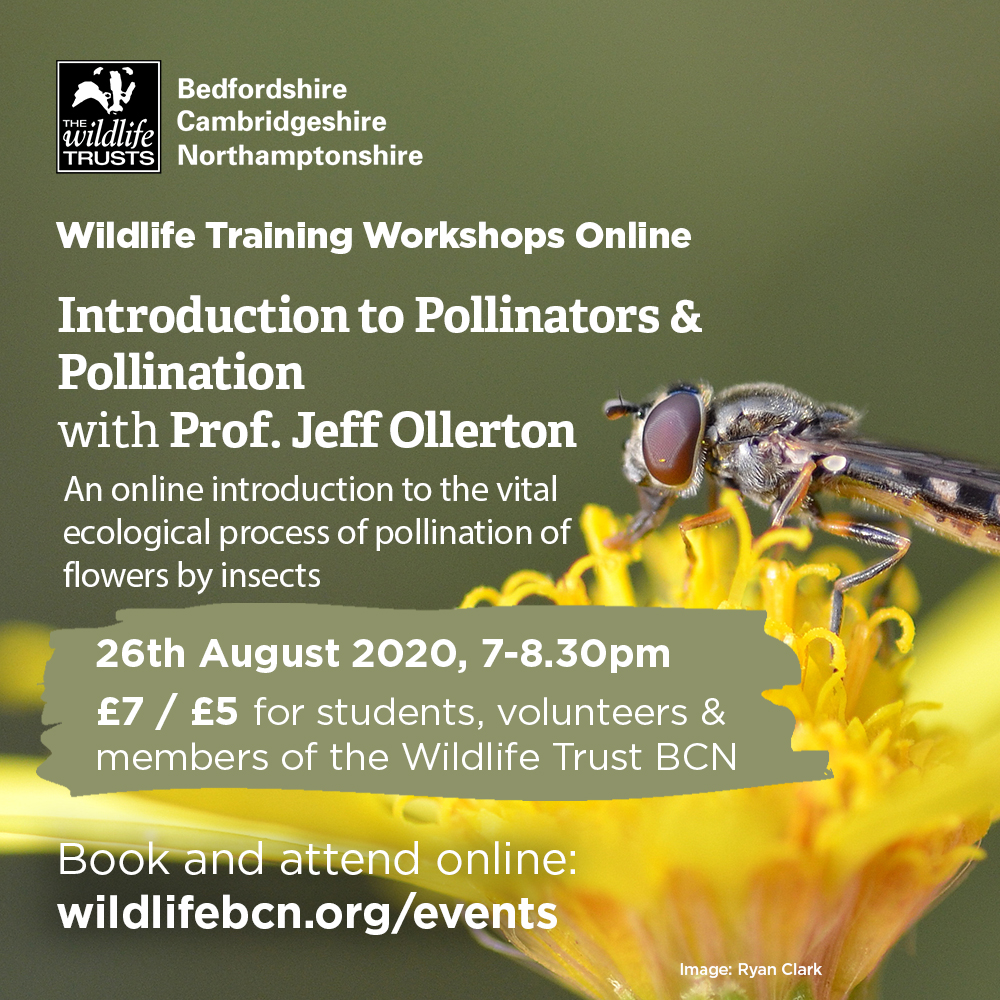
The Wildlife Trust for Bedfordshire, Cambridgeshire and Northamptonshire has invited me to run my Introduction to Pollinators and Pollination workshop again this year, but of course it will all be online. Details for signing up are on the images, or you can follow this link.
Here’s a description of the workshop:
Pollination of flowers ensures the reproduction of most British wild plants and many of our agricultural crops. This session will provide an introduction to the natural history of pollinators and how they interact with the flowers that they pollinate. The main groups of pollinators will be introduced, with guidance on how to identify them, and their ecology and behaviour will be explored. The session will also consider why conserving these species is so important, followed by a Q and A discussion showing what individuals can do to help ensure their future diversity and abundance.
At the time scientists and the media were suggesting that perhaps half a billion reptiles, mammals and birds had been killed, a figure that provoked a strong public reaction when accompanied by images of fire-scorched koalas. This was then revised upwards to 1 billion. But it turns out that even a billion is nowhere close to the real number of animal deaths. A new interim report commissioned by WWF-Australia suggests that just under 3 billion animals were either directly killed or displaced. Those which were displaced were vulnerable to feral predators such as foxes and cats, or more likely to succumb to starvation. An article in The Guardian about the WWF-Australia report is worth reading – here’s the link.
The actual figure is 2.69 billion individual animals. Think about that for a moment. That’s about equivalent the number of people living in India and China combined. This is the breakdown for the different animal groups that were assessed:
● 143 million mammals
● 2.46 billion reptiles
● 180 million birds
● 51 million frogs
One thing should be immediately apparent: this is not a complete list of the “animals” that have been killed. A lack of data means that fish, turtles and (crucially) invertebrates such as spiders, bees, beetles, and earthworms, were excluded. Those invertebrates live at much higher densities than any of the animal groups that were assessed and indeed are the sole or principle food for many of those species. The number of insects required to support just the insectivorous birds is staggering: globally, birds are estimated to eat 400-500 million tonnes of insects and other arthropods every year.
Even if we were to consider just the larger invertebrates, those bigger than say 0.5 cm in length (which are a minority – most are considerably smaller), then then the true scale of the animal deaths is going to be one or two orders of magnitude higher. Or possibly more. Thirty billion, 300 billion, 3 trillion…? Who knows? It’s impossible to estimate, we just don’t have enough information about those organisms.
The other major component of wildlife that is missing from the report is the plants. I know that studies of plant mortality are being undertaken at the moment and it will be important that this is given the same level of publicity as the assessments of animals.
Writing in the foreword of the report, Dermot O’Gorman the CEO of WWF-Australia pointed out that: “It’s hard to think of another event anywhere in the world in living memory that has killed or displaced that many animals. This ranks as one of the worst wildlife disasters in modern history”.
I disagree. I think it’s THE worst wildlife disaster in terms of the scale of animal losses over such a short period of time. No doubt deforestation and destruction of grasslands in South America, Asia and Africa has killed more animals and plants. But that’s over a timescale of decades to hundreds of years. Australian wildlife was devastated in a matter of months. And no one knows exactly what the 2020-21 fire season will bring. But I think that we can safely predict further impacts on wildlife – and people.
In the next few months my new book Pollinators & Pollination: Nature and Society will be published. As you can imagine, I’m very excited! The book is currently available to pre-order: you can find full details here at the Pelagic Publishing website. If you do pre-order it you can claim a 30% discount by using the pre-publication offer code POLLINATOR.
As with my blog, the book is aimed at a very broad audience including the interested public, gardeners, conservationists, and scientists working in the various sub-fields of pollinator and pollination research. The chapter titles are as follows:
Preface and Acknowledgements
1. The importance of pollinators and pollination
2. More than just bees: the diversity of pollinators
3. To be a flower
4. Fidelity and promiscuity in Darwin’s entangled bank
5. The evolution of pollination strategies
6. A matter of time: from daily cycles to climate change
7. Agricultural perspectives
8. Urban environments
9. The significance of gardens
10. Shifting fates of pollinators
11. New bees on the block
12. Managing, restoring and connecting habitats
13. The politics of pollination
14. Studying pollinators and pollination
References
Index
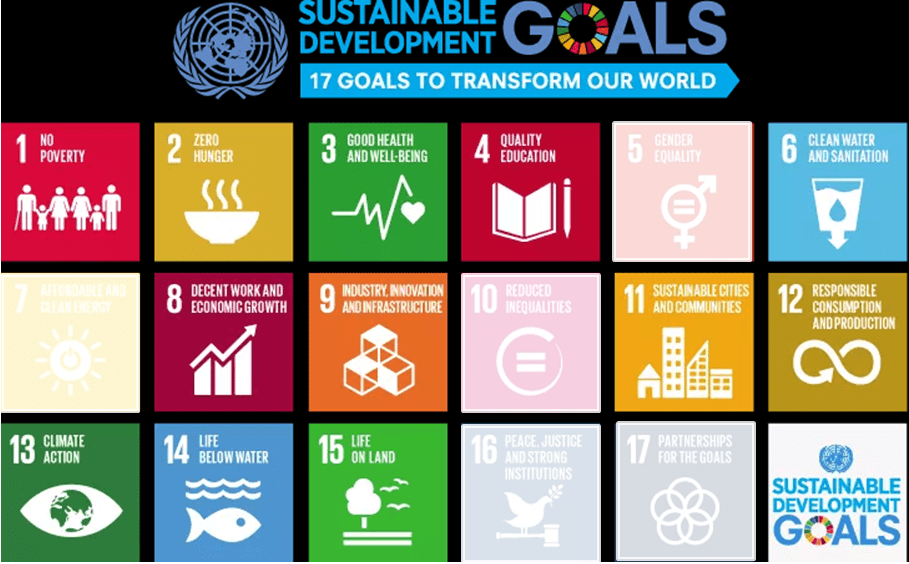
In the past couple of weeks I’ve delivered two presentations at virtual conferences. The first was at a Global Sustainability Summit run by Amity University, one of our partner institutions in India. The second was at the University of Northampton’s own internal research conference. Both of these focused on pollinators, as you might imagine, but they also referred to the United Nations’ Sustainable Development Goals (SDGs). The 17 SDGs are being increasingly used as a framework for promoting the importance of biodiversity to human societies across the globe, and I’m seeing them referred to more and more often in studies and reports about pollinator conservation. That’s great, and I’m all in favour of the SDGs being promoted in this way. However I wanted to highlight a couple of aspects of the SDGs that I think are missing from recent discussions.
The first is that pollinators, and their interactions with plants, are often seen as contributing mainly to those SDGs that are directly related to agriculture and biodiversity. Here’s an example. Last week the European Commission’s Science for Environment Policy released a “Future Brief” report entitled: “Pollinators: importance for nature and human well-being, drivers of decline and the need for monitoring“. It’s a really interesting summary of current threats to pollinator populations, how we can monitor them, and why it’s important. I recommend you follow that link and take a look. However, in the section about relevant, global-level policies, the report highlights “the UN Sustainable Development Goals (SDGs) – especially regarding food security (‘zero hunger’) and biodiversity (‘life on land’).
I think this is under-selling pollinators and pollination, and here’s why. First of all, as we pointed out in our 2011 paper “How many flowering plants are pollinated by animals?”, approaching 90% of terrestrial plants use insects and vertebrates as agents of their reproduction and hence their long-term survival. As we showed in that paper, and a follow up entitled “The macroecology of animal versus wind pollination: ecological factors are more important than historical climate stability“, the proportion of animal-pollinated plants in a community varies predictably with latitude, typically from 40 to 50 % in temperate areas up to 90 to 100% in tropical habitats. Now, flowering plants dominate most terrestrial habitats and form the basis of most terrestrial food chains. So the long-term viability and sustainability of much the Earth’s biodiversity can be linked back, directly or indirectly, to pollinators. That’s even true of coastal marine biomes, which receive a significant input of energy and nutrients from terrestrial habitats.
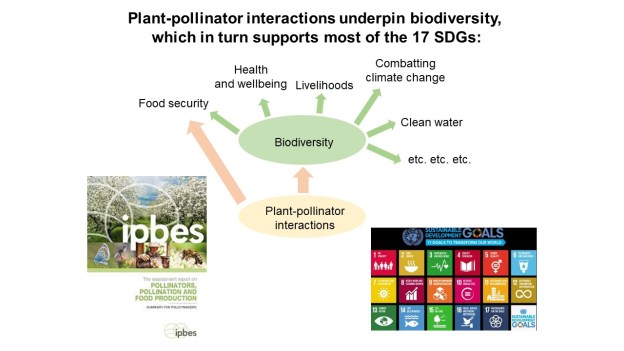
Biodiversity itself underpins, or directly or indirectly links to, most of the 17 SDGS; those that don’t have an obvious link have been faded out in this graphic:
The underpinning role of biodiversity, and in particular plant-pollinator interactions, on the SDGs needs to be stated more often and with greater emphasis than it is currently.
The second way in which I think that some writers and researchers in this area have misconstrued the SDGs is that they seem to think that it only applies to “developing” countries. But that’s certainly not the way that the UN intended them. ALL countries, everywhere, are (or should be) “developing” and trying to become more sustainable. To quote the UN’s SDG website:
“the 17 Sustainable Development Goals (SDGs)….are an urgent call for action by all countries – developed and developing – in a global partnership.”
and
“the SDGs are a call for action by all countries – poor, rich and middle-income – to promote prosperity while protecting the environment.”
I interpret this as meaning that “developed” countries need to consider their own future development, not that they only have to give a helping hand to “developing” countries (though that’s important too). Just to drive this home, here’s a recent case study by Elizabeth Nicholls, Dave Goulson and others that uses Brighton and Hove to show how small-scale urban food production can contribute to the SDGs. I like this because it goes beyond just considering the agricultural and food-related SDGs, and also because by any measure, Brighton and Hove is a fairly affluent part of England.
I’m going to be talking about all of this and discussing it with the audience during an online Cafe Scientifique on Thursday 25th June – details are here. I’m also going to be exploring more of these ideas in my forthcoming book Pollinators & Pollination: Nature and Society, which is due for publication later this year. The manuscript is submitted and is about to be copy-edited. The PowerPoint slide which heads this post uses a graphic from that book that sums up how I feel about biodiversity, plant-pollinator interactions, and the UN’s Sustainable Development Goals.





 Prof. Jeff Ollerton - ecological scientist and author