
All the details that you need are on the poster.

All the details that you need are on the poster.

When we think of pollination, we often picture bees buzzing around flowers or butterflies flitting from bloom to bloom. This relationship between plants and pollinators is one of the most well-known interactions in nature. But insect pollination didn’t begin with the colorful flowers we see today. In fact, pollinators were at work millions of years before flowering plants (angiosperms) even existed. In a new review led by Spanish researchers David Peris and Ricardo Pérez-de la Fuente, to which I added a modern ecological perspective, we explored this topic and why it’s relevant to our current understanding of plant-pollinator relationships.
Despite centuries of research on pollination, the fossil record of pollinating insects has only gained serious attention in the past few decades. What palaeontologists have uncovered is reshaping our understanding of pollination’s origins. It turns out that insects were pollinating plants long before flowers evolved—playing a crucial role in the reproduction of ancient gymnosperms, the group of seed-producing plants that includes conifers, cycads, and ginkgos.
Most people assume that insect pollination began with flowering plants, but the evidence tells a different story. Fossilised insects with specialised body structures for carrying pollen—such as hairy bodies or mouthparts adapted for nectar-feeding—have been found in deposits dating back hundreds of millions of years. These early pollinators likely visited gymnosperms, helping them reproduce in a world that looked vastly different from today’s landscapes.
Ancient pollination was driven by a diverse range of insects, many of which are now extinct. The fossil record reveals that various insect groups—including beetles, flies, wasps, and even some long-lost relatives of modern lacewings—were already acting as pollinators long before the first flower bloomed. This means that pollination as an ecological process has far deeper evolutionary roots than many realise.
As plants evolved, so did their pollinators. The rise of flowering plants during the Cretaceous period (around 100 million years ago) transformed pollination systems, leading to the incredible diversity of plant-pollinator relationships we see today. Many of the insect groups that once dominated pollination in prehistoric times have since declined or disappeared, replaced by the bees, butterflies, and other familiar pollinators that thrive in modern ecosystems.
Understanding this long history is essential—not just for scientists, but for anyone interested in biodiversity and conservation. When we focus only on present-day pollinators and plants, we miss a crucial part of the story. The fossil record helps us see how pollination has changed over time, which in turn can offer insights into how today’s ecosystems might respond to environmental pressures such as climate change and habitat loss.
Recognising the ancient history of insect pollination isn’t just an academic exercise—it has real-world implications. If we understand how pollination evolved and adapted to past environmental changes, we can better predict how it might shift in the future. Conservation efforts that aim to protect pollinators today can benefit from a long-term perspective, ensuring that we’re not just responding to recent trends but also considering deep-time ecological processes.
So the next time you see a bee visiting a flower, remember—you’re witnessing the latest chapter in a story that began hundreds of millions of years ago. The relationship between plants and pollinators is far older, more complex, and more fascinating than we ever imagined.
Here’s the reference with a link to the paper. It should be open access, but if you have problems obtaining it, send me a message via my Contact page:

Recently the Bumblebee Conservation Trust (BCT) reported that, in 2024, British bumblebees experienced their worst year since the BCT started its monitoring campaign. Overall, the numbers of bees were down by more than one fifth, with one of our commonest species, the Red-tailed Bumblebee (Bombus lapidarius) declining a staggering 74%! The cause seems to be the cold, wet spring of 2024 and we have to hope that this is a blip that will not be repeated in 2025. So far the year has been cold and I didn’t see my first queen bumblebee flying until early March. But the very warm weather over the last few days has encouraged bumblebees out of hibernation and plants to start flowering.
Long-term monitoring of the type that the BCT undertakes with its volunteers, is vital if we are to understand how British pollinators are faring. When I compiled the evidence for the chapter entitled ‘The shifting fates of pollinators’ in my book Pollinators & Pollination: Nature and Society, I tried to give a global overview, but also focused on British records, which are probably the best long-term data that is available on trends in pollinators. This information is compiled by the Joint Nature Conservation Committee (JNCC) as part of its annual UK Biodiversity Indicators reports. Each year it produces an indicator showing trends in bees, hoverflies, and the two combined as an overall pollinator trend*. To quote the JNCC website:
The indicator is based on 394 species (158 species of bee and 236 species of hoverfly), and measures change in the number of 1 kilometre grid squares across the UK in which they were recorded in any given year: this is referred to as the ‘occupancy index’.
The bee data comes from the Bees, Wasps and Ants Recording Society (BWARS) and the graph of bee trends that I used in that chapter of my book assessed records up until 2017. It looked like this:

As you can see, the index fluctuated a bit but was on average fairly stable up until 2005, after which there was a sharp decline, then an uptick from about 2014, though still low compared to the 1980 baseline. The overall impression is that bees had a tough time from the early 2000s onward, but things seem to be improving.
Since my book came out in 2021 I’ve given a lot of talks to natural history societies, ran training with consultancies and local councils, and so forth. Each year I update the JNCC graphs in my talks to give the audience the latest information. This is the one I used last year, which took the data up to 2019**:

This looks a bit different – the fluctuations are more pronounced – but overall the trend is similar, though the drop after 2015 is worrying. The impression is that there’s been big (cyclical?) fluctuations in the bee index over time, but its generally always below the 1980 baseline.
Updating the story to 2022 (the most recent available) shows a very different picture:

The impression it gives is that there’s been some modest fluctuations in the bee index, but then from about 2013 onward, the index has massively improved and now wild bees are doing better than ever!
What’s happening here? Why are these three graphs – published over a period of about five years – giving such different impressions of what’s happening to wild bees in Britain? As far as I can tell there’s two main reasons for the changes. The first is that the number of bee species included in the index increased from 137 to 148 to 158. Adding species for which there was previously no or little data is clearly going to have an effect.
The second reason, perhaps more fundamental, is that the method used for calculating the index has been refined, as explained in the technical annex to the study. That’s important because the data underlying the bee index was never collected in a standardised way for the purposes of assessing species’ trends. For this reason the UK Pollinator Monitoring Scheme (PoMS) was developed and it’s interesting to see that the data in the latest PoMS report shows some stability in wild bee abundance from 2017 to 2022:

So the latest data suggests that, for once, there’s some good news in the world of British wildlife. Does this mean that we should be complacent about the state of our wild bees? Absolutely not! As always, the devil’s in the details. The BCT report that I cited at the start of this post provides one level of (worrying) detail. But another is provided by the JNCC’s own statistics. As well as showing the overall trend in the bee index, the analysis digs into what is happening for individual species and provides a helpful summary figure like this:

Clearly many species are doing well, or at least have not changed since the 1980s. But more than one quarter of British wild bees are showing a weak or strong decline over the long term. That’s a clear signal that we need to keep on with our efforts to support wildlife and enhance our strategies to improve the state of nature in Britain.
As always, feel free to comment on the post or get in touch via my Contact page.
My sincere thanks to all of the volunteer naturalists who collect the data used by JNCC and PoMS – the task of assessing trends in wildlife would be impossible without your commitment!
————————————————————————————————–
*Why JNCC does not include butterflies – which are assessed separately – in this overall trend is unclear to me, as we know that they can be important pollinators for some plants – see my blog post: ‘Butterflies, bumblebees and hoverflies can be equally effective pollinators of some plants says a new study‘.
**The data in the JNCC report is always a couple of years behind the publication date.

Bees play a vital role in pollination, supporting both natural ecosystems and our food supply. However, their numbers are declining globally due to multiple threats—including urbanisation. As cities expand, understanding how different habitats within urban areas affect pollinator populations is crucial for conservation efforts and for supporting urban and peri-urban agriculture. It’s a topic to which I devoted whole chapters in my books Pollinators & Pollination: Nature and Society and Birds & Flowers: An Intimate 50 Million Year Relationship.
The latest paper from Muzafar Sirohi‘s PhD thesis has just been published in the journal Urban Ecosystems. It follows on from his two other recent papers on plant–bee interactions and resource utilisation and how the timing of emergence of solitary bees varies between urban and non-urban settings.
This element of Muzafar’s work explored how solitary and primitively eusocial bees (those that live alone or in simple social groups) respond to different aspects of city landscapes. He examined local habitat factors such as floral diversity, bare soil availability, and sunlight exposure, alongside broader urban features like green spaces, roads, and paved areas.
The findings highlight that small-scale habitat conditions—especially the variety of flowering plants and access to sunlight—had a greater influence on bee diversity and abundance than overall habitat size. While larger landscape features, such as urban green spaces, played a role at a broader scale, even small patches of wild vegetation and roadsides were found to be important for bees.
These results challenge the idea that bees need large, uninterrupted green spaces to thrive. Instead, even fragmented urban habitats, when managed thoughtfully, can support pollinators. By planting diverse flowers, preserving patches of wild vegetation, and maintaining sunlit areas, cities can become havens for these essential insects.
Simple changes—like creating wildflower-rich roadside verges or maintaining natural pockets of greenery—can make a significant difference. As urbanisation continues, ensuring that bees have the resources they need to survive will be key to supporting biodiversity and maintaining the critical pollination services they provide.
Here’s the reference with a link to the published study; if you are not able to access it, send me a request for a PDF via my Contact page:
Here’s the abstract:
Solitary and primitively eusocial bees are important pollinators of plants, which are experiencing a global decline. Urbanisation is one of the contributing factors to this decline. It is crucial to understand the complex community dynamics of solitary and primitively eusocial bees in urban areas as urbanization grows globally. For bee communities, the local habitat as well as the surrounding urban landscape play an important role. The study considered four local habitat variables: habitat size, floral species richness, bare soil and shade. Moreover, five common land cover types (green space, buildings, roads, car parks, and paved surfaces) were assessed at multiple spatial scales from 40 m to 200 m from the centre of the sites with 20 m steps, analysing their potential impacts on the bee community. The study found a greater effect of local habitat compared to landscape variables at a smaller spatial scale. However, landscapes affected the bee community at larger spatial scales. The size of the habitat did not affect the bee community in urban areas. However, habitats with a higher number of plant species and exposed to sunlight attracted relatively more bees. This study suggests that urban areas are capable of conserving solitary and primitively eusocial bees. Although green space is important for the dispersal of species at larger landscape scales, small patches of wild, leftover vegetation and roadsides are equally important for bees. The management of bee friendly open vegetation with wildflowers would be beneficial for the successful conservation of solitary and primitively eusocial bees in urban areas.

Over the past few years, the ways in which we collate and use large databases of plant-pollinator interactions, and make them publicly available according to FAIR data principles, has been much on my mind. These were and are important considerations for several projects, including the Pollinators of Apocynaceae Database; the pandemic garden pollinators initiative that I coordinated during lock-down; the WorldFAIR project; and, most recently, an EU-funded project called BUTTERFLY that launches in April and involves both the DoPI and GloBI databases.
The latter are just two of a growing number of databases making information about plant-pollinator interactions in wild and agricultural settings freely available to other scientists and to wider stakeholders. An intriguing question to those of us interested in the history of pollination ecology as a science is: what was the first such online database? I think that I have the answer, but I’m happy to be corrected. But first some background.
Since returning to Britain from Denmark in March, Karin and I have been renting a house from some friends as a temporary measure before we found somewhere else to live. A really nice property became available late last year and we decided to move in on 18th December. Then last week the final consignment of boxes and furniture that we’d had in storage arrived at our new home and we’ve been spending time deciding what we want to keep and what needs disposing of.
I’d be the first to admit that I’ve always been something of a hoarder when it comes to books and paperwork, so one of my priorities has been thinning out the contents of old folders and box files. Yesterday I opened one that contained a sheaf of papers related to the study that Sigrid Liede-Schumann and I published on pollination systems in the family Asclepiadaceae (now subsumed into Apocynaceae). One of the items I found is, I think, a fascinating piece of history with regard to online interaction databases.
As you can see in the image above, it’s a print-out* of an email that I received on 31st December 1995 from Mark Fishbein. If I recall correctly, I’d met Mark at a conference and he’d mentioned that he’d been compiling published and unpublished records of pollinators of North American Asclepiadaceae into a database. In this email he tells me that:
“I now have my data base accessible (primitively) on the World Wide Web. It would be easiest for me if you accessed the data base this way…Here’s what to do (if you have access to a web browser)…”
As we complete the first quarter of the 21st century it’s difficult to conceive that, less than 30 years ago, people were saying things like “if you have access to a web browser”! But the World Wide Web was only opened to public use in 1991 and even by the mid-90s, was not being widely used even in academia. Note also that Mark’s database was not password protected – it was freely (FAIRly?) available to anyone who could access it. In this regard Mark was certainly ahead of his time and, as far as I know, “pollrec” was the first online database of plant-pollinator interactions.
After we published our paper in 1997, Sigrid and I made what was then termed ASCLEPOL (including Mark’s and our own records) available online, and this was later merged with APOPOL to form the basis of the Pollinators of Apocynaceae Database. The latter is not formally available online, but it is available as supplementary information in the paper and has been merged into GloBI.
Thirty years is not a long time in real terms, but over that period there’s been huge cultural changes as far as society is concerned, and we take for granted things like online access to information that were hardly conceived of back then. But in 1995, Mark’s approach was revolutionary, even if we didn’t appreciate it at the time. When I emailed him about it yesterday he told me that he was “comfortable with my new role of being someone of historical interest”, followed by a smiley face emoji (another late 20th century development). So thank you Mark, this blog post is for you!
—————————————————————————————————
*Yes kids, back in the day grandpa printed out some important emails so as not to lose them.
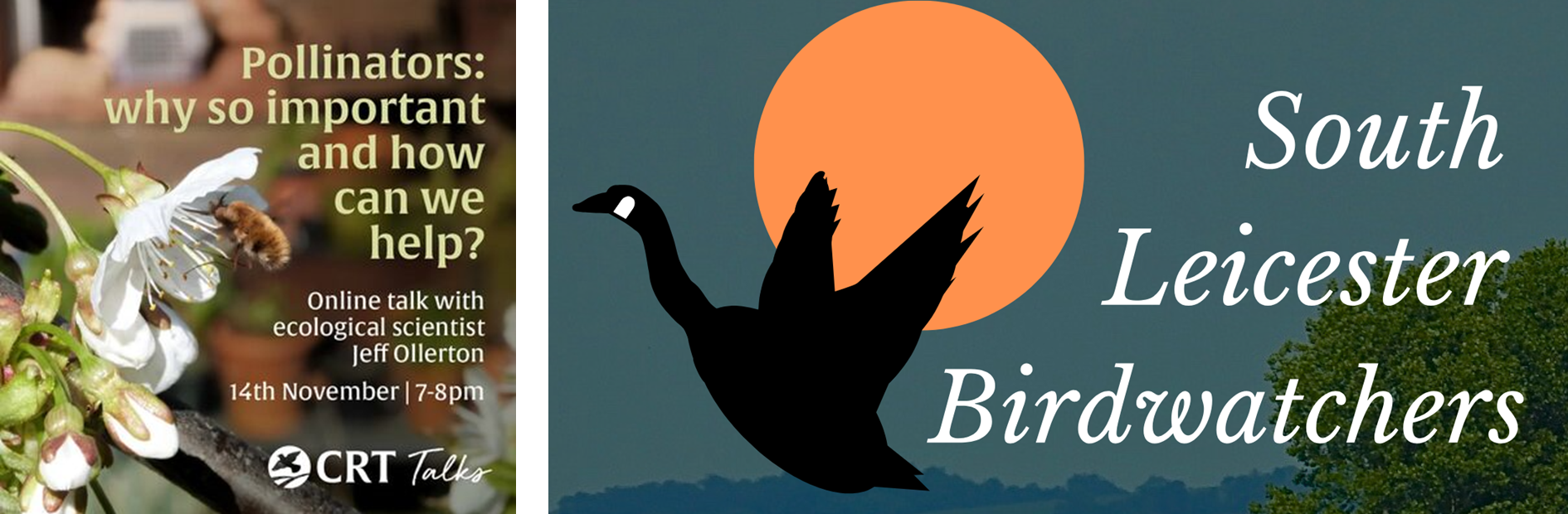
It’s been a busy year for talks! But next week sees the final two of 2024 put to bed:
On Tuesday 12th November at 6.45pm I’ll be speaking in person about my recent book Birds & Flowers: An Intimate 50 Million Year Relationship at South Leicester Birdwatchers – details can be found by following this link. I’ll bring along copies of my books to buy – the perfect Christmas gift!
On Thursday 14th November at 7pm I’ll be giving an online presentation to the Countryside Regeneration Trust about UK pollinators and how farmers and other large landowners can help to conserve their populations – booking details are here.
I hope to see you at one or both of these talks.

Yesterday I delivered a webinar for the Biological Recording Company on the topic of what Biodiversity Net Gain (BNG) could mean for pollinator conservation. It’s a topic that clearly has a lot of resonance for the ecology community: almost one thousand people (994 to be precise) booked to attend, of which 380 actually watched. That’s a fairly typical ratio for free webinars, in my experience – many people book a place in the expectation that they will receive a link to watch the recording later.
The talk was indeed recorded and can be viewed by following this link to YouTube. There was a Q&A session afterwards which is not part of the recording but the questions and my answers have been transcribed and can be viewed on the Biological Recording Company’s blog, together with links to all of the references and data sources that I cited. Here’s the link to the blog.
I had a lot of really positive feedback during and after my talk, plus some extremely useful comments about where my interpretation of BNG was incorrect (or at least didn’t tell the whole story). As I stressed during my talk, BNG is a journey not an end point and we are all at the start of that journey! It’s going to be fascinating and important to see whether BNG can positively impact declining pollinator populations.
The most globally significant groups of pollinators are well known and have been studied for a long time: bees and wasps, flies, butterflies and moths, birds, bats and beetles are all familiar to those of us with an interest in pollination ecology. However, every few years a new type of pollinator or a novel pollination system is described from nature or from the fossil record, or we add further examples of previously neglected pollinator groups such as cockroaches.
This begs the question: how much is there still to discover? How close are we to describing the full diversity of animals that act as pollen vectors? Can looking at the past help us to predict what we might find in the future? That’s the topic of a Perspective article that I was invited to write for the special issue of the Journal of Applied Entomology on the theme of The Neglected Pollinators that I mentioned last month. It’s a subject that I’ve thought about a lot over the last few decades and it was great to get an opportunity to air some ideas and speculation.
The article is open access and you can download a copy by following the link in this reference:
Here’s the abstract:
Although huge progress has been made over the past 200 years in identifying the diversity of pollinators of angiosperms and other plants, new discoveries continue to be made each year, especially in tropical areas and in the fossil record. In this perspective article I address the following questions: Just how diverse are the pollinators and what are the phylogenetic limits to that diversity? Which other groups of animals, not currently known to regularly engage with flowers, might be found to be pollinators in the future? Can we predict, from the fossil record and from discoveries in under-researched parts of the world, which animal groups might turn out in the future to contain pollinators? I also discuss why adding to our knowledge of plant–pollinator interactions is important, but also stress that an incomplete knowledge may not be a bad thing if it means that remote, inaccessible and relatively pristine parts of the world remain that way.
Just after I arrived in Northampton in 1995, I set about looking for suitable local sites for conducting pollination ecology field work for myself and students. The campus on which we were situated at the time was adjacent to an urban park – Bradlaugh* Fields – parts of which were designated as local nature reserves. In the intervening years, data from that area have made their way into a wide range of published studies, including:
I still have data collected during that time that have never been published, but good data are hard won and they may see the light of day at some point. Case in point is that we’ve just published a paper based on data from Bradlaugh Fields, the first of which were collected in 2001!
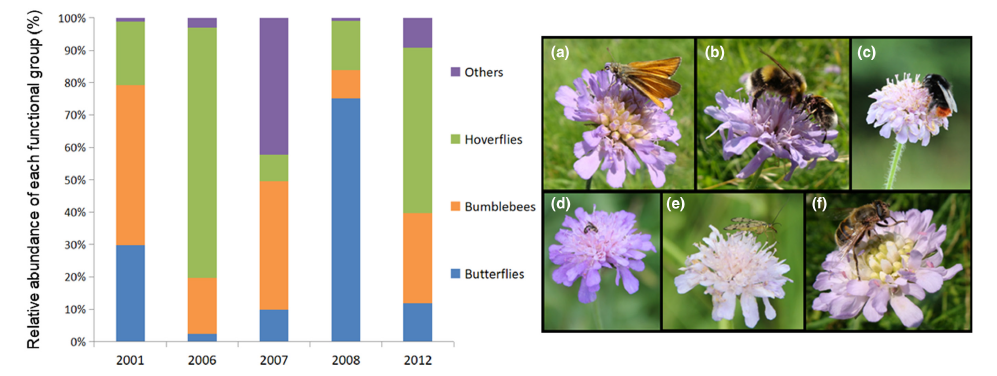
In this paper we’ve tested how effective hoverflies, butterflies and bumblebees are at pollinating the flowers of a common generalist grassland plant, colloquially called Field Scabious (Knautia arvensis). The expectation was that bumblebees, being generally larger, hairier and more flower-focused than the other groups, would be the most effective at transferring pollen to stigmas. To our surprise, they were not: hoverflies and butterflies performed just as well! In fact we argue that butterflies may be MORE important as pollinators of this plant because they fly further distances between individual plants, rather than hopping between the inflorescences of the same plants, as bumblebees tend to do.
Crucially, the importance of these different groups of pollinators varies enormously as the relative abundance of the insects visiting the flowers differs between seasons. In some years butterflies dominate as pollinators, in other years bumblebees or hoverflies. This is driven, we think, both by fluctuations in the populations of these insects and by the availability of other, more preferred flowers that may bloom at the same time.
The paper is part of a special issue of the Journal of Applied Entomology devoted to The Neglected Pollinators. It’s open access and you can download a copy by following the link in this reference:
Here’s the abstract:
Plant-pollinator interactions exist along a continuum from complete specialisation to highly generalised, that may vary in time and space. A long-held assumption is that large bees are usually the most effective pollinators of generalist plants. We tested this by studying the relative importance of different groups of pollinators of Knautia arvensis (L.) Coult. (Caprifoliaceae: Dipsacoideae). This plant is suitable for such a study because it attracts a diversity of flower visitors, belonging to different functional groups. We asked whether all functional groups of pollinators are equally effective, or if one group is most effective, which has been documented in other species with apparently generalised pollination systems. We studied two subpopulations of K. arvensis, one at low and one at high density in Northampton, UK. To assess pollinator importance we exposed unvisited inflorescences to single visits by different groups of pollinators (butterflies, bumblebees, hoverflies and others) and assessed the proportion of pollinated stigmas. We then multiplied the effectiveness of each pollinator group with their proportional visitation frequency in five different years. For each group we also compared time spent on flowers and flight distance between visits. The relative importance of each pollinator group varied between years, as did their flight distances between flower visits. Butterflies were the best pollinators on a per visit basis (in terms of the proportion of stigmas pollinated) and flew further after visiting an inflorescence. Different measures and proxies of pollinator effectiveness varied between taxa, subpopulations, and years, and no one group of pollinators was consistently more effective than the others. Our results demonstrate the adaptive value of generalised pollination strategies when variation in relative abundance of different types of pollinators is considered. Such strategies may have buffered the ability of plants to reproduce during past periods of environmental change and may do so in the future.
*Named after the estimable local MP and radical Charles Bradlaugh – see my blog post When Charles collide: Darwin, Bradlaugh, and birth control for Darwin Day 2016
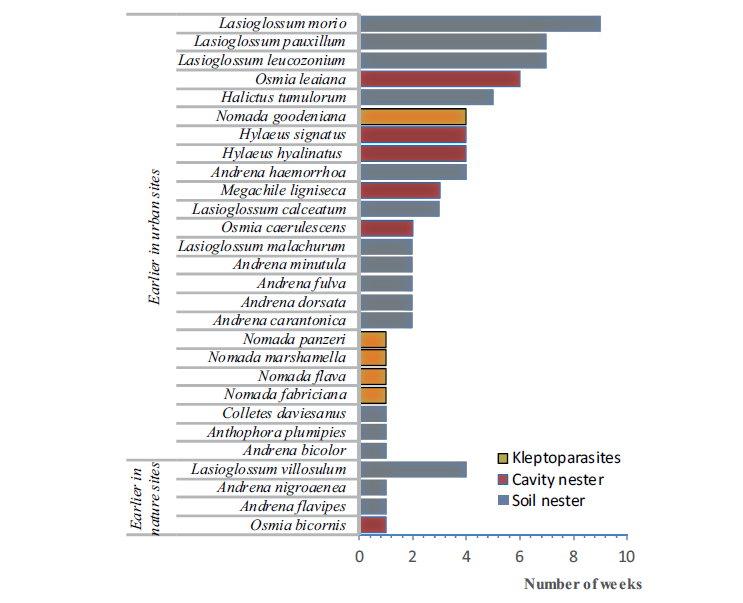
The latest paper from Muzafar Sirohi‘s PhD work on urban solitary bees has just been published in the journal Zoodiversity, a publication of the National Academy of Sciences of Ukraine. In this paper we looked at how the flight periods of urban populations of bees differ from those in surrounding nature reserves and other “natural” settings. One of the most interesting findings is that urban bees tend to emerge earlier, and be active longer, than their rural counterparts. The quote the study:
“We observed a substantial effect of urban microclimate on bee flight periods. A total of 153 individuals of nine bee species were recorded one to nine weeks before or after their expected flight periods. In contrast, only 14 individuals of four species were seen at unusual flight periods in nature sites.”
In my book Pollinators & Pollination: Nature and Society I discussed the importance of towns and cities for supporting pollinator populations, and conversely how important those populations are for urban food production. Likewise, in Birds and Flowers: An Intimate 50 Million Year Relationship I have a chapter entitled “Urban flowers for urban birds”. The relationship between our built environment and pollinators is a fascinating topic, but there’s still much we don’t understand about how these insects and vertebrates respond behaviorally to urbanisation. Are they adapting in an evolutionary sense, or simply responding flexibly to the different conditions that cities impose on their biologies? Will future climate change make towns and cities uninhabitable for these animals? Hopefully our paper will stimulate further work on these and other topics.
Here’s the full reference with a link to the paper (which is open access):
Here’s the abstract:
Solitary and primitively eusocial bees, an important group of pollinators, have declined in the past few decades. In view of the recent focus on safeguarding pollinating insects, it is vital to understand the basic ecology of species for their conservation, for example their phenologies. We observed the flight periods of solitary and primitively eusocial bees in both the urban core of a large British town and nearby nature conservation areas. The bee surveys were conducted with standardised methods, on warm sunny days from the first appearance of bees in March 2012 and continued until October 2012. This study confirmed that a high number of species are active in the spring season. The emergence dates of species in urban areas and nature sites varied; about 26 of the 35 species were recorded at least one week earlier in urban areas; in contrast, only four species were seen earlier in nature conservation sites. When comparing this with the expected flight periods recorded (largely in nature sites) in the literature, many species were recorded at their expected time. However, a few individuals were recorded after their usual flight activity time, suggesting that the populations were possibly affected by the microclimate in urban areas. More urban phenological data are needed to understand the phenological trends in bees in urban habitats.
 Prof. Jeff Ollerton - ecological scientist and author