Category Archives: Hummingbirds

Flowers, feathers and time: a new study of the temporal dynamics of plant-hummingbird interactions just published

What happens when you spend an entire year watching hummingbirds and the plants they visit in one of Brazil’s most unique ecosystems? You begin to unravel the complex, ever-changing relationships that tie together birds, flowers, and the environment they share.

In a new study jointly led by Steffani Queiroz and Marsal Amorim — and part of my ongoing collaboration with a brilliant team of Brazilian hummingbird researchers — we explored how plant–pollinator interactions shift over time in the Campo Rupestre, a montane tropical ecosystem rich in biodiversity and endemic species. Despite the region’s relatively stable climate, we found that the relationships between hummingbirds and flowers are anything but static.

Over the course of 624 hours of observation spread across a full year, we recorded over 9,000 hummingbird visits involving nine bird species and 47 plant species. Many of these plants — and one of the most frequent visitors, the stunning Hyacinth Visorbearer (Augastes scutatus) — are found nowhere else on Earth.

Our goal was to understand how the structure of this ecological network — which plants interact with which hummingbirds, and how often — changes over time, and what drives those changes. Are they shaped by morphological fit (the match between beak and flower shape)? By phenology (when plants bloom)? By nectar characteristics such as the amount produced and its sugar concentration?

What we discovered is that different factors dominate in different seasons. During the rainy season, when hummingbirds are more abundant, interactions were shaped mostly by morphological matching — suggesting that competition leads to greater niche partitioning. In contrast, during the dry season, the network became sparser and was more influenced by nectar sugar content and flowering patterns.

Interestingly, while the overall annual network wasn’t especially nested (a common pattern in mutualistic networks), it was highly modular — meaning that it contained distinct clusters of species that mostly interacted among themselves. This structure changed significantly across months, highlighting the dynamic nature of tropical plant-pollinator interactions, even in environments with relatively little climate variation.

This work highlights the importance of long-term, fine-scale studies in uncovering how interactions among species shift through time. It also underscores the remarkable biodiversity and ecological complexity of the Campo Rupestre — and the need to understand and protect it.

Here’s the reference – if anyone wants a copy, drop me a message via my Contact page:

Queiroz, S.N.P., Amorim, M.D., Lopes, S.A., Vizentin-Bugoni, J., Jorge, L.R., Ollerton, J., Santos, T. & Rech, A.R. (2025) Temporal dynamics of a Neotropical plant-hummingbird interaction network. Austral Ecology 50:e70089

And here’s the full abstract:

Species interaction networks are expected to vary following temporal changes in the environment and the composition of the local community. However, there are still gaps in our knowledge about temporal variation in networks in tropical areas, where less variable climates are expected to produce more stable community structures over time. Here we describe a plant-hummingbird network in the Brazilian Campo Rupestre ecosystem and investigate multiscale temporal variation of interactions in this community as well as the possible mechanisms underlying the frequencies of species interactions. Plants visited by hummingbirds were observed monthly for a year and each species had morphology, phenology and nectar traits measured. During 624 h of observation we recorded nine hummingbird species visiting 47 plant species, amounting to 9015 visits to flowers. Most plants (28 species) were endemic to the Campo Rupestre and mostly visited by the also endemic hummingbird Augastes scutatus (the Hyacinth Visorbearer). The annual network was not nested but presented high modularity and intermediate specialisation. While the overall (annual) frequencies of interaction were primarily defined by morphological matching and phenological overlap, we found a remarkable temporal change in community structure over the year, with different processes underlying interactions among plants and hummingbirds at different seasons. The interaction pattern during the rainy season was more similar to the annual network than the dry season (when nectar sugar content and plant phenology were also important), with more links per species and lower specialisation. The higher importance of morphology to predict interactions during the rainy season suggests higher niche partitioning when more hummingbird species are present in the community. Our results exemplify the importance of considering the temporal dynamics of the community to advance the understanding of the processes defining species interactions over time in the tropics.

My sincere thanks to Sinzinando Albuquerque-Lima for the photograph, which was taken in the Amazon, not where the research described above was conducted.

Join me for a talk at Northamptonshire Bird Club – Wednesday 5th March

The first in a series of public talks that I’m doing this year to promote my book Birds & Flowers: An Intimate 50 Million Year Relationship will take place at Northamptonshire Bird Club on Wednesday 5th March at 19:30.

If you follow this link you can find out more details of the talk and venue.

I’m happy to consider giving similar talks to bird groups across the country, either in person or online. Please use my Contact page to get in touch.

What are the limits to pollinator diversity? A new article poses the question

The most globally significant groups of pollinators are well known and have been studied for a long time: bees and wasps, flies, butterflies and moths, birds, bats and beetles are all familiar to those of us with an interest in pollination ecology. However, every few years a new type of pollinator or a novel pollination system is described from nature or from the fossil record, or we add further examples of previously neglected pollinator groups such as cockroaches.

This begs the question: how much is there still to discover? How close are we to describing the full diversity of animals that act as pollen vectors? Can looking at the past help us to predict what we might find in the future? That’s the topic of a Perspective article that I was invited to write for the special issue of the Journal of Applied Entomology on the theme of  The Neglected Pollinators that I mentioned last month. It’s a subject that I’ve thought about a lot over the last few decades and it was great to get an opportunity to air some ideas and speculation.

The article is open access and you can download a copy by following the link in this reference:

Ollerton, J. (2024) What are the phylogenetic limits to pollinator diversity? Journal of Applied Entomology (in press)

Here’s the abstract:

Although huge progress has been made over the past 200 years in identifying the diversity of pollinators of angiosperms and other plants, new discoveries continue to be made each year, especially in tropical areas and in the fossil record. In this perspective article I address the following questions: Just how diverse are the pollinators and what are the phylogenetic limits to that diversity? Which other groups of animals, not currently known to regularly engage with flowers, might be found to be pollinators in the future? Can we predict, from the fossil record and from discoveries in under-researched parts of the world, which animal groups might turn out in the future to contain pollinators? I also discuss why adding to our knowledge of plant–pollinator interactions is important, but also stress that an incomplete knowledge may not be a bad thing if it means that remote, inaccessible and relatively pristine parts of the world remain that way.

Speaking at Oxford Ornithological Society – 11th September

Later this month I’ve been invited by the Oxford Ornithological Society to give a talk about my new book Birds & Flowers: An Intimate 50 Million Year Relationship. The talk will summarise the main themes from the book, particularly the sheer diversity of birds that can act as pollinators, what it means for the ecology and evolution of flowers, why the conservation of such interactions matters, and the cultural significance of bird-flower interactions. I’ll also deal with the question of why Europe is so odd when it comes to the question of birds as pollinators.

The talk is on Wednesday 11th September at Exeter Hall, Kidlington, starting at 7.45 pm; it’s free to society members, and non-members are invited to make a donation. Do come along if you’re in the area!

More details here: https://www.oos.org.uk/programme.php

I’ll bring a few copies of Birds & Flowers and Pollinators & Pollination: Nature and Society if anyone wants to buy a signed book.

Also in the diary are talks at South Leicester Birdwatchers (13th November) and Northamptonshire Bird Club (5th March).

If you represent a birding club or natural history society and wish to book me for a talk, please get in touch via my Contact page.

Urban bees are often early bees says a new study

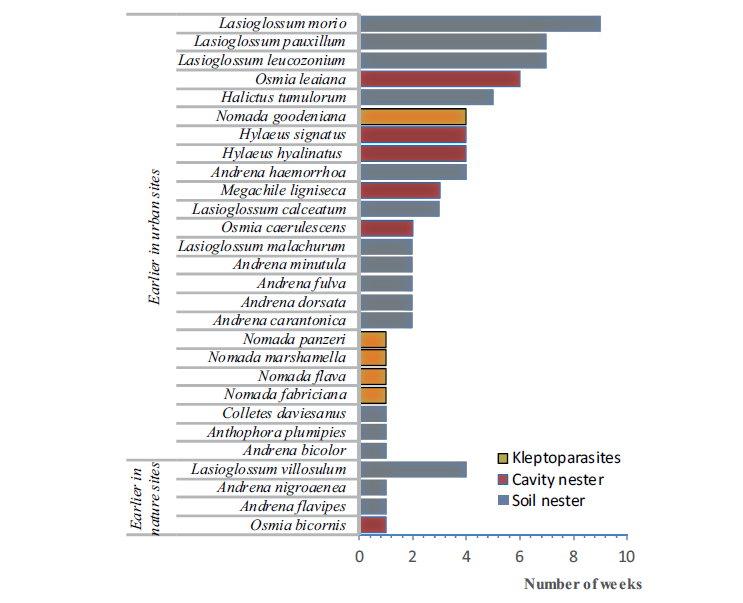
The latest paper from Muzafar Sirohi‘s PhD work on urban solitary bees has just been published in the journal Zoodiversity, a publication of the National Academy of Sciences of Ukraine. In this paper we looked at how the flight periods of urban populations of bees differ from those in surrounding nature reserves and other “natural” settings. One of the most interesting findings is that urban bees tend to emerge earlier, and be active longer, than their rural counterparts. The quote the study:

“We observed a substantial effect of urban microclimate on bee flight periods. A total of 153 individuals of nine bee species were recorded one to nine weeks before or after their expected flight periods. In contrast, only 14 individuals of four species were seen at unusual flight periods in nature sites.”

In my book Pollinators & Pollination: Nature and Society I discussed the importance of towns and cities for supporting pollinator populations, and conversely how important those populations are for urban food production. Likewise, in Birds and Flowers: An Intimate 50 Million Year Relationship I have a chapter entitled “Urban flowers for urban birds”. The relationship between our built environment and pollinators is a fascinating topic, but there’s still much we don’t understand about how these insects and vertebrates respond behaviorally to urbanisation. Are they adapting in an evolutionary sense, or simply responding flexibly to the different conditions that cities impose on their biologies? Will future climate change make towns and cities uninhabitable for these animals? Hopefully our paper will stimulate further work on these and other topics.

Here’s the full reference with a link to the paper (which is open access):

Sirohi, M. H., Jackson, J., & Ollerton, J. (2024). Comparison of Flight Periods of Solitary and Primitively Eusocial Bees in Urban Environments and Nature Conservation Areas: a Preliminary Report. Zoodiversity 58: 317-334

Here’s the abstract:

Solitary and primitively eusocial bees, an important group of pollinators, have declined in the past few decades. In view of the recent focus on safeguarding pollinating insects, it is vital to understand the basic ecology of species for their conservation, for example their phenologies. We observed the flight periods of solitary and primitively eusocial bees in both the urban core of a large British town and nearby nature conservation areas. The bee surveys were conducted with standardised methods, on warm sunny days from the first appearance of bees in March 2012 and continued until October 2012. This study confirmed that a high number of species are active in the spring season. The emergence dates of species in urban areas and nature sites varied; about 26 of the 35 species were recorded at least one week earlier in urban areas; in contrast, only four species were seen earlier in nature conservation sites. When comparing this with the expected flight periods recorded (largely in nature sites) in the literature, many species were recorded at their expected time. However, a few individuals were recorded after their usual flight activity time, suggesting that the populations were possibly affected by the microclimate in urban areas. More urban phenological data are needed to understand the phenological trends in bees in urban habitats.

Listen to my interview on the Crime Pays But Botany Doesn’t podcast!

Last week I had the pleasure of chatting for over two hours with Joey Santore for his Crime Pays But Botany Doesn’t podcast series about my two books Plants & Pollinators: Nature and Society and Birds & Flowers: An Intimate 50 Million Year Relationship.

I’m a long-standing fan of his YouTube video channel which Joey describes as “A Low-Brow, Crass Approach to Plant Ecology & Evolution as muttered by a Misanthropic Chicago Italian.”

It was a lot of fun to talk flowers and pollinators with him and although I tried to keep my swearing to a minimum, if you know Joey and his work, you know what you’re in for, so be warned! It’s not for the easily offended.

We had sound issues at a couple of points and note that at 54:20 I made an error, and said “hummingbirds” a couple of times when I meant “sunbirds”. Put it down to a lack of coffee that morning….

Here’s the link:

The mystery of what pollinates poinsettias – China Diary 3

Is it too early to talk about Christmas? Not if you’re interested in pollinators and pollination! The mid-winter festival has featured quite a number of times on my blog over the years, especially in relation to the iconic plants that represent this time of year in Northern Europe, and what one might describe as the ‘cultural biodiversity‘ of Christmas. The final plant that I included in that last post was the poinsettia (Euphorbia pulcherrima) – this is how I described it:

In many ways this is an unusual plant to have such a strong cultural association with Christmas: it’s a mildly toxic species of spurge from tropical Mexico that was introduced to North America in the 19th century, then subsequently to Europe. However its festive connotations date back to the earliest period of Spanish colonisation in the 16th century, so it’s older than some…other Christmasy traditions…

I also discuss poinsettia, and specifically its pollination, in my recent book Birds & Flowers: An Intimate 50 Million Year Relationship – this is what I say in the chapter called ‘Urban flowers for urban birds’:

Just occasionally one sees a bird-pollinated tree planted in a city. The most common in my experience are various banksias in Australia, and the Royal Poinciana (from Madagascar) and the African Tulip Tree in the urban tropics and subtropics elsewhere in the world. I’ve also occasionally encountered large specimens of Poinsettia: when they are given free rein they are a much more impressive plant than their Christmas cousins. The vivid red bracts that surround the clusters of flowers suggest that they may be hummingbird-pollinated in their native Central America, but as far as I know their pollination ecology has not been studied.

Here at the Kunming Botanic Garden there’s several quite large specimens of poinsettia that, as I write, are in full flower, their red bracts a signal to pollinators that can be seen for quite a distance. However we’ve not seen any of the local sunbirds or white-eyes visit the flowers, and, as I said in the book, as far as I know the pollination ecology of poinsettia has never been studied in the wild. Close inspection of the flowers in the garden revealed that almost all of the nectaries had at least one nectar-collecting ant sticking out from it, their prominent backsides a deterrent to the Asian Honey Bees (Apis cerana) that also wanted a piece of the action.

Based on the position of the nectaries in relation to the stamens, if the plant is hummingbird-pollinated then the pollen is likely to end up under the chin of the bird. That’s certainly been described in other plant-bird pollination systems. But it does not have to be birds that move the pollen around – red flowers are also associated with other kinds of pollinators, for example butterflies and beetles. But until someone in Mexico does the necessary field work, we’ll just have to speculate.

A new review of ‘Birds & Flowers’ in the Journal of Pollination Ecology

The reviews of Birds & Flowers: An Intimate 50 Million Year Relationship are starting to appear in blogs, magazines and journals. The latest, by Diane Campbell, has just been published in the Journal of Pollination Ecology and I’m so pleased that it was positive! I’ve only met Diane a couple of times at conferences but I have a lot of respect for her work. The review is fair and balanced, and gratifyingly enthusiastic, for example:

In this delightful book, [Ollerton] describes the ways that birds and flowers interact. As in his previous book, Pollinators & Pollination: Nature and Society, [he] takes a deeply personal approach to the subject. He combines anecdotes from his research travels around the world, to mountains of Kenya and Tanzania, the Andes of Peru, Brazil, and Nepal, among other places, with his contributions to, and masterful knowledge of, the recent literature…

The review is free to read and download from Journal of Pollination Ecology. I’m so glad that people are enjoying the book – if you’ve bought or borrowed a copy, please do leave a comment and let me know what you think.

The flower that’s pollinated by birds, bees….and the wind!

In my new book Birds & Flowers: An Intimate 50 Million Year Relationship I spend a bit of time discussing the idea of the bird pollination syndrome that we refer to as ‘ornithophily’, its limitations, and the fact that it has two distinct meanings that are often conflated. One of the problems with ornithophily, and indeed all of the syndromes, is that historically it’s sometimes blinkered scientists to the extent that they only look at the flower visitors that are “right” for the syndrome, ignoring the rest or dismissing them as “secondary pollinators”, a term I dislike.

Why do I dislike that term? Because it fails to capture the complexity of flower-pollinator interactions and relegates an important component of plant reproduction to a subsidiary role. I could go on about this at some length, but if you’re interested in discovering more, look at pages 62-65 of Birds & Flowers. There I contrast the classical Most Effective Pollinator Principle with the equally valid (but much less well studied) Least Effective Pollinator Principle, with a segue into one of my favourite tracks from Led Zeppelin’s second album: What is and What Should Never Be.

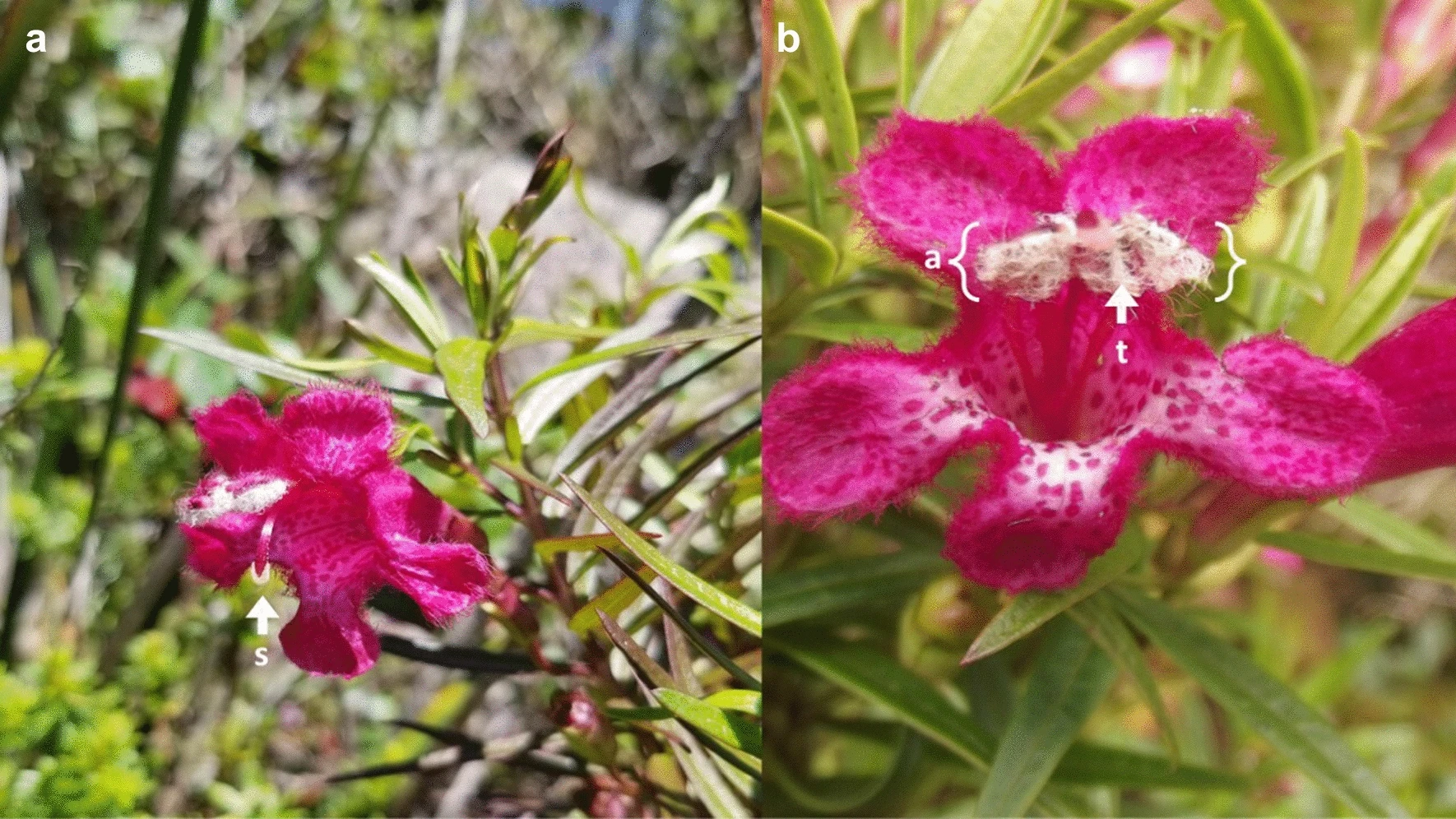
But back to the real subject of this post – a flower that corresponds to the classical bird pollination syndrome BUT is also pollinated by bees and (very surprisingly) wind! It’s such an interesting paper by Brazilian ecologists Amanda Pacheco, Pedro Bergamo & Leandro Freitas – here’s the reference and a link to the study:

Pacheco, A., Bergamo, P.J. & Freitas, L. (2024) An unexpected case of wind pollination: ambophily in an ornithophilous tropical mountaintop Orobanchaceae. Plant Systematics and Evolution 310, 9. https://doi.org/10.1007/s00606-024-01890-6

For over 100 years the classical pollination syndromes have acted as a framework for understanding the ecology and evolution of plant-pollinator interactions. But we’ve long known that while they can be a useful shorthand, they do not fully reflect the complexity of how pollination systems evolve. That shouldn’t surprise us because, as I point out in my two recent books, we have data (of any quality) on no more than 10% of the 350,000 or so species of flowering plants!

In addition, those plants for which we do have good data are NOT a random subset of the flowering plants: they have been specifically chosen by researchers because they look to be good systems with which to address particular ecological or evolutionary questions.

Which is fine, but we MUST recognise that this imposes significant restrictions on our understanding of the biodiversity of plant-pollinator interactions. The authors of this paper expressed it very well when they wrote that assumptions about:

“predictability may cause researchers to take for granted that only birds pollinate ornithophilous flowers, hindering research on the contribution of other vectors.”

To which I’d add: it also hinders our understanding of how these interactions evolve over long time scales and across multiple populations.

An obvious question is: how frequent are these sorts of complex pollination systems, involving different pollen vectors of an apparently specialised flower? The answer is that we simply don’t know, because most researchers would have not gone into this level of detail. So a huge congratulations to the authors for a great study – I hope it stimulates others to look beyond the ‘expected’ pollinators of flowers.

Photos: Nathália Susin Streher from the original paper.

Read my author interview and get a 25% discount off ‘Birds & Flowers’, ‘Pollinators & Pollination’ and other books from Pelagic Publishing!

I recently did a short interview with Pelagic Publishing’s marketing person, Sarah Stott, which you can read here: https://pelagicpublishing.com/blogs/news/birds-and-flowers-author-interview.

On that page you can sign up to Pelagic’s newsletter (which I STRONGLY recommend, because they produce some great natural history and science books, and not just mine!) and by doing so you can receive a 25% discount on all orders.

What are you waiting for?