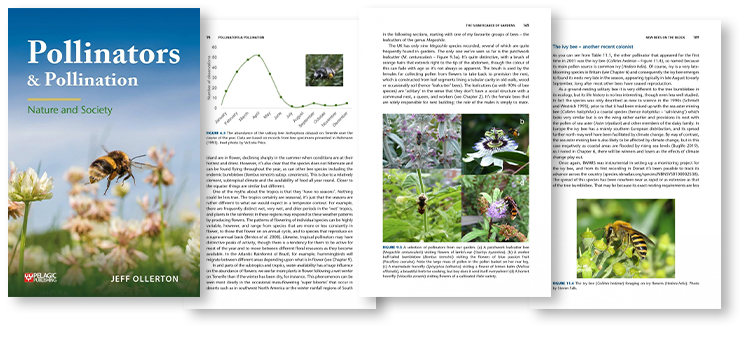
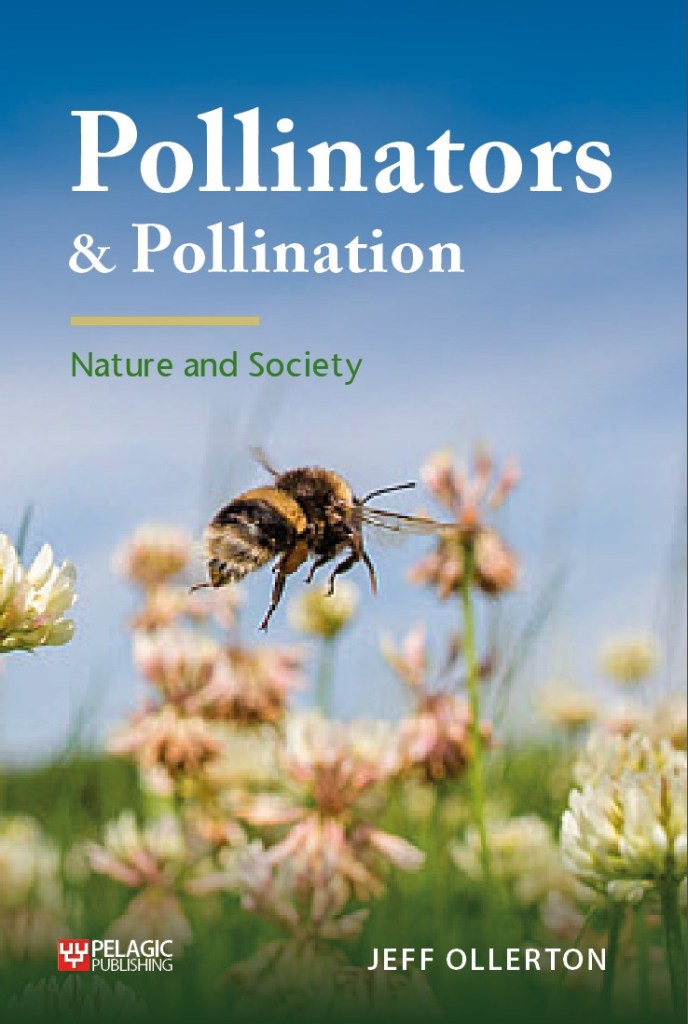
The nice people at NHBS recently did a wide-ranging interview with me about my new book Pollinators & Pollination: Nature and Society and what led me to write it. It covers a lot of ground, including climate change, food security, the UK Pollinator Monitoring Scheme, and growing up in Sunderland.
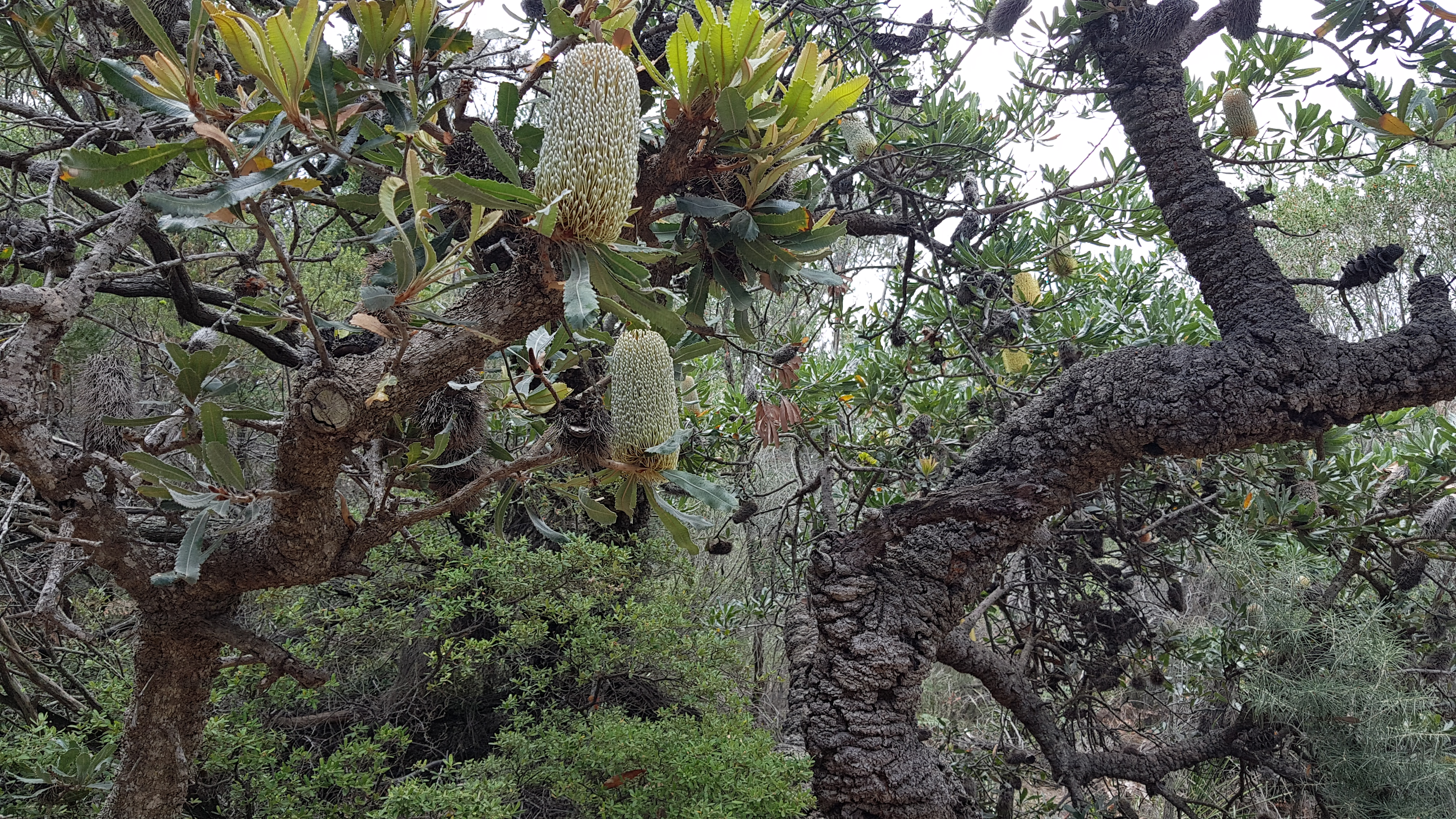
Towns and cities are ecologically complex environments where nature finds a home in all sorts of places, including both highly artificial gardens created by people, and the fragments of natural environment left behind when developments are built. In a new study that I’ve co-authored with Australian researcher Kit Prendergast we’ve for the first time compared and contrasted the pollinators, and the plants that they visit, in urban settings in the the biodiversity hotspot of Western Australia. Full disclosure: the field work was all done by Kit as part of her PhD. I just acted as an “adopted supervisor” (her words!) to help with data analysis and writing up of the work.
I think that it’s a great study, not least because it really highlights just how different gardens are to remnant natural vegetation. If we are to maintain the maximum possible pollinator diversity, and associated pollination services, we need to retain as much remnant vegetation as possible when designing and building new developments. Gardens alone are not enough.
The abstract is below; if you’d like a PDF of the paper please use the form on the Contact page.
Abstract
Urbanisation is a prominent and increasing form of land-use change, with the potential to disrupt the interactions between pollinators such as bees and the flowering plants that they visit. This in turn may cause cascading local extinctions and have consequences for pollination services. Network approaches go beyond simple metrics of abundance and species richness, enabling understanding of how the structure of plant-pollinator communities are affected by urbanisation. Here we compared pollination networks between native vegetation (bushland) remnants and residential gardens in the urbanised region of the southwest Australian biodiversity hotspot. Across fourteen sites, seven per habitat, plant-bee visitor networks were created from surveys conducted monthly during the spring-summer period over two years. Extinction slope (a measure of how extinctions cascade through the network), and network robustness and nestedness were higher for bushland remnants, suggesting that networks in bushland remnants had greater functional integrity, but if disrupted, more cascading extinctions could occur. In contrast, niche overlap between pollinators was higher in residential gardens, suggesting greater competition for resources. Most species-level properties did not differ between habitats, except for normalised degree, which was higher in bushland remnants. In conclusion, it appears that pollination networks in managed residential gardens are not structurally equivalent with those in bushland remnants. This has implications for conservation of wild bee assemblages in this biodiversity hotspot, and suggests removal of remnant native vegetation for residential development could disrupt the integrity of plant-pollinator assemblages.
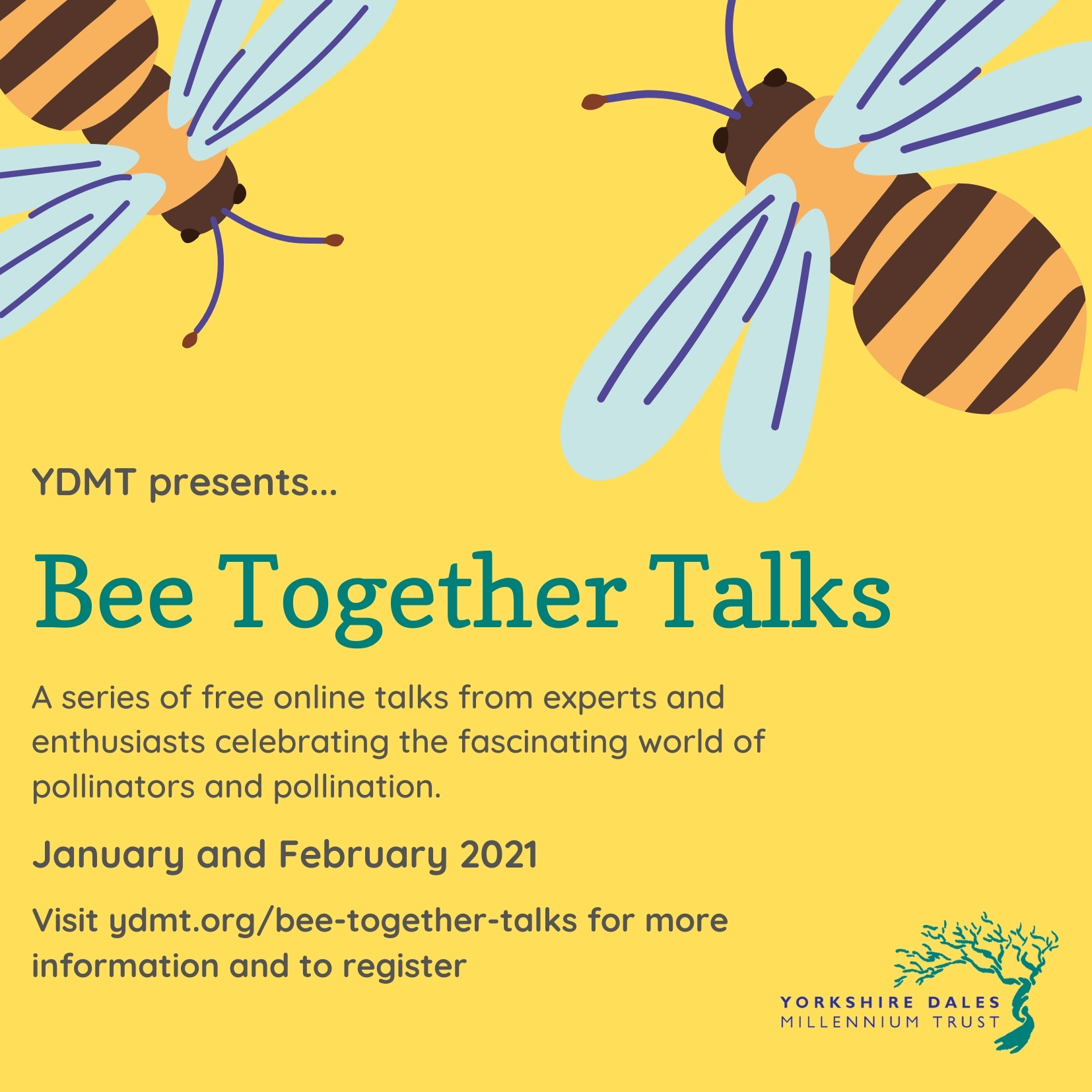
As I write a slow haze of fine snow is falling, covering our garden with a thin white dusting. Spring feels a long way off, despite the emerging spears of daffodil leaves. But you can get a taste of what the new season will bring by signing up for a short series of free evening online talks on the topic of pollinators that has been organised by the Yorkshire Dales Millennium Trust – here’s the link for the Bee Together programme – and here’s more details of the talks:
Thursday January 28 at 7pm: Pollinators and Pollination: Nature and Society An overview of the diversity of pollinators in Britain, why they are important, and the threats to that diversity with Jeff Ollerton.
Thursday February 18 (7pm): The B-Lines Project Buglife’s B-Lines network is an imaginative solution to the problem of the loss of flowers and pollinators. B-Lines are a series of ‘insect pathways’ running through our countryside and towns, along which Buglife are restoring and creating a series of wildflower-rich habitat stepping stones. Catherine Jones talks about mapping the recently completed B-Lines map and some of the projects that have already created habitat for pollinators.
Thursday February 25 (7pm): The Hidden Lives of Garden Bees Brigit Strawbridge Howard will explain some of the basic differences between bumblebees, solitary bees, and honeybees – including lifecycles and nesting behaviour; the problems they all face; and, most important, what we can do to help. Brigit is a wildlife gardener, amateur naturalist and advocate of bees. She writes and campaigns to raise awareness of the importance of native wild bees, and is the author of Dancing with Bees: A Journey Back to Nature.
I hope to see some of you there: Happy New Year everyone!
Pollinators are responsible for producing much of the traditional Christmas food that we enjoy at this time of the year, and add considerable value to the holly and mistletoethat decorates our homes in northern Europe and elsewhere. The link between pollinators and Christmas is something that I discuss in my new book Pollinators & Pollination: Nature and Society. As a special seasonal gift, the publishers (Pelagic) are offering a 30% discount on orders in the run up to Christmas. To claim the discount follow that previous link and use the code CHRISTMAS30 at the checkout. UPDATE: Apologies, the publisher tells me that the discount period has now passed.
Although the book has not yet been formally reviewed in any journal or other form of media, I’ve had some very nice (and unsolicited) comments about it via Twitter . Here’s some examples:
This new book is SUPERB. It contains everything I’ve spent the last 10 years trying to grasp, all in one book, AND written in a way I can understand! I cannot tell you how much I’m learning from it already. It makes such a difference to a non-scientist (like me) to be able to grasp the facts, and the science behind the facts, without having to first look up dozens of terms I don’t understand.
Brigit Strawbridge Howard – author of Dancing With Bees
Good to see discussions of ecology, culture and politics together.
Anon
I was delighted to receive this superb book over the weekend. It’s an extremely informative read for anyone interested in the subject of pollination!
Anon
Looking forward to reading this. I like the tone of what I’ve dipped into so far, really engaging and none of that turgid academic English that gives me a headache!
Steven Falk – author of Field Guide to the Bees of Great Britain and Ireland
Yesterday I was delighted to finally receive an advance copy of my book Pollinators & Pollination: Nature and Society! It’s been over three years in the writing and production, much longer than I had anticipated. But, as I describe in its pages, the book is the culmination of >50 years of experience, study and research. So perhaps three years isn’t so bad…
If you’re interested in buying a copy you can order it direct from Pelagic Publishing and from most of the large online booksellers. Let me know what you think.
It was eminent bee biologist Charles Michener who first* pointed out that there was something odd about the global distribution of bees. In his 1979 paper Biogeography of the bees he writes:
“unlike many groups which abound in the tropics, bees attain their greatest abundance in warm temperate areas”
Think about that for a moment: in contrast to most other groups of insects, birds, mammals, flowering plants, fish, indeed the majority of the Earth’s biodiversity, bees are NOT generally at their most species rich in tropical areas. Rather, we have to move north and south of the equator to find them at their highest diversity. This is an odd pattern of distribution for such a successful (> 20,000 species), globally widespread and ecologically important group of organisms.
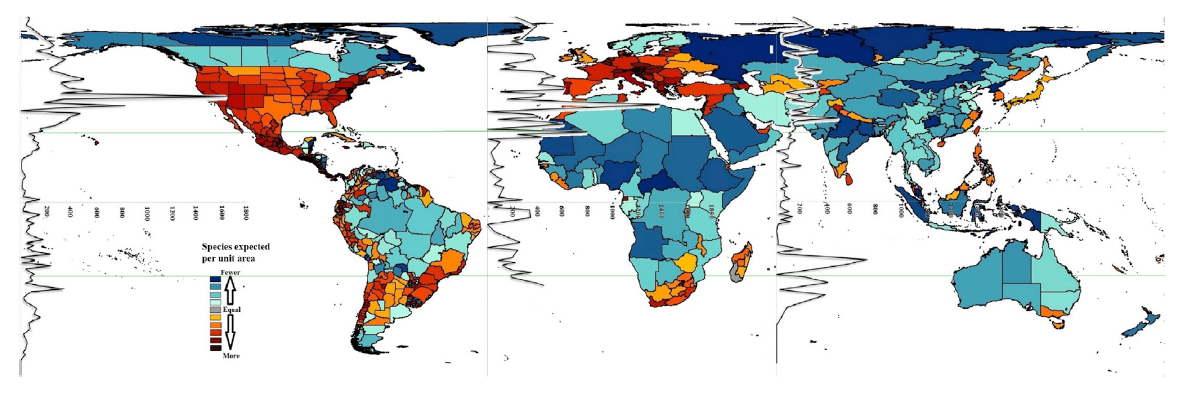
Some 15 years ago I was inspired by Michener’s comments when, together with colleagues Steve Johnson and Andrew Hingston, we wrote a chapter called Geographical variation in diversity and specificity of pollination systems for the 2006 Waser & Ollerton edited volume Plant-pollinator Interactions: from Specialization to Generalization. In that chapter we presented a rough analysis of how bee diversity per unit area in different countries changes with latitude. This, and a follow-up that appeared in my 2017 Annual Review of Ecology, Evolution and Systematics paper, confirmed Michener’s view that there’s an unusual relationship between bee diversity and latitude, with peak species richness outside of the tropics, in warm, dry environments.
What I really hoped over this time was that some serious bee biologists would follow up Michener’s insights and produce a full analysis of how bee diversity changes across the planet. Yesterday that hope was realised when Michael Orr, Alice Hughes, Douglas Chesters, John Pickering, Chao-Dong Zhu and John Ascher published the first analysis of bee diversity across the whole planet, and its underlying causes, in their open-access paper Global Patterns and Drivers of Bee Distribution.
Their analyses are based on a data set of >5,800,000 records of where bees occur and it’s been an incredible achievement to bring all of that together into a planet-wide view of where bees are found, and why. I highly recommend that you download and read it, it’s an impressive piece of work.
What have camels got to do with all of this? Well, as the authors show in their paper (from which the image above is taken), if you graph up the increase in bee species richness with latitude from the poles in each hemisphere, you get two humps at about 35 degrees north and south of the equator: like a Bactrian camel. In contrast, as I noted above, if you were to do the same for for most other species you’d get a single hump at the equator: like a dromedary camel.
One of the key drivers of this bimodal pattern seems to be the amount of rainfall in an environment – bees do not like it too wet, in contrast to their relatives the ants which do show the more typical tropical peak in diversity. As the authors put it:
“humidity may play a key role in limiting bee distribution, such as through spoilage of pollen resources”
One of the implications of this for the biogeography of plant-pollinator interactions is that we might expect there to be a greater diversity of different types of pollinators in areas where bees are not so abundant. And indeed that is exactly what we find: in that Ollerton, Johnson and Hingston book chapter I mentioned we showed that there’s a step-change in the diversity of functionally specialised pollination systems as one moves from the sub-tropics into the tropics. There could be many reason for that but I suspect that one is a relative lack of bees compared to the number of plants species; thus you get tropical “oddities” such as specialised cockroach pollination in some plants.
Orr et al.’s paper is a milestone in bee biogeography and opens up new opportunities for conserving these insects, and their vital relationships with the flowering plants. To give just one example: these analyses provide a framework for predicting bee diversity hotspots in parts of the world that have been poorly explored by bee taxonomists, but which are nevertheless severely threatened by habitat degradation and conversion to agriculture. It could also be used for predicting how climate change might affect future bee distributions, especially in parts of the world that are expected to become wetter. I’m looking forward to seeing how the team’s work develops in the future.
——————————————–
*It’s always risky to state “first”, but Michener was certainly the first that I am aware of. Let me know if you’ve come across any precedents.
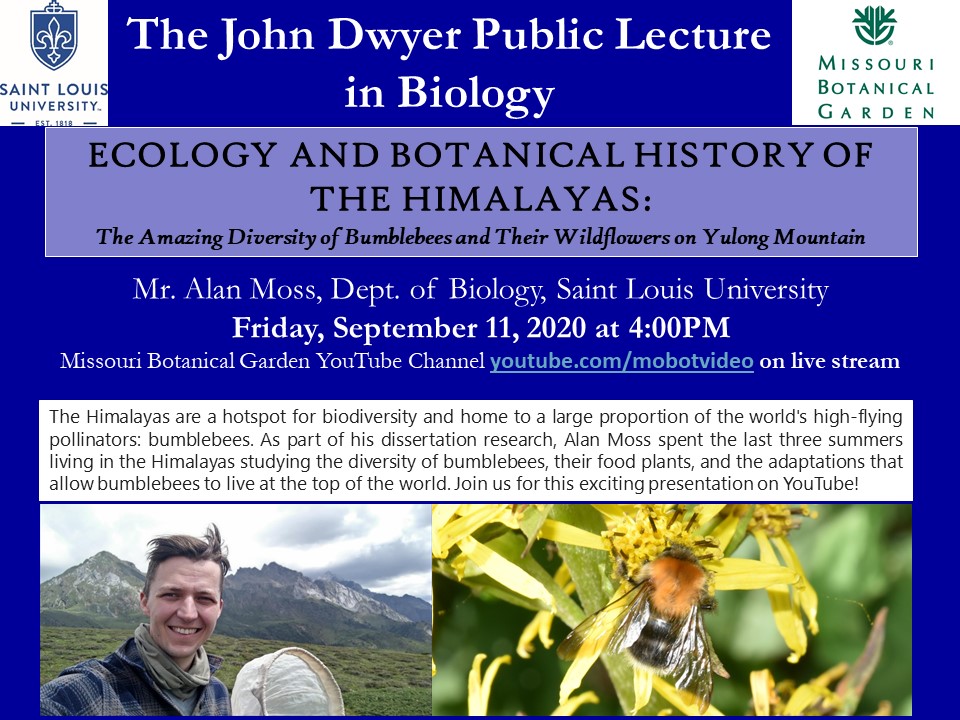
The Missouri Botanical Garden’s annual John Dwyer Public Lecture in Biology for 2020 that I highlighted in a post last month is now available to view on YouTube – follow this link.
The talk by Alan Moss of Saint Louis University is called: “Ecology and Botanical History of the Himalayas: The Amazing Diversity of Bumblebees and Their Wildflowers on Yulong Mountain”.
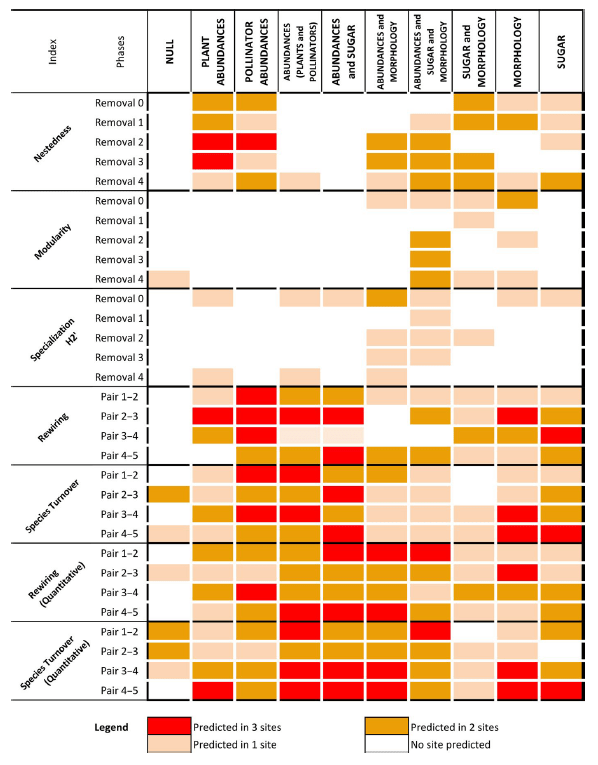
The latest paper from Paolo Biella‘s PhD work, on which I collaborated and that I’ve discussed before on the blog, has just been published in the journal Functional Ecology. It’s entitled “An empirical attack tolerance test alters the structure and species richness of plant–pollinator networks“. The paper presents more of Paolo’s work showing how the experimental removal of the floral resources provided by the more generalised plants in a community can significantly (and negatively) affect the patterns of interaction between flowers and pollinators that we observe. It’s another piece of evidence that demonstrates how important it is to not neglect the common plants that attract a lot of flower visitors when considering how to manage a habitat.
If anyone has trouble accessing the PDF, drop me a line and I will send it to you.
Here’s the reference:
Biella, P., Akter, A., Ollerton, J., Nielsen, A. & Klecka, J. (2020) An empirical attack tolerance test alters the structure and species richness of plant-pollinator networks. Functional Ecology DOI: 10.1111/1365-2435.13642
Here’s the abstract:
Ecological network theory hypothesizes that the structuring of species interactions can convey stability to the system. Investigating how these structures react to species loss is fundamental for understanding network disassembly or their robustness. However, this topic has mainly been studied in‐silico so far.
Here, in an experimental manipulation, we sequentially removed four generalist plants from real plant–pollinator networks. We explored the effects on, and drivers of, species and interaction disappearance, network structure and interaction rewiring. First, we compared both the local extinctions of species and interactions and the observed network indices with those expected from three co‐extinction models. Second, we investigated the trends in network indices and rewiring rate after plant removal and the pollinator tendency at establishing novel links in relation to their proportional visitation to the removed plants. Furthermore, we explored the underlying drivers of network assembly with probability matrices based on ecological traits.
Our results indicate that the cumulative local extinctions of species and interactions increased faster with generalist plant loss than what was expected by co‐extinction models, which predicted the survival or disappearance of many species incorrectly, and the observed network indices were lowly correlated to those predicted by co‐extinction models. Furthermore, the real networks reacted in complex ways to plant removal. First, network nestedness decreased and modularity increased. Second, although species abundance was a main assembly rule, opportunistic random interactions and structural unpredictability emerged as plants were removed. Both these reactions could indicate network instability and fragility. Other results showed network reorganization, as rewiring rate was high and asymmetries between network levels emerged as plants increased their centrality. Moreover, the generalist pollinators that had frequently visited both the plants targeted of removal and the non‐target plants tended to establish novel links more than who either had only visited the removal plants or avoided to do so.
With the experimental manipulation of real networks, our study shows that despite their reorganizational ability, plant–pollinator networks changed towards a more fragile state when generalist plants are lost.
2 More than just bees: the diversity of pollinators
3 To be a flower
4 Fidelity and promiscuity in Darwin’s entangled bank
5 The evolution of pollination strategies
6 A matter of time: from daily cycles to climate change
7 Agricultural perspectives
8 Urban environments
9 The significance of gardens
10 The shifting fates of pollinators
11 New bees on the block
12 Managing, restoring and connecting habitats
13 The politics of pollination
14 Studying pollinators and pollination
As you can see it’s a very wide-ranging overview of the subject, and written to be accessible to both specialists and non-specialists alike. To quote what I wrote in the Preface:
“While the book is aimed at a very broad audience, and is intended to be comprehensible to anyone with an interest in science and the environment, and their intersection with human societies, I hope it will also be of interest to those dealing professionally with plants and pollinators. The subject is vast, and those working on bee or hoverfly biology, for example, or plant reproductive ecology, may learn something new about topics adjacent to their specialisms. I certainly learned a lot from writing the book.”
The book is about 100,000 words in length, lots of illustrations, and there will be an index. My copy editor reckons there’s 450 references cited, though I haven’t counted. I do know that they run to 28 pages in the manuscript, and that’s with 11pt text. All going well it will be published before Christmas.
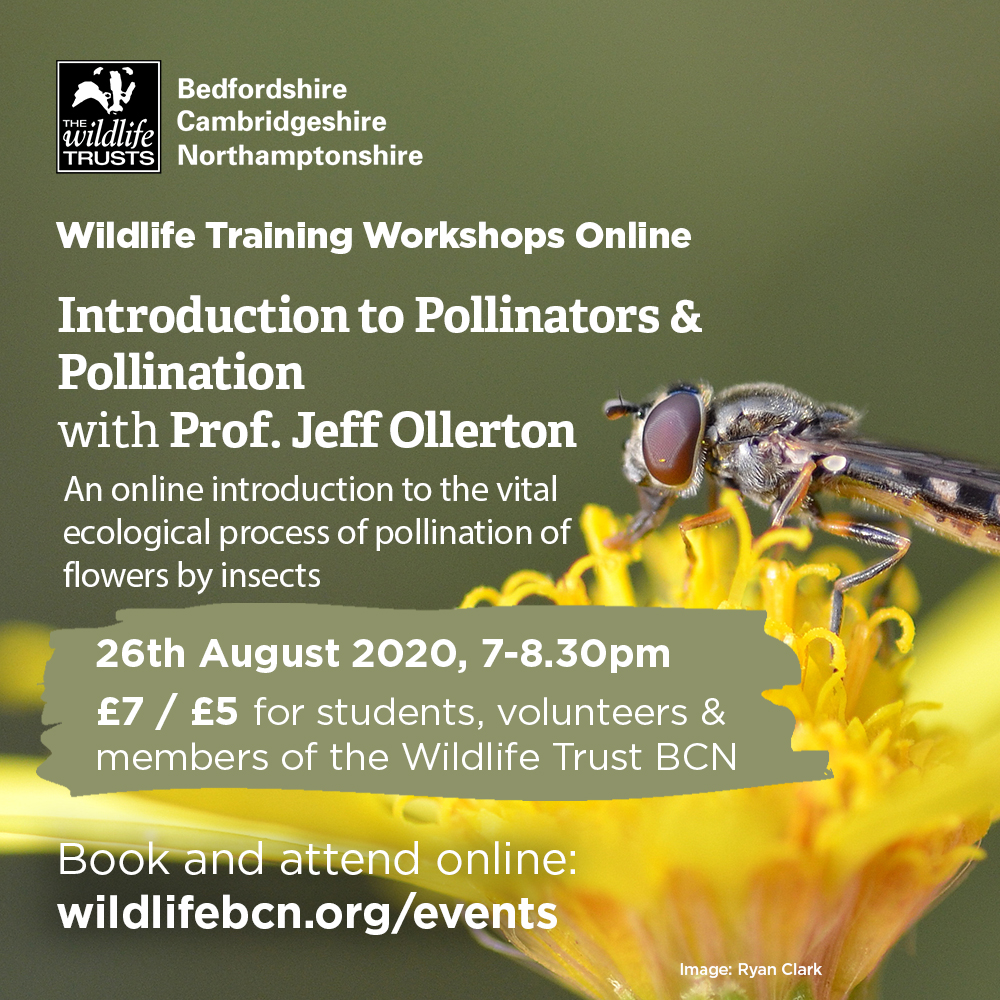
The Wildlife Trust for Bedfordshire, Cambridgeshire and Northamptonshire has invited me to run my Introduction to Pollinators and Pollination workshop again this year, but of course it will all be online. Details for signing up are on the images, or you can follow this link.
Here’s a description of the workshop:
Pollination of flowers ensures the reproduction of most British wild plants and many of our agricultural crops. This session will provide an introduction to the natural history of pollinators and how they interact with the flowers that they pollinate. The main groups of pollinators will be introduced, with guidance on how to identify them, and their ecology and behaviour will be explored. The session will also consider why conserving these species is so important, followed by a Q and A discussion showing what individuals can do to help ensure their future diversity and abundance.