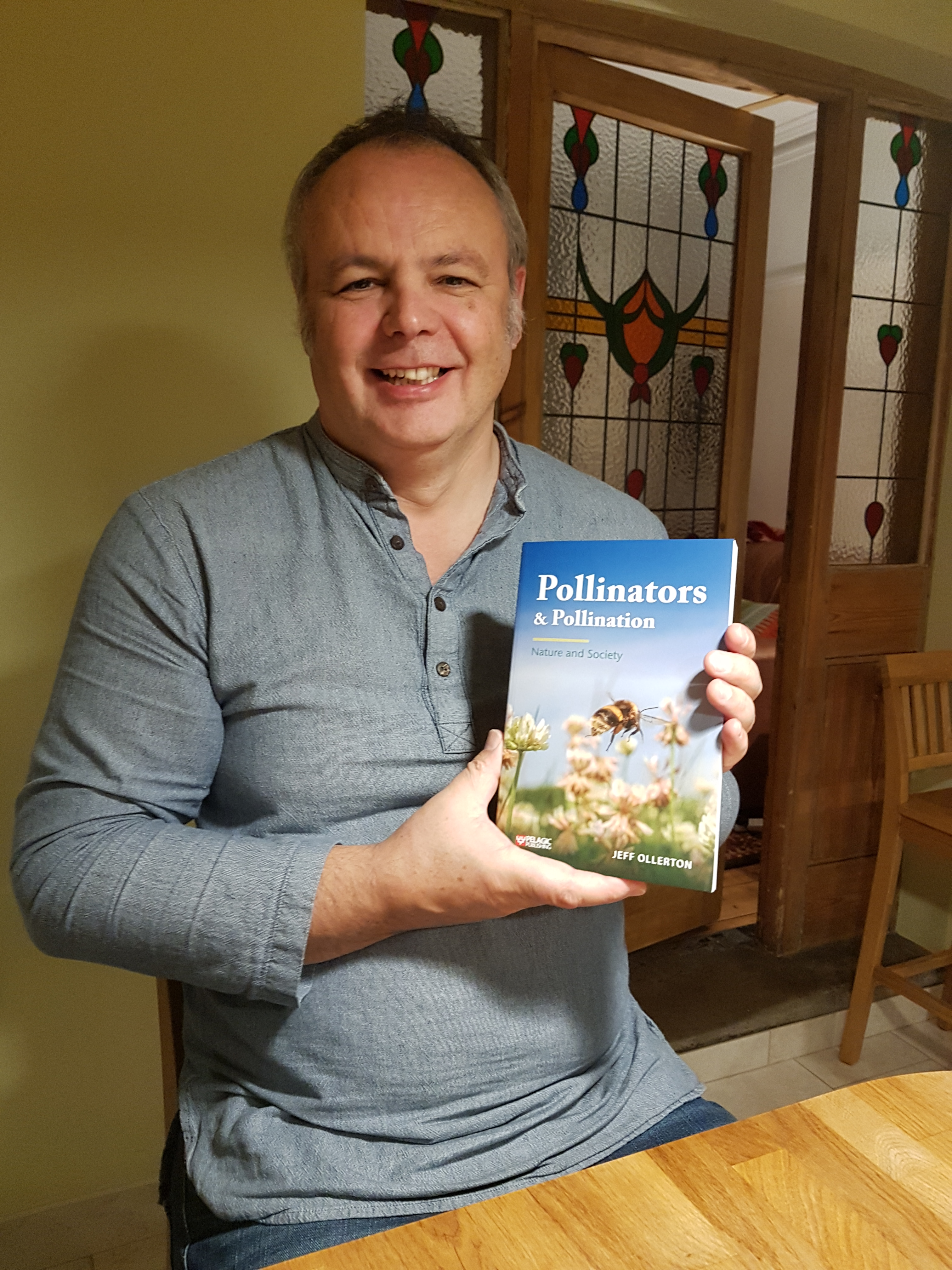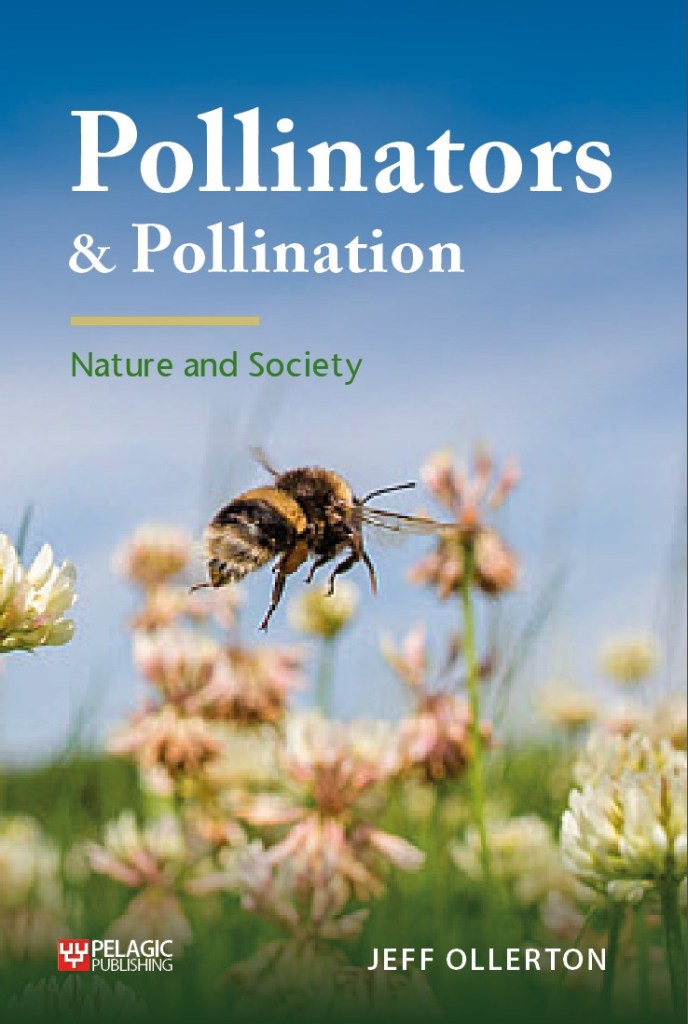
Yesterday I was delighted to finally receive an advance copy of my book Pollinators & Pollination: Nature and Society! It’s been over three years in the writing and production, much longer than I had anticipated. But, as I describe in its pages, the book is the culmination of >50 years of experience, study and research. So perhaps three years isn’t so bad…
If you’re interested in buying a copy you can order it direct from Pelagic Publishing and from most of the large online booksellers. Let me know what you think.
This is a short guest post by Dr Peter Bernhardt who recently retired as a professor at St Louis University and continues to be active in pollination biology.
Each of the 50 American states has its own flag. On Election Day in November 2020 the citizens of the state of Mississippi will vote on whether they want a new flag featuring the flower of their state tree, the southern magnolia or bull bay (Magnolia grandiflora). Of the eight Magnolia species native to the continental United States six have natural distributions including the state of Mississippi.
By voting in the magnolia flag Mississippians drop its 126-year old predecessor, which incorporated an emblem (the stainless banner) adopted by southern states during the American Civil War (1861-1865). This will also mean that Mississippi will be the only state with a flag depicting a flower in which tepals, stamens and carpels are all arranged in a continuous spiral and is pollinated by beetles (see Leonard Thien’s study published in 1974).
The popularity of M. grandifora far exceeds silviculture in the American south as successful exports stretch over two centuries and its cultigens are found as far as China and Australia.
Politics in America have turned floral in the last months of 2020: kamala, as in vice-presidential candidate Kamala Harris, is an Indian word for sacred lotus (Nelumbo nucifera).
To which Jeff adds: the flag above is the one that Mississippi citizens will be voting on – follow the link at the start to get the full story of the competition that was run to select a new flag.
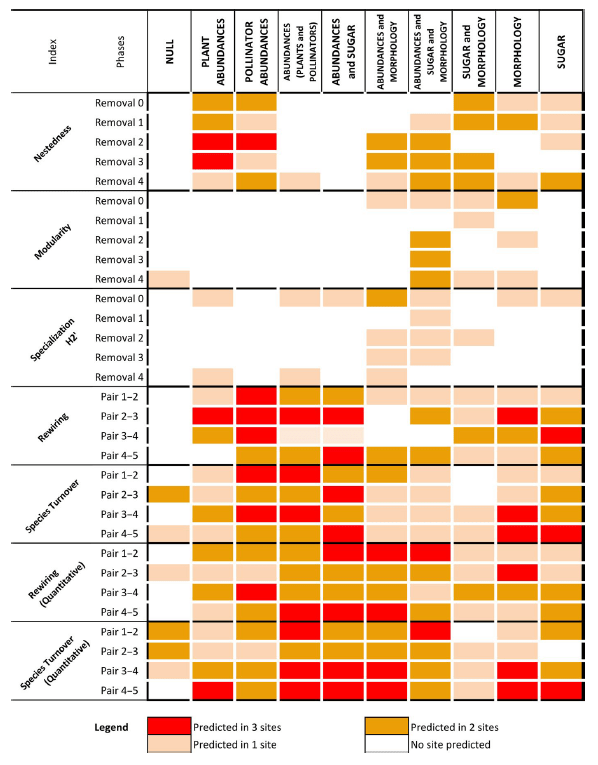
The latest paper from Paolo Biella‘s PhD work, on which I collaborated and that I’ve discussed before on the blog, has just been published in the journal Functional Ecology. It’s entitled “An empirical attack tolerance test alters the structure and species richness of plant–pollinator networks“. The paper presents more of Paolo’s work showing how the experimental removal of the floral resources provided by the more generalised plants in a community can significantly (and negatively) affect the patterns of interaction between flowers and pollinators that we observe. It’s another piece of evidence that demonstrates how important it is to not neglect the common plants that attract a lot of flower visitors when considering how to manage a habitat.
If anyone has trouble accessing the PDF, drop me a line and I will send it to you.
Here’s the reference:
Biella, P., Akter, A., Ollerton, J., Nielsen, A. & Klecka, J. (2020) An empirical attack tolerance test alters the structure and species richness of plant-pollinator networks. Functional Ecology DOI: 10.1111/1365-2435.13642
Here’s the abstract:
Ecological network theory hypothesizes that the structuring of species interactions can convey stability to the system. Investigating how these structures react to species loss is fundamental for understanding network disassembly or their robustness. However, this topic has mainly been studied in‐silico so far.
Here, in an experimental manipulation, we sequentially removed four generalist plants from real plant–pollinator networks. We explored the effects on, and drivers of, species and interaction disappearance, network structure and interaction rewiring. First, we compared both the local extinctions of species and interactions and the observed network indices with those expected from three co‐extinction models. Second, we investigated the trends in network indices and rewiring rate after plant removal and the pollinator tendency at establishing novel links in relation to their proportional visitation to the removed plants. Furthermore, we explored the underlying drivers of network assembly with probability matrices based on ecological traits.
Our results indicate that the cumulative local extinctions of species and interactions increased faster with generalist plant loss than what was expected by co‐extinction models, which predicted the survival or disappearance of many species incorrectly, and the observed network indices were lowly correlated to those predicted by co‐extinction models. Furthermore, the real networks reacted in complex ways to plant removal. First, network nestedness decreased and modularity increased. Second, although species abundance was a main assembly rule, opportunistic random interactions and structural unpredictability emerged as plants were removed. Both these reactions could indicate network instability and fragility. Other results showed network reorganization, as rewiring rate was high and asymmetries between network levels emerged as plants increased their centrality. Moreover, the generalist pollinators that had frequently visited both the plants targeted of removal and the non‐target plants tended to establish novel links more than who either had only visited the removal plants or avoided to do so.
With the experimental manipulation of real networks, our study shows that despite their reorganizational ability, plant–pollinator networks changed towards a more fragile state when generalist plants are lost.
2 More than just bees: the diversity of pollinators
3 To be a flower
4 Fidelity and promiscuity in Darwin’s entangled bank
5 The evolution of pollination strategies
6 A matter of time: from daily cycles to climate change
7 Agricultural perspectives
8 Urban environments
9 The significance of gardens
10 The shifting fates of pollinators
11 New bees on the block
12 Managing, restoring and connecting habitats
13 The politics of pollination
14 Studying pollinators and pollination
As you can see it’s a very wide-ranging overview of the subject, and written to be accessible to both specialists and non-specialists alike. To quote what I wrote in the Preface:
“While the book is aimed at a very broad audience, and is intended to be comprehensible to anyone with an interest in science and the environment, and their intersection with human societies, I hope it will also be of interest to those dealing professionally with plants and pollinators. The subject is vast, and those working on bee or hoverfly biology, for example, or plant reproductive ecology, may learn something new about topics adjacent to their specialisms. I certainly learned a lot from writing the book.”
The book is about 100,000 words in length, lots of illustrations, and there will be an index. My copy editor reckons there’s 450 references cited, though I haven’t counted. I do know that they run to 28 pages in the manuscript, and that’s with 11pt text. All going well it will be published before Christmas.
The Scandinavian Association for Pollination Ecology (SCAPE) now has a dedicated website: https://scape-pollination.org/
The site includes some history of the conference and links to old programmes and abstract booklets, and we will use this for all future conference announcements. SCAPE2020 will be online and registration to give a talk or just attend is now open. If you’re tweeting about it please use the hashtag #SCAPE2020
My thanks to Yannick Klomberg for developing and maintaining the website.
The Wildlife Trust for Bedfordshire, Cambridgeshire and Northamptonshire has invited me to run my Introduction to Pollinators and Pollination workshop again this year, but of course it will all be online. Details for signing up are on the images, or you can follow this link.
Here’s a description of the workshop:
Pollination of flowers ensures the reproduction of most British wild plants and many of our agricultural crops. This session will provide an introduction to the natural history of pollinators and how they interact with the flowers that they pollinate. The main groups of pollinators will be introduced, with guidance on how to identify them, and their ecology and behaviour will be explored. The session will also consider why conserving these species is so important, followed by a Q and A discussion showing what individuals can do to help ensure their future diversity and abundance.
At the time scientists and the media were suggesting that perhaps half a billion reptiles, mammals and birds had been killed, a figure that provoked a strong public reaction when accompanied by images of fire-scorched koalas. This was then revised upwards to 1 billion. But it turns out that even a billion is nowhere close to the real number of animal deaths. A new interim report commissioned by WWF-Australia suggests that just under 3 billion animals were either directly killed or displaced. Those which were displaced were vulnerable to feral predators such as foxes and cats, or more likely to succumb to starvation. An article in The Guardian about the WWF-Australia report is worth reading – here’s the link.
The actual figure is 2.69 billion individual animals. Think about that for a moment. That’s about equivalent the number of people living in India and China combined. This is the breakdown for the different animal groups that were assessed:
● 143 million mammals
● 2.46 billion reptiles
● 180 million birds
● 51 million frogs
One thing should be immediately apparent: this is not a complete list of the “animals” that have been killed. A lack of data means that fish, turtles and (crucially) invertebrates such as spiders, bees, beetles, and earthworms, were excluded. Those invertebrates live at much higher densities than any of the animal groups that were assessed and indeed are the sole or principle food for many of those species. The number of insects required to support just the insectivorous birds is staggering: globally, birds are estimated to eat 400-500 million tonnes of insects and other arthropods every year.
Even if we were to consider just the larger invertebrates, those bigger than say 0.5 cm in length (which are a minority – most are considerably smaller), then then the true scale of the animal deaths is going to be one or two orders of magnitude higher. Or possibly more. Thirty billion, 300 billion, 3 trillion…? Who knows? It’s impossible to estimate, we just don’t have enough information about those organisms.
The other major component of wildlife that is missing from the report is the plants. I know that studies of plant mortality are being undertaken at the moment and it will be important that this is given the same level of publicity as the assessments of animals.
Writing in the foreword of the report, Dermot O’Gorman the CEO of WWF-Australia pointed out that: “It’s hard to think of another event anywhere in the world in living memory that has killed or displaced that many animals. This ranks as one of the worst wildlife disasters in modern history”.
I disagree. I think it’s THE worst wildlife disaster in terms of the scale of animal losses over such a short period of time. No doubt deforestation and destruction of grasslands in South America, Asia and Africa has killed more animals and plants. But that’s over a timescale of decades to hundreds of years. Australian wildlife was devastated in a matter of months. And no one knows exactly what the 2020-21 fire season will bring. But I think that we can safely predict further impacts on wildlife – and people.
Recently I came across an online game based on a simple cellular automaton modelcalled orb.farm in which you have to design an enclosed ecosystem that supports plant, animal and bacterial life. It’s a little bit addictive and a lot of fun! Reminds me of a more sophisticated form of the Tamagotchi, but without the ridiculous waste of plastic, metal and electronics that inevitably comes with these kids’ crazes.
When I tweeted about this earlier in the week the most excitement was generated by some scientists who actually work in lake ecosystem ecology. They were very impressed! The occasional Easter Eggs that appear also keep you hooked. Helpfully, you can also close down your browser or computer and your ecosystem is still there when you open it up again.
Orb.farm is by Max Bittkerand I hope that he develops it further. I can see it being used for some serious experiments as well as being educational and fun.
In the next few months my new book Pollinators & Pollination: Nature and Society will be published. As you can imagine, I’m very excited! The book is currently available to pre-order: you can find full details here at the Pelagic Publishing website. If you do pre-order it you can claim a 30% discount by using the pre-publication offer code POLLINATOR.
As with my blog, the book is aimed at a very broad audience including the interested public, gardeners, conservationists, and scientists working in the various sub-fields of pollinator and pollination research. The chapter titles are as follows:
Preface and Acknowledgements
1. The importance of pollinators and pollination
2. More than just bees: the diversity of pollinators
3. To be a flower
4. Fidelity and promiscuity in Darwin’s entangled bank
5. The evolution of pollination strategies
6. A matter of time: from daily cycles to climate change
7. Agricultural perspectives
8. Urban environments
9. The significance of gardens
10. Shifting fates of pollinators
11. New bees on the block
12. Managing, restoring and connecting habitats
13. The politics of pollination
14. Studying pollinators and pollination
References
Index
This commentary brings together some recent findings in palaeontology, molecular phylogenetics, and pollinator sensory physiology and behaviour, to discuss the progress that’s been made in understanding the deep-time evolution of this most familiar and charismatic of ecological interactions.
The short version is that the old conceptual models are absolutely wrong. Some version of “first came the gymnosperms and they were primitive and unsuccessful because they were wind pollinated. Then, at the start of the Cretaceous, the angiosperms evolved and they were insect pollinated and advanced and so more successful” continues to appear in text books. But we’ve known for a long time that many of the Jurassic gymnosperms were insect pollinated. This may (or may not) predate insect pollination of angiosperms: there are huge disagreements between palaeobotanists and molecular phylogeneticists about when the first flowering plants evolved. The graphic above comes from our essay and shows just how big the discrepancy is: molecular models suggest an origin for the angiosperms about 70 million years prior to the first confirmed fossils. That’s about equivalent to the whole of the Jurassic period! There are similar disagreements when it comes to the evolution of pollinating insects: for the Lepidoptera (butterflies and moths) the difference between the earlier molecular and later fossil evidence may be as much as 100 million years.
As we discuss, there are huge implications in these discrepancies for understanding not just how major elements within the Earth’s biodiversity evolved, but also for the origins of pollinator sensory physiology. Insect behaviours linked to colour vision and odour reception may in turn influence effective crop and wild plant pollination.
The image accompanying our essay is by the very talented biologist, science communicator and graphic designer Elzemiek Zinkstok – follow that link and check out her work.