On Thursday, October 2 at 6:30pm, I’m running an online webinar on the theme of Surveying for Pollinators. Follow that link for more details and to book a ticket.
Here’s an overview of what I’ll be covering:
Pollinators like bees, butterflies, hoverflies and even beetles play a vital role in keeping our ecosystems thriving. They help plants reproduce, support biodiversity, boost food production, and contribute billions to the global economy. Beyond their ecological importance, they’re also excellent indicators of environmental health — when pollinators are doing well, nature usually is too.
But how do we actually find out what’s happening with pollinators?
In this webinar, we’ll explore the fascinating world of pollinator surveys — from simple, hands-on methods anyone can try, to more advanced techniques used by experienced entomologists and ecologists. You’ll get an overview of popular approaches, including:
Flower-Insect Timed Counts – A quick and accessible method inspired by the UK Pollinator Monitoring Scheme (PoMS).
Transect Walks – Great for spotting pollinators along a fixed route and comparing habitats.
Plant-focused sampling – for when you really want to delve deep into the pollinators of a species.
Trapping methods – including pan traps, vane traps, Malaise traps, and moth traps.
Camera Traps – A non-intrusive way to capture who’s visiting flowers when you’re not looking.
We’ll break down the pros and cons of each technique, which approaches are best suited to the question being asked, what to consider before starting your own survey, and how your efforts can feed into national monitoring schemes like PoMS, the UK Butterfly Monitoring Scheme, and BeeWalk.
Whether you’re a curious beginner, a budding citizen scientist, a research student, or a conservation professional, this session will give you the knowledge and tools to design a pollinator survey that fits your goals — and helps protect the buzz behind biodiversity.
The 90-minute event will consist of a 1-hour presentation followed by a Q&A with the tutor using questions provided by the live audience.
The presentations will be recorded and shared with those who booked, alongside Q&A transcripts and relevant links following the event via a password-protected website.
As April comes to a close, many people with gardens will be considering having a No Mow May in which, to quote Plantlife (who have trademarked the phrase!), you ‘pack away the lawnmower, let wildflowers grow freely and help nature’. On the face of it this is a positive thing and (hopefully) it gets people thinking a bit more about the impact of gardening practices on wildlife. However, I do worry that its message is too simplistic, as I’ll explain in the rest of this post. Let me say at the outset that I’m using the word ‘mindful’ in its sense of ‘paying attention to’, rather than in relation to mental health mindfulness. Though there are certainly connections between lawns and both meanings of this word, for example mindfully watching pollinators in your garden.
I’ve previously written about the garden that Karin and I developed in Northampton, including a ‘defence’ of its lawn. During the lockdown spring and summer of 2020, when I coordinated a loose consortium of scientists to collect standardised data on the flowers and pollinators in their own garden, our lawn was one of the areas that I surveyed. In that year, as every year, we had no intention of not mowing the lawn, but of mowing it in a mindful way that left some flowering patches of the main nectar sources: Dandelion (Taraxacum officinale), White Clover (Trifolium repens), and Daisy (Bellis perennis). It also allowed a patch of Common Ragwort (Jacobaea vulgaris), and the Cinnabar Moths (Tyria jacobaeae) that depend on it, to come back year after year.
In the graph below you can see the nectar production of dandelions, clovers and daisies over the course of the late spring to late summer. For each species, I have multiplied the number of flower heads I counted by the average amount of nectar sugar per flower head from the data collected by the Agriland project. Clover produces 48.97 micrograms of sugar per day, by far the highest amount of the three. Daisy produces the least, just 0.84 micrograms, and dandelion is in the middle with 22.57 micrograms.
Because these species vary in their peak flowering, there’s a continuous supply of nectar in the lawn over this time period and mowing does impact the immediate availability of nectar. Using green shading, I’ve marked the two days when I know for certain the lawn was mown and you can see that there’s an immediate drop in the nectar. Here you can also seen that both dandelions and daisies re-flower quite soon afterwards – it’s not a permanent effect by any means. The same is probably true of clover later in the season, but unfortunately I didn’t record the exact mowing dates.
The important thing to appreciate here is that without mowing, these three species would probably disappear from the lawn because all require that grasses are suppressed in order for them to flourish. Not only that, but most ground-nesting bee species need either very short turf or bare soil in which to nest. And most bees, at least in the UK, are ground-nesting.
The image at the top of this post is from my book Pollinators & Pollination: Nature and Society, and it shows two views of the same grassy, south-facing bank in Kettering, Northamptonshire. I included it because it’s a nice example of the mindful approach to lawn mowing that I am describing: bees are able to nest in the low-cut turf and collect the nectar and pollen from the flowers in the unmown areas. Later in the season that unmown area will be cut. This is referred to as ‘matrix mowing’, which is to say that by cutting some areas and leaving others, you create a matrix of different lawn lengths that has a greater overall benefit than is obtained by either cutting everything at the same time or cutting nothing for a whole month. It’s even better if you have the space to leave some patches unmown for a year or two. That way you create longer grassy areas in which insects can over winter and some bumblebees can nest.
It’s worth mentioning at this point that I know of only one published study that’s assessed the impact on No Mow May on pollinators, and that study was retracted shortly after it appeared. If I’ve missed other studies please do let me know in the comments.
I’ll finish with the Royal Horticultural Society, which was in the news recently with an announcement that it’s collaborated with gardener Monty Don to come up with ‘hard-wearing flower lawn that is good for pollinators, dogs and people’. This is hardly rocket surgery, it’s the sort of diverse, low-input, low maintenance lawn that many of us have been advocating for years, but if it brings these ideas to popular attention, so much the better.
So, consider engaging in Mindful Mow May* (and April, and June, and all the other months!) As always, feel free to comment below or get in touch with me via my Contact page.
*In the past I’ve also used the term “Matrix Mow May” which amounts to the same thing – being mindful of exactly where is mown and where is not.
Yesterday I delivered a webinar for the Biological Recording Company on the topic of what Biodiversity Net Gain (BNG) could mean for pollinator conservation. It’s a topic that clearly has a lot of resonance for the ecology community: almost one thousand people (994 to be precise) booked to attend, of which 380 actually watched. That’s a fairly typical ratio for free webinars, in my experience – many people book a place in the expectation that they will receive a link to watch the recording later.
The talk was indeed recorded and can be viewed by following this link to YouTube. There was a Q&A session afterwards which is not part of the recording but the questions and my answers have been transcribed and can be viewed on the Biological Recording Company’s blog, together with links to all of the references and data sources that I cited. Here’s the link to the blog.
I had a lot of really positive feedback during and after my talk, plus some extremely useful comments about where my interpretation of BNG was incorrect (or at least didn’t tell the whole story). As I stressed during my talk, BNG is a journey not an end point and we are all at the start of that journey! It’s going to be fascinating and important to see whether BNG can positively impact declining pollinator populations.
The most globally significant groups of pollinators are well known and have been studied for a long time: bees and wasps, flies, butterflies and moths, birds, bats and beetles are all familiar to those of us with an interest in pollination ecology. However, every few years a new type of pollinator or a novel pollination system is described from nature or from the fossil record, or we add further examples of previously neglected pollinator groups such as cockroaches.
This begs the question: how much is there still to discover? How close are we to describing the full diversity of animals that act as pollen vectors? Can looking at the past help us to predict what we might find in the future? That’s the topic of a Perspective article that I was invited to write for the special issue of the Journal of Applied Entomology on the theme of The Neglected Pollinators that I mentioned last month. It’s a subject that I’ve thought about a lot over the last few decades and it was great to get an opportunity to air some ideas and speculation.
The article is open access and you can download a copy by following the link in this reference:
Although huge progress has been made over the past 200 years in identifying the diversity of pollinators of angiosperms and other plants, new discoveries continue to be made each year, especially in tropical areas and in the fossil record. In this perspective article I address the following questions: Just how diverse are the pollinators and what are the phylogenetic limits to that diversity? Which other groups of animals, not currently known to regularly engage with flowers, might be found to be pollinators in the future? Can we predict, from the fossil record and from discoveries in under-researched parts of the world, which animal groups might turn out in the future to contain pollinators? I also discuss why adding to our knowledge of plant–pollinator interactions is important, but also stress that an incomplete knowledge may not be a bad thing if it means that remote, inaccessible and relatively pristine parts of the world remain that way.
Just after I arrived in Northampton in 1995, I set about looking for suitable local sites for conducting pollination ecology field work for myself and students. The campus on which we were situated at the time was adjacent to an urban park – Bradlaugh* Fields – parts of which were designated as local nature reserves. In the intervening years, data from that area have made their way into a wide range of published studies, including:
I still have data collected during that time that have never been published, but good data are hard won and they may see the light of day at some point. Case in point is that we’ve just published a paper based on data from Bradlaugh Fields, the first of which were collected in 2001!
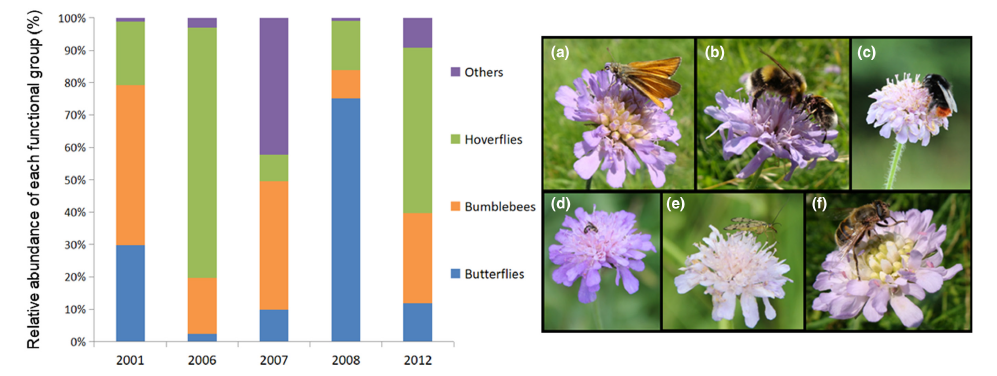
In this paper we’ve tested how effective hoverflies, butterflies and bumblebees are at pollinating the flowers of a common generalist grassland plant, colloquially called Field Scabious (Knautia arvensis). The expectation was that bumblebees, being generally larger, hairier and more flower-focused than the other groups, would be the most effective at transferring pollen to stigmas. To our surprise, they were not: hoverflies and butterflies performed just as well! In fact we argue that butterflies may be MORE important as pollinators of this plant because they fly further distances between individual plants, rather than hopping between the inflorescences of the same plants, as bumblebees tend to do.
Crucially, the importance of these different groups of pollinators varies enormously as the relative abundance of the insects visiting the flowers differs between seasons. In some years butterflies dominate as pollinators, in other years bumblebees or hoverflies. This is driven, we think, both by fluctuations in the populations of these insects and by the availability of other, more preferred flowers that may bloom at the same time.
The paper is part of a special issue of the Journal of Applied Entomology devoted to The Neglected Pollinators. It’s open access and you can download a copy by following the link in this reference:
Plant-pollinator interactions exist along a continuum from complete specialisation to highly generalised, that may vary in time and space. A long-held assumption is that large bees are usually the most effective pollinators of generalist plants. We tested this by studying the relative importance of different groups of pollinators of Knautia arvensis (L.) Coult. (Caprifoliaceae: Dipsacoideae). This plant is suitable for such a study because it attracts a diversity of flower visitors, belonging to different functional groups. We asked whether all functional groups of pollinators are equally effective, or if one group is most effective, which has been documented in other species with apparently generalised pollination systems. We studied two subpopulations of K. arvensis, one at low and one at high density in Northampton, UK. To assess pollinator importance we exposed unvisited inflorescences to single visits by different groups of pollinators (butterflies, bumblebees, hoverflies and others) and assessed the proportion of pollinated stigmas. We then multiplied the effectiveness of each pollinator group with their proportional visitation frequency in five different years. For each group we also compared time spent on flowers and flight distance between visits. The relative importance of each pollinator group varied between years, as did their flight distances between flower visits. Butterflies were the best pollinators on a per visit basis (in terms of the proportion of stigmas pollinated) and flew further after visiting an inflorescence. Different measures and proxies of pollinator effectiveness varied between taxa, subpopulations, and years, and no one group of pollinators was consistently more effective than the others. Our results demonstrate the adaptive value of generalised pollination strategies when variation in relative abundance of different types of pollinators is considered. Such strategies may have buffered the ability of plants to reproduce during past periods of environmental change and may do so in the future.
During the 2020 lockdown caused by the COVID-19 pandemic, I coordinated an international network of pollination ecologists who used standardised methods to collect data in their gardens. I blogged about it at the time – see here and here for instance – and also put up a post when the data paper from that work was published.
Several research groups are now working with that huge data set and interrogating it for answers to a wide range of questions. The first group to actually publish a paper from the data is a largely Chinese set of researchers from the Key Laboratory of Plant Resources, Conservation and Sustainable Utilization, at the South China Botanical Garden in Guangzhou, assisted by Kit Prendergast and myself.
In this paper we’ve considered how robust these plant-pollinator networks are to simulated extinctions of species, and how this is affected by the elevation, latitude, and plant species diversity of the network.
Here’s the full reference with a link to the study:
If you can’t access it and need a PDF, please send me a request via my Contact page.
Here’s the abstract:
Plant-pollinator interactions play a vital role in the maintenance of biodiversity and ecosystem function. Geographical variation in environmental factors can influence the diversity of pollinators and thus, affect the structure of pollination networks. Given the current global climate change, understanding the variation of pollination network structure along environmental gradients is vital to predict how global change will affect the ecological interaction processes. Here, we used a global plant-pollinator interaction data collection by the same sampling method at the same period to explore the effects of elevation, latitude, and plant richness on the structure and robustness of pollination networks. We analyzed a total of 87 networks of plant-pollinator interactions on 47 sites from 14 countries. We conducted a piecewise structural equation model to examine the direct and indirect effects of elevation, latitude, and plant richness on the network robustness and analyzed the function of network structure in elucidating the relationship between robustness and these gradients. We found that plant richness had both positive effects on robustness under random and specialist-first scenarios. Elevation, latitude, and plant richness affected network connectance and modularity, and ultimately affected network robustness which were mediated by nestedness under specialist-first and random scenarios, and by connectance under the generalist-first scenario. This study reveals the indirect effects of elevation, latitude, and plant richness on pollination network robustness were mediated by nestedness or connectance depended on the order of species extinctions, implying that communities with different pollination network structures can resist different extinction scenarios.
A message from Dr Debora Drucker, WorldFAIR Agricultural Biodiversity Case Study Lead:
Registration is open to our contribution to the WorldFAIR webinar series – “Reusing Plant-Pollinator Datasets: a Global Perspective with Guidelines and Recommendations inspired by Pilot Studies from Africa, the Americas and Europe”.
We will present results from Deliverables 10.2 & 10.3, with focus on our pilot studies:
Drucker, D., Salim, J. A., Poelen, J., Soares, F. M., Gonzalez-Vaquero, R. A., Ollerton, J., Devoto, M., Rünzel, M., Robinson, D., Kasina, M., Taliga, C., Parr, C., Cox-Foster, D., Hill, E., Maues, M. M., Saraiva, A. M., Agostini, K., Carvalheiro, L. G., Bergamo, P., Varassin, I.; Alves, D. A., Marques, B., Tinoco, F. C., Rech, A. R., Cardona-Duque, J., Idárraga, M., Agudelo-Zapata, M. C., Marentes Herrera, E. Trekels, M. (2024). WorldFAIR (D10.2) Agricultural Biodiversity Standards, Best Practices and Guidelines Recommendations (Version 1). Zenodo. https://doi.org/10.5281/zenodo.10666593
Drucker, D. P., Salim, J. A., Poelen, J., Soares, F. M., Gonzalez-Vaquero, R. A., Devoto, M., Ollerton, J., Kasina, M., Carvalheiro, L. G., Bergamo, P. J., Alves, D. A., Varassin, I., Tinoco, F. C., Rünzel, M., Robinson, D., Cardona-Duque, J., Idárraga, M., Agudelo-Zapata, M. C., Marentes Herrera, E., Taliga, C., Parr, C.S., Cox-Foster, D., Hill, E., Maués, M.M. Agostini, K. Rech, A.R., Saraiva, A. (2024). WorldFAIR (D10.3) Agricultural biodiversity FAIR data assessment rubrics (Version 1). Zenodo. https://doi.org/10.5281/zenodo.10719265
We reserved a good amount of time for Q&A – I hope to see you there and have a nice discussion!
Yesterday I received an email containing the following press release. I thought it might interest readers of the blog so I am copying it in full with no edits. I had a quick look over the report and it’s amazingly detailed and comprehensive. It’s a shame that the report only covers insects, but that probably reflects my current bias given that my next book, due out in February, is about pollinating birds! Press release follows:
Governor Polis and the Department of Natural Resources Release Pollinator Report
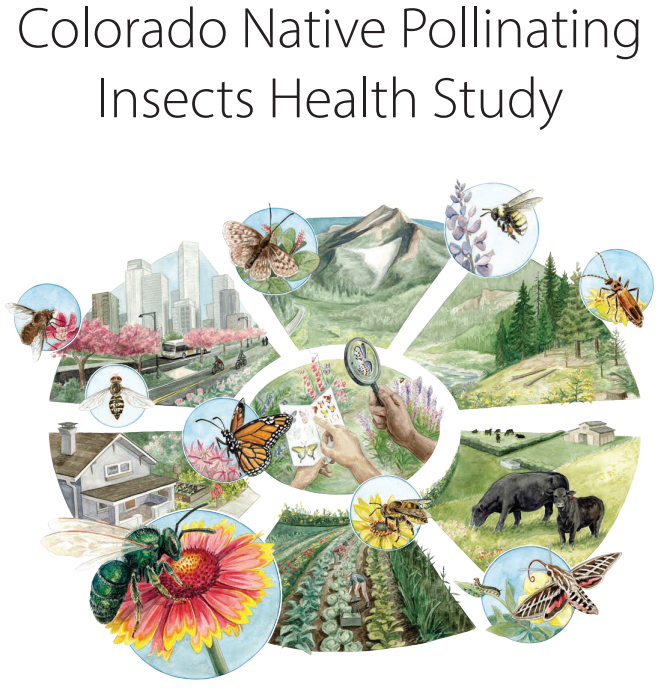
BROOMFIELD – Today, Governor Polis in partnership with The Colorado Department of Natural Resources (DNR), Colorado State University Extension, Xerces Society for Invertebrate Conservation, and University of Colorado Museum of Natural History released the Colorado Native Pollinating Insects Health Study which is the most robust and detailed account of pollinator health ever undertaken in Colorado history. As directed by SB22-199, Native Pollinating Insects Protection Study, sponsored by Senators Sonya Jaquez Lewis and Kevin Priola, and Representatives Cathy Kipp and Meg Froelich, signed by Governor Polis on May 27, 2022, the study assesses the health of Colorado’s native pollinators, evaluates state policies for safeguarding pollinators, and makes recommendations on how to preserve and protect pollinators in Colorado.
“Pollinators play a critical role in Colorado life. From Crested Butte’s beautiful spring meadows to Palisade Peaches and Rocky Ford melons, Colorado’s pollinators sustain our flora and enable many foundational industries in every corner of the state. As our climate changes, we must safeguard the pollinators that generate and regenerate the Colorful Colorado we love,” said Governor Polis
Colorado is home to various native insects and bats whose pollinating services are at the heart of healthy environments and economies. Pollinators are critical to Colorado’s economy and our agricultural production and food systems, and they are essential for flowering plants that support the state’s wildlife ecosystem and add color to Colorado’s beautiful landscapes.
“Colorado is fortunate to have a tremendous diversity of plants and animals, but pollinating insects are perhaps the least studied but most beneficial for our ecosystems, economy and quality of life,” said Dan Gibbs, Executive Director, Colorado Department of Natural Resources. “I greatly appreciate the time and effort of the study authors who truly did a deep dive into the current state of pollinating insects and state policies and structures. I look forward to working with Colorado legislators and stakeholders in pursuing the best policies to ensure pollinating insect protection and long-term health.”
Colorado is home to over 1,000 species of bees—nearly 30% of North America’s and approximately 5% of the world’s bee species—and nearly 300 species of butterflies, representing over 40% of the diversity of butterflies in North America north of Mexico, some of which are already listed under the federal Endangered Species Act. This report underscores the importance of the Polis administration’s goals to tackle Colorado’s greenhouse gas emissions, prepare industries for the impending effects of climate change, and create more sustainable living in Colorado for pollinator populations.
“Our ecosystems rely on pollinators, which is why I’ve championed measures that limit toxic chemicals from harming pollinators and put forth a statewide assessment to better understand the problems our pollinators face and identify practices to better sustain them,” said Senator Sonya Jaquez Lewis, D-Longmont. “Today’s report shows that there’s plenty to do moving forward, and I am looking forward to continuing our work to protect pollinators and the ecosystems that are dependent on them.”
“I’m excited that we have this report to help us understand the extent of pollinator decline in Colorado. While Colorado ranks fifth nationally for the rate of honey-bee die-offs, we haven’t known as much about native pollinating insects. This threatens our food production, biodiversity and health of our ecosystems,” said Rep. Cathy Kipp, D-Fort Collins. “We created the Native Pollinating Insects Protection Study in 2022 to identify ways to better protect and support the native Colorado pollinators, like different bee species, butterflies, and moths, that are also essential to maintaining a healthy environment. These findings will help direct future legislation to create a safer environment for our pollinators, protect our food supply and support biodiversity.”
Promoting policies that benefit native pollinating insects represents an opportunity to foster healthy and sustainable pollinator populations, especially in agricultural and urban habitats. This includes enhancing pollinator-friendly native plantings along I-76 following its designation as a Colorado Pollinator Highway by the Colorado Department of Transportation and other existing state plans such as the state’s Natural Areas Program, and Wildlife Action Plan among others.
“Working on the Pollinator Health Study has been an amazing opportunity to collaborate with so many locally, nationally, and internationally recognized experts in the field of pollinator conservation. In addition to the immense amount of information within the report, this study highlights the importance of collaboration between scientists and land management agencies to bring together the many facets needed for conserving native pollinating insects,” said Deryn Davidson, Sustainable Landscape State Specialist, Colorado State University Extension. “Having the existing research on Colorado pollinators paired with recommended land management practices in one, comprehensive document is an incredible tool for policy makers, land managers, and really anyone interested in actionable steps for pollinator conservation.”
Areas of immediate action and priorities highlighted by the Pollinator Report include:
Priority 2: Protect, restore, and connect pollinator habitats.
Priority 3: Mitigate environmental changes that negatively impact pollinators and their habitats.
Priority 4: Reduce the risks from pesticides to pollinating insects.
Priority 5: Monitor and support native and managed pollinator health.
Governor Polis announced his annual budget proposal on November 1, focusing on ensuring Colorado is more affordable, sustainable, and liveable. The Governor included $100,000 to support education and incentives to encourage the use of pesticide alternatives in agricultural production and residential or commercial landscaping. On May 17, 2023, Governor Polis signed Neonic Pesticides as Limited-Use Pesticides, sponsored by Senators Kevin Priola and Sonya Jaquez Lewis and Representatives Kyle Brown and Cathy Kipp, which protects pollinators from harmful toxins.
Biodiversity Net Gain (or BNG) promises to transform the way that we approach nature conservation in the UK. I’ve been giving a lot of thought to what this might mean for insect pollinators and have produced a new report that summarises the opportunities that BNG presents and how we can make the most of them. You can download a copy of that report by following this link.
This is meant to be a working document and as BNG progresses, and our understanding of its impacts on pollinators increases, I will update it. In the meantime, please do feel free to comment.
There’s an estimated 350,000 described species of pollinators, and many, many more undescribed. Only about 20,000 of these (i.e. less than 6%) are bee species, although you wouldn’t know it from the media obsession with bees. It’s important and and timely, therefore, that a team of South American scientists have come together to propose a special issue of the Journal of Applied Entomology that focuses on these “other” insects.
The special issue will be called “The Neglected Pollinators: Understanding the Importance of Lesser-Known Insect Taxa in Pollination”. Consider submitting a manuscript if you work on anything except bees! Here’s the link to the details of how to submit your work:





 Prof. Jeff Ollerton - ecological scientist and author