Category Archives: Ecosystem services

Pollinator-flower interactions in gardens during the COVID-19 pandemic lockdown of 2020: the data paper has just been published!

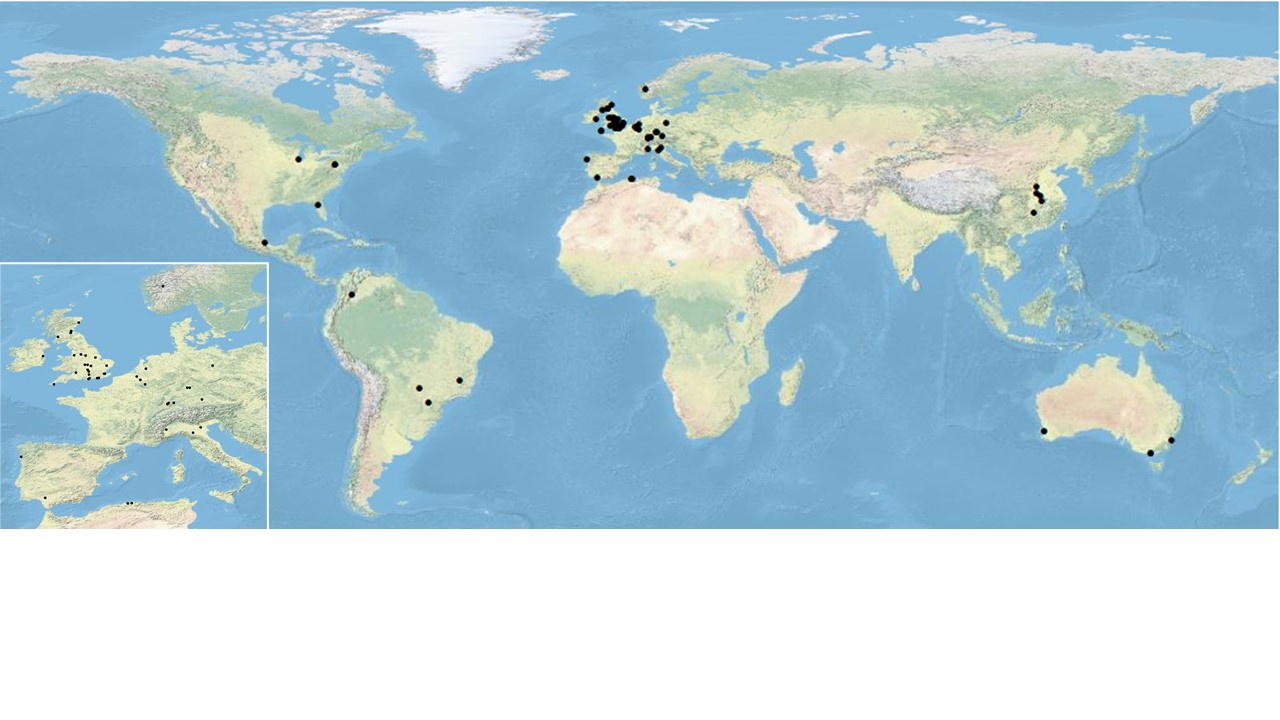
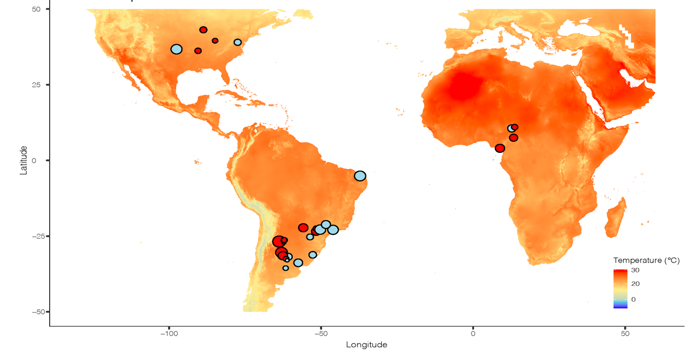
During the lockdown period of the COVID-19 pandemic in 2020, many pollination ecologists were stuck at home: universities and research institutes were closed and restrictions on travel meant that it was not possible to get out and do field work. In order to keep active and motivated, and to turn adversity into an opportunity, an ad hoc network of more than 70 researchers from 15 different countries (see the map above) decided to collect standardised data on the plant-pollinator networks in their own gardens and nearby public spaces.

When combined with information about location, size of garden, floral diversity, how the garden is managed, and so forth, this would provide some useful data about how gardens support pollinators. For those with kids at home it could also be a good way of getting them out into fresh air and giving them something to do!

Following discussions, several different protocols were instigated which depended upon the time available to the researchers, including one that mirrored the UK Pollinator Monitoring Scheme’s  FIT (Flower-Insect Timed) counts.

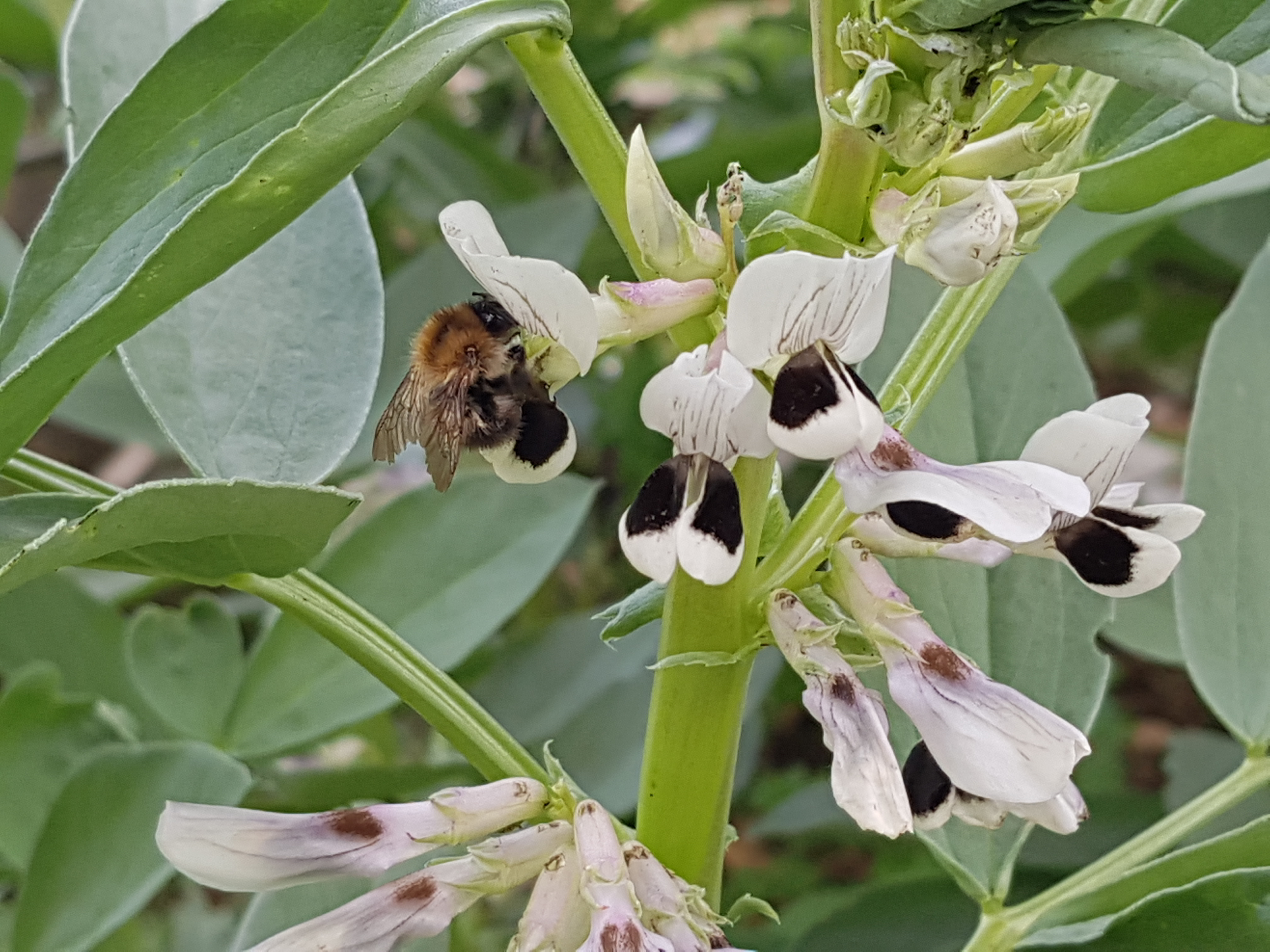
The resulting data set of almost 47,000 visits by insects and birds to flowers, as well as information about flowers that were never visited, is freely available and will be an invaluable resource for pollination ecologists. For example, analysing the links between ornamental flowers that share pollinators with fruits and vegetables such as apples and beans, will allow us to make recommendations for the best plants to grow in home gardens that can increase yields of crops.  

There’s an old saying about turning adversity into a positive outcome: “When life gives you lemons, make lemonade”, and the researchers were pleased to find that there’s one record of Citrus limon in the data set!

The paper describing the data set has just been published in the Journal of Pollination Ecology and you can download a PDF of the paper and the associated data for free by following this link.

Sincere thanks to all of my co-authors for their commitment to the project!

Pollinators (not) on the menu at Kew

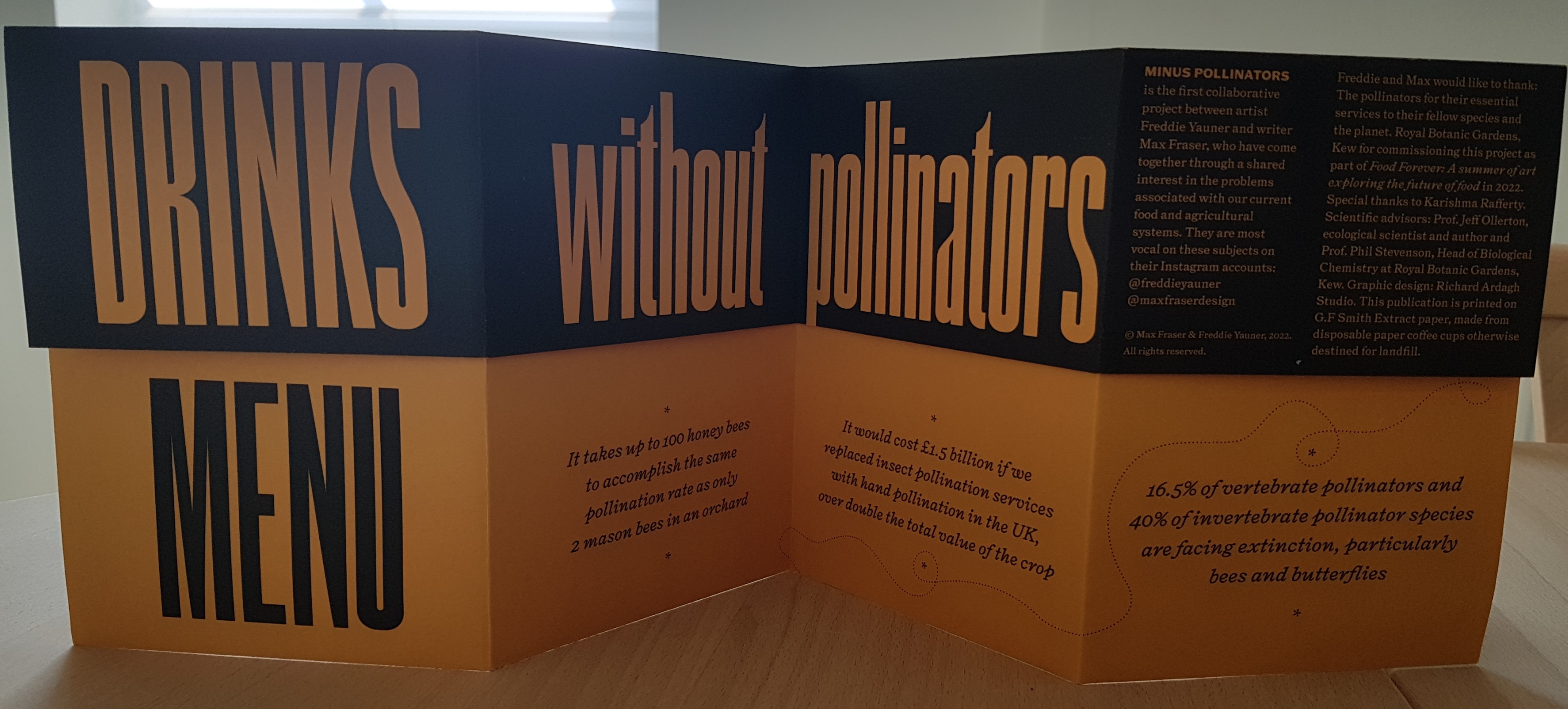
Recently Phil Stevenson and I advised on an art/science project called Minus Pollinators which considered what a small café menu might look like if there were no pollinators to help produce the many, many fruits and vegetables and nuts that are animal pollinated.

The project is a collaboration between writer and consultant Max Fraser and artist Freddie Yauner. To quote Freddie’s description on his website, the project represents:

A dystopian future in the form of a drinks kiosk where the staples such as coffee, teas, juices, chocolate etc. are no longer available due to pollinator decline…the mobile drinks kiosk acts as an exhibition display, with artworks painted in pollen…and a take-away pamphlet…detailing the importance of insect pollinators for our collective future on this planet.

Minus Pollinators was commissioned as part of a summer-long event called Food Forever at the Royal Botanic Gardens, Kew, after which it goes to the Groundswell festival.

It was a pleasure to work with Max, Freddie and Phil on this because art/science projects are a great way of getting the message across about the importance of biodiversity and the current environmental crisis that we are facing.

Practical methods for assessing insect pollination services provided by sites – download our new study for free

In September 2016, along with 11 other pollinator & pollination scientists, I took part in a two-day two-day workshop held at the UNEP-World Conservation Monitoring Centre in Cambridge. The aim was to develop a range of simple, practical methods to enable the valuation of insect pollination services to agricultural crops that are provided by a nature reserves or other natural or semi-natural habitats, for TESSA – the Toolkit for Ecosystem Service Site-Based Assessments.

After a long gestation, caused not least by the COVID-19 pandemic, the paper outlining the methods that we developed has been published. It’s open-access and downloadable for free. Here’s the full reference with a link to the paper:

Ratto, F., Breeze, T. D., Cole, L. J., Garratt, M. P. D., Kleijn, D., Kunin, B., Michez, D., O’Connor, R., Ollerton, J., Paxton, R. J., Poppy, G. M., Potts, S. G., Senapathi, D., Shaw, R., Dicks, L. V., & Peh, K. S.-H. (2022) Rapid assessment of insect pollination services to inform decision-making. Conservation Biology 1–13

And here’s the Abstract:

Pollinator declines have prompted efforts to assess how land-use change affects insect pollinators and pollination services in agricultural landscapes. Yet many tools to measure insect pollination services require substantial landscape-scale data and technical expertise. In expert workshops, 3 straightforward methods (desk-based method, field survey, and empirical manipulation with exclusion experiments) for rapid insect pollination assessment at site scale were developed to provide an adaptable framework that is accessible to non-specialist with limited resources. These methods were designed for TESSA (Toolkit for Ecosystem Service Site-Based Assessment) and allow comparative assessment of pollination services at a site of conservation interest and in its most plausible alternative state (e.g., converted to agricultural land). We applied the methods at a nature reserve in the United Kingdom to estimate the value of insect pollination services provided by the reserve. The economic value of pollination services provided by the reserve ranged from US$6163 to US$11,546/year. The conversion of the reserve to arable land would provide no insect pollination services and a net annual benefit from insect-pollinated crop production of approximately $1542/year (US$24∙ha–1∙year–1). The methods had wide applicability and were readily adapted to different insect-pollinated crops: rape (Brassica napus) and beans (Vicia faba) crops. All methods were rapidly employed under a low budget. The relatively less robust methods that required fewer resources yielded higher estimates of annual insect pollination benefit.

The value of nature, the value of guitars

How we, as a society, value nature, and the tension between valuing (or appreciating) nature versus appreciating (or pouring money into) human cultural activities, have been consistent themes of this blog since I started it almost a decade ago; see for example my posts “How do we value nature? Costanza, Monbiot and the clash of concepts” and “Is the angry response of (some) environmentalists in the aftermath of the Notre Dame fire reasonable?

Putting a monetary price on nature runs counter to the personal philosophies of many conservationists, which I completely understand: I have mixed feelings too. However there’s a whole field of research devoted to it called Ecological Economics and the valuation of natural capital and ecosystem services now plays a central role in the policies and strategies of both businesses and governments: see for instance the UK Government’s recent report on “The Economics of Biodiversity: The Dasgupta Review“. And whether we like it or not, the Earth’s ecosystems and the biodiversity that they contain support our global economy in very tangible ways, a point that I emphasise in my book Pollinators & Pollination: Nature and Society. If you’re reading this with a cup of coffee in your hand, you have to consider the ecological and financial impact of the billions of wild and managed bees that support the global coffee industry.

“What’s all of this got to do with guitars?” I hear you asking. Well, music, and especially guitars, are another constant theme of the blog, including my love of the songs of Crosby, Stills, Nash and Young, and my restoration of an old acoustic guitar back in 2020.

These themes converged together in a rather unexpected way just over a week ago. It was my birthday and as a present Karin had offered to buy me a new guitar. So off we went to Copenhagen for the day. One of the city’s best guitar shops is Akustikken and there I tried out several makes and models of acoustic guitar, of varying price and quality, before finally settling on an Epiphone Texan in an aged sunburst finish (see the image below). It plays very nicely, felt right in my hands, and was moderately priced despite its solid wood construction (cheap guitars often use laminated wood).

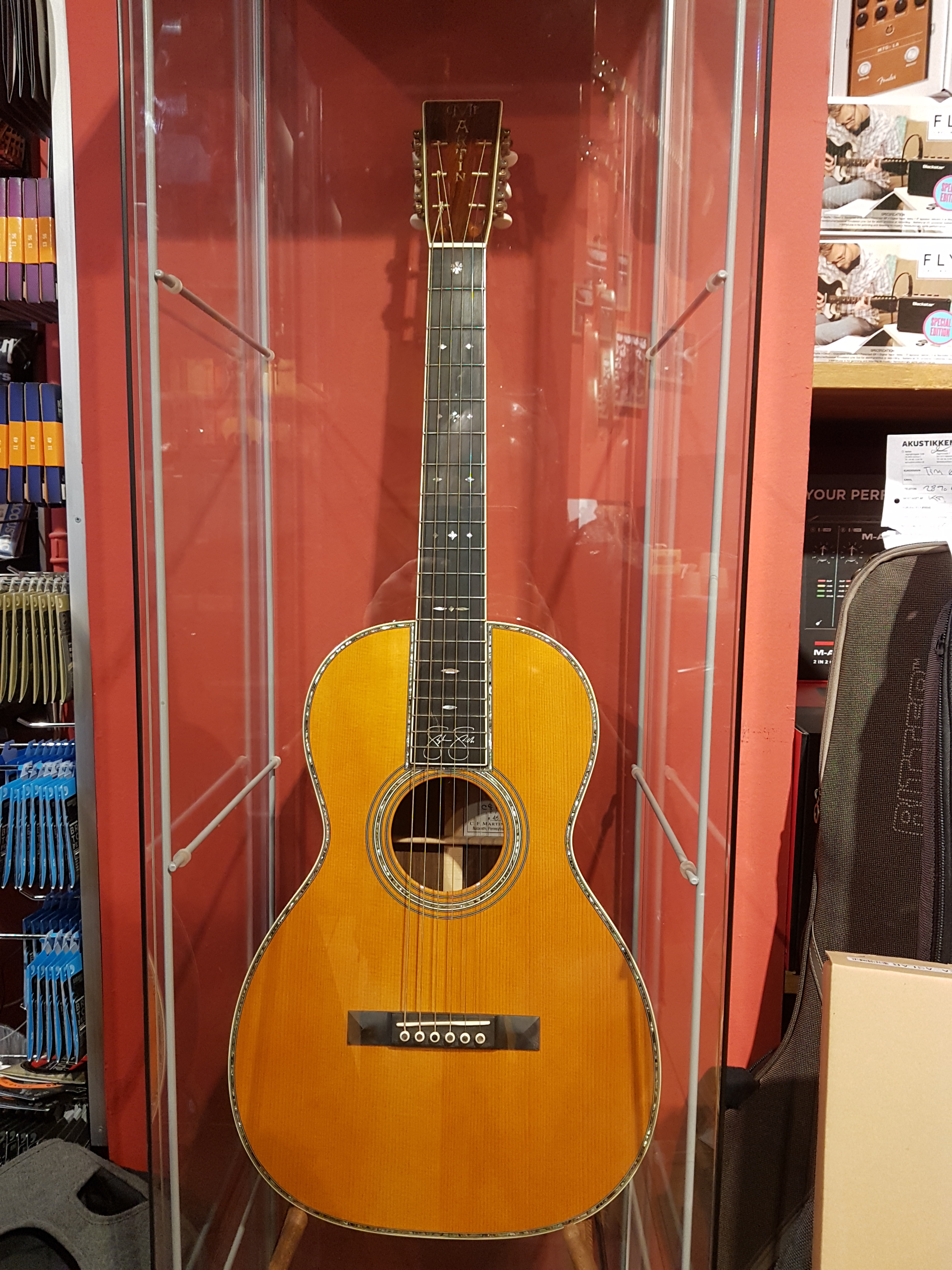
The guitar that really caught my eye, however, was the one in the photograph above: a Martin 045-S Stephen Stills Signature Model. Now, this is a serious, serious guitar. Based on a 1930s model owned by Stills himself, it was hand made in the USA in a limited edition of 91, of which this was number 48. The woods from which it’s made are rare and exceptional, including Adirondack spruce, Madagascar rosewood, and ebony, all species about which there are significant conservation concerns (see Richard Hobbs’s great blog The Nature of Music for more on this – highly recommended for anyone interested in the interface between human culture and ecological conservation).

The price tag for this guitar? A mere160,000 Danish kroner, about £18,000 or $20,000…..

That was WAY outside of our budget! But when the staff learned that it was my birthday they kindly took the Martin out of its humidity-controlled glass case and let me play it. I was a bit overwhelmed and very nervous if I’m honest, it was easily the most expensive guitar I have ever had in my hands! Karin took a short video of me strumming a few chords which I uploaded to Twitter:

Now, I’d played guitars up to around $2,000 in price that day, so a reasonable question is: did the $20,000 guitar sound ten times as good? Well, not in my hands it didn’t…. But in one sense it doesn’t matter, you’re not just paying for what it sounds like, you’re paying for the story, for the association with Stills, and the highly skilled crafting of the guitar – it is an exceptionally beautiful and fine-sounding instrument.

This brings us back to nature. We know from a lot of ecological experiments that have been conducted over the years that there’s a positive relationship between biodiversity (measured by the number of species in an ecosystem) and the way in which that ecosystem functions. So if you have more different kinds of plants in a grassland, for example, there tends to be greater carbon capture, more efficient use of water and uptake of nitrates from the soil, more resilience to events like drought and fire, and so forth. This is a strong and pervasive argument for conserving species within ecosystems: the more we have, the better the “health” of that ecosystem.

But, as with the sound of guitars, there’s probably an upper limit to this and ecosystems with ten times as many species probably do not function ten times as well. But they do function better. Having said that, this is a complex area of research with some competing ideas (and scientists) – this Wiki provides quite a good summary.

Regardless of the technical details, there’s no doubt that having more pollinators in an ecosystem, for example, increases the reproduction of a wider range of the plants that are present. Or that the presence of a greater diversity of dung beetles improves the rate of dung removal in grasslands.

But of course nature is more complicated than this. Just as a well made and high-value guitar is never going to sound good in the hands of a poor guitarist, likewise, species diversity in itself is insufficient. It is the interactions between those species that determines much of the way in which the ecosystem functions, and an ecosystem is never going to function well over the long term if it is inappropriately managed or if the processes that shape ecosystems, such as grazing by wild herbivores or natural fire regimes, are absent or have been altered.

Ecology is a hugely complex science but perhaps by exploring metaphors like this, some of that complexity can be made accessible to a wider range of people. Tell me what you think, does the metaphor work for you?

Claims that only 10% – and not 75% – of crops are pollinator dependent are misleading and dishonest

Earlier this week the Genetic Literacy Project site posted an essay entitled ‘10% — not 75% — of crops pollinator-dependent: Our World in Data debunks claims that global food supply is imminently endangered by ‘disappearing’ insects‘. That click-bait title is hugely misleading, some of the purported ‘facts’ are incorrect, and indeed the whole thing reeks of dishonesty and bad faith.

First the misleading title. This ‘debunks’ claim actually compares two different things: 75% of CROPS being dependent on pollinators versus 10% of crop YIELD. However, even if we focus on the 10% claim, a small increase in yield can be the difference between profit and bankruptcy for small-scale farmers. And most of the world’s farmers are small-scale and living on the borderline between loss and break-even. In addition, there’s no acknowledgement of the food production from home gardens, allotments, and community gardens, which is significant but largely unquantified.

Next, by focusing on yield and comparing, say, wind-pollinated wheat with insect-pollinated apples, the article takes no account of the fact that many of these crops that depend to some extent on pollinators mainly provide essential vitamins and minerals – not calories – to diets. When I tweeted about this earlier in the week, one person commented that they describe the insect-pollinated foods as ‘an important source of flavour and colour in our diets, rice and wheat are all well and good, but you do kinda need something more than grey slop to live’. Another said: ‘I’m so glad you mentioned this. I’m sick of reading articles that praise innovations to increase calories, when what we need is better nutrition from vitamins, minerals & fibres’.

Both great points, and well made.

That essay was also factually incorrect when it described roots crops such as carrots or some of the leafy cabbages and lettuces as not requiring pollinators. Many varieties of these crops ARE pollinator dependent: how do they think we get the seed for the next year’s crop?! And there are many crops and varieties that have not been evaluated for their dependency on pollinators: the 75% figure actually refers to the 115 most productive crop plants (Klein et al. 2007).

When I tweeted about the essay I commented that I was very disappointed by ‘Our World in Data’ – they are usually better than this when it comes to the facts. What I hadn’t appreciated at the time was that in fact the Genetic Literacy Project had highjacked the original piece by Hannah Ritchie and reworked it to give it a very different slant*.

This is where it starts to get dishonest and in fact the Genetic Literacy Project (GLP) has form in this area. The Sourcewatch site describes the GLP as ‘a corporate front group that was formerly funded by Monsanto’ with a remit to ‘shame scientists and highlight information helpful to Monsanto and other chemical producers’. In other words it’s heavily tied to Big Agriculture which, of course, would like us to believe that there’s not an issue with declining pollinators, that pesticides and agricultural intensification are our friends, and that Everything Is OK. Read the full account here.

Frankly, the GLP is so tainted that I’d not believe anything that they publish.

Pollinator decline and the role of pollinators in agriculture are complex issues. If you’d like to know more about the importance of pollinators to agriculture, complete with some accurate and objective facts, then there’s a whole chapter devoted to the topic in my book Pollinators & Pollination: Nature and Society.

*Note that I’ve been communicating with Hannah about the root and leaf crop issue and she accepts that this needs to change in the original. She’s also asked the Genetic Literacy Project to take down their version as it contravenes copyright.

Reference

Klein, A.-M., Vaissière, B.E., Cane, J.H. et al. (2007) Importance of pollinators in
changing landscapes for world crops. Proceedings of the Royal Society of London B
274: 303–313.

For World Bee Day 2021: an update of the coffee-bee visits figure from my book

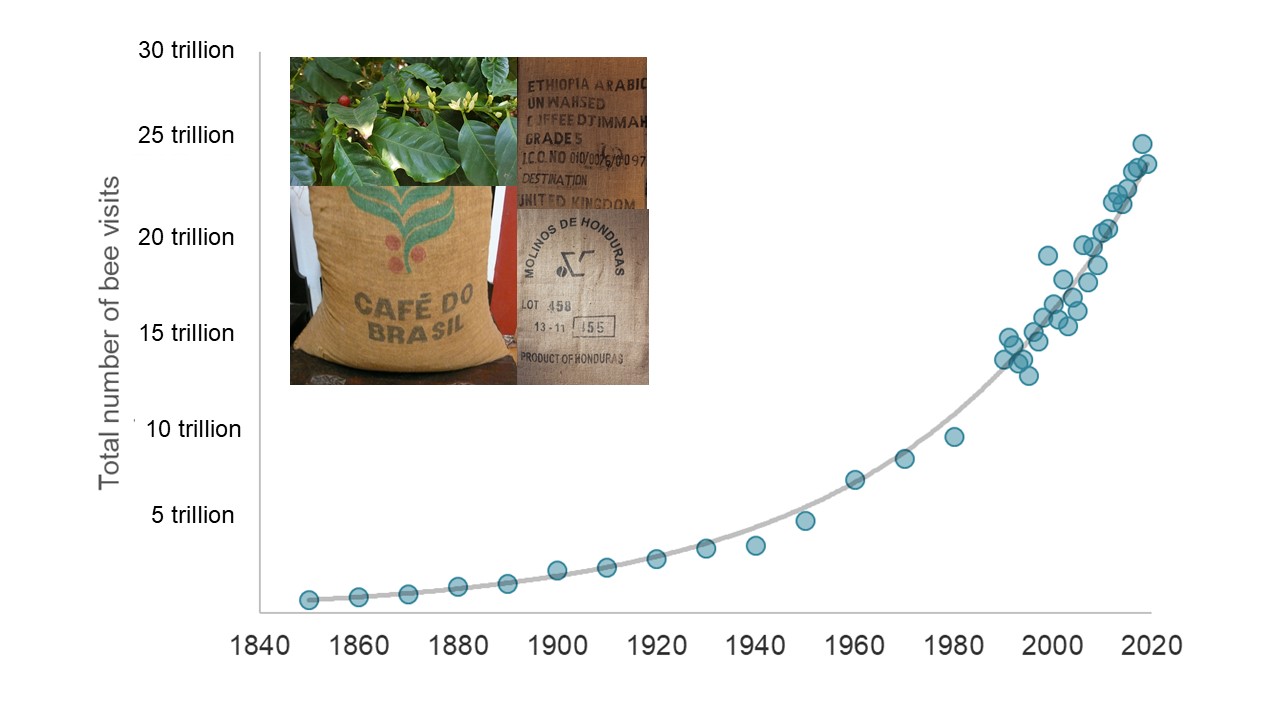
Today is World Bee Day 2021! To celebrate it, here’s an update of a figure that appears in my book Pollinators & Pollination: Nature and Society. It’s reminder of just how important bees are as the main pollinators of coffee, one of the world’s major crops. The new figure adds another two years of data and also improves the accuracy of some of the statistics for the previous decade. The coffee production data are from the International Coffee Organization.

Bottom line is that the global coffee production in 2019/20 was the result of 24 TRILLION flower visits by bees! That’s down a little from the previous year, but it’s still a LOT of visits by a HELL of a lot bees!

If you want to know more about how this was calculated and what it means for both coffee production and bee conservation, I discuss it with Dr Kirsten Traynor in this recent podcast for the magazine 2 Million Blossoms.

Happy World Bee Day everyone!

Global effects of land-use intensity on pollinator biodiversity: a new study just published

Humans affect the land on which they live in many different ways, and this in turn influences local biodiversity. Sometimes this has positive effects on local wildlife: consider the diversity of birds to be found in well-managed suburban gardens, for example. But often the effect is negative, especially when the land is intensively managed or habitats are destroyed, for example via deforestation or urban development.

This is not a new phenomenon – according to a recent study, most of the habitable parts of the planet have been shaped by humans for at least 12,000 years (see Ellis et al. 2021). What is new, however, is the scale and the speed with which land-use is changing, which are far greater than they have been historically. An important question is the extent to which this change in land-use intensity is affecting pollinator diversity in different parts of the world. Over the past 18 months I’ve been collaborating on a project led by Joe Millard (as part of his PhD) and Tim Newbold which uses the Projecting Responses of Ecological Diversity In Changing Terrestrial Systems (PREDICTS) database to address that very question.

A paper from that collaboration is published today in the journal Nature Communications; it’s open access and can be downloaded by following this link.

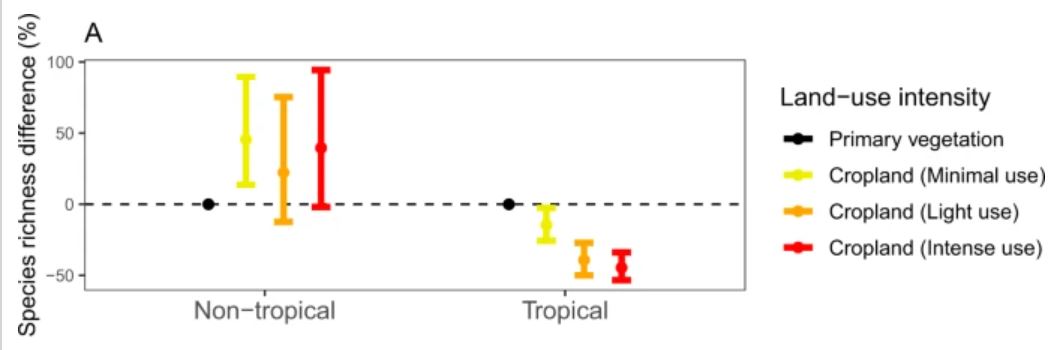
The study was global in scale and used data from 12,170 sites to assess the affect of land-use intensity on 4502 pollinating species. The findings are really fascinating; highlights include:

  • In comparison to natural vegetation, low levels of land-use intensity can have a positive effect on the diversity of pollinators.
  • For most land categories, greater intensity of land-use results in significant reductions in diversity and abundance of pollinators, however. For example, for urban sites there’s a 43% drop in number of species and a drop in 62% pollinator abundance from the least to the most intensive urban sites.
  • On cropland, strong negative responses of pollinators to increasing intensity are only found in tropical areas, although different taxonomic groups vary in their responses.
  • The latter finding is especially concerning given that: (i) most pollinator diversity is found in the tropics; (ii) the majority of tropical crops are insect pollinated; and (3) tropical agriculture is becoming increasingly intensive and land use is likely to rapidly change in the coming decades.

The full reference for the study, with all authors, is:

Millard, J., Outhwaite, C.L., Kinnersley, R., Freeman, R., Gregory, R.D., Adedoja, O., Gavini, S., Kioko, E., Kuhlmann, M., Ollerton, J., Ren, Z.-X. & Newbold, T. (2021) Global effects of land-use intensity on local pollinator biodiversity. Nature Communications 12, 2902. https://doi.org/10.1038/s41467-021-23228-3

Natural Capital, Ecosystem Services, and Nature-Based Solutions: an analogy with books

The terms ‘Natural Capital’, ‘Ecosystem Services’, and ‘Nature-Based Solutions’ seem to generate one of two emotions in some people: confusion and irritation. Confusion stems from not appreciating that these are different, though closely related, concepts, as I will show below. Irritation often is the result of seeing ecosystem ‘valuation’ as a neo-liberal plot to somehow ‘sell-off nature’. I’ve discussed this irritation in the past – see this old post for instance about ‘How do we value nature?‘ – so I’m not going to dwell on it: some people see the advantage of using these concepts, others don’t. And that’s fine. But I will touch briefly on the confusion aspect because it pertains to a discussion on Twitter this morning that was stimulated by this tweet from Prof. James Bullock, in which he saw the three concepts as re-packaging on the same ideas under different (and confusing) names.

James and I have been friends for a long time, and there’s things we agree on and things we disagree on. And that’s also fine. But as I pointed out in my response to the tweet, I think that these concepts are different, and that they logically flow together. To me, Ecosystem Services are the benefits to society provided by Natural Capital. Nature-Based Solutions are strategies or schemes for targeting Natural Capital creation or enhancement (e.g. flood meadows or woodland) to provide Ecosystem Services (e.g. flood management or carbon storage).

The analogy that I used (which a few people seemed to appreciate) is that this is the difference between books, what we learn from books, and decisions on how to produce more books.

Since the publication of Pollinators & Pollination: Nature and Society, books have been on my mind a lot 🙂

As always, your comments are encouraged.

Online talks and training: here’s a selection of what I offer

Over the past few months I’ve done a large number of online talks for a variety of audiences, including natural history and gardening societies, beekeeping groups, private companies, university estates departments, and ecological consultancies. I thought it would be useful to provide a list of what I offer, with a short description. All talks are accessible and understandable to a broad audience, and can be tailored to the individual needs of the group:

Pollinators & Pollination: Nature and Society is an introduction to the importance of pollinators and the pollination services that they provide to both wild and crop plants. The name, of course, reflects that of my recent book.

The Politics of Pollination is an account of how society (governments, organisations and individuals) has responded to the current “pollination crisis” (if that’s what it actually is…)

Bees in Cities: an Introduction to Urban Pollinators focuses on the positive roles that urban environments can play for pollinators, and the potential threats of city living.

Pollinators in Gardens gives practical advice on how to make your garden “pollinator friendly”.

Pollinator Conservation: Threats and Opportunities describes how and why pollinators are declining and what we can do about it at the individual and societal level.

Habitat Creation and Management for Pollinators gives an introduction to how NGOs, estates departments, consultancies, and so forth, can effectively support pollinators in ways that go beyond just planting flowers and putting up a few “bee hotels”.

To Be a Flower is an introduction to how flowers function and the ways in which they manipulate the behaviour of their pollinators to ensure reproduction.

Darwin’s Unrequited Isle: a Personal Natural History of Tenerife describes some of the field work that we’ve been doing on this most fascinating of the Canary Islands.

Biodiversity: What Is It and Why Should We Care? gives a very general overview of the topic of biodiversity and ecosystem services.

Talks typically last for around 50 minutes, following which I’m happy to answer questions and discuss any issues that have arisen. I also offer a half- or full-day of training for those organisations that need more depth, for example ecological consultancies. Note that I charge for all of my talks and training. If you would like to enquire about any of this, please use the form on the Contact page.

Finally, a physical copy of my book!

Yesterday I was delighted to finally receive an advance copy of my book Pollinators & Pollination: Nature and Society! It’s been over three years in the writing and production, much longer than I had anticipated. But, as I describe in its pages, the book is the culmination of >50 years of experience, study and research. So perhaps three years isn’t so bad…

If you’re interested in buying a copy you can order it direct from Pelagic Publishing and from most of the large online booksellers. Let me know what you think.