Tag Archives: Conservation

Leveraging Biodiversity Net Gain to address invertebrate declines in England – a new pre-print is available

Back in October I posted about a report I’d written that considered Biodiversity Net Gain (BNG) and what it could mean for pollinators. The report generated some interest and has helped to inform a study by University of Oxford PhD researcher Natalie (Nat) Duffus that has just been posted as a pre-print entitled “Leveraging Biodiversity Net Gain to address invertebrate declines in England” – here’s the link to it: https://ecoevorxiv.org/repository/view/6667/

In this work, Nat has asked a group of us who are interested in this topic to assess the limitations of the current BNG system and how it might be improved to better support invertebrate populations. Please do read the study and comment either on the blog or directly on the pre-print. We’re interested in people’s views on this and whether we have missed anything important.

Here’s the abstract:

Meeting ambitions such as the Global Biodiversity Framework 2030 targets will require multiple conservation mechanisms that benefit the widest possible range of habitats and species. Using England as a case study, here we evaluate the likely impact of a novel and ambitious ecological compensation policy, Biodiversity Net Gain (BNG), on terrestrial insects, spiders, and other arthropods (‘invertebrates’), a functionally important but rapidly declining component of biodiversity. Current implementation of BNG in England sets out to provide a 10% uplift in biodiversity when infrastructure development (such as housebuilding) occurs. However, BNG is a habitat-driven approach, which risks overlooking important considerations relevant to invertebrate conservation, threatens to further reduce the size and quality of their habitats, and may increase habitat fragmentation. BNG – as currently implemented – therefore represents a missed opportunity to use a universally applied policy to benefit invertebrates and other functionally important components of biodiversity. We suggest ways forward to realign BNG with what we know to be crucial for successful invertebrate conservation, and with other policy mechanisms such as the National Pollinator Strategy. This will ensure that appropriate habitats and conditions for invertebrates are retained, enhanced, and created at a landscape scale, and that BNG is optimised to contribute to broader national conservation targets. As biodiversity accounting and offsetting schemes such as BNG are increasingly adopted around the world, the experience of BNG in England provides valuable insights into how ecological compensation programmes could be better designed, implemented, and monitored to ensure that benefits for a wide variety of taxa are achieved.

Key tropical crops at risk from pollinator loss due to climate change and land use – a new study just published

PREDICTS (Projecting Responses of Ecological Diversity In Changing Terrestrial Systems) is one of the most important sources of data for large-scale modelling of how changes in land use is impacting biodiversity. Marry that with future climate models and you have a powerful tool for understanding how these two major factors in global change will shape both biodiversity and human society over the coming decades.

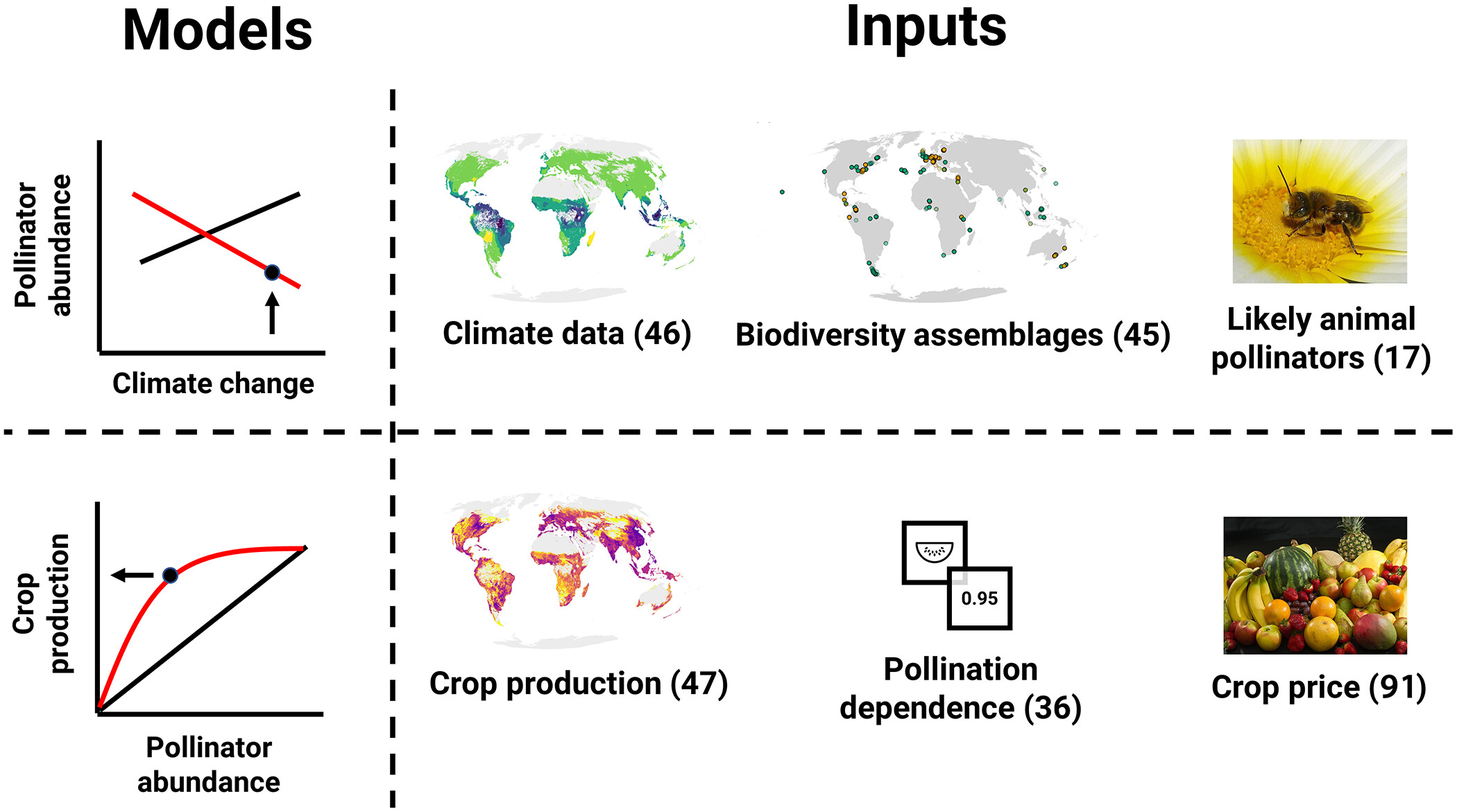
In recent years it’s been a privilege to be part of a project led by Joe Millard and Tim Newbold that’s using PREDICTS to model how pollinators and pollination services are likely to be impacted by human activities. The first paper from that work (which was Joe’s PhD) was entitled ‘Global effects of land-use intensity on local pollinator biodiversity’ and came out in 2021, as I documented on my blog at the time.

Yesterday a second paper was published, this time focused on how land use and anthropogenic climate change interact to potentially affect insect-pollinated crops across the world.

Our main finding is that it’s tropical crops, especially cocoa, mango, watermelon, and coffee, that in the future will suffer the greatest negative impacts from loss of pollinators. Although we can have perfectly healthy diets without consuming any of those, they currently support tens of millions of farmers across the tropics and are part of global supply chains worth billions of dollars per year.

Here’s the full reference with a link to the paper, which is open access:

Millard, J., Outhwaite, C.L., Ceaușu, S., Luísa G. Carvalheiro, da Silva e Silva, F.D., Dicks, L.V., Ollerton, J. & Newbold, T. (2023) Key tropical crops at risk from pollinator loss due to climate change and land use. Science Advances 9, eadh0756

Here’s the abstract:

Insect pollinator biodiversity is changing rapidly, with potential consequences for the provision of crop pollination. However, the role of land use–climate interactions in pollinator biodiversity changes, as well as consequent economic effects via changes in crop pollination, remains poorly understood. We present a global assessment of the interactive effects of climate change and land use on pollinator abundance and richness and predictions of the risk to crop pollination from the inferred changes. Using a dataset containing 2673 sites and 3080 insect pollinator species, we show that the interactive combination of agriculture and climate change is associated with large reductions in insect pollinators. As a result, it is expected that the tropics will experience the greatest risk to crop production from pollinator losses. Localized risk is highest and predicted to increase most rapidly, in regions of sub-Saharan Africa, northern South America, and Southeast Asia. Via pollinator loss alone, climate change and agricultural land use could be a risk to human well-being.

Biodiversity Net Gain and what it could mean for pollinators – read the new report

Biodiversity Net Gain (or BNG) promises to transform the way that we approach nature conservation in the UK. I’ve been giving a lot of thought to what this might mean for insect pollinators and have produced a new report that summarises the opportunities that BNG presents and how we can make the most of them. You can download a copy of that report by following this link.

This is meant to be a working document and as BNG progresses, and our understanding of its impacts on pollinators increases, I will update it. In the meantime, please do feel free to comment.

“Enemy release” of invasive plants is unpredictable – a new study just published

The summer of 2019, before the COVID-19 pandemic turned the world on its head, feels like a very long time ago. Early in that summer, as I recounted on this blog, Zoe Xirocostas joined my research group for a while in order to collect data for her PhD on the comparative ecologies of plants that are native to Europe but invasive in Australia. That work has proven to be very successful, and the latest paper from Zoe’s PhD has just been published.

The paper focuses on the “enemy release hypothesis” (ERH), a well-studied concept in invasion ecology that nonetheless generates significant debate and disagreement. In essence, the ERH posits that the reason why so many species become invasive is that they leave their consumers, pathogens and parasites behind when they move to a new locality. Those “enemies” would normally reduce the fecundity of the invader, putting a brake on their population growth. But in their absence, the invader can become far more successful. Of course, as well as leaving “enemies” behind the invader also loses its “friends”, such as pollinators, seed dispersers, and defensive or nutritional partners. This “Missed Mutualist Hypothesis” is something that I’ve recently explored with Angela Moles, who was Zoe’s main supervisor, and other collaborators in Australia. Expect to hear more about this from Zoe’s work in the near future.

But back to the enemies. Drawing on the most extensive set of standardised comparisons yet collected of the same plants in native and invasive habitats, Zoe found that plants in the invasive populations suffer on average seven times less damage from insect herbivores, as predicted by the (ERH). Rather remarkably, however, the amount of enemy release enjoyed by a plant species was not explained by how long the species had been present in the new range, the extent of that range, or factors such as the temperature, precipitation, humidity and elevation experienced by the native versus invasive populations.

In other words, it’s extremely hard to predict the extent of enemy release based on historical and ecological considerations that one might expect to impose a strong influence.

The study has just appeared in Proceedings of the Royal Society series B and is open access. Here’s the reference with a link to the paper:

Xirocostas, Z.A., Ollerton, J., Tamme, R., Peco, B., Lesieur, V., Slavich, E., Junker, R.R., Pärtel, M., Raghu, S., Uesugi, A., Bonser, S.P., Chiarenza, G.M., Hovenden M.J. & Moles, A.T. (2023) The great escape: patterns of enemy release are not explained by time, space or climate. Proceedings of the Royal Society series B 290: 20231022.

Here’s the abstract:

When a plant is introduced to a new ecosystem it may escape from some of its coevolved herbivores. Reduced herbivore damage, and the ability of introduced plants to allocate resources from defence to growth and reproduction can increase the success of introduced species. This mechanism is known as enemy release and is known to occur in some species and situations, but not in others. Understanding the conditions under which enemy release is most likely to occur is important, as this will help us to identify which species and habitats may be most at risk of invasion. We compared in situ measurements of herbivory on 16 plant species at 12 locations within their native European and introduced Australian ranges to quantify their level of enemy release and understand the relationship between enemy release and time, space and climate. Overall, plants experienced approximately seven times more herbivore damage in their native range than in their introduced range. We found no evidence that enemy release was related to time since introduction, introduced range size, temperature, precipitation, humidity or elevation. From here, we can explore whether traits, such as leaf defences or phylogenetic relatedness to neighbouring plants, are stronger indicators of enemy release across species.

Should honey bee hives be placed on or near conservation sites?

Earlier this week, the East Midlands Environment Agency proudly tweeted that they had placed honey bee hives on an ecologically important site that they own. As you might imagine, the response from pollinator experts such as myself, conservation NGOs, and some beekeepers, was not positive, as you can see if you look at the comments beneath my tweet:

By coincidence, overnight I received a message from someone in the USA asking for advice. Here’s a redacted version of their message:

My community has a 4 acre serpentine barren site that is part of a larger string of these unique barrens ….. Honey bee hives have recently been located adjacent to the barrens. Can you advise me as to the best way to determine whether there are, and to document any, adverse effects to the serpentine barrens native pollinators?

The question of how managed honey bees can impact wild pollinators and the pollination of wild plants is one that frequently comes up in the talks and training that I do. Many beekeepers share these concerns – see for example this very detailed blog post by Mark Patterson.

Going back to the question of how to assess any impacts, the simple answer is that it’s not easy and it relies on having good data. This was my response to my American correspondent:

Ideally you would need to take a before-and-after approach where you have data on things like number of native pollinator species, their abundance (including nest sites), rates of visitation of different pollinators to flowers, and fruit or seed set from particular plants. You’d then compare what was going on before the hives arrived with what’s occurring since their arrival.

If you don’t have the “before” data it’s much more difficult to assess if there has been an impact from the honey bees. However, the advice of most conservation groups is to adopt the “precautionary principle” and not site hives on or adjacent to areas of nature conservation value, especially if they are relatively small areas. See for example the Bumblebee Conservation Trust’s advice: https://www.bumblebeeconservation.org/managed-honeybees/

The precautionary principle is a well established concept across a range of areas, including health and engineering, as well as nature conservation. In the latter it needs to be more widely applied, especially when it comes to questions of where to site honey bee hives, and how many.

Managing railway assets for biodiversity – new guidance just published

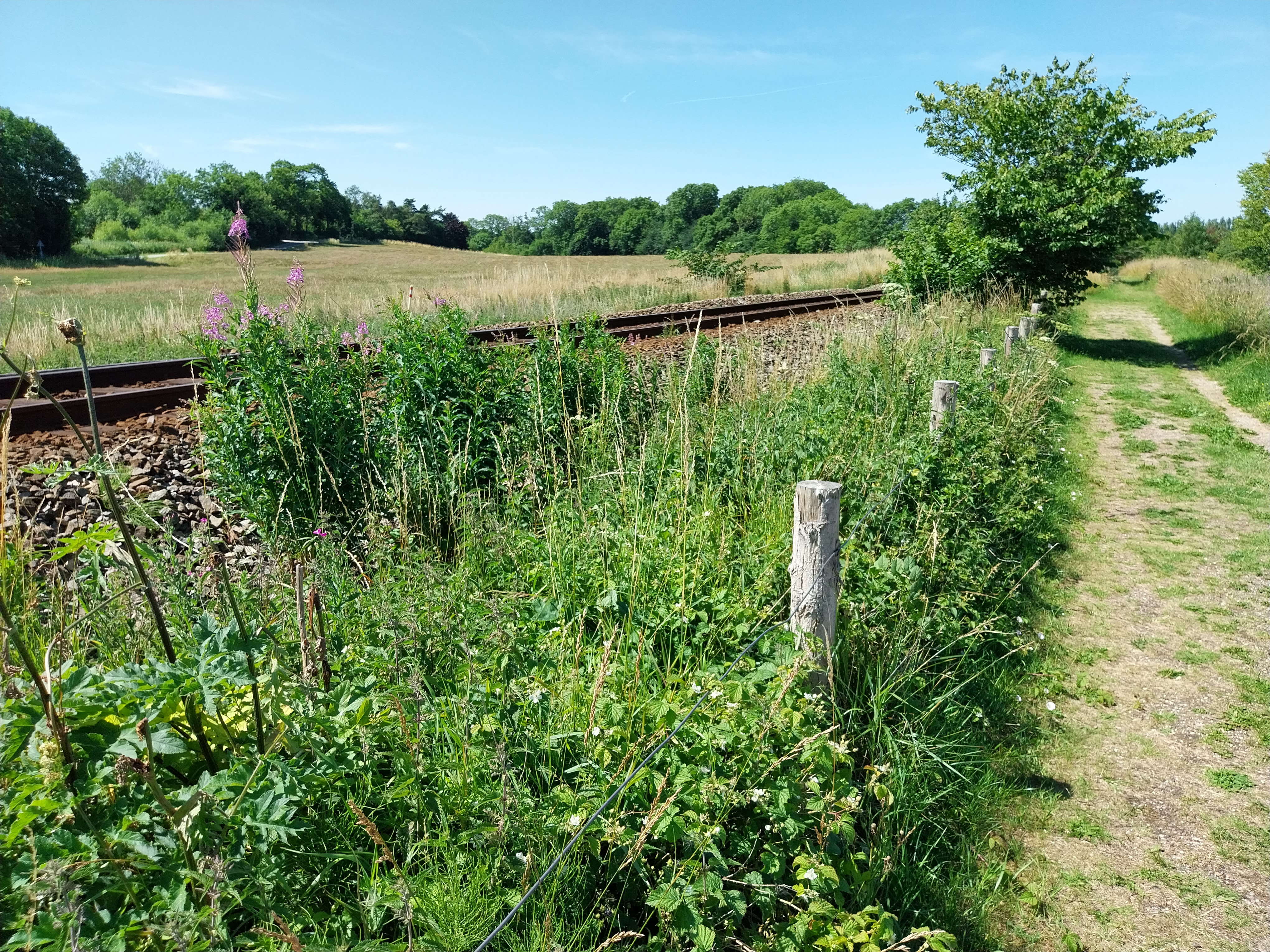
Last year I posted about the work that I’ve been doing on railways and biodiversity with UIC – the International Union of Railways – and the UK Centre for Ecology & Hydrology. That work is now complete and the second of our two reports called UIC Guidelines on Managing Railway Assets for Biodiversity is now out.

UKCEH has produced a press release and I’m copying it verbatim below:

New guidelines for the management of Europe’s railway network to protect and enhance biodiversity have been published.

The UK Centre for Ecology & Hydrology (UKCEH) has worked with the International Union of Railways (UIC), the professional association representing rail companies across the world, to provide technical recommendations and key design features for incorporating and enhancing habitats within the existing European network and new line upgrades, providing examples of best practice.

The UIC European region comprises 118-member companies from 39 countries, amounting to 350,000 kilometres of rail network.

Professor Richard Pywell, Head of Biodiversity at UKCEH who is one of the lead authors of the report, said: “We worked closely with railway companies across Europe to distil the best available knowledge on managing railway assets to benefit nature. For each asset, we considered the most effective measures to protect and restore biodiversity, and how to monitor the outcomes of these interventions.”

Another report author, independent consultant Professor Jeff Ollerton, added: “Working with UIC on this project has revealed just how important the land managed by Europe’s railway companies is for nature. The next step is to better understand how nature supports Europe’s economy, and the health and wellbeing of its people.”

The authors used the widely-adopted mitigation hierarchy approach which guides, developers on protecting existing habitats and ecosystems where possible.

The new UIC Guidelines for Managing Railway Assets for Biodiversity have been drawn up as part of the REVERSE project, in which UIC has worked with its members and UKCEH to formulate a collective vision for protecting and enhancing biodiversity across the European rail network. They now form part of the European Railways: Strategy and Action Guide to ensure management for biodiversity is embedded at every level of the railway business, alongside safety, performance and sustainability. The adoption of the guidelines by member companies will be promoted through various UIC meetings and online events.

The REVERSE project comprises more than 20 European rail companies including Network Rail and SNCF as well as WWF (Worldwide Fund for Nature).

In 2021, UKCEH worked with Network Rail to draw up the rail company’s Biodiversity Action Plan to inform lineside habitat management across the UK. This involved using high-resolution imagery from satellites and aircraft to produce a detailed national map of all the habitats alongside the rail network.

Plant-based diets are a problem for bees! A new study of the significance of the ratio of food K:Na in bee ecology and evolution

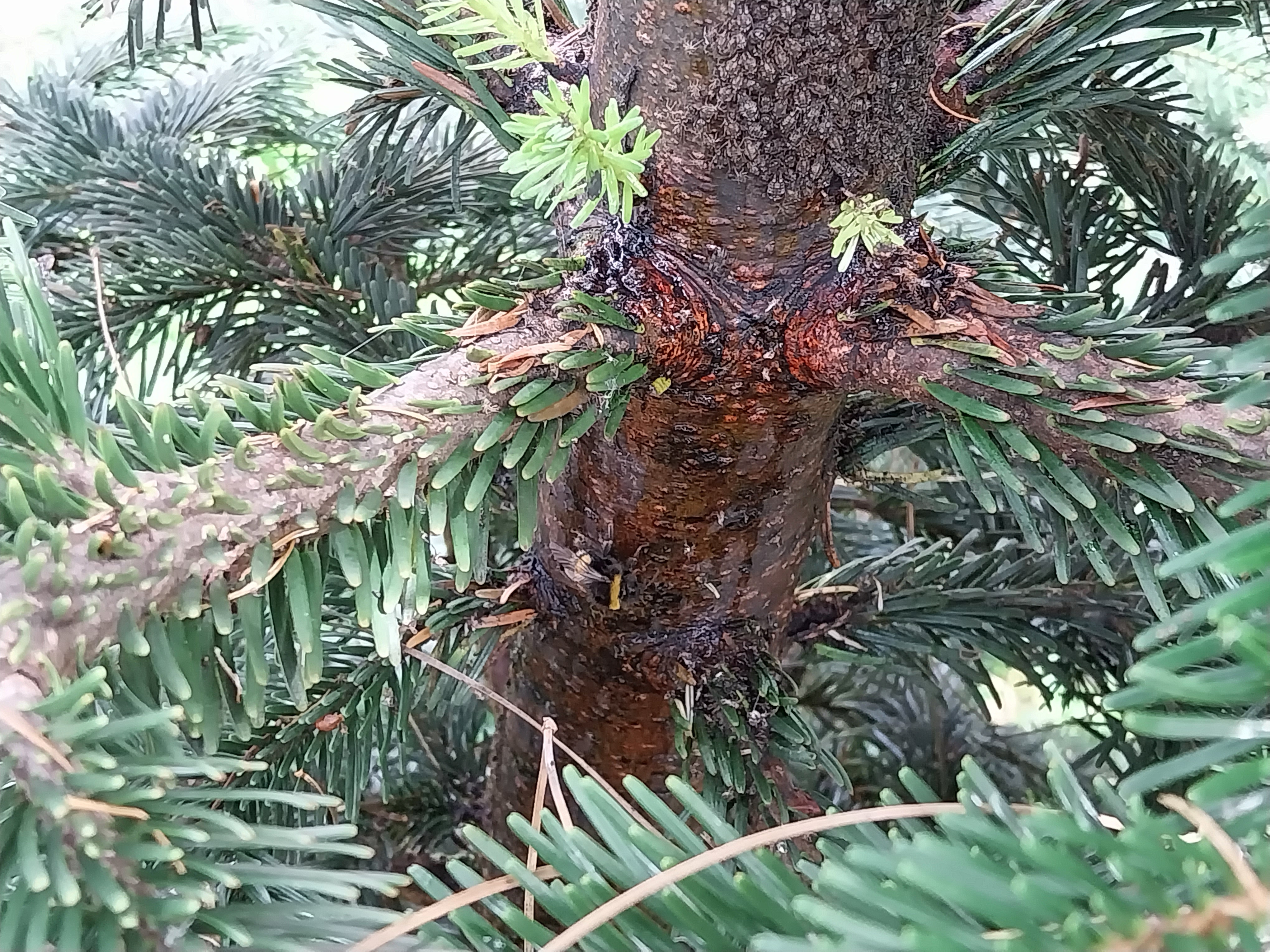
At the moment Karin and I are in the UK for a couple of weeks. I had work to do as an external examiner at the University of Swansea, plus we wanted to catch up with some family and friends. Our main base has been the home of our mates Ian and Simone and we’ve enjoyed some warm, muggy evenings sitting in their garden chewing the fat. Every now and again my eyes have been drawn to the activities of bumblebees as they move in and out of the foliage of a small Silver Fir. The bees are attracted to the large colonies of an aphid that is feeding on the tree’s trunk, from which they are collecting honeydew, as you can see in the photograph above.

When we think of the diets of bees we automatically think “nectar and pollen”. Honeydew, as a sugar-rich fluid, fits broadly into this concept, though as far as I know there’s been little study of its relative importance as a food source for bees. Aside from a few “vulture bees”, all of the 20,000 or so species are vegetarian. And therein lies a problem. Bees evolved from carnivorous wasps and so the evolution of bees, and their complex ecologies, is tied into this profound dietary shift toward a plant-based diet.

A particular issue that has hardly been investigated until recently is that the ratio of elements within meat is very different to that of plants. In particular, animal tissue has a high ratio of sodium (Na) relative to potassium (K), whereas for plants the ratio is reversed – high ratio of K:Na.

In a new conceptual review paper with my colleagues Zuzanna Filipiak and Michał Filipiak, we have explored the implications of this difference in elemental ratios for bee ecology and evolution, and for the conservation of these important insects. The paper is open access and you can download a copy by following a link in this reference:

Filipiak, Z.M., Ollerton, J. & Filipiak, M. (2023) Uncovering the significance of the ratio of food K:Na in bee ecology and evolution. Ecology e4110. https://doi.org/10.1002/ecy.4110

Here’s the abstract:

Bees provide important ecological services, and many species are threatened globally, yet our knowledge of wild bee ecology and evolution is limited. While evolving from carnivorous ancestors, bees had to develop strategies for coping with limitations imposed on them by a plant-based diet, with nectar providing energy and essential amino acids and pollen as an extraordinary, protein- and lipid-rich food nutritionally similar to animal tissues. Both nectar and pollen display one characteristic common to plants, a high ratio of potassium to sodium (K:Na), potentially leading to bee underdevelopment, health problems, and death. We discuss why and how the ratio of K:Na contributes to bee ecology and evolution and how considering this factor in future studies will provide new knowledge, more accurately depicting the relationship of bees with their environments. Such knowledge is essential for understanding how plants and bees function and interact and is needed to effectively protect wild bees.

Pesticides and pollinators: please sign this petition!

As part of our roles as ambassadors of the new conservation organisation Restore (more of which later this year), several of us including Dave Goulson, George McGavin, and myself, are promoting this online petition to get the government to take the issue of neonicotinoid pesticides seriously. Here’s some text from Dave explaining the situation with a link to a petition that you can sign:

“For three years in a row our government has granted farmers special permission to use banned neonicotinoid pesticides on sugar beet. This is contrary to the expert advice of their own Expert Committee on Pesticides, who specifically recommended that permission should not be granted.  It also flies in the face of a huge body of scientific evidence showing that these chemicals are phenomenally toxic to all insect life, and that their use on any crop contaminates soils, hedgerow plants, and nearby streams and ponds for years to come. We are in a crisis, with insect populations in freefall. It is about time our government woke up to this, and acted accordingly. This petition https://petition.parliament.uk/petitions/631948 is a necessary means of holding the government to account. Please sign and share, as signing will ensure the issue is debated in Parliament.”

This petition now has more than 15,000 signatures which ensures that it gets a response from the Government. If it reaches 100,000 mark, it will trigger a debate in Parliament. Please sign and promote this important initiative! 

The hidden potential value of woodland trees for wild bee assemblages – lead author Guthrie Allen introduces his recently published study

Note: This is a guest blog post by Guthrie Allen who is a PhD candidate at the University of East Anglia.

Though often overlooked, woodlands have great potential to support wild bees in farmed landscapes. Both the understory and canopy can provide large quantities of early-season nectar. The pollen of woodland-tree taxa such as Acer can form a large proportion of the early-season diets of bumblebees and solitary bees. Even the pollen from wind-pollinated trees such as Quercus can form a significant part of the diets of several common solitary bee species. Woodlands are also believed to provide ample nesting opportunities. These factors may explain why several studies have found positive correlations between bee abundance and/or diversity and woodland cover at the landscape scale. Despite this, a large-scale European study has shown that interior woodland understories support very few bees compared to exposed woodland edges.

Sampling the canopy – at heights of up to 20 metres – is not easy, but unlike the understory, this habitat remains sun-exposed after canopy closure and could be favourable for bees. In Europe, however, our knowledge of bee activity in the woodland canopy is very limited. Furthermore, whilst canopy-tree taxa have been identified as suitable food sources for many bees, we have little evidence that these trees are used for forage when located within woodlands. To explore the role of the canopy, we trapped bees in late spring in the understory and canopy – at the exposed edges and in the interiors – of 15 woodland sites across an English agricultural landscape.

A significant proportion of bee abundance was found in the canopy, represented by 23 of the 29 total sampled species. Interior canopy activity was much higher when nectar-producing Sycamore (Acer pseudoplatanus) trees were nearby. Communities differed between the canopy and understory: of the seven most common species sampled, three were more active in the understory, while the opposite was true of one species – Bombus lapidarius. Interestingly, we found the sex ratio of the most abundant species – B. pratorum – to be female-skewed in the canopy. For four of these species, and contrary to expectations, we found no evidence that understory activity was any higher at woodland edges compared to woodland interiors.

Further research is needed to understand community differences between the canopy and understory. Nonetheless, our results suggest that both these habitats have a significant role to play in supporting farmland bees. We demonstrate that a diverse bee community has the potential to exploit canopy resources, with nectar-producing trees in woodland interiors likely to provide forage for many bees. And we show the unexpected potential of interior woodland understories to support bee abundance.

Here’s the full reference with a link to the open access paper:

Allen, G. & Davies, R.G. (2022) Canopy sampling reveals hidden potential value of woodland trees for wild bee assemblages. Insect Conservation and Diversity. Available from: https://doi.org/10.1111/icad.12606

Here’s the abstract:

Woodlands can play an important role in supporting bee abundance and diversity in agricultural landscapes. However, in temperate-region studies, the canopy is rarely sampled, and our understanding of its contribution is limited. To explore this, we sampled bees in late spring with blue vane traps in the understory (n = 30) and crowns of mature Quercus robur (n = 35) at the exposed southern edges and in the interiors (ca. 25–75 m from woodland edges) of 15 woodland sites across an English agricultural landscape. A significant proportion of bee abundance and diversity was found in the canopy: canopy-trap catches were estimated to be a third as large as understory-trap catches, and 23 of the 29 sampled species were present in the canopy. Of the seven most common species sampled, four were equally abundant in woodland edge and interior traps; three were more abundant in understory traps, and a single species—Bombus lapidarius—was more abundant in canopy traps. The sex ratio of the most abundant species, B. pratorum, was female-skewed in the canopy. Additionally, the presence of nearby Acer pseudoplatanus trees in flower greatly increased canopy-trap catches in woodland interiors. These results suggest that both the woodland canopy and understory have a significant role to play in supporting farmland bee communities; they indicate the importance of nectar-producing trees in woodland interiors, opening avenues for canopy-based management; and they demonstrate that a diverse bee community has the potential to exploit canopy floral resources.

Some seaweeds have “pollinators”! New research published this week

Most of us have at some time stared in fascination at the life contained within the pools that form on rocky shores at low tide. But none of us realized that a whole new class of ecological interaction was taking place!

The 12,000 or so described (and many un-named) seaweeds are incredibly important organisms. Their diverse and abundant photosynthesizing fronds make them one of the main primary producers in coastal seas, creating food and habitat for a huge range of animals. Not only that, but some – the coralline seaweeds – lock up vast amount of CO2 as calcium carbonate and help to create reef systems in the same way as coral.

Although scientists have studied seaweeds for hundreds of years, many aspects of their ecology are still unknown. Their detailed mode of reproduction, for example has only been studied in a small proportion of species.

In a newly published study in the journal Science, French PhD researcher Emma Lavaut and her colleagues have shown that small isopod crustaceans – relatives of woodlice and sea slaters – facilitate the movement of the equivalent of seaweed sperm (termed “spermatia”) from male to female reproductive structures in just the same way that bees and other pollinators move pollen between flowers, so fertilizing female gametes.

Your read that correctly: some seaweeds have pollinators!

It’s an incredible finding! And the implications of this are enormous: Emma and her colleagues have added a whole new branch of life to the examples of sedentary (fixed-place) organisms that require a third party to enable their reproduction. In addition to being a fascinating biological discovery, it has significant environmental and sustainability implications.  

Seaweeds are a diverse group of macroalgae that appeared more than one billion years ago, at least 500 million years before the evolution of what we think of as “true” plants, such as the flowering plants, conifers, cycads, ferns and mosses. Sexual reproduction in the brown and green seaweeds, which include kelps, wracks and sea lettuces, involves spermatia that are mobile and use a flagellum to swim through the water to seek out female reproductive structures. However, Emma studied a seaweed, Gracilaria gracilis, which belongs to the Rhodophyta or red seaweeds, and none of the species in this group have these swimming sperm equivalents.

Sexual reproduction in the red seaweeds has therefore always been something of a mystery. Three quarters of species have separate male and female individuals and so they cannot mate with themselves. It was assumed that the gametes were just released into water currents that haphazardly transported them to the female reproductive organs, much as wind pollinated grasses and pine trees release their vast clouds of pollen on land. The authors of this new study, however, point out that most sexual reproduction by these red seaweeds takes place in the relatively still waters of rock pools, a habitat that they mimicked in the laboratory in a series of elegant aquarium experiments.

The isopod crustaceans are attracted to the seaweed because they provide a habitat away from predators and a supply of food: they graze on the microalgae that colonise the seaweed’s fronds. Picking up spermatia and moving them between fronds is a side-effect of this activity by the small invertebrates. As you can see from the illustration above, the isopods and the seaweed are engaged in a “double mutualism“: a plus sign (+) indicates a positive effect of one species on another, while a minus sign (-) indicates a negative impact. 

What I find especially fascinating about this research is that both the seaweed (Gracilaria gracilis) and the isopod (Idotea balthica) were originally described as species more than 200 years ago. They also have an extremely wide distribution. The isopod is found around the coasts of Europe and down the eastern seaboard of the Americas. The seaweed is pretty much found globally. These are not rare, unusual species, yet the interaction between them has only just been discovered! This is a point that I made in my recent book Pollinators & Pollination: Nature and Society: quite often, species that are well known interact in previously undocumented ways because no one has had the time or inspiration to look closely at them.

Although the idea that small sea creatures might be helping seaweeds to reproduce sounds very fanciful, there is a precedence for this discovery. Back in 2016, in a paper published in Nature Communications, a group of Mexican researchers led by Brigitta van Tussenbroek showed that a species of seagrass is pollinated by a diverse assemblage of small crustaceans and polychaete worms. Seagrasses are flowering plants, not seaweeds, but clearly this type of mutually beneficial relationship can exist between different species in the oceans.

Rhodophyta are the most diverse group of seaweeds, with more than 7,000 known species. They are especially abundant on coastal shores, oceanic habitats that are under huge pressure from infrastructure development, pollution, and climate change. At the same time, these seaweeds are economically important and millions of tonnes of them are collected every year as food, as nutritional and pharmaceutical supplements, and to produce agar. In order to conserve these seaweed populations, we need to better understand their ecology and their environmental requirements.

The work by Emma Lavaut and colleagues suggests that interactions with their “pollinators” may be a critical aspect of this understanding. In the same way that “Save the Bees” has been a rallying call for conserving interactions between species on land, we may soon hear this message echoed in “Save the Isopods”. At the very least, I have to add a new section to the second edition of my book!

Full disclosure: I was one of the reviewers of the original manuscript submitted to Science by Emma and her co-authors. It’s a rare privilege to review a study and think: “Wow! This is a game-changer!” and including this paper it’s happened to me only a handful of times. The editors at Science kindly invited my colleague Dr Zong-Xin Ren and myself to write a Perspective piece about the work and we were delighted to do so.


Image credits: Isopod and diatom images from Lavaut et al (2022). Gracilaria image by Emoody26 at English Wikipedia CC BY 3.0 https://commons.wikimedia.org/w/index.php?curid=3455016. Design by Shijia Wen and Jeff Ollerton.