Tag Archives: Bees

Should honey bee hives be placed on or near conservation sites?

Earlier this week, the East Midlands Environment Agency proudly tweeted that they had placed honey bee hives on an ecologically important site that they own. As you might imagine, the response from pollinator experts such as myself, conservation NGOs, and some beekeepers, was not positive, as you can see if you look at the comments beneath my tweet:

By coincidence, overnight I received a message from someone in the USA asking for advice. Here’s a redacted version of their message:

My community has a 4 acre serpentine barren site that is part of a larger string of these unique barrens ….. Honey bee hives have recently been located adjacent to the barrens. Can you advise me as to the best way to determine whether there are, and to document any, adverse effects to the serpentine barrens native pollinators?

The question of how managed honey bees can impact wild pollinators and the pollination of wild plants is one that frequently comes up in the talks and training that I do. Many beekeepers share these concerns – see for example this very detailed blog post by Mark Patterson.

Going back to the question of how to assess any impacts, the simple answer is that it’s not easy and it relies on having good data. This was my response to my American correspondent:

Ideally you would need to take a before-and-after approach where you have data on things like number of native pollinator species, their abundance (including nest sites), rates of visitation of different pollinators to flowers, and fruit or seed set from particular plants. You’d then compare what was going on before the hives arrived with what’s occurring since their arrival.

If you don’t have the “before” data it’s much more difficult to assess if there has been an impact from the honey bees. However, the advice of most conservation groups is to adopt the “precautionary principle” and not site hives on or adjacent to areas of nature conservation value, especially if they are relatively small areas. See for example the Bumblebee Conservation Trust’s advice: https://www.bumblebeeconservation.org/managed-honeybees/

The precautionary principle is a well established concept across a range of areas, including health and engineering, as well as nature conservation. In the latter it needs to be more widely applied, especially when it comes to questions of where to site honey bee hives, and how many.

Week-long Master’s course in Italy – March 2024 – on Pollination as an Ecosystem Service

I’m excited to announce that in March 2024 I will teach a week-long, Master’s-level residential course entitled “Pollination as an Ecosystem Service” at the University of Pavia in Italy. It will be taught in English. Here’s a summary of the course and a brief description of the the syllabus, which is broadly accurate but subject to change as it develops:

POLLINATION AS AN ECOSYSTEM SERVICE

A 3 credit Master’s course for the University of Pavia

Overview

The pollination of crops by bees, flies, birds, bats and other animals, is an ecosystem service that increases crop yields and quality. This is valued at hundreds of billions of Euros each year to European and global agriculture. In addition, these same animals pollinate around 90% of the world’s wild plants which in turn provide us with ecosystem services such as wild food, flood alleviation, microclimate modification, and carbon capture.

In this course, students will explore pollination as an ecosystem service from its first principles and historical roots through to the latest research findings around the consequences of pollinator decline and climate change. The emphasis of the course is on the students learning by actively participating during classes. Each day has a particular theme and will be a mix of interactive lectures, short video clips to illustrate particular points, discussion seminars (for which they will be expected to do some guided reading) and local excursions.

At the end of the course the students will have a developed a deep understanding of the diversity of pollinators, the ecological nature of their interactions with flowers, and the importance of these relationships to nature and to society.  

Assessment

            At the end of the course, the students will be asked to give a 10 minute presentation based on one of the topics covered in the course, and posed as a question such as “What is….?”, “Why does….?”, “What would happen if….?”, and so forth. The questions will be agreed with me in advance. Presentations will take place on the final day of the course and at the end of each presentation the students will have 5 minutes to answer questions posed by their peers and myself.

Syllabus

Day 1

Theme: Pollinators and pollination – first principles; including historical perspectives, the diversity of pollinators and flowers, and the biology of pollination. Introducing the course assessment.

Excursion: a walk around the local area to observe flowers and pollinators in action.

Day 2

Theme: Pollination as an ecosystem service; including the types of crops that are animal pollinated, how we calculate the value of pollination, and going beyond agriculture to look at the other ecosystem services provided by pollinators; approaches to studying pollinators and pollination.

Day 3

Theme: Pollinator conservation: including reasons for pollinator decline, impacts of climate change, the “politics of pollination”, the consequences of that decline for crop and wild plant pollination, how we can manage and restore habitats for pollinators.

Day 4

Theme: Urban pollinators: understanding the importance of pollinators in an urban setting and in gardens, and how towns and cities support pollinators. Excursion: How is the city of Pavia supporting pollinator populations and what could be improved?

Day 5

Theme: Summing up what we’ve learned, followed by assessed student presentations.

The course is open to all and there’s details of how to apply (in Italian and English) in the following link: https://portale.unipv.it/it/didattica/corsi-di-laurea/ammissioni/casi-particolari-di-iscrizione/iscriversi-ai-corsi-singoli

The brochure with all available courses can be downloaded here: http://news.unipv.it/?p=84031

I’d be very happy to talk with other universities who might be interested in running such a course.

If you have any questions, please use my Contact page to get in touch.

Pesticides and pollinators: please sign this petition!

As part of our roles as ambassadors of the new conservation organisation Restore (more of which later this year), several of us including Dave Goulson, George McGavin, and myself, are promoting this online petition to get the government to take the issue of neonicotinoid pesticides seriously. Here’s some text from Dave explaining the situation with a link to a petition that you can sign:

“For three years in a row our government has granted farmers special permission to use banned neonicotinoid pesticides on sugar beet. This is contrary to the expert advice of their own Expert Committee on Pesticides, who specifically recommended that permission should not be granted.  It also flies in the face of a huge body of scientific evidence showing that these chemicals are phenomenally toxic to all insect life, and that their use on any crop contaminates soils, hedgerow plants, and nearby streams and ponds for years to come. We are in a crisis, with insect populations in freefall. It is about time our government woke up to this, and acted accordingly. This petition https://petition.parliament.uk/petitions/631948 is a necessary means of holding the government to account. Please sign and share, as signing will ensure the issue is debated in Parliament.”

This petition now has more than 15,000 signatures which ensures that it gets a response from the Government. If it reaches 100,000 mark, it will trigger a debate in Parliament. Please sign and promote this important initiative! 

Pollinators and the UN Sustainable Development Goals – free webinar on Monday!

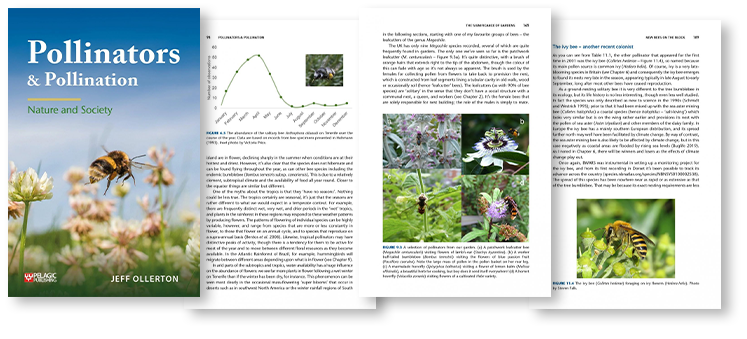
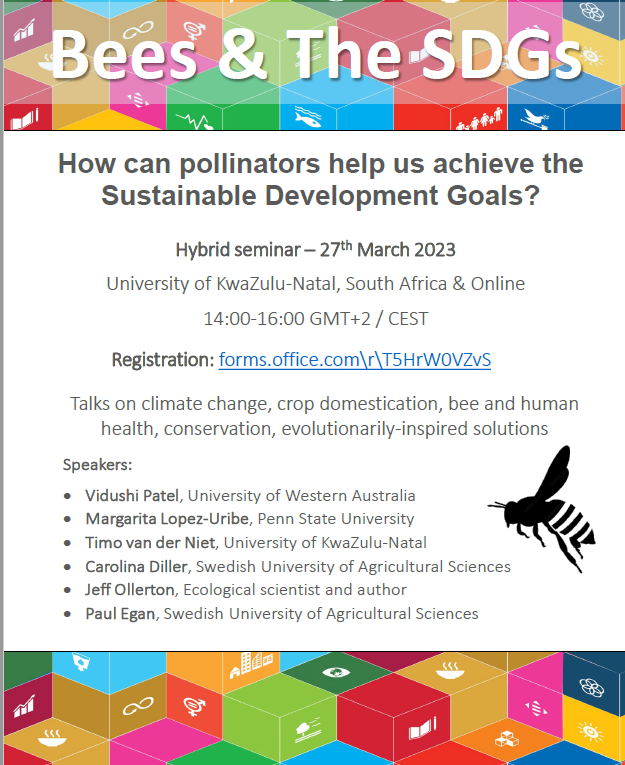
There’s been a lot of discussion recently about how pollinators can contribute to the United Nations’ 17 Sustainable Development Goals. It’s a topic that I reflected on in Pollinators & Pollination: Nature and Society, and I’ve seen a few papers and articles that raise the subject – see here for instance. This free webinar on Monday 27th March is therefore very timely! To register, follow this link: forms.office.com\r\T5HrW0VZvS

Although I’m one of the speakers, I can’t make it in person as I’ve got teaching commitments at Roskilde University, so I’ve recorded my ten minute piece and I’m happy to answer questions via the Contact page on my website.

Join me tomorrow evening for an online talk about pollinators in the UK!

It’s been a couple of years since I last did a talk or workshop for the Wildlife Trust for Bedfordshire, Cambridgeshire & Northamptonshire. But I’m pleased to say that they’ve invited me back and you can join me tomorrow evening for an online introductory talk about pollinators and pollination in the UK.

The talk starts at 7pm UK time and full details of how to sign up are in the link below:

https://www.wildlifebcn.org/events/2023-02-22-online-pollinators-and-pollination-professor-jeff-ollerton

I look forward to seeing some of you there!

Plant-pollinator meta-network of the Kashmir Himalaya: a new study just published

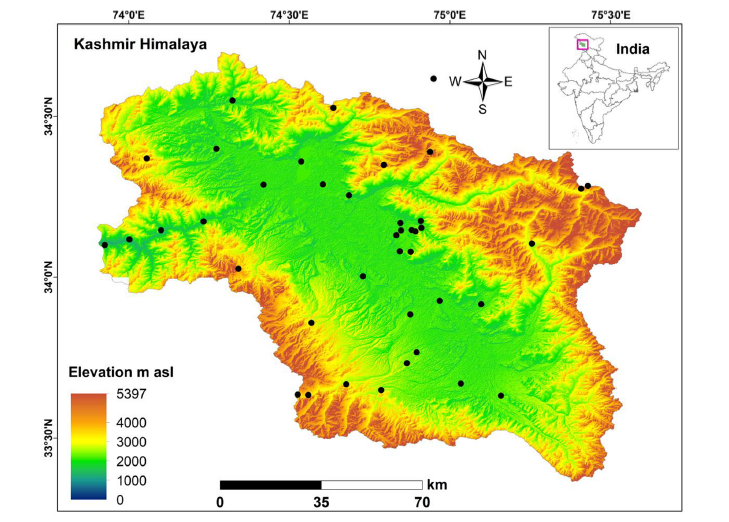
Although we sometimes like to think that we have a “global” perspective on plant-pollinator interactions, in truth there are large parts of the world where we have little or no information. That’s especially true of biodiversity hotspots. One such hotspot is the Kashmir Himalaya, a relatively small area (just 135 km long by 32 km wide) that nonetheless contains an estimated 2,000 species of flowering plant, more than 150 of which are endemic to the area. In addition, over 1,280 insect pollinator species have been described, including at least 29 species of bumblebees and as many as 40 species of butterflies.

Recently I’ve been collaborating with Dr Zubair Rather from the University of Kashmir and his colleagues on a data set that represents the first network analysis of plant-pollinator interactions from the region. The network is presented at a large spatial scale – what is often termed a “meta-network”. As Dr Kit Prendergast and I noted in our recent paper, scale matters when it comes to analysing these sorts of networks. Nonetheless (to quote the current paper):

“meta-networks represent the “backbone” of plant-pollinator interactions to which smaller, local networks are attached”

Even at this very large scale we’re seeing some fascinating patterns emerging with respect to the plants, for example the importance of cultivated apples in supporting the wider network of flower visitors. Also notable, and I believe demonstrated for the first time, is the fact that both the indigenous Asian Honeybee (Apis cerana) and the introduced Western Honeybee (A. mellifera) utilise exactly the same, extremely broad array of plants from which to collect nectar and pollen.

Our Kashmir meta-network is, hopefully, the starting point for further work on plant-pollinator interactions in this fascinating and diverse part of the world. The paper is published in a special issue of the journal Flora that’s dedicated to the importance of natural history when considering the ecology and evolution of plant-pollinator relationships. The special issue is a celebration of the work of Professor Marlies Sazima and is edited by Dr Pedro Bergamo.

Here’s the reference with a link to download a free copy which should be valid up to and including 23rd January 2023:

Rather, Z.A, Ollerton, J., Parey, S.H., Ara, S., Watts, S., Paray, M.M & Khuroo, A.A. (2022) Plant-pollinator meta-network of the Kashmir Himalaya: structure, modularity, integration of alien species and extinction simulation. Flora (in press)

Here’s the abstract:

Plant-pollinator studies are increasingly using network analysis to investigate the structure and function of such communities. However, many areas of high biodiversity largely remain unexplored in this way. Our study describes a plant-pollinator meta-network from an understudied biodiversity hotspot, the Kashmir Himalaya, where we specifically investigate plant-pollinator network nestedness and modularity, as well as the influence of alien species and the impacts of simulating species extinctions on network structure. Natural history observations were used to document the meta-network between 230 plant and 80 pollinator species forming 1958 (11% of the possible) interactions. Among the plants Malus domestica and among the pollinators Apis mellifera and A. cerana formed the largest number of interactions with significant influence over the whole network. Network cumulative degree distribution depicted a higher number of degree levels in pollinators than plants. A moderately high number of realized interactions were revealed, thereby indicating potential structural and functional stability in the network. Eight strongly defined modules were observed in the network which varied in their composition. For example, the Ephedra module exclusively comprised of native species whereas the Apis module comprised of all the four different types of interacting species (i.e. native and alien plants and pollinators) and also integrated the highest number of alien species. In the network overall, 40% of interactions were by alien species, reflecting how well these were integrated. Extinction simulations suggested that the network would collapse more quickly when the most connected pollinators are removed, rather than the most connected plant species. Our study is the first assessment of a plant-pollinator network from this Himalayan biodiversity hotspot; and will help to inform the ecological and economic implications of plant-pollinator interactions in an era of global biodiversity crisis.

The hidden potential value of woodland trees for wild bee assemblages – lead author Guthrie Allen introduces his recently published study

Note: This is a guest blog post by Guthrie Allen who is a PhD candidate at the University of East Anglia.

Though often overlooked, woodlands have great potential to support wild bees in farmed landscapes. Both the understory and canopy can provide large quantities of early-season nectar. The pollen of woodland-tree taxa such as Acer can form a large proportion of the early-season diets of bumblebees and solitary bees. Even the pollen from wind-pollinated trees such as Quercus can form a significant part of the diets of several common solitary bee species. Woodlands are also believed to provide ample nesting opportunities. These factors may explain why several studies have found positive correlations between bee abundance and/or diversity and woodland cover at the landscape scale. Despite this, a large-scale European study has shown that interior woodland understories support very few bees compared to exposed woodland edges.

Sampling the canopy – at heights of up to 20 metres – is not easy, but unlike the understory, this habitat remains sun-exposed after canopy closure and could be favourable for bees. In Europe, however, our knowledge of bee activity in the woodland canopy is very limited. Furthermore, whilst canopy-tree taxa have been identified as suitable food sources for many bees, we have little evidence that these trees are used for forage when located within woodlands. To explore the role of the canopy, we trapped bees in late spring in the understory and canopy – at the exposed edges and in the interiors – of 15 woodland sites across an English agricultural landscape.

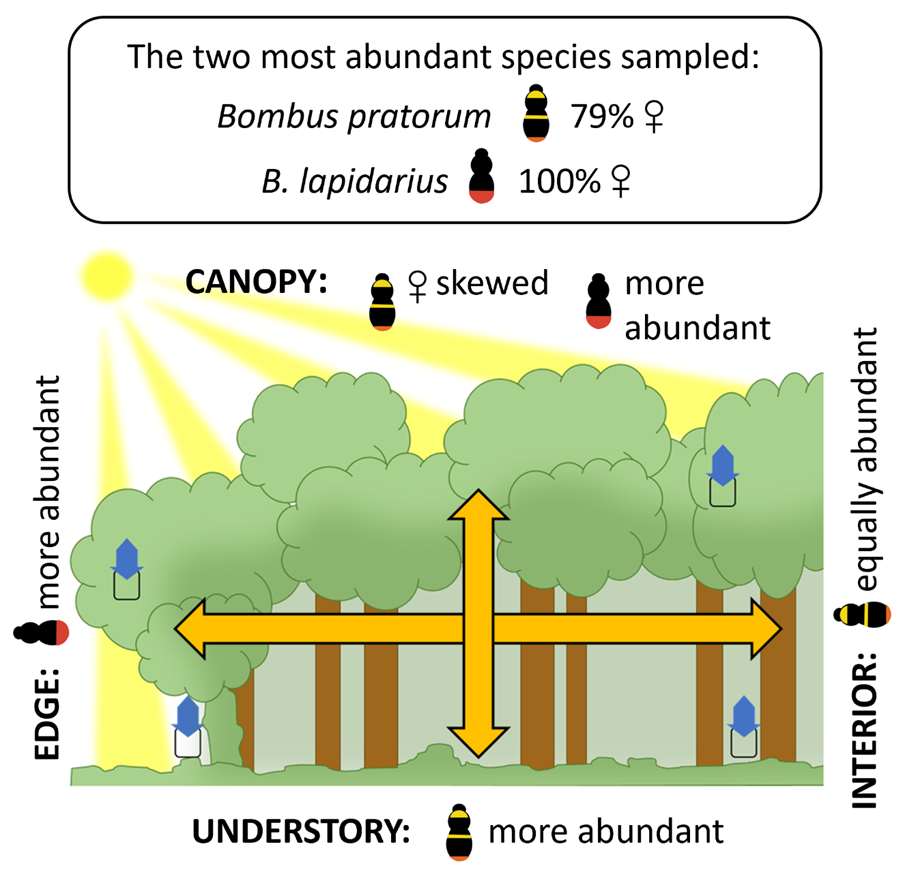
A significant proportion of bee abundance was found in the canopy, represented by 23 of the 29 total sampled species. Interior canopy activity was much higher when nectar-producing Sycamore (Acer pseudoplatanus) trees were nearby. Communities differed between the canopy and understory: of the seven most common species sampled, three were more active in the understory, while the opposite was true of one species – Bombus lapidarius. Interestingly, we found the sex ratio of the most abundant species – B. pratorum – to be female-skewed in the canopy. For four of these species, and contrary to expectations, we found no evidence that understory activity was any higher at woodland edges compared to woodland interiors.

Further research is needed to understand community differences between the canopy and understory. Nonetheless, our results suggest that both these habitats have a significant role to play in supporting farmland bees. We demonstrate that a diverse bee community has the potential to exploit canopy resources, with nectar-producing trees in woodland interiors likely to provide forage for many bees. And we show the unexpected potential of interior woodland understories to support bee abundance.

Here’s the full reference with a link to the open access paper:

Allen, G. & Davies, R.G. (2022) Canopy sampling reveals hidden potential value of woodland trees for wild bee assemblages. Insect Conservation and Diversity. Available from: https://doi.org/10.1111/icad.12606

Here’s the abstract:

Woodlands can play an important role in supporting bee abundance and diversity in agricultural landscapes. However, in temperate-region studies, the canopy is rarely sampled, and our understanding of its contribution is limited. To explore this, we sampled bees in late spring with blue vane traps in the understory (n = 30) and crowns of mature Quercus robur (n = 35) at the exposed southern edges and in the interiors (ca. 25–75 m from woodland edges) of 15 woodland sites across an English agricultural landscape. A significant proportion of bee abundance and diversity was found in the canopy: canopy-trap catches were estimated to be a third as large as understory-trap catches, and 23 of the 29 sampled species were present in the canopy. Of the seven most common species sampled, four were equally abundant in woodland edge and interior traps; three were more abundant in understory traps, and a single species—Bombus lapidarius—was more abundant in canopy traps. The sex ratio of the most abundant species, B. pratorum, was female-skewed in the canopy. Additionally, the presence of nearby Acer pseudoplatanus trees in flower greatly increased canopy-trap catches in woodland interiors. These results suggest that both the woodland canopy and understory have a significant role to play in supporting farmland bee communities; they indicate the importance of nectar-producing trees in woodland interiors, opening avenues for canopy-based management; and they demonstrate that a diverse bee community has the potential to exploit canopy floral resources.

Scale matters when analysing plant-pollinator networks: a new research paper out today

It’s long been recognised that the scale at which we study the natural world – over long or short time periods, or across small areas or whole regions – affects the conclusions that we draw about ecological patterns and processes. This is certainly true of plant-pollinator interactions. For example, a widely distributed plant can have very different pollinators at the extremes of its range, and pollinators like bees may vary their focus on nectar and pollen sources from year to year.

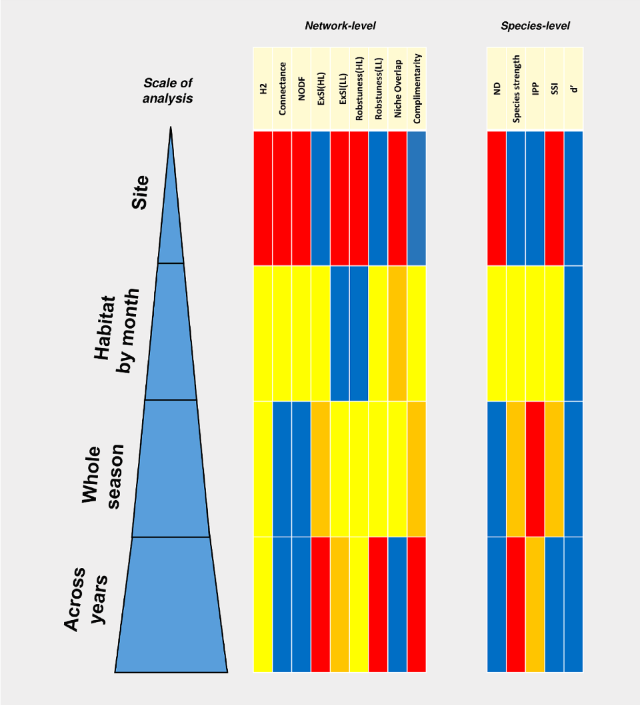
The analysis of these interactions as networks of actors has become increasingly popular in the last couple of decades. However there is no consensus about how frequent sampling should be, or the geographical scale over which networks should be studied. In fact all scales (from regional “meta-networks” down to single-season, single-site, single taxon observations) are relevant, depending on the questions being asked or the hypotheses posed.

But it’s important that we acknowledge that conclusions drawn at one scale may not apply at other scales.

That’s the take home message from a paper published this week which is the latest output from the PhD work of Australian bee expert Kit Prendergast. We have collaborated on several papers based on her data and this is actually my 100th peer-reviewed publication: a proud milestone for me and one which I’m glad to share with a wonderful early career researcher like Kit!

Here’s the reference with a link to a read-only version of the paper:

Prendergast, K.S. & Ollerton, J. (2022) Spatial and temporal scale of analysis alters conclusions about the effects of urbanisation on plant-pollinator networks. Arthropod-Plant Interactions https://doi.org/10.1007/s11252-022-01290-z

And here’s the abstract:

Bipartite networks of flowering plants and their visitors (potential pollinators) are increasingly being used in studies of the structure and function of these ecological interactions. Whilst they hold much promise in understanding the ecology of plant– pollinator networks and how this may be altered by environmental perturbations, like land-use change and invasive species, there is no consensus about the scale at which such networks should be constructed and analysed. Ecologists, however, have emphasised that many processes are scale dependent. Here, we compare network- and species-level properties of ecological networks analysed at the level of a site, pooling across sites within a given habitat for each month of surveys, and pooling across all sites and months to create a single network per habitat type. We additionally considered how these three scales of resolution influenced conclusions regarding differences between networks according to two contrasting habitat types (urban bushland remnants and residential gardens) and the influence of honey bee abundance on network properties. We found that most network properties varied markedly depending on the scale of analysis, as did the significance, or lack thereof, of habitat type and honey bee abundance on network properties. We caution against pooling across sites and months as this can create unrealistic links, invalidating conclusions on network structure. In conclusion, consideration of scale of analysis is also important when conducting and interpreting plant–pollinator networks.

Plant–bee interactions and resource utilisation in an urban landscape: a new study just published

Within the last decade there’s been a growing awareness of the importance of urban environments for supporting populations of pollinators, especially bees. Indeed, I devoted a whole chapter of my book Pollinators & Pollination: Nature and Society to the topic, though even then I was only able to scratch the surface of the research that’s been done. Since then there’s been some important studies published and this 2020 review by Kath Baldock provides a good starting point for the topic, whilst a recent pre-print by Pietro Maruyama and colleagues emphasises how little we know about pollinators in tropical cities.

One of the most detailed studies of urban solitary bees in a British town was conducted by Muzafar Sirohi when he was a PhD researcher in my department in Northampton. The first paper from that work, documenting the diversity and abundance of bees, came out in 2015, but since then commitments to other projects, plus Muzafar’s return to his university in Pakistan, have meant that we’ve struggled to find the time to publish more. Hopefully that’s changing and the second publication from Muzafar’s thesis is now out, with a third in progress.

This new paper uses a network approach to study the use of flowers by these bees; here’s the reference with a link to a read-only copy of the paper, followed by the abstract.

Sirohi, M.H., Jackson, J. & Ollerton, J. (2022) Plant–bee interactions and resource utilisation in an urban landscape. Urban Ecosystems https://doi.org/10.1007/s11252-022-01290-z

Abstract:

Biodiversity is declining through human activities and urbanisation is often seen as a particular concern. Urban settings, however, provide diverse microclimatic conditions for plants and pollinating insects, and therefore may be significant habitats for the conservation of solitary and primitively eusocial bees, a major group of pollinators. This study analysed the interactions between these bees and the plants on which they forage, using a network approach. We compared urban habitats (gardens, roadsides, and open vegetation) in a large British town with nearby nature reserves. One native plant Taraxacum officinale (dandelion) was a core generalist species visited in all habitat types. Other core plant species restricted to particular habitats include species of Geranium, Bellis, Crepis, and Ranunculus. Two generalist bee species, Anthophora plumipes and Osmia bicornis were the core visitor species within the networks. The networks were comparatively more nested in urban habitat types than nature areas, suggesting more frequent interactions between generalist and specialist species in urban areas. Network connectance, network level specialisation (H2’ index), and plant generality (network level) were not significantly different in urban and nature areas. However, visitor generality was found to be significantly higher in urban gardens than in nature areas. Careful management of common urban vegetation would be beneficial for supporting urban wild pollinators.

Pollinator-flower interactions in gardens during the COVID-19 pandemic lockdown of 2020: the data paper has just been published!

During the lockdown period of the COVID-19 pandemic in 2020, many pollination ecologists were stuck at home: universities and research institutes were closed and restrictions on travel meant that it was not possible to get out and do field work. In order to keep active and motivated, and to turn adversity into an opportunity, an ad hoc network of more than 70 researchers from 15 different countries (see the map above) decided to collect standardised data on the plant-pollinator networks in their own gardens and nearby public spaces.

When combined with information about location, size of garden, floral diversity, how the garden is managed, and so forth, this would provide some useful data about how gardens support pollinators. For those with kids at home it could also be a good way of getting them out into fresh air and giving them something to do!

Following discussions, several different protocols were instigated which depended upon the time available to the researchers, including one that mirrored the UK Pollinator Monitoring Scheme’s  FIT (Flower-Insect Timed) counts.

The resulting data set of almost 47,000 visits by insects and birds to flowers, as well as information about flowers that were never visited, is freely available and will be an invaluable resource for pollination ecologists. For example, analysing the links between ornamental flowers that share pollinators with fruits and vegetables such as apples and beans, will allow us to make recommendations for the best plants to grow in home gardens that can increase yields of crops.  

There’s an old saying about turning adversity into a positive outcome: “When life gives you lemons, make lemonade”, and the researchers were pleased to find that there’s one record of Citrus limon in the data set!

The paper describing the data set has just been published in the Journal of Pollination Ecology and you can download a PDF of the paper and the associated data for free by following this link.

Sincere thanks to all of my co-authors for their commitment to the project!