After what seems like a long wait, for me at least, today marks the official publication of Birds & Flowers: An Intimate 50 Million Year Relationship! I received my advance copies on Friday, an event that Karin commemorated with a short unboxing video:
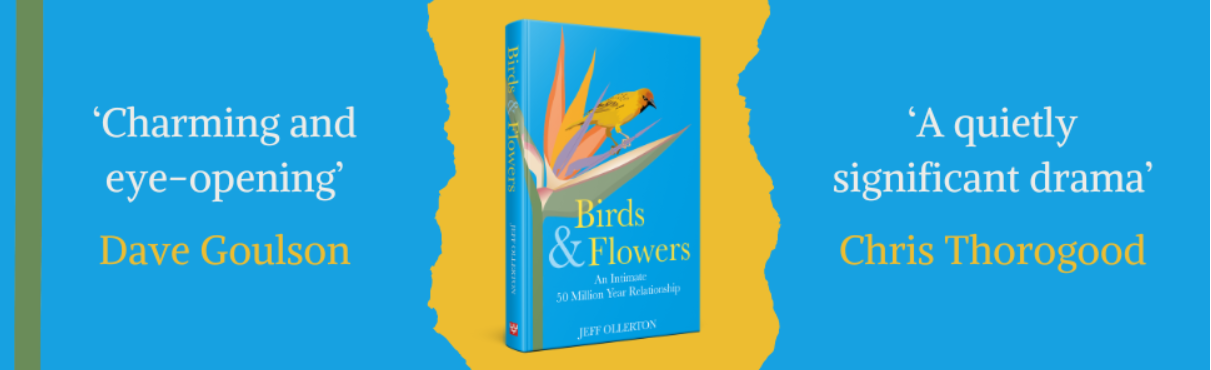
It’s been a long journey from pitching the initial idea to Pelagic Publishing back in early 2021, through the various drafts that have culminated in the finished book. As you can see from the images on this post and the endorsements on the publisher’s web site, Birds & Flowers has so far been warmly received. I hope that future reviews are as positive!
A few people have asked me what’s next. In fact I have definite plans (as in topics, provisional titles, the start of chapter structure, and even some initial writing) for three more books. The next one is actually about half written, but then I have been working at it, on and off, for 30 years! Watch this space for more details…
In the shorter term, Karin and I are returning (permanently) to the UK at the start of March. We’ve enjoyed our time in Denmark, it’s been a fun two and a half years, but we’re missing our immediate family plus we both have some interesting work possibilities to pursue. In mid-April I will be going to China for three months to work with my colleague Zong-Xin Ren at the Kunming Institute of Botany. I’ll be sure to blog about my adventures there!
In the meantime, if you buy my book or borrow it from the library or from a friend, please let me know what you think in the comments section below.
In the run up to release of my new book Birds & Flowers: An Intimate 50 Million Year Relationship, my publisher, Pelagic, has updated the book description and provided a preview of some of the pages and colour plates – follow this link to view them. On that page you can also pre-order the book direct from Pelagic Publishing, who will ship worldwide, or it’s available from many of the online book sellers.
I’m really excited to be sharing this with the readers of my blog and can’t wait for publication day! Early in 2024 I hope to do some talks, online and in person, to promote the book – so watch this space.
With best wishes to you all and hopes for a peaceful, and more sustainable, New Year.
But just as when a movie director says “That’s a wrap” at the end of the final day of filming, the hard work does not stop here. Two people have read the full manuscript as I was producing chapters and their suggestions have been incorporated into this draft. The publisher will now send it to a third, independent beta reader and once their feedback has been acted on it will go to a copy editor who will suggest stylistic changes, check for logic and consistency, and so forth.
At the same time I will be choosing which plates to put in the book, which images to use on the back cover, writing their descriptions and deciding where to cite them; checking the sources and further reading sections for each chapter and formatting the references; and producing an appendix that lists the scientific names against the vernacular names that I am using in the book. I also need to finalise the acknowledgements section.
As an author, producing a book is a long process that doesn’t end with the actual writing of the manuscript. It’s incredibly satisfying, however, and working with Pelagic on my second book for them has been a great experience. All being well, Birds & Flowers should be out by early winter.
Now, I have three options for the next book that I’m writing….which one to choose…?
For the past year I’ve been keeping a secret from all but a few trusted confidantes: the subject and title of my next book! My publisher – Pelagic – has now announced it on their website and so it’s time to make it public. “Birds & Flowers: An Intimate 50 Million Year Relationship” will be the first book that covers bird pollination in its entirety, going beyond just hummingbirds, sunbirds and honeyeaters, to consider the more than 60 other bird families that interact with flowers, and the tens of thousands of plants that rely on them as pollinators. You can read more about it on Pelagic’s website.
The 3D mock-up of the cover shown above features an illustration by my good friend Stephen Valentine, a very talented artist who you may remember produced this painting of waxwings that Karin bought for my birthday a few years ago. I’m extremely pleased with how Pelagic have incorporated this into the design of the cover.
The book will be available by autumn I hope, if my writing schedule goes to plan!
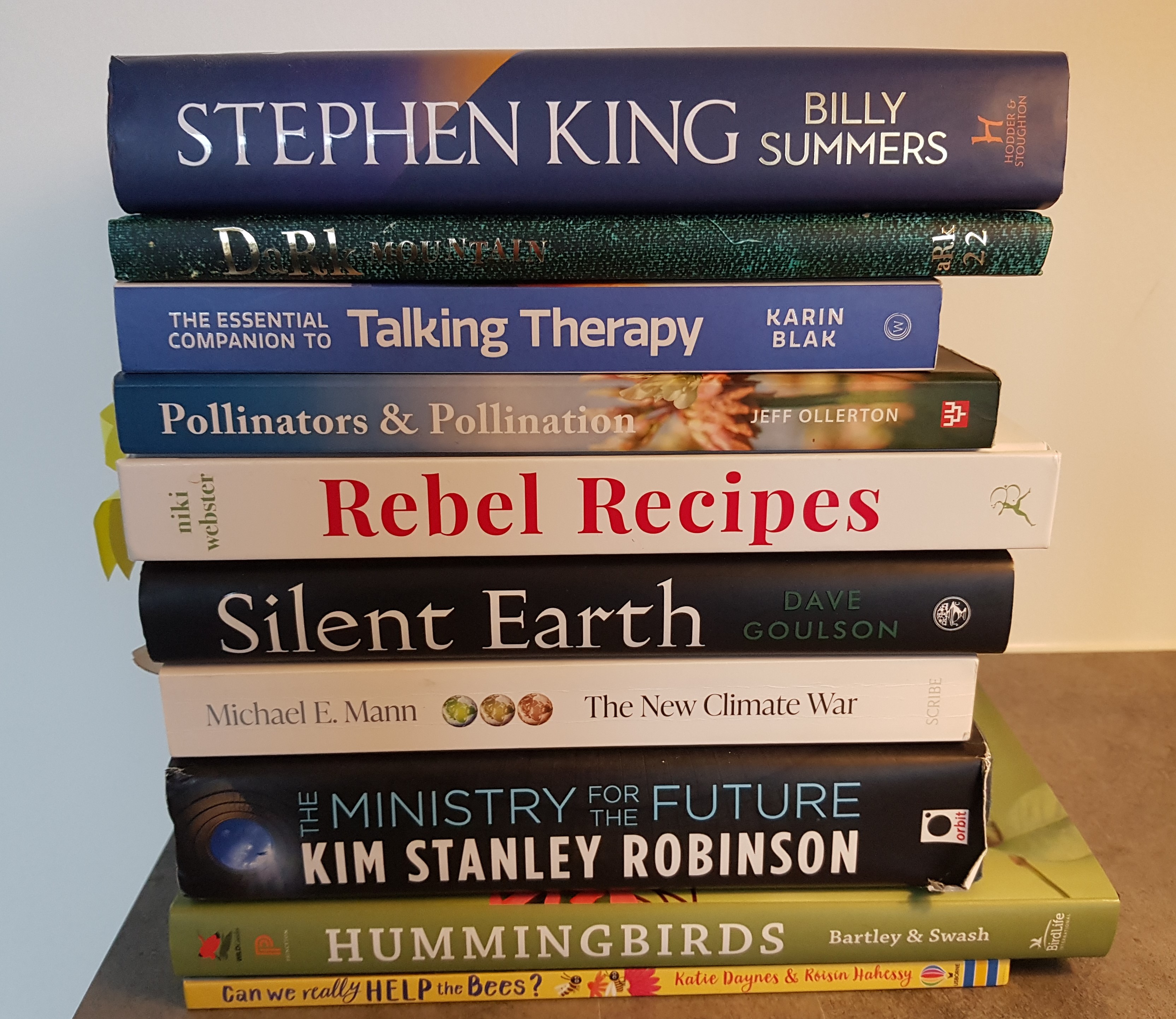
Although we are still in the early part of November, it’s never too soon to be thinking about buying Christmas gifts for friends and family. And what better gift than a book? Here’s a few suggestions for some that I’ve read this year that I think will make fine presents.
Who doesn’t love a good story, and Stephen King is a master storyteller. I’ve really enjoyed his more recent novels and Billy Summers stands out for me. It’s part thriller, part romance, and as always there’s a little touch of the uncanny. Very different, but just as much a page turner, is The Ministry for the Future by Kim Stanley Robinson. Although Robinson is known as a science fiction writer, this novel is set in the near future when climate change breakdown is forcing governments and businesses into making radical changes. As much as anything this is a road map for how we can get ourselves out of the current climate crisis.
Talking of which, Michael Mann’s The New Climate War should be read by everyone interested in understanding how big corporations have colluded with the media and governments to trivialise and misrepresent the problems that we currently face. I reviewed this and a book about the insect biodiversity crisis, Silent Earth by Dave Goulson, in this blog post.
If you are looking for a book to help young children understand the importance of bees and other pollinators then I can highly recommend Can We Really Help the Bees? by Katie Daynes and Róisín Hahessy, for which I acted as science advisor.
For the ornithologically minded you might want to consider the lavishly illustrated Hummingbirds: A Celebration of Nature’s Jewels by Glenn Bartley and Andy Swash. Those who love writing and art with an environmental focus would appreciate an annual subscription to Dark Mountain, which gives you two beautifully produced volumes every year. A couple of my essays appeared in earlier volumes and the quality of the contributions never fails to impress me.
For the budding or experienced cook, Niki Webster’s Rebel Recipes serves up some amazing vegan dishes that Karin and I have really enjoyed trying. And speaking of my wife, of course I have to include her Essential Companion to Talking Therapy as the perfect gift for anyone considering or currently undergoing counselling or therapy, or who is thinking about becoming a practitioner.
Finally, if you’re looking for particular book ideas or just like browsing through lists of what others recommend, there’s lots of inspiration over at the independent Shepherd site.
I hope that you’ve found this useful. Feel free to comment with suggestions for other books that you’ve enjoyed.
The question of whether interactions between different species are more specialised in tropical environments (as theory predicts) has intrigued me for a couple of decades. In fact it’s just occurred to me that August 2022 was the 20th anniversary of my paper in Oikos co-authored with Louise Cranmer entitled: Latitudinal trends in plant-pollinator interactions: are tropical plants more specialised? That paper was one of the first to seriously challenge an idea that was long-embedded in the scientific and (especially) popular literature, that tropical ecology was in a sense “special” and that the ways in which species parasitised, consumed, or engaged in mutualistic relationships in the tropics was different to what was happening in the subtropics and temperate zones.
Since then I’ve written about this subject in a number of publications, most recently in my book Pollinators & Pollination: Nature and Society and it’s inspired some other researchers to address the topic.
One of the real challenges with asking questions about how plant-pollinator relationships change over large geographical areas is obtaining good, robust data to analyse. It’s a challenge to convince science funding agencies to give money to spend many years travelling the world and collecting the kind of data that are needed. However we can gain some idea of the patterns, and potential processes, that drive the macroecology of plant-pollinator interactions by piecing together databases of interactions for particular taxa, gleaned from published and unpublished sources.
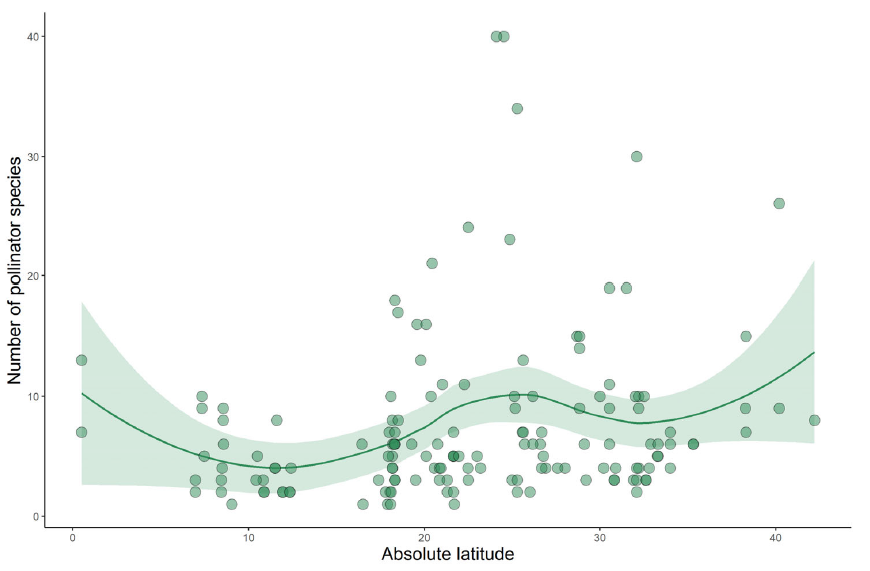
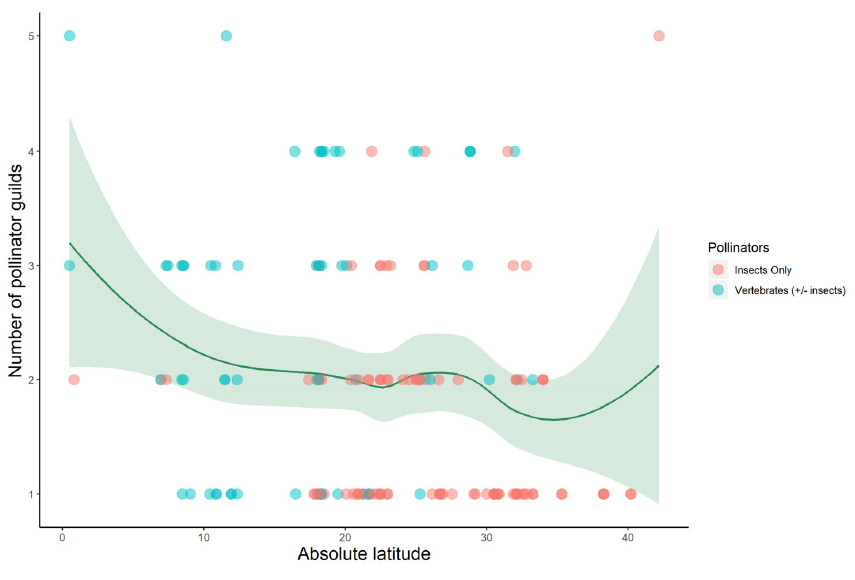
That’s what we have done for the family Cactaceae in a new study led by Pablo Gorostiague from the Universidad Nacional de Salta in Argentina. This collaboration started when Pablo visited Northampton back in 2018 and spent some time with my research group, including helping out with field work in Tenerife. Since then the usual issues (work, COVID, etc.) have delayed publication of our paper, but now it’s finally out. Amongst other results we find that, yes, tropical cacti are pollinated by fewer species on average (though it’s hugely variable – see the figure above) but that functional specialisation (i.e. the number of pollinator guilds that are used by species) is no different in the tropics compared to the extra-tropics (that’s the figure at the end of this post).
The full reference with a link to the paper is below; if anyone wants a PDF, please send me a message via the Contact page:
Biotic interactions are said to be more specialized in the tropics, and this was also proposed for the pollination systems of columnar cacti from North America. However, this has not yet been tested for a wider set of cactus species. Here, we use the available information about pollination in the Cactaceae to explore the geographic patterns of this mutualistic interaction, and test if there is a latitudinal gradient in its degree of specialization.
We performed a bibliographic search of all publications on the pollination of cacti species and summarized the information to build a database. We used generalized linear models to evaluate if the degree of specialization in cacti pollination systems is affected by latitude, using two different measures: the number of pollinator guilds (functional specialization) and the number of pollinator species (ecological specialization).
Our database contained information about the pollination of 148 species. The most frequent pollinator guilds were bees, birds, moths and bats. There was no apparent effect of latitude on the number of guilds that pollinate a cactus species. However, latitude had a small but significant effect on the number of pollinator species that service a given cactus species.
Bees are found as pollinators of most cactus species, along a wide latitudinal gradient. Bat and bird pollination is more common in the tropics than in the extra-tropics. The available information suggests that cacti pollination systems are slightly more ecologically specialized in the tropics, but it does not support any trend with regard to functional specialization.
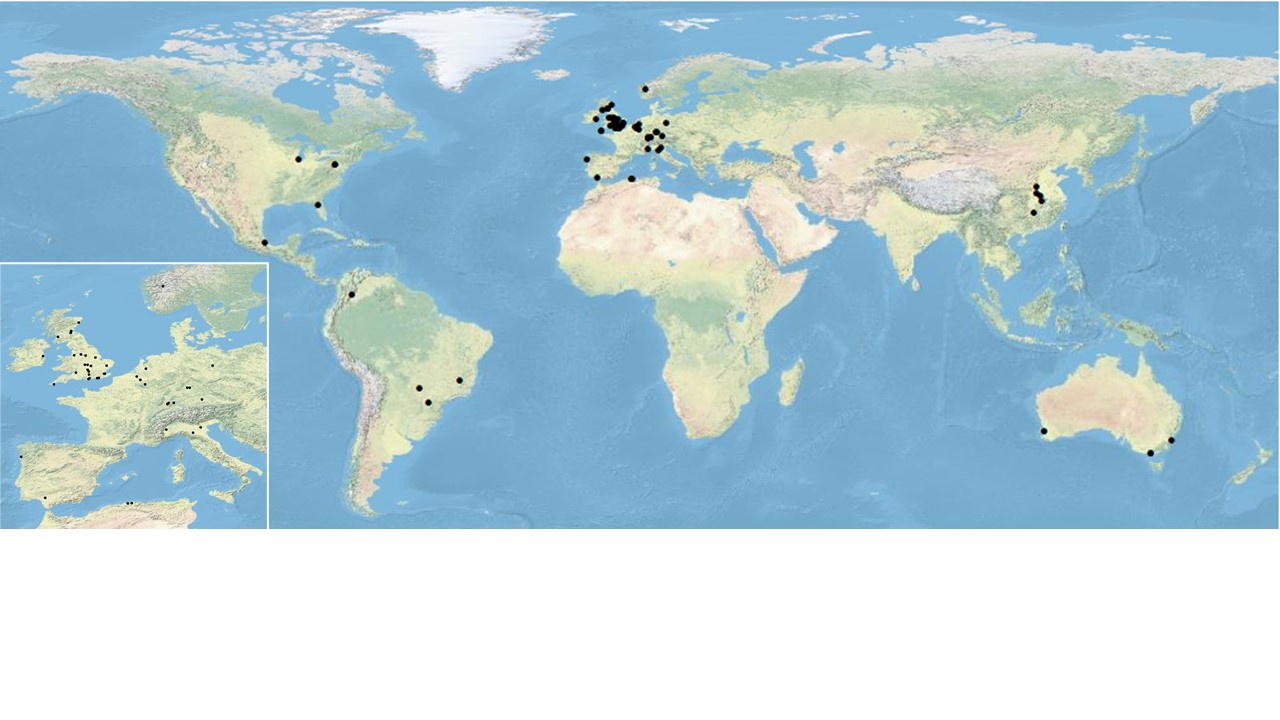
During the lockdown period of the COVID-19 pandemic in 2020, many pollination ecologists were stuck at home: universities and research institutes were closed and restrictions on travel meant that it was not possible to get out and do field work. In order to keep active and motivated, and to turn adversity into an opportunity, an ad hoc network of more than 70 researchers from 15 different countries (see the map above) decided to collect standardised data on the plant-pollinator networks in their own gardens and nearby public spaces.
When combined with information about location, size of garden, floral diversity, how the garden is managed, and so forth, this would provide some useful data about how gardens support pollinators. For those with kids at home it could also be a good way of getting them out into fresh air and giving them something to do!
The resulting data set of almost 47,000 visits by insects and birds to flowers, as well as information about flowers that were never visited, is freely available and will be an invaluable resource for pollination ecologists. For example, analysing the links between ornamental flowers that share pollinators with fruits and vegetables such as apples and beans, will allow us to make recommendations for the best plants to grow in home gardens that can increase yields of crops.
There’s an old saying about turning adversity into a positive outcome: “When life gives you lemons, make lemonade”, and the researchers were pleased to find that there’s one record of Citrus limon in the data set!
The paper describing the data set has just been published in the Journal of Pollination Ecology and you can download a PDF of the paper and the associated data for free by following this link.
Sincere thanks to all of my co-authors for their commitment to the project!
In my recent book Pollinators & Pollination: Nature and Society I discussed the current state of our knowledge of how populations of pollinators have changed over time. Although we have some quite detailed data for particular, often charismatic, species or for certain geographic localities or regions, for most species we know almost nothing. As I wrote in the chapter “The shifting fates of pollinators”:
“For most pollinators we are ‘data deficient’, in other words, we don’t know how their populations are performing. They could be doing well, but they may not be”
This is particularly true for those regions for the world that hold the greatest terrestrial biodiversity: the tropics. For the vast majority of species in the tropics we know precious little about trends in their populations and how their distributions have changed over time in the face of wide-scale land transformation and recent climatic shifts. Filling in some of the gaps in our knowledge of Neotropical pollinator distributions is one of its aims of SURPASS2, a collaboration between South American and UK ecologists, and one of several research and outreach projects with which I’m involved.
In a new study that’s come out of that work, led by Rob Boyd from the UK Centre for Ecology and Hydrology, we’ve used the GBIF database to look at the changing distributions of four important groups of pollinators: bees, hoverflies, leaf-nosed bats and hummingbirds. In particular we were interested in understanding the kinds of biases that come with such publicly available data, and whether recent efforts to add data to GBIF has improved our understanding of trends.
Our overall conclusion is that there are significant limitations and biases inherent in all of these data sets even for groups like hummingbirds which one would imagine are well documented by scientists and bird-watching naturalists. In addition, having more data does not necessarily help matters: it can introduce its own biases.
The paper is open access and feely available; here’s the reference with a link:
Aim Aggregated species occurrence data are increasingly accessible through public databases for the analysis of temporal trends in the geographic distributions of species. However, biases in these data present challenges for statistical inference. We assessed potential biases in data available through GBIF on the occurrences of four flower-visiting taxa: bees (Anthophila), hoverflies (Syrphidae), leaf-nosed bats (Phyllostomidae) and hummingbirds (Trochilidae). We also assessed whether and to what extent data mobilization efforts improved our ability to estimate trends in species’ distributions.
Location The Neotropics.
Methods We used five data-driven heuristics to screen the data for potential geographic, temporal and taxonomic biases. We began with a continental-scale assessment of the data for all four taxa. We then identified two recent data mobilization efforts (2021) that drastically increased the quantity of records of bees collected in Chile available through GBIF. We compared the dataset before and after the addition of these new records in terms of their biases and estimated trends in species’ distributions.
Results We found evidence of potential sampling biases for all taxa. The addition of newly-mobilized records of bees in Chile decreased some biases but introduced others. Despite increasing the quantity of data for bees in Chile sixfold, estimates of trends in species’ distributions derived using the postmobilization dataset were broadly similar to what would have been estimated before their introduction, albeit more precise.
Main conclusions Our results highlight the challenges associated with drawing robust inferences about trends in species’ distributions using publicly available data. Mobilizing historic records will not always enable trend estimation because more data do not necessarily equal less bias. Analysts should carefully assess their data before conducting analyses: this might enable the estimation of more robust trends and help to identify strategies for effective data mobilization. Our study also reinforces the need for targeted monitoring of pollinators worldwide.
——————————————————–
SURPASS2 has been a hugely productive project as you’ll see if you look at the Publications page of the website. There’s much more to come and I’ll report on those research papers as they appear.




 Prof. Jeff Ollerton - ecological scientist and author