Category Archives: Flies

New study just published: The effect of elevation, latitude, and plant richness on robustness of pollination networks at a global scale

During the 2020 lockdown caused by the COVID-19 pandemic, I coordinated an international network of pollination ecologists who used standardised methods to collect data in their gardens. I blogged about it at the time – see here and here for instance – and also put up a post when the data paper from that work was published.

Several research groups are now working with that huge data set and interrogating it for answers to a wide range of questions. The first group to actually publish a paper from the data is a largely Chinese set of researchers from the Key Laboratory of Plant Resources, Conservation and Sustainable Utilization, at the South China Botanical Garden in Guangzhou, assisted by Kit Prendergast and myself.

In this paper we’ve considered how robust these plant-pollinator networks are to simulated extinctions of species, and how this is affected by the elevation, latitude, and plant species diversity of the network.

Here’s the full reference with a link to the study:

Wang, X.-P., Ollerton, J., Prendergast, K.S., Cai, J.-C., Tong, M.-Y., Shi, M.-M., Zhao, Z.-T., Li, S.-J. & Tu, T.-Y. (2024) The effect of elevation, latitude, and plant richness on robustness of pollination networks at a global scale. Arthropod-Plant Interactions (in press) https://doi.org/10.1007/s11829-024-10056-7

If you can’t access it and need a PDF, please send me a request via my Contact page.

Here’s the abstract:

Plant-pollinator interactions play a vital role in the maintenance of biodiversity and ecosystem function. Geographical variation in environmental factors can influence the diversity of pollinators and thus, affect the structure of pollination networks. Given the current global climate change, understanding the variation of pollination network structure along environmental gradients is vital to predict how global change will affect the ecological interaction processes. Here, we used a global plant-pollinator interaction data collection by the same sampling method at the same period to explore the effects of elevation, latitude, and plant richness on the structure and robustness of pollination networks. We analyzed a total of 87 networks of plant-pollinator interactions on 47 sites from 14 countries. We conducted a piecewise structural equation model to examine the direct and indirect effects of elevation, latitude, and plant richness on the network robustness and analyzed the function of network structure in elucidating the relationship between robustness and these gradients. We found that plant richness had both positive effects on robustness under random and specialist-first scenarios. Elevation, latitude, and plant richness affected network connectance and modularity, and ultimately affected network robustness which were mediated by nestedness under specialist-first and random scenarios, and by connectance under the generalist-first scenario. This study reveals the indirect effects of elevation, latitude, and plant richness on pollination network robustness were mediated by nestedness or connectance depended on the order of species extinctions, implying that communities with different pollination network structures can resist different extinction scenarios.

Reusing Plant-Pollinator Datasets – a free WorldFAIR webinar on 18th April

A message from Dr Debora Drucker, WorldFAIR Agricultural Biodiversity Case Study Lead:

Registration is open to our contribution to the WorldFAIR webinar series – “Reusing Plant-Pollinator Datasets: a Global Perspective with Guidelines and Recommendations inspired by Pilot Studies from Africa, the Americas and Europe”.

It will be held on April 18 at 2:00 pm – 3:00 pm (Times in UTC) – https://worldfair-project.eu/event/the-worldfair-webinar-series-reusing-plant-pollinator-datasets-a-global-perspective-with-guidelines-and-recommendations-inspired-by-pilot-studies-from-africa-the-americas-and-europe/

We will present results from Deliverables 10.2 & 10.3, with focus on our pilot studies:

Drucker, D., Salim, J. A., Poelen, J., Soares, F. M., Gonzalez-Vaquero, R. A., Ollerton, J., Devoto, M., Rünzel, M., Robinson, D., Kasina, M., Taliga, C., Parr, C., Cox-Foster, D., Hill, E., Maues, M. M., Saraiva, A. M., Agostini, K., Carvalheiro, L. G., Bergamo, P., Varassin, I.; Alves, D. A., Marques, B., Tinoco, F. C., Rech, A. R., Cardona-Duque, J., Idárraga, M., Agudelo-Zapata, M. C., Marentes Herrera, E. Trekels, M. (2024). WorldFAIR (D10.2) Agricultural Biodiversity Standards, Best Practices and Guidelines Recommendations (Version 1). Zenodo. https://doi.org/10.5281/zenodo.10666593

Drucker, D. P., Salim, J. A., Poelen, J., Soares, F. M., Gonzalez-Vaquero, R. A., Devoto, M., Ollerton, J., Kasina, M., Carvalheiro, L. G., Bergamo, P. J., Alves, D. A., Varassin, I., Tinoco, F. C., Rünzel, M., Robinson, D., Cardona-Duque, J., Idárraga, M., Agudelo-Zapata, M. C., Marentes Herrera, E., Taliga, C., Parr, C.S., Cox-Foster, D., Hill, E., Maués, M.M. Agostini, K. Rech, A.R., Saraiva, A. (2024). WorldFAIR (D10.3) Agricultural biodiversity FAIR data assessment rubrics (Version 1). Zenodo. https://doi.org/10.5281/zenodo.10719265

We reserved a good amount of time for Q&A – I hope to see you there and have a nice discussion!

We’ve just named a new species of fly from Yemen! And it came out of a flower from Kew

Back in the late 1990s and early 2000s, whenever I had a (rare) day free from teaching, marking, supervision, meetings, writing, and other university commitments, I would hop on the train from Northampton to London. My destination was the Spirit Collection of the Herbarium at the Royal Botanic Gardens, Kew, where bottled flowers are preserved in their three-dimensional complexity, rather than squashed flat onto herbarium sheets. To this day, the smell of formaldehyde in the “Kew Mix” takes me back to the chilly basement space of that collection.

The Kew Herbarium is a massive, internationally important resource for taxonomy, evolutionary biology and ecology, and one which ought to stay where it is, in my opinion.

The purpose of my visits was to exploit the large number of Ceropegia specimens that had been collected by botanists working in Africa, the Middle East, and Asia. These amazing flowers are so complex that they are best preserved in spirit, and that complexity in turn is a function of their sophisticated pollination systems. The flowers temporarily trap their pollinators, releasing them unharmed after a period, during which they will have picked up pollen and/or the flower will have been pollinated. If you have ever grown String-of-Hearts as a house plant, that’s the group we are talking about.

The botanists who collected these flowers were, of course, only interested in the plants. But as well as pickling the blooms they sometimes pickled the insect contents of the flowers, giving us a record of what the flowers were luring into their temporary traps. Not only that, but Ceropegia belongs to the milkweed subfamily of Apocynaceae, which means that their pollen is in the form of pollinia. These are coherent packages of pollen that mechanically, and persistently, clip to the insect. This gives us an opportunity to sort out the real pollinators (with pollinia attached) from other insects that may be inside the flowers for other reasons, such as looking for prey or sheltering from the dry heat of the day.

It had occurred to me that if someone was to check these flowers for insects, and extract any that were found, then we could build up an unprecedentedly complete picture of the diversity of pollinators in a large, mainly tropical plant genus of around 200 species. So that’s what I did, whenever time allowed. Having gained permission to do this, I was pleased to discover that the process was considerably speeded up by the fact that preserving the flowers in this way clears the tissues, making them colourless and translucent. By shining a bench light through the bottles I could see which flowers contained insects and carefully dissect them out.

Most flowers were empty, but occasional visits over a period of a few years resulted in a data set of flower visitors and pollinators for about 60 species and subspecies of Ceropegia. The first paper from that work was published in 2008 in Annals of Botany as ‘Fly pollination in Ceropegia (Apocynaceae: Asclepiadoideae): biogeographic and phylogenetic perspectives‘. Later work by colleagues and myself meant that in 2017 we could publish an update in the journal Flora (Diversity of Diptera families that pollinate Ceropegia (Apocynaceae) trap flowers: An update in light of new data and phylogenetic analyses).

The work also fed into our large study of pollination systems in Apocynaceae and I even published a small note about an ant specimen that I had extracted which still had the evidence of its last meal (a fly’s wing) protruding from its mouth.

The work at Kew had given us a short cut to understanding how pollination systems have evolved in this big plant species radiation. The equivalent field work required to collect the same data would have taken many person years and no funding agency would have given it the time of day. Not only that, but a portion of the data is from parts of the word that are war-torn, dangerous, and largely inaccessible to field scientists at the moment. Which brings us to the present paper.

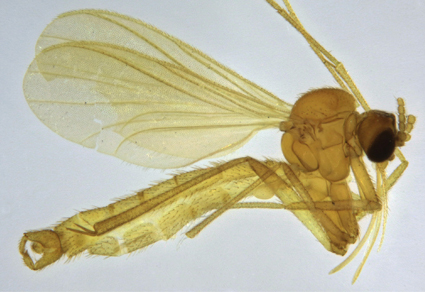
All of the pollinators, and most of the flower visitors, to Ceropegia that have been discovered to date are small flies (Diptera) often only a couple of millimetres in length. There are relatively few taxonomists who can identify such flies and most of the specimens I extracted were identified to genus or family by Andrew Whittington. One such specimen was determined to be a species of Lygistorrhina, known as ‘long-beaked fungus gnats‘. It was found in a flower of Ceropegia aristolochioides ssp. deflersiana, which is something of a generalist in this genus of specialists: it’s pollinated by at least four fly genera and 11 others have been collected from its flowers sans pollinia, including this one.

The flower was collected in 1975 by botanist John Wood, in Yemen – like I said, inaccessible – and the semi-arid climate in which it was found, whilst typical for Ceropegia, is unusual for Lygistorrhina. When National Museums Scotland entomologist Vladimir Blagoderov looked at the specimen he quickly realised that it was a new species and contacted Andrew and myself to discuss describing it. The paper documenting the new species, which we have named Lygistorrhina woodi in John’s honour, was published today. Here’s the reference with a link to the paper, which is open access:

Blagoderov, V., Ollerton, J. & Whittington A. (2023) A new species of Lygistorrhina (Lygistorrhina) Skuse, 1890 (Diptera: Keroplatidae, Lygistorrhininae) with a key to the subgenus. Zootaxa 5361: 151–158

Here’s the abstract:

A new species of Lygistorrhina (Lygistorrhina) Skuse, 1890, Lygistorrhina woodi sp. nov., is described. The specimen was dissected from an alcohol-preserved flower of Ceropegia aristolochioides ssp. deflersiana Bruyns (Apocynaceae, Asclepiadoideae, Ceropegieae) stored in the Kew herbarium. This is the first occurrence of the lygistorrhine gnats in a hot, semi-arid climate. A key to all known species of the subgenus Lygistorrhina (Lygistorrhina) is provided.

Biodiversity Net Gain and what it could mean for pollinators – read the new report

Biodiversity Net Gain (or BNG) promises to transform the way that we approach nature conservation in the UK. I’ve been giving a lot of thought to what this might mean for insect pollinators and have produced a new report that summarises the opportunities that BNG presents and how we can make the most of them. You can download a copy of that report by following this link.

This is meant to be a working document and as BNG progresses, and our understanding of its impacts on pollinators increases, I will update it. In the meantime, please do feel free to comment.

The neglected pollinators – a call for papers for a special issue

There’s an estimated 350,000 described species of pollinators, and many, many more undescribed. Only about 20,000 of these (i.e. less than 6%) are bee species, although you wouldn’t know it from the media obsession with bees. It’s important and and timely, therefore, that a team of South American scientists have come together to propose a special issue of the Journal of Applied Entomology that focuses on these “other” insects.

The special issue will be called “The Neglected Pollinators: Understanding the Importance of Lesser-Known Insect Taxa in Pollination”. Consider submitting a manuscript if you work on anything except bees! Here’s the link to the details of how to submit your work:


https://onlinelibrary.wiley.com/page/journal/14390418/homepage/call-for-papers/si-2023-000411

Pesticides and pollinators: please sign this petition!

As part of our roles as ambassadors of the new conservation organisation Restore (more of which later this year), several of us including Dave Goulson, George McGavin, and myself, are promoting this online petition to get the government to take the issue of neonicotinoid pesticides seriously. Here’s some text from Dave explaining the situation with a link to a petition that you can sign:

“For three years in a row our government has granted farmers special permission to use banned neonicotinoid pesticides on sugar beet. This is contrary to the expert advice of their own Expert Committee on Pesticides, who specifically recommended that permission should not be granted.  It also flies in the face of a huge body of scientific evidence showing that these chemicals are phenomenally toxic to all insect life, and that their use on any crop contaminates soils, hedgerow plants, and nearby streams and ponds for years to come. We are in a crisis, with insect populations in freefall. It is about time our government woke up to this, and acted accordingly. This petition https://petition.parliament.uk/petitions/631948 is a necessary means of holding the government to account. Please sign and share, as signing will ensure the issue is debated in Parliament.”

This petition now has more than 15,000 signatures which ensures that it gets a response from the Government. If it reaches 100,000 mark, it will trigger a debate in Parliament. Please sign and promote this important initiative! 

Join me tomorrow evening for an online talk about pollinators in the UK!

It’s been a couple of years since I last did a talk or workshop for the Wildlife Trust for Bedfordshire, Cambridgeshire & Northamptonshire. But I’m pleased to say that they’ve invited me back and you can join me tomorrow evening for an online introductory talk about pollinators and pollination in the UK.

The talk starts at 7pm UK time and full details of how to sign up are in the link below:

https://www.wildlifebcn.org/events/2023-02-22-online-pollinators-and-pollination-professor-jeff-ollerton

I look forward to seeing some of you there!

Introducing Ceropegia stylesii – a novel species of “Brachystelma” from South Africa

This is a guest post by Dr Annemarie Heiduk about a new species that she’s recently described.

—————————————————————————————————————————-

In an earlier blog post about the discovery of a novel Ceropegia species, Jeff’s finishing sentence was: “I wonder what else is still waiting to be discovered in the stunning grasslands of South Africa?”

I am happy to provide a first answer to this question: Ceropegia stylesii.

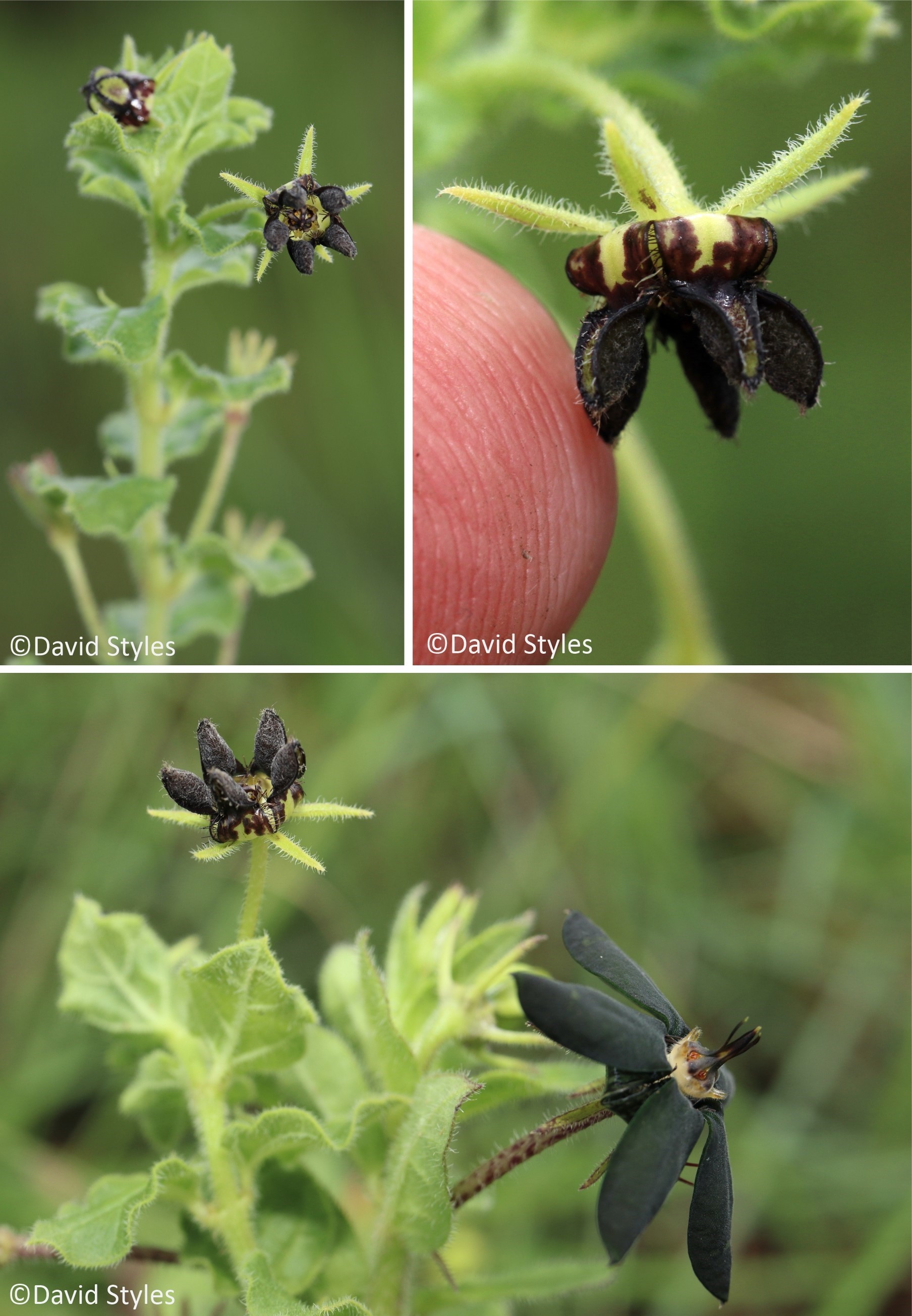
This new species does not have the tubular kettle-trap flowers typical of Ceropegia, which temporarily trap pollinators, but open-rotate corollas where the gynostegium (fused male and female reproductive organs) is freely accessible to pollinators. So, in the traditional sense, C. stylesii is not a Ceropegia. This needs some explanation here!

Ceropegia is a genus in the plant family Apocynaceae (Jeff’s favourite family of plants!) and therein the genus is placed in the subfamily Asclepiadoideae which originally was a family on its own (“Asclepiadaceae”).

Within this subfamily, the genus Ceropegia belongs to the Stapeliinae – a subtribe which comprises ca. 720 species. About 220 species thereof have exciting looking and very cleverly designed kettle-trap flowers which attract small flies as pollinators via deceptive strategies (see http://plantlifesouthafrica.blogspot.com/2019/07/plantlife-sa-volume-473-july-2019.html). The remaining species in Stapeliinae are the well-known stem-succulent stapeliads (ca. 355 species in >30 genera) and ca. 140 species known as Brachystelma.

With increasingly better molecular methods to study the evolutionary relationships of species in Stapeliinae, the traditional grouping of the species was illuminated as being artificial, i.e., species with kettle-trap flowers are not actually a natural group and Brachystelma species are scattered among them; the stapeliads are also nested in Ceropegia but as a single (monophyletic) group. These results based on DNA-sequence similarities are not compatible with the traditional generic concept in Stapeliinae, and as a result, changes were instigated.

Some colleagues wish to see all 720 species of Ceropegia, Brachystelma and the stapeliads merged into one single large genus Ceropegia, a solution which would entail more than 400 new name combinations. Others prefer to adopt a less dramatic change of concept and only include Brachystelma in an enlarged Ceropegia while keeping the stapeliads separate based on their monophyly and distinct vegetative features. This pragmatic solution considers both taxonomic and phylogenetic facts and reduces the previously multiple cases of paraphyly to a single case. More importantly, it avoids hundreds of name changes in the group. Both concepts are correct in their own right and justified, so it is a personal decision which one to follow.

The newly described species C. stylesii would traditionally have been placed in Brachystelma as it is lacking tubular kettle-trap flowers. After the inclusion of Brachystelma into Ceropegia, C. stylesii is placed within section Bowkerianae – a group comprising species both with and without tubular kettle-trap flowers. With the description of C. stylesii, the section now has 15 members of which 10 have open-rotate flowers. Among these, C. stylesii appears to be most closely related to C. gerrardii from which it can only readily be distinguished when in flower (see the lower most image above).

The flowers of C. stylesii superficially look like miniature versions of a dark-flowered form of C. gerrardii, which growths in the same habitat. C. stylesii flowers are only about 6 mm in size whereas those of C. gerrardii are about three times larger. While C. gerrardii occurs in grasslands throughout eastern South Africa, C. stylesii is believed to be endemic to Ngome, where it is known from two localities with a total of less than 10 plants. After the recent discovery of C. heidukiae at Ngome, the area revealed another outstanding member of this amazing plant group, and thereby once again proves its conservation importance.  

C. stylesii is named for David Gordon Alexander Styles, botanical explorer and collector, to honour his valuable contribution to botanical knowledge in South Africa. David is renowned for “…his daring nature to go leaps and bounds for the specimen he is interested in” (see Chetty 2021), a statement I can readily confirm based on personal experience. Many of David’s collections (by now well over 6000 specimens donated to various herbaria) are novelties awaiting to be described. With C. stylesii, a total of five plant species bear his name. I am delighted that eventually a Ceropegia species could be named for him as David’s knowledge on the distribution and habitats of these special plants is of great value to my research on this plant group.

Pollinator-flower interactions in gardens during the COVID-19 pandemic lockdown of 2020: the data paper has just been published!

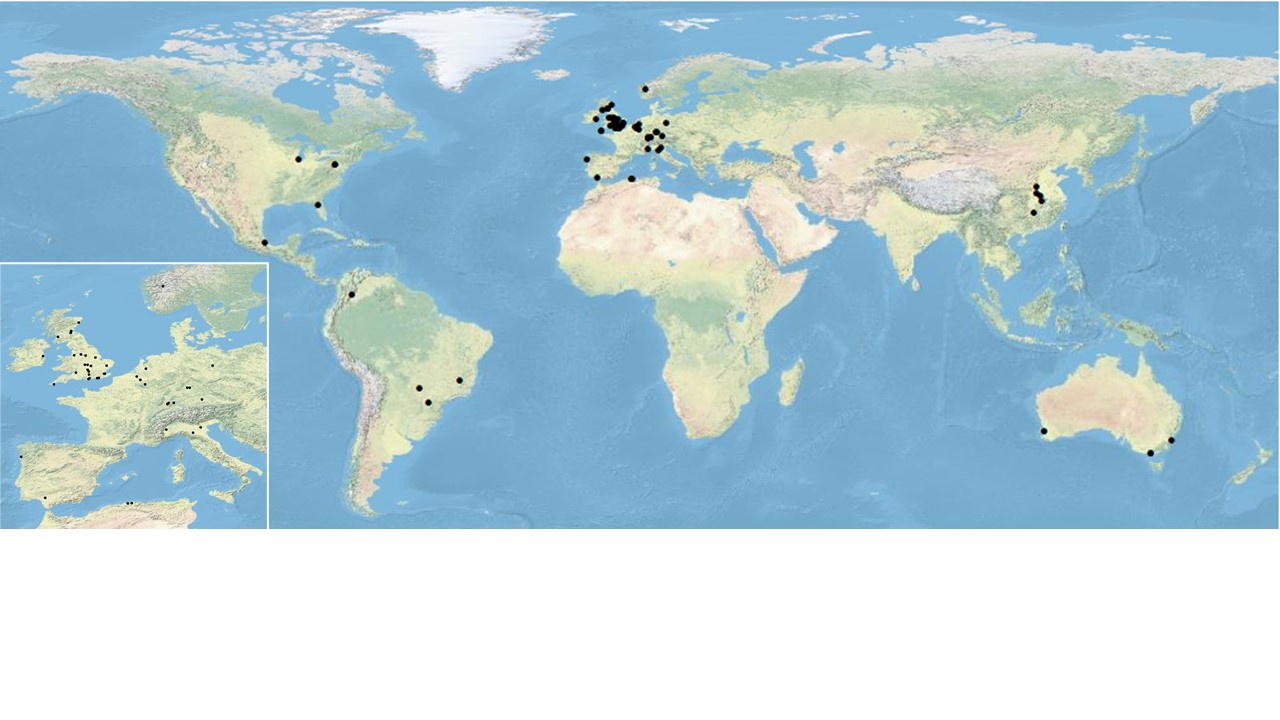
During the lockdown period of the COVID-19 pandemic in 2020, many pollination ecologists were stuck at home: universities and research institutes were closed and restrictions on travel meant that it was not possible to get out and do field work. In order to keep active and motivated, and to turn adversity into an opportunity, an ad hoc network of more than 70 researchers from 15 different countries (see the map above) decided to collect standardised data on the plant-pollinator networks in their own gardens and nearby public spaces.

When combined with information about location, size of garden, floral diversity, how the garden is managed, and so forth, this would provide some useful data about how gardens support pollinators. For those with kids at home it could also be a good way of getting them out into fresh air and giving them something to do!

Following discussions, several different protocols were instigated which depended upon the time available to the researchers, including one that mirrored the UK Pollinator Monitoring Scheme’s  FIT (Flower-Insect Timed) counts.

The resulting data set of almost 47,000 visits by insects and birds to flowers, as well as information about flowers that were never visited, is freely available and will be an invaluable resource for pollination ecologists. For example, analysing the links between ornamental flowers that share pollinators with fruits and vegetables such as apples and beans, will allow us to make recommendations for the best plants to grow in home gardens that can increase yields of crops.  

There’s an old saying about turning adversity into a positive outcome: “When life gives you lemons, make lemonade”, and the researchers were pleased to find that there’s one record of Citrus limon in the data set!

The paper describing the data set has just been published in the Journal of Pollination Ecology and you can download a PDF of the paper and the associated data for free by following this link.

Sincere thanks to all of my co-authors for their commitment to the project!

Published today: a new children’s book about bees and other pollinators!

One of the projects with which I’ve been involved over the last year has been advising on a new book for children about bees and other pollinators, called Can We Really Help The Bees? Written by Katie Daynes and wonderfully illustrated by Róisín Hahessy, it tells the story of what happens when a swarm of bees comes to the window to let a group of children know that they, and their friends the other pollinators, are in trouble. Can they help? Yes they can!

It’s been a real pleasure working with Katie and Róisín on this project for Usborne Publishing and seeing the ideas, text, and illustrations evolve over time. I’ve written a short post over at the Usborne blog with some ideas about how to get children involved in helping the pollinators, and I think that it’s worth repeating one of the things that I wrote: everyone can make a difference to the wildlife around us and no one is too young to be involved!

Because of my involvement with Can We Really Help The Bees? I wasn’t able to include it on my curated list of the best books about bees and other pollinators at the Shepherd site. But it definitely should be on there and is highly recommended!