Category Archives: China

New study just published: The effect of elevation, latitude, and plant richness on robustness of pollination networks at a global scale

During the 2020 lockdown caused by the COVID-19 pandemic, I coordinated an international network of pollination ecologists who used standardised methods to collect data in their gardens. I blogged about it at the time – see here and here for instance – and also put up a post when the data paper from that work was published.

Several research groups are now working with that huge data set and interrogating it for answers to a wide range of questions. The first group to actually publish a paper from the data is a largely Chinese set of researchers from the Key Laboratory of Plant Resources, Conservation and Sustainable Utilization, at the South China Botanical Garden in Guangzhou, assisted by Kit Prendergast and myself.

In this paper we’ve considered how robust these plant-pollinator networks are to simulated extinctions of species, and how this is affected by the elevation, latitude, and plant species diversity of the network.

Here’s the full reference with a link to the study:

Wang, X.-P., Ollerton, J., Prendergast, K.S., Cai, J.-C., Tong, M.-Y., Shi, M.-M., Zhao, Z.-T., Li, S.-J. & Tu, T.-Y. (2024) The effect of elevation, latitude, and plant richness on robustness of pollination networks at a global scale. Arthropod-Plant Interactions (in press) https://doi.org/10.1007/s11829-024-10056-7

If you can’t access it and need a PDF, please send me a request via my Contact page.

Here’s the abstract:

Plant-pollinator interactions play a vital role in the maintenance of biodiversity and ecosystem function. Geographical variation in environmental factors can influence the diversity of pollinators and thus, affect the structure of pollination networks. Given the current global climate change, understanding the variation of pollination network structure along environmental gradients is vital to predict how global change will affect the ecological interaction processes. Here, we used a global plant-pollinator interaction data collection by the same sampling method at the same period to explore the effects of elevation, latitude, and plant richness on the structure and robustness of pollination networks. We analyzed a total of 87 networks of plant-pollinator interactions on 47 sites from 14 countries. We conducted a piecewise structural equation model to examine the direct and indirect effects of elevation, latitude, and plant richness on the network robustness and analyzed the function of network structure in elucidating the relationship between robustness and these gradients. We found that plant richness had both positive effects on robustness under random and specialist-first scenarios. Elevation, latitude, and plant richness affected network connectance and modularity, and ultimately affected network robustness which were mediated by nestedness under specialist-first and random scenarios, and by connectance under the generalist-first scenario. This study reveals the indirect effects of elevation, latitude, and plant richness on pollination network robustness were mediated by nestedness or connectance depended on the order of species extinctions, implying that communities with different pollination network structures can resist different extinction scenarios.

Pollinator-flower interactions in gardens during the COVID-19 pandemic lockdown of 2020: the data paper has just been published!

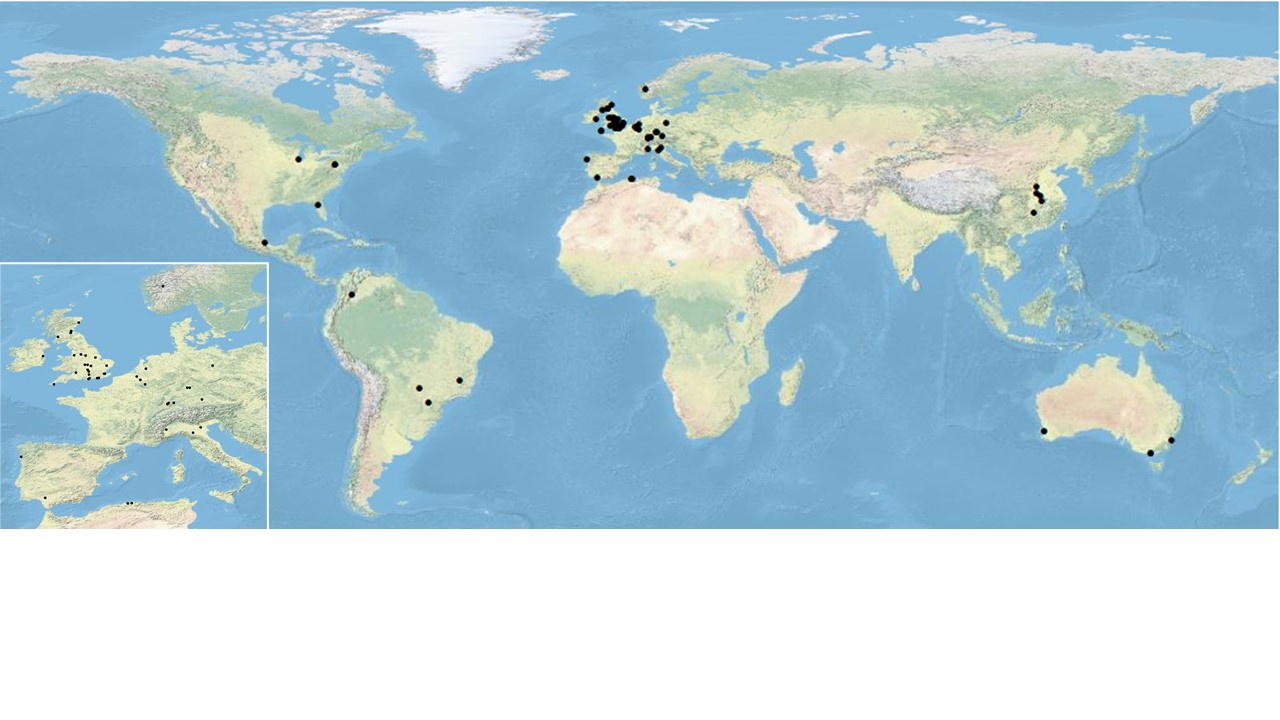
During the lockdown period of the COVID-19 pandemic in 2020, many pollination ecologists were stuck at home: universities and research institutes were closed and restrictions on travel meant that it was not possible to get out and do field work. In order to keep active and motivated, and to turn adversity into an opportunity, an ad hoc network of more than 70 researchers from 15 different countries (see the map above) decided to collect standardised data on the plant-pollinator networks in their own gardens and nearby public spaces.

When combined with information about location, size of garden, floral diversity, how the garden is managed, and so forth, this would provide some useful data about how gardens support pollinators. For those with kids at home it could also be a good way of getting them out into fresh air and giving them something to do!

Following discussions, several different protocols were instigated which depended upon the time available to the researchers, including one that mirrored the UK Pollinator Monitoring Scheme’s  FIT (Flower-Insect Timed) counts.

The resulting data set of almost 47,000 visits by insects and birds to flowers, as well as information about flowers that were never visited, is freely available and will be an invaluable resource for pollination ecologists. For example, analysing the links between ornamental flowers that share pollinators with fruits and vegetables such as apples and beans, will allow us to make recommendations for the best plants to grow in home gardens that can increase yields of crops.  

There’s an old saying about turning adversity into a positive outcome: “When life gives you lemons, make lemonade”, and the researchers were pleased to find that there’s one record of Citrus limon in the data set!

The paper describing the data set has just been published in the Journal of Pollination Ecology and you can download a PDF of the paper and the associated data for free by following this link.

Sincere thanks to all of my co-authors for their commitment to the project!

A milkweed on the shore: tracking down an elusive Danish plant

Since arriving in Odsherred towards the end of August I’ve been looking out for one plant in particular on our bicycle rides and hikes around the region. Vincetoxicum hirundinaria is a widespread asclepiad or milkweed: a member of the family Apocynaceae, subfamily Asclepiadoideae. This is a group of plants on which I’ve published quite a few research papers and which feature heavily in my book Pollinators & Pollination: Nature and Society.

So far the species has proven elusive and a few Danish ecologists that I’d spoken with told me they had never seen it in the wild. The GBIF account of the species shows a few populations in this part of Denmark but I wasn’t sure if they were old records of populations that no longer exist. But as of yesterday I can confirm that at least one of those populations is extant!

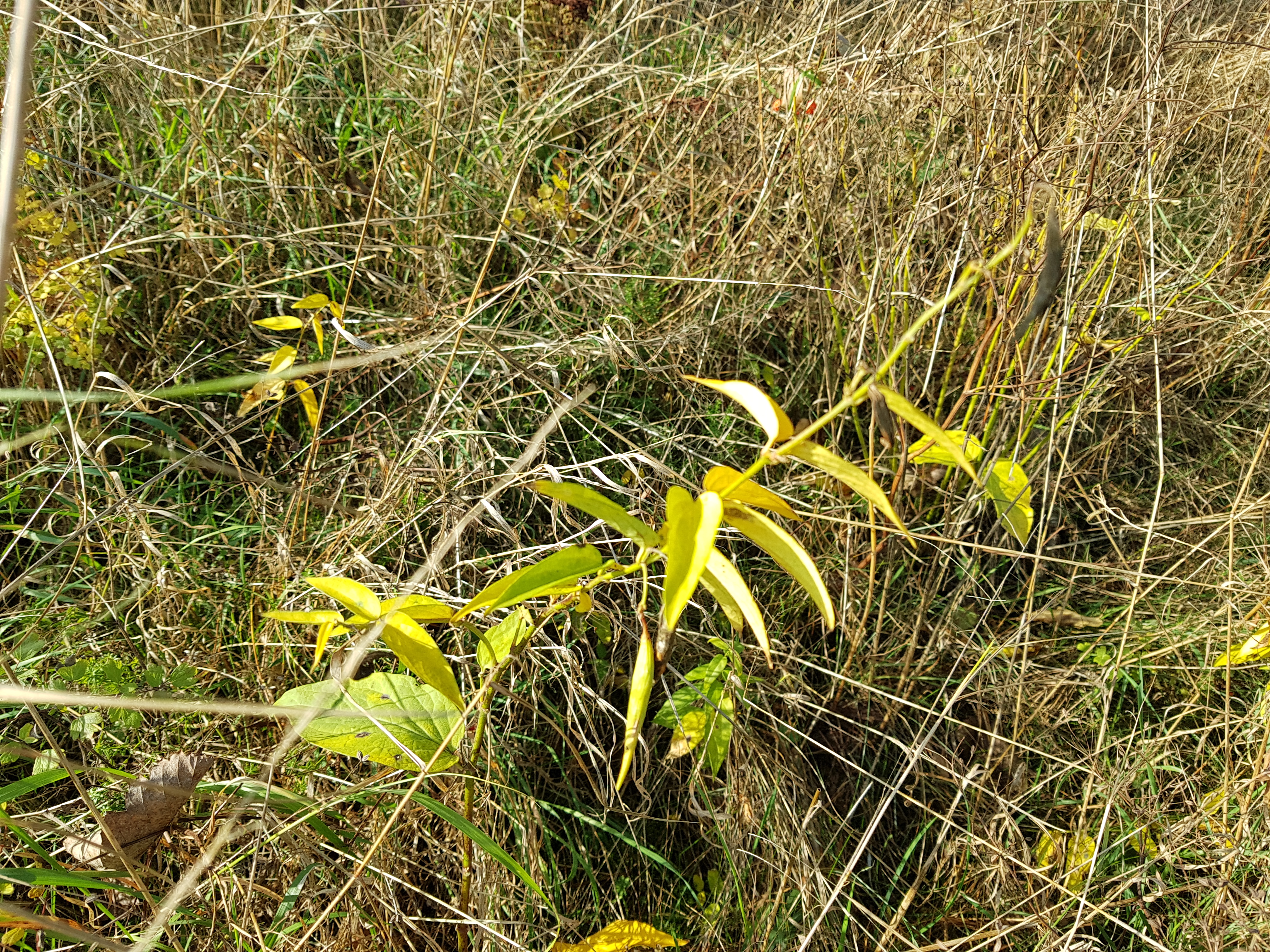
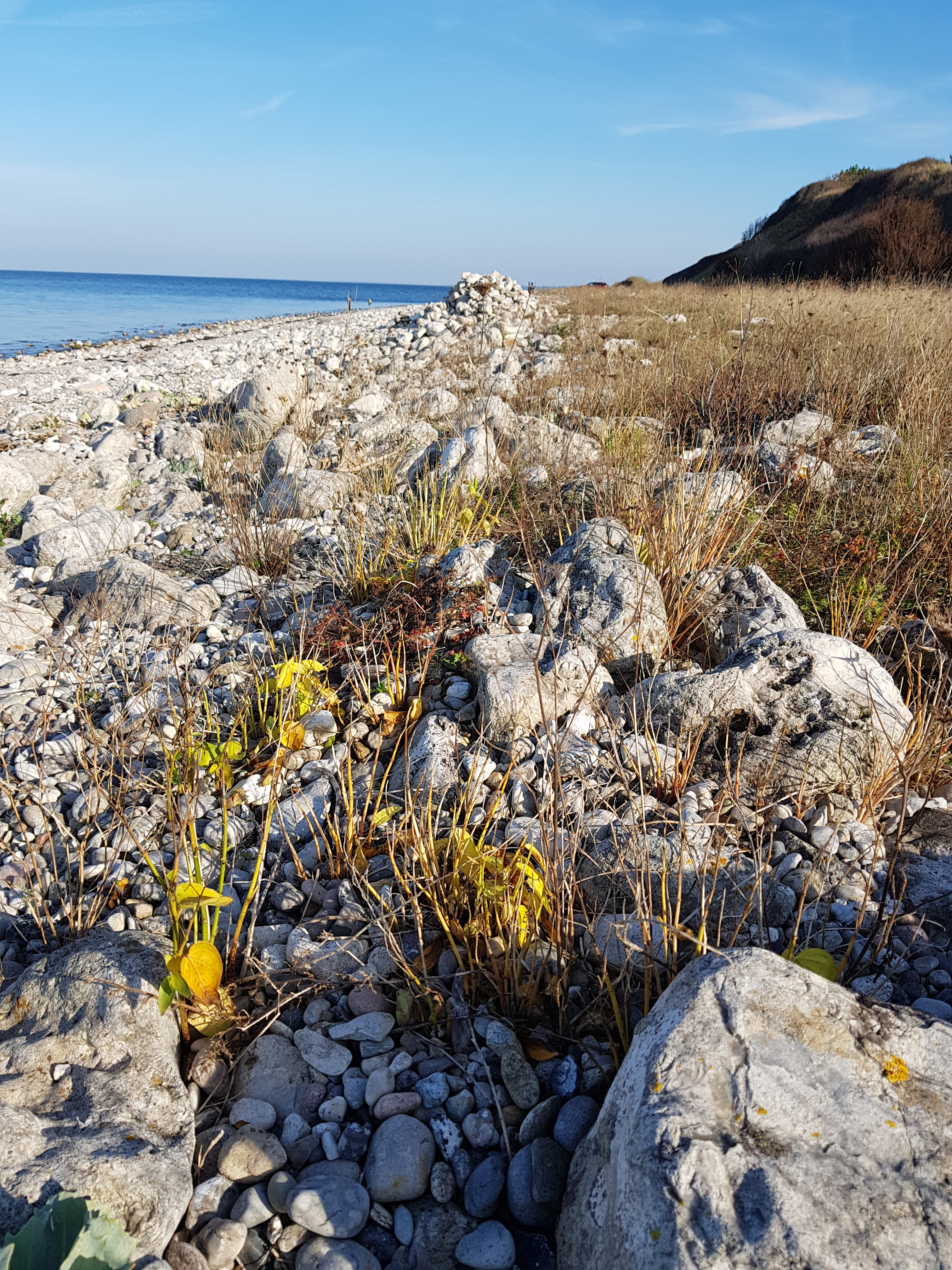
We had cycled out to the small town of Klint about 13km west of us, to see the glacial moraine landscape for which the area is famous and which gives Odsherred UNESCO Geopark status. As we approached the small fishing harbour at Klint I let out an excited shout to Karin who was just ahead of me: in amongst the roadside vegetation I’d spotted the distinctive and immediately recognisable yellow of Vincetoxicum hirundinaria in its autumnal hues! In the photos that follow you can see how well that yellow stands out against the colours of the other plants in the community.

At this time of the year the plant has ceased flowering, but the occasional swollen green seed pod was evidence of successful pollination of their morphologically complex flowers.

I was surprised at just how close to the sea the plants were growing; they must get inundated by sea water during stormy tidal surges.

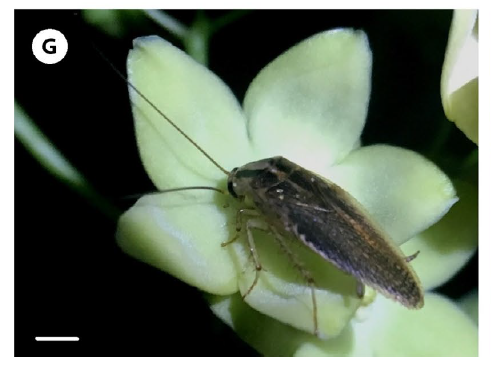
So what is pollinating these flowers on this exposed shoreline? That’s a question that I want to pursue in the coming years. The Pollinators of Apocynaceae Database has remarkably few records of pollinators in this species, given how widespread it is. Flies certainly pollinate it, but there’s also records of wasps and bees as visitors, including bumblebees on flowers of a plant that I had in cultivation in Northampton. There’s a couple of other research groups in Scandinavia and Europe who are looking at the pollination ecology of the species and I’m hoping that we can collaborate on a study of spatial variation in its reproduction. Vincetoxicum is quite a large genus (around 150 species) and only around 10% of the species have been studied in any detail. But these studies are revealing a complex diversity of pollinators, including most recently, cockroaches in the Chinese species Vincetoxicum hainanense. I’m sure this intriguing group of plants has more fascinating stories to tell us about the ecology and evolution of its pollination systems.

FIGURE 4 from Xiong et al. (2020) Specialized cockroach pollination in the rare and
endangered plant Vincetoxicum hainanense in China. American Journal of Botany 107:
1355–1365.

Why are bees like Bactrian camels? Because they both have two humps!

It was eminent bee biologist Charles Michener who first* pointed out that there was something odd about the global distribution of bees. In his 1979 paper Biogeography of the bees he writes:

“unlike many groups which abound in the tropics, bees attain their greatest abundance in warm temperate areas”

Think about that for a moment: in contrast to most other groups of insects, birds, mammals, flowering plants, fish, indeed the majority of the Earth’s biodiversity, bees are NOT generally at their most species rich in tropical areas. Rather, we have to move north and south of the equator to find them at their highest diversity. This is an odd pattern of distribution for such a successful (> 20,000 species), globally widespread and ecologically important group of organisms.

Some 15 years ago I was inspired by Michener’s comments when, together with colleagues Steve Johnson and Andrew Hingston, we wrote a chapter called Geographical variation in diversity and specificity of pollination systems for the 2006 Waser & Ollerton edited volume Plant-pollinator Interactions: from Specialization to Generalization. In that chapter we presented a rough analysis of how bee diversity per unit area in different countries changes with latitude. This, and a follow-up that appeared in my 2017 Annual Review of Ecology, Evolution and Systematics paper, confirmed Michener’s view that there’s an unusual relationship between bee diversity and latitude, with peak species richness outside of the tropics, in warm, dry environments.

What I really hoped over this time was that some serious bee biologists would follow up Michener’s insights and produce a full analysis of how bee diversity changes across the planet. Yesterday that hope was realised when Michael Orr, Alice Hughes, Douglas Chesters, John Pickering, Chao-Dong Zhu and John Ascher published the first analysis of bee diversity across the whole planet, and its underlying causes, in their open-access paper Global Patterns and Drivers of Bee Distribution.

Their analyses are based on a data set of >5,800,000 records of where bees occur and it’s been an incredible achievement to bring all of that together into a planet-wide view of where bees are found, and why. I highly recommend that you download and read it, it’s an impressive piece of work.

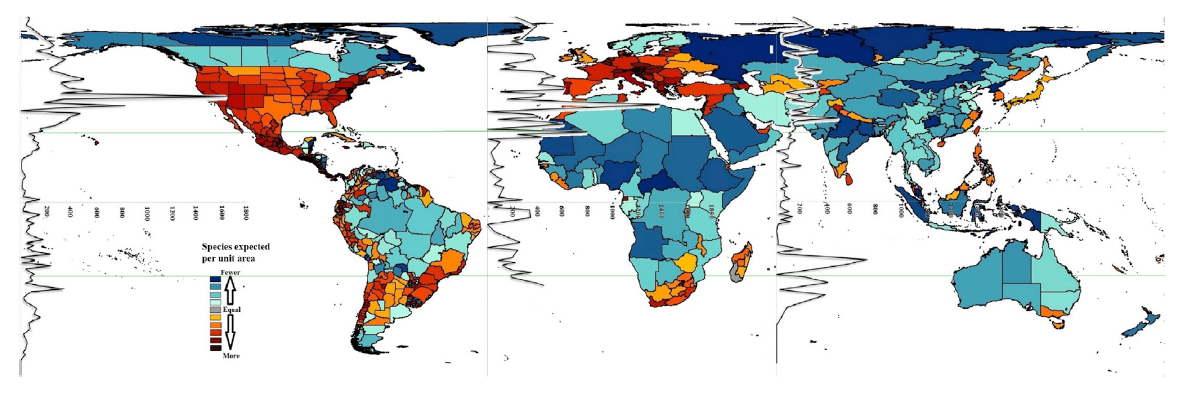
What have camels got to do with all of this? Well, as the authors show in their paper (from which the image above is taken), if you graph up the increase in bee species richness with latitude from the poles in each hemisphere, you get two humps at about 35 degrees north and south of the equator: like a Bactrian camel. In contrast, as I noted above, if you were to do the same for for most other species you’d get a single hump at the equator: like a dromedary camel.

One of the key drivers of this bimodal pattern seems to be the amount of rainfall in an environment – bees do not like it too wet, in contrast to their relatives the ants which do show the more typical tropical peak in diversity. As the authors put it:

“humidity may play a key role in limiting bee distribution, such as through spoilage of pollen resources”

One of the implications of this for the biogeography of plant-pollinator interactions is that we might expect there to be a greater diversity of different types of pollinators in areas where bees are not so abundant. And indeed that is exactly what we find: in that Ollerton, Johnson and Hingston book chapter I mentioned we showed that there’s a step-change in the diversity of functionally specialised pollination systems as one moves from the sub-tropics into the tropics. There could be many reason for that but I suspect that one is a relative lack of bees compared to the number of plants species; thus you get tropical “oddities” such as specialised cockroach pollination in some plants.

Orr et al.’s paper is a milestone in bee biogeography and opens up new opportunities for conserving these insects, and their vital relationships with the flowering plants. To give just one example: these analyses provide a framework for predicting bee diversity hotspots in parts of the world that have been poorly explored by bee taxonomists, but which are nevertheless severely threatened by habitat degradation and conversion to agriculture. It could also be used for predicting how climate change might affect future bee distributions, especially in parts of the world that are expected to become wetter. I’m looking forward to seeing how the team’s work develops in the future.

——————————————–

*It’s always risky to state “first”, but Michener was certainly the first that I am aware of. Let me know if you’ve come across any precedents.

Cockroaches as pollinators: a new example just published

When you think of the word “pollinator” what comes to mind? For most people it will be bees, particularly the western honeybee (Apis mellifera). Some might also think of hoverflies, butterflies, moths, bats, hummingbirds…..but cockroaches?! The first published example that I know of which demonstrated that the flowers of a plant are specialised for cockroach pollination is from the mid-1990s. Since then only a handful of well documented cases have come to light, but there are undoubtedly more out there waiting to be discovered, particularly in the wet tropics. Most of the c. 4,600 species of cockroaches are nocturnal, and cockroach-pollinated flowers tend to open at night, which is one reason why they are under documented.

In a new study, published this week in the American Journal of Botany, a team of Chinese, German and British biologists has shown that a species of Apocynaceae from China is the first known example of cockroach pollination in that large family. Here’s the reference with a link to the study; if anyone wants a copy please email me:

Xiong, W., Ollerton, J., Liede-Schumann, S., Zhao, W., Jiang, Q., Sun, H. Liao, W. & You, W. (2020) Specialized cockroach pollination in the rare and endangered plant Vincetoxicum hainanense (Apocynaceae, Asclepiadoideae) in China. American Journal of Botany (in press)

The abstract for the paper follows:

Premise

Species of Apocynaceae are pollinated by a diverse assemblage of animals. Here we report the first record of specialized cockroach pollination in the family, involving an endangered climbing vine species, Vincetoxicum hainanense in China. Experiments were designed to provide direct proof of cockroach pollination and compare the effectiveness of other flower visitors.

Methods

We investigated the reproductive biology, pollination ecology, pollinaria removal, pollinia insertion, and fruit set following single visits by the most common insects. In addition, we reviewed reports of cockroaches as pollinators of other plants and analyzed the known pollination systems in Vincetoxicum in a phylogenetic context.

Results

The small, pale green flowers of V. hainanense opened during the night. The flowers were not autogamous, but were self‐compatible. Flower visitors included beetles, flies, ants and bush crickets, but the most effective pollinator was the cockroach Blattella bisignata, the only visitor that carried pollen between plants. Less frequent and effective pollinators are ants and Carabidae. Plants in this genus are predominantly pollinated by flies, moths and wasps.

Conclusions

Globally, only 11 plant species are known to be cockroach‐pollinated. Because their range of floral features encompass similarities and differences, defining a “cockroach pollination syndrome” is difficult. One commonality is that flowers are often visited by insects other than cockroaches, such as beetles, that vary in their significance as pollinators. Cockroach pollination is undoubtedly more widespread than previously thought and requires further attention.