
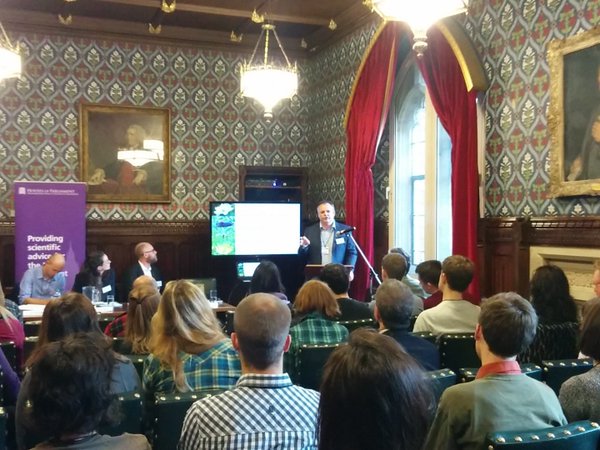
As I advertised a couple of weeks ago, last Wednesday I was in London to take part in a Pollinators Update seminar at the Houses of Parliament organised by the Parliamentary Office for Science and Technology (POST). It was a very interesting event and good to catch up with some of the latest ideas about pollinators and their conservation. However it’s been a busy week since then and I’ve not had time to post a full account of the seminar, which was attended by over 40 people. So I’ve decided to write a brief summary of eight things I learned that day from my fellow speakers* and from the day in general; in some cases I’ve linked to the original sources where available:
1. About 46% of Europe’s bumblebees have declining populations (see the European Red List for Bees that I highlighted in an earlier post)
2. Around 2% of the world’s bee species do 80% of the crop pollination (Kleijn et al. (2015) Nature Communications)
3. Pollinators other than bees perform 39% of the flower visits to crops (Rader et al. (2015) Proceedings of the National Academy of Sciences)
4. By 2100 the Red-tailed Bumblebee (Bombus lapidarius), one of the commonest species in Europe, may be extinct across most of the continent due to climate change (Rasmont et al. (2015) Climatic Risk and Distribution Atlas of European Bumblebees)
5. Only 6.6% of Entry Level Stewardship agreements by farmers across England included plans to grow nectar- and pollen-rich flower mixes.
6. Criticism of laboratory studies of the effects of neonicotinoid pesticides are just as illogical as criticisms of field studies: both have their limitations and advantages, and both are needed.
7. A panel of four experts on pollinators and pollination will largely agree about the answers to most questions an audience asks.
8. A Westminster seminar such as this will attract very few MPs if it clashes with an important debate in the House of Commons, in this case about future military action in Syria.
UPDATE: here’s a number 9 suggested by Simon Potts: we all strongly support and encourage the setup of an All Party Parliamentary Group on “Pollinators” not just “honeybees” or “bees”.
*With thanks to my fellow panelists Simon Potts, Claire Carvell and Richard Gill, and to Kirsten Miller and the POST team for organising the event, and for the photograph of the panel in action.
 Prof. Jeff Ollerton - ecological scientist and author