One of the projects in which I’m currently involved is the WorldFAIR project. Funded by the European Commission, WorldFAIR is exploring how to make data FAIR – Findable, Accessible, Interoperable and Reusable – across a range of different disciplines in the sciences and humanities.
My involvement is specifically with Work Package 10, which is focused on data standards for plant-pollinator interactions, particularly as they relate to pollination of agricultural crops. After a year of hard work, I’m delighted to announce that our interim draft report from this Work Package has just been published! You can read the summary and download the report from Zenodo – here’s the link: https://zenodo.org/record/8176978
There’s more to come over the next twelve months and I’ll post updates as and when they appear. In the meantime, do check out the WorldFAIR website for information about the other Work Packages, their webinar series, FAIR data standards, and so forth.
There’s a frequently cited statistic that one third of the food produced for human consumption is wasted every year. That waste occurs for a variety of reasons, including spoilage, over-production and inefficient processing methods. This has clear environmental (and therefore human) consequences, for example in terms of increased carbon dioxide and other greenhouse gas production; excessive use of fertilisers and pesticides; unsustainable water extraction; and conversion of natural habitats to farmland.
Much of the wastage occurs before the food ever reaches shops and markets, so individual consumers have little control over the waste, other than to try to pressure business and political leadership into action. However, we can all do our bit when it comes to reducing food waste in our home, which has positive impacts on our health and our bank balance.
When it comes to fruit and vegetables, we in the west often throw away perfectly edible parts, I suspect because it doesn’t fit with our expectations of what the food “should” look like. A good example is radishes (Raphanus raphanistrum subsp. sativus) where it’s not uncommon to discard the perfectly edible leaves. People who grow them often pull out plants that have flowered, despite the fact that the seed pods are delicious and arguably nicer than the roots, as I discussed in this blog post from a few years ago.
There’s lots of other examples like this, one of my favourites being the crunchy central pith that you find in the thick stems of broccoli (Brassica oleracea var. italica). I love it raw and it has a flavour quite distinct from the normal part that we consume.
It was only quite recently that Karin introduced me to the fact that the mature pods of peas (Pisum sativum) are also edible, if you know how to process them correctly. If you eat the pod as it is, the texture is tough and stringy and not very pleasant. But if you carefully peel away and discard the thin inner membrane of the pod, the remaining flesh is sweet and delicious. It’s fiddly and takes a bit of practice. The easiest way is to gently snap one corner of the half-pod and peel from there – see the example third from the top in the accompanying photograph. Below that in the photo is the thin membrane, which can be put into your food waste or composted, and below that the edible portion of the pod.
Karin and I just eat this raw, but no doubt you could add the pod flesh to any number of dishes. If you have children or grandkids, set them the task of removing the membrane in one piece – it’s not easy!
Please leave a comment below and let me know your favourite bits of edible fruit and veg that are normally discarded.
I’m excited to announce that in March 2024 I will teach a week-long, Master’s-level residential course entitled “Pollination as an Ecosystem Service” at the University of Pavia in Italy. It will be taught in English. Here’s a summary of the course and a brief description of the the syllabus, which is broadly accurate but subject to change as it develops:
POLLINATION AS AN ECOSYSTEM SERVICE
A 3 credit Master’s course for the University of Pavia
Overview
The pollination of crops by bees, flies, birds, bats and other animals, is an ecosystem service that increases crop yields and quality. This is valued at hundreds of billions of Euros each year to European and global agriculture. In addition, these same animals pollinate around 90% of the world’s wild plants which in turn provide us with ecosystem services such as wild food, flood alleviation, microclimate modification, and carbon capture.
In this course, students will explore pollination as an ecosystem service from its first principles and historical roots through to the latest research findings around the consequences of pollinator decline and climate change. The emphasis of the course is on the students learning by actively participating during classes. Each day has a particular theme and will be a mix of interactive lectures, short video clips to illustrate particular points, discussion seminars (for which they will be expected to do some guided reading) and local excursions.
At the end of the course the students will have a developed a deep understanding of the diversity of pollinators, the ecological nature of their interactions with flowers, and the importance of these relationships to nature and to society.
Assessment
At the end of the course, the students will be asked to give a 10 minute presentation based on one of the topics covered in the course, and posed as a question such as “What is….?”, “Why does….?”, “What would happen if….?”, and so forth. The questions will be agreed with me in advance. Presentations will take place on the final day of the course and at the end of each presentation the students will have 5 minutes to answer questions posed by their peers and myself.
Syllabus
Day 1
Theme: Pollinators and pollination – first principles; including historical perspectives, the diversity of pollinators and flowers, and the biology of pollination. Introducing the course assessment.
Excursion: a walk around the local area to observe flowers and pollinators in action.
Day 2
Theme: Pollination as an ecosystem service; including the types of crops that are animal pollinated, how we calculate the value of pollination, and going beyond agriculture to look at the other ecosystem services provided by pollinators; approaches to studying pollinators and pollination.
Day 3
Theme: Pollinator conservation: including reasons for pollinator decline, impacts of climate change, the “politics of pollination”, the consequences of that decline for crop and wild plant pollination, how we can manage and restore habitats for pollinators.
Day 4
Theme: Urban pollinators: understanding the importance of pollinators in an urban setting and in gardens, and how towns and cities support pollinators. Excursion: How is the city of Pavia supporting pollinator populations and what could be improved?
Day 5
Theme: Summing up what we’ve learned, followed by assessed student presentations.
It’s been a rather nomadic couple of years. After Karin and I sold our house in Northampton, we travelled around in the UK and then in Denmark, renting places as we needed them, plus we spent a month in Kenya. We’ve now become more settled in Sjælland and, after some deliberation about whether to buy a house or continue renting, we’ve reached a compromise and bought into an andelsbolig, one of the many Danish cooperative housing schemes – see this article in The Guardianfor more details.
The development of twenty-eight small properties has been newly built to the highest standards of insulation and is plugged into the district heating system which uses a combination of solar warming and gas (in part using methane generated from food waste).
It’s nice to have a garden again. I hadn’t realised how much I’d missed having a space in which to plant and potter. All gardens present challenges, of course, and this one is no exception. Until about 600 years ago the area was under the shallow Kattegat sea. It’s now above sea level due to post-glacial rebound and in fact this whole region of Odsherred is a UNESCO Global Geopark because of the postglacial landscape.
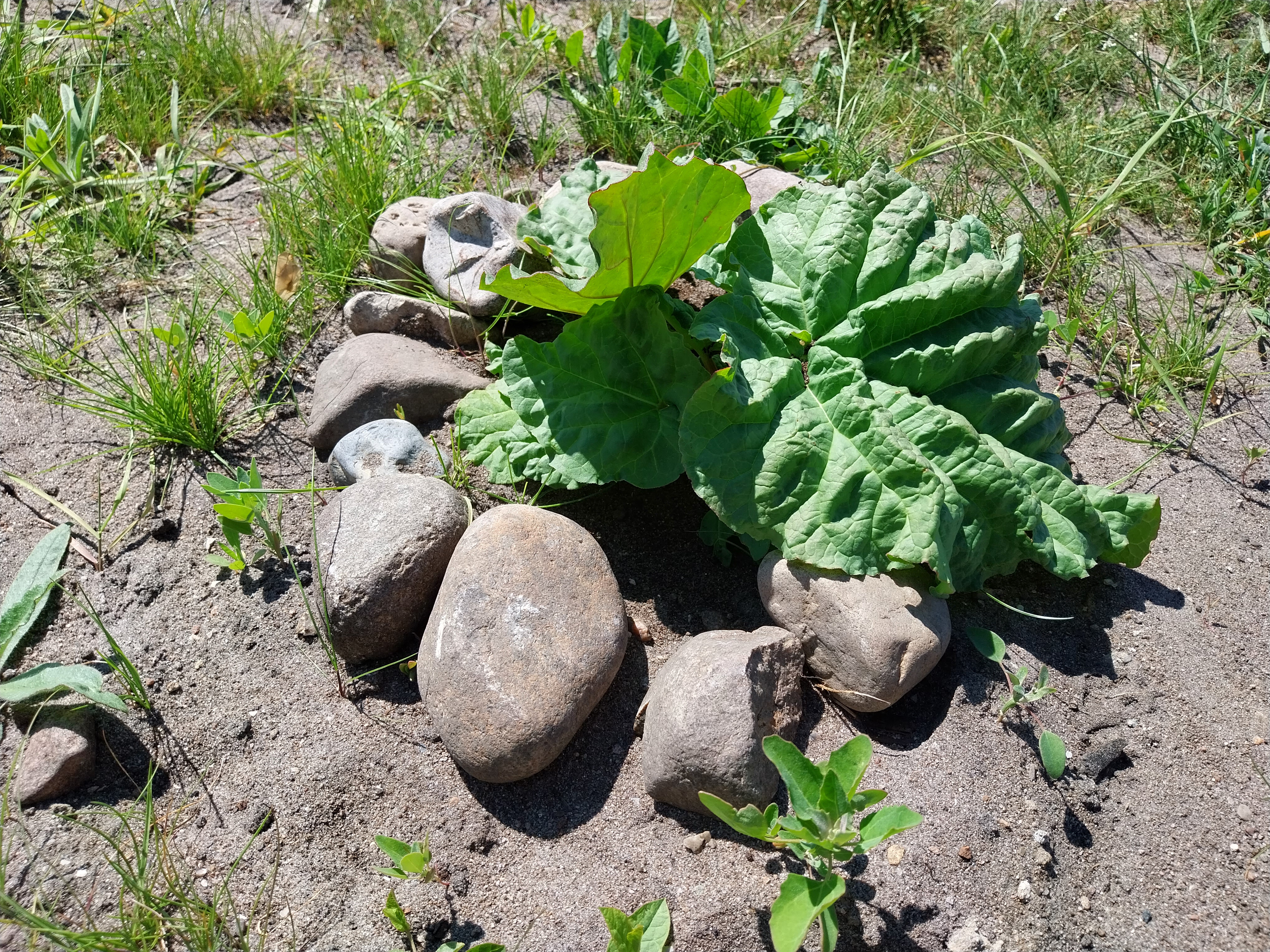
What this means for us is that we are gardening on “soil” which has a very high sand content and is filled with stones, large and small.
Added to that, we’re in one of the driest parts of Denmark (certainly this year) and a persistent coastal wind rapidly strips the moisture from the soil. So as we dig up or find large stones we are using them around plants to retain water and mulching with the smaller stones that we find in abundance. As yet we don’t have any rain water butts so we’re using the kitchen water from washing up to supplement the hosepipe.
It’s not easy gardening here, but we like a challenge and we’re calling in favours from friends and family to provide us with cuttings and divisions of plants from their own gardens, which should mean that they are better adapted to the local conditions than most of the shop-bought plants. We’ve also started a small vegetable and fruit patch and planted apples and pears around a paved patio that over time we will train as self-supporting espaliers.
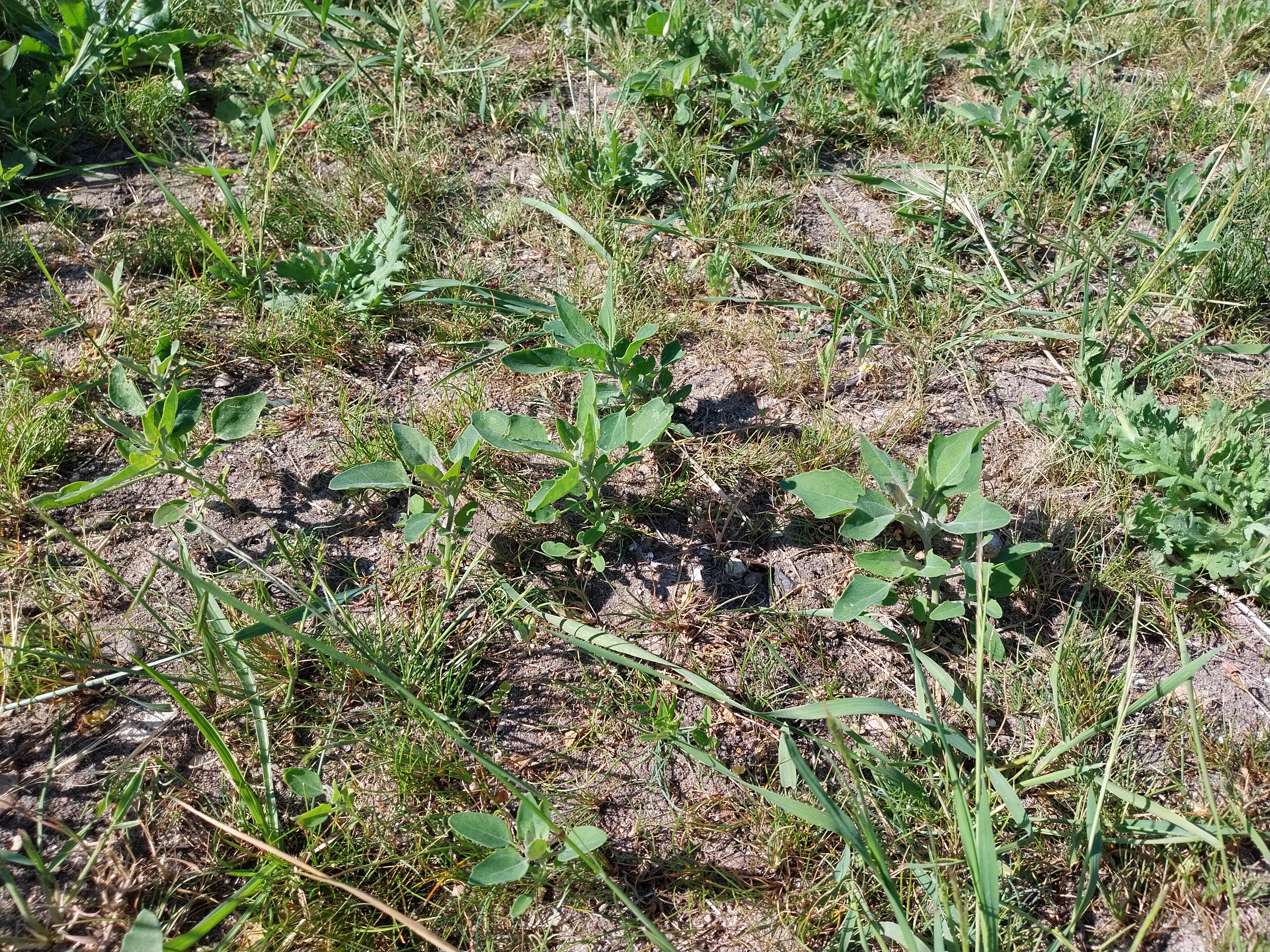
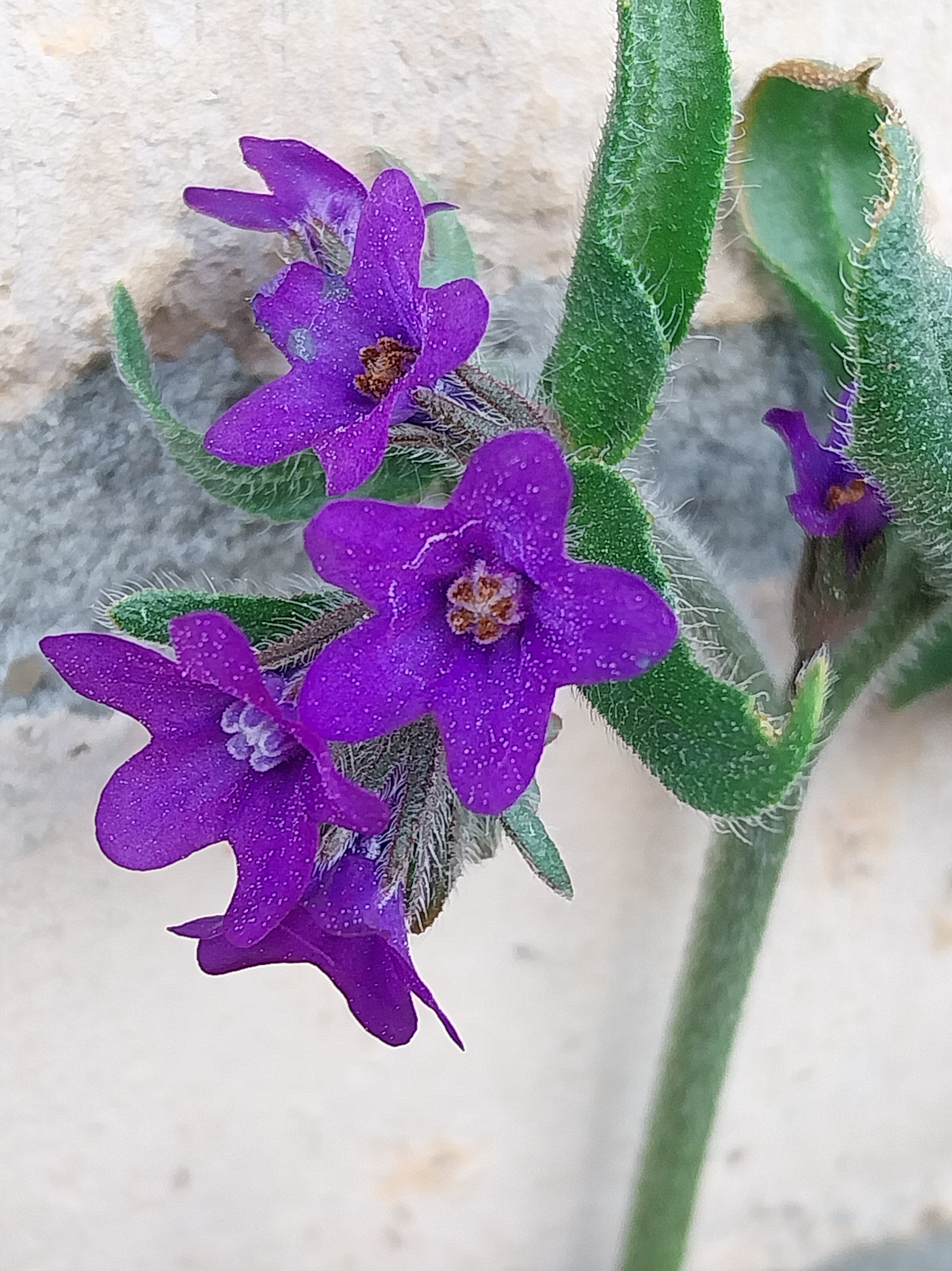
Gradually we’ll fill up the space and move things around as needed. But for now I’m also interested in seeing what plants come up spontaneously, especially the annual species that are benefitting from the disturbance. I don’t use the term “weed” to refer to these: weeds are just plants in the wrong place at the wrong time. Many such plants are ecologically important, especially as nectar and pollen sources for bees and other insects. This includes Common Bugloss (Anchusa officinalis) with its richly purple, velvet-textured flowers.
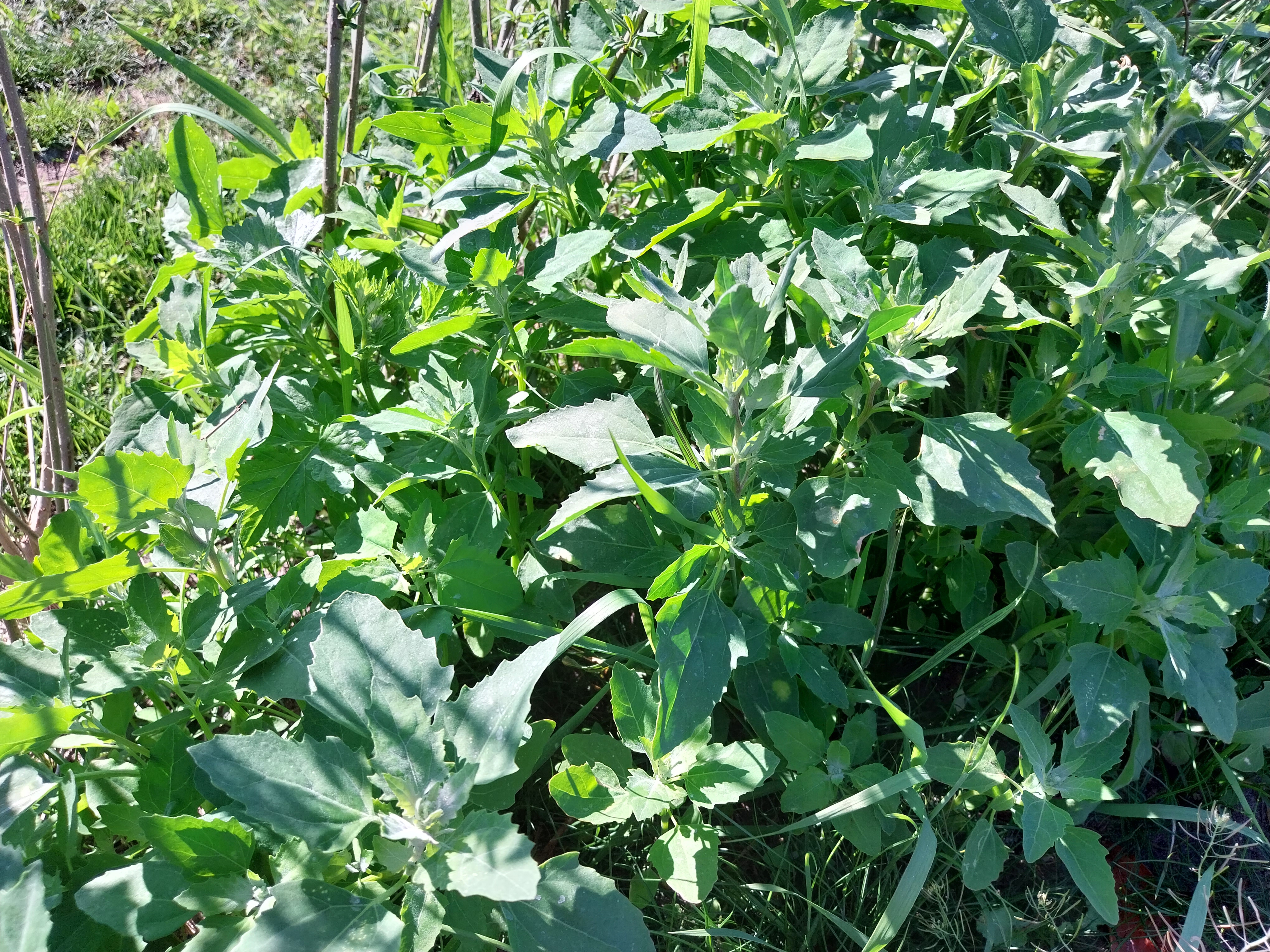
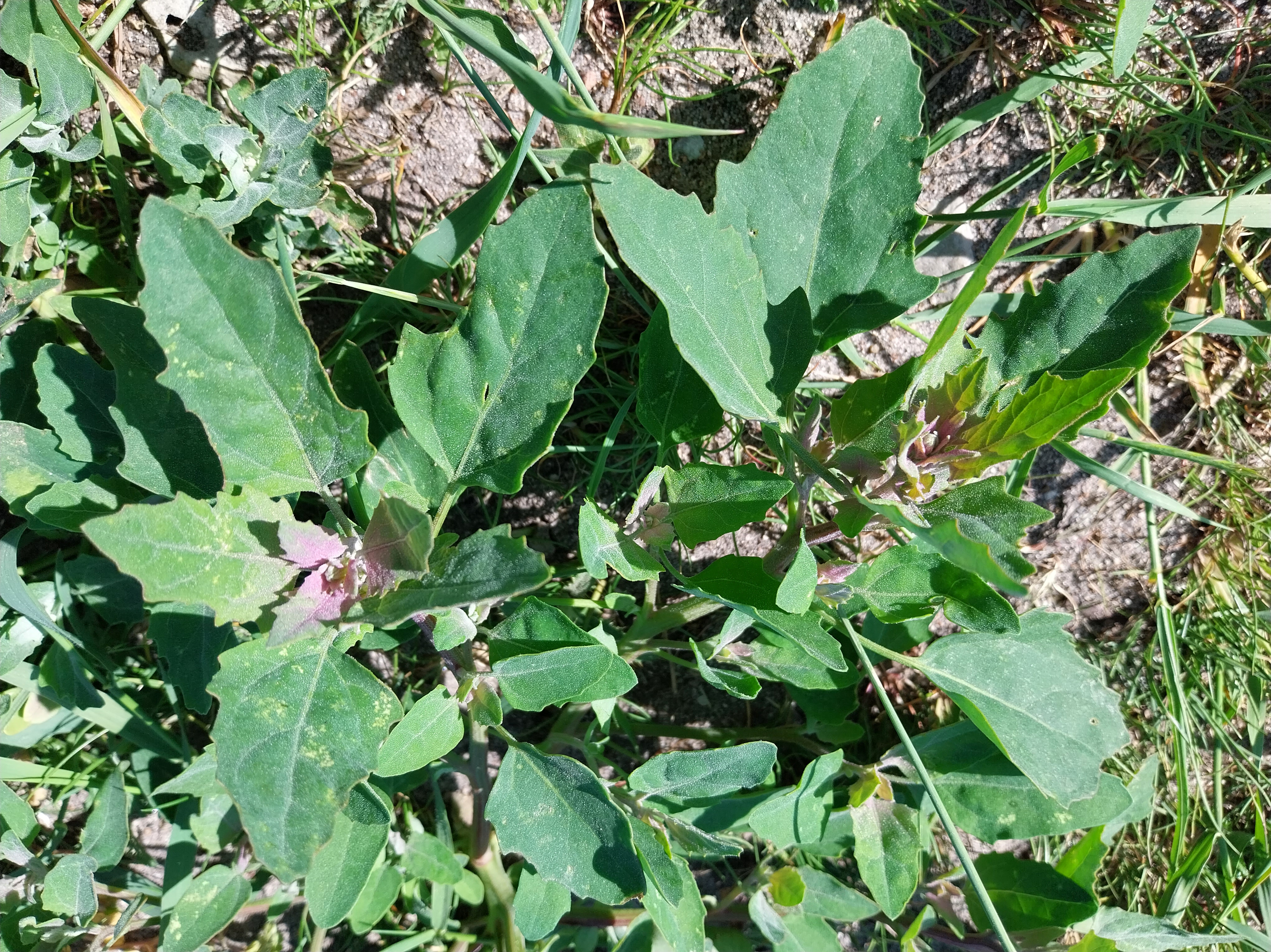
Another plant that we are tolerating is a fast-growing relative of spinach that’s variously called Goosefoot or Fat Hen (Chenopodium album). I’d long known that it was edible (it’s grown as a crop in parts of Asia) but until last night I’d not cooked with it.
In fact it’s delicious! I threw some roughly chopped leaves and stems into a mushroom omelette and I have to say that it was better than any commercial spinach I’ve bought or grown. In particular, the texture is much nicer as the leaves are very water-repellant which mean that they don’t absorb as much moisture during cooking. Highly recommended as an alternative to spinach but make sure you correctly identify the plant before you try it – there’s some good advice on this website: https://www.wildfooduk.com/edible-wild-plants/fat-hen/.
As well as Fat Hen we also have the close relative Tree Spinach (Chenopodium giganteum), with it’s beautiful magenta-tinged leaves, coming up in the garden. I’m looking forward to trying that too:
I’ll try to post more as the garden progresses, if I have time. But as I mentioned yesterday, even though the manuscript is complete and submitted to the publisher, there’s still lots to do on my next book! Have a good weekend.
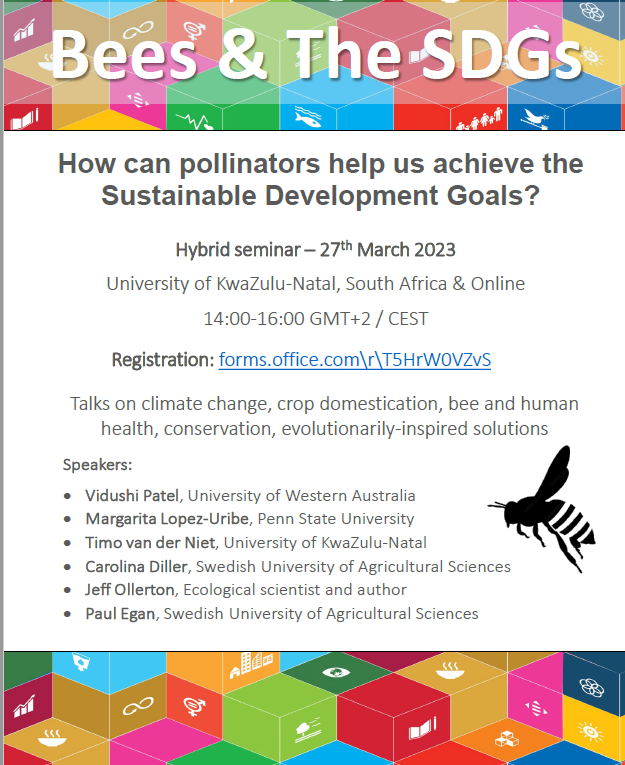
Although I’m one of the speakers, I can’t make it in person as I’ve got teaching commitments at Roskilde University, so I’ve recorded my ten minute piece and I’m happy to answer questions via the Contact page on my website.
It’s been an interesting start to the year in the world of pollinators and pollination. The European Union has revised its 2018 initiative for pollinator conservation with an update called “A New Deal for Pollinators“. At the same time the UK Government has released its plans for Post-Brexit farm subsidies, many of which focus on environmental action that can support pollinators, such as planting hedgerows. I think that it’s fair to say that there’s been a mixed response to these planned subsidies. There’s also mixed news in Butterfly Conservation’s State of the UK’s Butterflies 2022 report. The headline figure is that 80% of butterflies in the UK have decreased since the 1970s. However there are enough positive conservation stories in that report to demonstrate that this decline does not have to be irreversible, we can turn things around.
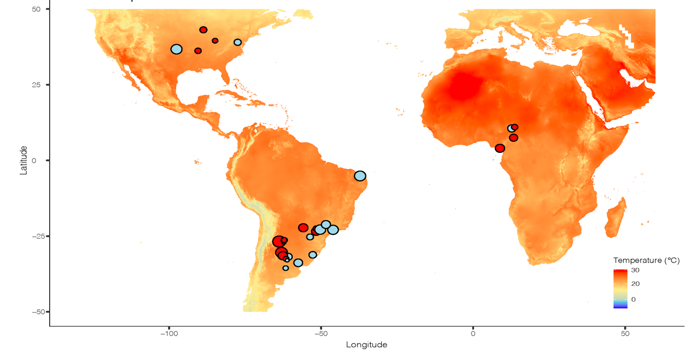
Against this wider backdrop of pollinator actions, I was pleased to have a new research paper published this week, which is an output from the SURPASS2 project with which I’ve been involved. Led by Brazilian researcher Nicolay Leme da Cunha, this paper assess the variability of soybean dependence on pollinators. Although soybean is one of the most widely grown crops globally, there’s still much that we don’t understand about which of the many different varieties have improved yields when visited by bees, and which are purely self-pollinating. One of our main findings was that for some varieties, especially in the tropics, an absence of pollinators results in a decline in yield of about 50%.
The paper is open access and you can download a copy by following the link in the reference:
Identifying large-scale patterns of variation in pollinator dependence (PD) in crops is important from both basic and applied perspectives. Evidence from wild plants indicates that this variation can be structured latitudinally. Individuals from populations at high latitudes may be more selfed and less dependent on pollinators due to higher environmental instability and overall lower temperatures, environmental conditions that may affect pollinator availability. However, whether this pattern is similarly present in crops remains unknown. Soybean (Glycine max), one of the most important crops globally, is partially self-pollinated and autogamous, exhibiting large variation in the extent of PD (from a 0 to ∼50% decrease in yield in the absence of animal pollination). We examined latitudinal variation in soybean’s PD using data from 28 independent studies distributed along a wide latitudinal gradient (4–43 degrees). We estimated PD by comparing yields between open-pollinated and pollinator-excluded plants. In the absence of pollinators, soybean yield was found to decrease by an average of ∼30%. However, PD decreases abruptly at high latitudes, suggesting a relative increase in autogamous seed production. Pollinator supplementation does not seem to increase seed production at any latitude. We propose that latitudinal variation in PD in soybean may be driven by temperature and photoperiod affecting the expression of cleistogamy and androsterility. Therefore, an adaptive mating response to an unpredictable pollinator environment apparently common in wild plants can also be imprinted in highly domesticated and genetically-modified crops
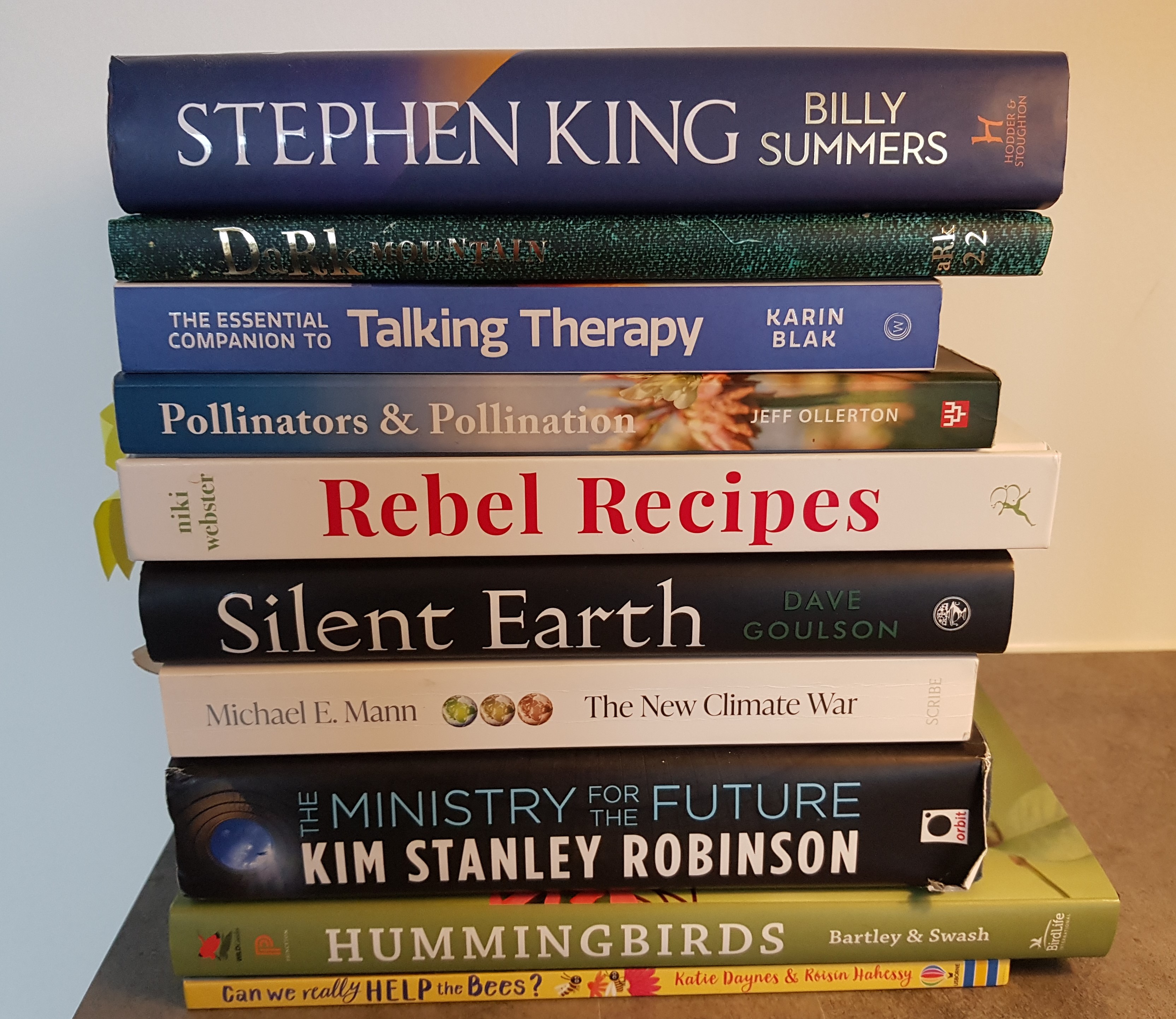
Although we are still in the early part of November, it’s never too soon to be thinking about buying Christmas gifts for friends and family. And what better gift than a book? Here’s a few suggestions for some that I’ve read this year that I think will make fine presents.
Who doesn’t love a good story, and Stephen King is a master storyteller. I’ve really enjoyed his more recent novels and Billy Summers stands out for me. It’s part thriller, part romance, and as always there’s a little touch of the uncanny. Very different, but just as much a page turner, is The Ministry for the Future by Kim Stanley Robinson. Although Robinson is known as a science fiction writer, this novel is set in the near future when climate change breakdown is forcing governments and businesses into making radical changes. As much as anything this is a road map for how we can get ourselves out of the current climate crisis.
Talking of which, Michael Mann’s The New Climate War should be read by everyone interested in understanding how big corporations have colluded with the media and governments to trivialise and misrepresent the problems that we currently face. I reviewed this and a book about the insect biodiversity crisis, Silent Earth by Dave Goulson, in this blog post.
If you are looking for a book to help young children understand the importance of bees and other pollinators then I can highly recommend Can We Really Help the Bees? by Katie Daynes and Róisín Hahessy, for which I acted as science advisor.
For the ornithologically minded you might want to consider the lavishly illustrated Hummingbirds: A Celebration of Nature’s Jewels by Glenn Bartley and Andy Swash. Those who love writing and art with an environmental focus would appreciate an annual subscription to Dark Mountain, which gives you two beautifully produced volumes every year. A couple of my essays appeared in earlier volumes and the quality of the contributions never fails to impress me.
For the budding or experienced cook, Niki Webster’s Rebel Recipes serves up some amazing vegan dishes that Karin and I have really enjoyed trying. And speaking of my wife, of course I have to include her Essential Companion to Talking Therapy as the perfect gift for anyone considering or currently undergoing counselling or therapy, or who is thinking about becoming a practitioner.
Finally, if you’re looking for particular book ideas or just like browsing through lists of what others recommend, there’s lots of inspiration over at the independent Shepherd site.
I hope that you’ve found this useful. Feel free to comment with suggestions for other books that you’ve enjoyed.
Human populations across the planet are locked into complex economic, agricultural, social, political and ecological systems that provide them with food or, under extreme circumstances, fail to provide that sustenance. The complexity of these food systems requires that they are studied from a multi-disciplinary perspective because no one subject, or individual, can possibly do justice to this crucial topic.
One of the most pressing questions related to food systems is how we ensure that they are resilient to the current and future challenges of war, pandemics, climate change, economic shocks, biodiversity loss (including pollinators, of course), and a host of other factors. Some of these are predictable, others are not, except that recent and distant history tells us that such challenges are always going to be a feature of our societies and we need to prepare as best we can. This review of our current understanding of resilience in food systems is therefore timely and important.
Food system resilience has multiple dimensions. We draw on food system and resilience concepts and review resilience framings of different communities. We present four questions to frame food system resilience (Resilience of what? Resilience to what? Resilience from whose perspective? Resilience for how long?) and three approaches to enhancing resilience (robustness, recovery, and reorientation—the three “Rs”). We focus on enhancing resilience of food system outcomes and argue this will require food system actors adapting their activities, noting that activities do not change spontaneously but in response to a change in drivers: an opportunity or a threat. However, operationalizing resilience enhancement involves normative choices and will result in decisions having to be negotiated about trade-offs among food system outcomes for different stakeholders. New approaches to including different food system actors’ perceptions and goals are needed to build food systems that are better positioned to address challenges of the future.
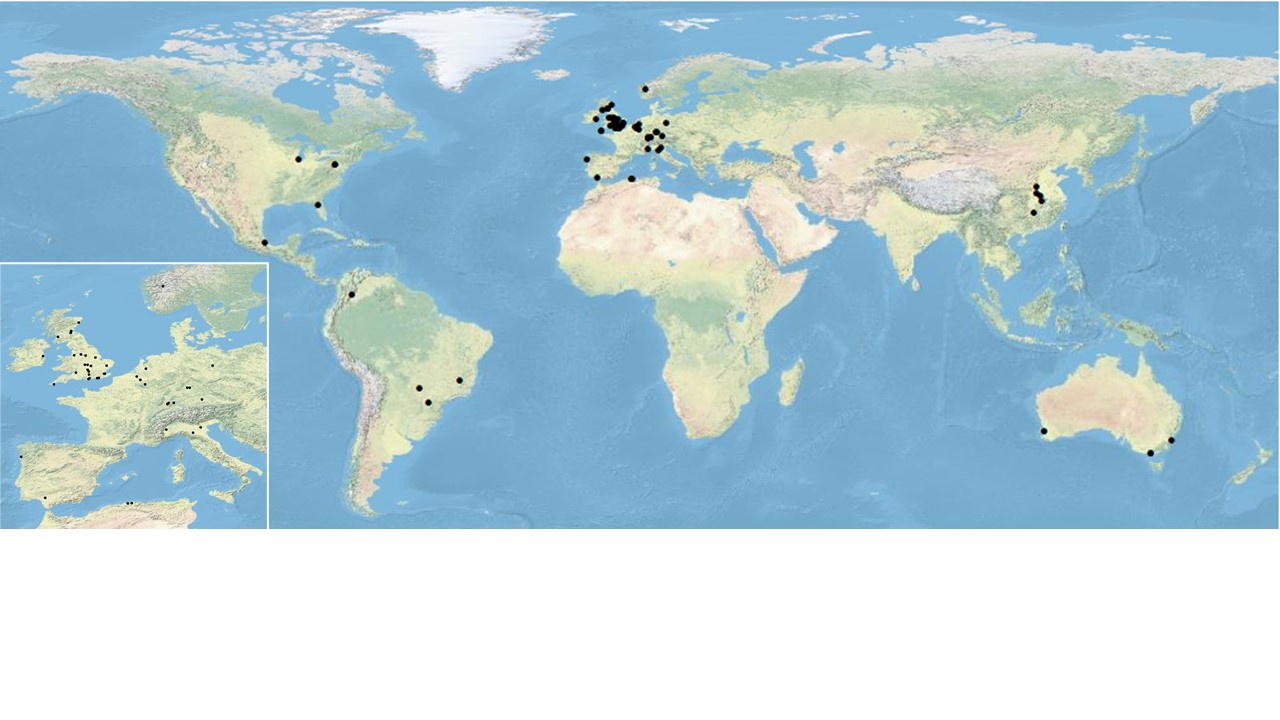
During the lockdown period of the COVID-19 pandemic in 2020, many pollination ecologists were stuck at home: universities and research institutes were closed and restrictions on travel meant that it was not possible to get out and do field work. In order to keep active and motivated, and to turn adversity into an opportunity, an ad hoc network of more than 70 researchers from 15 different countries (see the map above) decided to collect standardised data on the plant-pollinator networks in their own gardens and nearby public spaces.
When combined with information about location, size of garden, floral diversity, how the garden is managed, and so forth, this would provide some useful data about how gardens support pollinators. For those with kids at home it could also be a good way of getting them out into fresh air and giving them something to do!
The resulting data set of almost 47,000 visits by insects and birds to flowers, as well as information about flowers that were never visited, is freely available and will be an invaluable resource for pollination ecologists. For example, analysing the links between ornamental flowers that share pollinators with fruits and vegetables such as apples and beans, will allow us to make recommendations for the best plants to grow in home gardens that can increase yields of crops.
There’s an old saying about turning adversity into a positive outcome: “When life gives you lemons, make lemonade”, and the researchers were pleased to find that there’s one record of Citrus limon in the data set!
The paper describing the data set has just been published in the Journal of Pollination Ecology and you can download a PDF of the paper and the associated data for free by following this link.
Sincere thanks to all of my co-authors for their commitment to the project!
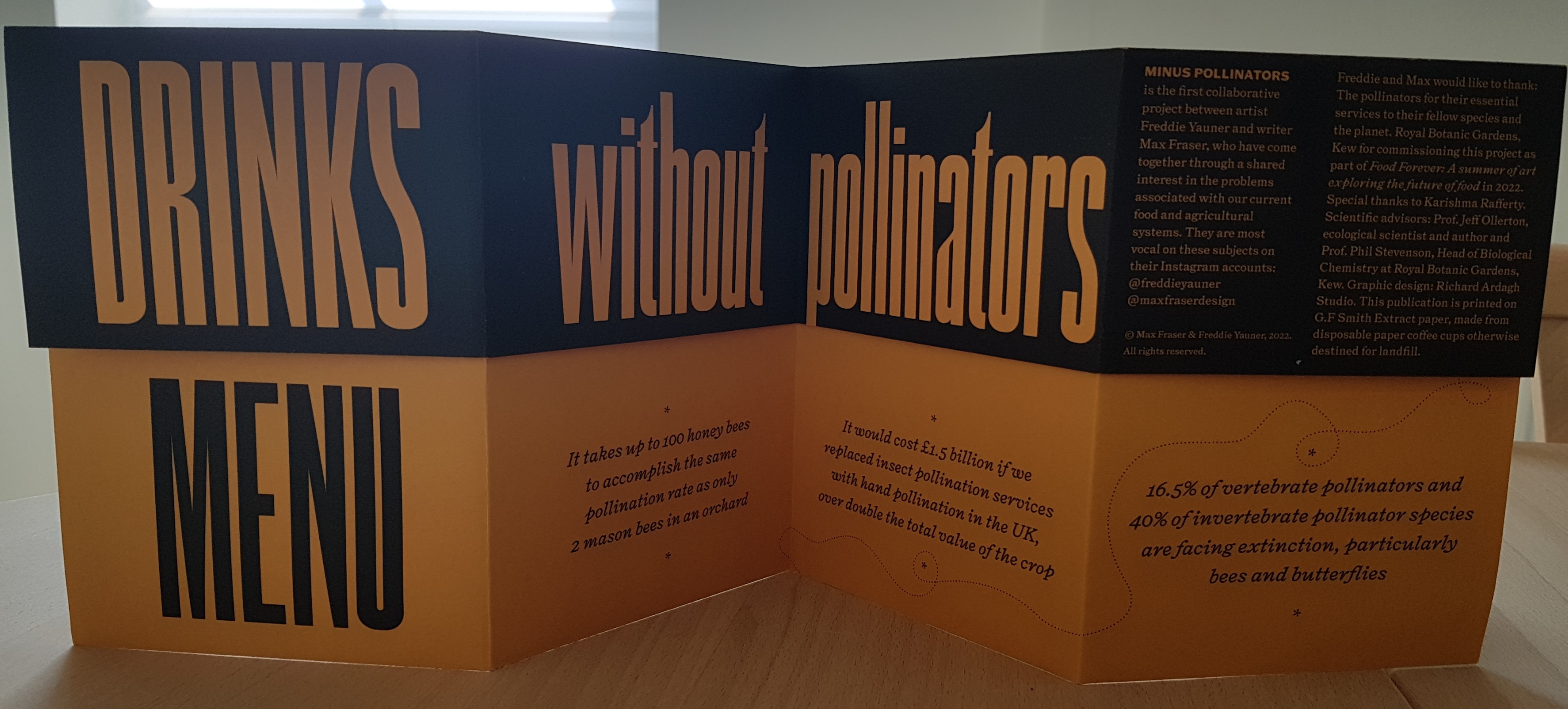
Recently Phil Stevenson and I advised on an art/science project called Minus Pollinators which considered what a small café menu might look like if there were no pollinators to help produce the many, many fruits and vegetables and nuts that are animal pollinated.
The project is a collaboration between writer and consultant Max Fraser and artist Freddie Yauner. To quote Freddie’s description on his website, the project represents:
A dystopian future in the form of a drinks kiosk where the staples such as coffee, teas, juices, chocolate etc. are no longer available due to pollinator decline…the mobile drinks kiosk acts as an exhibition display, with artworks painted in pollen…and a take-away pamphlet…detailing the importance of insect pollinators for our collective future on this planet.
Minus Pollinators was commissioned as part of a summer-long event called Food Forever at the Royal Botanic Gardens, Kew, after which it goes to the Groundswell festival.
It was a pleasure to work with Max, Freddie and Phil on this because art/science projects are a great way of getting the message across about the importance of biodiversity and the current environmental crisis that we are facing.