Category Archives: Australia

Introduced species shed friends as well as enemies – a new study published this week

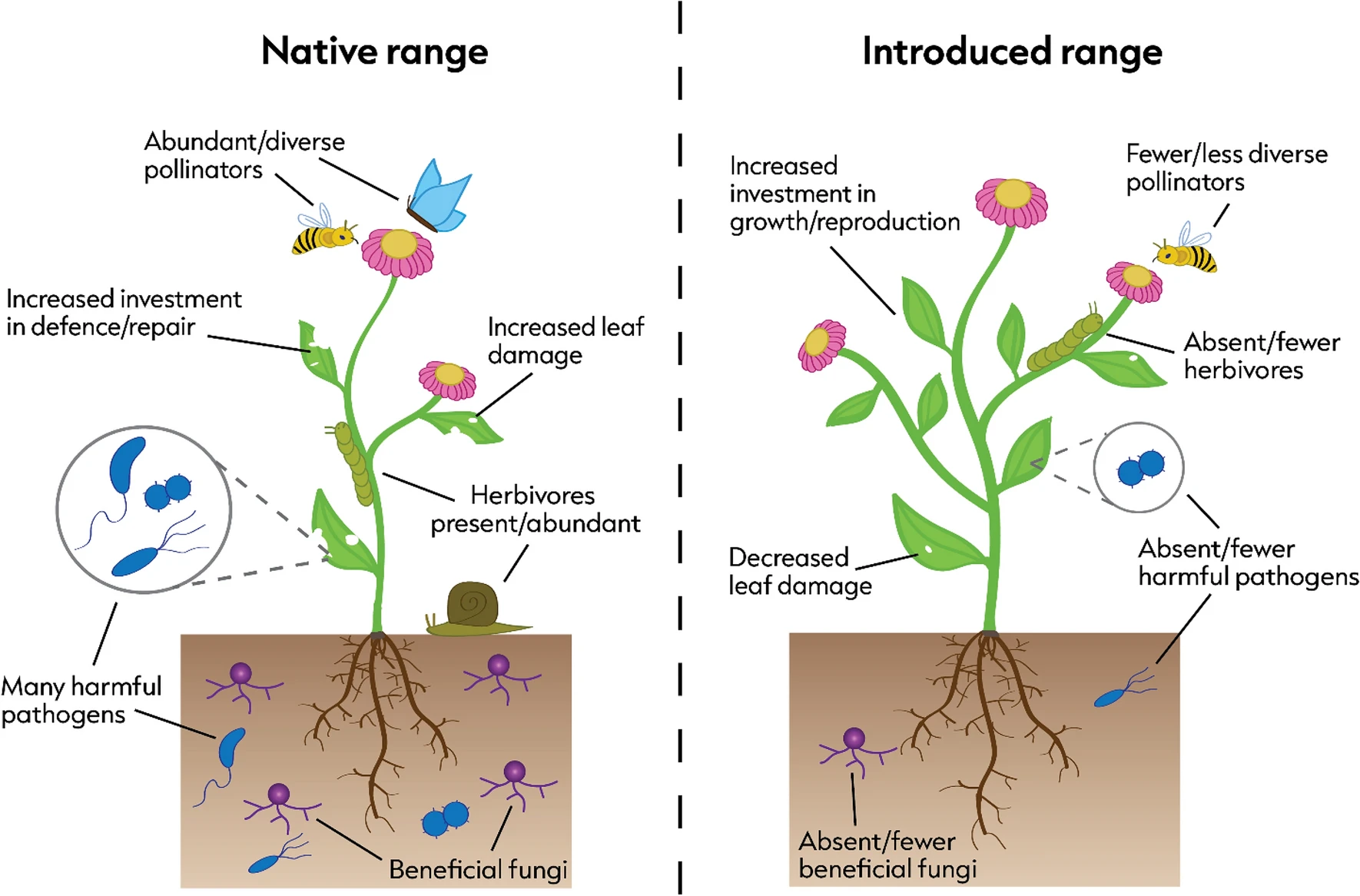
As I’ve previously discussed on the blog, when species are moved to a different part of the world they lose many of the ‘enemies’ – such as predators, herbivores and pathogens – that would normally keep their populations in check. This can have implications for the likelihood of a species becoming invasive, and it’s called the Enemy Release Hypothesis (ERH) and has been well studied. Less well researched is the flip side of the ERH, the Missed Mutualist Hypothesis (MMH), in which species lose their ‘friends’, such as pollinators, seed dispersers, symbiotic fungi, and so forth. It’s a topic I’ve worked on with my colleagues at the University of New South Wales, principally Angela Moles and her former PhD student Zoe Xirocostas.

Another paper from Zoe’s PhD work has just been published and in it she carried out a comparison of European plants that have been transported to Australia, and asked whether they had fewer pollinators in their new range. It turns out that they do!

Here’s the full reference with a link to the paper, which is open access:

Xirocostas, Z.A., Ollerton, J., Peco, B., Slavich, E., Bonser, S.P., Pärtel, M., Raghu, S. & Moles, A.T. (2024) Introduced species shed friends as well as enemies. Scientific Reports 14: 11088

Here’s the abstract:

Many studies seeking to understand the success of biological invasions focus on species’ escape from negative interactions, such as damage from herbivores, pathogens, or predators in their introduced range (enemy release). However, much less work has been done to assess the possibility that introduced species might shed mutualists such as pollinators, seed dispersers, and mycorrhizae when they are transported to a new range. We ran a cross-continental field study and found that plants were being visited by 2.6 times more potential pollinators with 1.8 times greater richness in their native range than in their introduced range. Understanding both the positive and negative consequences of introduction to a new range can help us predict, monitor, and manage future invasion events.

Recent research and seminars on pollinators and pollination that have caught my eye

There’s so much good science and so many great talks coming out of the (broad) field of pollinator and pollination research at the moment! Here’s a few things that have come up on my radar. Feel free to comment and add your own examples of things I may have missed.

“Enemy release” of invasive plants is unpredictable – a new study just published

The summer of 2019, before the COVID-19 pandemic turned the world on its head, feels like a very long time ago. Early in that summer, as I recounted on this blog, Zoe Xirocostas joined my research group for a while in order to collect data for her PhD on the comparative ecologies of plants that are native to Europe but invasive in Australia. That work has proven to be very successful, and the latest paper from Zoe’s PhD has just been published.

The paper focuses on the “enemy release hypothesis” (ERH), a well-studied concept in invasion ecology that nonetheless generates significant debate and disagreement. In essence, the ERH posits that the reason why so many species become invasive is that they leave their consumers, pathogens and parasites behind when they move to a new locality. Those “enemies” would normally reduce the fecundity of the invader, putting a brake on their population growth. But in their absence, the invader can become far more successful. Of course, as well as leaving “enemies” behind the invader also loses its “friends”, such as pollinators, seed dispersers, and defensive or nutritional partners. This “Missed Mutualist Hypothesis” is something that I’ve recently explored with Angela Moles, who was Zoe’s main supervisor, and other collaborators in Australia. Expect to hear more about this from Zoe’s work in the near future.

But back to the enemies. Drawing on the most extensive set of standardised comparisons yet collected of the same plants in native and invasive habitats, Zoe found that plants in the invasive populations suffer on average seven times less damage from insect herbivores, as predicted by the (ERH). Rather remarkably, however, the amount of enemy release enjoyed by a plant species was not explained by how long the species had been present in the new range, the extent of that range, or factors such as the temperature, precipitation, humidity and elevation experienced by the native versus invasive populations.

In other words, it’s extremely hard to predict the extent of enemy release based on historical and ecological considerations that one might expect to impose a strong influence.

The study has just appeared in Proceedings of the Royal Society series B and is open access. Here’s the reference with a link to the paper:

Xirocostas, Z.A., Ollerton, J., Tamme, R., Peco, B., Lesieur, V., Slavich, E., Junker, R.R., Pärtel, M., Raghu, S., Uesugi, A., Bonser, S.P., Chiarenza, G.M., Hovenden M.J. & Moles, A.T. (2023) The great escape: patterns of enemy release are not explained by time, space or climate. Proceedings of the Royal Society series B 290: 20231022.

Here’s the abstract:

When a plant is introduced to a new ecosystem it may escape from some of its coevolved herbivores. Reduced herbivore damage, and the ability of introduced plants to allocate resources from defence to growth and reproduction can increase the success of introduced species. This mechanism is known as enemy release and is known to occur in some species and situations, but not in others. Understanding the conditions under which enemy release is most likely to occur is important, as this will help us to identify which species and habitats may be most at risk of invasion. We compared in situ measurements of herbivory on 16 plant species at 12 locations within their native European and introduced Australian ranges to quantify their level of enemy release and understand the relationship between enemy release and time, space and climate. Overall, plants experienced approximately seven times more herbivore damage in their native range than in their introduced range. We found no evidence that enemy release was related to time since introduction, introduced range size, temperature, precipitation, humidity or elevation. From here, we can explore whether traits, such as leaf defences or phylogenetic relatedness to neighbouring plants, are stronger indicators of enemy release across species.

When organisms lose their friends: a new review of the “Missed Mutualist Hypothesis” just published

All organisms – be they plants, animals, fungi, or whatever – interact with other species throughout their lives, in relationships that include predation, parasitism, commensalism, and the many and varied forms of mutualism. But when species are transported to a different part of the world, as has happened often during the Anthropocene, these interactions typically break down because usually only one of the participants moves. This loss of ecological relationships can play a role in whether or not a species becomes established in its new home, and has been mostly explored in the “Enemy Release Hypothesis” (ERH) which predicts that, by leaving behind predators or parasites or herbivores, a species becomes more ecologically successful and ultimately invasive in its novel range.

Less well studied, though potentially just as important, is the “Missed Mutualist Hypothesis” (MMH) which in a sense is the twin of the ERH. As well as leaving behind “enemies”, introduced species leave behind “friends” such as pollinators, seed dispersers, mycorrhizal fungi, defensive partners, and other mutually beneficial associates. Negative effects arising from the loss of these relationships could potentially balance the positive impacts arising from the ERH.

In a new quantitative review just published, we review what’s known about the MMH (currently much less than the ERH) and suggest some fruitful lines of enquiry. The study is led by Angela Moles, my collaborator at the University of New South Wales where I spent time as a Visiting Research Fellow in 2019/20 (see my blog posts about that visit starting here). The paper has had a long gestation and gone through several iterations and revisions since we started writing it in late 2019, not least caused by the covid pandemic, but I think that it’s all the better for it.

Here’s the full reference with a link to the paper:

Moles, A.T., Dalrymple, R.L., Raghu, S., Bonser, S.P. & Ollerton, J. (2022) Advancing the missed mutualist hypothesis, the under-appreciated twin of the enemy release hypothesis. Biology Letters 18: 20220220.

Here’s the abstract:

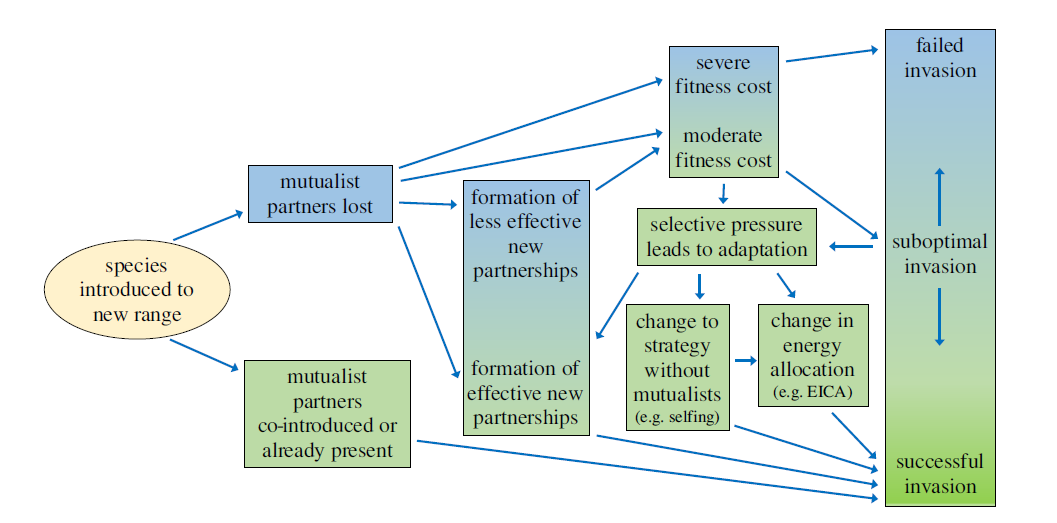
Introduced species often benefit from escaping their enemies when they are transported to a new range, an idea commonly expressed as the enemy release hypothesis. However, species might shed mutualists as well as enemies when they colonize a new range. Loss of mutualists might reduce the success of introduced populations, or even cause failure to establish. We provide the first quantitative synthesis testing this natural but often overlooked parallel of the enemy release hypothesis, which is known as the missed mutualist hypothesis.

Meta-analysis showed that plants interact with 1.9 times more mutualist species, and have 2.3 times more interactions with mutualists per unit time in their native range than in their introduced range. Species may mitigate the negative effects of missed mutualists. For instance, selection arising from missed mutualists could cause introduced species to evolve either to facilitate interactions with a new
suite of species or to exist without mutualisms. Just as enemy release can allow introduced populations to redirect energy from defence to growth, potentially evolving increased competitive ability, species that shift to strategies without mutualists may be able to reallocate energy from mutualism toward increased competitive ability or seed production. The missed mutualist hypothesis advances understanding of the selective forces and filters that act on plant species in the early stages of introduction and establishment and thus could inform the management of introduced species.

Scale matters when analysing plant-pollinator networks: a new research paper out today

It’s long been recognised that the scale at which we study the natural world – over long or short time periods, or across small areas or whole regions – affects the conclusions that we draw about ecological patterns and processes. This is certainly true of plant-pollinator interactions. For example, a widely distributed plant can have very different pollinators at the extremes of its range, and pollinators like bees may vary their focus on nectar and pollen sources from year to year.

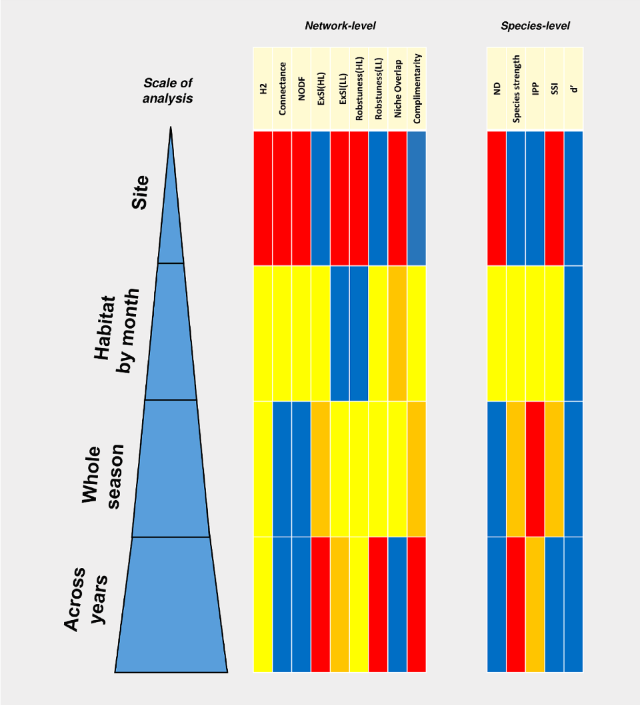
The analysis of these interactions as networks of actors has become increasingly popular in the last couple of decades. However there is no consensus about how frequent sampling should be, or the geographical scale over which networks should be studied. In fact all scales (from regional “meta-networks” down to single-season, single-site, single taxon observations) are relevant, depending on the questions being asked or the hypotheses posed.

But it’s important that we acknowledge that conclusions drawn at one scale may not apply at other scales.

That’s the take home message from a paper published this week which is the latest output from the PhD work of Australian bee expert Kit Prendergast. We have collaborated on several papers based on her data and this is actually my 100th peer-reviewed publication: a proud milestone for me and one which I’m glad to share with a wonderful early career researcher like Kit!

Here’s the reference with a link to a read-only version of the paper:

Prendergast, K.S. & Ollerton, J. (2022) Spatial and temporal scale of analysis alters conclusions about the effects of urbanisation on plant-pollinator networks. Arthropod-Plant Interactions https://doi.org/10.1007/s11252-022-01290-z

And here’s the abstract:

Bipartite networks of flowering plants and their visitors (potential pollinators) are increasingly being used in studies of the structure and function of these ecological interactions. Whilst they hold much promise in understanding the ecology of plant– pollinator networks and how this may be altered by environmental perturbations, like land-use change and invasive species, there is no consensus about the scale at which such networks should be constructed and analysed. Ecologists, however, have emphasised that many processes are scale dependent. Here, we compare network- and species-level properties of ecological networks analysed at the level of a site, pooling across sites within a given habitat for each month of surveys, and pooling across all sites and months to create a single network per habitat type. We additionally considered how these three scales of resolution influenced conclusions regarding differences between networks according to two contrasting habitat types (urban bushland remnants and residential gardens) and the influence of honey bee abundance on network properties. We found that most network properties varied markedly depending on the scale of analysis, as did the significance, or lack thereof, of habitat type and honey bee abundance on network properties. We caution against pooling across sites and months as this can create unrealistic links, invalidating conclusions on network structure. In conclusion, consideration of scale of analysis is also important when conducting and interpreting plant–pollinator networks.

Pollinator-flower interactions in gardens during the COVID-19 pandemic lockdown of 2020: the data paper has just been published!

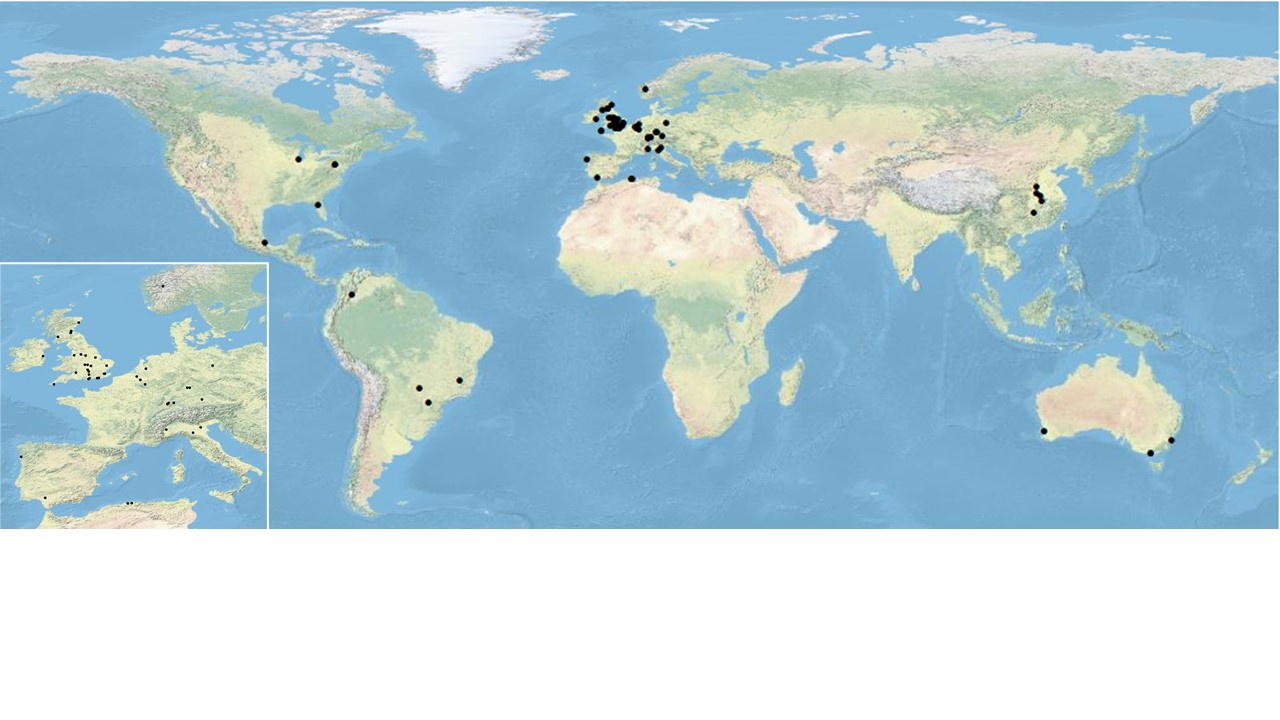
During the lockdown period of the COVID-19 pandemic in 2020, many pollination ecologists were stuck at home: universities and research institutes were closed and restrictions on travel meant that it was not possible to get out and do field work. In order to keep active and motivated, and to turn adversity into an opportunity, an ad hoc network of more than 70 researchers from 15 different countries (see the map above) decided to collect standardised data on the plant-pollinator networks in their own gardens and nearby public spaces.

When combined with information about location, size of garden, floral diversity, how the garden is managed, and so forth, this would provide some useful data about how gardens support pollinators. For those with kids at home it could also be a good way of getting them out into fresh air and giving them something to do!

Following discussions, several different protocols were instigated which depended upon the time available to the researchers, including one that mirrored the UK Pollinator Monitoring Scheme’s  FIT (Flower-Insect Timed) counts.

The resulting data set of almost 47,000 visits by insects and birds to flowers, as well as information about flowers that were never visited, is freely available and will be an invaluable resource for pollination ecologists. For example, analysing the links between ornamental flowers that share pollinators with fruits and vegetables such as apples and beans, will allow us to make recommendations for the best plants to grow in home gardens that can increase yields of crops.  

There’s an old saying about turning adversity into a positive outcome: “When life gives you lemons, make lemonade”, and the researchers were pleased to find that there’s one record of Citrus limon in the data set!

The paper describing the data set has just been published in the Journal of Pollination Ecology and you can download a PDF of the paper and the associated data for free by following this link.

Sincere thanks to all of my co-authors for their commitment to the project!

Which honeybees are declining and which are not?

Over the weekend there was a discussion on Twitter about “beewashing” that was spun out of this tweet by London beekeeper Richard Glassborow. Richard and his colleagues are some of the most responsible beekeepers that I know and they are getting increasingly frustrated by claims from irresponsible companies that keeping a hive of bees in your garden will help to “save the bees”, backed up by spurious claims that “honeybee colonies are dying out”.

The Twitter exchange prompted me to produce the Condescending Wonka meme that you see above because, as I discussed in my recent book Pollinators & Pollination: Nature and Society, pollinator conservation is a really complex area. But there’s no doubt that beekeeping as it’s being widely promoted is not the answer to bee conservation. Let me explain why.

The word “honeybee” does not refer to just one species. It’s most often* applied to bees in the genus Apis, especially the Western Honeybee Apis mellifera, but there are another seven or so Apis species to which the word can be applied. Of those other Apis species, most have never been domesticated and they live as free-living colonies is the various parts of Asia where they evolved. Only Apis cerana is kept in hives, as far as I am aware. The conservation status of most of these other Apis species is unclear but given that they are predominantly forest species, and deforestation is a chronic problem in Asia, we can surmise that some species may be declining. If you want to know more about them the Wikipedia page is a good starting point.

In this short post I just want to consider the Western Honeybee (Apis mellifera). This is a really knotty species to get to grips with because there are multiple subspecies and within subspecies there are various genetic lineages. In addition, the Western Honeybee has been subject to artificial selection for desirable qualities, such as docility, amount of honey produced per hive, and disease resistance, as well as cross-breeding between different subspecies**. The best recent summary of our current understanding of Western Honeybee genetics and conservation is this 2019 review by Fabrice Requier and colleagues, from which I’ve drawn quite a bit of information.

For the purposes of this explaining what’s going on, it’s easiest to think about the species as comprising three “megapopulations”:

Western Honeybees that are managed in hives: For the most part these are not endangered. Britain has as many hives now as it did in the mid-1950s and indeed globally we have more hives than ever (about 90 million hives at the last count). They are found far beyond their natural range and have been introduced into places where they are not native such as the Americas, parts of Asia, and Australia. STATUS: doing just fine.

Western Honeybees that have founded “feral” colonies: These have escaped from hives in countries where they have been introduced and become naturalised. They are doing well, too well in fact: they are a significant conservation issue in places like Australia. STATUS: doing just fine.

Western Honeybees that are living wild in their native range: This is where things become a little muddier. The African populations of the various subspecies seem to be doing well, but more studies are needed to confirm this. In Europe, actually defining what constitutes “wild” honeybees across a region where a lot of selection and hybridization has gone on, probably for thousands of years, is tricky. However there’s no doubt that wild colonies of Apis mellifera are not uncommon in suitable woodland: see this paper about free-living colonies in Ireland by Keith Browne and colleagues, for instance. Note their statement that genetic evidence shows that “the free-living population sampled is largely comprised of pure A. m. mellifera“, i.e. the European Black Honeybee. STATUS: probably doing quite well though more data is needed.

Conclusion: as I said, it’s really complicated and I don’t pretend to have all of the answers, no one does. But what IS clear is that managed Western Honeybees are not declining and keeping yet more hives of them is not going to help us to “Save the Bees”. I’ll leave the last word to Requier et al., whose review I really do recommend: “We argue for the redirection of attention from managed honey bees to the neglected conservation of wild honey bees.” Amen to that.

———————————————————————————————

*The term “honeybee” is sometimes also used for other social bees that produce honey, for example stingless honeybees in the genus Trigona, but there’s no real consensus on what “honey” actually is, and as I’ve argued in another post, bumblebees (Bombus spp.) also produce honey.

**You may be horrified (but perhaps not surprised) to learn that in the 1930s the Nazis enacted policies to ensure that German beekeepers kept only European Black Honeybees (Apis mellifera mellifera), in line with their views on racial “purity”. Then in the early 1940s, German beekeepers suffered a huge number of colony losses due to disease. The restrictions were lifted to allow beekeepers to cross their bees with disease-resistant A. mellifera carnica. Go figure.

Do bumblebees make honey? Yes and no…and…maybe [UPDATED]

As kids, my friends and I did a lot of digging. We always seemed to be burrowing into slopes or excavating trenches, pretending to be archaeologists or treasure hunters. Indeed, there was a lot of ground treasure to be found in the part of Sunderland where I grew up. The area has a long history of pottery and glass making, and ship building, and the remnants of these industries could be uncovered every time we stuck a spade in the earth. Over time I developed my own small museum of interesting, unearthed fragments, including bits of hand-painted ceramics, glass bottles, and unidentifiable metal shards, alongside various animal bones I’d excavated. My parents quietly indulged this interest, and my muck-streaked face and clothes, even if they didn’t quite understand what I was doing.

Aged about 10, my first encounter with a bumblebee nest was during one such dig. On the waste ground behind a large advertising hoarding, we began digging into a low, grass-covered mound and accidentally excavated what was probably a small nest of Buff-tailed Bumblebees (Bombus terrestris). I can recall being fascinated by the waxy, odd shaped cells and by the sticky fluid that some of them were leaking. Being an adventurous sort of child I tasted the liquid: it was sweet and sticky, and that was my first encounter with bumblebee “honey”.

I’m going to leave those quotation marks in place because if you do an online search for “do bumblebees make honey?” you generally find that the answer is “no, only honey bees make honey”.

Now, defining honey as something made by honey bee strikes me as a circular argument at best. And it also neglects the “honey” made by meliponine bees that is central to the culture of stingless bee keeping by indigenous groups in Central and South America, and the long tradition pre-colonial tradition of honey hunting by Aboriginal Australians. So if we widen our definition of “honey” as being the nectar*-derived fluid stored in the nests of social bees, then Apis honey bees, stingless bees and bumblebees must all, by logic, make honey. And likewise there’s wasps in the genus Brachygastra from Central and South America that are referred to as “honey wasps” because, well, I’m sure you can work it out!

But this is where things become a little trickier, because turning nectar* into honey involves some complex evaporation and enzymatic activity, so that the resulting fluid is more concentrated and dominated by the sugars glucose and fructose. Although analysis of honey bee honey is commonplace, and there’s been some research conducted on the honey of stingless bees, I don’t know of any studies that have compared Bombus honey with that of other bees, or with what is stored in the nests of honey wasps**. If I’ve missed anything, please do comment and let me know, but this strikes me as an area of research demanding some attention.

So do bumblebees make honey? That very much depends on our definitions, but I’m happy to accept that they do because “honey” is not a single thing: it’s an insect-derived substance that can take a range of forms but serves the same broad purpose of feeding the colony. And although insects have probably been producing it for millions of years, I think I’ve known the answer to the question for almost 50 of them…

UPDATE: A couple of people have commented on social media that there are legal definitions of “honey” as a foodstuff. Here’s the definition according to UK law***:

“the natural sweet substance produced by Apis mellifera bees from the nectar of plants or from secretions of living parts of plants or excretions of plant-sucking insects on the living parts of plants which the bees collect, transform by combining with specific substances of their own, deposit, dehydrate, store and leave in honeycombs to ripen and mature”

So, legally, we can’t call anything that isn’t made by Apis mellifera “honey”, at least from a foodstuffs regulation perspective. But that’s clearly different to what we have been discussing above, which is about a biological definition of honey.

It’s also interesting to look at the compositional requirements of honey as a foodstuff (presented in Schedule one of that document, if you follow the link above). The lower limit for moisture content is 20%. Now if you consider that most nectar in flowers has a sugar content of between about 20% and 50%, clearly there’s been a lot of evaporative work done by the bees to reduce the amount of water in the honey. I would love to know how bumblebee (and other insect) “honey” compares to this: do they put the same kind of effort into evaporating the water from the stored nectar? Given that the purpose of reducing the water content is to prevent fermentation by yeasts when it’s stored for a long time, and that there are bumblebee species which have colonies that are active for more than one year, I imagine that at least some species in some parts of their range may employ similar tactics.

Thanks to everyone who has been commenting and discussing the topic. It never ceases to amaze me how much we still do not understand about some fundamental aspects of the natural history of familiar species!

*And honeydew to a greater or lesser extent.

**I’m going to ignore honey pot ants for now as this is complex enough as it is and they don’t store the “honey” in nest cells.

***From what I can gather definitions in other countries are similar.

Leonard B. Thien (1938-2021) – botanist and pollination biologist

I was saddened to learn recently of the death of Professor Leonard B. Thien of Tulane University who passed away at the end of October after a long illness. Although I didn’t know Professor Thien personally, I knew of his work in floral ecology, pollination biology and plant evolution, topics on which he had worked for since obtaining his PhD in 1968. Over the course of his career he published more than 80 articles on a huge range of botanical subjects, including ground-breaking work on mosquito pollination of orchids (Thien 1969). The orchid species Alaticaulia thienii is named in his honour.

The studies Leonard Thien published that really inspired me when I was first starting out on my journey as a researcher, however, involved his work on “relictual” angiosperms, i.e. flowering plants that have very long evolutionary histories and deep phylogenetic roots back to the early Cretaceous period, for example Magnolia and Illicium. Papers with titles such as “Patterns of pollination in the primitive angiosperms” (Thien 1980) piqued my interest and motivated me to work on Australian Piperaceae for a short while following my PhD (Ollerton 1996). It was a topic that I struggled to gain further funding for, and later molecular systematic studies changed many of our ideas about what constitutes the most basal groups of extant flowering plants. But nonetheless, the questions that Leonard inspired in me, regarding the ecologies of these relictual taxa, and whether we can infer the reproductive ecology of the earliest flowering plants from studies of their surviving descendants, are ones that intrigue me to this day (van der Kooi and Ollerton 2020).

Leonard Thien kept up this interest even as new DNA technologies over turned old ideas, and he was the first to study the reproductive ecology of Amborella trichopoda on New Caledonia, a species now considered to be the earliest surviving clade of flowering plants (Thien et al. 2003). This is just one part of a legacy of work that current and future generations will build upon as we develop our understanding of the relationships between pollinators, plants, and evolutionary processes.

I’m grateful to Peter Bernhardt for prompting this post and for sending me a copy of the In Memoriam article that he and and David White will publish in the Plant Sciences Newsletter in March, and to Lorraine Thien for providing the photograph that accompanies this post.

References

Ollerton, J. (1996) Interactions between gall midges (Diptera: Cecidomyiidae) and inflorescences of Piper novae-hollandiae (Piperaceae) in Australia. The Entomologist 115: 181-184

Thien, L.B. 1969. Mosquito pollination of Habenaria obtusata (Orchidaceae). American Journal of Botany 56: 232-237.

Thien, L.B. 1980. Patterns of pollination in the primitive angiosperms. Biotropica 12: 1-14

Thien, L.B., Sage, T.L., Jaffre, T., Bernhardt, P., Pontieri, V., Wesston, P.H., Malloch, D., Azuma, H., Graham, S.W., McPherson, M.A., Hardeep, S.., Sage, R.S. & Dupre, J.-L. 2003. The population structure and floral biology of Amborella trichopoda (Amborellaceae). Annals of the Missouri Botanical Garden 90: 466-490

van der Kooi, C.J. & Ollerton, J. (2020) The origins of flowering plants and pollinators. Science 368: 1306-1308

Impacts of the introduced European honey bee on Australian bee-flower networks – a new study just published

As I mentioned in my previous post, it’s currently Invasive Species Week in the UK. Non-native species which have negative environmental impacts and disrupt infrastructure are a global phenomenon, of course, and almost all regions of the world have been impacted by species that originated elsewhere. One alien species that is of growing concern in Australia is the western honey bee Apis mellifera. We often think of bees as being relatively benign organisms, but a number of species have been introduced around the world and may compete with native species for nectar and pollen, and nesting sites.

In the second paper from my collaboration with Dr Kit Prendergast, we’ve assessed how introduced honey bees change the structure of bee-flower visitation networks in Australian urban habitats. The main finding is that when honey bees are common, they dominate these networks in ways that indicate significant competition with native bee species. You can get a sense of that from the figure above: the honey bees are in red, native bees in yellow, native plants in light green, and non-native plants in dark green. The length of the bars is proportional to the abundance of these plants and bees.

To say that honey bees ‘dominate’ these networks is an understatement: not only are they vastly more abundant than the other bees, but they visit almost all of the different types of flowers in the network, regardless of whether they are native or introduced.

Although the honey bee bullshit machine often claims that western honey bees are dying out, the exact opposite is true: across the world, managed Apis mellifera numbers are higher than ever, as you can see from the following chart based on figures from the United Nations Food and Agriculture Organization (UN-FAO):

Whilst the growth in honey bee numbers is a good thing for honey producers, bee farmers, and small-scale subsistence farmers, there are environmental consequences to the increase in hives, as we have shown.

If anyone wants a PDF of the paper, please use the Contact form. The full reference for the study and the abstract is:

Prendergast, K.S. & Ollerton, J. (2021) Impacts of the introduced European honeybee on Australian bee-flower network properties in urban bushland remnants and residential gardens. Austral Ecology (in press) https://doi.org/10.1111/aec.13040

Abstract:

The European honeybee Apis mellifera is a highly successful, abundant species and has been introduced into habitats across the globe. As a supergeneralist species, the European honeybee has the potential to disrupt pollination networks, especially in Australia, whose flora and fauna have co-evolved for millions of years. The role of honeybees in pollination networks in Australia has been little explored and has never been characterised in urban areas, which may favour this exotic species due to the proliferation of similarly exotic plant species which this hyper-generalist can utilise, unlike many native bee taxa. Here, we use a bipartite network approach to compare the roles, in terms of species-level properties, of honeybees with native bee taxa in bee-flower (‘pollination’) networks in an urbanised biodiversity hotspot. We also assessed whether the abundance of honeybees influences overall network structure. Pollination networks were created from surveys across seven residential gardens and seven urban native vegetation remnants conducted monthly during the spring-summer period over two years. There were consistent differences in species-level properties between bee taxa, with honeybees often differing from all other native bees. Honeybees had significant impacts on network properties, being associated with higher nestedness, extinction slopes of plants, functional complementarity and niche overlap (year two), as well as lower weighted connectance and generalisation. These associations all are indicative that competition is occurring between the introduced honeybee and the native bee taxa in bee-flower networks. In conclusion, the introduced honeybee occupies a dominant, distinct position in bee-flower networks in urban habitats in the southwest Western Australian biodiversity hotspot