Is it safe to use oleander to treat COVID-19 symptoms?

No, it’s not safe. It’s a really, really dumb idea. Oleander is VERY poisonous and you could die. Do not do it.

OK, that was the short version; here’s the longer version. Oleander (Nerium oleander) is a plant belonging to the plant family that’s been the focus of much of my research for the past 30 years: Apocynaceae. The plant is widely grown in warm temperate and subtropical areas as an ornamental shrub or small tree and there are cultivars with flowers in a diverse palette of colours. In the Mediterranean, where it’s native, it’s a pollination generalist and pollinated by large bees, hawkmoths, and small flies. However, visitation to flowers is infrequent because, as Javier Herrera showed in this study, the flowers produce no nectar. It’s a rare example of a species of Apocynaceae with rewardless flowers in a family with very diverse pollination systems, as we showed in our study last year.

Although it’s very beautiful, oleander is also extremely poisonous. Many members of the family Apocynaceae are toxic: they are crammed full of alkaloids, cardiac glycosides, and other nasty chemicals that defend the plant against all but the most specialised of herbivorous insects, such as monarch butterflies (Danaus plexippus). But even in a family renowned for its toxicity, oleander stands out as being especially lethal.

Recently, a chemical derived from oleander called oleandrin has been touted as a health supplement to treat patients with the COVID-19 coronavirus. However there is no evidence that it is effective as a treatment but a LOT of evidence that it is highly toxic to both animals and humans. The fact that’s being touted as a COVID19 treatment by President Trump and some of his pharmaceutical industry donors should ring alarm bells for anyone with any common sense. And just because it’s a “natural” product does not in any way make it safe. DO NOT EAT OLEANDER!

SCAPE gets a new website and registration for the 2020 conference is now open

SCAPE-logo_dark

The Scandinavian Association for Pollination Ecology (SCAPE) now has a dedicated website:  https://scape-pollination.org/

The site includes some history of the conference and links to old programmes and abstract booklets, and we will use this for all future conference announcements.  SCAPE2020 will be online and registration to give a talk or just attend is now open.  If you’re tweeting about it please use the hashtag #SCAPE2020

My thanks to Yannick Klomberg for developing and maintaining the website.

Pollinators and pollination in the UK: an introductory workshop – 26th August

Jeff WT workshop 2020

The Wildlife Trust for Bedfordshire, Cambridgeshire and Northamptonshire has invited me to run my Introduction to Pollinators and Pollination workshop again this year, but of course it will all be online.  Details for signing up are on the images, or you can follow this link. 

Here’s a description of the workshop:

Pollination of flowers ensures the reproduction of most British wild plants and many of our agricultural crops. This session will provide an introduction to the natural history of pollinators and how they interact with the flowers that they pollinate. The main groups of pollinators will be introduced, with guidance on how to identify them, and their ecology and behaviour will be explored. The session will also consider why conserving these species is so important, followed by a Q and A discussion showing what individuals can do to help ensure their future diversity and abundance.

Seminar: ecology and botanical history of the Himalayas – online on 11th September

Dwyer Lecture Flyer 2020

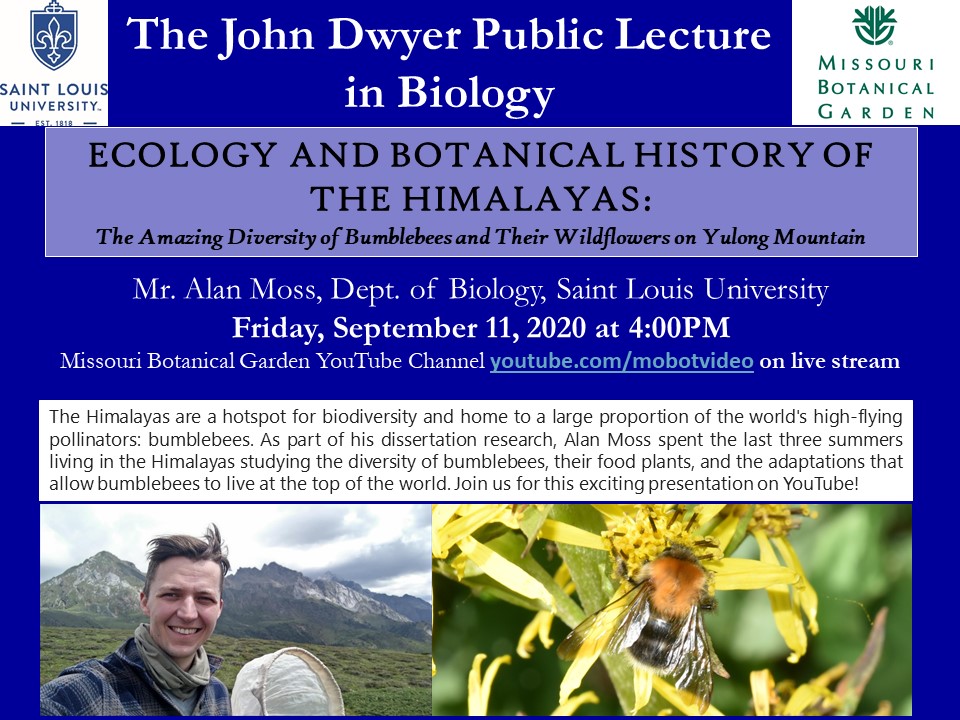
This year’s Missouri Botanical Garden/St Louis University John Dwyer Public Lecture in Biology will be given by Alan Moss who researches Himalayan bumblebees and their interactions with flowers.  The lecture is being live-streamed on YouTube – details are in the flyer above.

Recent pollinator and pollination related research that’s caught my eye

2020-07-30 16.25.26

As I near completion of the copy-editing phase of my forthcoming book it’s frustrating to see all of the great research that’s been produced in recent weeks that I probably won’t be able to cite!  Here’s a few things that caught my eye:

Damon Hall and Dino Martins have a short piece on Human dimensions of insect pollinator conservation in Current Opinion in Insect Science.  My favourite line is: “any call to ‘save the bees’ must be a call to stabilize agriculture”.  Amen to that.

In the journal New Phytologist, Rhiannon Dalrymple and colleagues, including Angela Moles who hosted me during my recent stay in Australia, have a great study entitled Macroecological patterns in flower colour are shaped by both biotic and abiotic factors.  The title pretty much sums it up: in order to fully understand how flowers evolve we need to consider more than just their interactions with pollinators.  It’s another demonstration of how we must look beyond simplistic ideas about pollination syndromes to fully understand the complexities of the relationship between flowering plants and pollinators…..

…..talking of which, again in New Phytologist, Agnes Dellinger asks: Pollination syndromes in the 21st century: where do we stand and where may we go?  It’s an insightful and far-reaching review of a topic that has intrigued me for more than 25 years.  There are still a lot of questions that need to be asked about a conceptual framework that, up until the 1990s, most people in ecology and biology accepted rather uncritically.  One of the main unanswered questions for me is how further study of largely unexplored floras will reveal the existence of new pollination systems/syndromes.  Which leads nicely to….

…..an amazing paper in Nature this week by Rodrigo Cámara-Leret et al. showing that New Guinea has the world’s richest island flora.  The described flora includes 13,634 plant species, 68% of which are endemic to New Guinea!  And the description of new species each year is not leveling off, there’s still more to be discovered.  A commentary on the paper by Vojtech Novotny and Kenneth Molem sets some wider context to the work, and quite a number of media outlets have covered the story.  Why is this relevant to pollinators and pollination?  Well, we actually know very little about this critical aspect of the ecology of the island: there’s only a handful of published studies of plant-pollinator interactions from New Guinea, mostly focused on figs, bird-flower interactions, and a couple of crops.  For such a biodiverse part of the world that’s a big gap in our understanding.

Finally, James Reilly, Rachael Winfree and colleagues have a paper in Proceedings of the Royal Society series B showing that: Crop production in the USA is frequently limited by a lack of pollinators.  Most significant findings to me were that of the seven crops studied, five of them have their yields limited by lack of pollinators, and that even in areas of highly intensive farming, wild bees provided as much pollination service as honeybees.

That’s a few of the things that I spotted this week; what have you seen that’s excited or intrigued you?  Feel free to comment.


Animal deaths in the Australian bushfires even greater than first feared – and what about the plants?

2019-12-27 15.07.16

Earlier this year I reported on the unprecedented Australian bushfires with some reflections of what I was observing during my time as a Visiting Research Fellow at the University of New South Wales – see: How are the Australian bushfires affecting biodiversity? Australia reflections part 4.   Karin also wrote a piece about the fires, focusing on the human impacts – see: Climate Change Stories From a Nation on Fire.

At the time scientists and the media were suggesting that perhaps half a billion reptiles, mammals and birds had been killed, a figure that provoked a strong public reaction when accompanied by images of fire-scorched koalas.  This was then revised upwards to 1 billion. But it turns out that even a billion is nowhere close to the real number of animal deaths.  A new interim report commissioned by WWF-Australia suggests that just under 3 billion animals were either directly killed or displaced.  Those which were displaced were vulnerable to feral predators such as foxes and cats, or more likely to succumb to starvation. An article in The Guardian about the WWF-Australia report is worth reading – here’s the link.

The actual figure is 2.69 billion individual animals.  Think about that for a moment.  That’s about equivalent the number of people living in India and China combined.  This is the breakdown for the different animal groups that were assessed:

● 143 million mammals
● 2.46 billion reptiles
● 180 million birds
● 51 million frogs

One thing should be immediately apparent: this is not a complete list of the “animals” that have been killed.  A lack of data means that fish, turtles and (crucially) invertebrates such as spiders, bees, beetles, and earthworms, were excluded.  Those invertebrates live at much higher densities than any of the animal groups that were assessed and indeed are the sole or principle food for many of those species.  The number of insects required to support just the insectivorous birds is staggering: globally, birds are estimated to eat 400-500 million tonnes of insects and other arthropods every year.

Even if we were to consider just the larger invertebrates, those bigger than say 0.5 cm in length (which are a minority – most are considerably smaller), then then the true scale of the animal deaths is going to be one or two orders of magnitude higher.  Or possibly more.  Thirty billion, 300 billion, 3 trillion…?  Who knows?  It’s impossible to estimate, we just don’t have enough information about those organisms.

The other major component of wildlife that is missing from the report is the plants.  I know that studies of plant mortality are being undertaken at the moment and it will be important that this is given the same level of publicity as the assessments of animals.

Writing in the foreword of the report, Dermot O’Gorman the CEO of WWF-Australia pointed out that: “It’s hard to think of another event anywhere in the world in living memory that has killed or displaced that many animals. This ranks as one of the worst wildlife disasters in modern history”.

I disagree.  I think it’s THE worst wildlife disaster in terms of the scale of animal losses over such a short period of time.  No doubt deforestation and destruction of grasslands in South America, Asia and Africa has killed more animals and plants.  But that’s over a timescale of decades to hundreds of years.  Australian wildlife was devastated in a matter of months. And no one knows exactly what the 2020-21 fire season will bring.  But I think that we can safely predict further impacts on wildlife – and people.


A simple online ecosystem model: like Tamagotchi for the green generation

Orb farm

Recently I came across an online game based on a simple cellular automaton model called orb.farm in which you have to design an enclosed ecosystem that supports plant, animal and bacterial life.  It’s a little bit addictive and a lot of fun! Reminds me of a more sophisticated form of the Tamagotchi, but without the ridiculous waste of plastic, metal and electronics that inevitably comes with these kids’ crazes.

When I tweeted about this earlier in the week the most excitement was generated by some scientists who actually work in lake ecosystem ecology.  They were very impressed!  The occasional Easter Eggs that appear also keep you hooked.  Helpfully, you can also close down your browser or computer and your ecosystem is still there when you open it up again.

Orb.farm is by Max Bittker and I hope that he develops it further.  I can see it being used for some serious experiments as well as being educational and fun.

Get a 30% discount if you pre-order my new book Pollinators & Pollination: Nature and Society

PollinatorsandPollination-frontcover

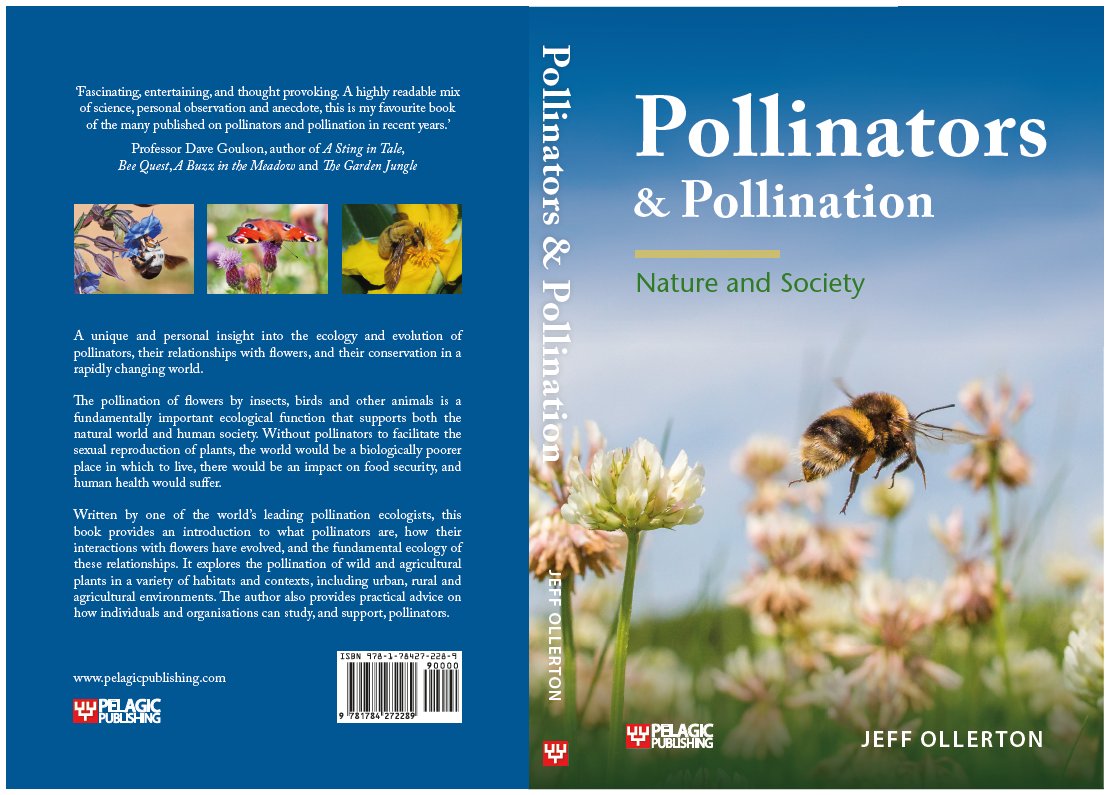
In the next few months my new book Pollinators & Pollination: Nature and Society will be published.  As you can imagine, I’m very excited! The book is currently available to pre-order: you can find full details here at the Pelagic Publishing website.  If you do pre-order it you can claim a 30% discount by using the pre-publication offer code POLLINATOR.

As with my blog, the book is aimed at a very broad audience including the interested public, gardeners, conservationists, and scientists working in the various sub-fields of pollinator and pollination research. The chapter titles are as follows:

Preface and Acknowledgements
1. The importance of pollinators and pollination
2. More than just bees: the diversity of pollinators
3. To be a flower
4. Fidelity and promiscuity in Darwin’s entangled bank
5. The evolution of pollination strategies
6. A matter of time: from daily cycles to climate change
7. Agricultural perspectives
8. Urban environments
9. The significance of gardens
10. Shifting fates of pollinators
11. New bees on the block
12. Managing, restoring and connecting habitats
13. The politics of pollination
14. Studying pollinators and pollination
References
Index


The evolution of insect pollination: a new essay just published

Science MagazineIn the latest issue of the journal Science you’ll find a commentary essay entitled: “The origins of flowering plants and pollinators“, written by Casper van der Kooi and myself.  It’s open access so do go and read it.

This commentary brings together some  recent findings in palaeontology, molecular phylogenetics, and pollinator sensory physiology and behaviour, to discuss the progress that’s been made in understanding the deep-time evolution of this most familiar and charismatic of ecological interactions.

The short version is that the old conceptual models are absolutely wrong.  Some version of “first came the gymnosperms and they were primitive and unsuccessful because they were wind pollinated.  Then, at the start of the Cretaceous, the angiosperms evolved and they were insect pollinated and advanced and so more successful” continues to appear in text books.  But we’ve known for a long time that many of the Jurassic gymnosperms were insect pollinated.  This may (or may not) predate insect pollination of angiosperms: there are huge disagreements between palaeobotanists and molecular phylogeneticists about when the first flowering plants evolved.  The graphic above comes from our essay and shows just how big the discrepancy is: molecular models suggest an origin for the angiosperms about 70 million years prior to the first confirmed fossils.  That’s about equivalent to the whole of the Jurassic period!  There are similar disagreements when it comes to the evolution of pollinating insects: for the Lepidoptera (butterflies and moths) the difference between the earlier molecular and later fossil evidence may be as much as 100 million years.

As we discuss, there are huge implications in these discrepancies for understanding not just how major elements within the Earth’s biodiversity evolved, but also for the origins of pollinator sensory physiology.  Insect behaviours linked to colour vision and odour reception may in turn influence effective crop and wild plant pollination.

The image accompanying our essay is by the very talented biologist, science communicator and graphic designer Elzemiek Zinkstok – follow that link and check out her work.