Tag Archives: Sustainability

The Black Cats go green, and go up!

It’s impossible to be a native of Sunderland and not to have at least a passing interest in football. If you’ve seen the Netflix series Sunderland ‘Til I Die, you’ll know that in my home town, football is more of a religion than a leisure activity. It’s a passion that extends back to the foundation of Sunderland Association Football Club (SAFC) in 1879, whose nickname is the Black Cats.

Growing up, football was always a topic of discussion in our house. My dad played Sunday League football for many years and my Uncle Gordon Howe was a professional footballer. But to the general disappointment of my family, I’ve never had a deep interest in the sport, though I do keep a watch on how well the team of my birthplace is doing. And as of yesterday they are doing extremely well! The team beat Sheffield United (ironically, one of the teams that Uncle Gordon played for) in a thrilling, close-run match to earn promotion back into the Premier League. I watched it live with friends in a local pub, and there was a great reception to the win, even among customers who had no vested interest in the club.

It brought back memories of the mid-1970s when I attended matches at SAFC’s old Roker Park stadium, buoyed up by the club’s ‘giant killing’ win over Leeds United in the 1973 FA Cup Final. But even after my childhood interest in football waned, replaced by a growing fascination with natural history, home matches were frequently a backdrop to Saturdays. The famous Roker Roar always signaled that the team had scored. That shout echoed across the town and down through the Magnesian Limestone gorge of the River Wear, part of which you can see in the photograph above. Exploring the exposed geology, and the grassland and brownfield habitats of that river valley, is an important reason why I became an ecologist, as I recounted on the blog a decade ago.

The shot was taken in early 1986 and it shows the view from the back of the house in which I grew up. On the south side of the river, you can see cranes and sheds associated with the shipbuilding industry, for hundreds of years one of the two main engines of the local economy. Directly ahead, situated on a promontory, you can see an example of the second engine: Wearmouth Colliery, a 2,000 ft deep coal mine that extended out under the North Sea. The mine employed quite a number of members of my family, including my grandfather and several uncles*, one of whom was killed in the early 1900s after a pit pony kicked him. My dad was also a miner for a time but he worked further up river at the Hylton Colliery, which produced more than its fair share of professional footballers, as well as coal.

In 1993 Wearmouth Colliery closed and the site was quickly cleared – see this amazing set of photos that was taken at the time. Four years later, SAFC closed Roker Park and moved to a new purpose-built stadium on the colliery site. They called it The Stadium of Light, a name that honours the ‘miners at Wearmouth Colliery [who] carried with them a Davy lamp as part of their working lives’. Here’s a shot of the stadium perched above the river, taken by my good friend Mark:

Not only have Sunderland gone up, they have also gone green, with a commitment to be carbon neutral and generate their own power from solar installations (though that scheme has attracted some controversy). They are also making the team’s kit from recycled plastic bottles and looking at more environmentally friendly ways of dealing with match day waste – see this press release on their ‘Ready Eco’ initiative. There’s also a plan to tap into the geothermal potential of the mine to heat local houses, though that has been delayed, unless anyone has more recent news on the scheme?

Biodiversity, always the Cinderella of environmental mission statements, is missing from that initiative, which is a shame because the stadium lies adjacent to some very interesting habitats. To the left of the stadium, on the steep slopes of the gorge, you can see patches of Magnesian Limestone Grassland, a relatively rare plant community that is virtually confined to the North East of England.

This minor gripe aside, it’s great to see Sunderland being promoted and taking a lead in thinking about how football as the national sport has an environmental impact. It makes me even prouder of my home town.

*When I was researching this post I came across the following article from the local newspaper. It mentions my Uncle Walter Ollerton who earned a safety badge that is still in my possession. At the outbreak of World War 2 he enlisted and fought in the Far East, where he was captured by the Japanese and held in a prisoner of war camp. After his release he returned to his job as a miner in Sunderland, but his health was never the same:

Biodiversity Net Gain and pollinators: catch up with my talk on YouTube

Yesterday I delivered a webinar for the Biological Recording Company on the topic of what Biodiversity Net Gain (BNG) could mean for pollinator conservation. It’s a topic that clearly has a lot of resonance for the ecology community: almost one thousand people (994 to be precise) booked to attend, of which 380 actually watched. That’s a fairly typical ratio for free webinars, in my experience – many people book a place in the expectation that they will receive a link to watch the recording later.

The talk was indeed recorded and can be viewed by following this link to YouTube. There was a Q&A session afterwards which is not part of the recording but the questions and my answers have been transcribed and can be viewed on the Biological Recording Company’s blog, together with links to all of the references and data sources that I cited. Here’s the link to the blog.

I had a lot of really positive feedback during and after my talk, plus some extremely useful comments about where my interpretation of BNG was incorrect (or at least didn’t tell the whole story). As I stressed during my talk, BNG is a journey not an end point and we are all at the start of that journey! It’s going to be fascinating and important to see whether BNG can positively impact declining pollinator populations.

Get more out of your fruit and veg: eat the parts we often throw away!

There’s a frequently cited statistic that one third of the food produced for human consumption is wasted every year. That waste occurs for a variety of reasons, including spoilage, over-production and inefficient processing methods. This has clear environmental (and therefore human) consequences, for example in terms of increased carbon dioxide and other greenhouse gas production; excessive use of fertilisers and pesticides; unsustainable water extraction; and conversion of natural habitats to farmland.

Much of the wastage occurs before the food ever reaches shops and markets, so individual consumers have little control over the waste, other than to try to pressure business and political leadership into action. However, we can all do our bit when it comes to reducing food waste in our home, which has positive impacts on our health and our bank balance.

When it comes to fruit and vegetables, we in the west often throw away perfectly edible parts, I suspect because it doesn’t fit with our expectations of what the food “should” look like. A good example is radishes (Raphanus raphanistrum subsp. sativus) where it’s not uncommon to discard the perfectly edible leaves. People who grow them often pull out plants that have flowered, despite the fact that the seed pods are delicious and arguably nicer than the roots, as I discussed in this blog post from a few years ago.

There’s lots of other examples like this, one of my favourites being the crunchy central pith that you find in the thick stems of broccoli (Brassica oleracea var. italica). I love it raw and it has a flavour quite distinct from the normal part that we consume.

It was only quite recently that Karin introduced me to the fact that the mature pods of peas (Pisum sativum) are also edible, if you know how to process them correctly. If you eat the pod as it is, the texture is tough and stringy and not very pleasant. But if you carefully peel away and discard the thin inner membrane of the pod, the remaining flesh is sweet and delicious. It’s fiddly and takes a bit of practice. The easiest way is to gently snap one corner of the half-pod and peel from there – see the example third from the top in the accompanying photograph. Below that in the photo is the thin membrane, which can be put into your food waste or composted, and below that the edible portion of the pod.

Karin and I just eat this raw, but no doubt you could add the pod flesh to any number of dishes. If you have children or grandkids, set them the task of removing the membrane in one piece – it’s not easy!

Please leave a comment below and let me know your favourite bits of edible fruit and veg that are normally discarded.

Pollinators and the UN Sustainable Development Goals – free webinar on Monday!

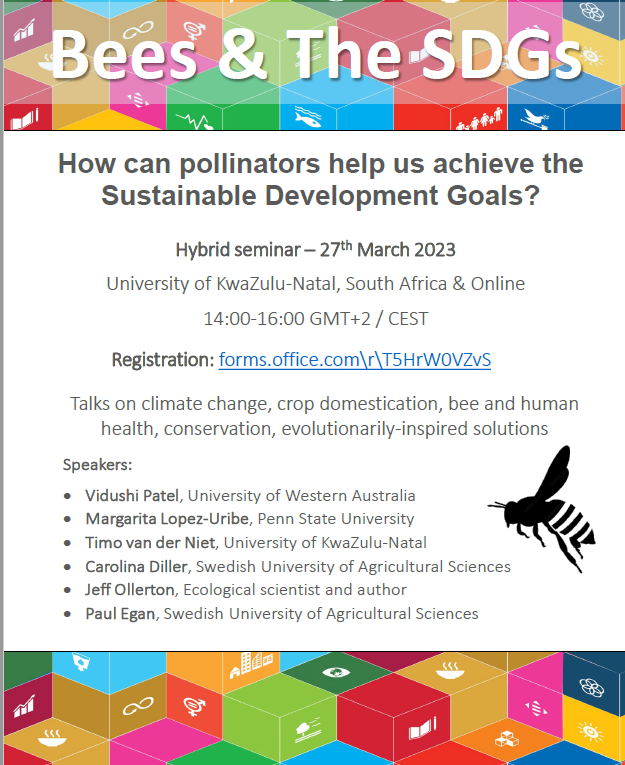
There’s been a lot of discussion recently about how pollinators can contribute to the United Nations’ 17 Sustainable Development Goals. It’s a topic that I reflected on in Pollinators & Pollination: Nature and Society, and I’ve seen a few papers and articles that raise the subject – see here for instance. This free webinar on Monday 27th March is therefore very timely! To register, follow this link: forms.office.com\r\T5HrW0VZvS

Although I’m one of the speakers, I can’t make it in person as I’ve got teaching commitments at Roskilde University, so I’ve recorded my ten minute piece and I’m happy to answer questions via the Contact page on my website.

Published today: a new children’s book about bees and other pollinators!

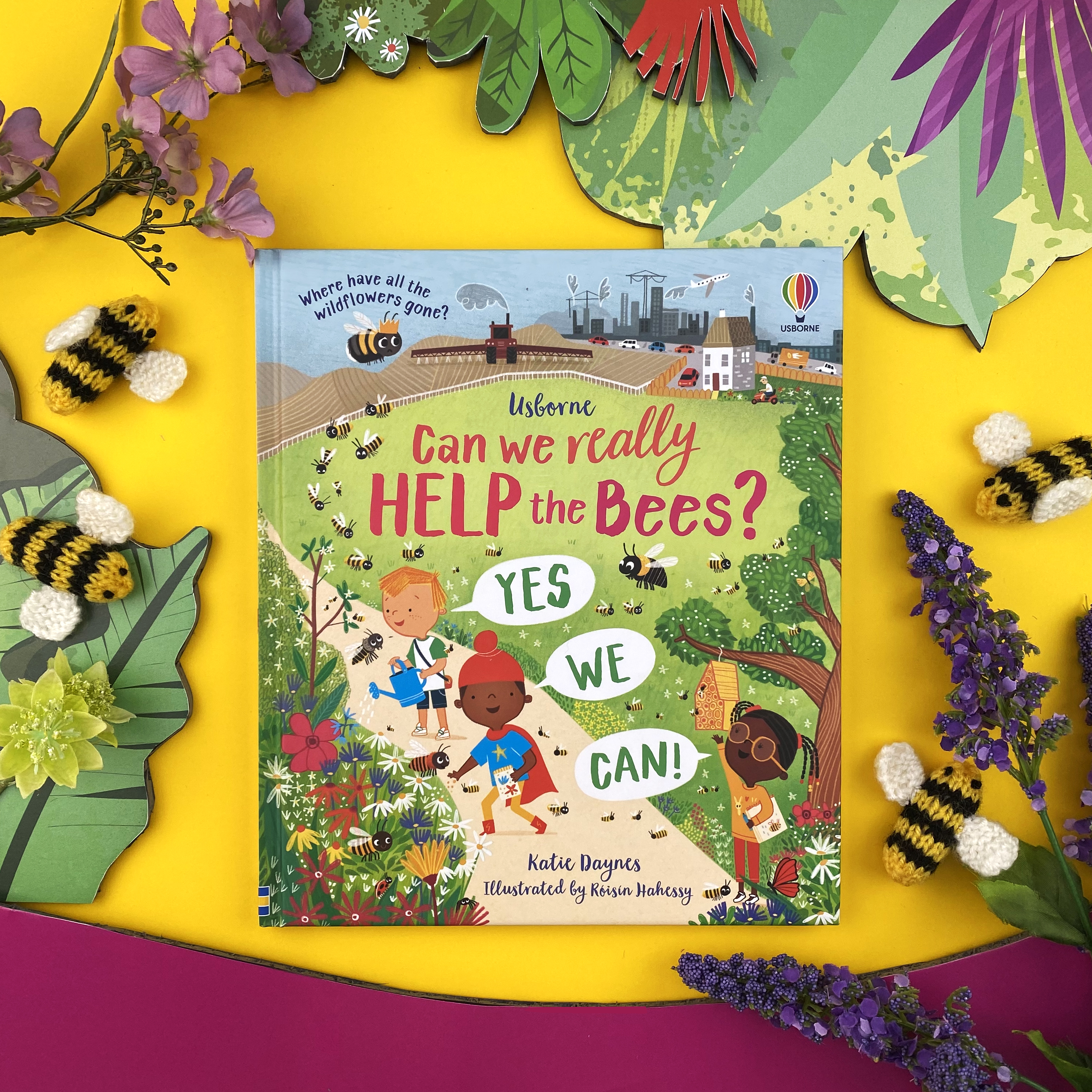
One of the projects with which I’ve been involved over the last year has been advising on a new book for children about bees and other pollinators, called Can We Really Help The Bees? Written by Katie Daynes and wonderfully illustrated by Róisín Hahessy, it tells the story of what happens when a swarm of bees comes to the window to let a group of children know that they, and their friends the other pollinators, are in trouble. Can they help? Yes they can!

It’s been a real pleasure working with Katie and Róisín on this project for Usborne Publishing and seeing the ideas, text, and illustrations evolve over time. I’ve written a short post over at the Usborne blog with some ideas about how to get children involved in helping the pollinators, and I think that it’s worth repeating one of the things that I wrote: everyone can make a difference to the wildlife around us and no one is too young to be involved!

Because of my involvement with Can We Really Help The Bees? I wasn’t able to include it on my curated list of the best books about bees and other pollinators at the Shepherd site. But it definitely should be on there and is highly recommended!

If you read only two books this year make them The New Climate War and Silent Earth

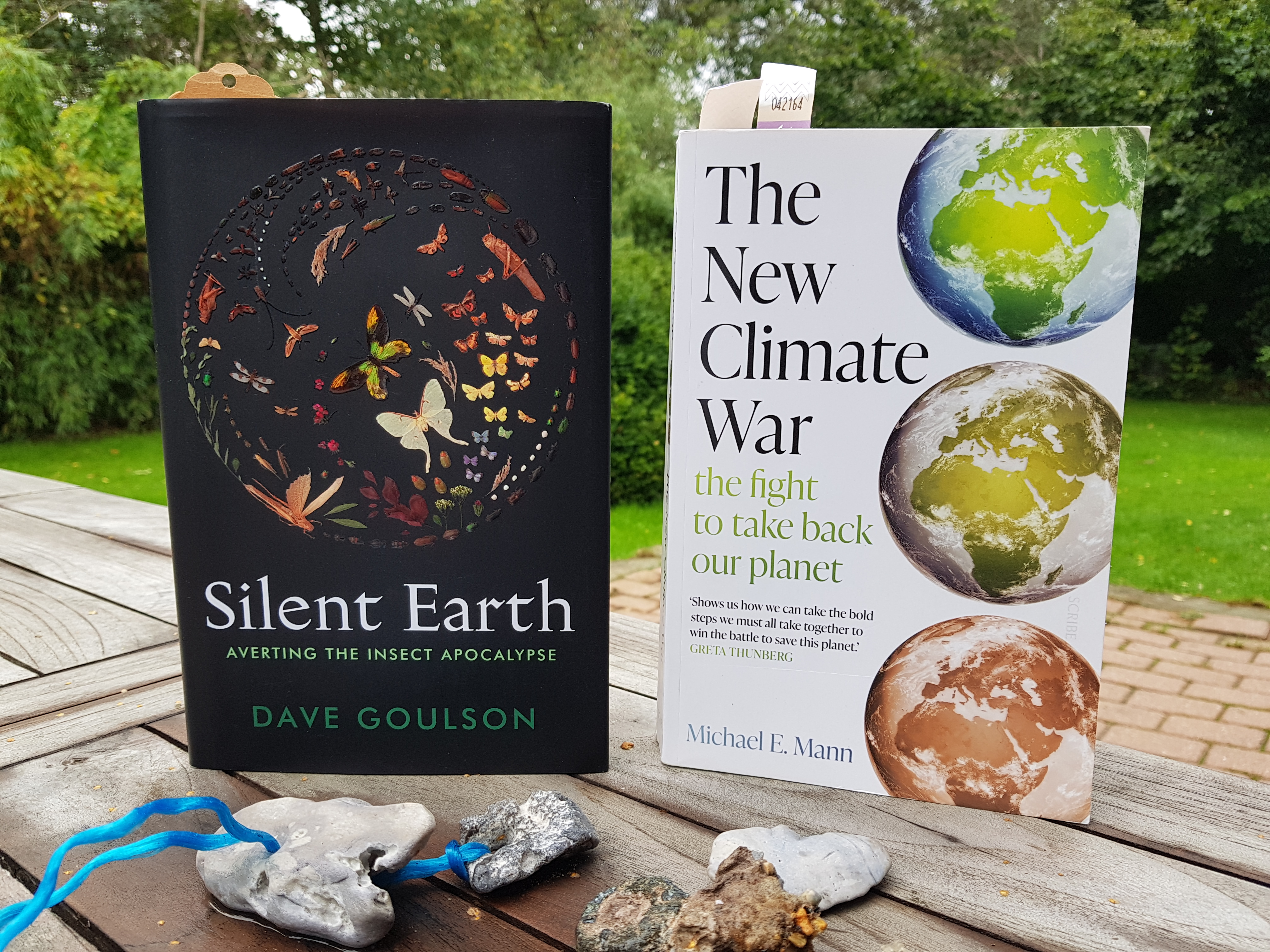
My summer reading this year has included two books that I’ve really looked forward to, and which have not disappointed. These books are on the one hand very different and yet share enough similarities for me to review them together. Michael E. Mann’s The New Climate War focuses on the ‘climate emergency’ whilst Dave Goulson’s Silent Earth is about the ‘ecological emergency’, and specifically the decline of insect populations. As I pointed out in a recent New Scientist opinion piece: “the climate emergency often overshadows the ecological emergency, even though the two overlap both in their causes and their solutions”. Reading these two volumes in parallel has given me a much deeper understanding of just how true that statement is, and it’s why I’m suggesting that of the many, many books that have been recently written about our current environmental crisis, these deserve to be the ones that you read.

Silent Earth deals with the billions of small things – the insects and other invertebrates – that make the world function the way it does. These creatures facilitate the recycling of organic material, the pollination of wild and crop plants, the regulation of populations of other species, and play a host of additional ecological roles. The central thesis of the book is that the growing evidence of declines and extinctions of these small animals should give us cause for concern. In contrast, The New Climate War is about the big stuff – how the world’s atmosphere and oceans are heating up, the contribution of human activities to that warming, and what this means for weather patterns and sea levels across the globe. And how industry and politicians have conspired to deny, obfuscate, and divide, undermining efforts to decarbonise the world’s economy.

It matters not whether we view the world through a microscope or via an Earth observation satellite, both of these ways of seeing and understanding are important to our future as a species. The flap of a butterfly’s wings may only rarely be the indirect cause of a hurricane in the Caribbean, but reading these books nonetheless reminds us of the connections between the world’s biosphere and its physical domains.

The science underlying both books acts as a background to their main purpose: convincing the reader that there are urgent issues with which we, as a society, must deal. In this respect they are unapologetically political, and the point at which science meets environmentalism. The books are written by scientists who are respected experts in their respective fields, but who are not content with sitting back on their award- and citation-laden laurels, and allowing their science to speak for itself (as important as that is). Both Mann and Goulson have entered the more public arenas of politics and social commentary to argue the case for fundamental restructuring of some aspects of our societies. Their reward has been near constant criticism, much of it personal, vindictive and even threatening, by the vested interests of the fossil fuel industry (Mann) and agro-chemical & farming interests (Goulson) and the keyboard warriors who labour on their behalf, wittingly or not. That Mann and Goulson persist in voicing their concerns in this way, at the same time continuing to publish high quality science, says much about them as people and their commitment to these important causes.

The stereotype of the cold, calculating, emotionless scientist is shattered by these authors as they frequently refer to their families, especially their children, as a prime motivation for their activism. In an emotive chapter, Goulson imagines his son as an old man sitting up through the night to defend the vegetables that he’s growing with his family in a Britain that has experienced not an apocalyptic collapse of society and basic infrastructure, but “a slow unravelling over decades”. As he remembers back to the world of his youth he wonders: “Why did we fail to act? We humans do not seem to be very good at grasping the big picture”.

The Big Picture is certainly an underlying theme of both books, despite the different scales at which these scientists work, and both are revelatory in their descriptions of what’s occurring behind the scenes. Pull aside the curtain and we see the financial connections between various anti-environmental think tanks and lobby groups (Mann) and the hypocrisy of large business corporations which continue to manufacture highly toxic pesticides that, although banned in the west, can be profitably exported to developing countries (Goulson). All of these messages of corruption and environmental degradation could make the books pessimistic reads. But in fact both have an optimistic undertone, a sense that we know what the issues are, we know what’s got us into this mess, and there are routes out of it. But only if (and it is a huge if) there is the willingness of governments and large corporations to act.

Both writers share a belief in humour and personal anecdotes as vehicles for emphasising important points. For example Mann describing the fearsome and brutal attention given by climate deniers to Greta Thunberg and other youthful activists as being like the Eye of Sauron (one of several Lord of the Rings analogies). Or Goulson’s description of giving a phone interview to Australian radio while lurking in the piss-smelling toilet of a British pub. These books are brought to life by the authors’ experiences as scientists and as advocates, and their passionate wish for a better future.

Full disclosure: this can hardly be considered an objective review as both Dave Goulson and Mike Mann are friends of mine. Dave I met over thirty years ago when we were graduate students in the same department, and we’ve published a few things together. Mike I encountered much more recently, as I described in this post, when we were concurrently on sabbatical at the University of New South Wales and discovered that we were living in adjacent apartment blocks. In some respects the world of science is a very small one. Despite these personal connections I don’t think that I would have said much that’s different about either book had I not known their writers. But who knows, that’s not the way things are. There are certainly things to criticise in both books, and I don’t agree with all of the writers’ conclusions and could debate several points of interpretation with them, especially in Silent Earth where I’m in more comfortable territory. But those would be minor criticisms in light of the conclusions that these important books draw: that our world is changing rapidly, that we are responsible, and that we have a duty to act immediately. It’s not too late, but we need to listen to the science and what scientists such as Mann and Goulson are telling us.

Biodiversity, plant-pollinator interactions, and the UN’s Sustainable Development Goals

In the past couple of weeks I’ve delivered two presentations at virtual conferences. The first was at a Global Sustainability Summit run by Amity University, one of our partner institutions in India. The second was at the University of Northampton’s own internal research conference. Both of these focused on pollinators, as you might imagine, but they also referred to the United Nations’ Sustainable Development Goals (SDGs). The 17 SDGs are being increasingly used as a framework for promoting the importance of biodiversity to human societies across the globe, and I’m seeing them referred to more and more often in studies and reports about pollinator conservation. That’s great, and I’m all in favour of the SDGs being promoted in this way. However I wanted to highlight a couple of aspects of the SDGs that I think are missing from recent discussions.

The first is that pollinators, and their interactions with plants, are often seen as contributing mainly to those SDGs that are directly related to agriculture and biodiversity. Here’s an example. Last week the European Commission’s Science for Environment Policy released a “Future Brief” report entitled: “Pollinators: importance for nature and human well-being, drivers of decline and the need for monitoring“. It’s a really interesting summary of current threats to pollinator populations, how we can monitor them, and why it’s important. I recommend you follow that link and take a look. However, in the section about relevant, global-level policies, the report highlights “the UN Sustainable Development Goals (SDGs) – especially regarding food security (‘zero hunger’) and biodiversity (‘life on land’).

I think this is under-selling pollinators and pollination, and here’s why. First of all, as we pointed out in our 2011 paper “How many flowering plants are pollinated by animals?”, approaching 90% of terrestrial plants use insects and vertebrates as agents of their reproduction and hence their long-term survival. As we showed in that paper, and a follow up entitled “The macroecology of animal versus wind pollination: ecological factors are more important than historical climate stability“, the proportion of animal-pollinated plants in a community varies predictably with latitude, typically from 40 to 50 % in temperate areas up to 90 to 100% in tropical habitats. Now, flowering plants dominate most terrestrial habitats and form the basis of most terrestrial food chains. So the long-term viability and sustainability of much the Earth’s biodiversity can be linked back, directly or indirectly, to pollinators. That’s even true of coastal marine biomes, which receive a significant input of energy and nutrients from terrestrial habitats.

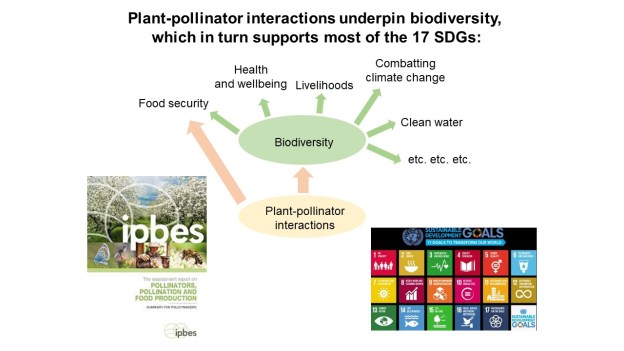
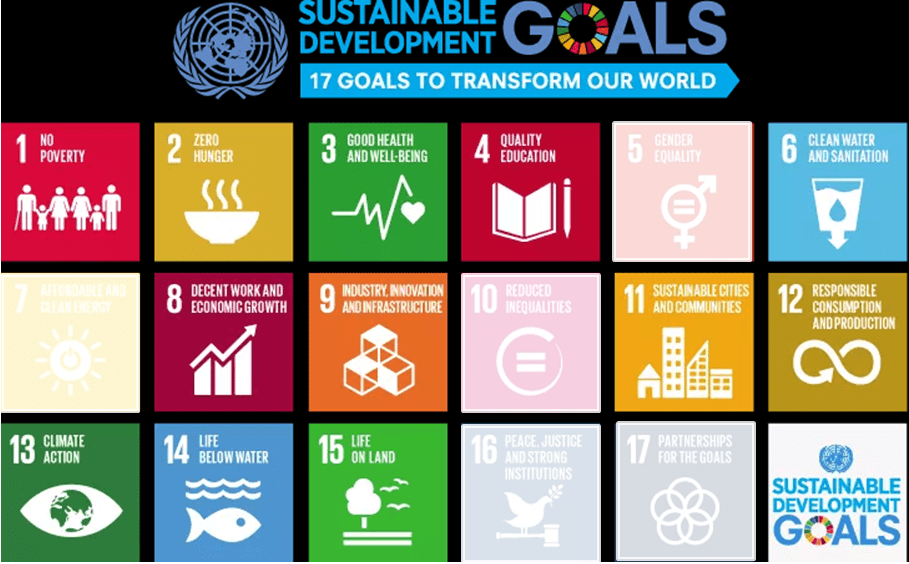
Biodiversity itself underpins, or directly or indirectly links to, most of the 17 SDGS; those that don’t have an obvious link have been faded out in this graphic:

The underpinning role of biodiversity, and in particular plant-pollinator interactions, on the SDGs needs to be stated more often and with greater emphasis than it is currently.

The second way in which I think that some writers and researchers in this area have misconstrued the SDGs is that they seem to think that it only applies to “developing” countries. But that’s certainly not the way that the UN intended them. ALL countries, everywhere, are (or should be) “developing” and trying to become more sustainable. To quote the UN’s SDG website:

“the 17 Sustainable Development Goals (SDGs)….are an urgent call for action by all countries – developed and developing – in a global partnership.”

and

“the SDGs are a call for action by all countries – poor, rich and middle-income – to promote prosperity while protecting the environment.”

I interpret this as meaning that “developed” countries need to consider their own future development, not that they only have to give a helping hand to “developing” countries (though that’s important too). Just to drive this home, here’s a recent case study by Elizabeth Nicholls, Dave Goulson and others that uses Brighton and Hove to show how small-scale urban food production can contribute to the SDGs. I like this because it goes beyond just considering the agricultural and food-related SDGs, and also because by any measure, Brighton and Hove is a fairly affluent part of England.

I’m going to be talking about all of this and discussing it with the audience during an online Cafe Scientifique on Thursday 25th June – details are here. I’m also going to be exploring more of these ideas in my forthcoming book Pollinators & Pollination: Nature and Society, which is due for publication later this year. The manuscript is submitted and is about to be copy-edited. The PowerPoint slide which heads this post uses a graphic from that book that sums up how I feel about biodiversity, plant-pollinator interactions, and the UN’s Sustainable Development Goals.

Sustainability and conservation podcasts: here’s some recommendations

Podcasts are an increasingly popular way of keeping up with recent developments and stories across a diverse range of topics, from music (I’ve been enjoying the David Crosby Freak Flag Flying and Robert Plant Digging Deep series) to serial killers and the machinations of the American big cat-keeping community.  Recently a call went out on the EAUC (Environmental Association for Universities and Colleges) email list for examples of sustainability and conservation podcasts.  The request came from Dr Sandra Lee who leads the Social Impact Team at the University of Leicester and she has kindly allowed me to share the set of podcasts she’s collated.  Feel free to add your own favourite examples in the comments.

Here’s the list that Sandra compiled: with the exception of In Defense of Plants (which I suggested) the accompanying text comes either from Sandra or from the original submissions by EAUC members.  I’ve not listened to all of them so can’t comment on the quality or factual accuracy of the podcasts.

General

  • Outrage and Optimism – very accessible and a great one for keeping up to date with climate policy and the global movement
  • The Sustainability Agenda with Fergal Byrne (he has had some amazing guest right at the top of the sustainability field like Naomi Klien, Jonathan Foley, Paul Hawkins, Caroline Lucas, Rob Hopkins, Kate Raworth, Tim Jackson)
  • Sustainability Defined (Spotify link) – mainly based in the US but there are some great conversations – https://sustainabilitydefined.com/  One university uses this series as the main material for seminar discussions (in this episode University Sustainability with Penn State)
  • Radio 4’s Costing the Earth
  • Mothers of invention: Climate is a man-made problem with feminist solutions with former Irish President Mary Robinson (it’s lighthearted and the co-presenter is a complete novice which makes the information very palatable)
  • Resurgence Voices – this is the Resurgence & Ecologist magazine podcast – (it’s okay not as well done as some others but worth a listen)

More specialist 

  • Vegan Vanguard – run by a Canadian political economist who shares anti-capitalist perspectives on everything from indigenous land rights to geo-engineering, gender-based violence and the alt-right. It’s very useful for learning about the underlying political structures of some of our big sustainability challenges
  • In Defense of Plants – more botanical than about sustainability per se, but plant conservation figures large in some episodes
  • Ways to Change the World with Krishnan Guru-Murthy – not always sustainability explicit but does have some great ideas on how to change the way we think, act and live
  • Making Sense with Sam Harris – looks into controversial questions about the human mind, society and current events
  • Sustainable World Radio – permaculture and ecology-based podcast
  • Next Economy Now: Business as a Force for Good – podcast is about leaders looking into regenerative, bio-regional, democratic, transparent and whole-system approaches
  • Feel Better, Live More – Dr Rangan Chattergee (not sustainability as we know it but absolutely links to Sustainable Development Goal 3)


UPDATE:  Feedspot rank and overview sustainability themed podcasts:

https://blog.feedspot.com/sustainability_podcasts/

(HT Michelle Morley, Environmental Sustainability Manager, Oxford Brookes University)

Should environmentalists be optimistic in a time of uncertainty?

zoogeo-ussr

Over at the Ideas for Sustainability blog Joern Fischer posted a really interesting piece on 1st January called “A new kind of hope” about the current state of the world and whether, from an environmental perspective, there’s really anything to be optimistic about.  If environmental collapse via climate change and over-exploitation is inevitable, the collapse of civilization is not far behind.  Joern’s piece is well worth reading, lots to think about in there, and I highly recommend that you take a look.

I posted a comment there which I’m going to copy here and add to because I think it bears repeating.

Going back to at least my student days I always thought that there was only a slim chance of our civilization making it to the end of the 20th century without some kind of catastrophe wiping us out.   So it was a surprise to celebrate the millennium as December 1999 segued into January 2000. Since then, whilst I think there’s lots to be optimistic about such as the increase in renewable energy, large-scale habitat restoration in some regions, and a growing recognition of the environmental damage of biocides and plastics, there’s also the nagging fear that it’s too little, too late.

These days I alternate between wild optimism and deep depression over the fate of humanity and of the planet. It’s so easy to get sucked into the vortex of negative environmental narratives and ignore the positive ones. Especially so if you actively use social media.  So I try hard to be optimistic and resist the urge to just give up, but the political situation across much of the world makes that difficult. As I learn more about the natural world through my own research and that of others’, and as world events such as Brexit and the rise of the Far Right unfold, I realise how little any of us really know about anything at all. Thus I have a deep suspicion of anyone who spouts certainties, whether they be moral, philosophical, religious, scientific, political, or artistic. All we can do is feel our way into the future, cautiously.

With respect to the question that Joern poses of “If we have to re-build something after some kind of collapse … do we have ideas for what that something will be?”, this is the rationale behind the Dark Mountain Project, a loose collaboration of writers, artists, thinkers, etc., who are trying to look for new narratives for humanity and the planet we depend upon. I’ve written a couple of pieces for their journal, most recently for issue 10 where I discussed the role of poetry in science.  And although I don’t buy into their certainty that there will be a collapse, I think it’s an important project for understanding where we are now, where we’ve been, and where we might be going to.  Here’s a link to the project’s website.

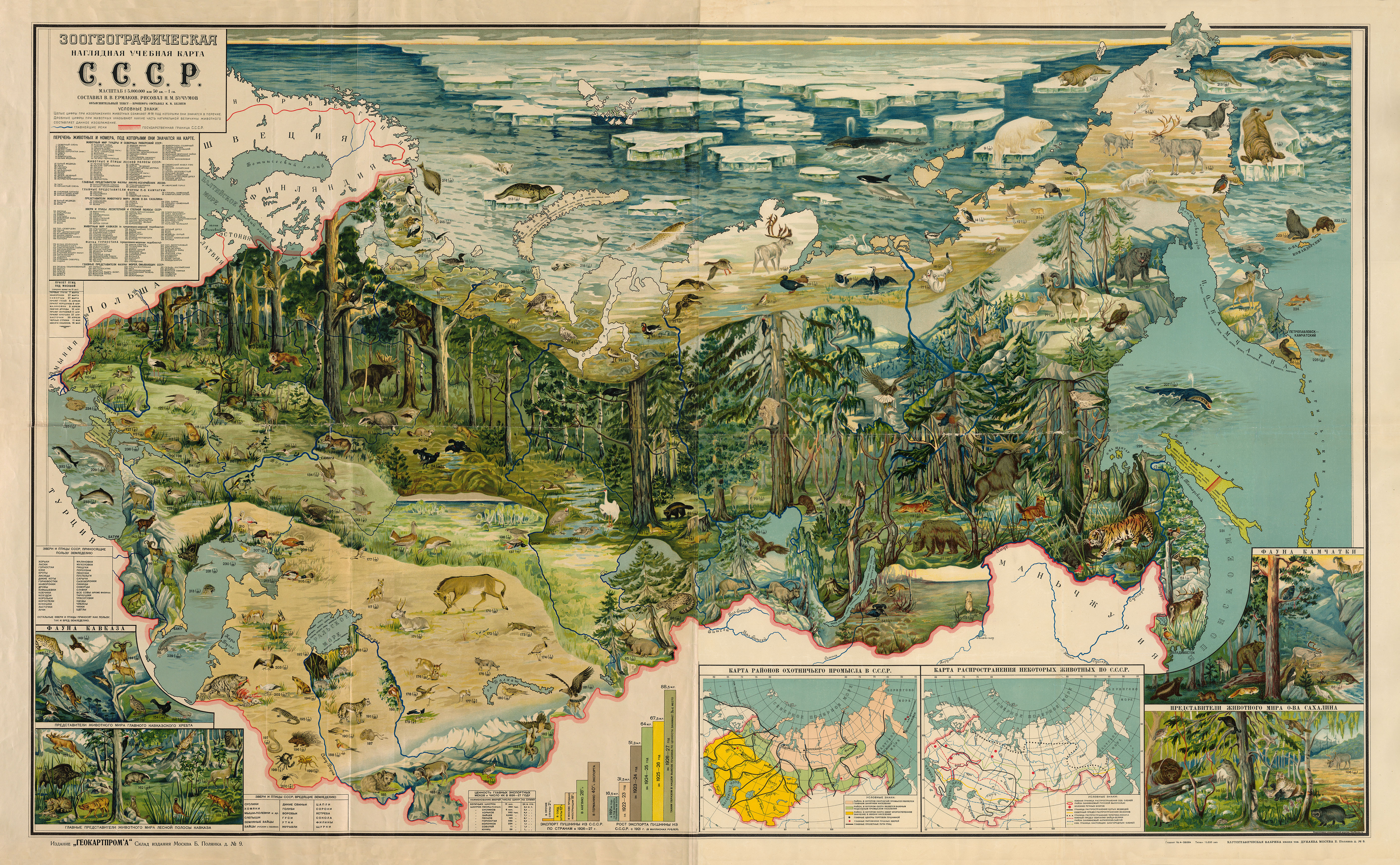
The discussion over whether we should be optimistic about the future of the planet that supports us, and how that optimism will play out, is important for scientists, and society at large, to be having.  By coincidence as I was writing this post the map above started circulating on Twitter.  It’s a Russian teaching aid from 1928 showing the different biomes of the USSR and can be downloaded from this site.

What really struck me about this graphic was the certainty with which it represents the natural world, as if all of this could never change. There are polar bears on ice flows and a frozen tundra in the far north; water still fills the Aral Sea, hyenas feast in the steppe, snow leopards haunt the mountains, Siberian tigers prowl the pine forests.  And an optimistic looking whale heads towards Japan.  Some of this is gone, some will almost certainly change, but a lot of it we could save, if we want to, saving ourselves in the process.

Split the kipper: snowfall thoughts of breakfast, fish and childhood games

Kipper 2018-01-21 10.39.16.png

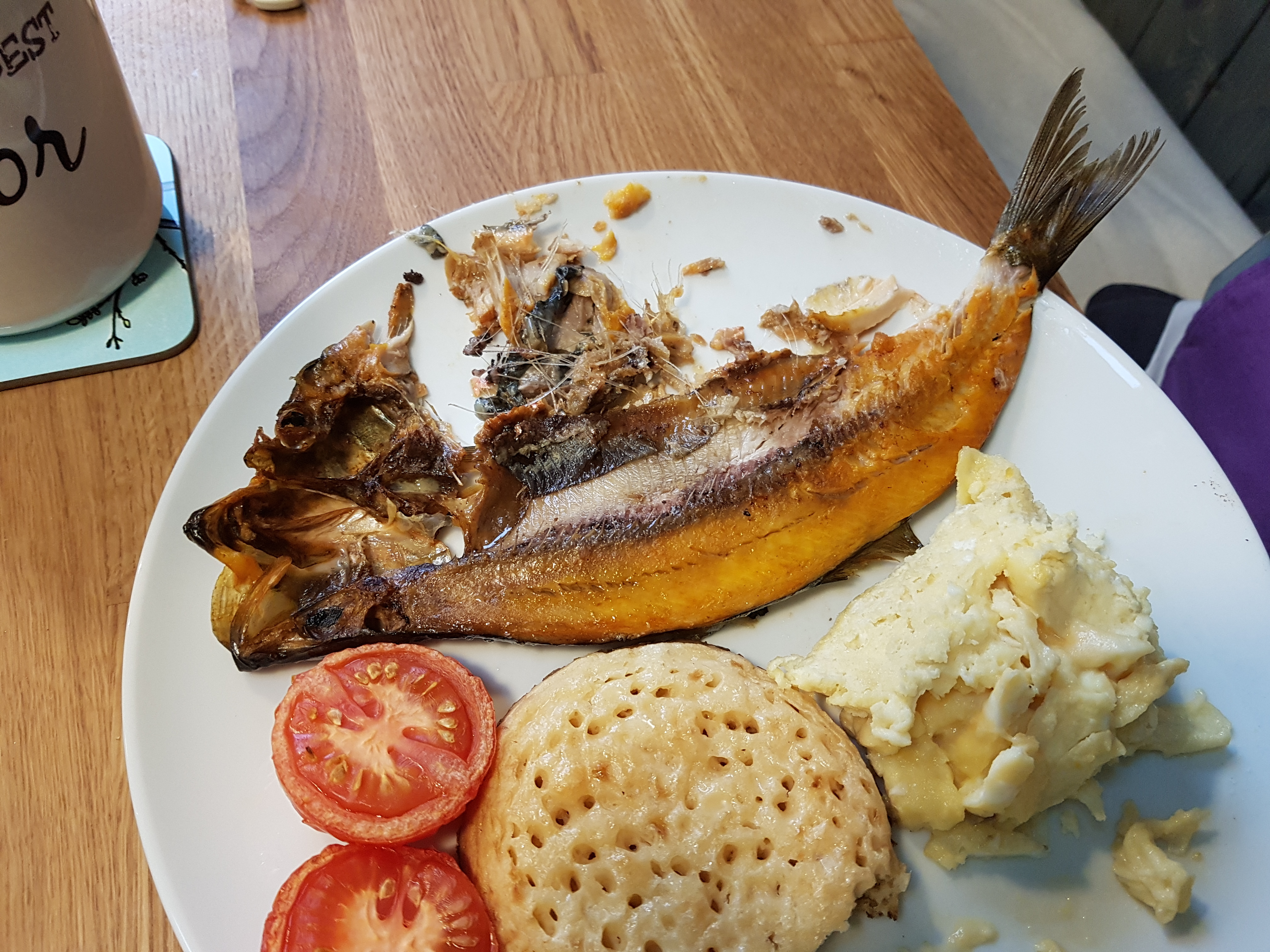
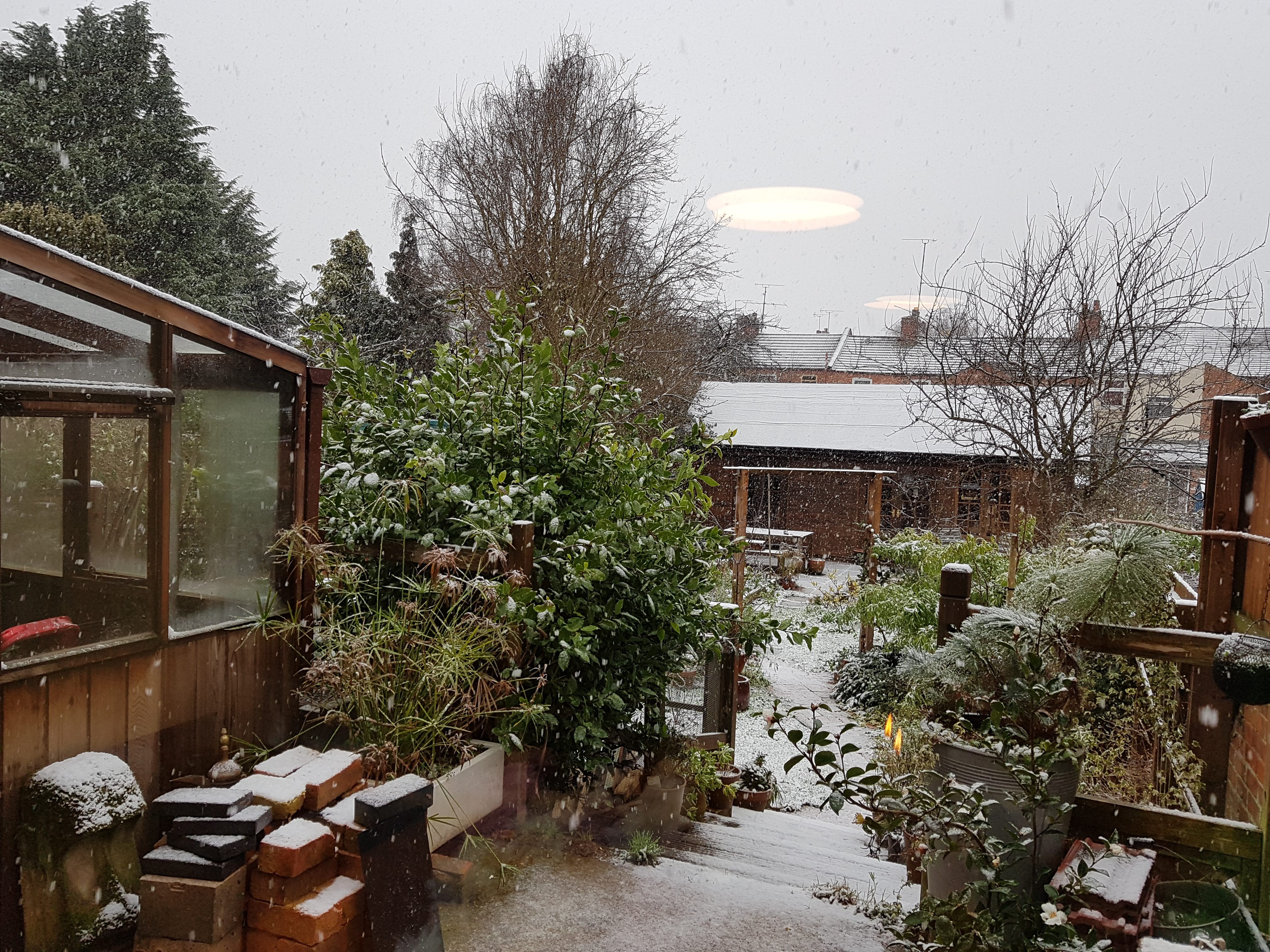
Karin and I had kippers for breakfast this morning, a satisfying and warming treat on this cold Sunday as we watched the snow fall into the garden, softening the edges and hedges:

Snow in the garden 2018-01-21 11.20.48.png

I do like a nice kipper!  Smoking fish to make it last longer has been repeatedly discovered and transmitted as an idea across cultures, and represents a fascinating intersection where wild biodiversity meets human ingenuity.  The north east of England, where I grew up, has a great and ancient tradition of smoking herrings to preserve a portion of the catch, a practice that may have originated with the Vikings who colonised that part of the country over one thousand years ago.

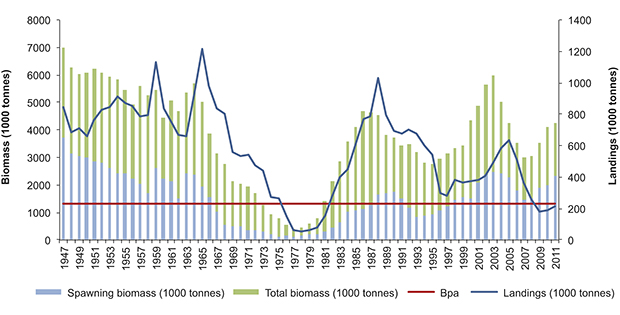
Of all of the North Sea’s edible biodiversity I feel most comfortable eating herring; although there were issues with over-fishing in the 1960s and 70s, current stocks look to be being managed sustainably.  The most up to date information I’ve found is in a Norwegian government report from which I took this graph:

Print

Kippers have had subtle, but interesting, influences on culture, spawning phrases, songs and games. To be “done up like a kipper”* is to be taken advantage of by someone or bamboozled, whilst a “kipper tie” is a fashion hangover from the 60s and 70s, named for its broad proportions.  Of course Supertramp sang about having kippers for breakfast, particularly in Texas “cos everyone’s a millionaire”.  That strikes me as an odd line as herrings (in whatever form) have always been considered a cheap dish. Though I suppose importing them from Craster to Dallas could be quite expensive.

Back to the north east and my childhood, where we played a game called “Split the Kipper”. This involved standing opposite a friend on a grassy field and taking it in turns to throw a knife near to your opponent’s foot.  If it stuck into the ground then your opponent had to slide their foot to that point.  This continued until one of you had your legs so far apart that you fell over – the kipper had been split!  Not the safest game for kids but I never knew anyone to get injured playing it. Like all the best games the point was not just to win but to win beautifully: inching your adversary’s legs apart with accurate knife throws gradually ramped up the tension of the game.  I wonder where the game originated? Is it too fanciful to imagine that it was brought over by the Vikings?

The snow is still falling – wonder what’s for lunch….?


*Whatever you do, don’t search the Urban Dictionary for the definition of the word “kippered”….