Category Archives: Pollination

Tracking trends in Neotropical pollinators: how good is our understanding and is more data always better?

In my recent book Pollinators & Pollination: Nature and Society I discussed the current state of our knowledge of how populations of pollinators have changed over time. Although we have some quite detailed data for particular, often charismatic, species or for certain geographic localities or regions, for most species we know almost nothing. As I wrote in the chapter “The shifting fates of pollinators”:

“For most pollinators we are ‘data deficient’, in other words, we don’t know how their populations are performing. They could be doing well, but they may not be”

This is particularly true for those regions for the world that hold the greatest terrestrial biodiversity: the tropics. For the vast majority of species in the tropics we know precious little about trends in their populations and how their distributions have changed over time in the face of wide-scale land transformation and recent climatic shifts. Filling in some of the gaps in our knowledge of Neotropical pollinator distributions is one of its aims of SURPASS2, a collaboration between South American and UK ecologists, and one of several research and outreach projects with which I’m involved.

In a new study that’s come out of that work, led by Rob Boyd from the UK Centre for Ecology and Hydrology, we’ve used the GBIF database to look at the changing distributions of four important groups of pollinators: bees, hoverflies, leaf-nosed bats and hummingbirds. In particular we were interested in understanding the kinds of biases that come with such publicly available data, and whether recent efforts to add data to GBIF has improved our understanding of trends.

Our overall conclusion is that there are significant limitations and biases inherent in all of these data sets even for groups like hummingbirds which one would imagine are well documented by scientists and bird-watching naturalists. In addition, having more data does not necessarily help matters: it can introduce its own biases.

The paper is open access and feely available; here’s the reference with a link:

Boyd, R. J., Aizen, M.A., Barahona-Segovia, R.M., Flores-Prado, L., Fontúrbel, F.E., Francoy, T.M., Lopez-Aliste, M., Martinez, L., Morales, C.L., Ollerton, J., Pescott, O.L., Powney, G.D., Saraiva, A.M., Schmucki, R., Zattara, E.E., & Carvell, C. (2022) Inferring trends in pollinator distributions across the Neotropics from publicly available data remains challenging despite mobilization efforts. Diversity and Distributions (in press)

Here’s the abstract:

Aim
Aggregated species occurrence data are increasingly accessible through public databases for the analysis of temporal trends in the geographic distributions of species. However, biases in these data present challenges for statistical inference. We assessed potential biases in data available through GBIF on the occurrences of four flower-visiting taxa: bees (Anthophila), hoverflies (Syrphidae), leaf-nosed bats (Phyllostomidae) and hummingbirds (Trochilidae). We also assessed whether and to what extent data mobilization efforts improved our ability to estimate trends in species’ distributions.

Location
The Neotropics.

Methods
We used five data-driven heuristics to screen the data for potential geographic, temporal and taxonomic biases. We began with a continental-scale assessment of the data for all four taxa. We then identified two recent data mobilization efforts (2021) that drastically increased the quantity of records of bees collected in Chile available through GBIF. We compared the dataset before and after the addition of these new records in terms of their biases and estimated trends in species’ distributions.

Results
We found evidence of potential sampling biases for all taxa. The addition of newly-mobilized records of bees in Chile decreased some biases but introduced others. Despite increasing the quantity of data for bees in Chile sixfold, estimates of trends in species’ distributions derived using the postmobilization dataset were broadly similar to what would have been estimated before their introduction, albeit more precise.

Main conclusions
Our results highlight the challenges associated with drawing robust inferences about trends in species’ distributions using publicly available data. Mobilizing historic records will not always enable trend estimation because more data do not necessarily equal less bias. Analysts should carefully assess their data before conducting analyses: this might enable the estimation of more robust trends and help to identify strategies for effective data mobilization. Our study also reinforces the need for targeted monitoring of pollinators worldwide.

——————————————————–

SURPASS2 has been a hugely productive project as you’ll see if you look at the Publications page of the website. There’s much more to come and I’ll report on those research papers as they appear.

Watch my recent interview on Earth To Be

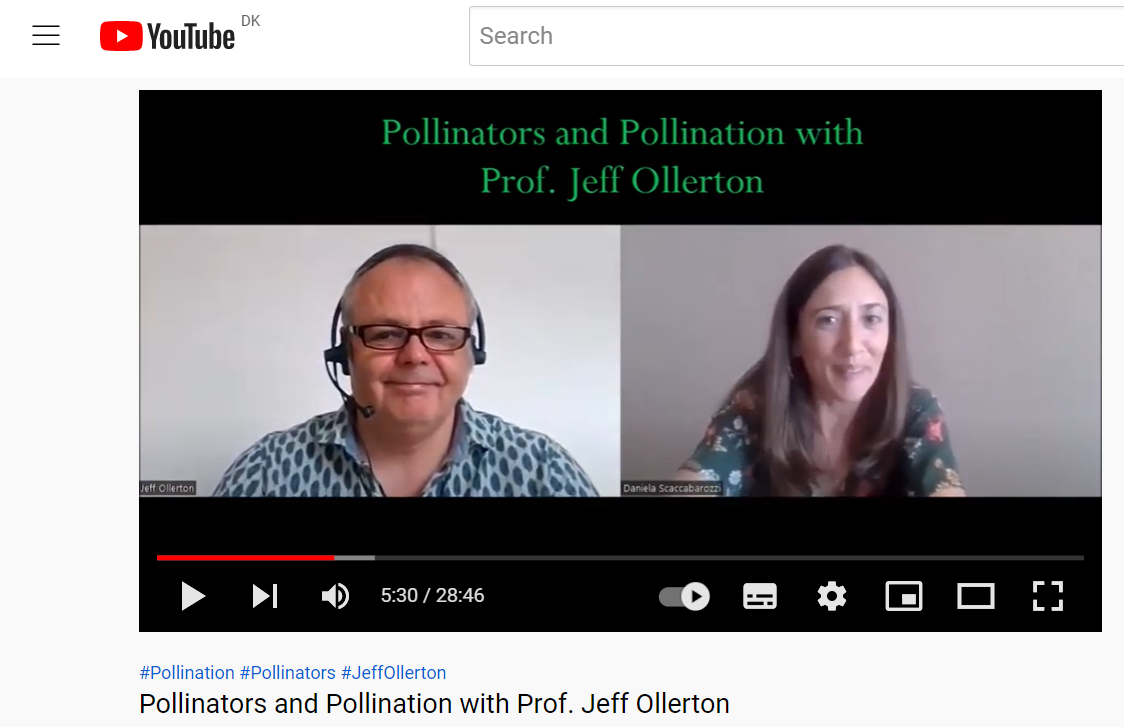
Recently I enjoyed chatting with Dr Daniela Scaccabarozzi for the YouTube channel that she runs called Earth To Be. In a wide ranging interview we discussed my recent book, how it came about, some of the things that intrigued me during its research (including a cockroach-pollinated flower!), and the role of people and pollinators in the wider ecosystem. Thanks to Daniela for the invitation to chat! Here’s the link to the interview.

What are the best books about bees and other pollinators?

Clearly that’s a very subjective question and everyone has their own view on which books about a particular subject they would recommend! So coming up with a list of just five for the Shepherd book recommendation site was not easy. My list features authors such as Brenda Z. Guiberson, Megan Lloyd, Steven Falk, Dave Goulson, Mike Shanahan and Stephen L. Buchmann, which will hopefully inspire you to read some of these books.

Here’s the link: https://shepherd.com/best-books/bees-and-other-pollinators

If you think that I’ve missed your favourite from the list, please do comment below. And if you’re an author, consider signing up for Shepherd and curating your own list, they’ve been really helpful and it’s a useful service for readers and authors.

A new study shows that even short-tubed flowers can specialise on hawkmoths as pollinators

Of all of the “classical” pollination syndromes, flowers that are hawkmoth pollinated have one of the highest levels of predictability. If a flower is pale in colour, opens at night, is highly scented, and possesses a long tube at the bottom of which is a supply of nectar, there’s a very high likelihood that it’s pollinated by long-tongued hawkmoths (Sphingidae).

Indeed, one of the foundational stories about the development of our understanding of how pollination systems evolve, relates to Charles Darwin, the long-tubed orchid Angraecum sesquipedale and the hawkmoth Xanthopan morganii praedicta.

Fast forward 160 years and we now know that pollination syndromes are more complex than 19th and early 20th century scientists imagined – see my recent book Pollinators & Pollination: Nature and Society for a discussion of this topic. That’s not surprising because, as I point out, we probably have data on the interactions between plants and their pollinators for only about 10% of the estimated 352,000 species of flowering plants. There’s still much to be discovered!

As an example of how our understanding of specialised flower-hawkmoth interactions is developing, consider this recent study that I’ve just published with my Brazilian colleague Felipe Amorim and other collaborators. In it we have shown that, contrary to expectations, a species of Apocynaceae (Schubertia grandiflora) with a relatively short floral tube can specialise on hawkmoths with much longer tongues than we might predict.

The full reference with a link to the study is shown below, followed by the abstract. If you would like a PDF, please drop me a line via my Contact page:

Amorim, F.W., Marin, S., Sanz-Viega, P.A., Ollerton, J. & Oliveira, P.E. (2022) Short flowers for long tongues: functional specialization in a nocturnal pollination network of an asclepiad in long-tongued hawkmoths. Biotropica https://doi.org/10.1111/btp.13090

Abstract:

Since Darwin, very long and narrow floral tubes have been known to represent the main floral morphological feature for specialized long-tongued hawkmoth pollination. However, specialization may be driven by other contrivances instead of floral tube morphology. Asclepiads are plants with a complex floral morphology where primary hawkmoth pollination had never been described. We detailed here the intricate pollination mechanism of the South American asclepiad Schubertia grandiflora, where functional specialization on long-tongued hawkmoth pollinators occurs despite the short floral tube of this species. We studied two plant populations in the Brazilian Cerrado and recorded floral visitors using different approaches, such as light-trapped hawkmoths for pollen analysis, direct field observations, and IR motion-activated cameras. Finally, using a community-level approach we applied an ecological network analysis to identify the realized pollinator niche of S. grandiflora among the available niches in the pollinator community. Throughout a period of 17 years, long-tongued hawkmoths were consistently recorded as the main floral visitors and the only effective pollinators of S. grandiflora. Flowers rely on highly modified corona and gynostegium, and enlarged nectar chambers, to drive visitors and pollination mechanism. Despite its relative short-tube, network analysis placed S. grandiflora in the module including exclusively long-tongued hawkmoth pollinators and the most phenotypically specialized sphingophilous plants in the community. These results represent the first example of functional specialization in long-tongued hawkmoths in an asclepiad species. However, this specialization is uncoupled from the long floral tubes historically associated with the sphingophily syndrome.

The coltsfoot is flowering! But why is it so different to dandelion?

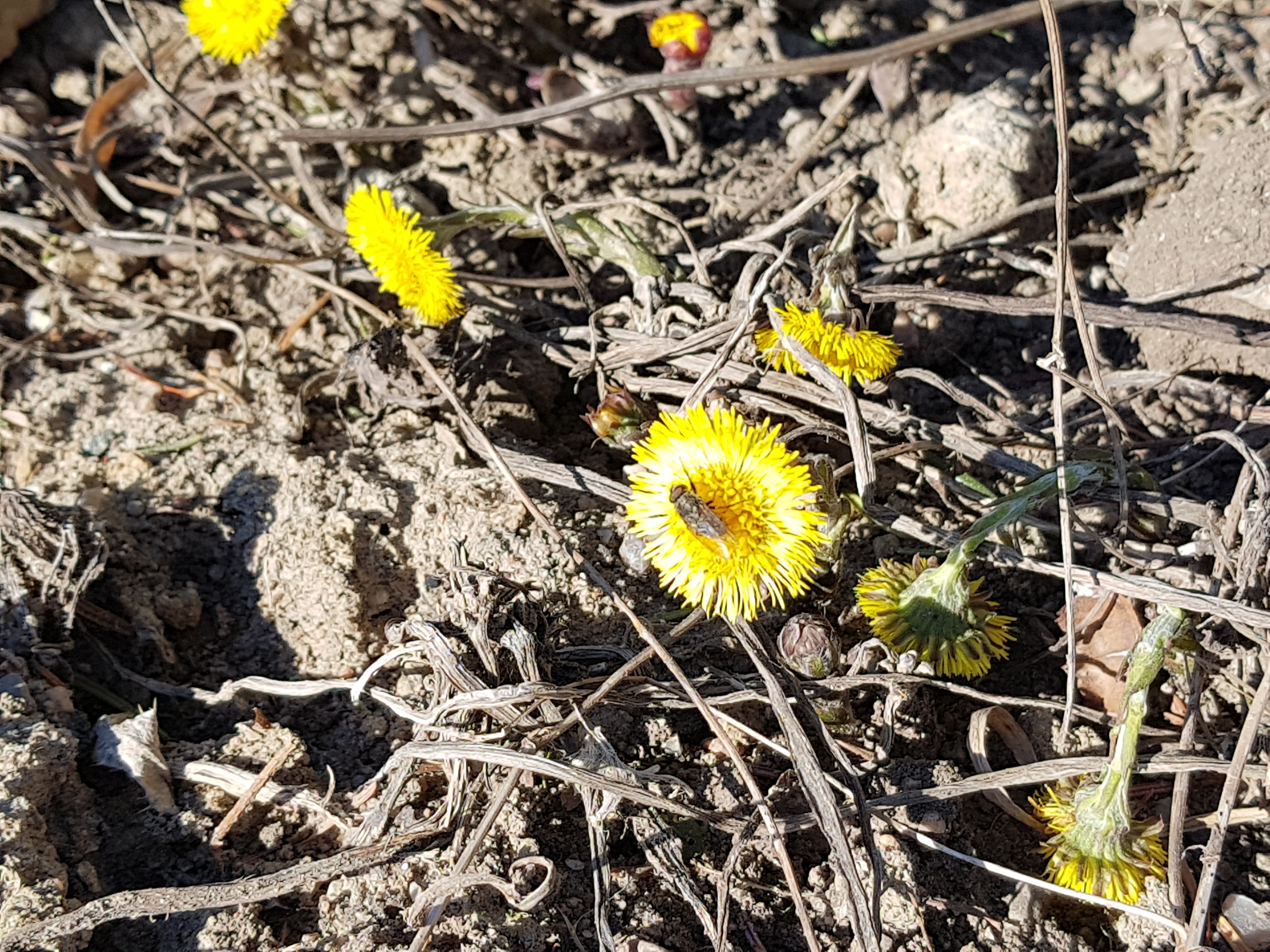
Yesterday Karin and I took to our bikes and rode south through some very nice, managed beech and oak woodland that runs parallel to the Isefjorden in this part of Odsherred. In was cold but sunny, birds were singing, and we saw the occasional insect on the wing. The kind of day that reminds you that spring is coming fast. On the way back we paused at a small housing development near the former psychiatric hospital at Annebergparken. In an area of disturbed ground I was delighted to see a patch of coltsfoot (Tussilago farfara) in full flower, the dandelion-like inflorescences a beacon to passing bees and flies.

Although it resembles a small dandelion, and belongs to the same family (Asteraceae), Tussilago is only distantly related to Taraxacum. Coltsfoot is really a type of groundsel (tribe Senecioneae) whereas dandelions are related to chicory (tribe Cichorieae).

Coltsfoot is unusual in that it produces its flowering stems long before the leaves that give it its common name, the plant’s reproduction powered by the energy that it stored up the previous year. Dandelions, like most herbaceous plants, produce their leaves first, then flower. That’s not the only difference to dandelions though.

The Database of Pollinator Interactions (DoPI) lists 9 species of insect that have been recorded as visiting coltsfoot for nectar and/or pollen. In contrast, the entry for Taraxacum officinale lists more than130 species as flower visitors. I thought initially that it might be due simply to under-recording, but this study of coltsfoot in Germany only recorded 16 insect species. So the greater attractiveness of dandelion is likely to be real. Why the big difference in pollinators?

One reason for it could be that dandelions have a very different flowering strategy; they can be in flower 12 months of the year, depending on local weather conditions, with a reproductive peak in May or June. They therefore have the opportunity to interact with many more insects than coltsfoot, which in contrast you generally only see in flower between March and May at the very latest.

Dandelions are also much more abundant than coltsfoot which is no doubt also a big factor in determining how often insects are observed on the flower heads. It’s not unusual to see whole fields full of dandelions in flower but I’ve never seen coltsfoot do that, perhaps because they prefer to grow on rather disturbed ground.

There may be some other factors at play here that I’m not aware of, for example a lower rate of nectar production in coltsfoot. Having said that, the fact that dandelions produce any nectar at all is a real conundrum. All of the literature claims that Taraxacum officinale is “apomictic“, a plant reproductive strategy in which seeds are produced without requiring ovules to be fertilised by pollen. In fact the online Ecological Flora of Britain and Ireland entry for dandelions lists the pollen vector as “none” for that very reason. But I’m sure that the real story is more complicated, otherwise why would these plants invest so much of their energy and resources in attracting and rewarding flower visitors? I’ve not delved deeply into the Taraxacum literature so perhaps one of my readers knows?

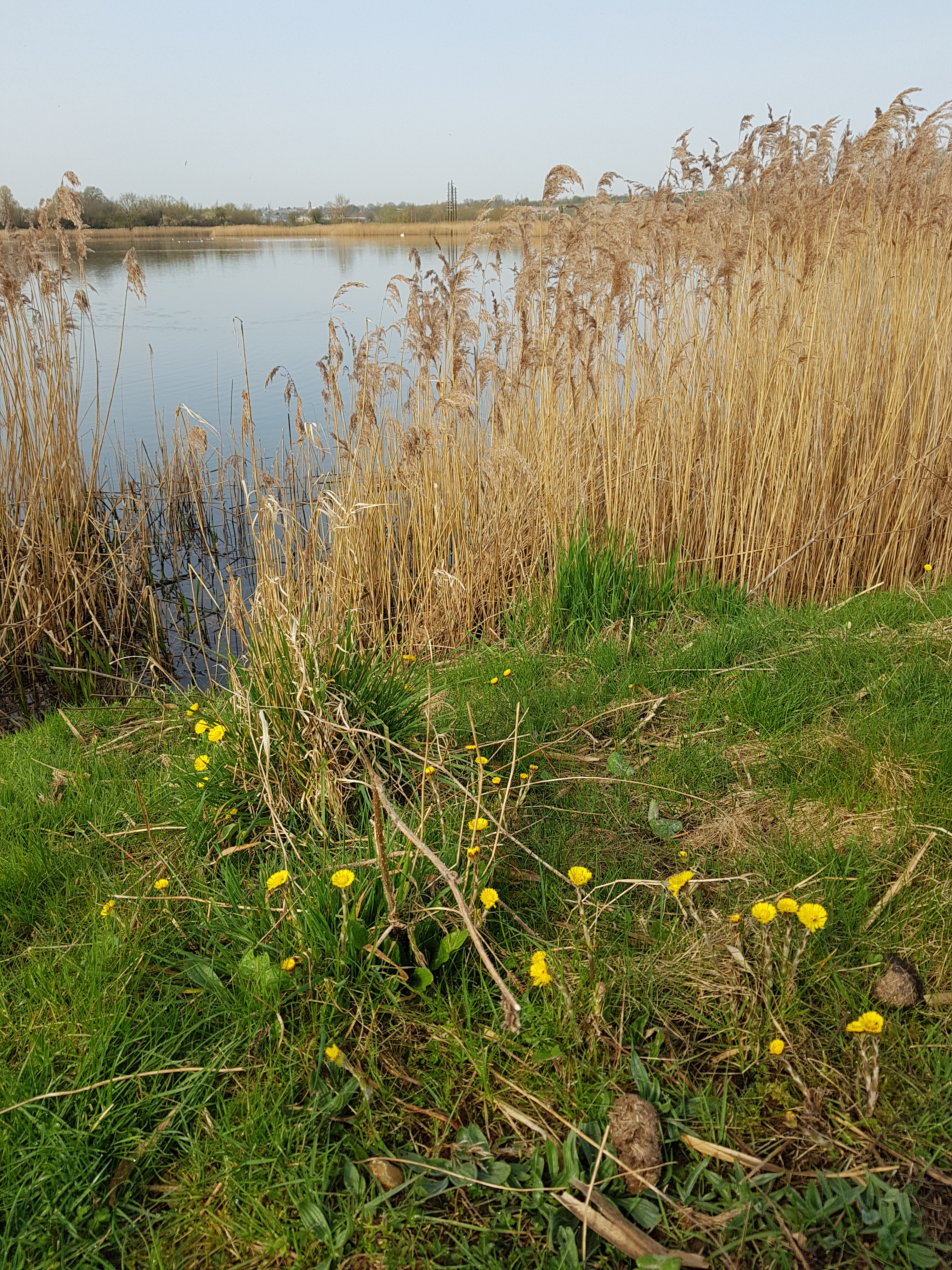
Our encounter with coltsfoot reminded me of the work that I did last year with the Stanwick Lakes nature reserve in Northamptonshire, advising on how best to enhance and manage the site (which is primarily a bird reserve) for pollinators. One of my recommendations was that they enlist their volunteers to collect seeds and root or stem cuttings from the small, isolated populations of early-flowering plants such as coltsfoot (pictured on the reserve below) and introduce them around the site in suitable spots. This would both increase the availability of nectar and pollen for the first flower visitors of spring, and also the ecological connectivity between different parts of the site as the pollinators are able to move around more effectively. So I was delighted to see this post on LinkedIn from Liz Williams who works at Stanwick, demonstrating that they have taken my advice on board and begun the hard work of planting for pollinators.

My work with Stanwick was an example of the advisory and consulting services that I offer. If you’d like some advice on how to improve an area for pollinators, or for biodiversity more broadly, please do get in touch via my Contact page.

Practical methods for assessing insect pollination services provided by sites – download our new study for free

In September 2016, along with 11 other pollinator & pollination scientists, I took part in a two-day two-day workshop held at the UNEP-World Conservation Monitoring Centre in Cambridge. The aim was to develop a range of simple, practical methods to enable the valuation of insect pollination services to agricultural crops that are provided by a nature reserves or other natural or semi-natural habitats, for TESSA – the Toolkit for Ecosystem Service Site-Based Assessments.

After a long gestation, caused not least by the COVID-19 pandemic, the paper outlining the methods that we developed has been published. It’s open-access and downloadable for free. Here’s the full reference with a link to the paper:

Ratto, F., Breeze, T. D., Cole, L. J., Garratt, M. P. D., Kleijn, D., Kunin, B., Michez, D., O’Connor, R., Ollerton, J., Paxton, R. J., Poppy, G. M., Potts, S. G., Senapathi, D., Shaw, R., Dicks, L. V., & Peh, K. S.-H. (2022) Rapid assessment of insect pollination services to inform decision-making. Conservation Biology 1–13

And here’s the Abstract:

Pollinator declines have prompted efforts to assess how land-use change affects insect pollinators and pollination services in agricultural landscapes. Yet many tools to measure insect pollination services require substantial landscape-scale data and technical expertise. In expert workshops, 3 straightforward methods (desk-based method, field survey, and empirical manipulation with exclusion experiments) for rapid insect pollination assessment at site scale were developed to provide an adaptable framework that is accessible to non-specialist with limited resources. These methods were designed for TESSA (Toolkit for Ecosystem Service Site-Based Assessment) and allow comparative assessment of pollination services at a site of conservation interest and in its most plausible alternative state (e.g., converted to agricultural land). We applied the methods at a nature reserve in the United Kingdom to estimate the value of insect pollination services provided by the reserve. The economic value of pollination services provided by the reserve ranged from US$6163 to US$11,546/year. The conversion of the reserve to arable land would provide no insect pollination services and a net annual benefit from insect-pollinated crop production of approximately $1542/year (US$24∙ha–1∙year–1). The methods had wide applicability and were readily adapted to different insect-pollinated crops: rape (Brassica napus) and beans (Vicia faba) crops. All methods were rapidly employed under a low budget. The relatively less robust methods that required fewer resources yielded higher estimates of annual insect pollination benefit.

Join me on Thursday for a free talk!

Join me this Thursday at a free online talk organised by Buglife where I’ll be giving an introduction to how flowers function and the ways in which their behaviour manipulates pollinators to ensure reproduction. I’ll be covering:

  • What are flowers and where did they come from?
  • How flowers function and reward pollinators.
  • Some case studies from my own research on flower and pollinator behaviour.
  • Why is it important that we understand floral biology?

Here’s the link to register for the event: https://www.buglife.org.uk/events/to-be-a-flower-with-professor-jeff-ollerton/

I look forward to seeing you there!

Listen to an interview with me on the Environmental Professional’s Radio podcast!

text and logo over a background picture of a person posing for the camera

I was recently invited to chat about careers and writing and pollinators and pollination with the folks from National Association of Environmental Professionals for their Environmental Professional’s Radio podcast. You can listen to it here:

https://www.environmentalprofessionalsradio.com/

We covered a lot of ground and it was great fun – thanks for having me!

Leonard B. Thien (1938-2021) – botanist and pollination biologist

I was saddened to learn recently of the death of Professor Leonard B. Thien of Tulane University who passed away at the end of October after a long illness. Although I didn’t know Professor Thien personally, I knew of his work in floral ecology, pollination biology and plant evolution, topics on which he had worked for since obtaining his PhD in 1968. Over the course of his career he published more than 80 articles on a huge range of botanical subjects, including ground-breaking work on mosquito pollination of orchids (Thien 1969). The orchid species Alaticaulia thienii is named in his honour.

The studies Leonard Thien published that really inspired me when I was first starting out on my journey as a researcher, however, involved his work on “relictual” angiosperms, i.e. flowering plants that have very long evolutionary histories and deep phylogenetic roots back to the early Cretaceous period, for example Magnolia and Illicium. Papers with titles such as “Patterns of pollination in the primitive angiosperms” (Thien 1980) piqued my interest and motivated me to work on Australian Piperaceae for a short while following my PhD (Ollerton 1996). It was a topic that I struggled to gain further funding for, and later molecular systematic studies changed many of our ideas about what constitutes the most basal groups of extant flowering plants. But nonetheless, the questions that Leonard inspired in me, regarding the ecologies of these relictual taxa, and whether we can infer the reproductive ecology of the earliest flowering plants from studies of their surviving descendants, are ones that intrigue me to this day (van der Kooi and Ollerton 2020).

Leonard Thien kept up this interest even as new DNA technologies over turned old ideas, and he was the first to study the reproductive ecology of Amborella trichopoda on New Caledonia, a species now considered to be the earliest surviving clade of flowering plants (Thien et al. 2003). This is just one part of a legacy of work that current and future generations will build upon as we develop our understanding of the relationships between pollinators, plants, and evolutionary processes.

I’m grateful to Peter Bernhardt for prompting this post and for sending me a copy of the In Memoriam article that he and and David White will publish in the Plant Sciences Newsletter in March, and to Lorraine Thien for providing the photograph that accompanies this post.

References

Ollerton, J. (1996) Interactions between gall midges (Diptera: Cecidomyiidae) and inflorescences of Piper novae-hollandiae (Piperaceae) in Australia. The Entomologist 115: 181-184

Thien, L.B. 1969. Mosquito pollination of Habenaria obtusata (Orchidaceae). American Journal of Botany 56: 232-237.

Thien, L.B. 1980. Patterns of pollination in the primitive angiosperms. Biotropica 12: 1-14

Thien, L.B., Sage, T.L., Jaffre, T., Bernhardt, P., Pontieri, V., Wesston, P.H., Malloch, D., Azuma, H., Graham, S.W., McPherson, M.A., Hardeep, S.., Sage, R.S. & Dupre, J.-L. 2003. The population structure and floral biology of Amborella trichopoda (Amborellaceae). Annals of the Missouri Botanical Garden 90: 466-490

van der Kooi, C.J. & Ollerton, J. (2020) The origins of flowering plants and pollinators. Science 368: 1306-1308

Heterospecific pollen deposition is positively associated with reproductive success in a diverse hummingbird-pollinated plant community: a new study just published

Plants which live in diverse communities with other species may often share pollinators, which means that their stigmas can receive the pollen from different types of plants as well from individuals of their own species. This “heterospecific” pollen deposition may have consequences for plant reproduction if it clogs up the stigmas and prevents “conspecific” pollen from gaining a foothold. However there’s still relatively little published on this phenomenon and its impact on reproduction, particularly in highly diverse tropical communities across different seasons. In a new study just published in the journal Oikos and led by Sabrina Aparecida Lopes, we have shown that in a Brazilian hummingbird-flower community heterospecific pollen deposition (HPD) shows seasonal patterns. Contrary to expectations, we also found a positive relationship between HPD and reproductive success, which by coincidence has also been shown this month for a high-Andean plant community in this paper just published by Sabrina Gavini and colleagues.

Here’s the full reference and the abstract for our Oikos paper:

Lopes, S.A, Bergamo, P.J, Queiroz, S.N.P., Ollerton, J., Santos, T. & Rech, A.R. (2021) Heterospecific pollen deposition is positively associated with reproductive success in a diverse hummingbird-pollinated plant community. Oikos (in press)

Heterospecific pollen deposition (HPD) is ubiquitous across plant communities, especially for generalized species which use a diversity of pollinators, and may have negative effects on plant reproduction. However, it is unclear whether temporal changes in the co-flowering community result in changes in HPD patterns. Moreover, community-level studies are required to understand which factors influence HPD and how the reproduction of different species is affected. We investigated the temporal variation of HPD, its relationship with level of specialization on pollinators and floral phenotypic specialization, and its association with reproductive success (pollen limitation and fruit set) in 31 hummingbird-pollinated plant species in a tropical Campo Rupestre. We found seasonality in HPD, with species flowering in the dry season having greater diversity of heterospecific pollen on stigmas and a higher frequency of stigmas containing heterospecific pollen, compared to the rainy season. Stigmas of ecologically generalized species had more heterospecific pollen, while the relationship for ecologically specialized species depended on floral phenotype. Surprisingly, and in contrast to theory, we found a positive relationship between HPD and reproductive success. Our results indicate benefits of generalization and facilitation, in which sharing pollinators brings greater reproductive success via increased conspecific pollen deposition, even if it incurs more HPD. We demonstrated how assessing HPD at a community-level can contribute to understanding the ecological causes and functional consequences of pollinator sharing.

If you’d like a PDF, please use the Contact page to request one.