Category Archives: Pollination

For World Bee Day – an extract from my forthcoming book – UPDATED

Image

UPDATE: turns out the figure I cited for number of bee species is out of date so I’ve corrected it below. Thanks to John Ascher for pointing this out.

Publication of my book Pollinators & Pollination: Nature and Society by Pelagic Publishing has been pushed back until the end of this year or early in 2021. The current pandemic has created problems for the printing and distribution sectors, as it has for so many industries. Therefore, to celebrate World Bee Day, here’s a preview of the bee section from Chapter 2 which is entitled (ironically enough) “More than just bees – the diversity of pollinators”.

2.3 Bees, wasps and sawflies (Hymenoptera)

The bees and their relatives rank only third in terms of overall pollinator diversity.  Within this taxonomic Order, bees are not especially species rich (17,000 or so described species, perhaps 20,000 in total) – over 20,400 (see: https://www.catalogueoflife.org/col/details/database/id/67) compared with the other 50,000 social and solitary wasps, sawflies, and so forth. But what they lack in diversity the bees make up for in importance as pollinators of both wild and agricultural plants, and in their cultural significance.  The general notion of what a bee is, and how it behaves, looks to the honeybee (Apis mellifera) as a model: social, with a hierarchy, a queen, and a large nest (termed a hive for colonies in captivity).  In fact, this view of bee-ness, though long embedded within our psyche, is far removed from the biology of the average bee: most of them have no social structure at all, and a fair proportion of those are parasitic.  In Britain we have about 270 species of bees, give or take (Falk 2015) though there have been extinctions and additions to this fauna (see Chapters 10 and 11).  These species provide a reasonable sample of the different lifestyles adopted by bees globally.  They can be divided into four broad groups.

Honeybees include several highly social species and subspecies of Apis, of which the ubiquitous western honeybee (A. mellifera) is the most familiar.  Most colonies are found in managed hives, though persistent feral colonies can be found in hollow trees, wall cavities, and other suitable spaces.  They are widely introduced into parts of the world where they are not native (e.g. the Americas, Australia, New Zealand) and there is some debate as to whether they are truly native to Britain and northern Europe, with supporting evidence and arguments on both sides.  Colonies can be enormous and contain thousands of individuals, mostly female workers, with a single queen.  Unmated queens and males (drones) are produced by the colony later in the season.

Bumblebees (Bombus spp.) are typically also social, though their nests are much smaller (tens to hundreds of individuals).  Depending upon the species these nests can be in long grass, rodent holes, or cavities in buildings and trees.  Twenty-seven of the more than 250 species have been recorded in the UK, but six of these are not strictly social; they are parasitic and belong to the subgenus Psithyrus which will be described below.

The so-called solitary bees are by far the largest group in Britain (about 170 species) and worldwide (more than 90% of all species).  In the UK they belong to 15 genera, including Andrena, Anthophora, Osmia, Megachile, etc.  The females of most of these bees, once they have mated, construct nests that they alone provision with pollen for their developing young.  Nesting sites can be genus- or species-specific, and include soil, cavities in stone or wood, and snail shells.  Some species are not strictly solitary at all and may produce colonies with varying levels of social structure, though without a queen or a strict caste system; we term them “primitively eusocial”.  In fact sociality has evolved and been lost numerous times in the bees and in the rest of the Hymenoptera (Danforth 2002, Hughes et al. 2008, Danforth et al. 2019).  It’s also been lost in some groups that have reverted back to a solitary lifestyle, and even within a single genus it can vary; for example in the carpenter bee genus Ceratina (Apidae: Xylocopinae) tropical species are more often social than temperate species (Groom & Rehan 2018).

The final group is termed the cuckoo bees and, like their avian namesake, they parasitise the nests of both social and solitary bees (though never, interestingly, honeybees).  There are about 70 species in 7 genera, including the bumblebee subgenus, Psithyrus.  Other genera include Melecta, Nomada and Sphecodes.  In some cases the parasitic species are closely related evolutionarily to their hosts and may resemble them, for example some Psithyrus species.  In other cases they may be only distantly related and in fact look more like wasps, e.g. Nomada species.  Some genera of cuckoo bees are restricted to parasitising only a single genus of bees, others are parasites of a range of genera (Figure 2.4).

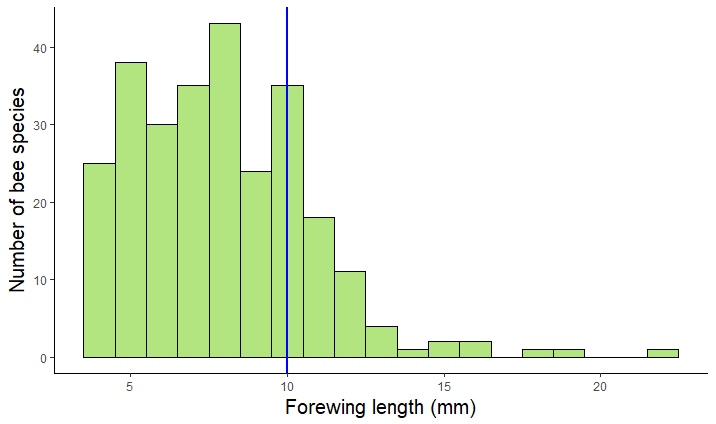
Although we often think of bees, overall, as being the most important pollinators, in fact species vary hugely in their importance.  Pollinating ability depends upon factors such as abundance, hairiness, behaviour, body size, and visitation rate to flowers (Figure 2.1).  Size is especially important for three reasons.  First of all, larger animals can pick up more pollen on their bodies, all other things being equal.  Secondly, in order to bridge the gap between picking up pollen and depositing it, flower visitors must be at least as large as the distance between anthers and stigma, unless they visit the stigma for other reasons.  Finally, larger bee species tend to forage over longer distances on average (Greenleaf et al. 2007) thus increasing the movement of pollen between plants.  However, most of the world’s bees are relatively small as we can see from the analysis of British bees in Figure 2.5.  Many species have a maximum forewing length of only 4 or 5 mm, and the majority of species are smaller than honeybees.  Remember also that these are maximum sizes measured from a sample; individual bees can vary a lot within populations and even (in the case of Bombus spp.) within nests (Goulson et al. 2002).  So the assumption that all bees are good pollinators needs to be tempered by an acknowledgement that some are much better than others.    


Figure 2.5: The sizes of British bees. Forewing length is a good measure of overall body size and the data are maximum lengths recorded for species, except for the social bumblebees and honeybee I have used maximum size of workers (queens are often much larger). The blue line indicates the honeybee (Apis mellifera). The biggest bee in this data set is the Violet Carpenter Bee (Xylocopa violacea) which, whilst not generally considered a native species (yet), has bred in Britain in the past. Data taken from Falk (2015).

Garden plant-pollinator surveys: progress so far

The network of pollination ecologists and insect specialists who have confirmed that they are surveying plant-pollinator networks in their gardens now stands at 50. As the map above shows, most are in the UK, Ireland and mainland Europe, but the Americas are also becoming well represented, we have a couple of people surveying in North Africa, and three in Australia. An x-y plot of the coordinates of the gardens shows the spread a little better:

Some people have started to send me data already, which is great; if you’re surveying and haven’t let me know your latitude and longitude, please do so, preferably decimalised – you can convert degrees/minutes/seconds to decimal here: https://www.latlong.net/degrees-minutes-seconds-to-decimal-degrees

I’ve managed 13 formal 15 minute surveys so far, plus have a few ad hoc observations that I am keeping separate, and I will be continuing my data collection for the foreseeable future. I’ve started playing with the data as you can see below. This is a plot made using the bipartite package in R, with plants to the left and pollinators to the right. The size of the bars is proportional to the number of pollinators/plants a taxon connects to. In the plants you can immediately see the dominance of apple (Malus domestica) and greengage (Prunus domestica), which attract a wide variety of insects to their flowers. Of the pollinators, the hairy-footed flower bee (Anthophora plumipes) and dark-edged beefly (Bombylius major) are especially common and generalist in their flower visits. It will be really interesting to see how this changes over the season, and how our fruit and vegetables are connected into the wider network via pollinators that they share with the ornamental and native plants.

If you are experienced at surveying pollinators and want to get involved, follow that first link and check out the protocol and FAQs, and please do email me: jeff.ollerton [at] northampton.ac.uk

The other pollinators: some recent videos that don’t focus on bees

The review of the biodiversity of pollinators that I published in 2017 estimated that on average about 18% of animal-pollinated plants within natural communities are specialised on bees. Bees also contribute to the reproduction of many of the plants that have generalist pollination systems, which account for perhaps 50% of plant species on average. But that stills leaves a significant fraction (maybe one third) that are specialised on the “other” pollinators, including flies, beetles, birds, bats, and so forth. There is growing awareness of how important these pollinators are for wild plant and crop pollination, but bees still hog most of the pollinator-related media.

In the last couple of weeks I’ve been sent links to videos that focus on these other pollinators so I thought I’d compile a list that show us something of the true diversity of animals that act as pollen vectors. Please add your own suggestions in the comments:

Elephant shrews, lizards, cockroaches*, crustaceans, and biting midges are covered in this SciShow video (HT Steve Hawkins)

Opossum pollination of a Brazilian plant is featured in this video (HT Felipe Amorim)

Here’s a recorded webinar on bird pollination by Dan Scheiman from Audubon Arkansas

A few videos on bat pollination by Jim Wolfe can be found here and here and here, and this is a short one that’s a supplement to a recent Journal of Applied Ecology paper on cactus pollination by Constance J. Tremlett et al.

The fascinating ecology of skunk cabbage (Symplocarpus foetidus), including fly and possibly beetle pollination, is the topic of this video.

Fly pollination is also highlighted in this short piece by the Natural History Museum, and this one deals with drone flies as managed pollinators for agriculture in New Zealand.

Enjoy!

*Watch out for my report on a newly discovered cockroach-pollinated plant….hopefully coming later this year…..

Pollination ecologists in gardens: protocol and links to other initiatives – UPDATE NUMBER 2

Andrena bicolor

UPDATE: Following conversations with a couple of the participants of the garden surveys, we’ve changed the protocol slightly to make Survey type A more quantitative and to take into account when we get large numbers of individuals all visiting the same plant at the same time – it’s crazy to have a single line for each individual.  Details are in the new spreadsheet which you can down load from here: Ollerton garden surveys 2020

The additions should be self explanatory.  If you are not able to go back to retro-fit the additional data, that’s fine, just use the new spreadsheet format for future surveys: all data are going to be useful!

In the present format the data will be useful for modelling using GLMMs etc., in order to test predictions about which plants, and in which contexts, support the most pollinators.  The data format will need tweaking slightly to make it analysable in bipartite, but that should be fairly straightforward.

If you are taking part in the surveys it would be really useful if you could email me your latitude and longitude as I’d like to start creating a map of where the surveys are happening.

Any questions, send me an email or ask in the comments.


Following up from my last post about ecologists using their gardens to collect standardised data, I’ve had a huge response from pollination ecologists all over the world wanting to get involved.  So to streamline the process I thought that I would put the protocol and updates on my blog.  Just to reiterate, this is really is designed for those who already have some experience of surveying pollinators and flowers.  I didn’t intend this to be a citizen science project, there are plenty of those around at the moment for inexperienced people who want to contribute, for example:

The Pollinator Monitoring Scheme’s  FIT (Flower-Insect Timed) counts: https://www.ceh.ac.uk/our-science/projects/pollinator-monitoring

Kit Prendergast’s “bee hotels” survey: https://www.facebook.com/groups/Beesintheburbs/announcements

If anyone wants me to publicise others, let me have the link in the comments below or send me an email.

OK, for those ecologists wanting to survey pollinators and the flowers they are visiting (or not visiting) in their gardens, here’s the protocol:

  1.  There are two types of survey – please do both if possible, it would be good to compare the results from the two approaches; otherwise choose the easiest one for you.
  2. Type A surveys involve regular walks at a steady pace around the garden, recording what insects and other flower visitors are active on particular flowers (and noting the ones they are not visiting).  Make your walks a standard time, proportional to the size of the garden. For example, in our 10m x 20m garden I am doing 15 minute walks, which involves walking the same route one way, then back, pausing to record data.
  3. Type B surveys involve 10 minute focused observations of a patch of flowers of one species, no larger than 0.5m x 0.5m, recording the number of flowers each pollinator visits.
  4. In both cases, identify the flower visitor to the taxonomic level to which you feel confident, e.g. it’s better to use Andrena sp. 1 or Calliphoridae sp. 2 or Diptera sp. 3 rather than guessing.
  5. Record all data plus metadata about your garden on this spreadsheet which has examples of data that I have collected so far.  When you return it, please change “Ollerton” to your own surname : Ollerton garden surveys 2020
  6. Please don’t modify the format of the survey sheets, it will make life very difficult when we collate the data.
  7. Collect data from now until the end of April.  By then we will know whether to continue further data collection.
  8. At the end of the month, send your spreadsheets to me: jeff.ollerton [at] northampton.ac.uk  I will acknowledge receipt of each one, so if you don’t get an acknowledgement it may be that our spam filter has rejected your email, in which case message me on Twitter or comment below.
  9. Finally – please respect local/national restrictions on movements and social isolation: safe safe and keep your community safe.


Here are some Frequently Asked Questions – I will update FAQs as they come in:

Q: What’s going to happen to all of the data?

I think that’s for the pollinator research community to decide.  My feeling at the moment is that in the first instance there should be a data paper that summarises the results and makes the data freely available to everyone.  That would include all data contributors as co-authors, probably under a project name rather than individually.  After that it’s up to individuals and groups to work with the data to address their own research questions.  I know that in the UK there are several PhD researchers who are worried about not being able to collect data this year and who want to contribute to this initiative and use it in their theses.  I’m sure that there are others elsewhere.  As a community it would be great to support these young researchers.

Q: I am not based in the UK, can I still take part?

A: Yes, of course, though check in your local networks to see if anyone is coordinating local efforts.

Q: How do I calculate “Total floral cover” for survey Type B?

A: The idea is to estimate the area covered by all of the patches of the plant in flower across the whole garden, and then add it up to get a total area covered. It is always going to be a rough estimate, but it at least gives us a sense of how abundant the flowers are in your garden.

Q: How do I classify “floral units” for survey Type B?

A: Use the UK POMS approach:

POMS flower heads

Q:  Should I collect weather data?

A: You can certainly add data to another sheet on the spreadsheet if you want to, but the plan is to use data from local weather stations to capture standardised weather information.

Q: Should I collect nectar and/or pollen and/or pollinator behaviour data?

A: Again, collect any data that you have the time and equipment for and add it to a different sheet

Q: My garden has very few flowers and pollinators – can I still take part?

A: Yes, absolutely, we need a range of garden types, from the very large and florally diverse to small window boxes or lawns with just daisies and dandelions..

Q: How long should I survey for, and how many surveys should I do.

A: Try to aim for what you think is a representative assessment of the plant-flower visitor network in your garden.  The idea is that people do as many surveys as they can, as often as they can, given their personal time constraints. I don’t want to dictate to people how to use their time, this needs to be enjoyable as well as useful. As long as we know the sampling effort and floral diversity within the gardens, we should be able to take account of sampling effort in any analyses.

Ecologists with gardens: in the current crisis, coordinate your networks to collect standardised data!

20200327_085658

In the current lockdown period of the COVID-19 pandemic, a lot of ecologists are stuck at home: universities and research institutes are closed and it’s not possible to get out and do field work.  Staring out of the window into our garden the other day I had a bright idea and I sent out this email to my network of colleagues in the UK who work on pollinator ecology:

Hi everyone,

I hope you’re all keeping well and safe during this difficult time. Given that we’re all supposed to be socially isolating as much as possible I wondered if we could use the time to generate some interesting data and keep ourselves sane in the process. The idea I had was for as many UK & Irish pollination ecologists as possible to carry out standardised garden surveys of insect-flower visitor interactions over the coming weeks. Combined with information about location, size of garden, floral diversity, etc. etc., it could give us some useful information about early spring plant-visitor garden networks along latitudinal and longitudinal gradients.

For those with kids at home it might be a good way of getting them out into fresh air and giving them something to do.
The response has been phenomenal and a lot of colleagues have agreed to take part.  We’ve worked out a protocol and we are starting to collect data.  If anyone (in the UK or elsewhere in the world) with the requisite pollinator and plant identification skills and experience wants to get involved, please send me an email: jeff.ollerton [at] northampton.ac.uk

Of course others who are less experienced can still help out by taking part in the Pollinator Monitoring Scheme’s  FIT (Flower-Insect Timed) counts: https://www.ceh.ac.uk/our-science/projects/pollinator-monitoring

However, it also struck me that there are plenty of other ecologists who could use their gardens, and networks of colleagues, to collect a large amount of useful data, in a standard way, across a wide geographical area, e.g. plant-herbivore interactions, bird behaviour, earthworm counts, etc. etc.

Let’s get away from our computers and into the fresh air and start generating results!

Landscapes for pollinators: please take the survey!

BB on margin

One of the research projects and collaborations that I’m involved with is a BBSRC-funded project entitled “Modelling landscapes for resilient pollination services in the UK” with colleagues from the University of Reading, the University of Huddersfield, and the Natural Capital Solutions consultancy.  As part of that project we are surveying opinions on what people in the UK value as landscapes and how these landscapes contribute to supporting biodiversity.

If you are based in the UK and are interested in taking part in this short survey, please read the following text and click on the link to take the survey: 

Bees and other insect pollinators are major contributors to UK agriculture. Despite their importance for crop production, pollinator populations are threatened by many modern land management and agricultural practices. This raises questions about how secure this service may be to future changes: will we have enough pollinators where we need them? Will populations be able to withstand changes to the way we manage land? What might be the costs to us, both financially and socially, if we get it wrong?

Our research aims to address this knowledge gap. Our team of ecologist, economists and social scientists are working together to model the ecological, economic and ‘human’ costs of different land management methods.

As part of this we have designed a short online survey to capture the ways that people value and use the countryside, what features they prefer and why.

The survey takes less than 10 minutes and asks you to rate a series of images and say what you think about the landscapes that are illustrated.  It can be found here:

http://hud.ac/landscapes

For more information about the project visit:

http://www.reading.ac.uk/caer/RP/RP_index.html

Just published: Interactions between birds and flowers of Rhododendron spp., and their implications for mountain communities in Nepal – download it for free

Figure 3

Back in April I posted a series of reports on a student field trip that I was involved with in Nepal, supporting our University of Northampton partner college NAMI in Kathmandu; the first one is here.  During that trip, my NAMI colleagues and I made some interesting observations about the role of generalist passerine birds and specialist flower-feeding sunbirds as pollinators of rhododendrons in the Himalayas.  This was subsequently followed up with another set of observations in which I didn’t take part, and then written up as a short research note.  I’m pleased to say that it has now been published in the new, open-access journal Plants, People, Planet.  Here’s a link to the paper which you can download for free:

Ollerton J., Koju N.P., Maharjan S.R. & Bashyal B. (2019) Interactions between birds and flowers of Rhododendron spp., and their implications for mountain communities in Nepal. Plants, People, Planet 00:1–6. https ://doi.org/10.1002/ppp3.10091

The report really asks more questions than it answers.  It points out how important these rhododendron forests are for the people of Nepal but that we know virtually nothing about the pollination biology of the dominant trees and therefore the long-term persistence of Rhododendron species in the face of forest exploitation and climate change.  Our hope is that it stimulates both further research on the topic and increased awareness of how important it is to protect these habitats.

Ash on the beach, fire in the bush: Australia reflections part 1

2019-12-13 12.17.43

Although we’ve only been in Australia for less that two weeks, it feels as if we’ve been here forever; once we got over the jetlag and the weird sleeping patterns, Karin and I have easily settled into the life of a Southern Hemisphere summer.  It’s hard to believe that back home in the UK it’s cold, wet and (politically) miserable….

We’re based at Coogee Beach in the eastern suburbs of sprawling Sydney, just a short walk from the University of New South Wales (UNSW) where I’ve spent most of my time, and an even shorter walk from sand and surf.  It sounds idyllic but one of the recurring features of the past week has been the amount of ash and charred leaves washing up on the beaches from the bush fires that surround Sydney at the moment:

2019-12-06 17.53.21

2019-12-06 18.18.34

The region is in the midst of an extended drought and this has worsened the fire season.  The Australian Government seems intent on denying that it’s anything to do with climate change, though recently one of the state ministers has broken ranks.  That’s going to be little consolation this year but may mark the start of some changes in policies.  Let’s see.

During our time here Karin and I have facilitated a workshop on “Writing for a non-academic audience” which was attended by 17 UNSW postgraduate researchers.  I’ve presented a lecture on “Macroecology and macroevolution of plant-pollinator interactions: pattern and process at large geographical and temporal scales”…..

2019-12-05 10.37.41

….and spent a lot of time chatting with staff and postgrads at UNSW.  In addition, Angela Moles, Stephen Bonser and I have made initial progress with a short paper that I’m hoping will be ready to submit before we head back to the UK in early February.

Time to actually get out and see some of the habitats and biodiversity of this part of Australia has been limited.  But we’ve done a couple of hikes north and south of Coogee Beach, along cliff-top trails and boardwalks through remnant coastal heathland habitat, enjoying the novelty of watching rainbow lorikeets visiting the inflorescences of native Banksia trees:

2019-12-04 12.56.12

Yesterday we went further afield with a bird watching trip down to the Royal National Park (RNP) with Kew/NRI scientist Phil Stevenson (who is in the country for a couple of weeks on a flying visiting to speak at a conference and meet with colleagues); and Graham Pyke from Macquarie University, whose work on foraging behaviour of pollinators I’ve known for many years, but whom I’d never met.  Leading our trip was Steve Anyon-Smith, a professional bird guide who literally wrote the book on birding in the RNP.  Steve was great, highly knowledgeable, and a mine of information about the Australian environment.  As well as seeing about 67 bird species we encountered a host of other wildlife, and I collected data on wind and animal pollination for another set of species.  Here’s some images from that day:

2019-12-13 10.41.43

An orchid – Dipodium punctatum.

2019-12-13 11.24.25

The bower of a male satin bower bird.

2019-12-13 09.17.10

2019-12-13 11.32.03

Not a great shot – it’s an Eastern dwarf tree frog.

2019-12-13 13.14.41 This is better – a very confiding Eastern water dragon along a well-used coastal trail.

Along that trail we also saw two forms of Banksia serrata – an upright one and a prostrate form – growing quite close together:

2019-12-13 13.17.162019-12-13 12.23.18

I’ve seen a lot of birds visiting the inflorescences of this species but it’s suggested that mammals might be the main pollinators – the flowers have a very thick, yeasty smell.  Perhaps it’s both?

2019-12-13 11.02.52

An Australian fringe-lily.

2019-12-13 12.10.16

This is Epacris longiflora – thanks to Ryan O’Donnell for the identification.

2019-12-13 14.58.35

And of course we saw a lot of the iconic laughing kookaburras.

Steve was really concerned that much of the forest and wildlife in the NPR may be destroyed over the summer.  None of it has yet burned and, with temperatures due to rise enormously by next week, much of this habitat could be lost to fire by summer’s end.  I sincerely hope not, it’s too precious and beautiful to lose.  Vegetation in relatively light burns can reestablish itself given time, as we encountered in one of the Coogee remnants that burned a few years ago:

2019-12-07 15.12.472019-12-07 15.12.51 (1)

But the bigger, hotter, more intense fires that are currently sweeping the state are something else entirely, and are alien to these forests.  Aboriginal Australians carefully managed their environment using regular, small burns, a practice that has been lost in most areas.

Fire in Australia is a theme that I keep coming back to.  A few weeks ago, during one of my second-year undergraduate grassland ecology lectures, I was  discussing fire as a threat and a management tool in grasslands.  I mentioned the situation in Australia with respect to Aboriginal use of fire and I asked my students what the purpose of their burning the grasslands was.  Someone suggested that it might relate to their agriculture.  My response then was “no” because Australian Aborigines were nomadic hunter-gatherers who never developed agriculture, which is what the received wisdom has been for decades.  The answer I’d give now is: “yes, quite probably”.  As so often is the case in science, the received wisdom was wrong.

My colleague at the University of New South Wales, Angela Moles, has loaned me a book called Dark Emu which draws on early European settler accounts, Aboriginal oral tradition, and recent archaeological discoveries to turn our understanding of the ecology of pre-European Australia on its head.  In particular, it seems as though the (then) very large Aboriginal population was much more settled and had developed a sophisticated form of agriculture that included the creation and exploitation of huge areas of native grasses for their grains.  This was all destroyed by colonial European agriculture within a short time period, before it was fully understood.  One of the arguments in Dark Emu is that these native grasses are much more suitable to the Australian climate than wheat and may allow more sustainable agriculture in the future.

If you want to know more, here’s a link to a recent review and interview with the author, Bruce Pascoe:

https://www.theguardian.com/books/2019/may/24/dark-emus-infinite-potential-our-kids-have-grown-up-in-a-fog-about-the-history-of-the-land

Strange as it might sound for a professor to say, I was happy to be wrong on this (or indeed any) occasion: scientific understanding only progresses by people being wrong and incorrect ideas being superseded by new knowledge.  I made a point of sending my students an email telling them about what I’d discovered.  It may well form a question on the test they have to take next term…..

Beexploitation in social media – UPDATED

2019-07-28 11.15.10

UPDATE:  I should really have linked to Charlotte de Keyzer’s “bee-washing” site – https://www.bee-washing.com/ – it’s making much the same argument in a more comprehensive and elegant way.  That’s what happens when you post blogs first thing in the morning before the (bee pollinated!) coffee has properly kicked your brain into gear…..

————————————————————

I am fond of new words – neologisms – and if pollinators can be included, so much the better.  For example see my recent post about autobeeography.  That refers to memoirs which focus around work or encounters with bees, of course.  So here’s a new one:  “beexploitation”.

Beexploitaton is a play on blaxpoitation of course, and refers to articles, campaigns, social media, etc., that seeks to make financial or reputational gain from making wild and unsubstantiated claims about pollinators, most often honeybees.  Here’s an egregious example that caught my eye this morning and stimulated this post:  https://www.boredpanda.com/influencer-bee-b-fondation-de-france/

Worryingly, this is set up by the French Government and is aimed at raising money from well meaning people to “save the bees”.  But it’s full of nonsense claims such as that bees pollinate cocoa plants to give us chocolate.  They don’t – the pollinators of cocoa are primarily, perhaps exclusively, small flies.  There are other errors too and we know that honeybees, globally, are not as important as wild pollinators for crop plants.  We need to highlight and critique this sort of rubbish because it diverts money and attention away from genuinely well thought out initiatives to conserve pollinators.

As always, I’m happy to receive comments and other examples of beexploitation.

Are you ready for SCAPE 2019?

SCAPE logo

Later this week the 33rd annual meeting of the Scandinavian Association for Pollination Ecology (SCAPE) takes place at a venue near Lund in Sweden.  Here’s a link to the conference website on which you can find the programme and the abstracts.

SCAPE is the longest running such conference in the world and this year’s meeting promises to be a bumper one, with at least 130 delegates and two great keynote speakers: Prof. Rachael Winfree and Prof. Sharon Strauss.

For the first time I’m giving a short “flash talk” of just four minutes which will be interesting…..will I be able to stick to time?

I will try to post some thoughts from the meeting on the blog but to be honest I’m more likely to tweet using the hash tag #SCAPE2019 and the account @SCAPE_Poll_Ecol.  Watch out for those if you’re on Twitter.