A pollination ecologist was recently working on the reproduction of a tropical plant species and discovered that the flowers were visited by two species of weevils, one large and one small.
The larger weevil was too big to access the nectar from the front, so it chewed its way into the flowers, destroying the petals, and in the process picking up no pollen.
The other weevil species was, however, able to enter the flowers, where it became smeared with pollen, which it then transferred to the stigmas in flowers of other plants.
The pollination ecologist therefore concluded that the true pollinator of this plant was, indeed, the lesser of the two weevils…
Writing in the open access Peer Community Journal, Julien Haran, Gael Kergoat, and Bruno de Medeiros have produced a really fascinating review of weevil pollination called:
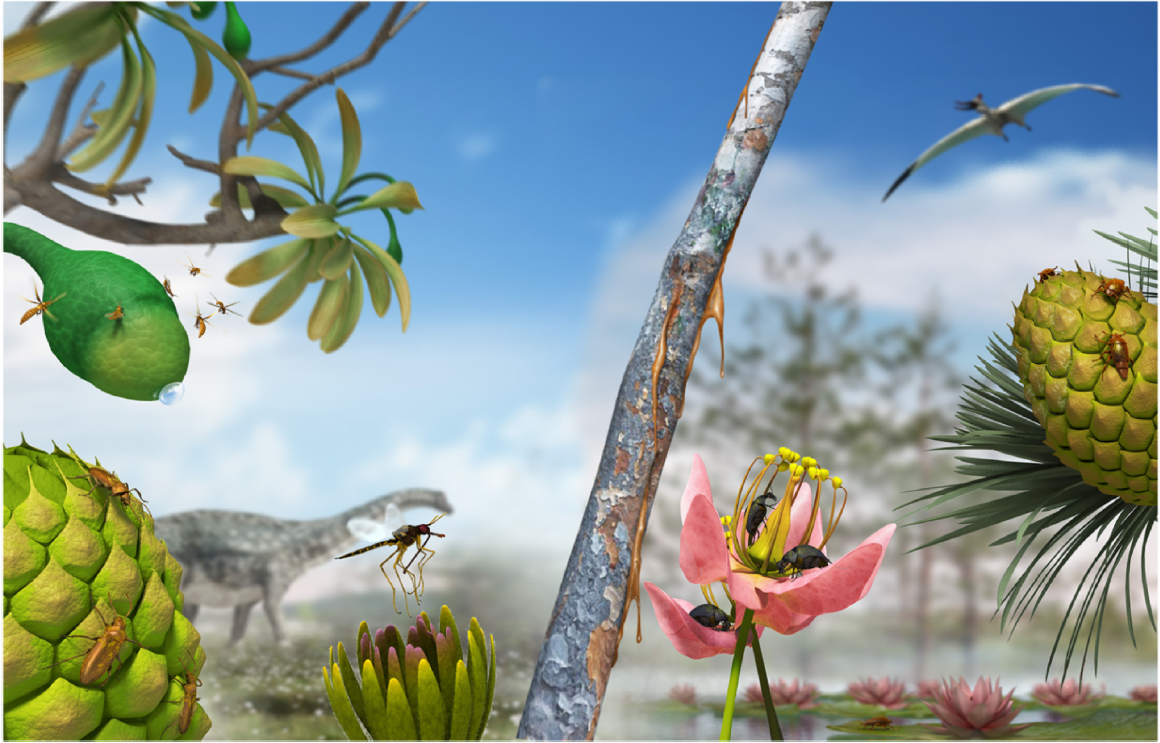
Weevils are beetles, members of the superfamily Curculionoidea, which contains an estimated 97,000 species. Many are herbivores, including seed predators – I first encountered them as a researcher during my PhD when I assessed the impact of one species as a seed predator of my study plant Bird’s-foot Trefoil. Surprisingly, however, pollinating relationships have evolved multiple times between weevils and plants. Drawing on published studies and their own unpublished observations, the authors conclude that such “associations have been described or indicated in no less than 600 instances.” Most of these are brood-site pollination systems that have probably evolved from seed predation relationships.
No doubt many more examples of weevil pollination remain to be discovered but as it stands, this review paper is a great summary of a fascinating and still rather neglected corner of pollination ecology.
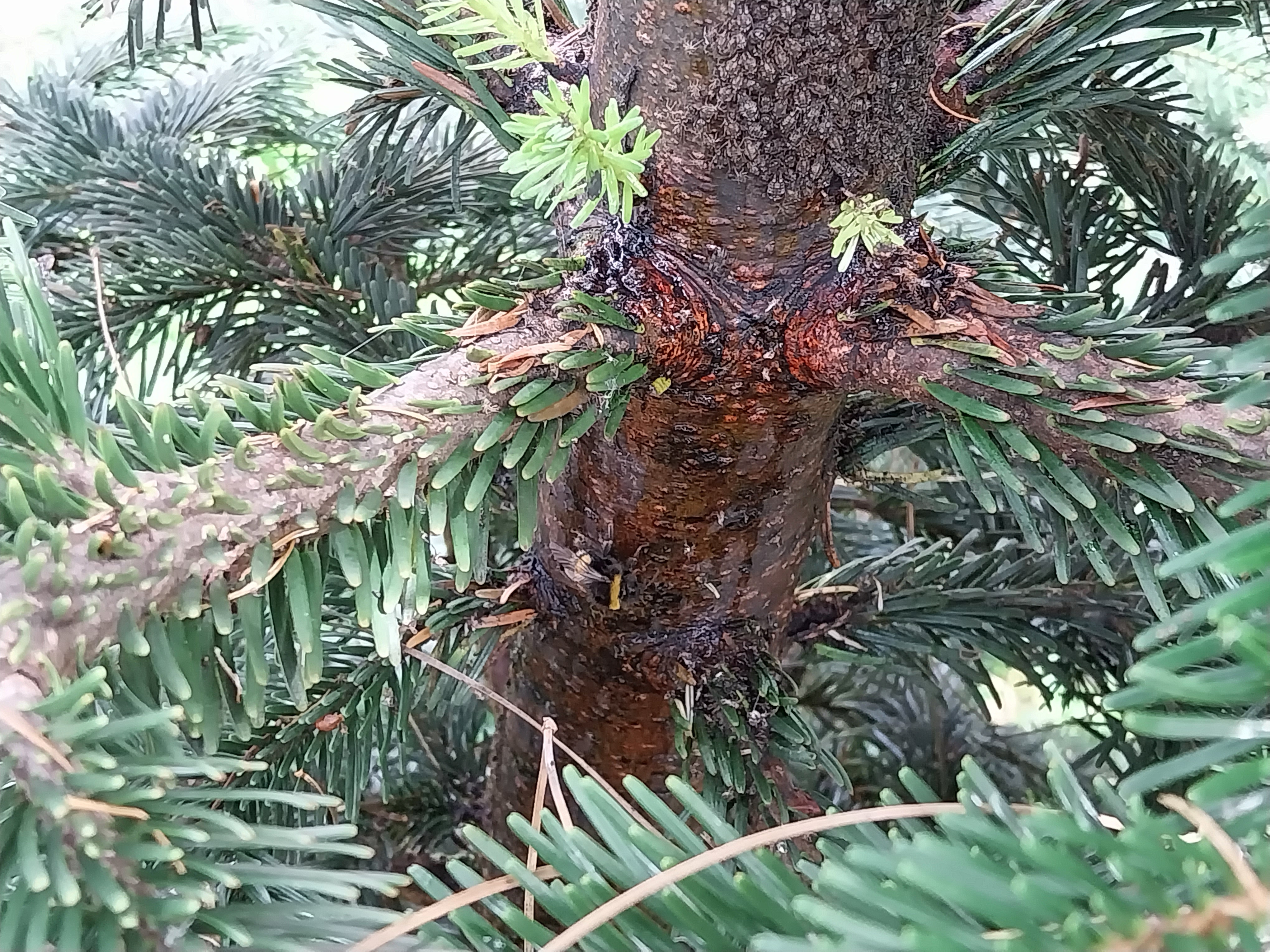
At the moment Karin and I are in the UK for a couple of weeks. I had work to do as an external examiner at the University of Swansea, plus we wanted to catch up with some family and friends. Our main base has been the home of our mates Ian and Simone and we’ve enjoyed some warm, muggy evenings sitting in their garden chewing the fat. Every now and again my eyes have been drawn to the activities of bumblebees as they move in and out of the foliage of a small Silver Fir. The bees are attracted to the large colonies of an aphid that is feeding on the tree’s trunk, from which they are collecting honeydew, as you can see in the photograph above.
When we think of the diets of bees we automatically think “nectar and pollen”. Honeydew, as a sugar-rich fluid, fits broadly into this concept, though as far as I know there’s been little study of its relative importance as a food source for bees. Aside from a few “vulture bees”, all of the 20,000 or so species are vegetarian. And therein lies a problem. Bees evolved from carnivorous wasps and so the evolution of bees, and their complex ecologies, is tied into this profound dietary shift toward a plant-based diet.
A particular issue that has hardly been investigated until recently is that the ratio of elements within meat is very different to that of plants. In particular, animal tissue has a high ratio of sodium (Na) relative to potassium (K), whereas for plants the ratio is reversed – high ratio of K:Na.
In a new conceptual review paper with my colleagues Zuzanna Filipiak and Michał Filipiak, we have explored the implications of this difference in elemental ratios for bee ecology and evolution, and for the conservation of these important insects. The paper is open access and you can download a copy by following a link in this reference:
Bees provide important ecological services, and many species are threatened globally, yet our knowledge of wild bee ecology and evolution is limited. While evolving from carnivorous ancestors, bees had to develop strategies for coping with limitations imposed on them by a plant-based diet, with nectar providing energy and essential amino acids and pollen as an extraordinary, protein- and lipid-rich food nutritionally similar to animal tissues. Both nectar and pollen display one characteristic common to plants, a high ratio of potassium to sodium (K:Na), potentially leading to bee underdevelopment, health problems, and death. We discuss why and how the ratio of K:Na contributes to bee ecology and evolution and how considering this factor in future studies will provide new knowledge, more accurately depicting the relationship of bees with their environments. Such knowledge is essential for understanding how plants and bees function and interact and is needed to effectively protect wild bees.
As a teenager one of my main interests was collecting fossils. In search of specimens I wandered for hours, scouring the Carboniferous coal shale heaps and Permian reef outcrops of my native Sunderland. I spent so much time bothering the geology curator at the local museum with my inquiries that he offered to host me for a year as the placement part of my college course. If I had been able to convince my tutors that paleontology was really just biology in deep time I may have ended up as a professional fossil researcher. But it was not to be and instead I spent a (mostly happy) year working in the microbiology laboratory of a local brewery.
My interest in the ecology of the past has never left me, and over the years I’ve contributed a few articles to journals commenting on the latest fossil findings as they relate to pollination and flowering plant evolution. So I was delighted to be asked by Spanish paleontologist David Peris to help with a new review of insect pollination in deep time, led by PhD candidate Constanza Peña-Kairath. That review has just been published in Trends in Ecology & Evolution, and for the next 50 days it’s available for free download by following the link in the reference:
Inferring insect pollination from compression fossils and amber inclusions is difficult because of a lack of consensus on defining an insect pollinator and the challenge of recognizing this ecological relationship in deep time. We propose a conceptual definition for such insects and an operational classification into pollinator or presumed pollinator. Using this approach, we identified 15 insect families that include fossil pollinators and show that pollination relationships have existed since at least the Upper Jurassic (~163 Ma). Insects prior to this can only be classified as presumed pollinators. This gives a more nuanced insight into the origin and evolution of an ecological relationship that is vital to the establishment, composition and conservation of modern terrestrial ecosystems.
The question of whether interactions between different species are more specialised in tropical environments (as theory predicts) has intrigued me for a couple of decades. In fact it’s just occurred to me that August 2022 was the 20th anniversary of my paper in Oikos co-authored with Louise Cranmer entitled: Latitudinal trends in plant-pollinator interactions: are tropical plants more specialised? That paper was one of the first to seriously challenge an idea that was long-embedded in the scientific and (especially) popular literature, that tropical ecology was in a sense “special” and that the ways in which species parasitised, consumed, or engaged in mutualistic relationships in the tropics was different to what was happening in the subtropics and temperate zones.
Since then I’ve written about this subject in a number of publications, most recently in my book Pollinators & Pollination: Nature and Society and it’s inspired some other researchers to address the topic.
One of the real challenges with asking questions about how plant-pollinator relationships change over large geographical areas is obtaining good, robust data to analyse. It’s a challenge to convince science funding agencies to give money to spend many years travelling the world and collecting the kind of data that are needed. However we can gain some idea of the patterns, and potential processes, that drive the macroecology of plant-pollinator interactions by piecing together databases of interactions for particular taxa, gleaned from published and unpublished sources.
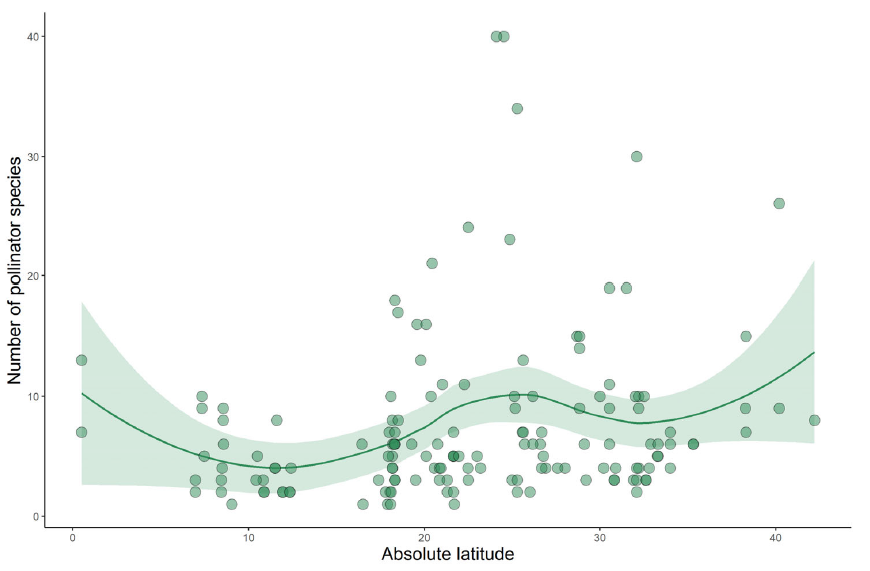
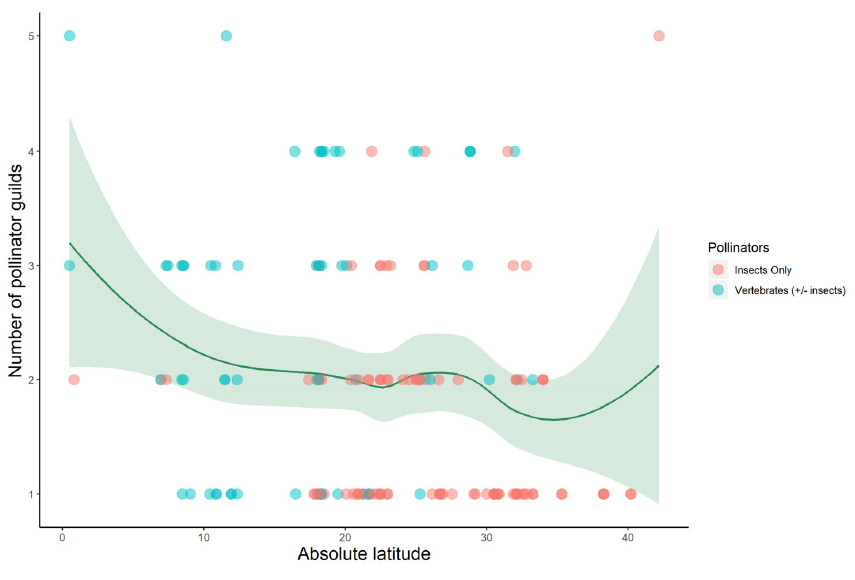
That’s what we have done for the family Cactaceae in a new study led by Pablo Gorostiague from the Universidad Nacional de Salta in Argentina. This collaboration started when Pablo visited Northampton back in 2018 and spent some time with my research group, including helping out with field work in Tenerife. Since then the usual issues (work, COVID, etc.) have delayed publication of our paper, but now it’s finally out. Amongst other results we find that, yes, tropical cacti are pollinated by fewer species on average (though it’s hugely variable – see the figure above) but that functional specialisation (i.e. the number of pollinator guilds that are used by species) is no different in the tropics compared to the extra-tropics (that’s the figure at the end of this post).
The full reference with a link to the paper is below; if anyone wants a PDF, please send me a message via the Contact page:
Biotic interactions are said to be more specialized in the tropics, and this was also proposed for the pollination systems of columnar cacti from North America. However, this has not yet been tested for a wider set of cactus species. Here, we use the available information about pollination in the Cactaceae to explore the geographic patterns of this mutualistic interaction, and test if there is a latitudinal gradient in its degree of specialization.
We performed a bibliographic search of all publications on the pollination of cacti species and summarized the information to build a database. We used generalized linear models to evaluate if the degree of specialization in cacti pollination systems is affected by latitude, using two different measures: the number of pollinator guilds (functional specialization) and the number of pollinator species (ecological specialization).
Our database contained information about the pollination of 148 species. The most frequent pollinator guilds were bees, birds, moths and bats. There was no apparent effect of latitude on the number of guilds that pollinate a cactus species. However, latitude had a small but significant effect on the number of pollinator species that service a given cactus species.
Bees are found as pollinators of most cactus species, along a wide latitudinal gradient. Bat and bird pollination is more common in the tropics than in the extra-tropics. The available information suggests that cacti pollination systems are slightly more ecologically specialized in the tropics, but it does not support any trend with regard to functional specialization.
Most of us have at some time stared in fascination at the life contained within the pools that form on rocky shores at low tide. But none of us realized that a whole new class of ecological interaction was taking place!
The 12,000 or so described (and many un-named) seaweeds are incredibly important organisms. Their diverse and abundant photosynthesizing fronds make them one of the main primary producers in coastal seas, creating food and habitat for a huge range of animals. Not only that, but some – the coralline seaweeds – lock up vast amount of CO2 as calcium carbonate and help to create reef systems in the same way as coral.
Although scientists have studied seaweeds for hundreds of years, many aspects of their ecology are still unknown. Their detailed mode of reproduction, for example has only been studied in a small proportion of species.
In a newly published study in the journal Science, French PhD researcher Emma Lavaut and her colleagues have shown that small isopod crustaceans – relatives of woodlice and sea slaters – facilitate the movement of the equivalent of seaweed sperm (termed “spermatia”) from male to female reproductive structures in just the same way that bees and other pollinators move pollen between flowers, so fertilizing female gametes.
Your read that correctly: some seaweeds have pollinators!
It’s an incredible finding! And the implications of this are enormous: Emma and her colleagues have added a whole new branch of life to the examples of sedentary (fixed-place) organisms that require a third party to enable their reproduction. In addition to being a fascinating biological discovery, it has significant environmental and sustainability implications.
Seaweeds are a diverse group of macroalgae that appeared more than one billion years ago, at least 500 million years before the evolution of what we think of as “true” plants, such as the flowering plants, conifers, cycads, ferns and mosses. Sexual reproduction in the brown and green seaweeds, which include kelps, wracks and sea lettuces, involves spermatia that are mobile and use a flagellum to swim through the water to seek out female reproductive structures. However, Emma studied a seaweed, Gracilaria gracilis, which belongs to the Rhodophyta or red seaweeds, and none of the species in this group have these swimming sperm equivalents.
Sexual reproduction in the red seaweeds has therefore always been something of a mystery. Three quarters of species have separate male and female individuals and so they cannot mate with themselves. It was assumed that the gametes were just released into water currents that haphazardly transported them to the female reproductive organs, much as wind pollinated grasses and pine trees release their vast clouds of pollen on land. The authors of this new study, however, point out that most sexual reproduction by these red seaweeds takes place in the relatively still waters of rock pools, a habitat that they mimicked in the laboratory in a series of elegant aquarium experiments.
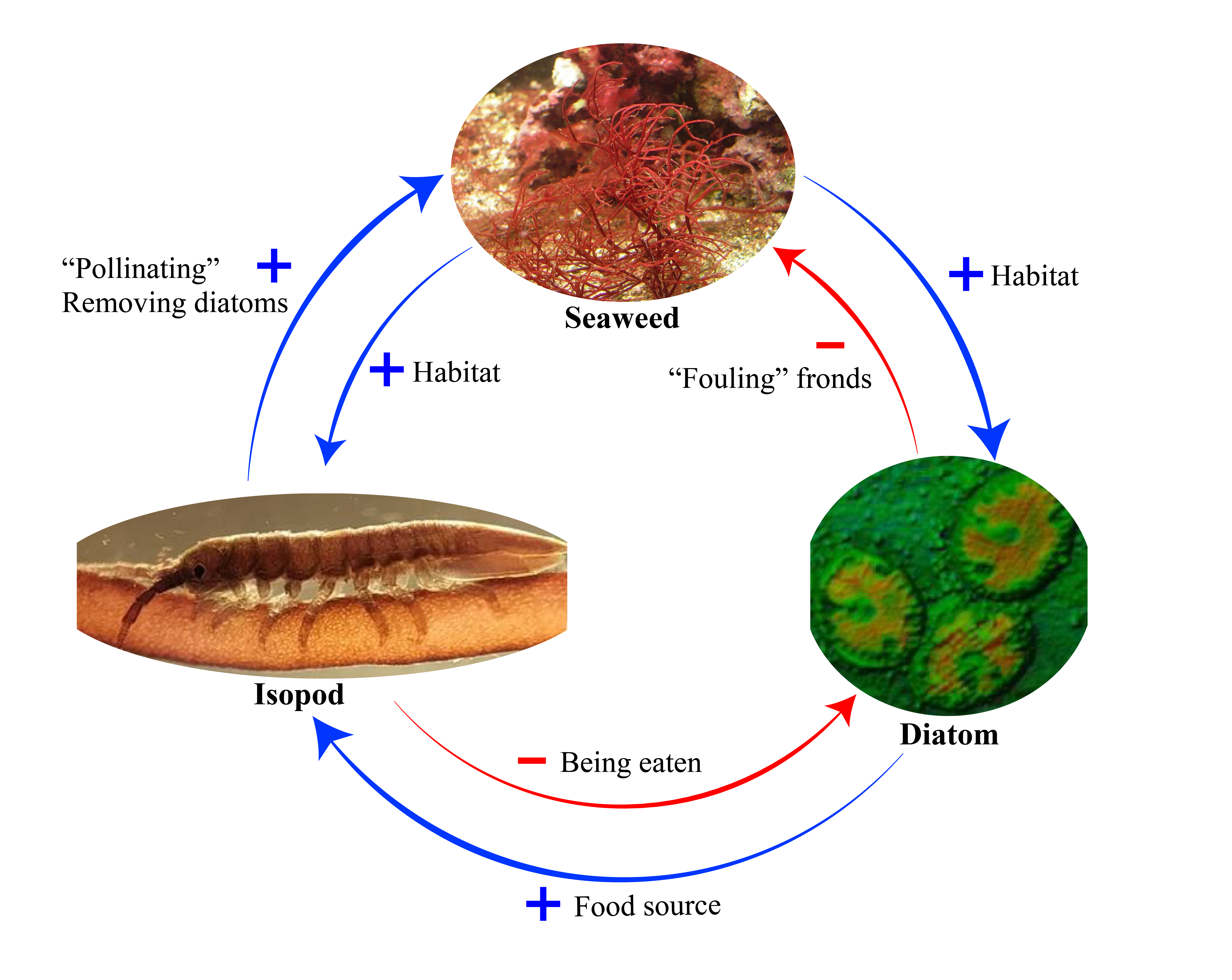
The isopod crustaceans are attracted to the seaweed because they provide a habitat away from predators and a supply of food: they graze on the microalgae that colonise the seaweed’s fronds. Picking up spermatia and moving them between fronds is a side-effect of this activity by the small invertebrates. As you can see from the illustration above, the isopods and the seaweed are engaged in a “double mutualism“: a plus sign (+) indicates a positive effect of one species on another, while a minus sign (-) indicates a negative impact.
What I find especially fascinating about this research is that both the seaweed (Gracilaria gracilis) and the isopod (Idotea balthica) were originally described as species more than 200 years ago. They also have an extremely wide distribution. The isopod is found around the coasts of Europe and down the eastern seaboard of the Americas. The seaweed is pretty much found globally. These are not rare, unusual species, yet the interaction between them has only just been discovered! This is a point that I made in my recent book Pollinators & Pollination: Nature and Society: quite often, species that are well known interact in previously undocumented ways because no one has had the time or inspiration to look closely at them.
Although the idea that small sea creatures might be helping seaweeds to reproduce sounds very fanciful, there is a precedence for this discovery. Back in 2016, in a paper published in Nature Communications, a group of Mexican researchers led by Brigitta van Tussenbroek showed that a species of seagrass is pollinated by a diverse assemblage of small crustaceans and polychaete worms. Seagrasses are flowering plants, not seaweeds, but clearly this type of mutually beneficial relationship can exist between different species in the oceans.
Rhodophyta are the most diverse group of seaweeds, with more than 7,000 known species. They are especially abundant on coastal shores, oceanic habitats that are under huge pressure from infrastructure development, pollution, and climate change. At the same time, these seaweeds are economically important and millions of tonnes of them are collected every year as food, as nutritional and pharmaceutical supplements, and to produce agar. In order to conserve these seaweed populations, we need to better understand their ecology and their environmental requirements.
The work by Emma Lavaut and colleagues suggests that interactions with their “pollinators” may be a critical aspect of this understanding. In the same way that “Save the Bees” has been a rallying call for conserving interactions between species on land, we may soon hear this message echoed in “Save the Isopods”. At the very least, I have to add a new section to the second edition of my book!
Full disclosure: I was one of the reviewers of the original manuscript submitted to Science by Emma and her co-authors. It’s a rare privilege to review a study and think: “Wow! This is a game-changer!” and including this paper it’s happened to me only a handful of times. The editors at Science kindly invited my colleague Dr Zong-Xin Ren and myself to write a Perspective piece about the work and we were delighted to do so.
Image credits: Isopod and diatom images from Lavaut et al (2022). Gracilaria image by Emoody26 at English Wikipedia CC BY 3.0 https://commons.wikimedia.org/w/index.php?curid=3455016. Design by Shijia Wen and Jeff Ollerton.
Of all of the “classical” pollination syndromes, flowers that are hawkmoth pollinated have one of the highest levels of predictability. If a flower is pale in colour, opens at night, is highly scented, and possesses a long tube at the bottom of which is a supply of nectar, there’s a very high likelihood that it’s pollinated by long-tongued hawkmoths (Sphingidae).
Fast forward 160 years and we now know that pollination syndromes are more complex than 19th and early 20th century scientists imagined – see my recent book Pollinators & Pollination: Nature and Society for a discussion of this topic. That’s not surprising because, as I point out, we probably have data on the interactions between plants and their pollinators for only about 10% of the estimated 352,000 species of flowering plants. There’s still much to be discovered!
As an example of how our understanding of specialised flower-hawkmoth interactions is developing, consider this recent study that I’ve just published with my Brazilian colleague Felipe Amorim and other collaborators. In it we have shown that, contrary to expectations, a species of Apocynaceae (Schubertia grandiflora) with a relatively short floral tube can specialise on hawkmoths with much longer tongues than we might predict.
The full reference with a link to the study is shown below, followed by the abstract. If you would like a PDF, please drop me a line via my Contact page:
Since Darwin, very long and narrow floral tubes have been known to represent the main floral morphological feature for specialized long-tongued hawkmoth pollination. However, specialization may be driven by other contrivances instead of floral tube morphology. Asclepiads are plants with a complex floral morphology where primary hawkmoth pollination had never been described. We detailed here the intricate pollination mechanism of the South American asclepiad Schubertia grandiflora, where functional specialization on long-tongued hawkmoth pollinators occurs despite the short floral tube of this species. We studied two plant populations in the Brazilian Cerrado and recorded floral visitors using different approaches, such as light-trapped hawkmoths for pollen analysis, direct field observations, and IR motion-activated cameras. Finally, using a community-level approach we applied an ecological network analysis to identify the realized pollinator niche of S. grandiflora among the available niches in the pollinator community. Throughout a period of 17 years, long-tongued hawkmoths were consistently recorded as the main floral visitors and the only effective pollinators of S. grandiflora. Flowers rely on highly modified corona and gynostegium, and enlarged nectar chambers, to drive visitors and pollination mechanism. Despite its relative short-tube, network analysis placed S. grandiflora in the module including exclusively long-tongued hawkmoth pollinators and the most phenotypically specialized sphingophilous plants in the community. These results represent the first example of functional specialization in long-tongued hawkmoths in an asclepiad species. However, this specialization is uncoupled from the long floral tubes historically associated with the sphingophily syndrome.
I love going to botanic gardens and I keep a “life list” of those that I have visited. So on a visit to Lund University last week, to give a seminar and take part in an MSc defence, I was delighted to be able to add another one to that list. Lund University Botanical Garden is quite small, like many such urban gardens, and this is not the best time of the year to visit. But there was a good show of early spring plants in flowers, the sun was shining, and quite a number of people were enjoying the peace and calm in the middle of a city.
The glasshouses were especially busy, and they have a nice collection of cold-sensitive plants arranged by habitat and taxonomy, such as cacti and succulents, ferns, orchids, and so forth. One of the reasons why I enjoy botanic gardens so much is that I always, without exception, see plants that I have never previously encountered, often doing unexpected things.
Lund was no exception, and I was particularly intrigued by a plant called Monolena primuliflora which was being grown in a hanging basket, as is often the case with epiphytic plants. It’s a species of Melastomataceae, a family that I know well from tropical field work. But this one looked unlike any melastome that I’d ever seen. In particular, I was drawn to the large rhizome or caudex from which the leaves emerge:
This immediately reminded me of some of the epiphytic “ant plants” such as species of Myrmecodia and Hydophytum and especially ferns such as Lecanopteris. All of these myrmecophyte genera have evolved swollen stems or rhizomes which house colonies of ants. The ants in turn defend the plants against herbivores, in a mutualistically advantageous relationship.
Sure enough, when I searched online for information about Monolena primuliflora, it’s widely described in the house plant community as an “ant plant” – see here and here for example. After I tweeted about this, biologist Guillaume Chomicki (who has been researching these ant-plant interactions) was intrigued but asked about the evidence for it being a myrmecophyte:
What's the evidence for it being an ant-plant? It's not obvious based on these photos. If you are anyone has more info or list, please let me know so that I can update my database!
That got me thinking, so I dug around in the botanical literature for the evidence and found…..nothing. The standard monograph on the genus by Warner (2002) doesn’t mention it and as far as I can tell (please someone will correct me if I am wrong) there’s no documented study of this species or genus having a myrmecophytic relationship with ants.
If I’m correct, how has the idea of Monolena primuliflora as an ant plant come about? This is a relatively new introduction to the houseplant trade and I suspect that plant sellers have made assumptions about the swollen rhizome (as I did!) to make the plant sound more interesting. There’s no doubt that the rhizome is fascinating and unusual in the family, but its function may be to store water (as found in many epiphytic orchids) rather than to house ants.
In my recent book Pollinators & Pollination: Nature and Society, and in this article last year in the magazine British Wildlife, I discussed how the world of plants (and pollinators) is full of myths and misunderstandings. This seems to be another one and by writing this blog post I’m hoping that we can clarify the situation with regard to Monolena primuliflora. So if you have any further information about it, please do comment below.
My thanks to everyone on Twitter who commented about the plant, especially Guillaume for asking the question!
Join me this Thursday at a free online talk organised by Buglife where I’ll be giving an introduction to how flowers function and the ways in which their behaviour manipulates pollinators to ensure reproduction. I’ll be covering:
What are flowers and where did they come from?
How flowers function and reward pollinators.
Some case studies from my own research on flower and pollinator behaviour.
Why is it important that we understand floral biology?
I was saddened to learn recently of the death of Professor Leonard B. Thien of Tulane University who passed away at the end of October after a long illness. Although I didn’t know Professor Thien personally, I knew of his work in floral ecology, pollination biology and plant evolution, topics on which he had worked for since obtaining his PhD in 1968. Over the course of his career he published more than 80 articles on a huge range of botanical subjects, including ground-breaking work on mosquito pollination of orchids (Thien 1969). The orchid species Alaticaulia thienii is named in his honour.
The studies Leonard Thien published that really inspired me when I was first starting out on my journey as a researcher, however, involved his work on “relictual” angiosperms, i.e. flowering plants that have very long evolutionary histories and deep phylogenetic roots back to the early Cretaceous period, for example Magnolia and Illicium. Papers with titles such as “Patterns of pollination in the primitive angiosperms” (Thien 1980) piqued my interest and motivated me to work on Australian Piperaceae for a short while following my PhD (Ollerton 1996). It was a topic that I struggled to gain further funding for, and later molecular systematic studies changed many of our ideas about what constitutes the most basal groups of extant flowering plants. But nonetheless, the questions that Leonard inspired in me, regarding the ecologies of these relictual taxa, and whether we can infer the reproductive ecology of the earliest flowering plants from studies of their surviving descendants, are ones that intrigue me to this day (van der Kooi and Ollerton 2020).
Leonard Thien kept up this interest even as new DNA technologies over turned old ideas, and he was the first to study the reproductive ecology of Amborella trichopoda on New Caledonia, a species now considered to be the earliest surviving clade of flowering plants (Thien et al. 2003). This is just one part of a legacy of work that current and future generations will build upon as we develop our understanding of the relationships between pollinators, plants, and evolutionary processes.
I’m grateful to Peter Bernhardt for prompting this post and for sending me a copy of the In Memoriam article that he and and David White will publish in the Plant Sciences Newsletter in March, and to Lorraine Thien for providing the photograph that accompanies this post.
References
Ollerton, J. (1996) Interactions between gall midges (Diptera: Cecidomyiidae) and inflorescences of Piper novae-hollandiae (Piperaceae) in Australia. The Entomologist 115: 181-184
Thien, L.B. 1969. Mosquito pollination of Habenaria obtusata (Orchidaceae). American Journal of Botany 56: 232-237.
Thien, L.B. 1980. Patterns of pollination in the primitive angiosperms. Biotropica 12: 1-14
Thien, L.B., Sage, T.L., Jaffre, T., Bernhardt, P., Pontieri, V., Wesston, P.H., Malloch, D., Azuma, H., Graham, S.W., McPherson, M.A., Hardeep, S.., Sage, R.S. & Dupre, J.-L. 2003. The population structure and floral biology of Amborella trichopoda (Amborellaceae). Annals of the Missouri Botanical Garden 90: 466-490
van der Kooi, C.J. & Ollerton, J. (2020) The origins of flowering plants and pollinators. Science 368: 1306-1308
Since arriving in Odsherred towards the end of August I’ve been looking out for one plant in particular on our bicycle rides and hikes around the region. Vincetoxicum hirundinaria is a widespread asclepiad or milkweed: a member of the family Apocynaceae, subfamily Asclepiadoideae. This is a group of plants on which I’ve published quite a few research papers and which feature heavily in my book Pollinators & Pollination: Nature and Society.
So far the species has proven elusive and a few Danish ecologists that I’d spoken with told me they had never seen it in the wild. The GBIF account of the species shows a few populations in this part of Denmark but I wasn’t sure if they were old records of populations that no longer exist. But as of yesterday I can confirm that at least one of those populations is extant!
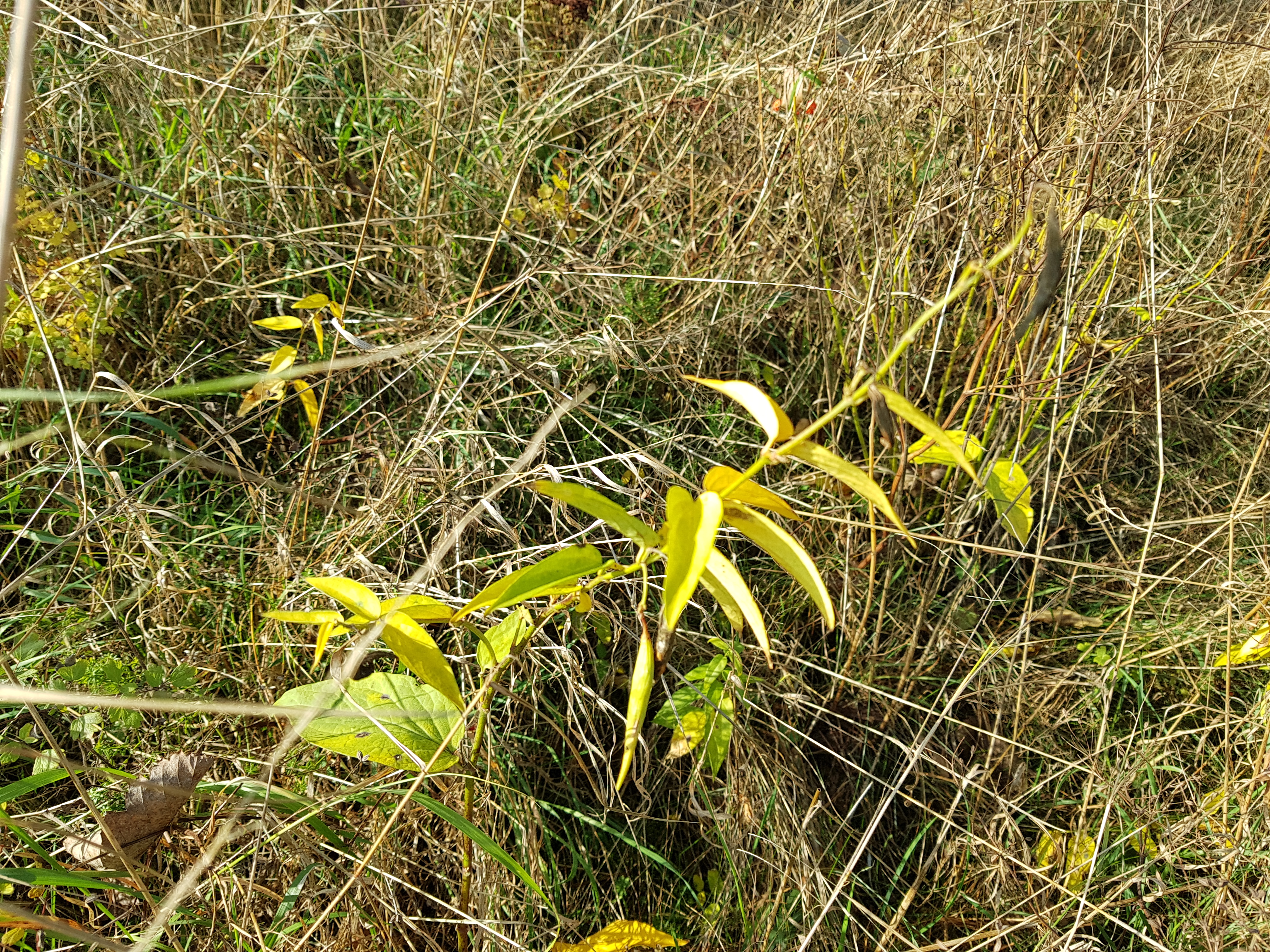
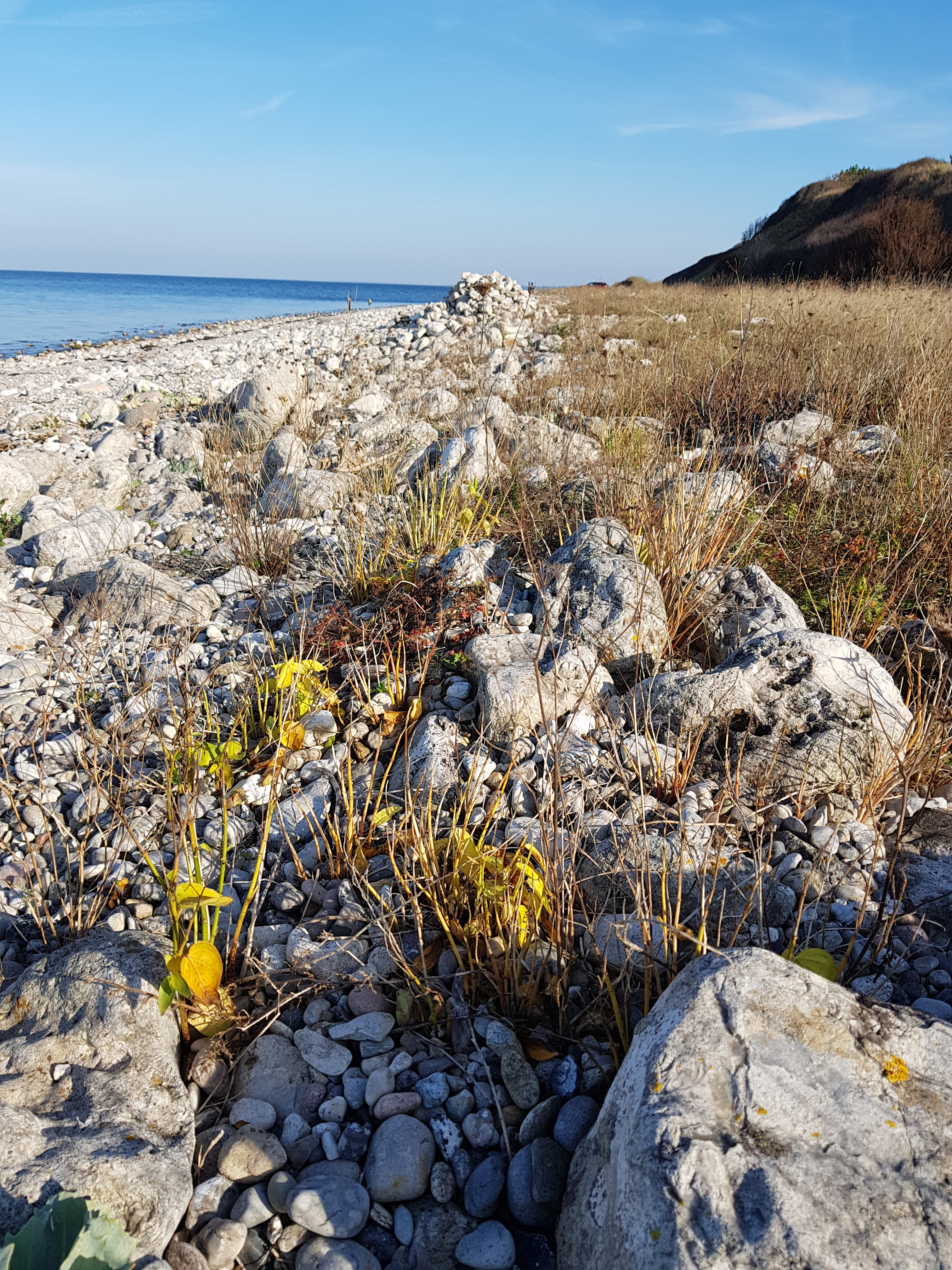
We had cycled out to the small town of Klint about 13km west of us, to see the glacial moraine landscape for which the area is famous and which gives Odsherred UNESCO Geopark status. As we approached the small fishing harbour at Klint I let out an excited shout to Karin who was just ahead of me: in amongst the roadside vegetation I’d spotted the distinctive and immediately recognisable yellow of Vincetoxicumhirundinaria in its autumnal hues! In the photos that follow you can see how well that yellow stands out against the colours of the other plants in the community.
At this time of the year the plant has ceased flowering, but the occasional swollen green seed pod was evidence of successful pollination of their morphologically complex flowers.
I was surprised at just how close to the sea the plants were growing; they must get inundated by sea water during stormy tidal surges.
So what is pollinating these flowers on this exposed shoreline? That’s a question that I want to pursue in the coming years. The Pollinators of Apocynaceae Database has remarkably few records of pollinators in this species, given how widespread it is. Flies certainly pollinate it, but there’s also records of wasps and bees as visitors, including bumblebees on flowers of a plant that I had in cultivation in Northampton. There’s a couple of other research groups in Scandinavia and Europe who are looking at the pollination ecology of the species and I’m hoping that we can collaborate on a study of spatial variation in its reproduction. Vincetoxicum is quite a large genus (around 150 species) and only around 10% of the species have been studied in any detail. But these studies are revealing a complex diversity of pollinators, including most recently, cockroaches in the Chinese species Vincetoxicumhainanense. I’m sure this intriguing group of plants has more fascinating stories to tell us about the ecology and evolution of its pollination systems.
FIGURE 4 from Xiong et al. (2020) Specialized cockroach pollination in the rare and endangered plant Vincetoxicum hainanense in China. American Journal of Botany 107: 1355–1365.




 Prof. Jeff Ollerton - ecological scientist and author