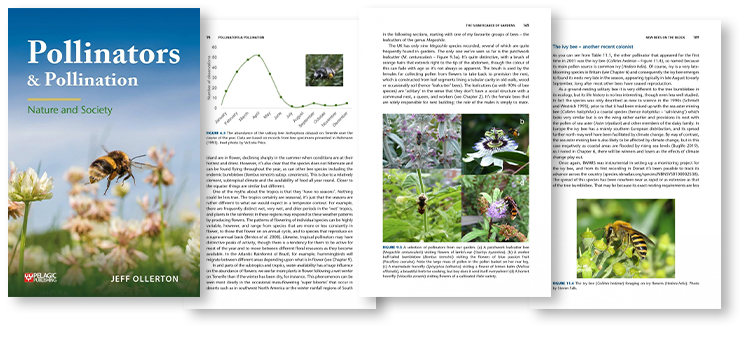
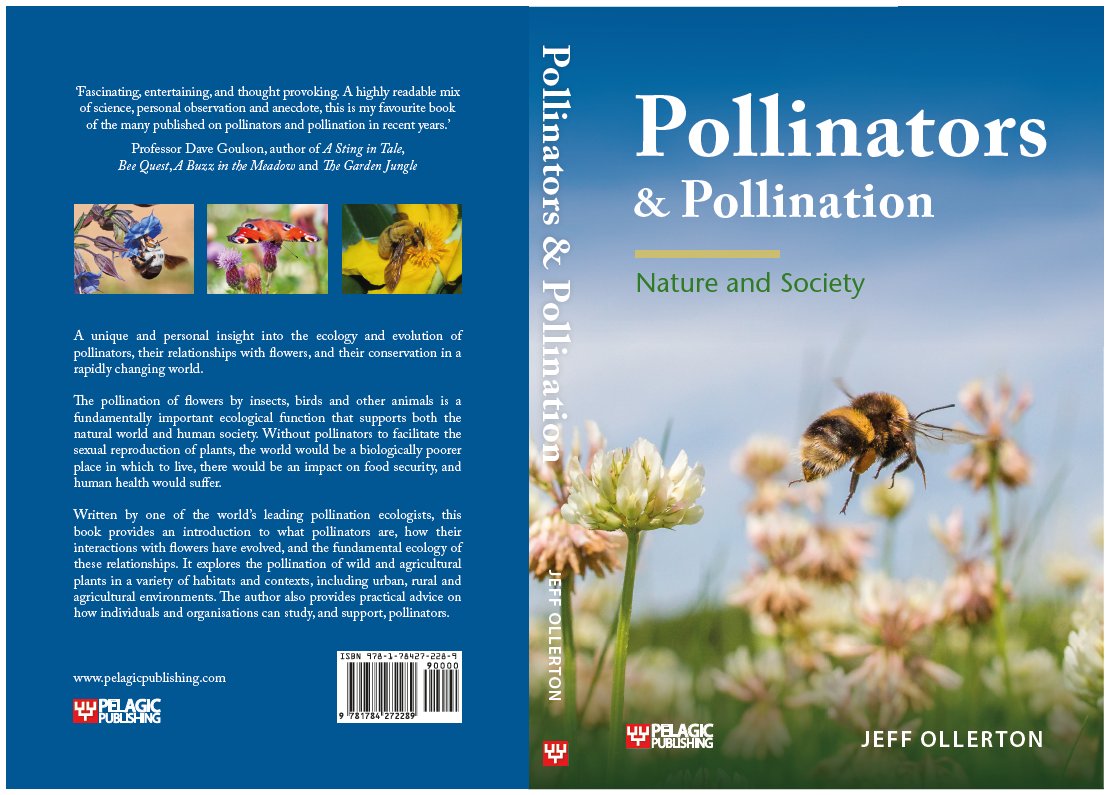
Pollinators are responsible for producing much of the traditional Christmas food that we enjoy at this time of the year, and add considerable value to the holly and mistletoethat decorates our homes in northern Europe and elsewhere. The link between pollinators and Christmas is something that I discuss in my new book Pollinators & Pollination: Nature and Society. As a special seasonal gift, the publishers (Pelagic) are offering a 30% discount on orders in the run up to Christmas. To claim the discount follow that previous link and use the code CHRISTMAS30 at the checkout. UPDATE: Apologies, the publisher tells me that the discount period has now passed.
Although the book has not yet been formally reviewed in any journal or other form of media, I’ve had some very nice (and unsolicited) comments about it via Twitter . Here’s some examples:
This new book is SUPERB. It contains everything I’ve spent the last 10 years trying to grasp, all in one book, AND written in a way I can understand! I cannot tell you how much I’m learning from it already. It makes such a difference to a non-scientist (like me) to be able to grasp the facts, and the science behind the facts, without having to first look up dozens of terms I don’t understand.
Brigit Strawbridge Howard – author of Dancing With Bees
Good to see discussions of ecology, culture and politics together.
Anon
I was delighted to receive this superb book over the weekend. It’s an extremely informative read for anyone interested in the subject of pollination!
Anon
Looking forward to reading this. I like the tone of what I’ve dipped into so far, really engaging and none of that turgid academic English that gives me a headache!
Steven Falk – author of Field Guide to the Bees of Great Britain and Ireland
Yesterday I was delighted to finally receive an advance copy of my book Pollinators & Pollination: Nature and Society! It’s been over three years in the writing and production, much longer than I had anticipated. But, as I describe in its pages, the book is the culmination of >50 years of experience, study and research. So perhaps three years isn’t so bad…
If you’re interested in buying a copy you can order it direct from Pelagic Publishing and from most of the large online booksellers. Let me know what you think.
It was eminent bee biologist Charles Michener who first* pointed out that there was something odd about the global distribution of bees. In his 1979 paper Biogeography of the bees he writes:
“unlike many groups which abound in the tropics, bees attain their greatest abundance in warm temperate areas”
Think about that for a moment: in contrast to most other groups of insects, birds, mammals, flowering plants, fish, indeed the majority of the Earth’s biodiversity, bees are NOT generally at their most species rich in tropical areas. Rather, we have to move north and south of the equator to find them at their highest diversity. This is an odd pattern of distribution for such a successful (> 20,000 species), globally widespread and ecologically important group of organisms.
Some 15 years ago I was inspired by Michener’s comments when, together with colleagues Steve Johnson and Andrew Hingston, we wrote a chapter called Geographical variation in diversity and specificity of pollination systems for the 2006 Waser & Ollerton edited volume Plant-pollinator Interactions: from Specialization to Generalization. In that chapter we presented a rough analysis of how bee diversity per unit area in different countries changes with latitude. This, and a follow-up that appeared in my 2017 Annual Review of Ecology, Evolution and Systematics paper, confirmed Michener’s view that there’s an unusual relationship between bee diversity and latitude, with peak species richness outside of the tropics, in warm, dry environments.
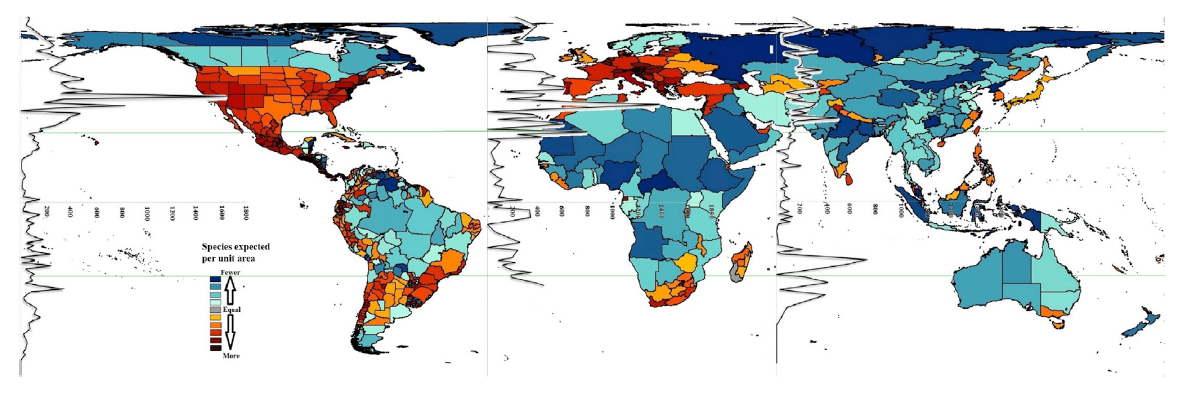
What I really hoped over this time was that some serious bee biologists would follow up Michener’s insights and produce a full analysis of how bee diversity changes across the planet. Yesterday that hope was realised when Michael Orr, Alice Hughes, Douglas Chesters, John Pickering, Chao-Dong Zhu and John Ascher published the first analysis of bee diversity across the whole planet, and its underlying causes, in their open-access paper Global Patterns and Drivers of Bee Distribution.
Their analyses are based on a data set of >5,800,000 records of where bees occur and it’s been an incredible achievement to bring all of that together into a planet-wide view of where bees are found, and why. I highly recommend that you download and read it, it’s an impressive piece of work.
What have camels got to do with all of this? Well, as the authors show in their paper (from which the image above is taken), if you graph up the increase in bee species richness with latitude from the poles in each hemisphere, you get two humps at about 35 degrees north and south of the equator: like a Bactrian camel. In contrast, as I noted above, if you were to do the same for for most other species you’d get a single hump at the equator: like a dromedary camel.
One of the key drivers of this bimodal pattern seems to be the amount of rainfall in an environment – bees do not like it too wet, in contrast to their relatives the ants which do show the more typical tropical peak in diversity. As the authors put it:
“humidity may play a key role in limiting bee distribution, such as through spoilage of pollen resources”
One of the implications of this for the biogeography of plant-pollinator interactions is that we might expect there to be a greater diversity of different types of pollinators in areas where bees are not so abundant. And indeed that is exactly what we find: in that Ollerton, Johnson and Hingston book chapter I mentioned we showed that there’s a step-change in the diversity of functionally specialised pollination systems as one moves from the sub-tropics into the tropics. There could be many reason for that but I suspect that one is a relative lack of bees compared to the number of plants species; thus you get tropical “oddities” such as specialised cockroach pollination in some plants.
Orr et al.’s paper is a milestone in bee biogeography and opens up new opportunities for conserving these insects, and their vital relationships with the flowering plants. To give just one example: these analyses provide a framework for predicting bee diversity hotspots in parts of the world that have been poorly explored by bee taxonomists, but which are nevertheless severely threatened by habitat degradation and conversion to agriculture. It could also be used for predicting how climate change might affect future bee distributions, especially in parts of the world that are expected to become wetter. I’m looking forward to seeing how the team’s work develops in the future.
——————————————–
*It’s always risky to state “first”, but Michener was certainly the first that I am aware of. Let me know if you’ve come across any precedents.
Last Friday to Sunday I hosted the annual Scandinavian Association for Pollination Ecology (SCAPE) conference virtually. This is my first opportunity to report back as I took some time off and then tried to catch up with other tasks.
Running any scientific conference is hard work, and virtual ones are no exception! On Monday I was exhausted after a marathon long weekend of three 10-hour days in front of a computer chairing sessions, queuing up speakers and their talks, and generally making sure things ran as smoothly as possible. Of course before that there were literally weeks of preparation, and since then I have been doing follow up work of responding to emails, sending out certificates and receipts, etc.
It’s been quite a job and I couldn’t have done it with the help of my wife Karin (especially for the loan of her office space in the garden) and also Yannick Klomberg who was working on the website, dealing with the posters, etc., all on top of having a week old baby and his partner to look after! In addition I’m grateful to Paul Egan who ran the SCAPE Twitter account, and the session Chairs, keynote speakers, and participants who contributed to a really amazing conference. Our technical support crew from the University of Northampton were great too.
It was the largest SCAPE meeting so far held, no doubt because it was the first to be carried out virtually, with 352 participants from 41 countries listening to and chatting about 92 talks and viewing 39 posters. We also ran several well-attended evening discussion and poster sessions.
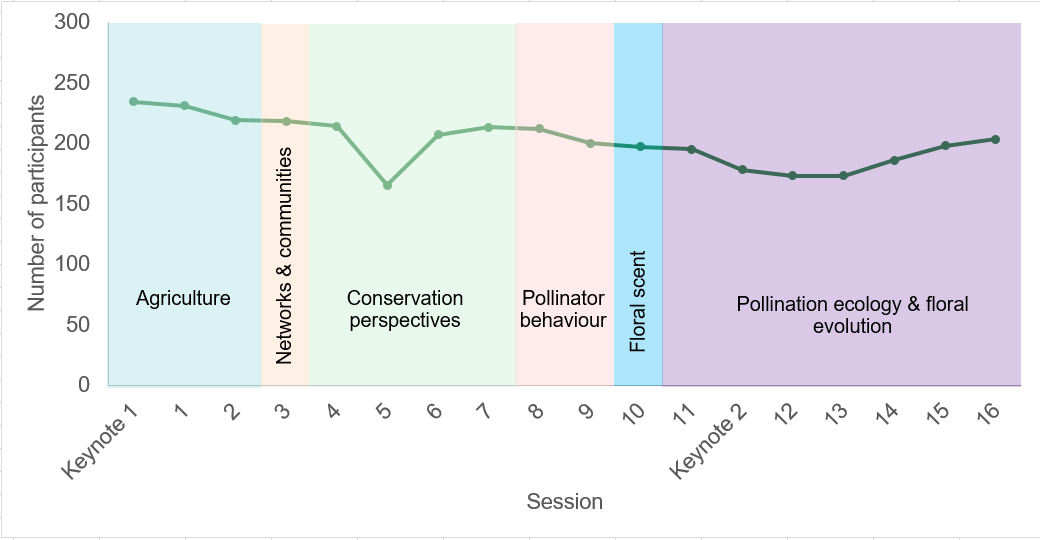
Long-standing SCAPEr Marcos Mendez kept a log of the number of participants in each of the sessions and I’ve graphed the data below, showing the broad themes of each group of sessions:
It’s pleasing to see that attendance was reasonably consistent over the course of the long weekend and that there was interest across the full spectrum of themes. The one downward blip was in session 5, which I can only surmise was due to it being the final session on Friday between 17:25 and 18:25.
As is traditional at SCAPE we announced the host of next year’s meeting at the very end. I’m delighted to announce that SCAPE 2021, the 35th annual meeting, will be held for the first time in Poland, where MarcinZych will be the host. “Wider Scandinavia” just got wider….
There’s still a few hours left in which to register to attend the SCAPE 2020 pollinators and pollination conference. Follow the links on the website: https://scape-pollination.org/
The programme is more or less finalised and is shown below. We have an amazing range of topics being presented from both established and early career researchers, including two keynote lectures, plus posters. It’s going to be a very exciting weekend of science!
PROGRAMME
Talk types:
K = Keynote
ST = Standard (10 minutes talk + 5 for questions)
F = Flash talk (5 minutes, no questions)
Friday 6th November – all timings are GMT (London) time
Timing
Type
Name
Title
Ref
09.00 –09.15
Jeff Ollerton
Open conference and welcome
09.15 –10.15
K
Lynn Dicks
Understanding the risks to human well-being from pollinator decline
K.01
10.15 –10.30
Comfort break
Time to top up your coffee
Session 1
Chair:Jeff Ollerton
Agriculture – 1
10.30 – 10.45
ST
Ke Chen
Indirect and additive effects of arbuscular mycorrhizal fungi on insect pollination and crop yield of raspberry under different fertilizer levels
1.01
10.45 – 11.00
ST
Julia Osterman
Enhancing mason bee populations for sweet cherry pollination
1.02
11.00 – 11.15
ST
Idan Kahnonitch
Viral distributions in bee communities: associations to honeybee density and flower visitation frequency
1.03
11.15 – 11.30
ST
Anna Birgitte Milford
Who takes responsibility for the bees?
1.04
11.30 – 11.45
ST
Emma Gardner
Boundary features increase and stabilise bee populations and the pollination of mass-flowering crops in rotational systems
1.05
11.45 – 12.00
ST
Stephanie Maher
Evaluating the quantity and quality of resources for pollinators on Irish farms
1.06
12.00 –12.05
F
Thomas Timberlake
Pollinators and human nutrition in rural Nepal: experiences of remote data collection during a global pandemic
1.07
12.05 –12.15
Comfort break
Session 2
Chair:Jane Stout
Agriculture – 2
12.15 – 12.30
ST
Michael Image
The impact of agri-environment schemes on crop pollination services at national scale
2.01
12.30 – 12.45
ST
Nicola Tommasi
Plant – pollinator interactions in sub-Saharan agroecosystems
2.02
12.45 – 13.00
ST
Tal Shapira
The combined effects of resource-landscape and herbivory on pollination services in agro-ecosystems
2.03
13.00 – 13.15
ST
Márcia Motta Maués
Despite the megadiversity of flower visitors, native bees are essential to açai palm (Euterpe oleracea Mart.) pollination at the Amazon estuary
2.04
13.15 – 13.30
ST
Sabrina Rondeau
Quantifying exposure of bumblebee queens to pesticide residues when hibernating in agricultural soils
2.05
13.30 –13.35
F
Maxime Eeraerts
Landscapes with high amounts of mass-flowering fruit crops reduce the reproduction of two solitary bees
2.06
13.35 – 13.40
F
Patricia Nunes-Silva
Crop domestication, flower characteristics and interaction with pollinators: the case of Cucurbita pepo (Cucurbitaceae)
2.07
13.40 – 14.30
Lunch break
Session 3
Chair:Mariano Devoto
Networks and communities
14.30 – 14.45
ST
Kit Prendergast
Plant-pollinator networks in Australian urban bushland remnants are not structurally equivalent to those in residential gardens
3.01
14.45 – 14.50
F
Kavya Mohan
Structure of plant-visitor networks in a seasonal southern Indian habitat
3.02
14.50 – 14.55
F
Opeyemi Adedoja
Asynchrony among insect pollinator groups and flowering plants with elevation
3.03
14.55 – 15.10
ST
Yael Mandelik
Rangeland sharing by cattle and bees: moderate grazing does not impair bee communities and resource availability
3.04
15.10 – 15.25
ST
Felipe Torres-Vanegas
Landscape change reduces pollen quality indirectly by shifting the functional composition of pollinator communities
3.05
15.25 – 15.40
ST
Isabela Vilella-Arnizaut
Quantifying plant-pollinator interactions in the Prairie Coteau
3.06
15.40 – 15.55
Comfort break
Session 4
Chair:Nina Sletvold
Conservation perspectives – 1
15.55 – 16.10
ST
Lise Ropars
Seasonal dynamics of competition between honeybees and wild bees in a protected Mediterranean scrubland
4.01
16.10 – 16.25
ST
Philip Donkersley
A One-Health model for reversing honeybee (Apis mellifera L.) decline
4.02
16.25 – 16.40
ST
Nicholas Tew
Nectar supply in gardens: spatial and temporal variation
4.03
16.40 – 16.55
ST
Peter Graystock
The effects of environmental toxicants on the health of bumble bees and their microbiomes
4.04
16.55 – 17.10
ST
Hauke Koch
Flagellum removal by a heather nectar metabolite inhibits infectivity of a bumblebee parasite
4.05
17.10 – 17.25
Comfort break
Session 5
Chair:Anders Nielsen
Conservation perspectives – 2
17.25 – 17.40
ST
Miranda Bane
Pollinators on Guernsey and a Pesticide-free Plan
5.01
17.40 – 17.55
ST
Jamie Wildman
Reintroducing Carterocephalus palaemon to England: using the legacy of a locally extinct butterfly as a (morpho)metric of future success
5.02
17.55 – 18.10
ST
Sjirk Geerts
Invasive alien Proteaceae lure some, but not other nectar feeding bird pollinators away from native Proteaceae in South African fynbos
5.03
18.10 – 18.25
ST
Sissi Lozada Gobilard
Habitat quality and connectivity in kettle holes enhance bee diversity in agricultural landscapes
5.04
18.25 –18.45
Comfort break
18.45 – 23.59
Themed discussion rooms open
Saturday 7th November – all timings are GMT (London) time
Timing
Type
Name
Title
Ref
08.55 – 09.00
Jeff Ollerton
Reminders and announcements
Session 6
Chair:Jeff Ollerton
Conservation perspectives – 3
09.00 – 09.15
ST
Paolo Biella
The effects of landscape composition and climatic variables on pollinator abundances and foraging along a gradient of increasing urbanization
6.01
09.15 – 09.30
ST
James Rodger
Potential impacts of pollinator declines on plant seed production and population viability
6.02
09.30 – 09.45
ST
Emilie Ellis
Moth assemblages within urban domestic gardens respond positively to habitat complexity, but only at a scale that extends beyond the garden boundary
6.03
09.45 – 10.00
ST
Samuel Boff
Novel pesticide class impact foraging behaviour in wild bees
6.04
10.00 – 10.15
Comfort break
Time to top up your coffee
Session 7
Chair:Jon Agren
Conservation perspectives – 4
10.15 – 10.20
F
Maisie Brett
The impacts of invasive Acacias on the pollination networks of South African Fynbos habitats
7.01
10.20 – 10.25
F
Joseph Millard
Global effects of land-use intensity on local pollinator biodiversity
7.02
10.25 – 10.30
F
Susanne Butschkau
How does land-use affect the mutualistic outcomes of bee-plant interactions?
7.03
10.30 – 10.35
F
Elżbieta Rożej-Pabijan
Impact of wet meadow translocation on species composition of bees (Hymenoptera: Apoidea: Apiformes)
7.04
10.35 – 10.40
F
Lorenzo Guzzetti
May urbanization affect the quality of pollinators diet? A case-study from Milan, Italy.
7.05
10.40 – 10.45
F
Emiliano Pioltelli
Functional traits variation in two bumblebee species along a gradient of landscape anthropization
7.06
10.45 – 11.00
Comfort break
Session 8
Chair:Marcos Mendez
Pollinator behaviour – 1
11.00 – 11.15
ST
Hema Somanathan
Foraging on left-overs: comparative resource use in diurnal and nocturnal bees
8.01
11.15 – 11.30
ST
Sajesh Vijayan
To leave or to stay? Answers from migratory waggle dances in Apis dorsata
8.02
11.30 – 11.45
ST
Balamurali MGS
Decision making in the Asian honeybee Apis cerana is influenced by innate sensory biases and associative learning at different spatial scales
8.03
11.45 – 12.00
ST
Gemma Villagomez
Resource intake of stingless bee colonies in a tropical ecosystem in Ecuador
8.04
12.00 – 12.15
ST
Ola Olsson
Pollen analysis using deep learning – better, stronger, faster
8.05
12.15 – 13.00
Lunch break
Session 9
Chair:Magne Friberg
Pollinator behaviour – 2
13.00 – 13.15
ST
Shuxuan Jing
‘Interviewing’ pollinators in the red clover field: foraging behaviour
9.01
13.15 – 13.30
ST
Océane Bartholomée
How to eat in the shade? Bumblebees’ behavior in partially shaded flower strips
9.02
13.30 – 13.45
ST
Manuela Giovanetti
Megachile sculpturalis: insights on the nesting activity of an alien bee species
9.03
13.45 – 14.00
ST
Zahra Moradinour
The allometry of sensory system in the butterfly Pieris napi
9.04
14.00 – 14.05
F
Pierre Tichit
New insights into the visual ecology of bees
9.05
14.05 – 14.10
F
Fabian Ruedenauer
Does pollinator dependence correlate with the nutritional profile of pollen in plants?
9.06
14.10 – 14.15
F
Hannah Burger
Floral signals involved in host finding by nectar-foraging social wasps
9.07
14.15 – 14.30
Comfort break
Session 10
Chair: Amy Parachnowitsch
Floral scent
14.30 – 14.45
ST
Herbert Braunschmid
Does the rarity of a flower´s scent phenotype in a deceptive orchid explain its pollination success?
10.01
14.45 – 15.00
ST
Yedra García
Ecology and evolution of floral scent compartmentalization
10.02
15.00 – 15.15
ST
Manoj Kaushalya Rathnayake
Does floral scent changes with pollinator syndrome?
10.03
15.15 – 15.20
F
Hanna Thosteman
The chemical landscape of Arabis alpina
10.04
15.20 – 15.25
F
Laura S. Hildesheim
Patterns of floral scent composition in species providing resin pollinator rewards
10.05
15.25 – 15.30
F
Christine Rose-Smyth
Does Myrmecophila thomsoniana (Orchidaceae) use uncoupled mimicry to obtain pollination?
10.06
15.30 – 15.45
Comfort break
Session 11
Chair:Renate Wesselingh
Pollination ecology and floral evolution – 1
15.45 – 16.00
ST
Rachel Spigler
Adaptive plasticity of floral display and its limits
11.01
16.00 – 16.15
ST
Wendy Semski
Individual flowering schedules and floral display size in monkeyflower: a common garden study
11.02
16.15 – 16.30
ST
Carlos Martel
Specialization for tachinid fly pollination and the evolutionary divergence between varieties of the orchid Neotinea ustulata
11.03
16.30 – 16.45
ST
Marcela Moré
Different points of view in a changing world: The tobacco tree flowers through the eyes of its pollinators in native and non-native ranges
11.05
16.45 – 17.00
Comfort break
17.00 – 18.00
Poster discussion rooms open
A chance to talk with the author of the posters
18.00 – 23.59
Themed discussion rooms open
Sunday 8th November – all timings are GMT (London) time
Timing
Type
Name
Title
Ref
08.55 – 09.00
Jeff Ollerton
Reminders and announcements
09.00 – 10.00
K
Scott Armbruster
Pollination accuracy explains the evolution of floral movements
K.02
10.00 – 10.15
Comfort break
Time to top up your coffee
Session 12
Chair:Jeff Ollerton
Pollination ecology and floral evolution – 2
10.15 – 10.30
ST
Kazuharu Ohashi
Three options are better than two: complementary nature of different pollination modes in Salix caprea
Flower visitation of the Sticky catchfly (Viscaria vulgaris) on isles within isle.
12.04
11.15 – 11.20
11.20 – 11.30
Comfort break
Session 13
Chair:Yuval Sapir
Pollination ecology and floral evolution – 3
11.30 – 11.45
ST
Jonas Kuppler
Impacts of drought on floral traits, plant-pollinator interactions and plant reproductive success – a meta-analysis
13.01
11.45 – 12.00
ST
Carmen Villacañas de Castro
Cost/benefit ratio of a nursery pollination system in natural populations: a model application
13.02
12.00 – 12.15
ST
Anna E-Vojtkó
Floral and reproductive plant functional traits as an independent axis of plant ecological strategies
13.03
12.15 – 12.30
ST
Camille Cornet
Role of pollinators in prezygotic isolation between calcicolous and silicicolous ecotypes of Silene nutans
13.04
12.30 – 12.45
ST
Courtney Gorman
Phenological and pollinator-mediated isolation among selfing and outcrossing Arabidopsis lyrata populations
13.05
12.45 – 13.45
Lunch break
Session 14
Chair:Rocio Barrales
Pollination ecology and floral evolution – 4
13.45 – 14.00
ST
Danae Laina
Geographic differences in pollinator availability in the habitats shape the degree of pollinator specialization in the deceptive Arum maculatum L. (Araceae)
14.01
14.00 – 14.15
ST
Eva Gfrerer
Is the inflorescence scent of Arum maculatum L. (Araceae) in populations north vs. south of the Alps locally adapted to a variable pollinator climate?
14.02
14.15 – 14.30
ST
Kelsey Byers
Pollinators and visitors to Gymnadenia orchids: historical and modern data reveal associations between insect proboscis and floral nectar spur length
14.03
14.30 – 14.45
ST
Nina Jirgal
Orientation matters: effect of floral symmetry and orientation on pollinator entry angle
14.04
14.45 – 15.00
ST
Alice Fairnie
Understanding the development, evolution and function of the bullseye pigmentation pattern in Hibiscus trionum
14.05
15.00 – 15.15
Comfort break
Session 15
Chair:Maria Clara Castellanos
Pollination ecology and floral evolution – 5
15.15 – 15.30
ST
Jon Ågren
On the measurement and meaning of pollinator-mediated selection
15.01
15.30 – 15.45
ST
Katarzyna Roguz
Plants taking charge: Autonomous self-pollination as response to plants-pollinator mismatch in Fritillaria persica
15.02
15.45 – 16.00
ST
Mario Vallejo-Marin
Bees vs flies: Comparison of non-flight vibrations and implications for buzz pollination
15.03
16.00 – 16.15
ST
Agnes Dellinger
Linking flower morphology to pollen-release dynamics: buzz-pollination in Melastomataceae
15.04
16.15 – 16.30
ST
Lucy Nevard
Are bees and flowers tuned to each other? Variation in the natural frequency of buzz-pollinated flowers.
15.05
16.30 – 16.35
F
Gabriel Chagas Lanes
An investigation of pollen movement and release by poricidal anthers using mathematical billiards
15.06
16.35 – 16.40
F
Rebecca Hoefer
The magnitude of water stress and high soil nitrogen decreases plants reproductive success
15.07
16.40 – 16.45
F
Marta Barberis
May ecotonal plants attract less efficient pollinators to stay on the safe side?
15.08
16.45 – 17.00
Comfort break
Session 16
Chair:Jeff Ollerton
Pollination ecology and floral evolution – 6
17.00 – 17.15
ST
Gabriela Doria
Petal cell shape and flower-pollinator interaction in Nicotiana
16.01
17.15 – 17.30
ST
Nathan Muchhala
The long stems characteristic of bat-pollinated flowers greatly reduce bat search times while foraging
16.02
17.30 – 17.35
F
Juan Isaac Moreira-Hernández
Differential tolerance to heterospecific pollen deposition in sympatric species of bat-pollinated Burmeistera (Campanulaceae: Lobelioideae)
16.03
17.35 – 17.40
F
Juan José Domínguez-Delgado
Does autopolyploidy contribute to shape plant-pollinator interactions?
16.04
17.40 – 17.45
F
Caio Simões Ballarin
How many animal-pollinated plants are nectar-producing?
16.05
17.45 – 17.50
F
Ana Clara Ibañez
Concerted evolution between flower phenotype and pollinators in Salpichroa (Solanaceae)
16.06
17.50 – 18.15
Jeff Ollerton
Prize announcements, conference handover and close.
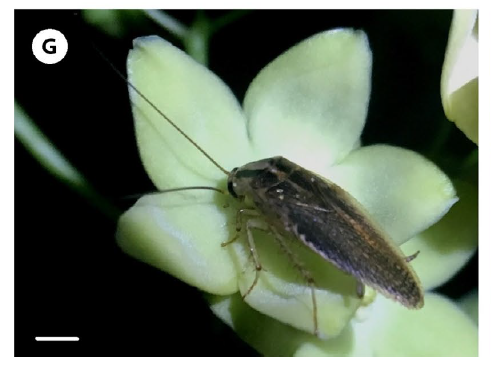
When you think of the word “pollinator” what comes to mind? For most people it will be bees, particularly the western honeybee (Apis mellifera). Some might also think of hoverflies, butterflies, moths, bats, hummingbirds…..but cockroaches?! The first published example that I know of which demonstrated that the flowers of a plant are specialised for cockroach pollination is from the mid-1990s. Since then only a handful of well documented cases have come to light, but there are undoubtedly more out there waiting to be discovered, particularly in the wet tropics. Most of the c. 4,600 species of cockroaches are nocturnal, and cockroach-pollinated flowers tend to open at night, which is one reason why they are under documented.
In a new study, published this week in the American Journal of Botany, a team of Chinese, German and British biologists has shown that a species of Apocynaceae from China is the first known example of cockroach pollination in that large family. Here’s the reference with a link to the study; if anyone wants a copy please email me:
Species of Apocynaceae are pollinated by a diverse assemblage of animals. Here we report the first record of specialized cockroach pollination in the family, involving an endangered climbing vine species, Vincetoxicum hainanense in China. Experiments were designed to provide direct proof of cockroach pollination and compare the effectiveness of other flower visitors.
Methods
We investigated the reproductive biology, pollination ecology, pollinaria removal, pollinia insertion, and fruit set following single visits by the most common insects. In addition, we reviewed reports of cockroaches as pollinators of other plants and analyzed the known pollination systems in Vincetoxicum in a phylogenetic context.
Results
The small, pale green flowers of V. hainanense opened during the night. The flowers were not autogamous, but were self‐compatible. Flower visitors included beetles, flies, ants and bush crickets, but the most effective pollinator was the cockroach Blattella bisignata, the only visitor that carried pollen between plants. Less frequent and effective pollinators are ants and Carabidae. Plants in this genus are predominantly pollinated by flies, moths and wasps.
Conclusions
Globally, only 11 plant species are known to be cockroach‐pollinated. Because their range of floral features encompass similarities and differences, defining a “cockroach pollination syndrome” is difficult. One commonality is that flowers are often visited by insects other than cockroaches, such as beetles, that vary in their significance as pollinators. Cockroach pollination is undoubtedly more widespread than previously thought and requires further attention.
Yesterday was my last day of employment at the University of Northampton, I have stepped down from my professorship to work independently. However I will be staying in touch as a Visiting Professor to complete some projects, supervise my remaining postgraduate researchers, and tidy up the last bits of our REF submission.
It’s been quite a journey over the last 25 years from Nene College > University College Northampton > University of Northampton. I’m proud to have played a part in its development and to have taught some great students along the way. I’ve also made some amazing friends and worked with incredible, talented colleagues. I will miss all of that, but it was time to move on.
So, what of the future? From today I am self-employed as a consultant scientist and writer, focusing on the conservation of pollinators and their plants in our rapidly changing world. No amount of pandemics, Brexits, and American elections can hide the fact that we are having a devastating effect on the nature we rely on to put food on our plates and air in our lungs. The rest of my career is going to be focused on working with individuals and organisations to help to reduce our impact and restore nature.
My philosophy for this is to use the science that I have spent more than 30 years researching and developing, and apply it to the conservation of pollinators and their interactions with plants. At the same time I will continue to take a pragmatic and down to earth approach to thinking about the science that I publish from the perspective of the knowledge and understanding that conservation professionals require to do their work. Some of this is detailed in my book Pollinators & Pollination: Nature and Society (which I hope will be in the shops before Christmas!) but by no means all of it.
Over the next couple of weeks the format of this website will change as I develop it to become more of a shop window for the work I do and the services that I offer. Watch this space!
2025 UPDATE: After a couple of years of experimentation I’ve decided that 5% salt is about right. Anything less than about 4% leads to some alcoholic off flavours, and anything more than 6% is salty overkill.
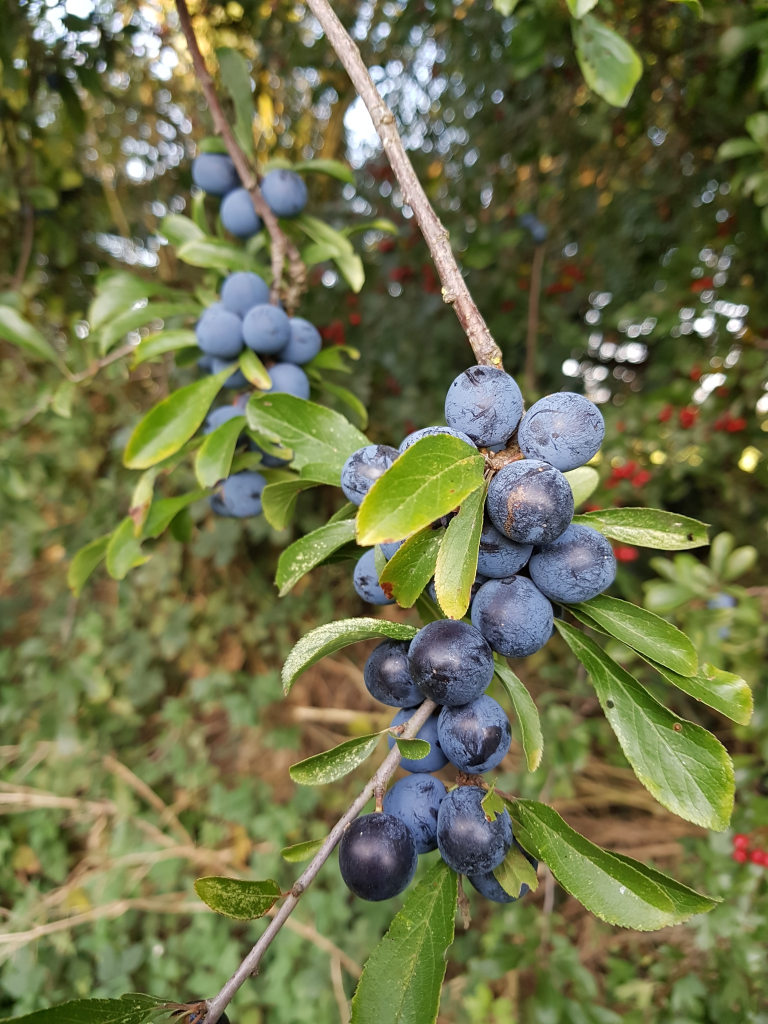
It has been an exceptional year for wild fruit of all kinds and British hedgerows are painted crimson by hawthorn berries, with splashes of purple-black where the sloes hang in succulent bunches. Sloes are, of course, the fruit of the blackthorn tree (Prunus spinosa) and are perfectly edible. In fact blackthorn is one of the progenitor species for cultivated plums. In Britain we tend to associate sloes with sloe gin. But, if you follow this link, you’ll see that there are lots of other edible uses for the fruit. However sloes are notoriously astringent so they need to be processed in some way before they are palatable.
Fermentation talks a lot about lacto-fermentation in which salt is used to prevent the growth of “bad” fungi and bacteria and promote the growth of Lactobacillus. These “good” bacteria then ferment the sugars in fruit and vegetables, releasing lactic acid and increasing the edibility and digestibility of the foodstuffs. Sauerkraut is a good example of this process in action. As well as salt you have to exclude air to make the process at least partially anaerobic.
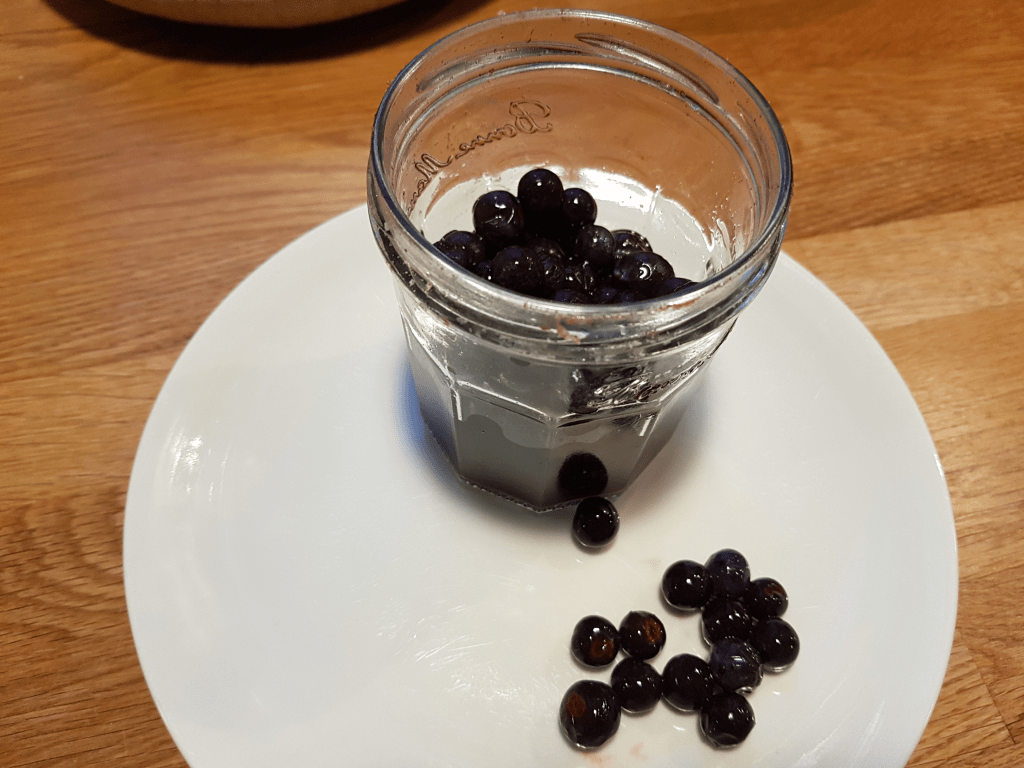
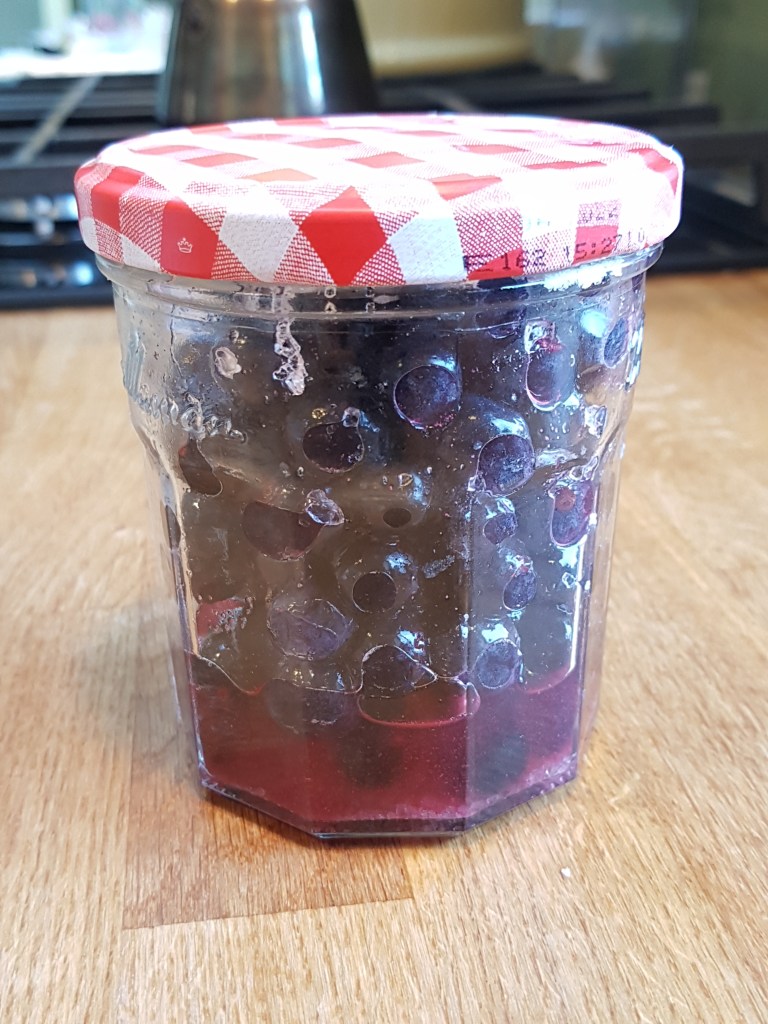
After a bit of reading I experimented with a basic recipe to lacto-ferment sloes to turn them into something resembling the flavoursome wonders that are umeboshi plums. And do you know, it worked! Lacto-fermenting the sloes transforms their flavour from mouth-puckeringly astringent to sour-and-salty.
Here’s the procedure:
Pick your sloes before they are frosted, discarding any that are shriveled or have been damaged by insects or fungi. Immediately wash them to get rid of any dust and rescue the spiders and other invertebrates that are bound to be flushed off! Put the sloes to one side.
Wash and rinse a glass jar with a tight fitting lid, which is equal to the capacity of the sloes but no more, i.e. you want the sloes to fill it to the top. Sterilisation shouldn’t be necessary as the conditions inside will not be suitable for growth of anything other than the Lactobacillus. But it’s best to rinse out any detergent.
Weigh the sloes and then weigh enough fine sea or rock salt to equal 8% of the weight of the sloes. In other words, for every 100 grams of sloes, you need 8 grams of salt*. Don’t use standard table salt as it usually contains chemicals of various kinds.
Add about a quarter of the sloes to the jar and then sprinkle in a quarter of the salt, put the lid on and invert it a couple of times to distribute the salt. Add another quarter of sloes and salt and invert again. Repeat until you have filled the jar with sloes and salt.
Put the lid on tightly, write the date on the jar or on a label, and put in a cupboard or shelf away from direct light. It’s best to stand the jar on a plate to catch any of the liquor that may come out of the fruit.
Invert the jar a couple of times once a day to keep the salt distributed over the sloes. After a few days a purple liquid will start to build up. This is the water from the sloes being drawn out by osmosis. After four or five days open the jar and try one or two sloes. If you like the flavour, put the jar in the fridge to stop the fermentation. Otherwise let them ferment until the flavour suits you.
At the moment I am just snacking on these sloes but I am sure they could be used in recipes that require a salty-sour note. The liquor that builds up in the jar could also be used to flavour dishes or as the basis for a salad dressing.
*8% salt was based on something that I read which I can’t now find and might be overkill. I am going to try it with 2% to 4% salt and see if that works.
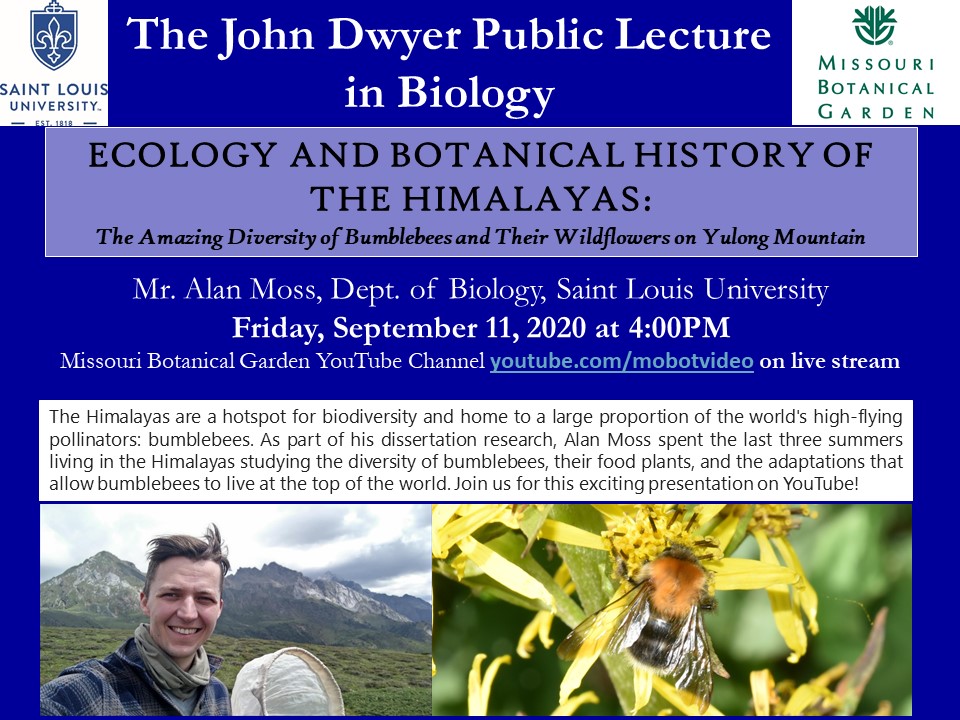
The Missouri Botanical Garden’s annual John Dwyer Public Lecture in Biology for 2020 that I highlighted in a post last month is now available to view on YouTube – follow this link.
The talk by Alan Moss of Saint Louis University is called: “Ecology and Botanical History of the Himalayas: The Amazing Diversity of Bumblebees and Their Wildflowers on Yulong Mountain”.
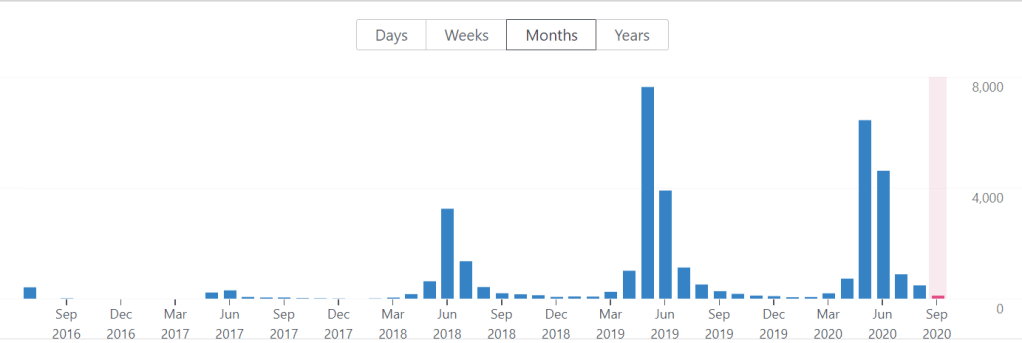
I conclude that Leather (2020) is correct in his assertion that insect-related posts such as these “show a correlation (OK, not tested) with the time of year associated with the appropriate part of the life cycle”. Furthermore, one of the research councils should give us a wodge of cash to explore this phenomenon in more detail*
—————————————————————————————————————–
*Only slightly tongue-in-cheek – I think that Simon’s results and those above are telling us something quite interesting about the ways in which people engage with insects throughout the year. Check out Simon’s piece for a fuller discussion of the phenomenon.


 Prof. Jeff Ollerton - ecological scientist and author