Category Archives: Bats

A new study shows how garden flowers keep city pollinators flying all year round

When we think of cities, gardens might not be the first thing that comes to mind. But these green patches — whether in private yards, parks, or balconies — play a surprisingly important role in supporting urban wildlife. Among their most crucial guests? Pollinators like bees, butterflies, and even birds and bats.

In a new study just published, I teamed up with some Brazilian colleagues to explore how the different features of garden flowers help sustain pollinators throughout the year in a subtropical urban garden. While we’ve long known that garden flowers provide food for pollinators, what’s less clear is how specific floral traits — like shape, flowering time, and type of nectar or pollen — influence who visits which plants and when.

To get a clearer picture, we conducted weekly surveys of pollinators visiting garden flowers over the course of a year. We paid close attention to traits such as the depth of flower, the kind of resources offered (nectar vs. pollen), how closely related different plants were, and when they flowered.

What we found was striking: the network of interactions between flowers and pollinators was highly organized. Plants grouped into clusters, or “modules,” that tended to share similar physical traits and evolutionary histories — but interestingly, not the same flowering times. This meant that within each module, different plants flowered at different times of year, effectively staggering their blooms so that there was always something on offer for pollinators.

Even more intriguing was the discovery that most plants had just a few connections in the network, usually restricted to a single module. These “peripheral” plants accounted for over 85% of all pollinator visits. Meanwhile, a few special species acted as bridges between modules — their role in linking different parts of the network made them key to its stability. These connector species didn’t flower at the same time, which helped to maintain a steady supply of food for pollinators across seasons.

Not all interactions between plants and pollinators are “legitimate” in the sense of leading to pollination. Some animals visit flowers just for the food, without helping with reproduction. But our study found that these interactions still played a valuable role in supporting a diverse pollinator community.

So what does all this mean for urban gardeners and city planners?

First, it highlights how important it is to plant a variety of flowers that bloom at different times of year. Second, it shows that even seemingly minor plants or interactions can contribute to the ecological resilience of urban green spaces. And finally, it underscores that thoughtful planting — considering things like flower shape, blooming schedules, and diversity — can help keep pollinators thriving, even in the heart of the city.

Urban gardens aren’t just pretty — they’re powerful allies in the fight to support biodiversity.

The study was led by Brazilian research student Luis de Sousa Perugini. Here’s the reference with a link to the paper:

de Sousa Perugini, L.G., Jorge, L.R., Ollerton, J., Milaneze‑Gutierre, M.A. & Rech, A.R. (2025) High modularity of plant-pollinator interactions in an urban garden is driven by phenological continuity and flower morphology. Urban Ecosystems 28, 126

Here’s the abstract:

Garden flowers play a vital role in urban environments, supporting pollinator communities. Yet, the extent to which floral traits shape urban pollination networks remains poorly understood. This study investigated how garden plants shape year-round pollination networks, sampled in weekly surveys in an urban subtropical garden. We focused on the role of floral morphology (corolla depth), type of resource, relatedness, and phenology in the organization of interactions. We determined whether modularity and species roles were influenced by these floral traits, comparing if legitimate pollination, illegitimate (i.e. non-pollinating) interactions and all interactions had similar drivers. All networks were modular, and in the overall network plants within the same module were morphologically and phylogenetically similar while their phenology was significantly overdispersed throughout the year. Peripheral species, those with few interactions and restricted to a single module, dominated all networks, representing over 85% of interactions. We found that phenology was related to the species role of overall network connectors (species that connect modules) and legitimate module hubs (species that connect their own modules). Both showed no overlap in their flowering periods, providing floral resources at different times of the year. Each module functioned as a distinct unit, showing year-round availability of resources to support its pollinators. This suggests that resource continuity and trait-based filtering may shape pollinator assemblages influencing ecological resilience in urban habitats. Even interactions that do not contribute to plant reproduction can sustain a diverse fauna, highlighting the importance of these interactions in urban green space planning and management.

Is Common Elder an under-appreciated habitat for bats? [updated]

Regular readers of my blog may recall that I have an obsession with something of an interest in Common Elder (Sambucus nigra) that goes back to my childhood, as I recounted in an article for British Wildlife back in 2022. In that article I mentioned that the larger hollow trunks and branches of elder “can offer nesting opportunities for birds and small mammals”, but didn’t go into detail. The mammals I was thinking of at the time were small rodents, but following a long country walk with Karin recently I wondered whether bats might also make use of these hollows as roosts for breeding and/or hibernation.

I posed this as a question for the bat specialists in the British Ecologists Facebook Group and received several replies, with respondents mentioning that they had encountered Natterer’s Bat (Myotis nattereri), Common Pipistrelles (Pipistrellus pipistrellus), and Brown Long-eared Bat (Plecotus auritus), in hollow elder trees, during summer and autumn surveys.

A couple of people suggested that I check out Arbology’s Look-up Tool for the Bat Tree Habitat Key (BTHK) database which records trees that are used by bats, but to my surprise it returned the following message:

“There are no positive results which match your query.
This does not mean that bats won’t use the feature type in the species and habitat you have selected, but current data suggests that survey effort may be better focused on features which have a proven occupation”. 

The BTHK relies on bat surveyors adding their observations, but clearly no one has submitted records of bats in elder, despite the fact that we know they occur. This concerns me for two reasons.

Firstly, of all of our smaller native woodland edge and hedgerow trees, elder is (in my experience) the one most likely to have significant cavities in their trunks and branches. The specialists in the Facebook Group introduced me to the phrase “if they fit, they sit”, meaning that almost any cavity might contain bats, even quite low to the ground: one respondent mentioned that a friend had found two Common Pipistrelles during an autumn survey, in a dead elder stem less than ten centimeters in diameter at about one metre above ground level.

Secondly, it’s not unusual for old elder trees to be cut right to the ground or even removed completely during work on hedgerows. It’s a neglected, even despised native British tree that, as I noted in that British Wildlife article, is:

“generally considered by naturalists, when it is considered at all, as rather boring, so commonplace that we hardly give it a second glance…[and by some as]…’barely a tree at all, more of a weed'”

Another respondent mentioned that ​tubular structures, such as elder branches, are less likely to be identified as active bat roosts in the absence of bats, as they provide limited shelter and often lack droppings, which tend to fall out, leaving minimal evidence. I’m sure that’s not the whole story, however, I think it’s more likely that small trees generally are overlooked when it comes to habitat for bats: the BTHK has a single entry for Common Hawthorn (Crataegus monogyna) and nothing for Blackthorn (Prunus spinosa), for instance.

In addition to bats, another respondent noted that Willow Tits (Poecile montanus), a species experiencing significant decline and now red-listed in the UK, often nest in elder trunks, where they excavate cavities in decaying wood. That’s yet another reason why we should pay more attention to this most interesting of trees!

My thanks to all of the British Ecologists who replied to my query. As always, feel free to comment or get in touch via my Contact page.

UPDATE: After I posted this on Bluesky, Richard Broughton, author of The Marsh Tit and the Willow Tit, pointed out that elder is also a significant nesting site for Marsh Tits (Poecile palustris), another red-listed species. To quote Richard’s comment:

“Elder is prob[ably] the very best cavity-bearing shrub, far better than hawthorn, hazel, blackthorn (very poor). Important nesting shrub for Marsh Tits & Willow Tits, but only if left to develop old trunks and cavities, not cut. Like Hazel, they self-coppice without management, with new growth from base….in Wytham Marsh Tit studies Elder was the main nest tree/shrub. Though it’s not common/available in woods everywhere. It develops *really* good hollow nest cavities for the small hole-nesting guild, and also very amenable for Willow Tits to excavate. Prob[ably] important in hedges, where holes rare.”

Richard kindly shared a scan from his book showing that for Willow Tits, elder ranks second (after willow and birch) and for Marsh Tits it ranks second after Ash.

No, the HS2 ‘bat tunnel’ has not cost £300,000 per bat

As I write I’m listening to the Radio 4 series AntiSocial with Adam Fleming and this week the topic is the economic and social cost of nature conservation. One of the topics being discussed is the so-called ‘bat tunnel’ being built through an area of ancient woodland in Buckinghamshire. The cost has been estimated at £100 million and, according to The Times, this amounts to £300,000 per bat protected. That’s clearly a lot of money to protect bats, but is it an accurate reflection of reality? The answer is no, and here’s why.

Let’s put aside the fact that the ‘bat tunnel’ will protect a lot of other wildlife associated with this area of ancient woodland, including other bat species and a range of additional mammals, birds and insects. Let’s also ignore the fact that the cost of the tunnel is so high because of decisions made by HS2 that have nothing to do with bats, such as making it wider to accommodate local train services. Let’s instead just focus on the type of bat that’s being specifically discussed, Bechstein’s bat. It is indeed a rare bat in Britain, known from just six breeding populations, all associated with ancient woodland (itself a rare habitat type in this country).

The population that the ‘bat tunnel’ protects is estimated to be 300 individuals – that’s where the figure of £300,000 per bat comes from, i.e. £100 million divided by 300 (actually £333,333 per bat, but let’s not quibble about a few tens of thousands of pounds when HS2 is going to cost tens of billions).

Anyone in possession of both a sense of proportion and some basic maths can see that such a calculation is nonsense. The tunnel will be in place for many decades, potentially hundreds of years. Over time bats will die and other bats will be born. Some will stay in the area and others will migrate away and (hopefully) found other populations, or at least add to the genetic diversity and growth of one of the other existing populations. Calculating the cost-per-bat on this basis is both impossible and nonsensical. But then making that initial calculation was also a pointless exercise. The only reason to do it was to generate publicity and clicks for a newspaper that ought to know better.

As I’ve previously discussed, the railway system of Britain and the rest of Europe has both a negative and a positive impact on biodiversity across the region, and understanding those impacts is important. Thoughtless, politically-motivated journalism such as The Times is promoting is not helpful.

(Before anyone asks, the photograph accompanying this post does NOT show the ‘bat tunnel’! It’s a tunnel in Tenerife, part of the network of water conduits that were built in the past and now provide homes for many of the resident bats)

What are the limits to pollinator diversity? A new article poses the question

The most globally significant groups of pollinators are well known and have been studied for a long time: bees and wasps, flies, butterflies and moths, birds, bats and beetles are all familiar to those of us with an interest in pollination ecology. However, every few years a new type of pollinator or a novel pollination system is described from nature or from the fossil record, or we add further examples of previously neglected pollinator groups such as cockroaches.

This begs the question: how much is there still to discover? How close are we to describing the full diversity of animals that act as pollen vectors? Can looking at the past help us to predict what we might find in the future? That’s the topic of a Perspective article that I was invited to write for the special issue of the Journal of Applied Entomology on the theme of  The Neglected Pollinators that I mentioned last month. It’s a subject that I’ve thought about a lot over the last few decades and it was great to get an opportunity to air some ideas and speculation.

The article is open access and you can download a copy by following the link in this reference:

Ollerton, J. (2024) What are the phylogenetic limits to pollinator diversity? Journal of Applied Entomology (in press)

Here’s the abstract:

Although huge progress has been made over the past 200 years in identifying the diversity of pollinators of angiosperms and other plants, new discoveries continue to be made each year, especially in tropical areas and in the fossil record. In this perspective article I address the following questions: Just how diverse are the pollinators and what are the phylogenetic limits to that diversity? Which other groups of animals, not currently known to regularly engage with flowers, might be found to be pollinators in the future? Can we predict, from the fossil record and from discoveries in under-researched parts of the world, which animal groups might turn out in the future to contain pollinators? I also discuss why adding to our knowledge of plant–pollinator interactions is important, but also stress that an incomplete knowledge may not be a bad thing if it means that remote, inaccessible and relatively pristine parts of the world remain that way.

The one thing I wish more people understood about flower pollination

Obviously the title of this post is click-bait, as there’s LOTS of things that I wish more people knew about pollination! But here’s one that really gets my (Yule) goat.

I’ve lost track of the number of times that I’ve read statements in books and research papers such as “bees collect lots of pollen from flowers therefore they are good pollinators”. Even worse, I sometimes see studies where pollen has been removed from “pollen baskets” or other scopae, then used as a measure of the importance of those bees as pollinators.

In both cases it seems to have been forgotten that bees are collecting pollen to feed their larvae and pollen that ends up in scopae is generally not available for pollination.

That’s the purpose of the Venn diagram at the top of this short post, to remind us that there can be a disconnect between what bees are doing and what plants require: foraging for pollen only partly correlates with flower pollination. Indeed, the same argument applies to any animal that feeds itself or its young on pollen, including pollen wasps (Maserinae), Heliconia butterflies, and some flower-visiting hoverflies, birds and bats.

It’s not only loss of pollen from reproduction that’s important here: depending on the size and behaviour of the bees relative to the shape and size of the flower, they may go nowhere near the stigma, so even if they are carrying viable pollen, it can be lost as far as the plant is concerned.

Note also that many bee species will collect pollen from wind-pollinated plants such as grasses, oaks, etc. Indeed in some species the availability of such pollen is extremely important – see Manu Saunders’ review on this topic and more recent papers that cite it. Again, it emphasises the partial disconnect between pollen collecting by bees and pollination of flowers by bees.

Assessing which flower visitors are actually pollinators is not technically demanding but it can be time consuming. The minimum that you need is single visit deposition (SVD) experiments in which you expose unvisited flowers to one visit by the potential pollinator. Then you assess how much pollen has landed on the stigma or (better) whether the visit results in seed set.

If you want to know more about the evidence that’s required to determine if a flower visitor is or is not a pollinator, they are codified in the “Cox-Knox Postulates” that I discuss in my book Pollinators & Pollination: Nature and Society.

Are cactus pollination systems more specialised in the tropics? A new study suggests yes…and no!

The question of whether interactions between different species are more specialised in tropical environments (as theory predicts) has intrigued me for a couple of decades. In fact it’s just occurred to me that August 2022 was the 20th anniversary of my paper in Oikos co-authored with Louise Cranmer entitled: Latitudinal trends in plant-pollinator interactions: are tropical plants more specialised? That paper was one of the first to seriously challenge an idea that was long-embedded in the scientific and (especially) popular literature, that tropical ecology was in a sense “special” and that the ways in which species parasitised, consumed, or engaged in mutualistic relationships in the tropics was different to what was happening in the subtropics and temperate zones.

Since then I’ve written about this subject in a number of publications, most recently in my book Pollinators & Pollination: Nature and Society and it’s inspired some other researchers to address the topic.

One of the real challenges with asking questions about how plant-pollinator relationships change over large geographical areas is obtaining good, robust data to analyse. It’s a challenge to convince science funding agencies to give money to spend many years travelling the world and collecting the kind of data that are needed. However we can gain some idea of the patterns, and potential processes, that drive the macroecology of plant-pollinator interactions by piecing together databases of interactions for particular taxa, gleaned from published and unpublished sources.

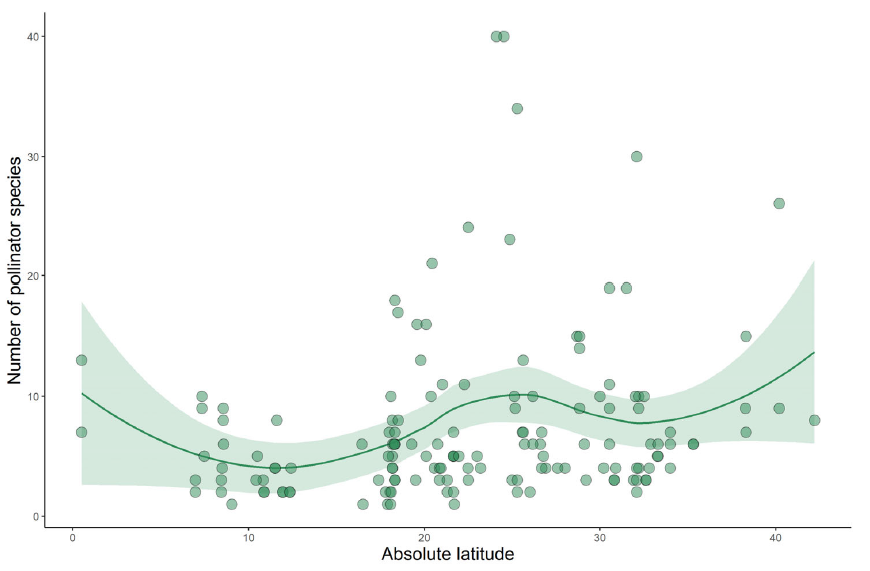
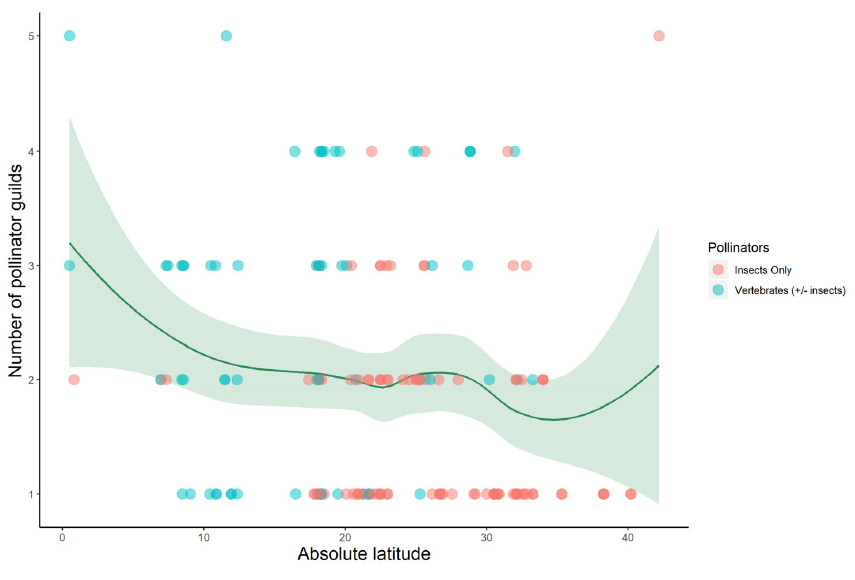
That’s what we have done for the family Cactaceae in a new study led by Pablo Gorostiague from the Universidad Nacional de Salta in Argentina. This collaboration started when Pablo visited Northampton back in 2018 and spent some time with my research group, including helping out with field work in Tenerife. Since then the usual issues (work, COVID, etc.) have delayed publication of our paper, but now it’s finally out. Amongst other results we find that, yes, tropical cacti are pollinated by fewer species on average (though it’s hugely variable – see the figure above) but that functional specialisation (i.e. the number of pollinator guilds that are used by species) is no different in the tropics compared to the extra-tropics (that’s the figure at the end of this post).

The full reference with a link to the paper is below; if anyone wants a PDF, please send me a message via the Contact page:

Gorostiague, P., Ollerton, J. and Ortega-Baes, P. (2022) Latitudinal gradients in biotic interactions: Are cacti pollination systems more specialized in the tropics? Plant Biology https://doi.org/10.1111/plb.13450

Here’s the abstract:

Biotic interactions are said to be more specialized in the tropics, and this was also proposed for the pollination systems of columnar cacti from North America. However, this has not yet been tested for a wider set of cactus species. Here, we use the available information about pollination in the Cactaceae to explore the geographic patterns of this mutualistic interaction, and test if there is a latitudinal gradient in its degree of specialization.

We performed a bibliographic search of all publications on the pollination of cacti species and summarized the information to build a database. We used generalized linear models to evaluate if the degree of specialization in cacti pollination systems is affected by latitude, using two different measures: the number of pollinator guilds (functional specialization) and the number of pollinator species (ecological specialization).

Our database contained information about the pollination of 148 species. The most frequent pollinator guilds were bees, birds, moths and bats. There was no apparent effect of latitude on the number of guilds that pollinate a cactus species. However, latitude had a small but significant effect on the number of pollinator species that service a given cactus species.

Bees are found as pollinators of most cactus species, along a wide latitudinal gradient. Bat and bird pollination is more common in the tropics than in the extra-tropics. The available information suggests that cacti pollination systems are slightly more ecologically specialized in the tropics, but it does not support any trend with regard to functional specialization.

Tracking trends in Neotropical pollinators: how good is our understanding and is more data always better?

In my recent book Pollinators & Pollination: Nature and Society I discussed the current state of our knowledge of how populations of pollinators have changed over time. Although we have some quite detailed data for particular, often charismatic, species or for certain geographic localities or regions, for most species we know almost nothing. As I wrote in the chapter “The shifting fates of pollinators”:

“For most pollinators we are ‘data deficient’, in other words, we don’t know how their populations are performing. They could be doing well, but they may not be”

This is particularly true for those regions for the world that hold the greatest terrestrial biodiversity: the tropics. For the vast majority of species in the tropics we know precious little about trends in their populations and how their distributions have changed over time in the face of wide-scale land transformation and recent climatic shifts. Filling in some of the gaps in our knowledge of Neotropical pollinator distributions is one of its aims of SURPASS2, a collaboration between South American and UK ecologists, and one of several research and outreach projects with which I’m involved.

In a new study that’s come out of that work, led by Rob Boyd from the UK Centre for Ecology and Hydrology, we’ve used the GBIF database to look at the changing distributions of four important groups of pollinators: bees, hoverflies, leaf-nosed bats and hummingbirds. In particular we were interested in understanding the kinds of biases that come with such publicly available data, and whether recent efforts to add data to GBIF has improved our understanding of trends.

Our overall conclusion is that there are significant limitations and biases inherent in all of these data sets even for groups like hummingbirds which one would imagine are well documented by scientists and bird-watching naturalists. In addition, having more data does not necessarily help matters: it can introduce its own biases.

The paper is open access and feely available; here’s the reference with a link:

Boyd, R. J., Aizen, M.A., Barahona-Segovia, R.M., Flores-Prado, L., Fontúrbel, F.E., Francoy, T.M., Lopez-Aliste, M., Martinez, L., Morales, C.L., Ollerton, J., Pescott, O.L., Powney, G.D., Saraiva, A.M., Schmucki, R., Zattara, E.E., & Carvell, C. (2022) Inferring trends in pollinator distributions across the Neotropics from publicly available data remains challenging despite mobilization efforts. Diversity and Distributions (in press)

Here’s the abstract:

Aim
Aggregated species occurrence data are increasingly accessible through public databases for the analysis of temporal trends in the geographic distributions of species. However, biases in these data present challenges for statistical inference. We assessed potential biases in data available through GBIF on the occurrences of four flower-visiting taxa: bees (Anthophila), hoverflies (Syrphidae), leaf-nosed bats (Phyllostomidae) and hummingbirds (Trochilidae). We also assessed whether and to what extent data mobilization efforts improved our ability to estimate trends in species’ distributions.

Location
The Neotropics.

Methods
We used five data-driven heuristics to screen the data for potential geographic, temporal and taxonomic biases. We began with a continental-scale assessment of the data for all four taxa. We then identified two recent data mobilization efforts (2021) that drastically increased the quantity of records of bees collected in Chile available through GBIF. We compared the dataset before and after the addition of these new records in terms of their biases and estimated trends in species’ distributions.

Results
We found evidence of potential sampling biases for all taxa. The addition of newly-mobilized records of bees in Chile decreased some biases but introduced others. Despite increasing the quantity of data for bees in Chile sixfold, estimates of trends in species’ distributions derived using the postmobilization dataset were broadly similar to what would have been estimated before their introduction, albeit more precise.

Main conclusions
Our results highlight the challenges associated with drawing robust inferences about trends in species’ distributions using publicly available data. Mobilizing historic records will not always enable trend estimation because more data do not necessarily equal less bias. Analysts should carefully assess their data before conducting analyses: this might enable the estimation of more robust trends and help to identify strategies for effective data mobilization. Our study also reinforces the need for targeted monitoring of pollinators worldwide.

——————————————————–

SURPASS2 has been a hugely productive project as you’ll see if you look at the Publications page of the website. There’s much more to come and I’ll report on those research papers as they appear.