Today I returned the final, edited files of the book manuscript to the publisher. It’s been a long summer of ‘fine distinctions and nice judgements’, to quote my editor, the inimitable Hugh Brazier. Now that’s all finalised, I thought that it was time to share the chapter titles with you – here goes:
Introduction: Encounters with birds and flowers
1 Origins of a partnership
Understanding 50 million years of bird and flower evolution
2 Surprising variety
The astounding diversity of pollinating birds
3 Keeping it in the family
Accounts of the different groups of bird pollinators
4 A flower’s point of view
How many plants are bird-pollinated, and where are they found?
5 In the eye of the beholder
What do bird flowers look like?
6 Goods and services
The enticements given to birds for pollinating flowers
7 Misaligned interests
The ongoing conflicts between flowers and birds
8 Senses and sensitivities
How bird brains shape the flowers that they pollinate
9 Codependent connections
Networks of interacting flowers and birds
10 Hitchhikers, drunks and killers
The other actors in the network and how they affect the main players
11 The limits to specialisation
How ‘specialised’ are the relationships between birds and flowers?
12 Islands in the sea, islands in the sky
Isolation, in oceans or in mountains, results in some remarkable interactions
13 The curious case of Europe
Why did we believe that Europe had no bird-pollinated flowers?
14 ‘After the Manner of Bees’
The origins of our understanding of birds as pollinators, and their cultural associations
15 Feathers and fruits
Birds as pollinators of edible wild plants and domesticated crops
16 Urban flowers for urban birds
Bird pollination in cities and gardens
17 Bad birds and feral flowers
The impact of invasive species
18 What escapes the eye
The decline and extinction of bird–flower relationships
19 The restoration of hope
People as conservationists of birds and their flowers
There you have it! I’m incredibly excited that the book is now just about finished (I still have to proof read the typeset text and produce an index) and I look forward to finally having a copy in my hands. Birds & Flowers: An Intimate 50 Million Year Relationship is available for pre-order from Pelagic Publishing, or via online bookshops.
A pollination ecologist was recently working on the reproduction of a tropical plant species and discovered that the flowers were visited by two species of weevils, one large and one small.
The larger weevil was too big to access the nectar from the front, so it chewed its way into the flowers, destroying the petals, and in the process picking up no pollen.
The other weevil species was, however, able to enter the flowers, where it became smeared with pollen, which it then transferred to the stigmas in flowers of other plants.
The pollination ecologist therefore concluded that the true pollinator of this plant was, indeed, the lesser of the two weevils…
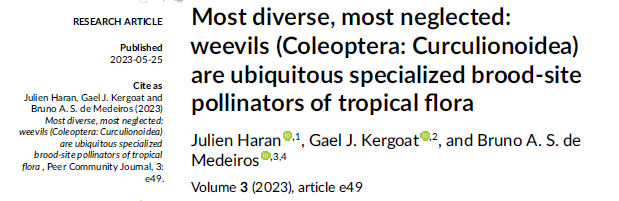
Writing in the open access Peer Community Journal, Julien Haran, Gael Kergoat, and Bruno de Medeiros have produced a really fascinating review of weevil pollination called:
Weevils are beetles, members of the superfamily Curculionoidea, which contains an estimated 97,000 species. Many are herbivores, including seed predators – I first encountered them as a researcher during my PhD when I assessed the impact of one species as a seed predator of my study plant Bird’s-foot Trefoil. Surprisingly, however, pollinating relationships have evolved multiple times between weevils and plants. Drawing on published studies and their own unpublished observations, the authors conclude that such “associations have been described or indicated in no less than 600 instances.” Most of these are brood-site pollination systems that have probably evolved from seed predation relationships.
No doubt many more examples of weevil pollination remain to be discovered but as it stands, this review paper is a great summary of a fascinating and still rather neglected corner of pollination ecology.
But just as when a movie director says “That’s a wrap” at the end of the final day of filming, the hard work does not stop here. Two people have read the full manuscript as I was producing chapters and their suggestions have been incorporated into this draft. The publisher will now send it to a third, independent beta reader and once their feedback has been acted on it will go to a copy editor who will suggest stylistic changes, check for logic and consistency, and so forth.
At the same time I will be choosing which plates to put in the book, which images to use on the back cover, writing their descriptions and deciding where to cite them; checking the sources and further reading sections for each chapter and formatting the references; and producing an appendix that lists the scientific names against the vernacular names that I am using in the book. I also need to finalise the acknowledgements section.
As an author, producing a book is a long process that doesn’t end with the actual writing of the manuscript. It’s incredibly satisfying, however, and working with Pelagic on my second book for them has been a great experience. All being well, Birds & Flowers should be out by early winter.
Now, I have three options for the next book that I’m writing….which one to choose…?
As part of our roles as ambassadors of the new conservation organisation Restore (more of which later this year), several of us including Dave Goulson, George McGavin, and myself, are promoting this online petition to get the government to take the issue of neonicotinoid pesticides seriously. Here’s some text from Dave explaining the situation with a link to a petition that you can sign:
“For three years in a row our government has granted farmers special permission to use banned neonicotinoid pesticides on sugar beet. This is contrary to the expert advice of their own Expert Committee on Pesticides, who specifically recommended that permission should not be granted. It also flies in the face of a huge body of scientific evidence showing that these chemicals are phenomenally toxic to all insect life, and that their use on any crop contaminates soils, hedgerow plants, and nearby streams and ponds for years to come. We are in a crisis, with insect populations in freefall. It is about time our government woke up to this, and acted accordingly. This petition https://petition.parliament.uk/petitions/631948 is a necessary means of holding the government to account. Please sign and share, as signing will ensure the issue is debated in Parliament.”
This petition now has more than 15,000 signatures which ensures that it gets a response from the Government. If it reaches 100,000 mark, it will trigger a debate in Parliament. Please sign and promote this important initiative!
For the past year I’ve been keeping a secret from all but a few trusted confidantes: the subject and title of my next book! My publisher – Pelagic – has now announced it on their website and so it’s time to make it public. “Birds & Flowers: An Intimate 50 Million Year Relationship” will be the first book that covers bird pollination in its entirety, going beyond just hummingbirds, sunbirds and honeyeaters, to consider the more than 60 other bird families that interact with flowers, and the tens of thousands of plants that rely on them as pollinators. You can read more about it on Pelagic’s website.
The 3D mock-up of the cover shown above features an illustration by my good friend Stephen Valentine, a very talented artist who you may remember produced this painting of waxwings that Karin bought for my birthday a few years ago. I’m extremely pleased with how Pelagic have incorporated this into the design of the cover.
The book will be available by autumn I hope, if my writing schedule goes to plan!
It’s been a couple of years since I last did a talk or workshop for the Wildlife Trust for Bedfordshire, Cambridgeshire & Northamptonshire. But I’m pleased to say that they’ve invited me back and you can join me tomorrow evening for an online introductory talk about pollinators and pollination in the UK.
The talk starts at 7pm UK time and full details of how to sign up are in the link below:
Note: This is a guest blog post by Guthrie Allen who is a PhD candidate at the University of East Anglia.
Though often overlooked, woodlands have great potential to support wild bees in farmed landscapes. Both the understory and canopy can provide large quantities of early-season nectar. The pollen of woodland-tree taxa such as Acer can form a large proportion of the early-season diets of bumblebees and solitary bees. Even the pollen from wind-pollinated trees such as Quercus can form a significant part of the diets of several common solitary bee species. Woodlands are also believed to provide ample nesting opportunities. These factors may explain why several studies have found positive correlations between bee abundance and/or diversity and woodland cover at the landscape scale. Despite this, a large-scale European study has shown that interior woodland understories support very few bees compared to exposed woodland edges.
Sampling the canopy – at heights of up to 20 metres – is not easy, but unlike the understory, this habitat remains sun-exposed after canopy closure and could be favourable for bees. In Europe, however, our knowledge of bee activity in the woodland canopy is very limited. Furthermore, whilst canopy-tree taxa have been identified as suitable food sources for many bees, we have little evidence that these trees are used for forage when located within woodlands. To explore the role of the canopy, we trapped bees in late spring in the understory and canopy – at the exposed edges and in the interiors – of 15 woodland sites across an English agricultural landscape.
A significant proportion of bee abundance was found in the canopy, represented by 23 of the 29 total sampled species. Interior canopy activity was much higher when nectar-producing Sycamore (Acer pseudoplatanus) trees were nearby. Communities differed between the canopy and understory: of the seven most common species sampled, three were more active in the understory, while the opposite was true of one species – Bombus lapidarius. Interestingly, we found the sex ratio of the most abundant species – B. pratorum – to be female-skewed in the canopy. For four of these species, and contrary to expectations, we found no evidence that understory activity was any higher at woodland edges compared to woodland interiors.
Further research is needed to understand community differences between the canopy and understory. Nonetheless, our results suggest that both these habitats have a significant role to play in supporting farmland bees. We demonstrate that a diverse bee community has the potential to exploit canopy resources, with nectar-producing trees in woodland interiors likely to provide forage for many bees. And we show the unexpected potential of interior woodland understories to support bee abundance.
Here’s the full reference with a link to the open access paper:
Allen, G. & Davies, R.G. (2022) Canopy sampling reveals hidden potential value of woodland trees for wild bee assemblages. Insect Conservation and Diversity. Available from: https://doi.org/10.1111/icad.12606
Here’s the abstract:
Woodlands can play an important role in supporting bee abundance and diversity in agricultural landscapes. However, in temperate-region studies, the canopy is rarely sampled, and our understanding of its contribution is limited. To explore this, we sampled bees in late spring with blue vane traps in the understory (n = 30) and crowns of mature Quercus robur (n = 35) at the exposed southern edges and in the interiors (ca. 25–75 m from woodland edges) of 15 woodland sites across an English agricultural landscape. A significant proportion of bee abundance and diversity was found in the canopy: canopy-trap catches were estimated to be a third as large as understory-trap catches, and 23 of the 29 sampled species were present in the canopy. Of the seven most common species sampled, four were equally abundant in woodland edge and interior traps; three were more abundant in understory traps, and a single species—Bombus lapidarius—was more abundant in canopy traps. The sex ratio of the most abundant species, B. pratorum, was female-skewed in the canopy. Additionally, the presence of nearby Acer pseudoplatanus trees in flower greatly increased canopy-trap catches in woodland interiors. These results suggest that both the woodland canopy and understory have a significant role to play in supporting farmland bee communities; they indicate the importance of nectar-producing trees in woodland interiors, opening avenues for canopy-based management; and they demonstrate that a diverse bee community has the potential to exploit canopy floral resources.
Within the last decade there’s been a growing awareness of the importance of urban environments for supporting populations of pollinators, especially bees. Indeed, I devoted a whole chapter of my book Pollinators & Pollination: Nature and Society to the topic, though even then I was only able to scratch the surface of the research that’s been done. Since then there’s been some important studies published and this 2020 review by Kath Baldock provides a good starting point for the topic, whilst a recent pre-print by Pietro Maruyama and colleagues emphasises how little we know about pollinators in tropical cities.
One of the most detailed studies of urban solitary bees in a British town was conducted by Muzafar Sirohi when he was a PhD researcher in my department in Northampton. The first paper from that work, documenting the diversity and abundance of bees, came out in 2015, but since then commitments to other projects, plus Muzafar’s return to his university in Pakistan, have meant that we’ve struggled to find the time to publish more. Hopefully that’s changing and the second publication from Muzafar’s thesis is now out, with a third in progress.
This new paper uses a network approach to study the use of flowers by these bees; here’s the reference with a link to a read-only copy of the paper, followed by the abstract.
Biodiversity is declining through human activities and urbanisation is often seen as a particular concern. Urban settings, however, provide diverse microclimatic conditions for plants and pollinating insects, and therefore may be significant habitats for the conservation of solitary and primitively eusocial bees, a major group of pollinators. This study analysed the interactions between these bees and the plants on which they forage, using a network approach. We compared urban habitats (gardens, roadsides, and open vegetation) in a large British town with nearby nature reserves. One native plant Taraxacum officinale (dandelion) was a core generalist species visited in all habitat types. Other core plant species restricted to particular habitats include species of Geranium, Bellis, Crepis, and Ranunculus. Two generalist bee species, Anthophora plumipes and Osmia bicornis were the core visitor species within the networks. The networks were comparatively more nested in urban habitat types than nature areas, suggesting more frequent interactions between generalist and specialist species in urban areas. Network connectance, network level specialisation (H2’ index), and plant generality (network level) were not significantly different in urban and nature areas. However, visitor generality was found to be significantly higher in urban gardens than in nature areas. Careful management of common urban vegetation would be beneficial for supporting urban wild pollinators.
One of the projects with which I’ve been involved over the past few years has been a collaboration with researchers at Imperial College and the Natural History Museum, alongside regional collections in the UK, to assess how museum specimens of bumblebees (Bombus spp.) can be used to look at long-term ecological changes in pollinator populations. The first two papers from that project were published in August but because of my trip to Kenya I’ve only now been able to post about them.
The details of the papers (both of which are open access and free to download) are below, followed by the official press release:
Arce, A., Cantwell-Jones, A., Tansley, M., Barnes, I., Brace, S., Mullin, V., Notton, D., Ollerton, J., Eatough, E., Rhodes, M., Bian, X., Hogan, J., Hunter, T., Jackson, S., Whiffin, A., Blagoderov, V., Broad, G., Judd, S., Kokkini, P., Livermore, L., Dixit, M., Pearse, W. & Gill, R. (2022) Signatures of increasing environmental stress in bumblebee wings over the past century: Insights from museum specimens. Journal of Animal Ecology 00, 1– 13. https://doi.org/10.1111/1365-2656.13788
Mullin, V. E., Stephen, W., Arce, A. N., Nash, W., Raine, C., Notton, D. G., Whiffin, A., Blagderov, V., Gharbi, K., Hogan, J., Hunter, T., Irish, N., Jackson, S., Judd, S., Watkins, C., Haerty, W., Ollerton, J., Brace, S., Gill, R. J., & Barnes, I. (2022). First large-scale quantification study of DNA preservation in insects from natural history collections using genome-wide sequencing. Methods in Ecology and Evolution, 00, 1– 12. https://doi.org/10.1111/2041-210X.13945
OFFICIAL PRESS RELEASE: Museum collections indicate bees increasingly stressed by changes in climate over the past 100 years
• An analysis of bumblebee wings from a network of UK museums shows signs of stress linked to increasingly hotter and wetter conditions. • As well as revealing what is linked to stress in bees in the past, the study can help predict when and where bees will face most stress and potential decline in the future. • Bumblebees and other insect pollinators have faced population declines in recent years. • The researchers have also for the first time used ancient DNA techniques to sequence bumblebee genomes dating back over 100 years. Scientists from Imperial College London and the Natural History Museum today published two concurrent papers analysing UK bumblebee populations.
The first investigated the morphology (body shapes) of bee specimens dating back to 1900. Using digital images, the group first investigated the asymmetry in bumblebee wings as an indicator of stress. High asymmetry (very differently shaped right and left wings) indicates the bees experienced stress during development – an external factor that affected their normal growth.
Studying four UK bumblebee species, the group found evidence for stress getting higher as the century progressed from its lowest point around 1925. Further analysis showed that each bee species displayed a consistently higher proxy of stress in the latter half of the century.
Learning from the past to predict the future By taking the climate conditions during the year of collection – namely annual mean temperature and annual rainfall – the team found that in hotter and wetter years bees showed higher wing asymmetry. The study is published today in the Journal of Animal Ecology.
Author Aoife Cantwell-Jones, from the Department of Life Sciences (Silwood Park) at Imperial, said: “By using a proxy of stress visible on the bee’s external anatomy and caused by stress during development just days or weeks before, we can look to more accurately track factors placing populations under pressure through historic space and time.”
Author Dr Andres Arce, now at the University of Suffolk, stated: “Our goal is to better understand responses to specific environmental factors and learn from the past to predict the future. We hope to be able to forecast where and when bumblebees will be most at risk and target effective conservation action.”
Senior author Dr Richard Gill, from the Department of Life Sciences (Silwood Park) at Imperial, said: “With hotter and wetter conditions predicted to place bumblebees under higher stress, the fact these conditions will become more frequent under climate change means bumblebees may be in for a rough time over the 21st century.”
DNA from a single leg As well as measuring the wing shapes of bees, in a second parallel study the team successfully sequenced the genomes of over a hundred bumblebee museum specimens dating back more than 130 years. In a pioneering advance, ancient DNA methods typically used for studying woolly mammoths and ancient humans, were for the first time used on an insect population.
Scientists from the Natural History Museum and the Earlham Institute quantified DNA preservation using just a single bee leg from each of the bees studied to create a baseline genome for each of the four species.
From these developments, published today in Methods in Ecology & Evolution, the researchers can now look to determine how the reported stress may lead to genetic diversity loss.
In conjunction with providing a new reference genome, the team will now use this data to study how bee genomes have changed over time, gaining an understanding of how whole populations have adapted – or not – to changing environments.
The value of museum collections Focusing on bumblebee collections, the team worked with curators from the Natural History Museum London, National Museums Scotland, Oxford University Museum of Natural History, World Museum Liverpool, and Tullie House Museum Carlisle.
Author Dr Victoria Mullin, from the Natural History Museum, said: “Museum insect collections offer an unparalleled opportunity to directly study how the genomes of populations and species have been affected by environmental changes through time. However, they are a finite resource and understanding how best to utilise them for genetic studies is important.”
Senior author Professor Ian Barnes, from the Natural History Museum, said: “One of the main problems with museum collections is that the quality of DNA can be very variable, making it difficult to predict which type of analyses we should do. We now have a much better idea about DNA preservation in insect collections, which is a massive boost to our ongoing work to understand the history and future of insect populations.”
Dr Gill concluded: “These studies showcase the value of leveraging museums specimens to go back in time and unlock the past’s secrets. But what we have done is just the beginning, and by continuing our work with these vital public collections and collaborating with curators we can only discover more. All this work was part of a Natural Environment Research Council-funded project and could not have been achieved without the commitment, hard work, and diligence of the museum curators, and our other collaborators”.
Rail travel is my favourite form of transport and always has been. I like its slower pace and the fact that on a long journey you can sit back, read or work, and watch the landscape unfold. Not only that but it’s one of the most environmentally friendly types of mass transport. So when I was asked to be one of the lead authors on a report outlining how the European Rail Network can support biodiversity along its 230,000 km length, I was happy to be involved! And that’s one of the main projects that I’ve been working on over the past 12 months, during which I’ve researched the literature, written and revised drafts, and learned a huge amount about the ecology of the rail network!
The report, which was formally released yesterday, was commissioned by the International Union of Railways (Union Internationale des Chemins de Fer or UIC), founded in 1922 as the global industry body for rail transport. The writing and desk top research was led by the UK Centre for Ecology and Hydrology (CEH).
That’s not the end of my involvement, however: the next stage is a technical guide and I’m already starting to work on that. I will report back once it’s complete.