Tag Archives: Wildlife

New report on Colorado’s native insect pollinators just published – download a free copy

Yesterday I received an email containing the following press release. I thought it might interest readers of the blog so I am copying it in full with no edits. I had a quick look over the report and it’s amazingly detailed and comprehensive. It’s a shame that the report only covers insects, but that probably reflects my current bias given that my next book, due out in February, is about pollinating birds! Press release follows:

Governor Polis and the Department of Natural Resources Release Pollinator Report

BROOMFIELD – Today, Governor Polis in partnership with The Colorado Department of Natural Resources (DNR), Colorado State University Extension, Xerces Society for Invertebrate Conservation, and University of Colorado Museum of Natural History released the Colorado Native Pollinating Insects Health Study which is the most robust and detailed account of pollinator health ever undertaken in Colorado history. As directed by SB22-199, Native Pollinating Insects Protection Study, sponsored by Senators Sonya Jaquez Lewis and Kevin Priola, and Representatives Cathy Kipp and Meg Froelich, signed by Governor Polis on May 27, 2022, the study assesses the health of Colorado’s native pollinators, evaluates state policies for safeguarding pollinators, and makes recommendations on how to preserve and protect pollinators in Colorado. 
 

“Pollinators play a critical role in Colorado life. From Crested Butte’s beautiful spring meadows to Palisade Peaches and Rocky Ford melons, Colorado’s pollinators sustain our flora and enable many foundational industries in every corner of the state. As our climate changes, we must safeguard the pollinators that generate and regenerate the Colorful Colorado we love,” said Governor Polis 
 

Colorado is home to various native insects and bats whose pollinating services are at the heart of healthy environments and economies. Pollinators are critical to Colorado’s economy and our agricultural production and food systems, and they are essential for flowering plants that support the state’s wildlife ecosystem and add color to Colorado’s beautiful landscapes. 

“Colorado is fortunate to have a tremendous diversity of plants and animals, but pollinating insects are perhaps the least studied but most beneficial for our ecosystems, economy and quality of life,” said Dan Gibbs, Executive Director, Colorado Department of Natural Resources. “I greatly appreciate the time and effort of the study authors who truly did a deep dive into the current state of pollinating insects and state policies and structures. I look forward to working with Colorado legislators and stakeholders in pursuing the best policies to ensure pollinating insect protection and long-term health.”
 

Colorado is home to over 1,000 species of bees—nearly 30% of North America’s and approximately 5% of the world’s bee species—and nearly 300 species of butterflies, representing over 40% of the diversity of butterflies in North America north of Mexico, some of which are already listed under the federal Endangered Species Act. This report underscores the importance of the Polis administration’s goals to tackle Colorado’s greenhouse gas emissions, prepare industries for the impending effects of climate change, and create more sustainable living in Colorado for pollinator populations. 
 

“Our ecosystems rely on pollinators, which is why I’ve championed measures that limit toxic chemicals from harming pollinators and put forth a statewide assessment to better understand the problems our pollinators face and identify practices to better sustain them,” said Senator Sonya Jaquez Lewis, D-Longmont. “Today’s report shows that there’s plenty to do moving forward, and I am looking forward to continuing our work to protect pollinators and the ecosystems that are dependent on them.”
 

“I’m excited that we have this report to help us understand the extent of pollinator decline in Colorado. While Colorado ranks fifth nationally for the rate of honey-bee die-offs, we haven’t known as much about native pollinating insects. This threatens our food production, biodiversity and health of our ecosystems,” said Rep. Cathy Kipp, D-Fort Collins. “We created the Native Pollinating Insects Protection Study in 2022 to identify ways to better protect and support the native Colorado pollinators, like different bee species, butterflies, and moths, that are also essential to maintaining a healthy environment. These findings will help direct future legislation to create a safer environment for our pollinators, protect our food supply and support biodiversity.”
 

Promoting policies that benefit native pollinating insects represents an opportunity to foster healthy and sustainable pollinator populations, especially in agricultural and urban habitats. This includes enhancing pollinator-friendly native plantings along I-76 following its designation as a Colorado Pollinator Highway by the Colorado Department of Transportation and other existing state plans such as the state’s Natural Areas Program, and Wildlife Action Plan among others. 

“Working on the Pollinator Health Study has been an amazing opportunity to collaborate with so many locally, nationally, and internationally recognized experts in the field of pollinator conservation. In addition to the immense amount of information within the report, this study highlights the importance of collaboration between scientists and land management agencies to bring together the many facets needed for conserving native pollinating insects,” said Deryn Davidson, Sustainable Landscape State Specialist, Colorado State University Extension. “Having the existing research on Colorado pollinators paired with recommended land management practices in one, comprehensive document is an incredible tool for policy makers, land managers, and really anyone interested in actionable steps for pollinator conservation.”

Areas of immediate action and priorities highlighted by the Pollinator Report include:
 

  • Priority 1: Protect imperiled native pollinating insects.
  • Priority 2: Protect, restore, and connect pollinator habitats.
  • Priority 3: Mitigate environmental changes that negatively impact pollinators and their habitats.
  • Priority 4: Reduce the risks from pesticides to pollinating insects.
  • Priority 5: Monitor and support native and managed pollinator health.

Governor Polis announced his annual budget proposal on November 1, focusing on ensuring Colorado is more affordable, sustainable, and liveable. The Governor included $100,000  to support education and incentives to encourage the use of pesticide alternatives in agricultural production and residential or commercial landscaping. On May 17, 2023, Governor Polis signed Neonic Pesticides as Limited-Use Pesticides, sponsored by Senators Kevin Priola and Sonya Jaquez Lewis and Representatives Kyle Brown and Cathy Kipp, which protects pollinators from harmful toxins. 

Want to keep up with what’s going on in nature conservation and biodiversity? Subscribe to Mike Shanahan’s ‘Nature Beat’!

The world of nature conservation is fast moving and complex. New opportunities for wildlife and threats to biodiversity seem to arrive almost daily, there are regular high-level meetings focused on conventions and policies, and an endless stream of scientific research being published in the world’s journals. Keeping up with all of this is impossible; trying to keep up with it is exhausting.

For this reason I’ve recently subscribed to Mike Shanahan’s newsletter The Nature Beat on Substack. Mike’s a writer with a background in science research. His PhD was on fig ecology and he wrote an excellent book about the ecological and cultural importance of these fascinating trees called Ladders to Heaven which was one of my five book choices on the Shepherd site.

The Nature Beat is described by Mike as being:

primarily aimed at journalists covering topics such as biodiversity, conservation, wildlife trade, ecological restoration and so on. Of course, non-journalists may also find it useful.

As a non-journalist trying to keep abreast of what’s happening in this complex and rapidly evolving arena, I find it extremely useful! For the past couple of months I’ve opted for the free subscription, but from today I’m going to pay. The kind of insights and expertise that Mike brings to his newsletter are invaluable for anyone interested in how our world is changing, for the worse and for the better. Please subscribe and if you find the content useful, and can afford it, consider upgrading to the paid version.

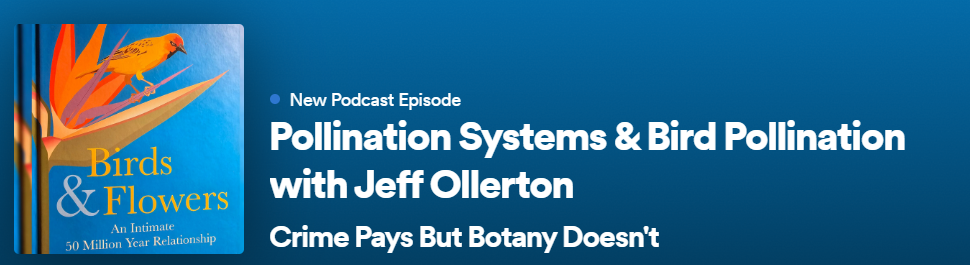
Read a preview of my new book ‘Birds & Flowers: An Intimate 50 Million Year Relationship’

In the run up to release of my new book Birds & Flowers: An Intimate 50 Million Year Relationship, my publisher, Pelagic, has updated the book description and provided a preview of some of the pages and colour plates – follow this link to view them. On that page you can also pre-order the book direct from Pelagic Publishing, who will ship worldwide, or it’s available from many of the online book sellers.

I’m really excited to be sharing this with the readers of my blog and can’t wait for publication day! Early in 2024 I hope to do some talks, online and in person, to promote the book – so watch this space.

With best wishes to you all and hopes for a peaceful, and more sustainable, New Year.

The one thing I wish more people understood about flower pollination

Obviously the title of this post is click-bait, as there’s LOTS of things that I wish more people knew about pollination! But here’s one that really gets my (Yule) goat.

I’ve lost track of the number of times that I’ve read statements in books and research papers such as “bees collect lots of pollen from flowers therefore they are good pollinators”. Even worse, I sometimes see studies where pollen has been removed from “pollen baskets” or other scopae, then used as a measure of the importance of those bees as pollinators.

In both cases it seems to have been forgotten that bees are collecting pollen to feed their larvae and pollen that ends up in scopae is generally not available for pollination.

That’s the purpose of the Venn diagram at the top of this short post, to remind us that there can be a disconnect between what bees are doing and what plants require: foraging for pollen only partly correlates with flower pollination. Indeed, the same argument applies to any animal that feeds itself or its young on pollen, including pollen wasps (Maserinae), Heliconia butterflies, and some flower-visiting hoverflies, birds and bats.

It’s not only loss of pollen from reproduction that’s important here: depending on the size and behaviour of the bees relative to the shape and size of the flower, they may go nowhere near the stigma, so even if they are carrying viable pollen, it can be lost as far as the plant is concerned.

Note also that many bee species will collect pollen from wind-pollinated plants such as grasses, oaks, etc. Indeed in some species the availability of such pollen is extremely important – see Manu Saunders’ review on this topic and more recent papers that cite it. Again, it emphasises the partial disconnect between pollen collecting by bees and pollination of flowers by bees.

Assessing which flower visitors are actually pollinators is not technically demanding but it can be time consuming. The minimum that you need is single visit deposition (SVD) experiments in which you expose unvisited flowers to one visit by the potential pollinator. Then you assess how much pollen has landed on the stigma or (better) whether the visit results in seed set.

If you want to know more about the evidence that’s required to determine if a flower visitor is or is not a pollinator, they are codified in the “Cox-Knox Postulates” that I discuss in my book Pollinators & Pollination: Nature and Society.

Corrections to the first edition of “Pollinators & Pollination: Nature and Society”

Books are never perfect. In the run-up to publication of Birds & Flowers: An Intimate 50 Million Year Relationship, I am all too aware that this is a truth that’s a cause of anxiety, and sometimes sleeplessness, for all authors. One category of imperfection is tipographical* errors have been introduced at some point in the process of writing and editing. In the past these were corrected in the first edition of a book by the inclusion of errata slips, and such errors are sometimes important in determining the true first editions of older books. On page 20 of the first edition of Darwin’s Origin of Species, for example, there is a misspelling of the word “species”**. This was corrected in the second edition but is an important marker of an extremely valuable book, intellectually and (now) commercially.

A second category involves errors of fact or interpretation or expression that, with hindsight and reader feedback, require correction, or at least acknowledgement, by the author. These are the ones that really make an author squirm inside, even though we know that they are inevitable: we are, after all only human.

It turns out that there are a few examples of both categories in the first edition of my 2021 book Pollinators & Pollination: Nature and Society. Some of them have been corrected in the second edition, but if you purchased the first edition then these are what you should look out for:

P22 – ‘Unmated queens and males (drones) are produced by the colony later in the season’ changes to: ‘Unmated queens and males (drones) are produced by the colony from spring onwards.’

P30, Fig 2.9 – Correct ‘Tabaernemontana’ to Tabernaemontana

P51, Figure 3.8 – title – it should read C. rhynchantha [there’s an h missing]

P57 – ‘The bank that Darwin was referring to is on his property at Down House in Kent, and it was one he observed many times during his walks through the garden.’ changes to ‘The bank that Darwin was referring to is near his property at Down House in Kent, and it was one he observed many times during his walks in the area.’***

P146 – ‘I’ve even see them attack and kill honey bees’ should read: ‘I’ve even seen them….’

P169 – in the title for Figure 10.5, Anon (2019) should be Anon (1919) [in some presentation copies of my book I have corrected this and initialed the change]

P259 – this reference: Klein, A.-M., Steffan-Dewenter, I. and Tscharntke, T. (2003) Fruit set of highland coffee increases with the diversity of pollinating bees. Proceedings of the Royal Society B 270: 955–961. doi: 10.1098/rspb.2002.2306.

Should be replaced by:

Klein, A.-M., Steffan-Dewenter, I. and Tscharntke, T. (2003) Bee pollination and fruit set of Coffea arabica and C. canephora (Rubiaceae). American Journal of Botany 90, 153– 157. doi: 10.1046/j.1365-2664.2003.00847.x

The last two have yet to be corrected and will need to wait for the third edition:

P119 – the Rader et al. study did not include birds and bats, just insects.

P262 – “Nabhan, G.P. and Buchmann, S.” should read “Buchmann, S. and Nabhan, G.P.”

That final error is really embarrassing because, as I point out in the chapter ‘The Politics of Pollination’, their book The Forgotten Pollinators was an inspirational one for stimulating research and action around pollinator conservation! I can offer no explanation for why the order of the authors got reversed in my head.

My sincere thanks to those readers who pointed out some of these errors. My hope is that Birds & Flowers has fewer, but I may be fooling myself…

*You see what I did there?

**Proof-reading is boring and soul-destroying for any author, but really Mr Darwin?!

***If there is an after-life, I’d like to think that Darwin’s now enjoying this error after my snarky comment in the second footnote. To which I’ll respond: watch out for a doozy of a footnote about a Darwin footnote in Birds & Flowers!

Recent research and seminars on pollinators and pollination that have caught my eye

There’s so much good science and so many great talks coming out of the (broad) field of pollinator and pollination research at the moment! Here’s a few things that have come up on my radar. Feel free to comment and add your own examples of things I may have missed.

Biodiversity Net Gain and what it could mean for pollinators – read the new report

Biodiversity Net Gain (or BNG) promises to transform the way that we approach nature conservation in the UK. I’ve been giving a lot of thought to what this might mean for insect pollinators and have produced a new report that summarises the opportunities that BNG presents and how we can make the most of them. You can download a copy of that report by following this link.

This is meant to be a working document and as BNG progresses, and our understanding of its impacts on pollinators increases, I will update it. In the meantime, please do feel free to comment.

‘…people would need to be very weak in the head… before it would occur to them to go into the garden and eat snails…’

‘…people would need to be very weak in the head… before it would occur to them to go into the garden and eat snails…’

Anon. (1867)

Delighted to announce that my essay “A short history of snail-eating in Britain” will be in October’s issue of British Wildlife magazine. This is a topic that’s intrigued me for many years because it has a close connection to the snail-eating habits of folks (my own family included) in the area of the north-east of England where I grew up. Hopefully it will also interest, and surprise, the readers of British Wildlife!

“Birds & Flowers” book update: here’s the list of chapters!

Today I returned the final, edited files of the book manuscript to the publisher. It’s been a long summer of ‘fine distinctions and nice judgements’, to quote my editor, the inimitable Hugh Brazier. Now that’s all finalised, I thought that it was time to share the chapter titles with you – here goes:

Introduction: Encounters with birds and flowers

1         Origins of a partnership

              Understanding 50 million years of bird and flower evolution

2          Surprising variety

              The astounding diversity of pollinating birds

3           Keeping it in the family

                 Accounts of the different groups of bird pollinators

4          A flower’s point of view

              How many plants are bird-pollinated, and where are they found?

5         In the eye of the beholder

              What do bird flowers look like?

6          Goods and services

              The enticements given to birds for pollinating flowers

7         Misaligned interests

              The ongoing conflicts between flowers and birds

8          Senses and sensitivities

              How bird brains shape the flowers that they pollinate

9          Codependent connections

                Networks of interacting flowers and birds

10        Hitchhikers, drunks and killers

              The other actors in the network and how they affect the main players

11        The limits to specialisation

              How ‘specialised’ are the relationships between birds and flowers?

12         Islands in the sea, islands in the sky

                  Isolation, in oceans or in mountains, results in some remarkable interactions

13         The curious case of Europe

              Why did we believe that Europe had no bird-pollinated flowers?

14         ‘After the Manner of Bees’

              The origins of our understanding of birds as pollinators, and their cultural associations

15        Feathers and fruits

                Birds as pollinators of edible wild plants and domesticated crops

16        Urban flowers for urban birds

              Bird pollination in cities and gardens

17       Bad birds and feral flowers

              The impact of invasive species

18         What escapes the eye

                 The decline and extinction of bird–flower relationships

19         The restoration of hope

                  People as conservationists of birds and their flowers

There you have it! I’m incredibly excited that the book is now just about finished (I still have to proof read the typeset text and produce an index) and I look forward to finally having a copy in my hands. Birds & Flowers: An Intimate 50 Million Year Relationship is available for pre-order from Pelagic Publishing, or via online bookshops.

Weevily good pollinators – a recent review of a neglected interaction

A pollination ecologist was recently working on the reproduction of a tropical plant species and discovered that the flowers were visited by two species of weevils, one large and one small.

The larger weevil was too big to access the nectar from the front, so it chewed its way into the flowers, destroying the petals, and in the process picking up no pollen.

The other weevil species was, however, able to enter the flowers, where it became smeared with pollen, which it then transferred to the stigmas in flowers of other plants.

The pollination ecologist therefore concluded that the true pollinator of this plant was, indeed, the lesser of the two weevils…

That’s not an original joke by any means – it comes from the movie Master and Commander. But it nicely sets up this short post about a review paper that came to my attention earlier in the summer and which fits neatly with my previous post about a special issue of the Journal of Applied Entomology dedicated to the “neglected pollinators”.

Writing in the open access Peer Community Journal, Julien Haran, Gael Kergoat, and Bruno de Medeiros have produced a really fascinating review of weevil pollination called:

Most diverse, most neglected: weevils (Coleoptera: Curculionoidea) are ubiquitous specialized brood-site pollinators of tropical flora

Weevils are beetles, members of the superfamily Curculionoidea, which contains an estimated 97,000 species. Many are herbivores, including seed predators – I first encountered them as a researcher during my PhD when I assessed the impact of one species as a seed predator of my study plant Bird’s-foot Trefoil. Surprisingly, however, pollinating relationships have evolved multiple times between weevils and plants. Drawing on published studies and their own unpublished observations, the authors conclude that such “associations have been described or indicated in no less than 600 instances.” Most of these are brood-site pollination systems that have probably evolved from seed predation relationships.

No doubt many more examples of weevil pollination remain to be discovered but as it stands, this review paper is a great summary of a fascinating and still rather neglected corner of pollination ecology.