
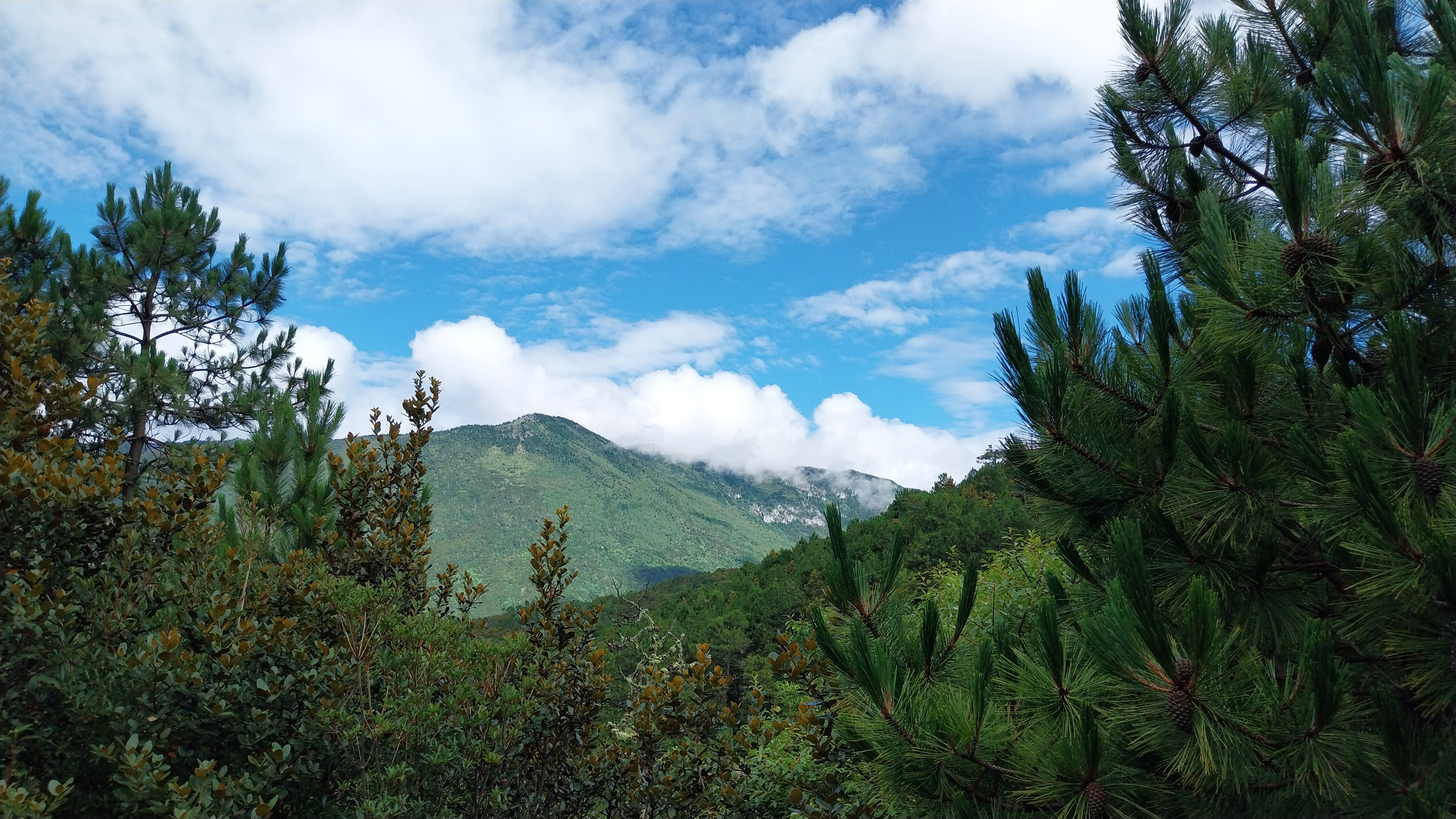
For several years now I have been fortunate to collaborate with colleagues in China on the ecology of plant–pollinator interactions. One of the things that makes that work so exciting is the sheer variety of landscapes in which these interactions play out. In a newly published paper led by Dr Xin Xu, we have studied pollination networks on Yulong Snow Mountain in Yunnan, in south-west China, a place where forests and flower-rich meadows sit side by side in a spectacular high-elevation environment.
The question we asked was simple enough: how do these adjacent habitats – woodland and grassland – differ in the way that plants and pollinators interact? But answering it required a huge amount of field effort. Over two flowering seasons, the team recorded more than 11,000 interactions between 229 pollinating insect species and 89 flowering plant species. That is an extraordinary reminder of how much ecological complexity can be packed into a relatively small area of mountain landscape.
What emerged was a very clear pattern. The open meadows supported far more activity than the neighbouring forests: more visits, more pollinator species, more plant species, and more interaction links. In fact, nearly 9,700 of the recorded interactions took place in meadow habitat, compared with about 1,365 in forest. Meadows were especially important for bumblebees, which are among the key pollinators in these cool, high-elevation systems.
But the forests were not simply poor relations. They supported their own distinctive subset of the wider pollinator community, and the network of interactions there was structured differently. Some pollinator species altered their daily foraging schedules depending on whether they were in meadow or forest, suggesting that they are responding flexibly to changes in light, temperature, floral resources, and perhaps competition. That is one of the aspects of pollination ecology that fascinates me most: these are not static systems, but living networks that shift across space and time.
More broadly, the study reinforces something that has become increasingly clear from ecological research: habitat heterogeneity matters. A landscape made up of different, connected habitat types can support a richer and more resilient community than one that is uniform. On Yulong Snow Mountain, the meadows seem to act as hotspots of pollinator diversity, while the forests add further complexity and help shape how those pollinators behave. Conserving that mosaic is therefore likely to be crucial if we want to maintain pollination services and biodiversity in mountain regions facing rapid environmental change.
For me personally, this paper is also a reminder of why international collaboration is so valuable. Working with Chinese colleagues has opened a window onto ecological systems that are both scientifically important and visually stunning. Yunnan is one of the world’s great biodiversity regions, and studying pollination there helps us understand not only how these mountain ecosystems function, but also how species interactions may respond to climate change and habitat alteration in the future.
Pollination ecology is about more than just bees, birds, or other animals visiting flowers. As a focus of study, it is much richer. It is about networks of interactions, about the timing of activity through the day, about the way species respond to different habitats, and about how whole ecosystems are stitched together. High on a Chinese mountain, among meadows and forests, we can see that complexity in action.
Here’s the full reference:
Here’s the abstract:
Understanding how habitat heterogeneity influences the structure and stability of ecological networks is critical for predicting ecosystem responses to environmental change. In alpine ecosystems, open meadows and forests represent contrasting habitats with distinct vegetation structures, resource availability, and microclimatic conditions. In this study, we integrated spatial and temporal data on pollinator-plant interactions to investigate network structure, species roles, and diurnal foraging dynamics across meadow and surrounding forest habitats during two flowering seasons on Yulong Snow Mountain, Yunnan, China. A total of 11,094 plant–pollinator interactions were recorded, involving 229 pollinator and 89 flowering plant species. Meadows supported significantly higher interaction frequencies, species richness, and α-diversity for both plants and pollinators, although they showed a striking numerical dominance of a single key pollinator, Bombus friseanus. Network dissimilarity analyses revealed substantial differences between habitats, with both species turnover and rewiring contributing to interaction dissimilarity. Diurnal foraging dynamic analysis revealed that some key species, such as Bombus lepidus, displayed distinct foraging patterns across habitats indicating behavioral adaptation and temporal niche partitioning to microclimate. Our findings highlight the strong influence of habitat type on pollination network architecture and reveal many shared pollinator species, indicating some degree of cross-habitat linkage. These results underscore the importance of habitat heterogeneity and spatial coupling in shaping pollination services and sustaining biodiversity in mountain ecosystems under environmental change.











 Prof. Jeff Ollerton - ecological scientist and author