Tag Archives: Nature

Biodiversity, plant-pollinator interactions, and the UN’s Sustainable Development Goals

In the past couple of weeks I’ve delivered two presentations at virtual conferences. The first was at a Global Sustainability Summit run by Amity University, one of our partner institutions in India. The second was at the University of Northampton’s own internal research conference. Both of these focused on pollinators, as you might imagine, but they also referred to the United Nations’ Sustainable Development Goals (SDGs). The 17 SDGs are being increasingly used as a framework for promoting the importance of biodiversity to human societies across the globe, and I’m seeing them referred to more and more often in studies and reports about pollinator conservation. That’s great, and I’m all in favour of the SDGs being promoted in this way. However I wanted to highlight a couple of aspects of the SDGs that I think are missing from recent discussions.

The first is that pollinators, and their interactions with plants, are often seen as contributing mainly to those SDGs that are directly related to agriculture and biodiversity. Here’s an example. Last week the European Commission’s Science for Environment Policy released a “Future Brief” report entitled: “Pollinators: importance for nature and human well-being, drivers of decline and the need for monitoring“. It’s a really interesting summary of current threats to pollinator populations, how we can monitor them, and why it’s important. I recommend you follow that link and take a look. However, in the section about relevant, global-level policies, the report highlights “the UN Sustainable Development Goals (SDGs) – especially regarding food security (‘zero hunger’) and biodiversity (‘life on land’).

I think this is under-selling pollinators and pollination, and here’s why. First of all, as we pointed out in our 2011 paper “How many flowering plants are pollinated by animals?”, approaching 90% of terrestrial plants use insects and vertebrates as agents of their reproduction and hence their long-term survival. As we showed in that paper, and a follow up entitled “The macroecology of animal versus wind pollination: ecological factors are more important than historical climate stability“, the proportion of animal-pollinated plants in a community varies predictably with latitude, typically from 40 to 50 % in temperate areas up to 90 to 100% in tropical habitats. Now, flowering plants dominate most terrestrial habitats and form the basis of most terrestrial food chains. So the long-term viability and sustainability of much the Earth’s biodiversity can be linked back, directly or indirectly, to pollinators. That’s even true of coastal marine biomes, which receive a significant input of energy and nutrients from terrestrial habitats.

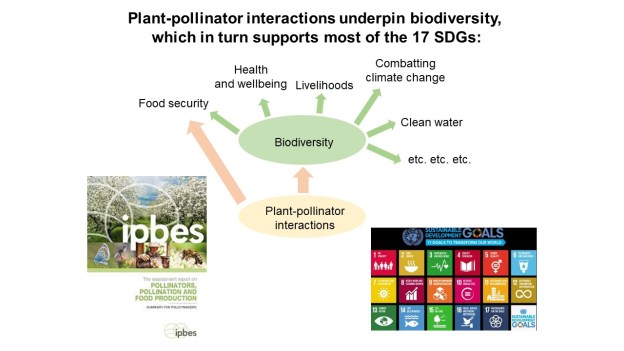
Biodiversity itself underpins, or directly or indirectly links to, most of the 17 SDGS; those that don’t have an obvious link have been faded out in this graphic:

The underpinning role of biodiversity, and in particular plant-pollinator interactions, on the SDGs needs to be stated more often and with greater emphasis than it is currently.

The second way in which I think that some writers and researchers in this area have misconstrued the SDGs is that they seem to think that it only applies to “developing” countries. But that’s certainly not the way that the UN intended them. ALL countries, everywhere, are (or should be) “developing” and trying to become more sustainable. To quote the UN’s SDG website:

“the 17 Sustainable Development Goals (SDGs)….are an urgent call for action by all countries – developed and developing – in a global partnership.”

and

“the SDGs are a call for action by all countries – poor, rich and middle-income – to promote prosperity while protecting the environment.”

I interpret this as meaning that “developed” countries need to consider their own future development, not that they only have to give a helping hand to “developing” countries (though that’s important too). Just to drive this home, here’s a recent case study by Elizabeth Nicholls, Dave Goulson and others that uses Brighton and Hove to show how small-scale urban food production can contribute to the SDGs. I like this because it goes beyond just considering the agricultural and food-related SDGs, and also because by any measure, Brighton and Hove is a fairly affluent part of England.

I’m going to be talking about all of this and discussing it with the audience during an online Cafe Scientifique on Thursday 25th June – details are here. I’m also going to be exploring more of these ideas in my forthcoming book Pollinators & Pollination: Nature and Society, which is due for publication later this year. The manuscript is submitted and is about to be copy-edited. The PowerPoint slide which heads this post uses a graphic from that book that sums up how I feel about biodiversity, plant-pollinator interactions, and the UN’s Sustainable Development Goals.

For World Bee Day – an extract from my forthcoming book – UPDATED

Image

UPDATE: turns out the figure I cited for number of bee species is out of date so I’ve corrected it below. Thanks to John Ascher for pointing this out.

Publication of my book Pollinators & Pollination: Nature and Society by Pelagic Publishing has been pushed back until the end of this year or early in 2021. The current pandemic has created problems for the printing and distribution sectors, as it has for so many industries. Therefore, to celebrate World Bee Day, here’s a preview of the bee section from Chapter 2 which is entitled (ironically enough) “More than just bees – the diversity of pollinators”.

2.3 Bees, wasps and sawflies (Hymenoptera)

The bees and their relatives rank only third in terms of overall pollinator diversity.  Within this taxonomic Order, bees are not especially species rich (17,000 or so described species, perhaps 20,000 in total) – over 20,400 (see: https://www.catalogueoflife.org/col/details/database/id/67) compared with the other 50,000 social and solitary wasps, sawflies, and so forth. But what they lack in diversity the bees make up for in importance as pollinators of both wild and agricultural plants, and in their cultural significance.  The general notion of what a bee is, and how it behaves, looks to the honeybee (Apis mellifera) as a model: social, with a hierarchy, a queen, and a large nest (termed a hive for colonies in captivity).  In fact, this view of bee-ness, though long embedded within our psyche, is far removed from the biology of the average bee: most of them have no social structure at all, and a fair proportion of those are parasitic.  In Britain we have about 270 species of bees, give or take (Falk 2015) though there have been extinctions and additions to this fauna (see Chapters 10 and 11).  These species provide a reasonable sample of the different lifestyles adopted by bees globally.  They can be divided into four broad groups.

Honeybees include several highly social species and subspecies of Apis, of which the ubiquitous western honeybee (A. mellifera) is the most familiar.  Most colonies are found in managed hives, though persistent feral colonies can be found in hollow trees, wall cavities, and other suitable spaces.  They are widely introduced into parts of the world where they are not native (e.g. the Americas, Australia, New Zealand) and there is some debate as to whether they are truly native to Britain and northern Europe, with supporting evidence and arguments on both sides.  Colonies can be enormous and contain thousands of individuals, mostly female workers, with a single queen.  Unmated queens and males (drones) are produced by the colony later in the season.

Bumblebees (Bombus spp.) are typically also social, though their nests are much smaller (tens to hundreds of individuals).  Depending upon the species these nests can be in long grass, rodent holes, or cavities in buildings and trees.  Twenty-seven of the more than 250 species have been recorded in the UK, but six of these are not strictly social; they are parasitic and belong to the subgenus Psithyrus which will be described below.

The so-called solitary bees are by far the largest group in Britain (about 170 species) and worldwide (more than 90% of all species).  In the UK they belong to 15 genera, including Andrena, Anthophora, Osmia, Megachile, etc.  The females of most of these bees, once they have mated, construct nests that they alone provision with pollen for their developing young.  Nesting sites can be genus- or species-specific, and include soil, cavities in stone or wood, and snail shells.  Some species are not strictly solitary at all and may produce colonies with varying levels of social structure, though without a queen or a strict caste system; we term them “primitively eusocial”.  In fact sociality has evolved and been lost numerous times in the bees and in the rest of the Hymenoptera (Danforth 2002, Hughes et al. 2008, Danforth et al. 2019).  It’s also been lost in some groups that have reverted back to a solitary lifestyle, and even within a single genus it can vary; for example in the carpenter bee genus Ceratina (Apidae: Xylocopinae) tropical species are more often social than temperate species (Groom & Rehan 2018).

The final group is termed the cuckoo bees and, like their avian namesake, they parasitise the nests of both social and solitary bees (though never, interestingly, honeybees).  There are about 70 species in 7 genera, including the bumblebee subgenus, Psithyrus.  Other genera include Melecta, Nomada and Sphecodes.  In some cases the parasitic species are closely related evolutionarily to their hosts and may resemble them, for example some Psithyrus species.  In other cases they may be only distantly related and in fact look more like wasps, e.g. Nomada species.  Some genera of cuckoo bees are restricted to parasitising only a single genus of bees, others are parasites of a range of genera (Figure 2.4).

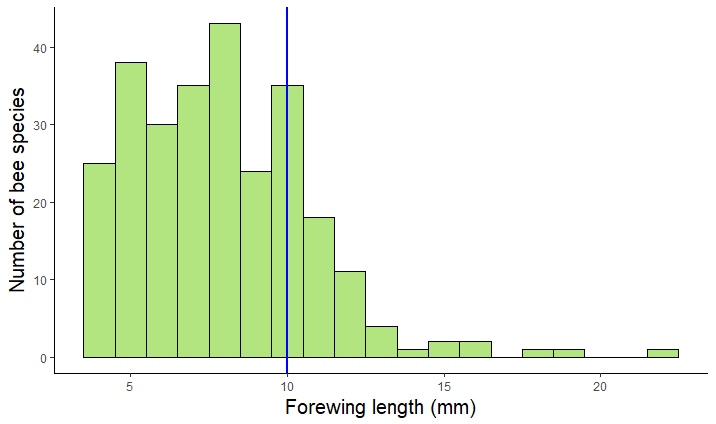
Although we often think of bees, overall, as being the most important pollinators, in fact species vary hugely in their importance.  Pollinating ability depends upon factors such as abundance, hairiness, behaviour, body size, and visitation rate to flowers (Figure 2.1).  Size is especially important for three reasons.  First of all, larger animals can pick up more pollen on their bodies, all other things being equal.  Secondly, in order to bridge the gap between picking up pollen and depositing it, flower visitors must be at least as large as the distance between anthers and stigma, unless they visit the stigma for other reasons.  Finally, larger bee species tend to forage over longer distances on average (Greenleaf et al. 2007) thus increasing the movement of pollen between plants.  However, most of the world’s bees are relatively small as we can see from the analysis of British bees in Figure 2.5.  Many species have a maximum forewing length of only 4 or 5 mm, and the majority of species are smaller than honeybees.  Remember also that these are maximum sizes measured from a sample; individual bees can vary a lot within populations and even (in the case of Bombus spp.) within nests (Goulson et al. 2002).  So the assumption that all bees are good pollinators needs to be tempered by an acknowledgement that some are much better than others.    


Figure 2.5: The sizes of British bees. Forewing length is a good measure of overall body size and the data are maximum lengths recorded for species, except for the social bumblebees and honeybee I have used maximum size of workers (queens are often much larger). The blue line indicates the honeybee (Apis mellifera). The biggest bee in this data set is the Violet Carpenter Bee (Xylocopa violacea) which, whilst not generally considered a native species (yet), has bred in Britain in the past. Data taken from Falk (2015).

A pollinator to watch out for in your gardens: the Red-girdled Mining Bee – UPDATED

Last week, during one of my lockdown garden pollinator surveys, I spotted a bee visiting Germander Speedwell (Veronica chamaedrys) in the garden that I didn’t recognise. It initially confused me as it looked superficially like a Blood Bee in the genus Sphecodes. However the bee was clearly collecting pollen, which Sphecodes spp., being cleptoparasites, don’t do. A quick check in Steven Falk’s Field Guide to the Bees of Great Britain and Ireland and a look at Steven’s Flickr site, suggested that it was almost certainly the Red-girdled Mining Bee (Andrena labiata), which is frequently associated with Germander Speedwell.

I posted this video on Twitter and Steven kindly confirmed my identification:

The Red-girdled Mining Bee is considered “Nationally Scarce” and it has a scattered and southerly distribution, as you can see from the map above, which is from the National Biodiversity Network Atlas account for the species. It’s only recorded from about half a dozen sites in Northamptonshire according to Ryan Clark, the County Bee Recorder. However Steven tells me that it’s being seen more and more frequently in gardens, and indeed just the other day Sarah Arnold, who is also carrying out surveys, emailed me to say that she had spotted it in her garden in Kent.

So this is a bee that’s definitely one to look out for, especially if you have Germander Speedwell growing.

UPDATE: I should of course have also given a link to the BWARS account for this species, and mentioned that confirmed or suspected observations can be uploaded to iRecord.

Garden plant-pollinator surveys: progress so far

The network of pollination ecologists and insect specialists who have confirmed that they are surveying plant-pollinator networks in their gardens now stands at 50. As the map above shows, most are in the UK, Ireland and mainland Europe, but the Americas are also becoming well represented, we have a couple of people surveying in North Africa, and three in Australia. An x-y plot of the coordinates of the gardens shows the spread a little better:

Some people have started to send me data already, which is great; if you’re surveying and haven’t let me know your latitude and longitude, please do so, preferably decimalised – you can convert degrees/minutes/seconds to decimal here: https://www.latlong.net/degrees-minutes-seconds-to-decimal-degrees

I’ve managed 13 formal 15 minute surveys so far, plus have a few ad hoc observations that I am keeping separate, and I will be continuing my data collection for the foreseeable future. I’ve started playing with the data as you can see below. This is a plot made using the bipartite package in R, with plants to the left and pollinators to the right. The size of the bars is proportional to the number of pollinators/plants a taxon connects to. In the plants you can immediately see the dominance of apple (Malus domestica) and greengage (Prunus domestica), which attract a wide variety of insects to their flowers. Of the pollinators, the hairy-footed flower bee (Anthophora plumipes) and dark-edged beefly (Bombylius major) are especially common and generalist in their flower visits. It will be really interesting to see how this changes over the season, and how our fruit and vegetables are connected into the wider network via pollinators that they share with the ornamental and native plants.

If you are experienced at surveying pollinators and want to get involved, follow that first link and check out the protocol and FAQs, and please do email me: jeff.ollerton [at] northampton.ac.uk

The other pollinators: some recent videos that don’t focus on bees

The review of the biodiversity of pollinators that I published in 2017 estimated that on average about 18% of animal-pollinated plants within natural communities are specialised on bees. Bees also contribute to the reproduction of many of the plants that have generalist pollination systems, which account for perhaps 50% of plant species on average. But that stills leaves a significant fraction (maybe one third) that are specialised on the “other” pollinators, including flies, beetles, birds, bats, and so forth. There is growing awareness of how important these pollinators are for wild plant and crop pollination, but bees still hog most of the pollinator-related media.

In the last couple of weeks I’ve been sent links to videos that focus on these other pollinators so I thought I’d compile a list that show us something of the true diversity of animals that act as pollen vectors. Please add your own suggestions in the comments:

Elephant shrews, lizards, cockroaches*, crustaceans, and biting midges are covered in this SciShow video (HT Steve Hawkins)

Opossum pollination of a Brazilian plant is featured in this video (HT Felipe Amorim)

Here’s a recorded webinar on bird pollination by Dan Scheiman from Audubon Arkansas

A few videos on bat pollination by Jim Wolfe can be found here and here and here, and this is a short one that’s a supplement to a recent Journal of Applied Ecology paper on cactus pollination by Constance J. Tremlett et al.

The fascinating ecology of skunk cabbage (Symplocarpus foetidus), including fly and possibly beetle pollination, is the topic of this video.

Fly pollination is also highlighted in this short piece by the Natural History Museum, and this one deals with drone flies as managed pollinators for agriculture in New Zealand.

Enjoy!

*Watch out for my report on a newly discovered cockroach-pollinated plant….hopefully coming later this year…..

Cherishing old wood: a guitar restoration story – UPDATED

UPDATE: After I posted this piece I shared it on a couple of Facebook guitar groups.  On the Parlor Acoustic Guitar Lovers Group one of the members, Mario Burgani, suggested that in fact the guitar might be Italian, made in Catania in Sicily.  I’ve done some searching online and I think that he’s correct.  Some of the features that I am seeing on Catania guitars on various websites are identical to mine, in particular the way the back of the guitar has been shaped to cover the heel of the neck, and the shape and design of the floating bridge, with the bone side pieces.  My thanks to Mario for pointing this out.

I have now corrected the post and removed mentions of German manufacture.


This post IS about biodiversity, eventually, but I need to give some background first….

Guitar-based music is a big part of my life, and has been since my teens.  However it wasn’t until I was about 20 that I first started playing guitar.  That’s late, and I wish I’d begun earlier, but neither of my parents were musical and there wasn’t the influence or encouragement.  It wasn’t until I finally left home for university, aged 22, that I started taking it in any way seriously and bought a half decent guitar (a 1986 Washburn D-12N, if you’re interested – I still have it and I’m very fond of it).  Before I started my PhD, in 1989, I played quite a lot and was involved with the local music scene in Oxford, working stage crew for bands.  It was a lot of fun and for a while I considered dropping my PhD and doing it full time.  Some of the guys I worked with went on to become part of Radiohead’s crew and have had careers in the music industry.  But, you know, life, kids, and science got in the way, the frequency of my playing became less and less, and for a long time I hardly picked up a guitar.

But in the past couple of years I’ve started to get back into it and am enjoying playing again.  A few things have prompted this.  The kids have all left home now, so I have more time.  I’m finding it relaxes me and it’s a good way to get away from work and social media and screens.  Also, there are many short “how to play” videos on YouTube, it’s like having a whole set of guitar tutors with different styles and approaches.  It’s not just about the music though: I have a fascination with taking apart guitars and fiddling with them, which leads me on to the point of this post.

Back in late September I was looking at vintage acoustic guitars on eBay and salivating over the Martins that were for sale, when a guitar caught my eye.  It was an old “parlour” guitar in pretty poor condition, and a steal at £50. Parlour guitars are small-bodied instruments that were popular in homes in the late 19th and early 20th centuries, before the guitars with big bodies, such as the Dreadnought models, became the vogue.  They were the sorts of instruments used by early blues players – check out the photograph of Blind Lemon Jefferson on his Wikipedia page and you’ll see what I mean.

I was intrigued by the idea of having an old guitar with an authentic bluesy sound and also having a project to work on, restoring this instrument back to playable condition. The seller was based in Bedford, not far from Northampton, so Karin and I drove down there one Friday evening to pick it up.

Here’s a shot of the guitar as I bought it:

2019-10-05 10.37.31

The body was sound and undamaged.  The neck had a bit of a curve to it, but the brass frets were in good condition, though due to the fret board drying out over time their ends were protruding a little either side.  However the bone nut at the top of the neck was broken, the pressed metal tailpiece was quite scratched, the tuning heads rusty and a little bent, plus there were a few other dings and dents.  Here are some close-ups:
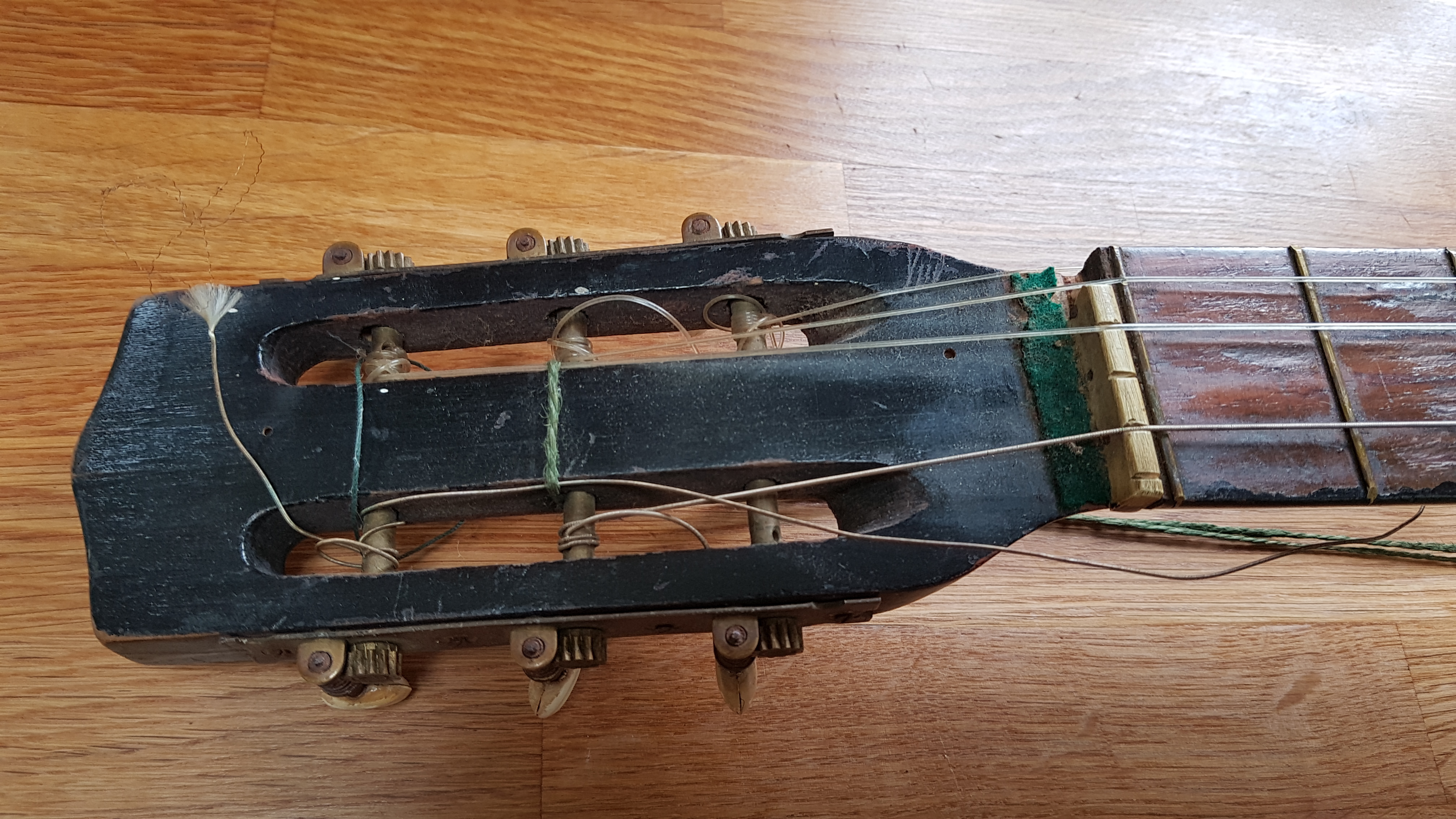
2019-10-05 10.37.38

Someone has strung it with nylon strings which is probably not what was intended for this instrument.  The point of a metal tailpiece like this is that it allows the guitar to have metal strings, which are under greater tension, without the need for more complex x-bracing under the soundboard to prevent it from warping or cracking:

2019-10-05 10.37.50

2019-10-05 11.16.12

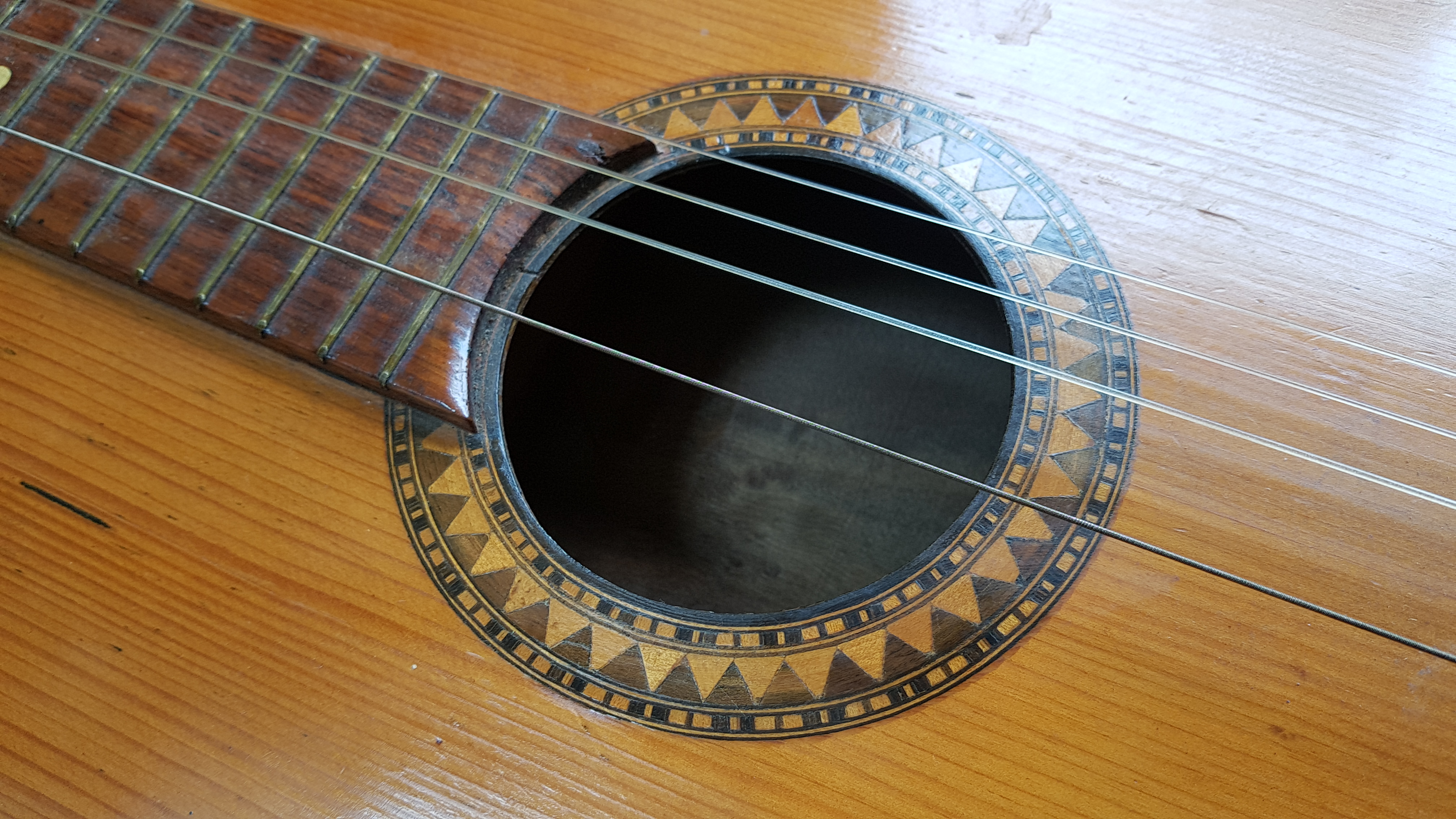
It was clearly not the most expensive of guitars when it was first made, but the marquetry around the sound hole is in perfect condition and nicely executed:
2019-10-05 10.37.54

There’s no manufacturer’s name or label in the guitar, no serial number or anything like that.  So I did a little research online.  It’s not the best quality guitar, as evidenced by the metal tailpiece which, as I mention, is designed to take the strain off the sound board when using metal strings.  The alternative is to have a fixed bridge but that requires more elaborate (= expensive) bracing under the soundboard. However it’s clear that the guitar was handmade, probably in Sicily,  by a local luthier, possibly in the 1920s, but certainly somewhere between 1900 and 1940: so it could be more than 100 years old.

The restoration of the guitar was fairly straightforward, the most complex part being the carving of a new bone nut from a blank that I bought online. The machine heads were removed, cleaned and oiled, then re-fitted; I could have replaced them but they were in decent condition given their age and I wanted to retain as much authenticity to the guitar as possible.  The frets were filed and a neighbour who is a metal worker polished up the tailpiece.  Most of the other work was fairly cosmetic – I didn’t want to touch the original finish.

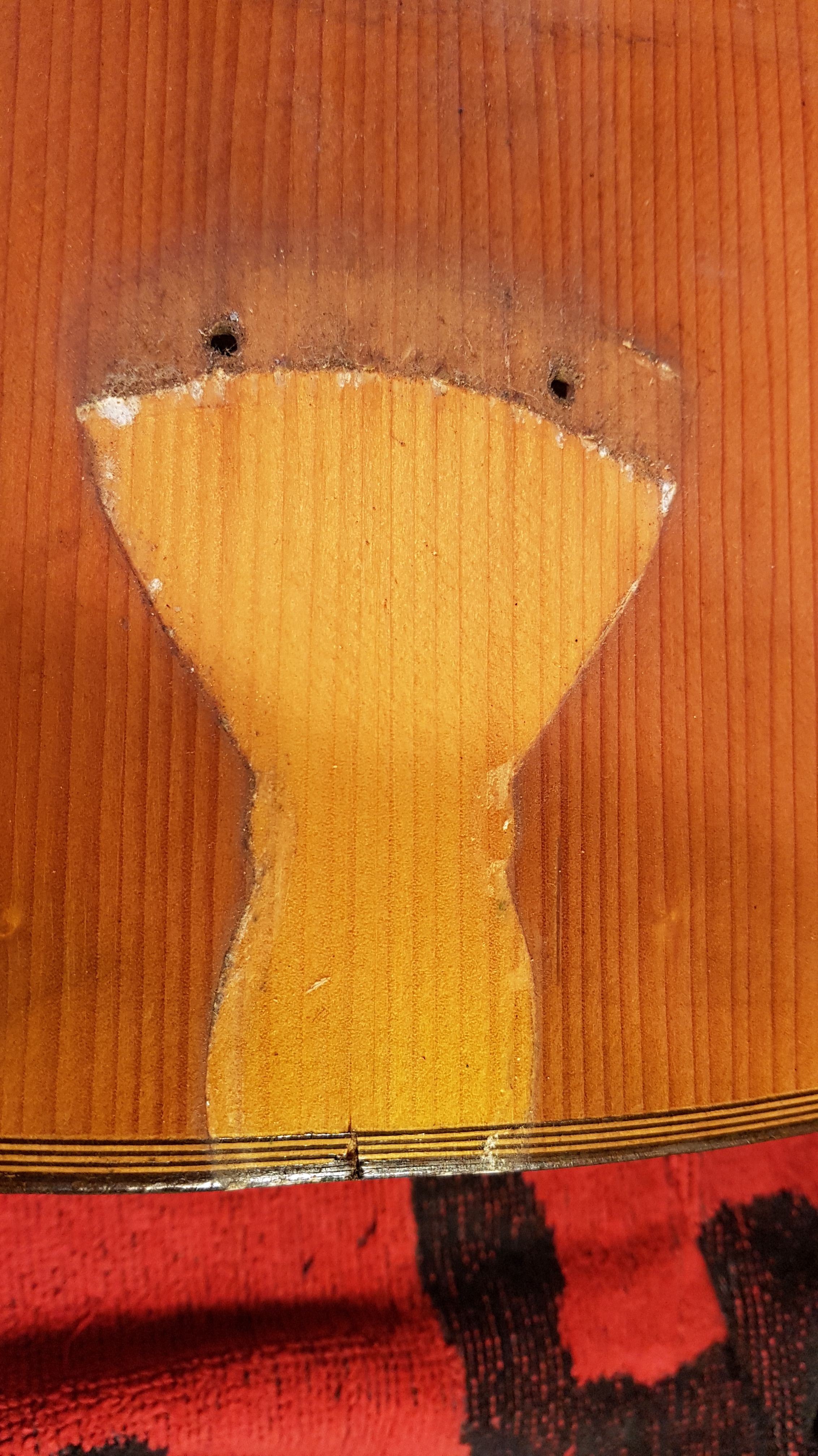
Now we get to biodiversity.  A lot of wood goes into the construction of acoustic guitars.  In the case of this instrument, the soundboard is solid European spruce (Picea abies) that has aged to a beautiful golden colour.  When I took off the tailpiece its original colour was revealed; that tailpiece has probably never been removed before:
2019-10-05 11.12.09

2019-10-05 11.12.17

That spruce top is book-matched: the two sides of the soundboard are symmetrical down the mid-line of the guitar, showing that they were split from the same board.  Book-matching is a common technique used by luthiers, both for aesthetic reasons and because it’s harder to get a single piece of tonally-acceptable wood of that width.  The tree from which it was cut was probably grown in a plantation; most old growth forest in Europe had been cut by the time this tree started growing.  If you count the number of growth lines across one half of the soundboard there’s about 60, which gives an indication of the  minimum age of the tree at harvest, i.e. it was at least 60 years old when it was felled.  If the guitar was made in around 1925, and given that the wood from the tree would have to season for at least a couple of years, perhaps longer, before it was used,  it means that the tree started growing some time in the mid-19th century.  So the tree that contributed the soundboard has lived through summers and winters of profound historical change in Europe.

The sides, back and neck of the guitar are mahogany, as is the bridge I think.  Nowadays “mahogany” can refer to a range of unrelated tropical trees – see this website for details.  But when this guitar was made, mahogany usually referred to wood from species in the genus Swietenia, which naturally grow in Central and northern South America, and the Caribbean.  So the tree that donated the wood was cut out of pristine, or at least long-established, tropical rainforest. One possible source is Belize which was exporting a lot of mahogany to Britain during this period, which may then have been exported all over Europe.

The fret board is probably Brazilian rosewood (Dalbergia nigra) judging by the black streaks or “spider webbing” in the timber. Brazil banned exports of the wood in the 1960s but there’s still much illegal harvesting going on of these and other trees.  This species, and the three in the genus Swietenia, are in the IUCN categories “Vulnerable” or “Endangered” due to their over-exploitation, and are CITES-listed.

Some other, so far unidentified, woods were used in the construction of the guitar, in the marquetry around the sound hole, in the binding around the top, and in the end strap button.  The latter may be ebony from one of several species in the genus Diospyros, which are likewise protected.

The timber used to make these old guitars is a legacy of an age when rapacious exploitation of the world’s natural resources was considered almost a public duty.  There was little or no consideration for the ecosystems that were exploited, or how deforestation affected both wildlife and indigenous peoples.  To some extent the situation has improved and there are global efforts to conserve the old growth forest that remains, albeit with variable results.  But we are far from giving these forests the protection and restoration that they deserve.   Modern guitar makers need to take responsibility for sourcing their materials ethically and sustainably, which some are and some are not.  There’s a really interesting set of articles about this in the series Building a Sustainable Guitar at the Forest Legality website.  At the other extreme the Gibson guitar company pleaded guilty in 2012 to knowingly using timber that was harvested illegally in Madagascar, a trade that Pete Lowry of the Missouri Botanical Garden is quoted as calling the “equivalent of Africa’s blood diamonds”.

Old musical instruments, furniture, and other artifacts have history as well as carbon locked into their timbers.  Therefore I think that it’s incumbent upon us to cherish and use them and not consign the wood to the bonfire or to landfill.  If that sounds too sentimental, then so be it.  But there’s a practical side to this too: they are often better quality than more modern instruments and can be much cheaper.

All of my guitars have names that reflect something of their history.  During the drive down to pick up the guitar from Bedford there was the most incredible rain storm, water lashing across the road and windscreen wipers on full blast.  So I’ve named this guitar The Rainmaker.  You can see the finished result of the restoration in the images at the top of this post.  I’m pleased with it and I hope it lasts another 100 years at least.

One final thing: how does the guitar play and sound?  Well, as I said, the neck has a bit of a curve to it and there’s no truss rod to adjust it, so re-setting it would be a major job.  This means that the action (the distance between the strings and the frets) is very high, especially close to the body.  So I’ve tuned the guitar to an open E chord, have invested in a glass bottleneck, and am using it to learn to play blues slide guitar.  And it sounds pretty good, with a warm, mellow, and (yes) bluesy sound.


Ecologists with gardens: in the current crisis, coordinate your networks to collect standardised data!

20200327_085658

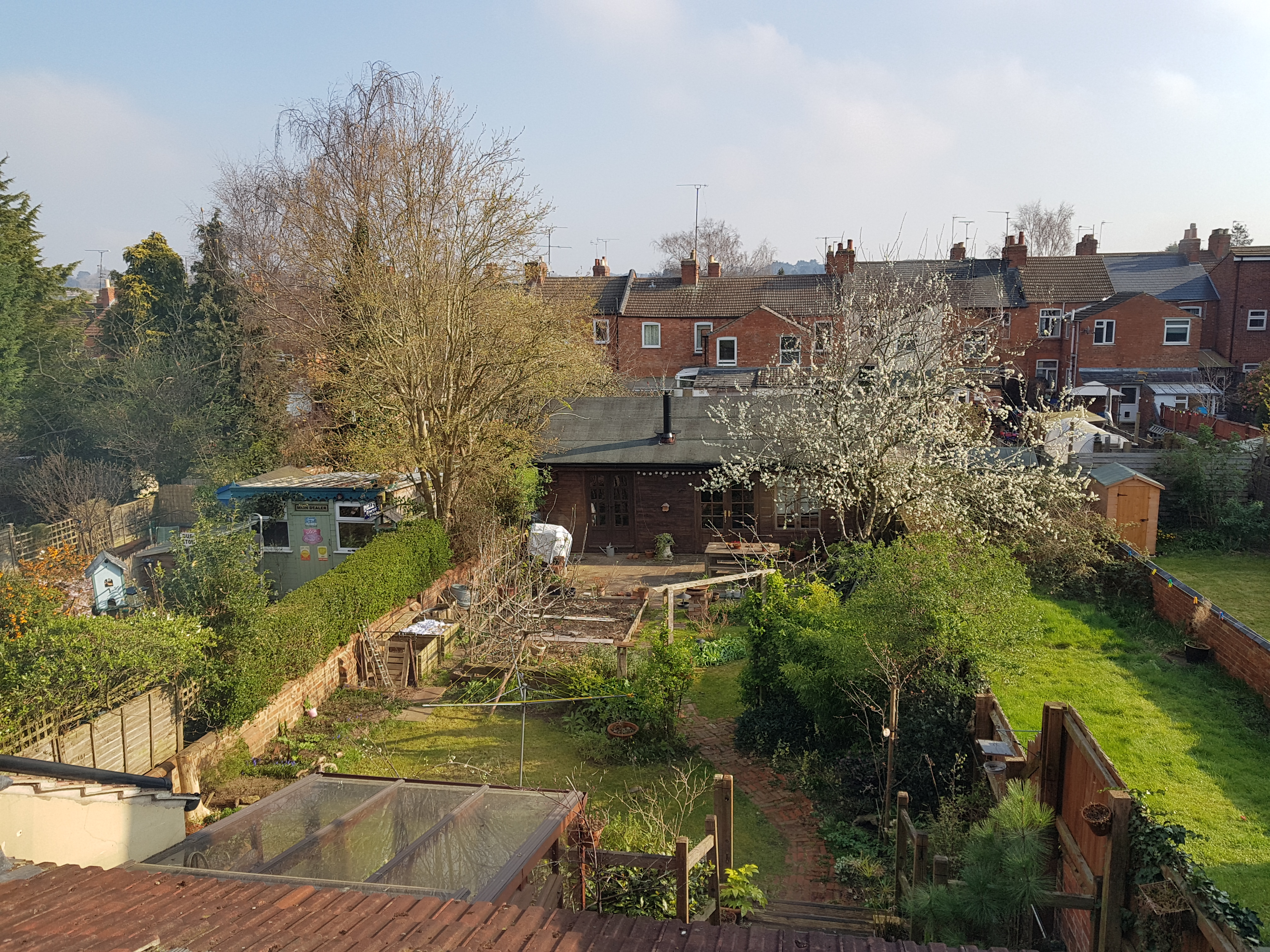
In the current lockdown period of the COVID-19 pandemic, a lot of ecologists are stuck at home: universities and research institutes are closed and it’s not possible to get out and do field work.  Staring out of the window into our garden the other day I had a bright idea and I sent out this email to my network of colleagues in the UK who work on pollinator ecology:

Hi everyone,

I hope you’re all keeping well and safe during this difficult time. Given that we’re all supposed to be socially isolating as much as possible I wondered if we could use the time to generate some interesting data and keep ourselves sane in the process. The idea I had was for as many UK & Irish pollination ecologists as possible to carry out standardised garden surveys of insect-flower visitor interactions over the coming weeks. Combined with information about location, size of garden, floral diversity, etc. etc., it could give us some useful information about early spring plant-visitor garden networks along latitudinal and longitudinal gradients.

For those with kids at home it might be a good way of getting them out into fresh air and giving them something to do.
The response has been phenomenal and a lot of colleagues have agreed to take part.  We’ve worked out a protocol and we are starting to collect data.  If anyone (in the UK or elsewhere in the world) with the requisite pollinator and plant identification skills and experience wants to get involved, please send me an email: jeff.ollerton [at] northampton.ac.uk

Of course others who are less experienced can still help out by taking part in the Pollinator Monitoring Scheme’s  FIT (Flower-Insect Timed) counts: https://www.ceh.ac.uk/our-science/projects/pollinator-monitoring

However, it also struck me that there are plenty of other ecologists who could use their gardens, and networks of colleagues, to collect a large amount of useful data, in a standard way, across a wide geographical area, e.g. plant-herbivore interactions, bird behaviour, earthworm counts, etc. etc.

Let’s get away from our computers and into the fresh air and start generating results!

Digital resources for teaching biodiversity online: some ideas to steal

Andrena bicolor

As I mentioned in an earlier post this week, the University of Northampton is stopping all face-to-face teaching from Friday.  Other UK universities have already done that, more will surely follow.  Luckily we are close to the end of term and I only have a few teaching session left to deliver for my Biodiversity & Conservation class.  For one of these I’ve dusted off an old “virtual seminar” that I put together a few years ago when I had to miss another class (I think I was ill).  If anyone is in need of a teaching resource like this, you are most welcome to steal it.  It’s infinitely adaptable.  The range of digital resources can be changed to reflect different countries and languages.  Also, I’ve deliberately kept it broad in scope, but you could tailor it in multiple ways.

It could also be integrated into the two other taxonomy and biodiversity teaching sessions I’ve discussed in the past:

The Taxonomy of Gastronomy – https://jeffollerton.wordpress.com/2016/11/17/engaging-students-with-the-fundamentals-of-biodiversity-1-the-taxonomy-of-gastronomy/

An Assessed Plant Taxonomy Questionnaire – https://jeffollerton.wordpress.com/2016/11/22/engaging-students-with-the-fundamentals-of-biodiversity-2-an-assessed-plant-taxonomy-questionnaire/

Again, feel free to steal these if they are useful


Here’s the text I send to students:


Digital resources for biodiversity: a virtual seminar

One of the great advances in understanding how biodiversity is distributed in time and space, and how it is changing, is the huge amount of digital resources (both raw data and data visualisation) that are available via the internet at no cost.  In this virtual seminar you will explore just a fraction of these resources; bear in mind that many more are available.

First of all, read this blog post about the definition of “biodiversity” and what it really means:

https://jeffollerton.wordpress.com/2016/01/22/tight-but-loose-just-what-is-biodiversity/

[Note: if that post isn’t suitable, you could point them to another definition, e.g. the Wikipedia entry: https://en.wikipedia.org/wiki/Biodiversity.]

Next, take a look at each of the digital resources for biodiversity listed below.  Spend some time exploring each website and the information that is available.  As you are doing so, consider this: do these digital resources provide data and information that corresponds with all aspects of biodiversity, as defined in that blog post and by your own understanding of the term?  If not, what’s missing, what else is required?  Do a web search and see if you can find resources to fill any gaps yourself.  [Note: at this point you could ask more specific questions about these resources and their usefulness for particular tasks or objectives, or set up a chat room in a VLE or similar to discuss issues raised].

Digital resources:

Global Biodiversity Information Facility (GBIF)

https://www.gbif.org/


United Nations Environment Programme (UNEP) Data Explorer

http://geodata.grid.unep.ch/


Interaction Web Database

https://www.nceas.ucsb.edu/interactionweb/


Kew Herbarium

http://apps.kew.org/herbcat/gotoHomePage.do


National Biodiversity Network (NBN) Atlas

https://nbnatlas.org/


Database of Insects and their Food Plants

http://www.brc.ac.uk/dbif/


Natural History Museum Data Portal

data.nhm.ac.uk/


British Trust for Ornithology (BTO) Garden Birdwatch

https://www.bto.org/volunteer-surveys/gbw/results


British Trust for Ornithology (BTO) Bird Trends

https://www.bto.org/about-birds/birdtrends/2019


Global Biotic Interactions (GloBI)

https://www.globalbioticinteractions.org/about.html


Global Invasive Species Database

http://www.iucngisd.org/gisd/


Landscapes for pollinators: please take the survey!

BB on margin

One of the research projects and collaborations that I’m involved with is a BBSRC-funded project entitled “Modelling landscapes for resilient pollination services in the UK” with colleagues from the University of Reading, the University of Huddersfield, and the Natural Capital Solutions consultancy.  As part of that project we are surveying opinions on what people in the UK value as landscapes and how these landscapes contribute to supporting biodiversity.

If you are based in the UK and are interested in taking part in this short survey, please read the following text and click on the link to take the survey: 

Bees and other insect pollinators are major contributors to UK agriculture. Despite their importance for crop production, pollinator populations are threatened by many modern land management and agricultural practices. This raises questions about how secure this service may be to future changes: will we have enough pollinators where we need them? Will populations be able to withstand changes to the way we manage land? What might be the costs to us, both financially and socially, if we get it wrong?

Our research aims to address this knowledge gap. Our team of ecologist, economists and social scientists are working together to model the ecological, economic and ‘human’ costs of different land management methods.

As part of this we have designed a short online survey to capture the ways that people value and use the countryside, what features they prefer and why.

The survey takes less than 10 minutes and asks you to rate a series of images and say what you think about the landscapes that are illustrated.  It can be found here:

http://hud.ac/landscapes

For more information about the project visit:

http://www.reading.ac.uk/caer/RP/RP_index.html

Ecologists in a time of COVID-19

20200311_140421

Yesterday I was involved in what’s likely to be be my last face-to-face teaching and meetings from some weeks, possibly months.  In the morning my colleague Duncan McCollin and I watched our final year students take part in an assessed debate that pitted two sides against one another to argue whether or not Brexit will have a negative effect on biodiversity.  The students did very well, they had a great grasp of the issues and the facts and figures.  The end result was very much a draw:

2020-03-16 10.35.33

Teaching at the University of Northampton will go online from the end of the week and a field trip for our first year undergraduates that we had planned for this Thursday has been pulled.  Our annual Tenerife Field Course has also been cancelled: this will be the first year since 2003 that I have not visited the island and it’s going to leave a hole in my long-term data sets.  Perhaps the universe is telling me that it’s time to write them up for publication?

Last week I did a quick vox pop on Twitter to ask how COVID-19 has affected ecology field work at other universities:

The response was interesting and it’s clear that overseas field courses have been massively impacted.  Following the UK Government’s advice yesterday about limiting social contact it seems that local field work for student groups will also be affected.  Hopefully those undertaking individual field work, especially PhD and postdoctoral researchers, will still be able to carry out their data collection.  Do let me know in the comments if it’s affecting your work.

There were also some Twitter responses from professional ecological consultants pointing out that they may not be able to carry out surveys of sites for planning and development purposes.  This is yet another way in which COVID-19 is going to impact our economy.

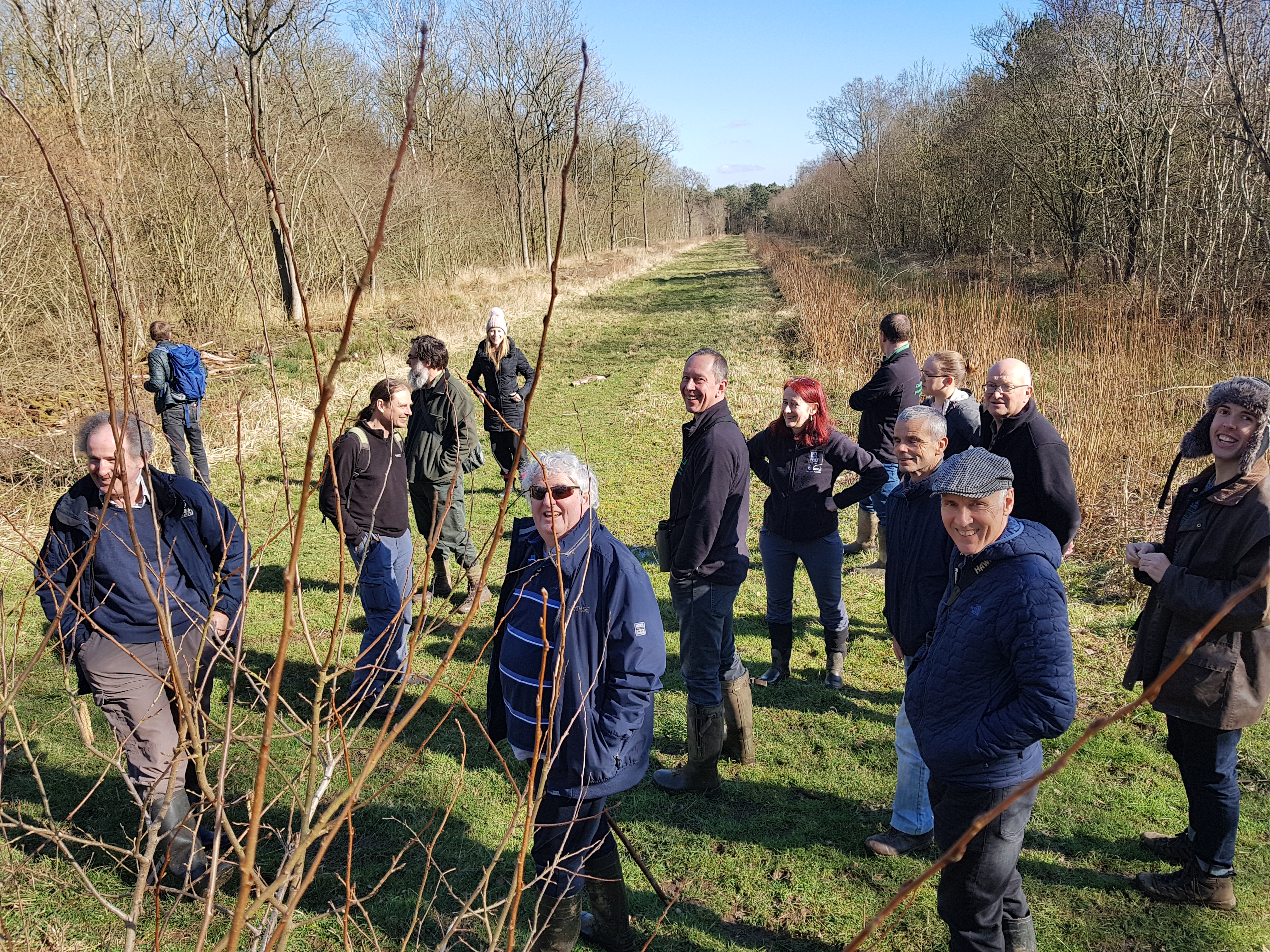
Following the student debate, Duncan and I headed out to catch up with a meeting of the steering group of the Chequered Skipper Reintroduction Project   We missed the morning’s presentations but arrived in time for the lunch and a short field trip:

2020-03-16 14.25.51

The location of the reintroduction is still being kept secret, as is a second site where a further reintroduction of butterflies from the Belgium population is being considered.  However there was much discussion as to whether restrictions on travel means that this would have to be delayed until next year.

On the way to that site, during a 15 minute drive, we spotted seven red kites.  They are now so common that seeing these amazing birds hardly requires comment.  But we should never forget what an incredibly successful conservation story this has been.  To cap it all, when we arrived at the site I had the pleasure of meeting Karl Ivens, one of the main drivers behind the reintroduction of red kites to Northamptonshire. He now estimates the regional population to be a couple of thousand birds.  The guy deserves a statue, or at least a blue plaque on his house!

On the way home I was thinking about my next blog post and what to write, and whether or not to bring the pandemic into it.  There’s a lot of information, and misinformation, about COVID-19 online and I’m not qualified to add to that: I’m not an epidemiologist.  However I’d like to link to a few things I think are worth reading.

Over at the Dynamic Ecology blog, Brian McGill has posted an open thread on ecologists discussing the coronavirus pandemic.  There are some interesting contributions in the comments, particularly around the response of the UK Government to the crisis.  I was struck by Jeremy Fox’s comment that Britain has some brilliant epidemiological modelers and that “even if you don’t think much of Boris Johnson or his senior advisers, the modelers who are feeding them information and advice are intellectually honest, hardworking, care deeply about protecting the public, and are as good at their jobs as anybody in the world.”  As I pointed out in a reply, this is undoubtedly true, but a lot depends on whether the government is willing to implement that advice. And its track record so far is not inspiring: for years it ignored expert advice on the effects of badger culling on the spread of bovine TB and continued to kill badgers. It’s only just reversed that decision.  Let’s hope that they have learned from that experience.

I am also hoping that there will be at least one positive outcome from the current pandemic on top of recent extreme weather patterns linked to climate change (for example the drought and fires in Australia that I blogged about in January).  I hope that it serves to  remind the public, governments and large corporations just how dependent on the environment our society is.  Despite our advanced technologies, we are incredibly sensitive to disruptions in the natural world.  As this old piece from the New York Times points out: “most epidemics — AIDS, Ebola, West Nile, SARS, Lyme disease and hundreds more that have occurred over the last several decades — don’t just happen. They are a result of things people do to nature“.   That was in 2012, long before COVID-19 was discovered.  To update this, check out the Wildlife Conservation Society’s ongoing series of articles about the relationship between our destruction of natural habitats, the trade in illegally (and legally) hunted animals, and emerging diseases such as COVID-19.

I realise that I’m fortunate and that there’s a lot that I can do by working from home.  For the next few weeks I’ll be doing just that, supporting students online, completing grant and manuscript reviews, having Zoom/Skype meetings, and completing the book that I am writing.  Stay safe everyone.