Tag Archives: Conservation

IUCN Bumblebee Specialist Group annual report 2015

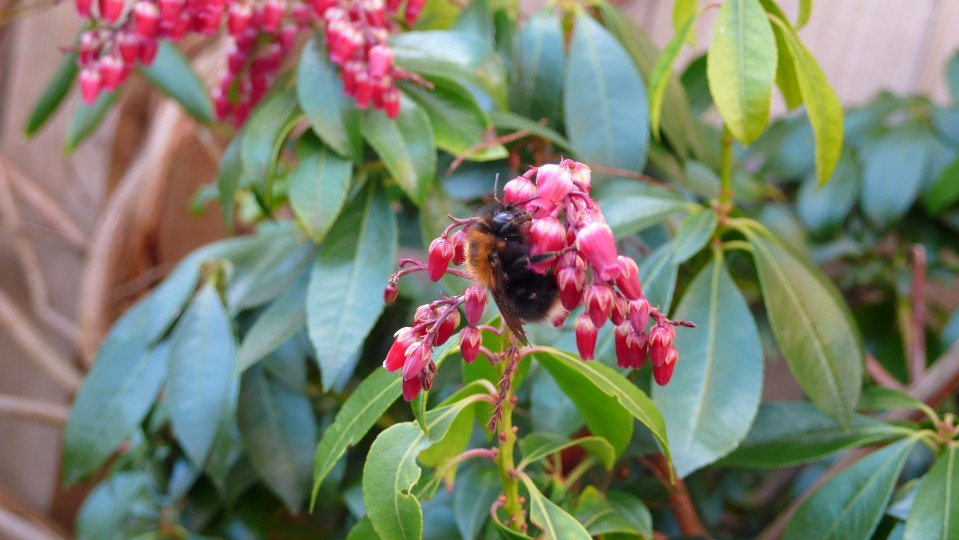
Bombus hypnorum March 2010

The International Union for Conservation of Nature (IUCN) has a Bumblebee Specialist Group which is focused on assessing the conservation status of the c. 260 species within the genus Bombus.  If you follow the link above you can find out more information about the group and a PDF of the most recent annual report for 2015, plus past reports for 2012-2014.

The work of specialist groups such as this is vital for providing evidence as to the true picture of how the world’s pollinators are faring, and what can be done to reverse local and regional declines in their diversity and abundance.

What I learned at the Bumblebee Working Group Meeting

20160330_171209Earlier this week I attended the Bumblebee Working Group Meeting at the University of Sussex, a one day event that takes place every two or three years.  It was a very stimulating day with some really interesting work being showcased; here are some examples of things that I learned that day, some questions that these findings have prompted (and the people presenting):

  • High arctic/montane bumblebees have undergone (and survived) periods of severe climate change in the past – does this mean they are less sensitive than temperate species to future climate change? (Paul Williams).
  • Bumblebees foraging closer to honey bee apiaries are more likely to be infected with a range of bee diseases – presumably picked up from the honey bees, but what is the route of transmission?  (Samantha Alger).
  • Queen Buff-tailed Bumblebees exposed to neonicotinoid pesticides have a 26% reduction in the probability of founding a colony, and the effects vary for other species – are the most sensitive species the ones that have declined the most since the mid-90s? (Gemma Baron).
  • Simulating bumblebee colony dynamics with the Bumble BeeHave model is producing comparable results to field data on male and queen production (Matthias Becher).
  • Environmental Stewardship Schemes appear to enhance bee nest densities on farms where they are situated – but are some species already at saturation point on those farms? (Tom Wood).
  • New, tougher EU guidelines for risk assessment of effects of pesticides on bees have been developed and are being tested at the moment (James Cresswell).
  • The annual spread of the Tree Bumblebee, Britain’s newest bumblebee species, is about 35km per year (Liam Crowther).
  • The equivalent of 737,914 bramble flowers are needed to provide the resources support a single colony of Buff-tailed Bumblebees for one year (Ellie Rotheray).
  • The moratorium on neonicotinoids seems to have had the desired effect of reducing the amount of these pesticides being taken up by bumblebee colonies in pollen and nectar (Beth Nicholls).
  • There have been significant range extensions of some of our rarer bumblebee species in Essex over the last 15 years or so – has this also been happening in other counties? (Ted Benton).
  • Sites with greater levels of radioactive contamination at Chernobyl have fewer older bees – does this mean that the radiation is affecting their lifespans?  (Katherine Raines).
  • Buglife’s B-Lines project continues to develop and gain momentum (Laurie Jackson).
  • The Short-haired Bumblebee reintroduction project has recorded workers every year since 2013.  However there have also been reintroductions of queens from Sweden every year – so are the queens surviving over-winter and founding new colonies? Or are the workers just from the new queens each year? (Nikki Gammans).

Thanks to all the speakers, it was a great meeting, and special thanks for Dave Goulson for his hospitality and for organising the event.

A number of people were tweeting from the event using the hashtag #BBWG16 – follow the link for more comments and some images, including a couple of yours truly in action – one of which I’ve stolen (below).

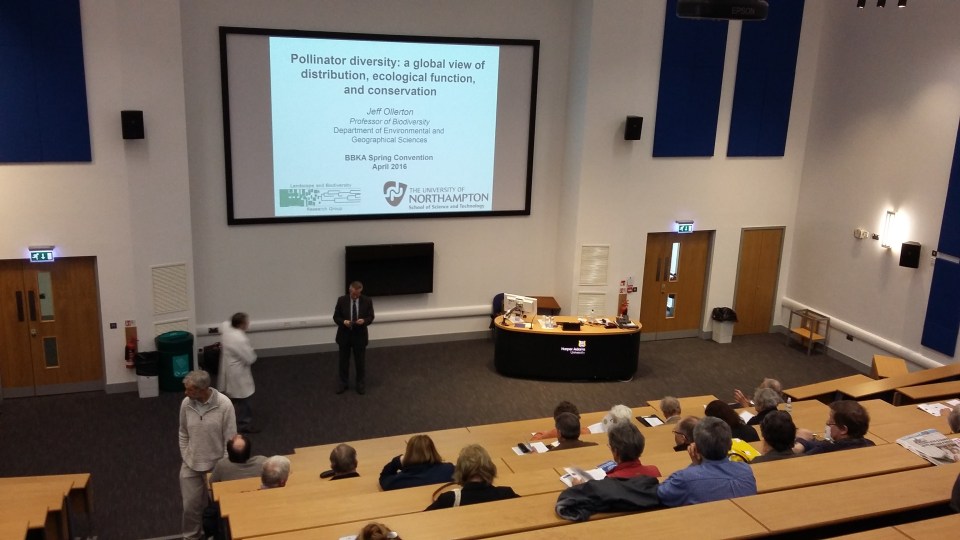
Jeff at BBWG 2016

Special issue of Leaf Litter devoted to pollinators

Leaf Litter

A short while ago I was interviewed by an American journalist as part of a special issue of the online newsletter Leaf Litter devoted to pollinators.  Produced by a conservation planning and ecological restoration organisation called Biohabitats, this special issue includes:

» Thoughts on Pollinators
» Expert Q&A: Jeff Ollerton
» Expert Q&A: Jerome Rozen
» Expert Q&A: Eugenie Regan
» Inspiration: Promising Progress With Pollinator Habitat
» Non-Profit Spotlight: The Xerces Society
» Video: An ecological planner walks into a cider mill…
» How Saving Pollinators Can Save Water and Fish Resources
» Biohabitats Projects, Places, and People

Here’s a link to Leaf Litter.

Urban Pollinator Knowledge Exchange summary – Bristol 22nd February

P1110838The importance of urban environments for supporting pollinator populations is a topic that I’ve covered several times on the blog, for example: “Urban pollinators for urban agriculture” and “Urban bee diversity – a new study“.  It’s a subject that’s generating a lot of interest at the moment with some really exciting research being published and conservation practice taking place.  However there’s clearly a lot to do if we are really to understand where pollinators are distributed across out townscapes, and how we can best manage urban habitats to support this diversity and increase their numbers – here’s a link to an interesting round table discussion on this very topic.

Recently I was invited to take part in a workshop event co-organised by Defra, NERC, and Dr Kath Baldock from Bristol University entitled: Knowledge Exchange: urban grassland management and creating space for pollinators.  As well as doing a short talk which contextualised the current scientific knowledge on urban pollinators, I facilitated one of the breakout discussion sessions.

The workshop was very well attended with some 50 delegates from a wide range of organisations, including local and national authorities, businesses, NGOs, and universities.  Feedback from those delegates was generally positive and most people learned something about managing urban settings for pollinators, and made some useful connections.  I certainly learned a lot: it’s good to get out of academia sometimes and talk with practitioners.

If you follow this link you’ll find a PDF of the summary from the facilitated sessions, covering topics such as grassland and verge management, the urban edgeland, innovative projects, and green infrastructure.

Over at the Bumblebee Conservation Trust’s blog, Sam Page has a very nice summary of the whole day which is also worth reading:  Trials and tribulations of managing urban grasslands for pollinators.

Many thanks to all of the organisers for their work in putting on this event.

Bumblebee Working Group meeting – University of Sussex – 30th March

Bombus hypnorum

It’s been three years since the last meeting of the semi-formal Bumblebee Working Group, which I hosted at the University of Northampton, and British Bombus researchers  are eagerly looking forward to the next one which is being organised by Professor Dave Goulson at the University of Sussex on 30th March.  There is no charge and if anyone with an interest in bumblebees wishes to attend, please contact Dave.

Here’s the programme for the day, which starts at 10am and finishes at 4.30pm:

Goulson, Dave – Welcome

Williams, Paul  – Bumblebees of extreme environments

Alger, Samantha – RNA viruses in Vermont bumblebees

COFFEE BREAK

Baron, Gemma – Impacts of a neonicotinoid pesticide on colony founding bumblebee queens

Becher, Matthias Bumble – BEEHAVE: using bumblebee colony models as a conservation management tool in agricultural landscapes

Breeze, Tom – Knowledge gaps for effectively valuing pollination services

Cresswell, James – New European Union protocols for testing the toxicological impacts of agro-chemicals on bees

Crowther, Liam – Inferring invertebrate dispersal distances from biological records

LUNCH

Rotheray, Ellie – Quantification of the floral landscape in agro-ecosystems and its effect on bumblebee colonies

Nicholls, Beth – Pesticides in rural and urban bumblebee nests

Benton, Ted – Status of the BAP carders in Essex

Ollerton, Jeff – Exceptional urban nest density of the Tree Bumblebee Bombus hypnorum during summer 2014

SHORT BREAK

Raine, Katherine – Chernobyl bumblebees: Understanding fitness consequences of living in the exclusion zone

Jackson, Laurie  – B-lines

Gammans, Nikki – An update on the progress of reintroducing the short-haired bumblebee, Bombus subterraneus 

CLOSE

Emerging threats to the Białowieża Forest, one of Europe’s last remaining wilderness areas

From various news sources and personal contacts I’m hearing about some emerging threats to the Białowieża Forest, which at 216,200 ha (2,162 km2 or 835 square miles) is one of Europe’s largest and most ancient forested wilderness areas, and one of the few places where you’ll still see European bison (Bison bonasus)roaming free.

Despite its designation as a World Heritage Site, in recent months the Polish government has revealed plans to increase the amount of logging in the forest, ostensibly as a tree disease control measure.  However Polish scientists dispute this and claim that the real motivation is commercial – see the commentary and letters in this week’s Nature.  Here’s a quote from that article which provides some context to the concerns:

“[the] Białowieża management plan limits logging in the forest to 48,000 cubic metres of wood per year — enough to allow locals to gather firewood. But on 10 November, the local forest administration proposed an amendment that would allow large-scale logging in sections outside the central 17% of the forest that is a national park. They cited an outbreak of the bark beetle pest (Ips typographus) in Białowieża’s Norway spruce (Picea abies). In one forest district where logging is currently limited to 6,000 cubic metres per year, the allowable yearly volume would increase to 53,000 cubic metres”.


Interestingly, both Ips typographus and Picea abies are native to these forests and any large-scale outbreak would probably constitute a disturbance that is part of the natural dynamics of the forest. A recent piece on the National Geographic site by conservation biologist Stuart Pimm is worth quoting from in this regard:

“To…scientists studying biodiversity, the main value of the Białowieża Forest is accumulated in a massive occurrence of large and old trees, high amounts of dead-wood and natural dynamics of forest stands all being very unique to this area and supporting thousands of different specialised species ranging from birds and mammals using cavities or building nests in the canopy to lichens, fungi and microbes dependent on different stages of tree life and its decomposition.  It is not surprising that Białowieża Forest has been an invaluable reference area for scientists studying natural characteristics of European forests.” [my emphasis]


This is not the first time that concerns have been raised about the Białowieża Forest – here’s an article from the Guardian newspaper from 2011:  http://www.theguardian.com/world/2011/apr/06/poland-environmentalists-foresters-primeval-forest

Is it too much to hope that the Polish government takes notice and strengthens, not weakens, the protection of its natural heritage?  And allows natural processes to determine what happens in this woodland, rather than trying to manage every aspect of its ecology.

Pollinators, Pollination and Food Production: IPBES gains momentum

Bee on apple blossom - 1st May 2015

The over-arching themes of this blog have been about understanding biodiversity; the science behind its study; why it’s important; how it contributes to human well being, (including both intangible and economic benefits); and how policy informed by science can support the conservation of species and ecosystems.  These are all issues that have a global perspective beyond the bounds of my home country (the United Kingdom), or even my continent (Europe) because species, ecosystems and the threats to them do not respect political borders.

Enter IPBES – the Intergovernmental Science-Policy Platform on Biodiversity and Ecosystem Services (sometimes shortened to Intergovernmental Platform on Biodiversity and Ecosystem Services).

IPBES is a United Nations body established in 2012 that in many ways is a parallel entity to the IPCC ( Intergovernmental Panel on Climate Change), bringing together scientists, policy makers and stakeholders, with a mission:

to strengthen the science-policy interface for biodiversity and ecosystem services for the conservation and sustainable use of biodiversity, long-term human well-being and sustainable development

Which has got to be a good thing: science informing policy, what’s not to like?

The first output from IPBES will be a Thematic Assessment of Pollinators, Pollination and Food Production, and it’s just been discussed (today) at the 4th Plenary meeting of IPBES in Kuala Lumpur – here’s a link to the press release.

In the coming weeks I’ll talk more about IPBES and its Thematic Assessment (for which I acted as a reviewer), but for now I’ll just repeat some of the headline figures from the report:

  • 20,000 – Number of species of wild bees. There are also some species of butterflies, moths, wasps, beetles, birds, bats and other vertebrates that contribute to pollination.
  • 75% – Percentage of the world’s food crops that depend at least in part on pollination.
  • US$235 billion–US$577 billion – Annual value of global crops directly affected by pollinators.
  • 300% — Increase in volume of agricultural production dependent on animal pollination in the past 50 years.
  • Almost 90% — Percentage of wild flowering plants that depend to some extent on animal pollination*.
  • 1.6 million tonnes – Annual honey production from the western honeybee.
  • 16.5% — Percentage of vertebrate pollinators threatened with extinction globally.
  • +40% – Percentage of invertebrate pollinator species – particularly bees and butterflies – facing extinction.


*They are quoting a figure that I calculated, and very proud of it I am too 🙂

Pollinators and pollination – something for the weekend #9

The latest in an (ir)regular series of posts to biodiversity-related* items that have caught my attention during the past few weeks; this one’s focused on pollinators and pollination because there’s been so much emerging on this recently it’s been impossible to decide what to write more fully about!


Feel free to recommend links that have caught your eye.

*Disclaimer: may sometimes contain non-biodiversity-related items.

Ecological intensification and pollinator diversity: a new study by Garibaldi et al. (2016)

2013-04-15 13.54.19-2Think of “farming” and those of us living in the more industrialised parts of the world usually envision large fields that are intensively worked using heavy machinery and regular inputs of fertilisers, pesticides and herbicides. But for 2 billion of the world’s farmers, agriculture takes place on smallholdings of less than 2 ha in size, with little money available for vehicles and chemicals.  Maximising food outputs in such systems can be difficult.

Now a new study by Lucas Garibaldi, Luisa Carvalheiro and colleagues entitled “Mutually beneficial pollinator diversity and crop yield outcomes in small and large farms” has demonstrated that these small-scale farmers can increase the yields from insect pollinated crops on their farms by allowing native vegetation to grow alongside the crops, which supports a greater diversity and abundance of pollinators that then spill over into the adjacent fields.

It’s a great study that delivers a message that large agro-chemical firms probably will not wish to hear: that yields can be enhanced without throwing ever more fertiliser or pesticides onto the crops.

The paper is paywalled so you’ll have to ask the authors for a copy unless you (or your institution) has an e-subscription to Science.  But here’s the original abstract:

Ecological intensification, or the improvement of crop yield through enhancement of biodiversity, may be a sustainable pathway toward greater food supplies. Such sustainable increases may be especially important for the 2 billion people reliant on small farms, many of which are undernourished, yet we know little about the efficacy of this approach. Using a coordinated protocol across regions and crops, we quantify to what degree enhancing pollinator density and richness can improve yields on 344 fields from 33 pollinator-dependent crop systems in small and large farms from Africa, Asia, and Latin America. For fields less than 2 hectares, we found that yield gaps could be closed by a median of 24% through higher flower-visitor density. For larger fields, such benefits only occurred at high flower-visitor richness. Worldwide, our study demonstrates that ecological intensification can create synchronous biodiversity and yield outcomes.


The challenge from this paper is two-fold.  First of all it’s how to operationalise this kind of research on the ground, to farmers and agronomists who are unlikely to be readers of the journal Science.  This is where organisations such as the UN’s FAO, country-level government agencies, and non-governmental organisations  have a crucial role to play, translating research into action.

The second challenge is likewise difficult – how do we bring “ecological intensification” into the industrialised agriculture of more developed nations?  I have no immediate answer to that, but research such as this shows what the potential benefits can be, for both agriculture and biodiversity.

The reference is:  Garibaldi, L.A. et al. (2016) Mutually beneficial pollinator diversity and crop yield outcomes in small and large farms.  Science 351: 388-391

Ecosystem services survey – share your thoughts

Researchers at the University of the West of England (UWE) are carrying out a public survey on attitudes to the concept of ecosystem services, a subject that I’ve referred to many times on this blog, most recently last week.

The UWE researchers write:  “……give us your views on the term ‘ecosystem services’! Do you feel it is a valuable concept? How should it be used and communicated? Regardless of whether you work with the concept or not, we would like to hear your views. The survey closes 5th February 2016……survey takes 10 minutes or less!”

I’ve done is and they’re right, it’s very short, but well worth completing as it should generate some interesting data into how far the concept has penetrated into the public consciousness.  The link to the survey is:

https://uwe.onlinesurveys.ac.uk/ecosystem-services-sfep