Tag Archives: Conservation

Brexit and biodiversity: submissions invited to a Government inquiry

20160520_114743

Following on from my posts regarding how Brexit may affect the UK’s environmental policies and activities (see here and here) the Government has moved (surprisingly) quickly to begin an inquiry into how leaving the EU may affect issues that [quote] “include the future of funding for biodiversity and agri-environment schemes, the likely changes in the devolved administration, and the role that managed rewilding can play in conservation and restoration”.

I say “surprisingly” because the Government is no doubt focused on what they might see as more pressing concerns; but then much of this inquiry relates to how Brexit might affect biodiversity via subsidies to farmers, and the farming lobby is very powerful of course, and is no doubt pressing Defra to get a move on.

Here’s a link to the inquiry’s official website.  From that site I’ve pulled out the following text:

The Environmental Audit Committee invites submissions on some or all of the questions below:

  • What are the implications for UK biodiversity of leaving the EU, in particular the Common Agricultural Policy? To what extent do initiatives to support biodiversity in the UK depend on CAP-related payments? What risks and opportunities could developing our own agri-environment policy and funding present?
  • How should future support for UK agriculture be structured in order to ensure there are incentives for environmentally-friendly land management? What are the positives/negatives of current schemes (e.g. Countryside Stewardship) that should be retained/avoided?
  • How should future UK agri-environment support be administered, and what outcomes should it focus on?
  • What are the prospects and challenges for future environmental stewardship schemes in the devolved administrations? How much divergence in policy between the nations of the United Kingdom is likely? How can divergence be managed?
  • What are the future risks and opportunities to innovative land practices, such as managed rewilding? What role can rewilding play in conservation and restoration of habitats and wildlife? What evidence is there to support the incentivising of such schemes in any new land management policies?

There is a form for submissions (available on the website) and the deadline is Friday 9th September 2016.

I’ll be submitting a response via the Northamptonshire Local Nature Partnership, and welcome comments and ideas from any readers.

“Insect pollinated” crops that don’t actually require insect pollination

Cucumber fruit 20160713_103558

Yesterday evening I learned that a large grant application that I’d submitted earlier this year had failed to secure funding.  Statistically there was a high likelihood of this happening but that doesn’t make it feel any better: weeks and weeks of work have come to nothing.

So in a mood of bloody-minded contrariness and general displeasure at the unfairness of the world I thought I’d provide an alternative to the Bees’ Needs week I mentioned yesterday by focusing on food crops that look as though they should be insect pollinated (and their ancestors certainly were) but which don’t actually require pollinators.

The example pictured above is an F1 hybrid cucumber (Cucumis sativus) variety called “Mini Munch”, kindly grown from seed and given to me by my friend and colleague Dr Janet Jackson.  Many cucumbers don’t need insect pollination, despite their large, colourful flowers, and the fact that related crops (melons, courgettes, squashes, etc.) generally do require pollinators.  Indeed some varieties taste bitter if they are pollinated.  I can recommend this web page on how to grow cucumbers for further advice.

As I was taking that photograph, and in another demonstration of how the world is against me at the moment, I spotted a bee feeding on one of the all-female flowers of this variety.

Megachile on cucumber 20160713_103627

It spent some time there probing the centre with its tongue, so I think these flowers still produce nectar despite them not needing pollinators, a hang-over from their ancestry.  Plants have a whole range of mechanisms that ensure reproduction without the agency of insects and other animal pollinators, and this has been exploited by crop breeders who have selected crop varieties for their ability to self pollinate or to reproduce asexually via apomixis (as in the case of this cucumber).

The same bee then flew onto a tomato (Solanum lycopersicum) flower (another group which varies in its demands for pollination) and I got a better look – seems to be a Leaf-cutter Bee of the genus Megachile.

Megachile on tomato 20160713_103712

The final example of a crop which requires little or no insect pollination are the chillies (Capsicum spp.) all of which are self-pollinating, I believe.  This variety is a scrambling purple type called Orzoco*.

Orzoco chilli 20160713_102213

So, crops vary hugely in their need for pollinators and the presence of certain traits of animal pollination, such as large, brightly coloured flowers and nectar, is no guarantee that the crop really does have to be serviced by pollinators.  The only way to be certain is to experimentally test the plants, a topic I hope to come back to later in the summer.

Don’t worry, this grumpiness won’t last long, in no time at all I’ll be back to banging on about the importance of pollinators.  At least Monty, one of our two cats, still loves me.


*At least, that’s what it said on the seed packet; I’ve also seen it referred to as Orozco – does anyone know which name is correct?

Bees’ Needs week (9th to 17th July) #BeesNeeds

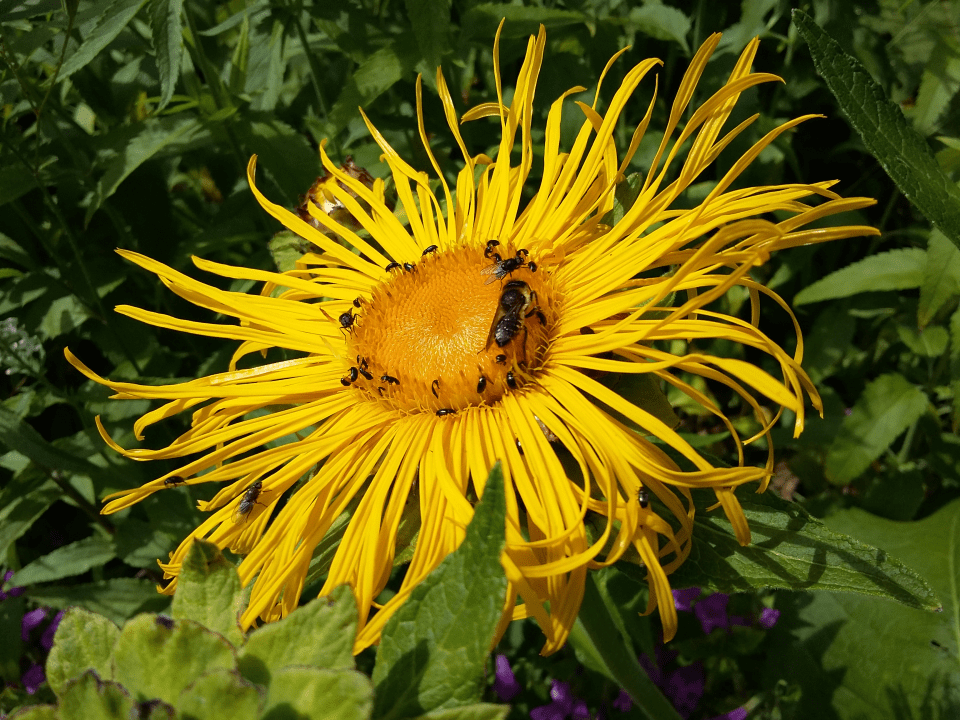
Inula at Ravensthorpe 20160710_145426.png

In the current political turmoil around the Chilcot Enquiry, Brexit, leadership challenges and a change of Prime Minister you’d be forgiven for having missed the fact that 9th to 17th July 2016 has been designated “Bees’ Knees” week, as a follow on to the Pollinator Awareness Week of 2015.

Here’s the link to the Defra press release.

Unlike last year I’ve no specific plans to do any regular posts on the topic, but I will provide links to relevant items as and when I see them, starting with these two:

Why insects are declining globally, and why it matters.

Dave Goulson is trying to crowdfund a project to look at pesticides in plants from garden centres.


What does Brexit mean for British biodiversity?

Friday 24th June 2016.  What a surreal day.  I spent it trying to understand why a small majority of the voting public had committed us to leaving the European Union, an organisation that has had a demonstrably positive impact upon our lives, our society, our economy, and our environment.  That dream-like state was not helped by the fact that I’d stayed up most of the night with my youngest son James, watching the results roll in.

Saturday 25th June 2016.  Twenty four hours later, after a good night’s sleep, I feel less dislocated but no less confused and disappointed.  It is what it is, let’s get on with it.

It’s much too early to properly answer the question of what this all means for British biodiversity, of course.  But as I pointed out in my post about the environmental arguments for remaining in the EU, there’s a whole raft of policies, legislation, agreements and initiatives that the government and NGOs need to consider.  Just to give a couple of examples, what will happen to the All-Ireland Pollinator Plan, or the Special Protected Area status of places such as the Upper Nene Valley?

What I really hope is that we can continue as before, building on the current situation rather than tearing up the whole thing.  To some extent I’m optimistic that we can for the near future, because the government will have (as it sees it) bigger things to worry about.  But I do worry that eventually we will get left behind as EU environmental legislation evolves.  That’s something we have to be mindful of in the coming years.

The ecological internet is already starting to discuss these issues; here are links to a few pieces that I’ve seen:

Adventuresinbeeland has discussed what leaving the EU means for British bees and beekeepers, pointing out that EU funding has enabled bee inspectors to carry out apiary inspections and work with beekeepers on issues such as bee pests and diseases.

The Wildlife Trusts are trying to look positively at the future, with Brian Eversham, Chief Executive for the Wildlife Trust for Bedfordshire, Cambridgeshire and Northamptonshire, summing it up very well:  “Many of those who disagreed over the Referendum agree strongly that wildlife, our countryside and the natural environment matter, now and for the future. We need their voices loud and clear in the coming months. As we are now responsible for our own, independent future, it is up to all of us to make sure that we keep the environment firmly on the national agenda.”

Mark Avery has also summed up the current situation very succinctly on his blog – one cartoon says an awful lot.

Finally, here’s Craig Bennett, CEO of Friends of the Earth, writing on how can we make Brexit work for the environment?

No doubt there will be more coming soon and I’ll try to provide updates on the blog.

In terms of my day job as an academic at the University of Northampton, things will also change across the whole British Higher Education sector, of course.  On one level that’s a different set of issues to what I’ve been discussing, but there are also links: a great deal of ecological research activity is being funded by the European Union and involves cross-border collaborations.  Scientists across Europe have to continue to make that work.

The environmental argument for the UK remaining in the European Union

Every week I receive an email bulletin called Science for Environment Policy, sent out by the Directorate-General for Environment, which is the European Commission department that sets and monitors European Union policies relating to the environment, for example pollution levels, conservation of biodiversity, etc.  Anyone can subscribe to these bulletins and they provide useful, lay-person summaries of recent research findings that have a direct or indirect bearing on how we manage and protect Europe’s environment.

A scan through the latest few bulletins reveals article titles such as:

  • Atlantic beaches of Europe reshaped in stormy winter of 2013–2014
  • Water management: five policy conditions to help overcome the challenges of an uncertain future
  • Climate change threatens early-flowering plants due to lack of snow
  • Black carbon emissions of individual cars measured under real conditions
  • Are endocrine disrupting chemicals responsible for downward trends in male fertility?
  • Environmental performance of construction and demolition waste management
  • Golden jackal should not be treated as an alien species in Europe
  • Environmental taxation in the right place can increase business productivity 

This set of topics is fairly typical, and demonstrates the complexity and breadth of the environmental issues facing the European Union.  All of these issues, however, share one feature: they do not respect political boundaries and are cross-border in scope.  Species, rivers, air masses, sea currents, economic resources, waste products: all of them can (and do) move through the different countries of Europe and beyond.

What this means is that the policies, laws and regulations that govern the behaviour of individuals and organisations towards the environment, and ultimately protect it, must also be cross-border in scope.  That’s where the European Union comes in, because it is largely EU directives that currently protect our environment.  Some examples of these directives, and some of their achievements, include:

  • Birds Directive which has helped to coordinate action plans for endangered resident and migratory birds.
  • Habitats Directive that relates to the conservation of natural habitats and the fauna and flora they contain, including setting up the Natura 2000 network that currently covers more that 18% of the EU’s land area and almost 6% of its marine territory, making it the world’s largest coordinated network of protected areas.
  • Water Framework Directive that determines action in the area of water policy.
  • Waste Framework Directive likewise determines action in the area of wastes policy and which, together with the Landfill Directive and the Waste Electrical and Electronic Equipment Directive, has been responsible for significantly reducing the amount of waste going into landfill, increased the amount being recycled, and placed pressure on manufacturers to take responsibility for packaging and end-of-life goods and materials.

There are many others, and you can find a list here.  It’s worth pointing out that these directives were not “imposed” on the UK by faceless bureaucrats in Brussels: the UK took an active role in their development and drafting.  In fact Boris Johnson’s father, Stanley Johnson, was one of the original authors of the Habitats Directive and is a prominent advocate of remaining in the EU.

Of course, no one is arguing that these directives are the only mechanism for protecting the environment, there are local regulations too, plus the work of NGOs such as the RSPB and the Wildlife Trusts.  Nor am I arguing that they have been wholly effective: there’s still a long way to go in many of these areas.  But they have had a demonstrably positive impact on the quality and protection of the UK’s environment that could be halted, or even reversed, if the UK was to leave the EU.

This last point is an important one to make and it’s not an example of the fear-mongering that has marked the EU Referendum debate on both sides.  Here is how I see it:  we cannot trust the UK government (whatever its political flavour) to safeguard our environment.

This is because, despite the best efforts of genuinely committed and environmentally savvy politicians, the political parties to which they belong are too focused on short-term goals of winning the next election to really consider the 20, 50, or 100 year perspectives that are required for environmental legislation.  This inevitably means that the environment is low on the list of priorities for most ministers, and environmental policy is subject to undue influence by special interest groups.  For example look at how easily Defra was persuaded to allow exceptions to the EU moratorium on neonicotinoid pesticides.  Likewise the HS2 project which ministers seem determined to keep going despite serious concerns about the environmental impact of the project (see my post “Ordinary by Choice“).

When considering whether or not to vote to remain in the EU, most people (understandably) are focused on the social and economic arguments: the impacts on jobs, standards of living, resources for health, etc.  But in part the environmental argument is a social and economic argument, because the natural environment underpins many jobs, our standards of living (who doesn’t want to live near unpolluted green space that is protected for future generations?), and plays an important part in the nation’s health and wellbeing.  The provision of these “ecosystem services” were clearly spelled out last year in Tony Juniper’s book What Nature Does for Britain, which I reviewed on this blog.

I’m not arguing that everything in the European Union is perfect, or even that the environment of the UK and the rest of the EU is as good as it ought to be, or could be.  But for every statistic about declining species and poor environments, it’s possible to quote figures for the success of other species and improvements in quality.  For example our major rivers such as the Thames, Tees, Mersey and Avon are now swimming with fish where once they were swimming with excrement, as I’ve previously discussed in relation to the River Wear.  Our membership of the European Union is, at least in part, responsible for these positive trends and I hope that they continue.  Please consider this when you’re deciding how to vote on 23rd June.


Postscript: much of what I’ve discussed above is being widely talked about amongst environmentalists, and I don’t know of any major environmental organisation that is in favour of the UK leaving the EU.  In fact a large number have publicly come out in favour of staying, including:

Chartered Institute of Ecology and Environmental Management

The Wildlife Trusts

Greenpeace

The RSPB and WWF-UK, who have produced a joint statement.

Friends of the Earth

Buglife

There is also a group called Environmentalists For Europe

So don’t just take my word for it.


Pollinators, yeast, and the BES at RHS Chelsea – official press release

P1030210

The official press release for this week’s British Ecological Society display at the RHS Chelsea Flower Show, which I talked about last week, was embargoed until this morning; here’s the full text that’s been tailored by the University of Northampton press office:


Scent, colour and form all shape the choices we make about what to plant in our gardens. Gardeners know that flowers produce nectar and scent to attract the birds, bats, insects and other animals they rely on as pollinators, but few realise that organisms too small to see with the naked eye also play a vital role in this process.

Ecologists have discovered that a yeast called Metschnikowia plays a key part in the pollination story and next week, for the first time, visitors to the RHS Chelsea Flower Show will be able to get a sniff of it and see how it looks under the scanning electron microscope.

The yeast forms part of the British Ecological Society‘s Animal Attraction: The garden and beyond display, which focuses on the relationships between plants and their pollinators – relationships that are amazing in their diversity as well as crucial to global food security. The University of Northampton’s Professor of Biodiversity, Jeff Ollerton, has been advising the British Ecological Society on the project.

Metschnikowia is ubiquitous, present in most flowers in most gardens, yet ecologists are only just beginning to uncover its mysterious role in pollination. The yeast is studied in only four laboratories in the world and Dr Manpreet Dhami from Stanford University has donated the yeast for the British Ecological Society’s garden.

Like other yeasts, Metschnikowia may produce volatile chemicals that mimic the scent flowers use to attract pollinators, thus helping the flower to attract more pollinators and therefore set more seed. In return, the yeast becomes attached to birds, insects and other pollinators, which it relies on for dispersal.

Professor Ollerton explained: “It was a pleasure to work with the British Ecological Society on this project as it highlights two important points about the natural world: that pollinators other than bees are just as important to both wild plants and crops, and that the diversity and abundance of many of these groups is declining worldwide.” Professor Ollerton’s recent study, published in Science, found that 23 species of British bees and flower-visiting wasps have gone extinct since the 19th century.

According to Jessica Bays of the British Ecological Society: “To tackle this decline, we need to understand its causes, including climate change, habitat loss and pesticide use, and we also need to understand the role played by yeasts such as Metschnikowia, which is why we decided to bring it to Chelsea this year.”

Tickets are still available for the RHS Chelsea Flower Show 2016 – for more information click here.

Pollinators at RHS Chelsea Flower Show

20160518_114732

Pollinators, as regular readers of this blog will know, are diverse and important, both ecologically and agriculturally.  But that diversity is declining and it’s an issue that deserves greater publicity and action.

To that end, for the past eight months I’ve been advising a team from the British Ecological Society (BES) on the content for a display at the RHS Chelsea Flower Show which is running all next week.  The display is called “Animal Attraction: The Garden and Beyond” – if you follow that link you’ll get a sense of what the display is all about, but in essence there are three key messages that the BES is trying to get across:

  • Celebrating the diversity of pollinators (not just bees!) both in the UK and globally.
  • Flowers have evolved many different ways of attracting and rewarding pollinators, leading to the fantastic diversity of floral form that gardeners appreciate.
  • Planting a diversity of flowers in your garden can only be a good thing for helping conserve pollinator populations.

As you can see from my wristband, I’ll be helping to staff the stand all day Tuesday 24th May, so if you’re at the show come and say hello and take a look at what the BES team has produced.

Tributes to Sir David – and he finds time to write to one of our students!

Saadias letter from Sir DavidThere can’t be many people currently working or studying in ecology, conservation, or the environmental sciences who were not in some way inspired by the programmes presented by Sir David Attenborough during his long career.  I certainly was, and I can trace my interest in the richness of our planet’s biodiversity right back to watching his ground-breaking series Life on Earth as a young teenager, and then reading the book, bought for me by my parents.

As you are probably aware, yesterday was Sir David’s 90th birthday, and the tributes to his iconic status as part of the scientific and cultural fabric of our nation, and his international standing, have been extensive and heartfelt. My personal favourites include naming the new NERC research vessel the RSS Sir David Attenborough and having a Madagascan dragonfly named after him by my friend and colleague KD Dijkstra, whose work I’ve highlighted previously on this blog.

But in the midst of all of these tributes and celebrations of a spectacular career, the measure of the man can be summed up by his taking the time to send a hand-written letter to one of our undergraduate students (see photograph).  The story of how Saadia Khan received Sir David’s letter can be read in full on the University of Northampton’s website.

All I can offer by way of my own tribute is to say thank you, Sir David,  for continuing to be such an inspiration, and may you have many more birthdays to come.

Design and Testing of a National Pollinator and Pollination Monitoring Framework – report published today

B pasc on sunflower

This morning there were swifts flying above the garden – summer’s [almost] here!  As if on cue, the eagerly anticipated report on “Design and Testing of a National Pollinator and Pollination Monitoring Framework“, one of the key recommendations of the National Pollinator Strategy, has been published today by Defra.  Here’s a link to the report and its annexes.

I’ve not had time to read the full report, and even the Executive Summary (ES) is quite long and detailed, but the Conclusion to the ES captures the key points (emphases in bold are mine):

“…there is considerable scope to enhance monitoring of pollinators and pollination services to ensure a robust and rigorous evidence-base to support the needs of policy, however this project has demonstrated clear trade-offs between likely cost and data quality, especially in terms of the taxonomic resolution and accuracy of species identifications. Currently the volunteer sector, namely the NSS*, provides the expertise to deliver monitoring of changes in species occurrence or distributions at a national scale for many, but not all, species. Indeed the total value of voluntary work provided by BWARS and HRS….is estimated, based on current levels, to reach in excess of £5M over ten years. Repeated systematic sampling from a stratified network of sites not typically covered by the NSS has the potential to add considerable value, providing data on pollinator abundance that may link with provision of pollination services and filling gaps in the spatial extent and species coverage. Enhancements to improve the range and accuracy of monitoring pollinators and pollination services over large spatial and temporal scales will depend on adequate resources to support capacity building, coordination and implementation.”

In summary, the volunteer schemes are a hugely valuable asset that need to be enhanced by funding from the public purse in order to set up a pollinator and pollinator monitoring scheme that will be fit for purpose.  Will the current Government show the necessary vision and leadership to provide that funding?  Watch this space….

* NSS = National Recording Schemes and Societies, e.g. Bees Wasps and Ants Recording Society (BWARS), Hoverfly Recording Scheme (HRS), etc.

Six bees, one stone: recent pollinator-related talks and workshops

BBKA lecture April 2016As I write this I’m painfully conscious that (a) it’s a couple of weeks since I last posted on the blog; and (b) I have a long list of things to complete before I head off to Tenerife for ten days of field work on Friday.  The absence of posting has been due to my current work load, including the number of conferences, talks and workshops I’ve been involved with in the past month, which seems to have taken up a disproportionate amount of my time.  It’s all been interesting and useful, however, and reflects the rising activity stemming from the National Pollinator Strategy, and increasing interest in pollinators more broadly.  I’ve certainly learned a lot and hopefully my own expertise contributed to the success of these events.

In this post I thought I’d briefly summarise what I’ve been up to recently, in the process expanding the numerical and phylogenetic parameters of “killing two birds with one stone“:

16th March – took part in a workshop to map the latest phase of Buglife’s B-Lines across Bedfordshire, Northamptonshire, Buckinghamshire and Oxfordshire.  This was a really interesting exercise and I felt that we’d actually achieved rather a lot by the end of the day.  Once the final maps are completed I’ll post a link so you can see where the routes go through these counties and how they meet up.

23rd March – spoke at a one-day conference on “delivering biodiversity” organised by the Environmental Association of Universities and Colleges at the University of Worcester.  Although I was talking about our bird surveys on the University of Northampton’s new Waterside Campus, pollinators did receive some attention during a workshop on creating wildflower meadows.  I’ll post an update on the Waterside work once we’ve completed the next set of spring surveys.

30th March – spoke at the Bumblebee Working Group at the University of Sussex – have already posted an account of that.

6th April – took part in a”Pollinator Experts Elicitation” workshop at the University of Warwick, along with a group of nine other academics, and members of stakeholder groups such as FERA and the NFU.  Run as part of Warwick’s Food and Behavioural Science Global Research priority groups, the organisers, from the university’s Department of Statistics, used the Delphi Method to assess the likelihood of sustaining pollinator populations under different scenarios of disease, climate change, and habitat degradation.  It was a fascinating process and interesting to see how often experts’ views converged on the same opinion.  Also rather humbling to see the degree of our uncertainty in our forecasts.  The workshop garnered quite a bit of media attention including pieces on the BBC’s Midlands Today and the Farming Today programmes.

8th-9th April – delivered two lectures at the British Beekeepers Association’s Spring Convention at Harper Adams University.  Rather disconcerting to be the least-informed person in the room, given my limited knowledge of bee keeping, but they were a friendly and curious lot with good-sized audiences for my talks on the diversity of bees to be found in urban settings, and the global diversity and functional importance of pollinators.

13th April – spoke to a very receptive audience at the Friends of Linford Lakes Nature Reserve near Milton Keynes, on the topic of “Bees for dinner?  The importance of pollinators in a changing world“.  Great evening and lots of interesting questions afterwards, though my talk was a bit too long (must cut it for next time).

That’s it for now, hope to do some posts from Tenerife while we are there.