It’s five years to the day since I left the University of Northampton. On that day, encouraged by Karin, I wrote two letters. One was “To the past” and the other was “To my future”. Once I’d written them they were sealed and tied up with a length of twine that we’d used as a timeline exercise.
This morning I opened the letters and thought about how far I (we) have come in the last five years. It was emotional but life-affirming to read those words to my past and future self. I’ll not go into the details of what I wrote – they will remain private – suffice to say, some of what I wanted to do has come to pass, some has not, and things that I never imagined would be possible have taken place!
If there’s a point to this story it’s that doors move in two directions – they open and they close. Big Life Decisions like leaving academia (or any other job for that matter) are really scary but they should not hold you back. I’m happier and healthier than I was five years ago and, while I won’t pretend that leaving my professorship behind was easy or that there’s been difficult times during the past half decade, it was one of the best decisions that I ever made.
So thank you to all of my colleagues and friends who have helped me on this journey, and especially to Karin for all her support.
Bees are among the most important pollinators in the natural world, quietly sustaining ecosystems and food production. While honeybees often steal the spotlight, a vast number of solitary and primitively eusocial bees play equally vital roles. But across both urban and natural landscapes, many of these species are facing worrying declines.
As cities expand, they’re increasingly being seen not just as threats to biodiversity, but as potential refuges for pollinators. Yet urban environments are very different from natural ones. The heat generated by buildings and concrete – known as the urban heat island effect – and the way green spaces are managed (often with little consideration for flowering plants) could be affecting bees in ways we’re only beginning to understand.
As part of a recent study led by my former PhD student Muzafar Sirohi, we explored how urban conditions might be influencing the timing of bee emergence and the sex ratios of different species. This work formed part of Muzafar’s PhD research, and I was pleased to be part of the team that supported and collaborated on the project.
We found that several solitary bee species were producing females before males – a reversal of the more typical pattern known as ‘protandry’, where males emerge first. Most bees in the families Apidae and Megachilidae did follow the usual male-first pattern, but there were some interesting exceptions, including Nomada marshamella and Nomada fabriciana. Soil-nesting species also showed a lot of variation in emergence timing, likely influenced by microclimatic differences in urban soils.
When we looked at overall sex ratios, patterns varied across bee families. In Halictidae, females were more common, whereas Apidae and Megachilidae were skewed towards males. Interestingly, the Colletidae family showed no strong bias either way. However, in five species from the Andrenidae and Halictidae families, we saw a clear difference between urban and natural environments: urban populations had a higher proportion of males.
This could suggest that urban habitats – especially those with limited floral resources due to mowing, paving, or the removal of wild plants – may not be supporting as many female bees. Since females are the ones responsible for nest-building and potentially pollination, as they visit more flowers, this imbalance could have long-term effects on bee populations and the pollination services they provide.
Our study adds to the growing body of evidence that urban environments can support pollinators – but only if managed thoughtfully. Cities need more than just green space: they need flowering plants, nesting habitats, and careful planning that recognises the delicate balance of bee ecology. With the right actions, we can make urban areas part of the solution to pollinator decline.
Solitary and primitively eusocial bees are essential pollinators of plants. However, recent observations indicate a decline in their populations in both urban and natural environments. Urban areas are increasingly recognized as potential habitats for bee conservation. Nonetheless, these urban habitats can influence the taxonomic and functional diversity of bee populations. Therefore, we hypothesize that the distinctive warmer climate of urban areas – resulting from the urban heat island effect – along with the potential scarcity of floral resources, contributes to shifts in emergence patterns and the sex ratio of solitary and primitively eusocial bees. We found that many solitary bee species produced females before males. Additionally, most species within the Apidae family were recorded as protandrous, with the exceptions of Nomada marshamella and Nomada fabriciana. All species of Megachilidae were found to be protandrous. We also observed significant variation in the emergence patterns of soil-nesting species. Notably, we did not find any relationship between sociality and nesting preferences in relation to sex-biased emergence. The overall sex ratio varied among different bee species and families. In Halictidae family, sex ratios were biased towards females, while the Apidae and Megachilidae families exhibited a skewed ratio towards males. The sex ratio in the Colletidae family did not show any significant difference. However, among the Andrenidae and Halictidae families, we identified five species with significantly different sex ratios between urban and nature areas, with a higher proportion of males observed in urban sites. This suggests that these species may have been affected by limited food resources, potentially due to urban management practices such as the removal of floral resources. This could lead to increased competition for resources among the species.
This element of Muzafar’s work explored how solitary and primitively eusocial bees (those that live alone or in simple social groups) respond to different aspects of city landscapes. He examined local habitat factors such as floral diversity, bare soil availability, and sunlight exposure, alongside broader urban features like green spaces, roads, and paved areas.
The findings highlight that small-scale habitat conditions—especially the variety of flowering plants and access to sunlight—had a greater influence on bee diversity and abundance than overall habitat size. While larger landscape features, such as urban green spaces, played a role at a broader scale, even small patches of wild vegetation and roadsides were found to be important for bees.
These results challenge the idea that bees need large, uninterrupted green spaces to thrive. Instead, even fragmented urban habitats, when managed thoughtfully, can support pollinators. By planting diverse flowers, preserving patches of wild vegetation, and maintaining sunlit areas, cities can become havens for these essential insects.
Simple changes—like creating wildflower-rich roadside verges or maintaining natural pockets of greenery—can make a significant difference. As urbanisation continues, ensuring that bees have the resources they need to survive will be key to supporting biodiversity and maintaining the critical pollination services they provide.
Here’s the reference with a link to the published study; if you are not able to access it, send me a request for a PDF via my Contact page:
Solitary and primitively eusocial bees are important pollinators of plants, which are experiencing a global decline. Urbanisation is one of the contributing factors to this decline. It is crucial to understand the complex community dynamics of solitary and primitively eusocial bees in urban areas as urbanization grows globally. For bee communities, the local habitat as well as the surrounding urban landscape play an important role. The study considered four local habitat variables: habitat size, floral species richness, bare soil and shade. Moreover, five common land cover types (green space, buildings, roads, car parks, and paved surfaces) were assessed at multiple spatial scales from 40 m to 200 m from the centre of the sites with 20 m steps, analysing their potential impacts on the bee community. The study found a greater effect of local habitat compared to landscape variables at a smaller spatial scale. However, landscapes affected the bee community at larger spatial scales. The size of the habitat did not affect the bee community in urban areas. However, habitats with a higher number of plant species and exposed to sunlight attracted relatively more bees. This study suggests that urban areas are capable of conserving solitary and primitively eusocial bees. Although green space is important for the dispersal of species at larger landscape scales, small patches of wild, leftover vegetation and roadsides are equally important for bees. The management of bee friendly open vegetation with wildflowers would be beneficial for the successful conservation of solitary and primitively eusocial bees in urban areas.
Just after I arrived in Northampton in 1995, I set about looking for suitable local sites for conducting pollination ecology field work for myself and students. The campus on which we were situated at the time was adjacent to an urban park – Bradlaugh* Fields – parts of which were designated as local nature reserves. In the intervening years, data from that area have made their way into a wide range of published studies, including:
I still have data collected during that time that have never been published, but good data are hard won and they may see the light of day at some point. Case in point is that we’ve just published a paper based on data from Bradlaugh Fields, the first of which were collected in 2001!
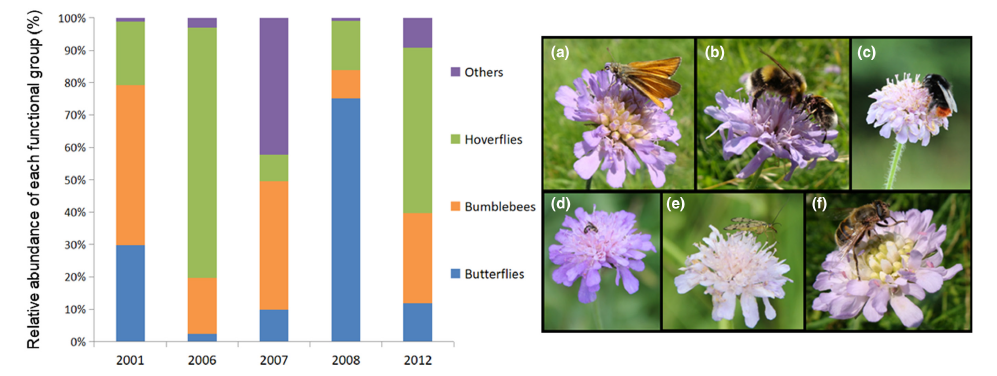
In this paper we’ve tested how effective hoverflies, butterflies and bumblebees are at pollinating the flowers of a common generalist grassland plant, colloquially called Field Scabious (Knautia arvensis). The expectation was that bumblebees, being generally larger, hairier and more flower-focused than the other groups, would be the most effective at transferring pollen to stigmas. To our surprise, they were not: hoverflies and butterflies performed just as well! In fact we argue that butterflies may be MORE important as pollinators of this plant because they fly further distances between individual plants, rather than hopping between the inflorescences of the same plants, as bumblebees tend to do.
Crucially, the importance of these different groups of pollinators varies enormously as the relative abundance of the insects visiting the flowers differs between seasons. In some years butterflies dominate as pollinators, in other years bumblebees or hoverflies. This is driven, we think, both by fluctuations in the populations of these insects and by the availability of other, more preferred flowers that may bloom at the same time.
The paper is part of a special issue of the Journal of Applied Entomology devoted to The Neglected Pollinators. It’s open access and you can download a copy by following the link in this reference:
Plant-pollinator interactions exist along a continuum from complete specialisation to highly generalised, that may vary in time and space. A long-held assumption is that large bees are usually the most effective pollinators of generalist plants. We tested this by studying the relative importance of different groups of pollinators of Knautia arvensis (L.) Coult. (Caprifoliaceae: Dipsacoideae). This plant is suitable for such a study because it attracts a diversity of flower visitors, belonging to different functional groups. We asked whether all functional groups of pollinators are equally effective, or if one group is most effective, which has been documented in other species with apparently generalised pollination systems. We studied two subpopulations of K. arvensis, one at low and one at high density in Northampton, UK. To assess pollinator importance we exposed unvisited inflorescences to single visits by different groups of pollinators (butterflies, bumblebees, hoverflies and others) and assessed the proportion of pollinated stigmas. We then multiplied the effectiveness of each pollinator group with their proportional visitation frequency in five different years. For each group we also compared time spent on flowers and flight distance between visits. The relative importance of each pollinator group varied between years, as did their flight distances between flower visits. Butterflies were the best pollinators on a per visit basis (in terms of the proportion of stigmas pollinated) and flew further after visiting an inflorescence. Different measures and proxies of pollinator effectiveness varied between taxa, subpopulations, and years, and no one group of pollinators was consistently more effective than the others. Our results demonstrate the adaptive value of generalised pollination strategies when variation in relative abundance of different types of pollinators is considered. Such strategies may have buffered the ability of plants to reproduce during past periods of environmental change and may do so in the future.
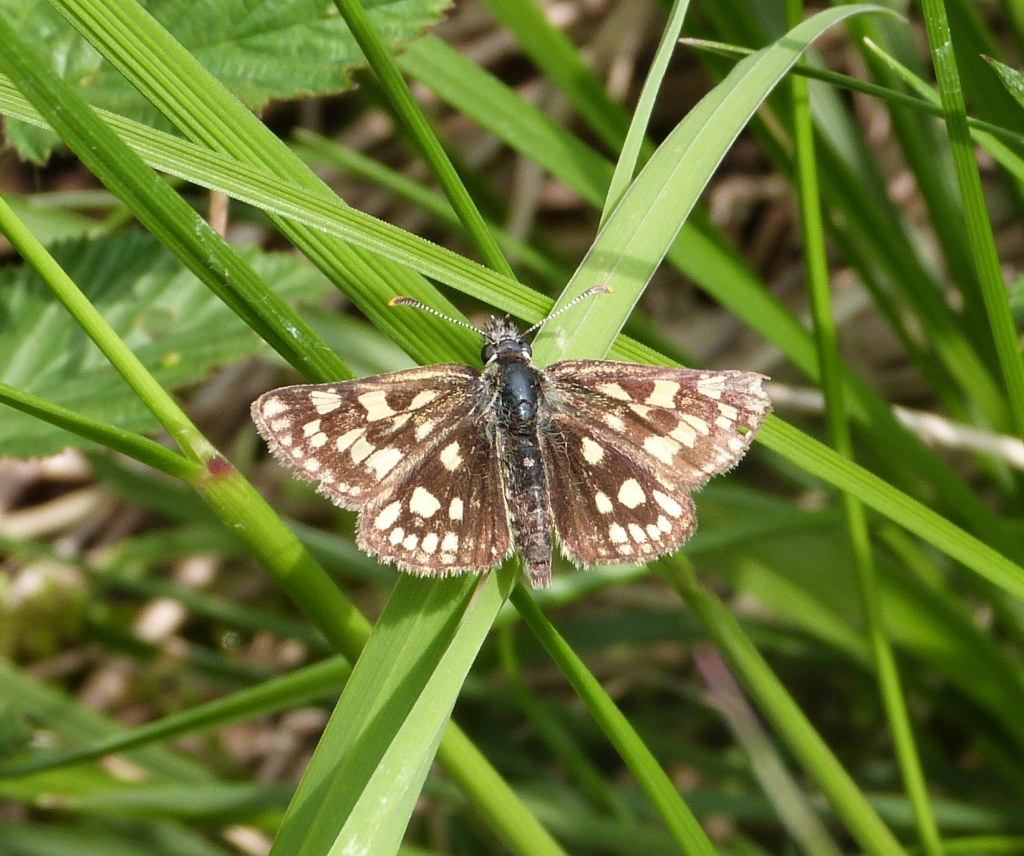
The reintroduction of the Chequered Skipper butterfly to England is one of the outstanding conservation success stories of the last ten years. I’ve been proud to play a part – see these old posts here, here and here – and in particular supervising Jamie Wildman’s PhD work. The second paper from his thesis has just been published and in it Jamie documents how you can identify individual butterflies by their markings and use this information to estimate the population size, life-span, and movements of Chequered Skippers. The technique could also be applied to other distinctively marked butterflies.
Here’s the reference with a link to a read-only version of the study:
If you need a PDF, get in touch via my Contact page.
Here’s the abstract:
The chequered skipper butterfly Carterocephalus palaemon was reintroduced to Fineshade Wood, England in 2018 as part of a Butterfly Conservation-led project following several years of planning. From 2019–2022, the population was sampled each May–June by the lead author, timed count volunteers, Butterfly Conservation staff, and casual observers.
A novel photographic mark-recapture (PMR) technique was trialled as an alternative to mark-release-recapture (MRR). In conjunction with timed counts, PMR was used to photoidentify individual C. palaemon through each butterfly’s upperside (ups) wing markings, estimate daily and gross population size, detect movements, and determine lifespan. As capture and recapture can be achieved non-invasively using PMR, habitat disturbance, the potential to influence butterfly behaviour, accelerate wing wear, affect mate selection and predation, and heighten mortality risk through handling are eliminated. We found PMR to be a viable alternative to MRR for a sensitive reintroduction of a low-density species with unique ups markings such as C. palaemon. Using capture histories generated through PMR, from a known founder population size of 42 butterflies in 2018, we estimated the population at Fineshade Wood had increased to 618 butterflies (+ 1371.43%) by 2022.
Movements of up to 2.22 km over a time period of 17 days were also detected. Lastly, we discuss the implications of PMR for population sampling of other Lepidopterans, and the potential to improve cost-efficiency of the technique using machine-based learning tools.
During the 25 years that I spent at the University of Northampton (and its predecessor institutions) I had a number of official roles, including heading up research within a faculty, chairing committees, and so forth. One of the most fulfilling of these was developing and leading the generic training programme that all postgraduate researchers across the university had to undertake.
These workshops covered a wide range of skills including strategies for literature searching, maintaining momentum in the middle stages of the journey, different approaches to writing and structuring a thesis, preparing for the oral defence, writing for different audiences, and dealing with different expectations and conflicts with supervisors. The last of these was run by Karin who brought to bear her skills as a relationship therapist and trainer.
Over the past few months I’ve been asked by a couple of universities to run my “Developing an online profile as a researcher” workshop virtually, most recently yesterday for Hartpury University. In this session I get the postgraduate researchers to think about their motivations for having an online profile, the different kinds of platforms that are available, the distinction between “shops window” and “market stall” approaches, and suggest a strategy and rules of engagement for using social media professionally. All of this is based on my own experiences from the last 20+ years of using online systems to promote and disseminate research to peers and to wider society.
If this is of interest and you’d like to discuss having me run this workshop (or indeed any of the others) for your graduate school or department, please use my Contact page to get in touch.
Within the last decade there’s been a growing awareness of the importance of urban environments for supporting populations of pollinators, especially bees. Indeed, I devoted a whole chapter of my book Pollinators & Pollination: Nature and Society to the topic, though even then I was only able to scratch the surface of the research that’s been done. Since then there’s been some important studies published and this 2020 review by Kath Baldock provides a good starting point for the topic, whilst a recent pre-print by Pietro Maruyama and colleagues emphasises how little we know about pollinators in tropical cities.
One of the most detailed studies of urban solitary bees in a British town was conducted by Muzafar Sirohi when he was a PhD researcher in my department in Northampton. The first paper from that work, documenting the diversity and abundance of bees, came out in 2015, but since then commitments to other projects, plus Muzafar’s return to his university in Pakistan, have meant that we’ve struggled to find the time to publish more. Hopefully that’s changing and the second publication from Muzafar’s thesis is now out, with a third in progress.
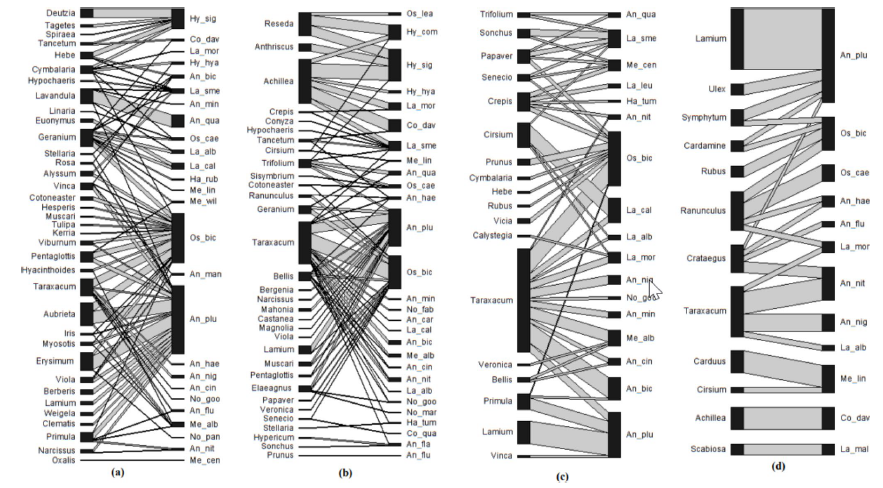
This new paper uses a network approach to study the use of flowers by these bees; here’s the reference with a link to a read-only copy of the paper, followed by the abstract.
Biodiversity is declining through human activities and urbanisation is often seen as a particular concern. Urban settings, however, provide diverse microclimatic conditions for plants and pollinating insects, and therefore may be significant habitats for the conservation of solitary and primitively eusocial bees, a major group of pollinators. This study analysed the interactions between these bees and the plants on which they forage, using a network approach. We compared urban habitats (gardens, roadsides, and open vegetation) in a large British town with nearby nature reserves. One native plant Taraxacum officinale (dandelion) was a core generalist species visited in all habitat types. Other core plant species restricted to particular habitats include species of Geranium, Bellis, Crepis, and Ranunculus. Two generalist bee species, Anthophora plumipes and Osmia bicornis were the core visitor species within the networks. The networks were comparatively more nested in urban habitat types than nature areas, suggesting more frequent interactions between generalist and specialist species in urban areas. Network connectance, network level specialisation (H2’ index), and plant generality (network level) were not significantly different in urban and nature areas. However, visitor generality was found to be significantly higher in urban gardens than in nature areas. Careful management of common urban vegetation would be beneficial for supporting urban wild pollinators.
The Chequered Skipper Reintroduction Project has featured in several posts over the last few years – see here and here – and University of Northampton PhD researcher Jamie Wildman has been working hard to complete his thesis under the less-than-ideal conditions imposed by the COVID-19 pandemic. The first paper from the project has just been published and it deals with Jamie’s monumental efforts to bring together all of the scattered data relating to preserved Chequered Skipper specimens held in museums and private collections. An existing database contained just 266 records; Jamie’s efforts increased that by an order of magnitude, adding a further 3,533 new records that document where and when specimens were collected, and by whom.
This 1,328 % increase in data means that we now know much more about the historical distribution of this butterfly and how that changed over time.
The Chequered Skipper went extinct in England in 1976 and this enhanced database will allow us to understand why that extinction occurred. This initial paper documents the strategy used to find the additional records as a road map for how others might proceed in the future. The full reference with a link to the paper is here:
The chequered skipper butterfly Carterocephalus palaemon (Pallas, 1771) was declared extinct in England in 1976 after suffering a precipitous decline in range and abundance during the 20th Century. By searching and collating museum and other records, we show how a deeper understanding of this decline can be achieved, thus furthering conservation objectives. A preexisting Butterflies for the New Millennium (BNM) database of United Kingdom butterfly species records, created by Butterfly Conservation in conjunction with the Biological Records Centre (BRC), contained 266 historic C. palaemon records from England. United Kingdom (UK) museums and natural history societies were contacted for specimen data, and these sources added 2175 new records to the BNM. Owners of private specimen collections were also contacted, and these collections accounted for a further 465 records. Specimens originating from UK museums, other institutions, and private collections represent 2640 (71%) of total new records. Other sources, such as personal accounts held in museums, published and unpublished texts produced an additional 894 records. A further 437 records from museums, private collections, and other sources were considered partial and omitted from the data due to limited or misleading date and/or locality information. In summary, data from UK museums and other sources has infilled English C. palaemon distribution prior to 1976, offering further insight into potential environmental and anthropogenic drivers of decline at key sites. The quality and quantity of data obtained using the method outlined in this study suggests similar work could be carried out for other extinct or declining butterfly species to improve our knowledge of habitat requirements and historical distribution via modelling, identify causes of decline, and provide valuable information for potential reintroductions.
It’s just over one year since I stepped down from my full time professorship at the University of Northampton in order to work independently as a consulting scientist and author. It was a move precipitated by a number of factors, not least that after 25 years at that institution I needed some new challenges. I was starting to feel stale, jaded, and not a little burned out.
Since making the decision to leave the university (where I still hold a Visiting Professorship) Karinand I have down-sized our lives by selling our house, disposing of possessions that we didn’t need (though there’s still a lot in storage in the UK) and moving to Denmark, where we are renting a small apartment for the time being. Karin is Danish and, yes, both Brexit and the pandemic have played a role in our decision making.
A few people have asked me recently how I’m managing to earn a living as an independent academic so I thought I’d share with you my experiences so far. I’ve looked at my various sources of income over the past year and put them into four broad categories: Conservation, Research, Education and Writing. Then I worked out the proportion of my income that can be attributed to each area, keeping in mind that there’s overlap between them. This is the result:
Conservation-related activities accounted for the largest fraction, about 46% of my income. This includes direct advisory and consulting, on pollinator-related projects but also on wider, biodiversity-related topics. For example I worked with the Stanwick Lakes nature reserve in Northamptonshire, advising on how best to enhance and manage the site for pollinators.
It’s a site that I know very well but which was set up mainly because it’s important bird habitat. Seeing it from a pollinator’s perspective allowed me to make suggestions for improving the amount and timing of floral resources, opportunities for ground nesting bees, and so forth.
I’ve also been working with the Centre for Ecology and Hydrology (Wallingford) on a biodiversity strategy for the European railway network which I’ll write more about later this year when the final report is published.
Also included in the Conservation category are the many, many talks (mainly online) that I’ve done for various natural history, gardening and beekeeping groups, plus training sessions that I’ve done with ecological consultancies, estates departments, and local government. There’s a list of those available on my training and public speaking page.
Research projects funded by UK and international agencies accounted for about 32% of my income. Some of these are projects that started when I was still employed at the University of Northampton and which are paying for my time (including completing the supervision of my remaining PhD students), others are new ones. You can find a list of present and past projects on this page of my website.
I am a partner on several funding applications that are in the process of being assessed and I’ll report back when we know if they have been successful.
As well as my own research I’m also reviewing grant applications for funding organisations, advising research groups and departments on their research strategies, and working with the Turkish Journal of Botany to promote the work it publishes to a wider international audience.
Education is the third, very broad category that includes things such as external examining (both taught and research degrees), assessing staff applications for promotion, and doing the occasional online lecture. It accounted for 11% of my income, less than I might have expected given that I’ve spent over 30 years teaching in higher education, educational consulting is quite a crowded field and unless you’re a high-profile specialist, it doesn’t pay well.
Writing accounted for about 11% of my income. As well as royalties from my book Pollinators & Pollination: Nature and Society, I earned money from writing for magazines such as BBC Gardeners’ World Magazine, New Scientist, British Wildlife, and Bees & Other Pollinators Quarterly.
In addition I’ve done some advisory work for publishers, including reviewing text and making suggestions for a forthcoming children’s book about bees and other pollinators, and some paid manuscript editing.
At the moment the balance of my work feels about right; I’ll never stop being a scientist so working on research projects is, and always will be, an important part of my life. I wish that it was possible to earn more from writing, but outside of the best-seller lists it’s difficult for authors to earn a decent living. However I’m working on my next book at the moment, as is Karin whose Essential Companion to Talking Therapy has been well received.
Working independently in this way, and putting together what amounts to a “portfolio career”, is not for everyone. It’s hard work and there are lots of uncertainties along the way, especially with regard to month-to-month consistency of one’s income. However a career as a university academic has prepared me for this in ways which I’m only just beginning to discover. Aside from the obvious subject expertise, familiarity with literature searching, and confidence when giving talks, the uncertainties associated with the high proportion of unsuccessful funding applications and navigating the (often contradictory) requirements of peer reviews has been extremely valuable experience. And of course I’ve established a large and diverse network of colleagues with whom I can collaborate and go to for advice. The diversity of paid work with which I’m engaged, plus the pro bono activities such as peer reviewing for journals, ensures that there’s never a dull day. I have absolutely no regrets about this latest step in my career!
If you’re interested in working with me or want to discuss any aspect of what I’ve written about, please do get in touch via my Contact page.
This is a guest post by Helen Tedds who is currently researching for a PhD at the University of Northampton. Although Helen’s work is far removed from my usual research and consultancy interests of plant-pollinator interactions, I’m proud to be part of her supervisory team! Amphibians were one of my early natural history obsessions, and invasive plants and pollinators are a long standing interest of mine. In this post Helen discusses her research on the UK reptile and amphibian pet trade.
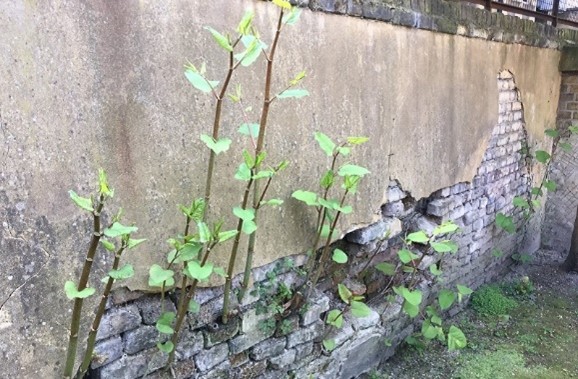
This week (24th-30th May 2021) is Invasive Species Week, an annual event led by the GB NNSS (Non-Native Species Secretariat) to raise awareness of invasive species and how we can help prevent their spread. Generally, the term ‘invasive species’ is defined as an introduced organism that has an adverse impact on its environment by causing ecological and economic damage. They are one of the top five causes of worldwide biodiversity loss through habitat damage, preying on or out-competing other species. They can also spread disease to other species, including humans. The estimated cost of invasive species to the UK’s economy is more than £1.7 billion [1] which is caused by things like damage to buildings [e.g. from the dreaded Japanese Knotweed (Fallopia japonica – fig. 1)], interference with food production, delays on work projects, and the expense of dealing with them. The number of new species being introduced to the UK is rapidly on the increase and can be exacerbated by climate change. This is an urgent problem that without intervention will continue to escalate!
Fig. 1: Japanese knotweed (Fallopia japonica) damaging a brick wall
In 2015 I embarked on a PhD that aimed to quantify the pet herpetofauna (reptile and amphibian) trade across England, mainly to understand the associated socio-economic factors and animal welfare consequences of this. Investigating invasive species was low on my already-full agenda, however, it has been a rabbit hole I ended up going down (pun intended: rabbits were named Britain’s most costly invasive species in 2010 according to The Guardian[2])!
The exotic pet trade has long been known to be a means of new species entering an environment (either through escape or deliberate release), but according to a recent study in Frontiers of Ecology it now ranks as a primary cause of invasive species[3]. It has long been illegal to release any non-native species into the wild under the Wildlife and Countryside Act 1981, however more recent legislation has been enacted to prohibit the trade of invasive species. Whilst the term ‘invasive’ can be subjective, in the UK a species officially considered to be invasive is listed in retained EU law: Invasive non-native (alien) animal species: rules in England and Wales. That’s not to say that other ‘feral’ pets are not ‘invasive’. There are concerns that Indian ring-necked parakeets (Psittacula krameria – fig. 2) that have spread across the UK are potentially out-competing some of our native birds for nesting sites in tree hollows[4]. However there needs to be a body of evidence built to support these claims before a species is added to the legislation.
Fig. 2: Indian ring-necked parakeet (Psittacula krameria)
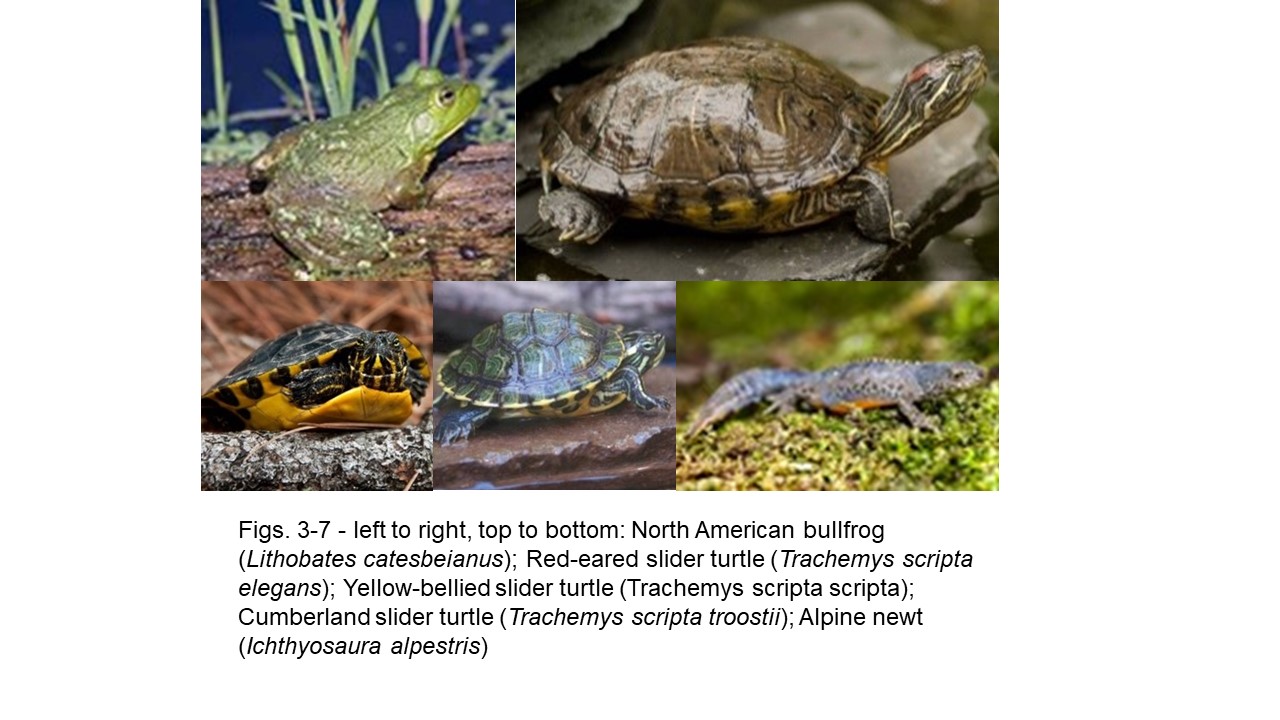
In terms of herpetofauna, there is only one invasive species of amphibian listed in the legislation, the North American bullfrog (Lithobates catesbeianus- fig. 3), and one species of reptile, the common slider turtle (Trachemys scripta) along with all sub-species, including T. s. elegans, T. s. scripta, and T. s. troostii -fig. 4-6)[5]. North American bullfrogs pose a threat to our already vulnerable native amphibians as they will eat frogs, newts, and other similar sized animals[6], and slider turtles threaten our waterfowl as they will eat bird eggs, as well as insect larvae[7].
The law has prohibited anyone from keeping, breeding, and selling these species since August 2016. If you owned one before the law came into force (turtles can be very long-lived) then you have what are called ‘grandfather rights’ where the animal can remain in your possession until the end of its days. If an owner can no longer take care of the turtle they cannot re-sell it- it is best to relinquish them to a rehoming centre that has the relevant license where they can live out the rest of their lives[8], such as The National Turtle Sanctuary at Lincolnshire Wildlife Park[9].
Part of my research into quantifying the herpetofauna trade has involved sampling from pet shops and online classified adverts as to what species are for sale. So far, I have officially documented 431 different reptile species, and 122 different amphibian species[10], and this number is set to grow as I continue to analyse four years’ worth of data. All these species are non-native, and whilst most of them would not survive in our British climate, there are some causes for concern.
In October 2020 a fellow PhD student, Ali North, got in touch with me as she is currently investigating the drivers of establishment and spread of a non-native amphibian in the UK, the alpine newt (Ichthyosaura alpestris- fig. 7). Her project uses distribution data of alpine newts in their native range across mid-Europe with an aim to predict the invasion risk of this species in the UK[11]. I was interested to learn from her that these newts have established various populations in the UK but most concerningly are known to be a vector of chytridiomycosis which can be transmitted to our native amphibians[12]. As part of her research at the University of Plymouth, ZSL Institute of Zoology, and the ARC Trust, Ali wanted to know how often alpine newts had occurred in my data sampling seeing as the pet trade is a potential route for non-native species entering the wild. It turns out that my data set had only 16 records of alpine newts (out of tens of thousands of records) which is not very many, however, do not be fooled by small numbers! It does not take many individual pets being released into the wild for a potentially invasive species to wreak havoc on an ecosystem. Whilst the understanding of alpine newts as an invader is in its infancy, I was delighted to be able to assist Ali with this part of her research and I look forward to reading her final thesis. If you have spotted an alpine newt in the UK you can also help towards her project by reporting it here: https://www.arc-trust.org/news/have-you-seen-an-alpine-newt-in-the-uk
Another interesting thing that my data collection has highlighted is that despite slider turtles being banned from sale for over four years now, they are still appearing on online classified websites such as Preloved, Pets4Homes, and Gumtree. Not only is this illegal, but it is also against the minimum standards set out by the Pet Advertising Advisory Group (PAAG) which these websites agree to adhere to as voluntary members[13]. Since I started collecting data in July 2017 to the time of publishing this blog there have been at least 102 adverts selling slider turtles, and these were the more obvious ones. On deeper investigation some adverts selling yellow-bellied sliders listed them as just the letters ‘YBS’ meaning that they would not be flagged when searching using key words. These adverts have consistently appeared in my data set at a rate of about two per month, with a noticeable spike in Oct-Dec 2020 at a rate of five per month, so there does not appear to be a downward trend since the legislation came into force. Also, some other adverts just listed animals using the word ‘turtle’ or ‘terrapin’; not only does this allow the potential for slider adverts to slip through the net but it also further violates PAAG minimum standards by not advising potential buyers what the species is. How can someone research the correct care information if they don’t know what species they are buying?
Another invasive species that I came into close contact with recently, coincidentally whilst in the process of writing this blog, was in my local park- Elmdon Park in Solihull. An invasive water weed, Azolla filiculoides, or red water fern (fig. 8), had suddenly appeared in one of the park’s ponds. This weed is believed to have entered UK water systems from the ornamental pond and aquarium trade either by spreading via birds’ legs between ponds or from people emptying fish tanks into wild water bodies. It spreads on the surface of water bodies, blocking out sunlight and decreasing oxygen, thereby killing native wildlife[14].
Fig. 8: Red water fern (Azolla filiculoides) in Elmdon Park, Solihull
I sit as Secretary on Elmdon Park Support Group’s[15] committee and run their social media pages, so I found myself reading more about this weed and treatments used to control it, in order to inform the local community on what would happen. The Warwickshire Wildlife Trust lease the land and therefore must foot the treatment bill, which turns out to be the use of a weevil (Stenopelmus rufinasus- fig. 9), affectionately known as ‘Weevil Knievel’ The weevil eats the weed but doesn’t come cheap at a cost of a few hundred pounds for just one container of them[16]. So here we have another casualty to our native wildlife because of the pet trade.
Fig 9: ‘Weevil Knievel’ (Stenopelmus rufinasus)
So, what can we do? Further research into identifying potentially invasive species will help in raising public awareness, whilst initiatives such as Invasive Species Week will spread the message on the consequences of releasing non-native species into our UK ecosystems. But there persists a deeper problem whereby some people fail to properly research the needs of the pets they buy, or fully understand how big they will grow, and feel that it’s easier to release them into the wild rather than to relinquish them via more responsible methods. This is perhaps the area of human-animal interactions that needs more attention and research.
Tedds, H.L., Sneddon, S., Ollerton, J., Clubb, R., and McCormick, W.D., Herps across England: investigating the scale of the reptile and amphibian trade: UFAW Recent Advances in Animal Welfare Science VII Conference Poster, 30th June- 1st July 2020, online.







 Prof. Jeff Ollerton - ecological scientist and author