Category Archives: Ecosystem services

Pollinators and pollination – something for the weekend #9

The latest in an (ir)regular series of posts to biodiversity-related* items that have caught my attention during the past few weeks; this one’s focused on pollinators and pollination because there’s been so much emerging on this recently it’s been impossible to decide what to write more fully about!


Feel free to recommend links that have caught your eye.

*Disclaimer: may sometimes contain non-biodiversity-related items.

Ecological intensification and pollinator diversity: a new study by Garibaldi et al. (2016)

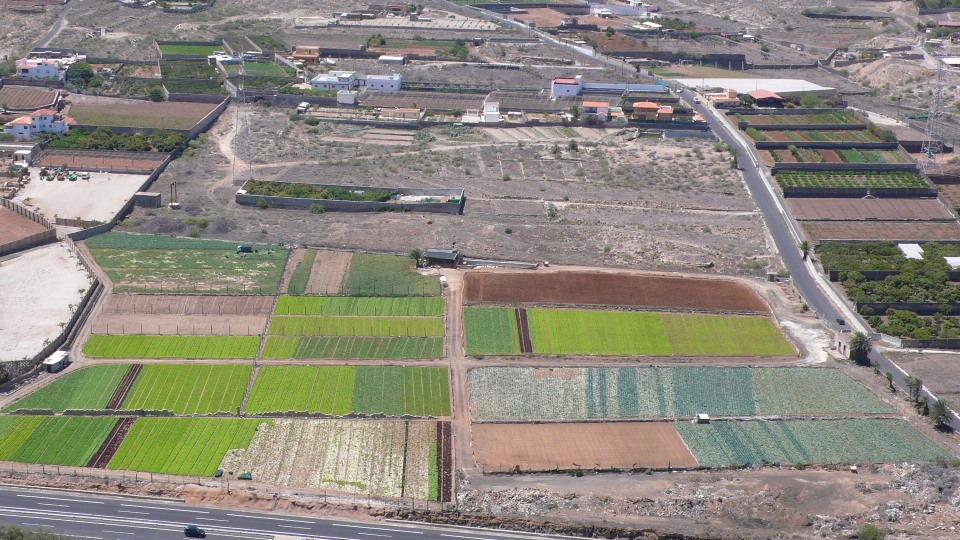
2013-04-15 13.54.19-2Think of “farming” and those of us living in the more industrialised parts of the world usually envision large fields that are intensively worked using heavy machinery and regular inputs of fertilisers, pesticides and herbicides. But for 2 billion of the world’s farmers, agriculture takes place on smallholdings of less than 2 ha in size, with little money available for vehicles and chemicals.  Maximising food outputs in such systems can be difficult.
Now a new study by Lucas Garibaldi, Luisa Carvalheiro and colleagues entitled “Mutually beneficial pollinator diversity and crop yield outcomes in small and large farms” has demonstrated that these small-scale farmers can increase the yields from insect pollinated crops on their farms by allowing native vegetation to grow alongside the crops, which supports a greater diversity and abundance of pollinators that then spill over into the adjacent fields.

It’s a great study that delivers a message that large agro-chemical firms probably will not wish to hear: that yields can be enhanced without throwing ever more fertiliser or pesticides onto the crops.

The paper is paywalled so you’ll have to ask the authors for a copy unless you (or your institution) has an e-subscription to Science.  But here’s the original abstract:

Ecological intensification, or the improvement of crop yield through enhancement of biodiversity, may be a sustainable pathway toward greater food supplies. Such sustainable increases may be especially important for the 2 billion people reliant on small farms, many of which are undernourished, yet we know little about the efficacy of this approach. Using a coordinated protocol across regions and crops, we quantify to what degree enhancing pollinator density and richness can improve yields on 344 fields from 33 pollinator-dependent crop systems in small and large farms from Africa, Asia, and Latin America. For fields less than 2 hectares, we found that yield gaps could be closed by a median of 24% through higher flower-visitor density. For larger fields, such benefits only occurred at high flower-visitor richness. Worldwide, our study demonstrates that ecological intensification can create synchronous biodiversity and yield outcomes.


The challenge from this paper is two-fold.  First of all it’s how to operationalise this kind of research on the ground, to farmers and agronomists who are unlikely to be readers of the journal Science.  This is where organisations such as the UN’s FAO, country-level government agencies, and non-governmental organisations  have a crucial role to play, translating research into action.

The second challenge is likewise difficult – how do we bring “ecological intensification” into the industrialised agriculture of more developed nations?  I have no immediate answer to that, but research such as this shows what the potential benefits can be, for both agriculture and biodiversity.

The reference is:  Garibaldi, L.A. et al. (2016) Mutually beneficial pollinator diversity and crop yield outcomes in small and large farms.  Science 351: 388-391

Ecosystem services survey – share your thoughts

Researchers at the University of the West of England (UWE) are carrying out a public survey on attitudes to the concept of ecosystem services, a subject that I’ve referred to many times on this blog, most recently last week.

The UWE researchers write:  “……give us your views on the term ‘ecosystem services’! Do you feel it is a valuable concept? How should it be used and communicated? Regardless of whether you work with the concept or not, we would like to hear your views. The survey closes 5th February 2016……survey takes 10 minutes or less!”

I’ve done is and they’re right, it’s very short, but well worth completing as it should generate some interesting data into how far the concept has penetrated into the public consciousness.  The link to the survey is:

https://uwe.onlinesurveys.ac.uk/ecosystem-services-sfep


Tight But Loose – just what is “biodiversity”?

Fleet photo 1

Ever since I set up the Biodiversity Blog in 2012 I’ve had it in mind to write a post asking the question “Just what is “biodiversity”?”, but have never quite got round to it, there’s been too many other interesting and important things to write about on here!  This week over at the Dynamic Ecology blog Brian McGill has beaten me to it with a really interesting post entitled:  Biodiversity and pizza – an extended analogy leading to a call for a more multidimensional treatment of nature.

I’m not entirely sure that the pizza analogy works, it’s a little tortuous, but none the less the post is provocative and interesting, and has generated a lot of comments.  I strongly recommend it.

In the interests of recycling, and because the readership of my blog only overlaps partially with that of Dynamic Ecology, thought I’d restate a few things that I brought up in the comments to Brian’s post (but this certainly won’t substitute for going over and reading it yourself”.

One of the questions that Brian asks is:  “Is biodiversity a useful term or has it outlived its usefulness?”  It’ll come as no surprise to readers that I like the word “biodiversity”: I used it for the title of my blog and for my professorship, because it captures a lot about what I value in the natural world, and because it’s a term that I’ve (professionally speaking) grown up with. To my mind it is an umbrella term that can mean different things to different people; some see this as a disadvantage but I think that, as long as we qualify precisely what we are referring to, using “biodiversity” in a loose way is not a problem. Perhaps an appropriate analogy is with politics: if someone describes themselves as a “conservative” or a “socialist” or a “liberal”, those terms cover huge internal variation and political scope, but it’s not a problem because it broadly describes the beliefs of that individual.

As an instance of when “biodiversity” may not be a useful concept for nature conservation, Brian gives an example of salt marsh, often areas with rather low species diversity, as being of low priority for conservation because they are poor in “biodiversity”.  But this ignores the fact that all of the “official” definitions of biodiversity explicitly include diversity of habitats/communities/ecosystems/biomes in a defined geographical area.  For example the United Nations Convention on Biological Diversity defines it as:

“the variability among living organisms from all sources including, inter alia, terrestrial, marine and other aquatic ecosystems and the ecological complexes of which they are part; this includes diversity within species, between species and of ecosystems.” [my emphasis]

Thus destroying an area of salt marsh may indeed result in few species being lost, but it would be a significant loss of biodiversity at that higher level of community/ecosystem, if a region has only salt marsh, woodland and grassland in it: in essence you’ve lost one third of your biodiversity because you’ve lost one third of your habitats.

Something that’s occurred to me over the last couple of days of reading comments and thinking about the questions that Brian posed is that “nature” and “biodiversity” are not actually synonymous at all. When people say they like “being in nature” or they “value contact with nature”, what they are usually saying is that they enjoy landscapes, seascapes, changes in the weather, being out of doors, etc., things which are not strictly part of what we understand as “biodiversity”.

Likewise, “protecting the environment” includes a whole set of non-biodiversity related questions and actions such as air and water quality, wastes management, sustainable use of resources, etc., much of which may not directly affect biodiversity at all.

“Biodiversity” has a specific meaning, as the definition above shows, even though that meaning can be broadly defined. Which sounds like a contradiction, but it’s not – and brought to mind the title of the Led Zeppelin fanzine: “Tight But Loose”*.  Biodiversity as a concept and as a field of research and action involves so many different types of stakeholder (ecologist, botanist, zoologist, artist, conservationist, activist) that (as I said) it provides a useful (loose) umbrella.  Problems only occur when people use different tight definitions and talk past one another.

The other aspect to Brian’s post is around the pros and cons of valuing ecosystem services, which is a much bigger argument in some ways, and I’m going to point readers to two blog posts, one recently from Steve Heard which I think is a very nice, concrete example that captures a lot of the uncertainties that Brian describes:

https://scientistseessquirrel.wordpress.com/2015/08/04/invasions-beauty-and-ecosystem-services-a-conundrum/

The second is one of mine from last July related to the value of valuing nature, which was prompted by the Costanza et al. update paper:

https://jeffollerton.wordpress.com/2014/07/27/how-do-we-value-nature/

These are fascinating discussions that will run and run, I have no doubt.


*I’m fond of bringing musical examples into these blog posts 🙂


Nature Improvement Area final report published today by Defra

As regular readers of the blog will be aware, over the past three years my research group has been involved as a lead partner in the Nene Valley Nature Improvement Area (NIA) project, one of 12 NIA schemes across England.  I’ve posted regular updates on the the Nene Valley NIA, for example see my posts entitled Angry Birds! (and startled bees), To Dream a River, and Biodiversity conservation pays its way.

Although our group still has work to do on writing up the results for our ecosystem services assessment of the Nene Valley, the NIA scheme has formally ended, and today Defra has issued a final NIA Monitoring and Evaluation Report, plus an accompanying press release.  Defra (and the government) judges the NIA scheme to be a resounding success and I have to agree with them.  To quote from the press release and from the final report:

  • Nearly 20,000 hectares of natural habitat – the equivalent of almost 23,000 football pitches – has been created, restored or preserved across England.
  • The Nature Improvement Areas have also helped people reconnect with nature, with volunteers contributing over 47,000 days, school children earning their green fingers by planting trees, and communities getting involved in decision making.
  • The NIA partnerships mobilised resources with an equivalent value of £26.2 million (including the financial value of volunteer time and services in-kind) in addition to the initial government grant funding. Of this total, £15.3 million was from non-public sources (e.g. private sector and nongovernmental organisations).
  • Learnings from the Nature Improvement Areas will now help to inform Defra’s 25 year plan for action on the environment which will be published later in the year as part of a comprehensive, long-term vision to protect the country’s natural heritage.

This last point is a critical one; much was achieved with the government’s initial investment of £7.5 million over three years.  Continuation of this type of funding, for the original 12 NIAs and additional projects, would achieve so much more, especially if it was tied in with upland and river restoration projects that focused on natural flood defences (which we know will work).  The potential savings from such investment could run into 100s of millions of pounds.  Let’s hope Defra has the strategic vision to make this happen.

Protecting an ecosystem service: approaches to understanding and mitigating threats to wild insect pollinators

Bee on apple blossom 2 - 1st May 2015Back in April 2015 I attended a two day meeting at Imperial College’s Silwood Park campus to discuss initial project ideas to address evidence gaps in the recent National Pollinator Strategy.  I mentioned the meeting in passing in a post at the time concerned with whether biodiversity scientists should also be campaigners, but didn’t say a lot about what conclusions we came to and what the next steps would be because at the time I was unclear on both of those counts: it was a very wide ranging meeting with a lot of participants coming at the question of pollinator conservation from different perspectives.  As well as academics there were representatives from the agrochemical industry, government research organisations, and  the National Farmers Union.
During summer 2015 one of the conveners of the meeting, Dr Richard Gillherded cats organised colleagues, pulled together all of the text and ideas that were generated, and took on the task of seeing a summary of the meeting through from initial draft to publication.  It was a monumental effort, involving 27 authors and 86 manuscript pages, and Richard did a sterling job.  Entitled “Protecting an ecosystem service: approaches to understanding and mitigating threats to wild insect pollinators” it will appear as a chapter in the next volume of Advances in Ecological Researchwhich should be published later this month.

The abstract and contents for the chapter are below; if anyone wants a copy of the full chapter, please let me know.

Abstract

Insect pollination constitutes an ecosystem service of global importance, providing significant economic and aesthetic benefits as well as cultural value to human society, alongside vital ecological processes in terrestrial ecosystems. It is therefore important to understand how insect pollinator populations and communities respond to rapidly changing environments if we are to maintain healthy and effective pollinator services. This paper considers the importance of conserving pollinator diversity to maintain a suite of functional traits to provide a diverse set of pollinator services. We explore how we can better understand and mitigate the factors that threaten insect pollinator richness, placing our discussion within the context of populations in predominantly agricultural landscapes in addition to urban environments. We highlight a selection of important evidence gaps, with a number of complementary research steps that can be taken to better understand: i) the stability of pollinator communities in different landscapes in order to provide diverse pollinator services; ii) how we can study the drivers of population change to mitigate the effects and support stable sources of pollinator services; and, iii) how we can manage habitats in complex landscapes to support insect pollinators and provide sustainable pollinator services for the
future. We advocate a collaborative effort to gain higher quality abundance data to understand the stability of pollinator populations and predict future trends. In addition, for effective mitigation strategies to be adopted, researchers need to conduct rigorous field- testing of outcomes under different landscape settings, acknowledge the needs of end-users when developing research proposals and consider effective methods of knowledge transfer to ensure effective uptake of actions.

Contents
1. Importance of Insect Pollination
1.1 Providing an Ecosystem Service
1.2 Brief Introduction to Pollination Ecology and the Importance of Wild
Pollinators
2. Major Threats to the Pollination Service Provided by Insects
3. Steps in the Right Direction to Protect Insect Pollinator Services: Policy Actions
4. Understanding and Mitigating Specific Threats to Wild Insect Pollinators to Protect Pollinator Services
4.1 Understanding the Stability of Insect Pollinator Communities
4.2 Using Molecular Approaches to Monitor Insect Pollinators
4.3 How Do Parasites Shape Wild Insect Pollinator Populations?
4.4 Understanding Insect Pollinator Population Responses to Resource Availability
4.5 Engineering Flowering Field Margins as Habitats to Attract Insect Pollinators
4.6 How Might We Improve the Wider Countryside to Support Insect Pollinators
4.7 Insect Pollinators in Urban Areas
5. Considerations When Developing Future Research and Mitigation Strategies
Acknowledgements
Appendix
References

Six Kingdoms for Christmas: the cultural biodiversity of a winter festival

P1120504

Since beginning this blog in 2012 I’ve traditionally posted one or two Christmas-themed items around this time of year, including a piece on “Thanking the pollinators for Christmas” and a true story from 2013, “A Christmas vignette“.  The role of pollinators in producing much of the traditional Christmas fare has subsequently been picked up by others (last year the University of Bristol, this year a blog from Trinity College Dublin) so I’ve decided to break with tradition and consider the ways in which biodiversity (both wild and farmed, though the latter of course originated as the former) adds to the cultural experience of Christmas through its traditions and rituals.

In this regard I’m coming at the topic as a north-European agnostic who values Christmas as an opportunity to relax and unwind at the darkest, coldest* part of the year, rather than as a Christian.  And because I’m a British scientist much of what I say relates to British customs, though I’ve tried to include non-British examples where I’m aware of them – feel free to let me know about examples I’ve missed by commenting below.

I’ve decided to structure this post taxonomically and focus on a Six Kingdom Classification** of life on Earth as that’s been the theme of my first year undergraduate teaching since October.  Four of the six Kingdoms can be dealt with fairly quickly as their significance to Christmas is marginal or non-existent.  The two “bacterial” Kingdoms (Archaea and Eubacteria) contribute little to Christmas other than providing much of the gut flora that’s going to help us digest our Christmas dinner. Important but not specifically festive.  Likewise the protists and algae (Kingdom Protoctista) add nothing specific to Christmas unless there are traditions associated with seaweed of which I am unaware.

The other three Kingdoms are the ones where cultural biodiversity associations are more apparent.  The Kingdom Fungi (yeasts, mushrooms and moulds) provides us with several Christmas traditions including (in Germany) hanging mushrooms on the Christmas tree for good luck, and in parts of Scandinavia hanging strings of dried mushrooms around the house as decorations and as a source of winter food.  There is also the association between the red-and-white colour scheme of fly agaric magic mushrooms (Amanita muscaria) and the robes of Santa Claus, though I’ve seen that idea debunked in a few places and it appears that the “traditional” interpretation of Santa’s suit originated in the USA in the 19th century.

The Kingdom Animalia (both invertebrates and vertebrates) affords us a host of cultural connections to Christmas.  Birds include the turkey (Meleagris gallopavo) which in times past were famously walked to London from Norfolk; the domestic goose (Anser anser domesticus); and much of the song Twelve Days of Christmas refers to birds, including the turtle dove (Streptopelia turtur) one of the UK’s most declining and threatened bird species.  Mammals we associate with Christmas include of course reindeer (Rangifer tarandus) pulling Santa’s sleigh, led by the nasally-advantaged Rudolph, but also domesticated farm animals.  For example in Denmark in osme households it’s more traditional to eat pork (Sus scrofa domesticus) for Christmas dinner than goose.

Staying with the vertebrates, in our house it’s traditional to have smoked salmon (Salmo salar) with scrambled eggs for breakfast on Christmas Day, and (again in Denmark) sild (Clupea harengus) is also traditionally served as a starter, but I don’t know of other fish traditions.  Likewise I’m unaware of any invertebrates that are specifically associated with Christmas, though there have been recent reports of sustainably-sourced lobsters (Homarus americanus and H. gammarus)  becoming “traditional” in Europe.  There are also some local traditions such as honey bees singing in their hives on Christmas Eve.

The last of the Six Kingdoms is the Plantae, which, whilst the least taxonomically diverse, provides us with a wealth of cultural associations to Christmas.  These traditionally include evergreen plants that have been used to decorate homes, probably since the earliest pagan Yuletide festivals, such as: Christmas trees (various conifers in the genera Picea, Abies and Pinus); European ivy (Hedera helix); holly (Ilex aquifolium); and mistletoe (Viscum album).  However such traditions evolve and adapt to local needs and availability of plants.  For example in North and South America other genera of conifers not found in europe, such as Pseudotsuga and  Araucaria, may be used as Christmas trees***.  Likewise the absence of European mistletoe in North America means that people have adopted native mistletoes in the related genus Phoradendron for decorating and snogging traditions.  Over at her blog, ecologist Manu Saunders has recently discussed how native Australian species can substitute European plants for Christmas decorations.

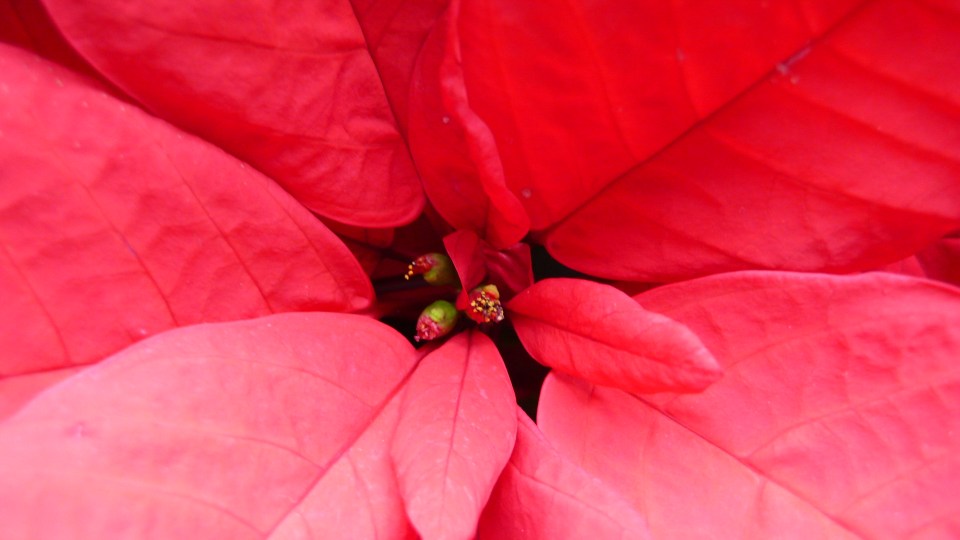
The final example from the Plantae is the poinsettia (Euphorbia pulcherrima) which I’ve pictured above.  In many ways this is an unusual plant to have such a strong cultural association with Christmas: it’s a mildly toxic species of spurge from tropical Mexico that was introduced to North America in the 19th century, then subsequently to Europe.  However its festive connotations date back to the earliest period of Spanish colonisation in the 16th century, so it’s older than some of the other Christmasy traditions I’ve discussed.

Of course biodiversity is about more than just species and taxonomic diversity, it also encompasses the diversity of habitats in which that life is found.  Here too we see strong influences of the natural world on the culture of Christmas, including festive scenes of snow-bound boreal conifer forest.  As our planet warms, however, that might be a view that is found only on Christmas cards and old movies, rather than directly experienced*.

And on that sobering note, I wish all of my readers and restful and biodiverse holiday: have a great Christmas everyone!


*Ha!  It’s looking to be the warmest December on record, and at times has felt more like early summer than mid-winter.

**I’m aware that there are other Kingdom-level classifications out there which could be used, but the Six Kingdom approach is a good starting point.

***Closer to home, colleagues in the office adjacent to mine have adorned their large weeping fig (Ficus benjamina) with home-made Christmas decorations.  Looks good.

8 things I learned from the Parliamentary Pollinators Update seminar – UPDATED

POST event December 2015

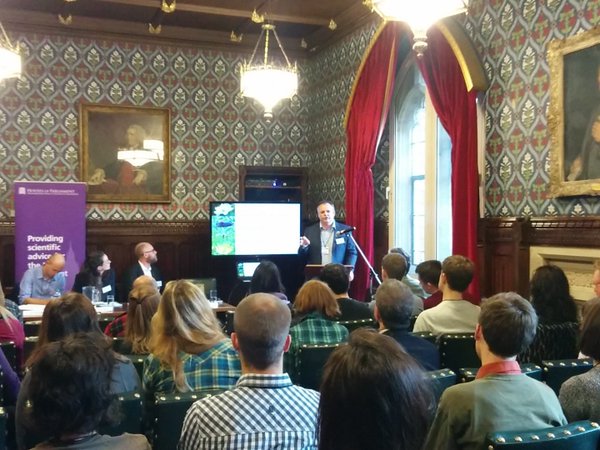
As I advertised a couple of weeks ago, last Wednesday I was in London to take part in a Pollinators Update seminar at the Houses of Parliament organised by the Parliamentary Office for Science and Technology (POST).  It was a very interesting event and good to catch up with some of the latest ideas about pollinators and their conservation.  However it’s been a busy week since then and I’ve not had time to post a full account of the seminar, which was attended by over 40 people.  So I’ve decided to write a brief summary of eight things I learned that day from my fellow speakers* and from the day in general; in some cases I’ve linked to the original sources where available:

1.  About 46% of Europe’s bumblebees have declining populations (see the European Red List for Bees that I highlighted in an earlier post)

2.  Around 2% of the world’s bee species do 80% of the crop pollination (Kleijn et al. (2015) Nature Communications)

3.  Pollinators other than bees perform 39% of the flower visits to crops (Rader et al. (2015) Proceedings of the National Academy of Sciences)

4.  By 2100 the Red-tailed Bumblebee (Bombus lapidarius), one of the commonest species in Europe, may be extinct across most of the continent due to climate change (Rasmont et al. (2015) Climatic Risk and Distribution Atlas of European Bumblebees)

5.  Only 6.6% of Entry Level Stewardship agreements by farmers across England included plans to grow nectar- and pollen-rich flower mixes.

6.  Criticism of laboratory studies of the effects of neonicotinoid pesticides are just as illogical as criticisms of field studies: both have their limitations and advantages, and both are needed.

7.  A panel of four experts on pollinators and pollination will largely agree about the answers to most questions an audience asks.

8.  A Westminster seminar such as this will attract very few MPs if it clashes with an important debate in the House of Commons, in this case about future military action in Syria.

UPDATE: here’s a number 9 suggested by Simon Potts: we all strongly support and encourage the setup of an All Party Parliamentary Group on “Pollinators” not just “honeybees” or “bees”.


*With thanks to my fellow panelists Simon Potts, Claire Carvell and Richard Gill, and to Kirsten Miller and the POST team for organising the event, and for the photograph of the panel in action.


Virtual Conference on Ecology and Climate Change

Following on from what seemed to be a quite popular Virtual Conference on Pollinators, Pollination and Flowers I thought I’d mark this week’s Paris talks on tackling climate change with a second  “virtual conference” on the topic of climate change and how it may affect (and be affected by) natural and agricultural ecological systems.

This is a great set of talks* with some very thought-provoking ideas.  Hope you enjoy them.

Douglas Sheil  (Norwegian University of Life Sciences)

Do forests attract rain?


Hans Joosten (University of Griefswald)

For peat’s sake – bogs and climate change


Nicola Di Cosmo (Institute for Advanced Study)

Climate, conflict, and historical method


Ben Beard (NCEZID Centers for Disease Control)

Climate change, ecology, and disease emergence


Jennifer Cartwright and Bill Wolfe (USGS Tennessee Water Science Center)

Climate-sensitive, insular ecosystems of the Southeast U.S.


Nabil Nemer (American University of Beirut)

Are changes in insect patterns in the Lebanese Mountains evidence of climate change?


Lini Wollenberg (University of Vermont)

Climate Change Mitigation on Agriculture-Forest Landscapes


Tim Benton (University of Leeds)

Food and the future: climate and resilience


Feel free to discuss the talks in the comments section and to post links to other talks on the same topic.


*I’m assuming that, as all of these videos are in the public domain, none of the presenters or copyright owners objects to them being presented here.  If you do, please get in touch and I’ll remove it.

Pollinators seminar at the Houses of Parliament – 2nd December

Skipper on ragwort - cropped

The Parliamentary Office of Science and Technology (POST) has organised a “Pollinators Update” afternoon seminar in London on Wednesday 2nd December, to discuss recent developments in pollinator conservation research. I’ve been asked to give a 15 minute presentation on the pollinator extinctions research we published in Science last year.

The full programme will be:


  • 2.30pm Sarah Newton MP, Chair’s Welcome
  • 2.40pm Presentations
  • Professor Simon Potts (Professor of Biodiversity and Ecosystem Services) – Reading University
  • Professor Jeff Ollerton (Professor of Biodiversity) University of Northampton
  • Dr Claire Carvell – NERC Centre for Ecology and Hydrology
  • Dr Richard Gill – Imperial College London
  • 3.40pm Discussion
  • 3.55pm Chair’s closing remarks
  • 4.00pm Refreshments


The seminar is free to attend but you need to book a place: see the POST website for details.