Category Archives: Biodiversity

Spiders: a guide for first-year students!

P1120445

Yesterday I had a phone call from a colleague in the university’s marketing department.  Apparently there’s been a lot of complaints, and some hysteria on social media, about spiders appearing in the rooms of first year students in our halls of residence.  My colleague asked if I’d write something about spiders, and how they were harmless and nothing to worry about, that they could use to placate the students’ worries.  This is what I wrote and I thought it worth sharing on the blog.

—————————————-

Spiders! Ugly. Unpleasant. Spooky. Dangerous…..even deadly?! Spiders in Britain are all of these things, right?

No! Absolutely not! Spiders are fascinating, sometimes beautiful, and are an ecologically important groups of animals. Although it’s true that large spiders can sometimes give us the jitters, myself included: I don’t like walking into them in the garden! In fact as a kid I had a real phobia of spiders that I got over by handling increasingly bigger ones until eventually I could pick up even the largest spider we have in this country.

Most of the fear of spiders is based on myths and misconceptions, rather than reality. Ignore the DRAMATIC HEADLINES about False Widow Spiders – it’s an uncommon species and it’s extremely rare to encounter one of these, never mind be bitten. They make their webs near rocks where there are deep cracks into which they can hide. So you’re not likely to find them in your room!

Spiders play a really important role in the environment by eating large numbers of flies, including some that bite or carry disease or that might otherwise be much more harmful to humans than spiders. Spiders in turn are a food source for many of our birds, and in the spring some birds also use spider webs to construct their nests. If we had no spiders then we’d lose a lot of the birds that are so familiar in our gardens, such as Blue Tits and Blackbirds.

At this time of the year spiders are more apparent than ever, and the one you are most likely to see is a large, beautifully patterned species know as the European Garden Spider. The big ones are the females; males are much smaller. They sometimes make their way into houses and can construct large webs. But they are harmless and would only bite if held tightly in the hand, and they are much happier outside than in your room. They can’t jump on you and they do not attack!

What to do if you find a spider in your room and you want to get it out but can’t bear to go near? Find a friend who is not so squeamish and ask them to use a glass and a book or piece of cardboard to gently capture the spider and take it outside. Don’t worry, it won’t find its way back! Before you release it, though, try to find the courage to look really closely at this creature: they are attractively speckled and really very pretty!

The other thing you can do is find some conkers from the Horse Chestnut trees on campus and put them on your windowsill. It’s an old folk tradition that spiders don’t like the smell of conkers and there is some evidence that it keeps them out of the house.

I’ll let you into a secret. As Professor of Biodiversity I’ve done ecological field work all over the world, including the rainforests of Africa and the savannahs of South America. Every now and again I come across spiders that are much larger, and potentially more dangerous, than anything we find in Britain. Initially they still give me a shiver; but once I’ve spotted them I can take time to study their colours and forms and beautiful webs, and appreciate just how amazing and important spiders really are.

Have a great year at university and don’t worry about the spiders!

Are tropical plants and animals more colourful? Not according to a new study!

Cinnabar caterpillars 1 P1020535

The notion that tropical ecosystems are somehow “different” to those at higher latitudes is a pervasive one in ecology and biogeography, that has its roots in the explorations of 18th and 19th century Europeans such as von Humboldt, Darwin, Wallace, and Belt.  All of these authors expressed their amazement at the biological riches they observed in their tropical explorations, and how different these habitats were to those they knew from home.

In many ways the tropics are special, of course and we know that they contain many more species than most other parts of the world; indeed my own work has shown that the tropics have significantly more types of functionally specialised pollination systems, and that the proportion of wind pollinated species is lower in tropical communities.  However tropical plants are not, on average, more ecologically specialised (that is, they do not use few species of pollinator) and, as the recent guest blog on Dynamic Ecology argued, there is a growing body of evidence to say that overall tropical interactions between species are not stronger and more specialised than those in the temperate zone (though there are others who dispute this and it’s an ongoing debate).

One of the central tenets of the “tropics are special” idea is that the tropics are more colourful; or rather that the biodiversity of the tropics tends to be more garish, gorgeous, and spectrally exuberant, than that of other parts of the globe.   Now a new study by Rhiannon Dalrymple, Angela Moles and colleagues, published in the journal Global Ecology and Biogeography, has challenged this idea for flowering plants, birds, and butterflies in Australia, using sophisticated colour analysis rather than relying on human impressions. Following that link will take you to the abstract and you can read it yourself; however I wanted to summarise their findings by quoting from the first section of the discussion in the paper:

Contrary to predictions…[our]…results have shown that tropical species of birds, butterflies and flowers are not more colourful than their temperate counterparts. In fact…species further away from the equator on average possess a greater diversity of colours, and their colours are more contrasting and more saturated than those seen in tropical species.”

It’s a really, really interesting study that, as the authors say, runs counter to all of our expectations.  Gradually ecologists and evolutionary biologists are testing some long-standing assumptions about the tropics and the results are proving to be a challenge to preconceived ideas about patterns in the Earth’s biodiversity.

———————————————

Full disclosure: senior author on the paper Angela Moles was my co-author on that Dynamic Ecology blog, based on which we’ve written a short review article that (hopefully) will be published soon.  Other than that I have no vested interest in the study.

The All-Ireland Pollinator Plan 2015-2020

B pasc on sunflower

In the last 12 months we’ve seen the release of the National Pollinator Strategy for England and the USA’s Strategy to Promote the Health of Honeybees and Other Pollinators.  Now the Republic of Ireland and Northern Ireland have joined forces to produce the All-Ireland Pollinator Plan, a strategy for 2015-2020 that has been released today.  Follow that link and you can download a copy.

This appears to be the first cross-jurisdiction pollinator plan in the world and, as such, is to be welcomed; as I said in my reflections on the National Pollinator Strategy, biodiversity does not respect political boundaries.

That “love wasps” article – this is how Friends of the Earth responded

Clearly my quick post this morning got through to Friends of the Earth at some level (thanks to everyone who tweeted it).  Here’s what they have done to the article in response:

  • Removed the not-a-wasp photograph (good)
  • Added some text about other things that wasps pollinate (good) but left in the text about figs (bad)
  • Under the “garden pests” section they have add some text, as follows (bad):

The University of Northampton’s Dr Jeff Ollerton says: “Wasps are part of a whole ecological guild of scavenging animals that includes ants, various birds, etc, which plays a valuable role by removing vast amounts of waste organic material from our towns and cities every year.”

Huh?  What I said had nothing at all to do with eating pests.  Was that not clear when I talked about “waste organic material” rather than “pests”?

Incidentally, and for the record, I’ve had no contact from anyone at Friends of the Earth asking if it was ok to quote me, or check text, or anything.

So, not a complete success then.  Once again, feel free to tweet this at FoE

More poor quality information: Friends of the Earth’s “Love Wasps” campaign

Despite some recent posts in that vein, I don’t want to turn this blog into just an outlet for my frustrations about the lack of science/evidence in otherwise well-meaning conservation initiatives.  However something caught my eye at the weekend that I feel I have to comment on.

Friends of the Earth has recently posted a very well-meaning piece about why we should stop hating wasps and learn to appreciate them.  I whole-heartedly support this: wasps are one of the least understood and most under-valued aspects of local biodiversity, and the article makes some very good points.

But there are also some aspects to the article that make me cringe and add a new layer of inaccuracy to a subject already flooded with crass statements such as “what use are wasps”:

  • The first photograph in the article does not show a wasp: it’s a syrphid fly, specifically a species that mimics wasps but is other wise harmless.  These flies do not sting or bite.
  • “Wasps pollinate figs” – yes they do, but fig pollinating “wasps” are tiny and only distantly related to the kinds of wasps you’re going to see in a British garden.  In any case they do not pollinate commercial edible figs: these wasps spend much of their life-cycle within the fig and who wants to eat a fig full of insects?
  • Having said that, the sorts of wasps the article is referring to ARE important pollinators of a whole range of plants, including some orchids, umbellifers, ivy, etc.  That’s not mentioned at all.
  • The piece misses out the fact that wasps are part of a whole ecological guild of scavenging animals that includes ants, various birds, etc., which plays a valuable role by removing vast amounts of waste organic material from our towns and cities every year.  They also perform a similar function in natural ecosystems.

What’s frustrating about Friends of the Earth’s article is that there are any number of individuals and organisations out there who would be happy to fact-check such a piece, including Buglife, BWARS, and a range of scientists and well-informed specialists in natural history.  Why doesn’t Friends of the Earth make use of them?

As I’ve said before I don’t use Twitter, so if anyone wishes to tweet this at Friends of the Earth, please go ahead.

The biodiversity of the human family tree just got bigger

Tring 8

Today’s announcement of the discovery in South Africa of a new extinct species in the genus Homo, named Homo naledi, is a major scientific discovery that may prove to be one of the findings of the year, if not the decade.  As I’ve mentioned previously, human evolution fascinates me and I could easily have been sucked into the frustrating, controversial and important world of the professional hominid hunter.  But I’m content to view and appreciate from a distance as palaeo-anthropologists make their amazing discoveries about human ancestral biodiversity, and I thought I’d collate the links to some of the main stories and items relating to today’s events:

The scientific paper describing Homo naledi has been published in the open-access online journal eLife, rather than a journal such as Nature or Science, the more usual outlet for such discoveries, presumably because the importance of the find certainly demands rapid publication.  Interestingly its Altmetric score is already 281, having been picked up by numerous news outlets, tweeted, blogged about, etc.

I first saw the story earlier today on the BBC News website; the long article has a video interview with Professor Lee Berger, lead author of the paper.  There is also video footage from today’s press conference in South Africa, presented by Professor John Hawks, in which he describes in more detail the significance of this fossil, with its mix of both primitive and more derived anatomical features.

The Guardian also ran the story, this time with some different video footage, including a view inside the cave where the fossils were found, and there’s a 40 minute podcast.

Finally, National Geographic, which funded the study, has some videos on YouTube, including a fascinating account of the workshop that was convened to study the fossils and more discussion of its significance and amazing footage of how the fossils were recovered from the cave, and how the species was reconstructed.

This is a story that will run and run: we don’t know how old the species is and there’s lots of speculation about the significance of finding such a large number of individuals all together in what appears to be a burial chamber.  It’s an exciting time to be interested in human evolution.

Something for the weekend #8 – the microclimatic value of planting our cities, one Buddhist view of environmentalism, and orchids. Oh, and we got married.

The latest in a regular series of posts to biodiversity-related* items that have caught my attention recently:

  • One of the best environmental writers around at the moment, Paul Kingsnorth, had an interesting essay on how Buddhism is helping him to come to terms with the current environmental crisis.  It was published earlier this year but I’ve only just seen it.  Paul is one of the founders of the Dark Mountain project, which I’ve mentioned before.
  • Here’s a piece about a fascinating study of how different types of vegetation can alter the average temperatures of our cities.
  • Finally, regular readers of this blog know that I often mix some personal stories with my professional reflections, so the Big News of Summer 2015 is that, on the 15th of August, Karin and I were married at The Guildhall, Northampton, accompanied by our family and friends.  We had an incredibly happy day, and I wore a very biodiverse shirt, as you can see:

Karin&Jeff (73 of 477)

Feel free to recommend links that have caught your eye.

*Disclaimer: may sometimes contain non-biodiversity-related items.

The organisers’ positive response to criticisms of the “honey bee decline” conference

P1120404

Three days ago I wrote a short, fast post expressing my unease (in robust terms) about a forthcoming conference entitled “Biodiversity and Local Partnerships: Halting the Decline of the Honey Bee in the UK”.  I had not anticipated that the post would generate quite as much interest as it did:  2007 views, 16 likes, and 28 comments (including my responses) as of 10am today.

There were also a lot of comments and likes on Facebook, most of it positive and agreeing with my sentiments, though some have suggested that I’m over-reacting, that I may be paranoid, and questioned what my “hidden agenda” is and whether I might be funded by an agrochemical firm (!)  Thanks to everyone who took the time to read the post and/or to respond*, to tweet the post, and even, in one case, phone up the conference organisers.

So it was with some satisfaction that yesterday I received the following email from the conference organisers, Public Policy Exchange (PPE), in response to my initial reply to their invitation:

Thank you for your response to our event, we always appreciate any
feedback from experts such as yourself. Your comments have been passed
on to our researchers and they are currently reviewing this event.

Our researchers do use a variety of sources, though on this occasion it
does appear that some have made sweeping generalisations and
over simplified statements, and ultimately have been unreliable. Clearly
our previous marketing mistakenly overplayed the role of the honey bee
in pollination processes. We certainly don’t want to contribute to a
misinformed narrative around bees and other pollinators; that was never
our intention and so we are looking at how we can improve this event.

Biodiversity is an area which we are very keen to develop further and
your feedback is therefore very helpful to us.

Kind regards,

The Conferences Team

They have also changed the title of the conference to “Biodiversity and Local Partnerships: Halting the Decline of Bees and Other Pollinators in the UK“.

So kudos to PPE for their fast response.  That’s a good outcome as far as I’m concerned and I may consider attending the conference; hell I’d even consider speaking at it if i was asked!

———————————————————-

*Yes, that’s deliberate – I got the impression that some on Facebook were responding without reading it…

Who is feeding the honey bee bullshit machine?

Bee on apple blossom 2 - 1st May 2015

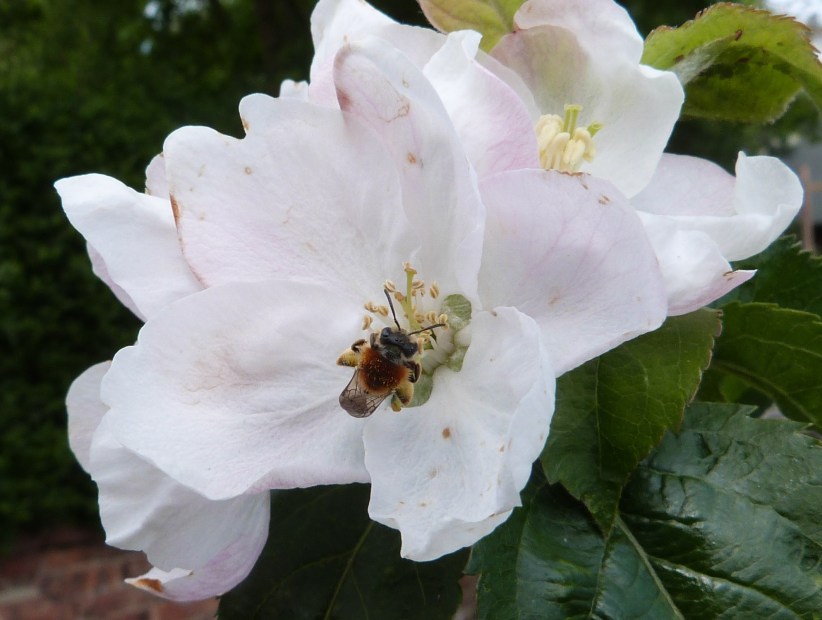
This morning I received an email from Public Policy Exchange (PPE) inviting me to a conference in London in November entitled “Biodiversity and Local Partnerships: Halting the Decline of the Honey Bee in the UK

The opening statement on the website and the official flyer convinced me that the organisers have been misinformed; all of it is wrong:

Healthy honey bee populations are vital to food and crop production, and the natural environment. In the UK, honey bees are responsible for 80% of pollination, and a third of the food we eat is pollinated by bees.”

Where are they getting this  information from?  Who is feeding organisations like the PPE this kind of bullshit?  Is it bee keeping organisations?  I’d really like to know.

Honeybees are responsible for only one third of the crop pollination in the UK (Breeze et al. 2011), and a very small proportion of the wild plant pollination. Wild bees, hoverflies, butterflies, and other pollinators are much more important than honeybees, and collectively they are responsible for this pollination, not just managed honeybees.  No one is denying that honey bees are important, but there is absolutely nothing to gain (and a lot to lose in terms of science credibility) by over-playing their importance, as I’ve argued in the peer-reviewed literature.

It’s not as if this is the only recent example, The Daily Express online has recently been equally ignorant of the facts, and didn’t even get the right bee in the accompanying image.

It’s interesting that the PPE website also uses the infamous not-Einstein quote, though they cite the author as “unknown”.  With good reason, because that’s bullshit too.

I won’t be attending the conference.

Selfie with pollinator

P1120403

There has been a recent spate of people taking selfies with wild animals, sometimes resulting in serious injury, including the guy who was bitten by a rattlesnake, and ended up with a huge hospital bill*.  Over at the Nothing in Biology Makes Sense blog they had a recent post about this phenomenon, on which I commented that perhaps I should start a new meme, involving selfies with bees (or pollinators more broadly, if you’re allergic to bee stings).

So here it is, me plus Bombus hypnorum, nectaring on Verbena bonariensis, in the garden this afternoon.  Look forward to seeing similar images (unless this turns out to be an n=1 meme…)

—————————–

*This wouldn’t happen in the UK.  We don’t have rattlesnakes.  And we have the NHS.