Category Archives: Biodiversity

The Living Planet Report 2016 – taking stock with a student seminar

20160118_1319391

This morning I started the first in a series of weekly two-hour seminar sessions with my final year undergraduate students on their Biodiversity and Conservation module.  By this stage in their BSc programme the students are being weaned off lectures and being encouraged to take a more critical perspective on the published scientific literature.  Each week we deal with a specific issue relating to biodiversity such as: measuring biodiversity; current trends; spatial patterns; biodiversity and  ecosystem services; and how much is there still to discover about biodiversity?

This morning we focused on the Living Planet Report 2016, the latest installment of an annual assessment of the rate and extent to which we are losing animals across the globe.  The report, which came out last month, generated a lot of media attention with headlines such as “World wildlife falls by 58% in 40 years” and “World on track to lose two-thirds of wild animals by 2020“.

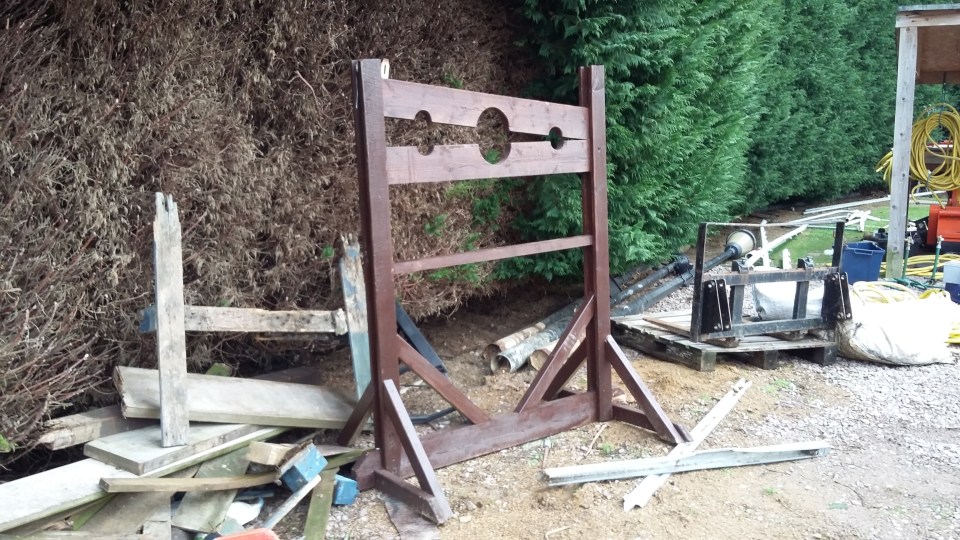
As preparation for the seminar I asked the students to read the first chapter of the report and then during the session I divided them into groups of three in order to take stock* of the report and answer a series of questions such as:

What do you understand by the “Anthropocene”?

What do you understand by the “Living Planet Index” (LPI)?

How do the LPIs vary across the planet and across taxonomic groups?

What is the evidence base for these trends?

Which LPIs show the greatest declines and which LPIs show the least declines? Can you account for these patterns?

Which LPI trend do you consider to be the most worrying, and why?

By way of a counter-point to the media hype, and to consider one potential area of criticism of the report, I also ask the students to look at critiques written by Simon Leather (You don’t need charismatic megafauna to go on an exciting safari) and Ryan Clarke (What about the little things?).  In both of these posts the bloggers take the report to task by pointing out that it ignores the vast majority of animal life, i.e. invertebrates such as insects, crustaceans, and so forth.

Simon and Ryan have a valid point, of course, but the fact of the matter is that we simply don’t have the same quality of long-term population data for invertebrates as we do for  birds, mammals, fish, reptiles and amphibians.  The exception to that is the butterflies which the Living Planet Report does discuss, devoting a whole page to grassland butterflies.  It also states (p20) that “Methods to incorporate invertebrates and plants are now in development”.

Although the hype around the report is a bit over the top, nonetheless this focus on the best possible data sets does emphasise the fact that the world’s biodiversity is declining in species richness and abundance.  The final question I ask the students is whether, in their opinion, we on the verge of a “Sixth Mass Extinction” (as the report suggests).  A show of hands at the end showed that about half think “yes”, a quarter think “no”; and a quarter (myself included) said “we don’t know”.  It was a nice demonstration of the complexities around coming to any kind of consensus when it comes to reports such as this.

All-in-all it was a great session, the students really engaged with it and raised some very interesting points.  I’m looking forward to the rest of these seminars, they promise to be very stimulating.


*Before anyone comments, yes, I know that the photo shows a pillory not a set of stocks.  But we don’t have a set of stocks at the university, only a pillory.  Exactly why we have a pillory on campus is another matter…..



Spiral Sunday #4 – from SCAPE

Abisko spiral 20161015_221148.png

This Spiral Sunday post is coming from the SCAPE conference, where  a bunch of us are sitting in the foyer of the Abisko tourist accommodation centre, waiting for a minibus to get us to Kiruna airport.  I took the photograph last night – it’s a close up of a woven place mat.  Spirals are everywhere, if you look closely….

Looking forward to getting home late tonight and seeing Karin and the family (including cats and chickens).

“I want to see the bright lights tonight” – the 30th annual SCAPE conference part 1

Kiruna 20161013_134106.jpg

The 30th annual Scandinavian Association for Pollination Ecology (SCAPE) meeting is taking place at its northern-most, and most remote, venue. We are at Abisko in Sweden, 68O N and 195km inside the Arctic Circle. It’s not too cold at the moment, but there is ice starting to form on the many lakes in the area, and the trees are leafless. It’s a stunning, sparse location for the conference.

About 75 of us have gathered to hear a wide range of talks on all matters related to pollinators and pollination. The programme kicked off at 1925 on Thursday evening when five participants discovered that they were speaking in the first session after a hard day of travelling. I’d been awake since 0330 that morning so was not as receptive to the science as I should have been… Yesterday was much better, in that I was more awake, but it was still quite an intensive day that culminated in my own talk on spatio-temporal stability in a plant-pollinator interaction on Tenerife.  Being last speaker in a session is a mixed blessing and needs a good story to keep people awake.  But I’m not best able to judge if I succeeded.

The quality of the science, and of the presentations, has so far been very good. Here’s a selection of just a few other things I’ve learned or that have intrigued me during the first half of the conference:

Individual pollen grains can be stained a variety of fluorescent colours by a new marking technique involving “quantum dots” (Bruce Anderson)

We are still a long way from understanding all of the subtle ecological and behavioural effects of neonicotinoid pesticides on pollinators and pollinations (Juho Lämsä and Dara Stanley)

There are serious prospects of us being able to track individual pollinators across landscapes using drones (Tonya Lander)

Active “stigma rubbing” by anthers to promote self pollination has been documented for using time-lapse photography (Mohamed Abdelaziz)

The outcomes of competition for pollinations and reproductive interference between co-flowering plant species are complex and certainly not always predictable (Sharon Strauss and James Rodger)

The title of this post refers to a great song by Richard and Linda Thompson called “I want to see the bright lights tonight” and reflects everyone’s desire over to see the aurora borealis during this meeting. We had a brief encounter with the northern lights on Thursday evening, but they were pale and obscured by clouds. Perhaps tonight will be brighter. Before that we have another full day of talks to look forward to, and I’ll try to report back before we leave tomorrow.  For now, breakfast is calling.

Ivy pollinators citizen science project

Ivy bee 20161011_143817.png

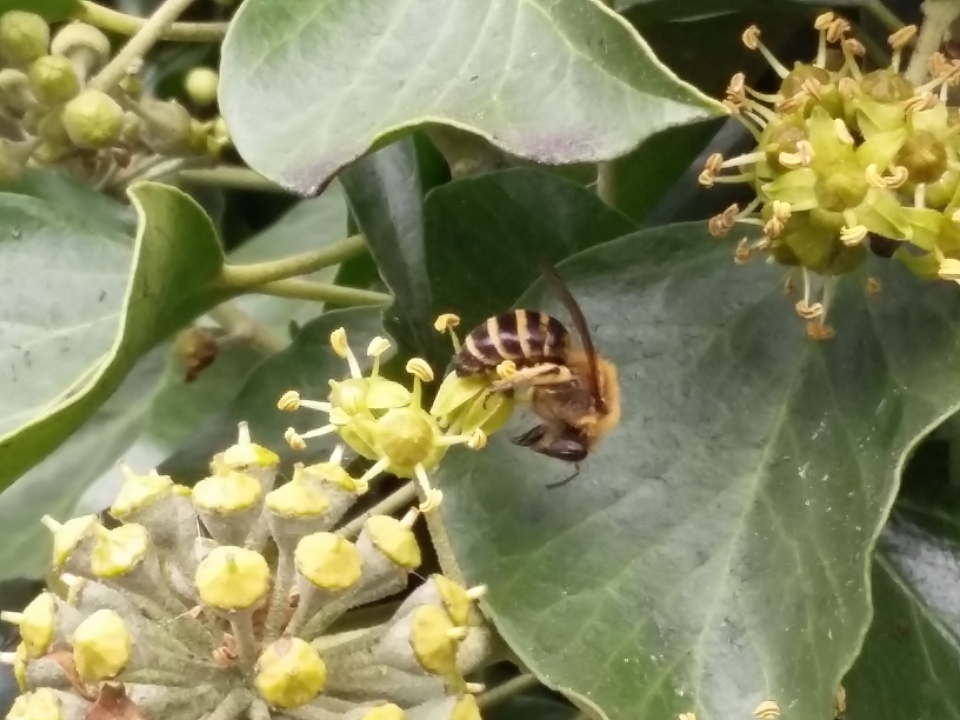
Today, finally, after several years of hunting for them in Northamptonshire, I got to see some Ivy Bees (Colletes hederae) and managed to get a couple of decent photos.  The Ivy Bee is a recent natural colonist to the British Isles, having arrived here in 2001.  The Bees, Wasps and Ants Recording Society (BWARS) is running an Ivy Bee Mapping Project and you can find out more details by following that link.

The bees we saw today were a few minutes walk from the University and were (it’s galling to admit) discovered by Fergus Chadwick, a keen young ecologist who is working with me for a couple of months to gain some postgraduate research experience.

The main thing that Fergus is going to work on is a Pollinators of Ivy Monitoring Project.  Follow that link and it will give you details of how you can provide us with data to better understand the pollination ecology of one of our most ecologically valuable and under-rated plants.  Ivy (Hedera helix) is a hugely important nectar source to a wide range of over wintering bees, flies, beetles, hoverflies, wasps, and other insects.  Not only that but its berries are a vital food source for many fruit eating birds.  Any and all help in this project is very much appreciated!

International Wildlife Gardening Conference – 23rd November

20160702_100724An International Wildlife Gardening conference is to be held at the Natural History Museum in London on 23rd November this year, organised by the Wildlife Gardening Forum.  The theme is:  “What European wildlife and nature gardeners can learn from each other” – very apt in these post-Brexit times.  The cost is £50 for the day (including lunch) and you can book by following this link.
Here is the programme for the day:

10.00 Registration and tea/coffee

10.30 Introduction and background; The Forum and the Wildlife gardening movement in England and Wales – Dr Steve Head (WLGF)

10.50 Nature gardening in Germany: an historical view from the start to today. How useful is the concept of native plants for wildlife? – Dr Reinhard Witt (President of Naturgarten e.V. [Nature Gardeners’ Association], Germany)

11.25 Naturgarten e.V.: nature-oriented design in gardens, educational institutions and public space in an era of climate change – Ulrike Aufderheide (Naturgarten e.V. [Nature Gardeners’ Association], Germany)

12.00 Lunch and networking (optional guided tour of the Wildlife Garden)

1.30 Biodiversity path in a heritage park: a case study – Jérôme Constant and Carole Paleco (Royal Belgian Institute of Natural Sciences) (Afternoon Session Chair: Andrew Salisbury)

2.05 Looking for oases – Marianne van Lier and Willy Leufgen (Stichting Oase [Oasis Foundation], Netherlands)

2.40 Tea/coffee

3.00 Looking after our roots and the brown stuff – Sarah Rubalcava (Ireland)

3.35 19 years of Garden for Life: working together to promote wildlife gardening in Scotland – Dr Deborah Long and Juliette Camburn (Garden for Life Forum, Scotland)

4.10 Panel session with speakers (led by Adrian Thomas)

4.30 Summing up and Close

(Please note; this programme may be subject to late changes)

Bumblebees, ferries, and mass migrations: an update

Sejero - 20160910_113537.png

The post earlier this week on the question of “Why do bumblebees follow ferries?” generated quite a few comments, both on the blog and on Facebook.  As I’d hoped a number of people have chimed in to say that they have observed the same thing, or commented that they often see bumblebees when sailing or kayaking out at sea.

Here are the additional observations in increasing distance order to nearest larger area of land.  Distances are approximate and in some cases it’s unclear where exactly the observations were made:

Isle of Mull to the Isle of Staffa: 6.5km

Skye and the Outer Hebrides going in both directions: 24km

Ferry to Jersey: 28.4km

Estonia to Helsinki: 80km – described in a short paper by Mikkola (1984).

However this is nothing compared to evidence that queen bumblebees may engage in mass migrations (involving thousands of bees) across the North Sea from England to Holland, a distance of 165km!  See Will Hawkes’s short article “Flight of the Bumblebee“.

This idea of mass migration is new to me, though the Mikkola (1984) paper cites some earlier literature on the topic.  And this morning I had a quick phone chat with Dave Goulson who tells me that he occasionally gets people contacting him to tell him about such events.  But it’s unclear why these bees should be flying such large distances, how they coordinate their migrations, or indeed how much energy they need to store to travel that far. In addition there are implications for gene flow between British and Continental subspecies of bees such as the Buff-tailed Bumblebee (Bombus terrestris). Even a relatively well studied group of insects such as the bumblebees can continue to surprise us with new questions!

Thanks to everyone who contributed observations and ideas, it’s much appreciated.

Why do bumblebees follow ferries?

Sejero - 20160910_180359.png

A few years ago I mentioned in my post “Garlicky archipelago” that I had seen bumblebees (Bombus spp.) following the ferry from Southampton to the Isle of Wight, a distance of about 1.5km across water.  If I remember correctly it was my colleague Scott Armbruster who first mentioned this to me: he lives on the Isle of Wight and commutes regularly to the mainland.

I’ve not thought much about this since then as 1.5km is a fairly modest distance for a bumblebee to fly.  But then a few weeks ago I saw the same thing in Denmark, but this time over a much longer distance.

Karin and I were visiting friends on the small island of Sejerø, which (at its closest point) is about 8km from the mainland of Zealand.  To get there you have to catch a ferry which takes about an hour to cross this stretch of water.  About half-way across,  whilst looking over the stern of the ship, I spotted a bumblebee following the ferry.

So that’s twice, on two different ferries and under very different contexts, that I’ve seen this phenomenon.  A pattern is starting to form….  Has anyone else observed this?  Please do comment.

I can think of a few explanations/hypotheses for what’s going on here (some of which are not mutually exclusive):

  1.  Clearly bumblebees do fly across significant stretches of open seawater.  Perhaps all I’m seeing is bees that do this, but spotted from the only vantage point where it’s viewable (i.e. the ferry).
  2. These bumblebees are taking advantage of the slipstream created by the ferry to reduce the energy required to fly these long distances.
  3. The bees are hitching a lift on the ferry and I only observe them as they arrive or depart.
  4. The bees are following the wake of the ship to navigate between the island and the mainland, in order to exploit significant flower patches.  Work by one of my PhD students, Louise Cranmer, a few years ago showed that bumblebees follow linear features such as non-flowering hedgerows to navigate – see Cranmer et al. (2012) Oikos.  Perhaps something similar is happening here?

There’s probably other possibilities I’ve not thought of.  But whatever the explanation, it looks to me as if there’s some potential for interesting experiments marking and recapturing bees on islands/mainland, releasing bees on ferries to see if they follow the wake, etc.  If only Northampton wasn’t so far from the coast….


Urban areas as a refuge for insect pollinators: conservation for the city

Waterside - 20160527_081706.png

Urban conservation ecology is a fast growing field that has mainly focused on how towns and cities can support populations of plants, animals and fungi that may be declining or threatened in the surrounding rural environment.  That is, the city for wildlife conservation.  In a new essay in the journal Conservation Biology, written with colleagues from across the world, we argue that conservation for the city (an idea originally conceived, I believe, by Steward Pickett) should also be a focus of future research and management activities.

Conservation, or ecology, for the city in essence means that plants, animals and fungi, as well as being supported by the city (see our recent urban bees example), play a role in supporting the city itself through the provision of ecosystem services such as decomposition, flood alleviation, and crop pollination.

It’s pollinators and pollination that we particualrly focus on in this essay – here’s the abstract:

Urban ecology research is changing how we view the biological value and ecological importance of cities. Lagging behind this revised image of the city are natural resource management agencies’ urban conservation programs that historically have invested in education and outreach rather than programs designed to achieve high-priority species conservation results. This essay synthesizes research on urban bee species diversity and abundance to suggest how urban conservation can be repositioned to better align with a newly unfolding image of urban landscapes. We argue that pollinators put high-priority and high-impact urban conservation within reach. In a rapidly urbanizing world, transforming how environmental managers view the city can improve citizen engagement while exploring more sustainable practices of urbanization.

I’m happy to send the PDF to anyone who wants a copy; here’s the full citation:


The macroecology of animal versus wind pollination – a new study just published

In collaboration with colleagues in Brazil, Denmark, and elsewhere in the UK, we’ve just published a new research paper which looks at the global spatial distribution of wind and animal pollinated plant species, and the underlying historical and contemporary ecological causes of that distribution.  It’s a study that builds on my “How many flowering plants are animal pollinated?” paper in Oikos, and has been a long time in its gestation.  We’re very excited by its findings and plan to develop this project in the future.

As a bonus we made the cover of the journal with the amazing image below!  Big thanks to Pedro Viana and Jesper Sonne for the photos.

Here’s the citation with a link to the publisher’s website; the abstract is below.  If anyone wants a PDF copy, please ask.

Rech AR, Dalsgaard B, Sandel B, Sonne J, Svenning J-C, Holmes N & Ollerton J (2016) The macroecology of animal versus wind pollination: ecological factors are more important than historical climate stability. Plant Ecology & Diversity 9: 253-262


Abstract:

Background: The relative frequency of wind- and animal-pollinated plants are non-randomly distributed across the globe and numerous hypotheses have been raised for the greater occurrence of wind pollination in some habitats and towards higher latitudes. To date, however, there has been no comprehensive global investigation of these hypotheses.

Aims: Investigating a range of hypotheses for the role of biotic and abiotic factors as determinants of the global variation in animal vs. wind pollination.

Methods: We analysed 67 plant communities ranging from 70º north to 34º south. For these we determined habitat type, species richness, insularity, topographic heterogeneity, current climate and late-Quaternary climate change. The predictive effects of these factors on the proportion of wind- and animal-pollinated plants were tested using correlations, ordinary least squares (OLS) and logistic regression analyses with information-theoretic model selection.

Results: The proportion of animal-pollinated plant species was positively associated with plant species richness and current temperature. Furthermore, in forest, animal pollination was positively related to precipitation. Historical climate was only weakly and idiosyncratically correlated with animal pollination.

Conclusion: Results were consistent with the hypothesised reduced chance for wind-transported pollen reaching conspecific flowers in species-rich communities, fewer constraints on nectar production in warm and wet habitats, and reduced relative effectiveness of wind dispersal in humid areas. There was little evidence of a legacy of historical climate change affecting these patterns.

andre-capa-1


Two-day Steven Falk bee ID course at Oxford University Museum 15th-16th October 2016

Male B lap on Salvia cropped P1120309

One of the most exciting, pollinator-related publishing events of last year was the publication of Steven Falk’s eagerly-anticipated Field Guide to the Bees of Britain and Ireland.  Not only does this book provide a state-of-the art account of the natural history and identification keys for all of the bees currently known from Britain (over 270 species) but it’s backed up by Steven’s own Flikr site with more photographs of the bees, including lots of close ups, and an ongoing list of updates and corrections.

But as Steven himself acknowledges, the identification of many of our bees is a challenge, even with the book and the additional imagery.  Anyone who is really keen to get to grips with bee identification is therefore recommended to book onto a hands-on identification course.  Steven has just announced that he is running a two-day course in Oxford on 15th to 16th October, at a cost of £60 per person – here’s a link to the booking page.  Seems like good value to me!