Tag Archives: Flowers

What are the limits to pollinator diversity? A new article poses the question

The most globally significant groups of pollinators are well known and have been studied for a long time: bees and wasps, flies, butterflies and moths, birds, bats and beetles are all familiar to those of us with an interest in pollination ecology. However, every few years a new type of pollinator or a novel pollination system is described from nature or from the fossil record, or we add further examples of previously neglected pollinator groups such as cockroaches.

This begs the question: how much is there still to discover? How close are we to describing the full diversity of animals that act as pollen vectors? Can looking at the past help us to predict what we might find in the future? That’s the topic of a Perspective article that I was invited to write for the special issue of the Journal of Applied Entomology on the theme of  The Neglected Pollinators that I mentioned last month. It’s a subject that I’ve thought about a lot over the last few decades and it was great to get an opportunity to air some ideas and speculation.

The article is open access and you can download a copy by following the link in this reference:

Ollerton, J. (2024) What are the phylogenetic limits to pollinator diversity? Journal of Applied Entomology (in press)

Here’s the abstract:

Although huge progress has been made over the past 200 years in identifying the diversity of pollinators of angiosperms and other plants, new discoveries continue to be made each year, especially in tropical areas and in the fossil record. In this perspective article I address the following questions: Just how diverse are the pollinators and what are the phylogenetic limits to that diversity? Which other groups of animals, not currently known to regularly engage with flowers, might be found to be pollinators in the future? Can we predict, from the fossil record and from discoveries in under-researched parts of the world, which animal groups might turn out in the future to contain pollinators? I also discuss why adding to our knowledge of plant–pollinator interactions is important, but also stress that an incomplete knowledge may not be a bad thing if it means that remote, inaccessible and relatively pristine parts of the world remain that way.
It’s publication day – “Birds & Flowers” is officially out!

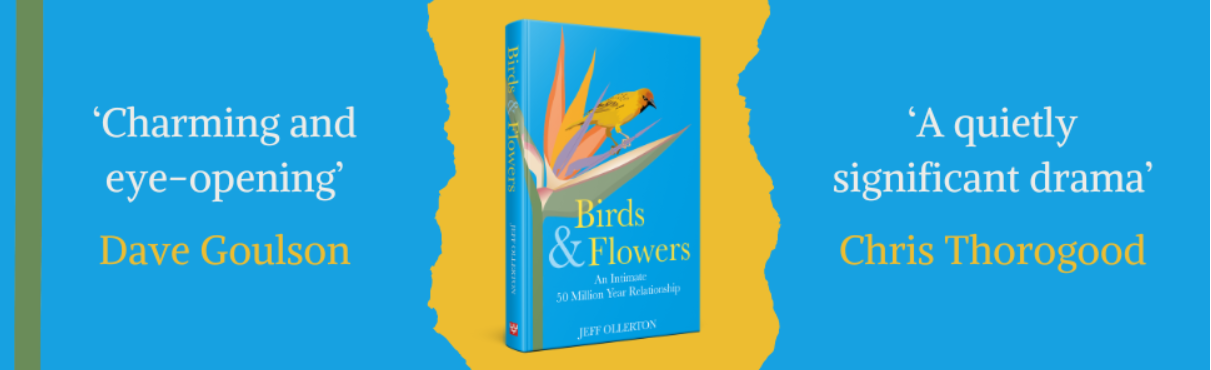
After what seems like a long wait, for me at least, today marks the official publication of Birds & Flowers: An Intimate 50 Million Year Relationship! I received my advance copies on Friday, an event that Karin commemorated with a short unboxing video:

https://www.facebook.com/100000638827245/videos/2177574652581431

It’s been a long journey from pitching the initial idea to Pelagic Publishing back in early 2021, through the various drafts that have culminated in the finished book. As you can see from the images on this post and the endorsements on the publisher’s web site, Birds & Flowers has so far been warmly received. I hope that future reviews are as positive!

A few people have asked me what’s next. In fact I have definite plans (as in topics, provisional titles, the start of chapter structure, and even some initial writing) for three more books. The next one is actually about half written, but then I have been working at it, on and off, for 30 years! Watch this space for more details…

In the shorter term, Karin and I are returning (permanently) to the UK at the start of March. We’ve enjoyed our time in Denmark, it’s been a fun two and a half years, but we’re missing our immediate family plus we both have some interesting work possibilities to pursue. In mid-April I will be going to China for three months to work with my colleague Zong-Xin Ren at the Kunming Institute of Botany. I’ll be sure to blog about my adventures there!

In the meantime, if you buy my book or borrow it from the library or from a friend, please let me know what you think in the comments section below.

The one thing I wish more people understood about flower pollination

Obviously the title of this post is click-bait, as there’s LOTS of things that I wish more people knew about pollination! But here’s one that really gets my (Yule) goat.

I’ve lost track of the number of times that I’ve read statements in books and research papers such as “bees collect lots of pollen from flowers therefore they are good pollinators”. Even worse, I sometimes see studies where pollen has been removed from “pollen baskets” or other scopae, then used as a measure of the importance of those bees as pollinators.

In both cases it seems to have been forgotten that bees are collecting pollen to feed their larvae and pollen that ends up in scopae is generally not available for pollination.

That’s the purpose of the Venn diagram at the top of this short post, to remind us that there can be a disconnect between what bees are doing and what plants require: foraging for pollen only partly correlates with flower pollination. Indeed, the same argument applies to any animal that feeds itself or its young on pollen, including pollen wasps (Maserinae), Heliconia butterflies, and some flower-visiting hoverflies, birds and bats.

It’s not only loss of pollen from reproduction that’s important here: depending on the size and behaviour of the bees relative to the shape and size of the flower, they may go nowhere near the stigma, so even if they are carrying viable pollen, it can be lost as far as the plant is concerned.

Note also that many bee species will collect pollen from wind-pollinated plants such as grasses, oaks, etc. Indeed in some species the availability of such pollen is extremely important – see Manu Saunders’ review on this topic and more recent papers that cite it. Again, it emphasises the partial disconnect between pollen collecting by bees and pollination of flowers by bees.

Assessing which flower visitors are actually pollinators is not technically demanding but it can be time consuming. The minimum that you need is single visit deposition (SVD) experiments in which you expose unvisited flowers to one visit by the potential pollinator. Then you assess how much pollen has landed on the stigma or (better) whether the visit results in seed set.

If you want to know more about the evidence that’s required to determine if a flower visitor is or is not a pollinator, they are codified in the “Cox-Knox Postulates” that I discuss in my book Pollinators & Pollination: Nature and Society.

Join me on Thursday for a free talk!

Join me this Thursday at a free online talk organised by Buglife where I’ll be giving an introduction to how flowers function and the ways in which their behaviour manipulates pollinators to ensure reproduction. I’ll be covering:

  • What are flowers and where did they come from?
  • How flowers function and reward pollinators.
  • Some case studies from my own research on flower and pollinator behaviour.
  • Why is it important that we understand floral biology?

Here’s the link to register for the event: https://www.buglife.org.uk/events/to-be-a-flower-with-professor-jeff-ollerton/

I look forward to seeing you there!

Magnolia, Mississippi, and American politics: a guest post

This is a short guest post by Dr Peter Bernhardt who recently retired as a professor at St Louis University and continues to be active in pollination biology.

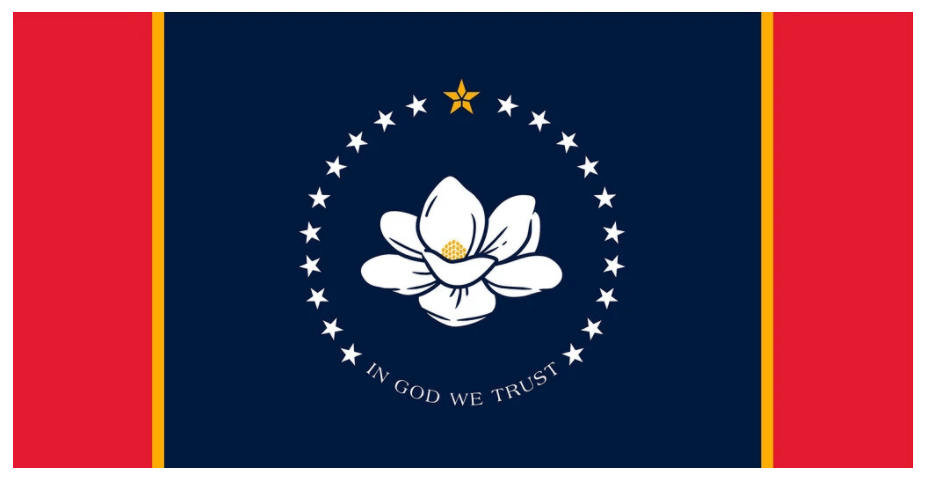
Each of the 50 American states has its own flag. On Election Day in November 2020 the citizens of the state of Mississippi will vote on whether they want a new flag featuring the flower of their state tree, the southern magnolia or bull bay (Magnolia grandiflora). Of the eight Magnolia species native to the continental United States six have natural distributions including the state of Mississippi.

By voting in the magnolia flag Mississippians drop its 126-year old predecessor, which incorporated an emblem (the stainless banner) adopted by southern states during the American Civil War (1861-1865). This will also mean that Mississippi will be the only state with a flag depicting a flower in which tepals, stamens and carpels are all arranged in a continuous spiral and is pollinated by beetles (see Leonard Thien’s study published in 1974). 

The popularity of M. grandifora far exceeds silviculture in the American south as successful exports stretch over two centuries and its cultigens are found as far as China and Australia.

Politics in America have turned floral in the last months of 2020: kamala, as in vice-presidential candidate Kamala Harris, is an Indian word for sacred lotus (Nelumbo nucifera). 

To which Jeff adds: the flag above is the one that Mississippi citizens will be voting on – follow the link at the start to get the full story of the competition that was run to select a new flag.

Hummingbirds have a sense of smell: so why do we keep saying that they don’t?

P1110560

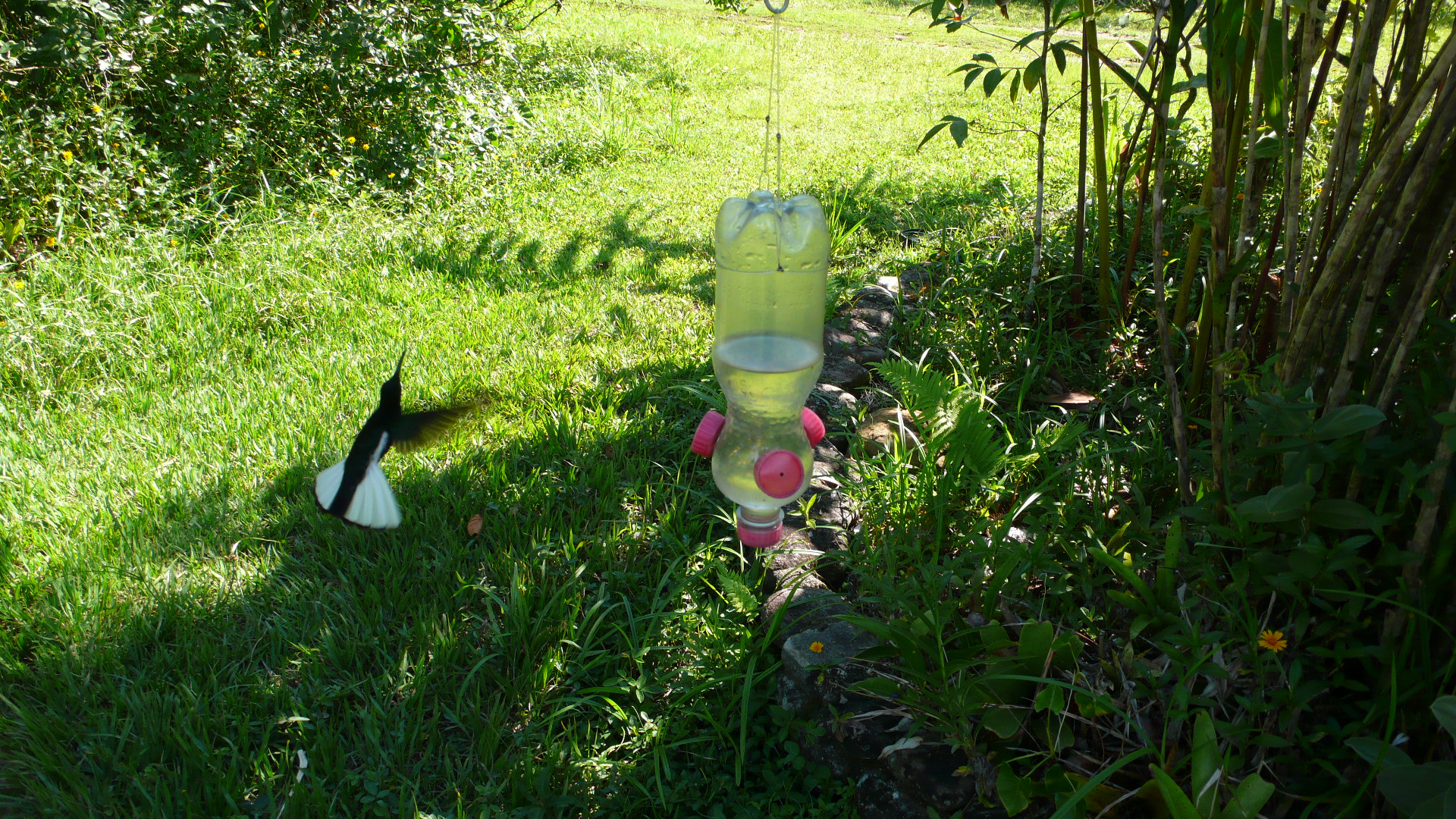
One of the general features associated with specialised hummingbird-pollinated flowers in the New World is that they often have no scent perceptible to the human nose.  This is then interpreted as evidence that hummingbirds have no sense of smell, which strikes me as circular reasoning at best.  This “fact” is then frequently repeated in text books and on the web, for example at the Bird Watcher’s Digest site, at The Spruce site, and at the World of Hummingbirds.

However I know of only two research papers that have tested whether or not hummingbirds can smell, both of them short notes; and in both cases they found that the hummingbirds they tested could associate scents with food in artificial flowers.  Those studies (with links to the originals) are:

Goldsmith, K.M. & Goldsmith, T.H. (1982) Sense of smell in the black-chinned hummingbird. Condor 84: 237-238

Heringer, H. et al. (n.d. – c. 2006?) Estudo da capacidade olfatória em três representantes da subfamília Trochilinae: Eupetomena macroura (Gould, 1853), Thalurania furcata eriphile (Lesson, 1832) e Amazilia lactea (Lesson, 1832).  Unpublished manuscript – possibly a student project (?)

It surprises me that this has been so little studied, given how much research has otherwise been done on hummingbirds.  Have I missed any other studies?  Clearly vision is more important for hummingbirds when locating food, but that’s not the same as stating that hummingbirds have no sense of smell.  Seems to be one of those myths that won’t go away, of which there are many in pollination biology.

Comments welcomed, as always.