Tag Archives: Biodiversity

What I learned at the Bumblebee Working Group Meeting

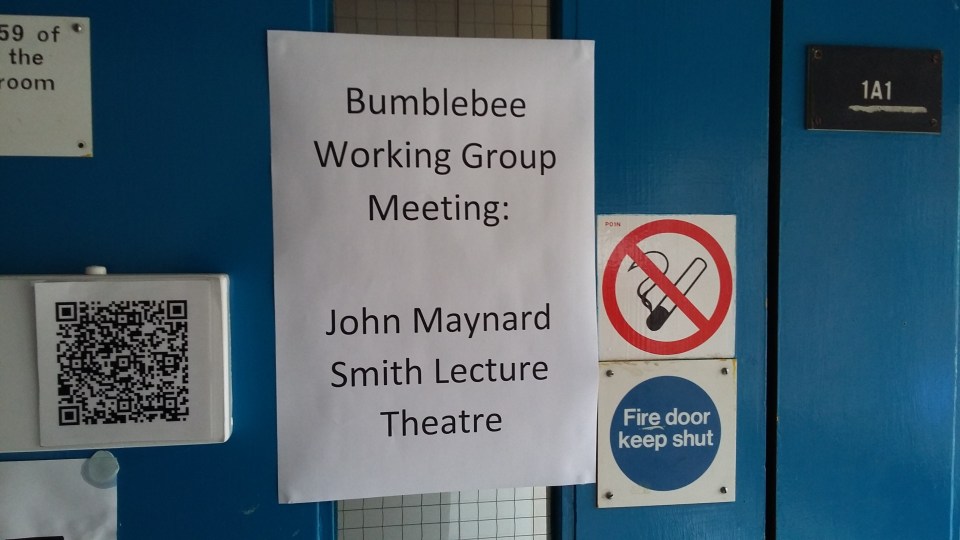
20160330_171209Earlier this week I attended the Bumblebee Working Group Meeting at the University of Sussex, a one day event that takes place every two or three years.  It was a very stimulating day with some really interesting work being showcased; here are some examples of things that I learned that day, some questions that these findings have prompted (and the people presenting):

  • High arctic/montane bumblebees have undergone (and survived) periods of severe climate change in the past – does this mean they are less sensitive than temperate species to future climate change? (Paul Williams).
  • Bumblebees foraging closer to honey bee apiaries are more likely to be infected with a range of bee diseases – presumably picked up from the honey bees, but what is the route of transmission?  (Samantha Alger).
  • Queen Buff-tailed Bumblebees exposed to neonicotinoid pesticides have a 26% reduction in the probability of founding a colony, and the effects vary for other species – are the most sensitive species the ones that have declined the most since the mid-90s? (Gemma Baron).
  • Simulating bumblebee colony dynamics with the Bumble BeeHave model is producing comparable results to field data on male and queen production (Matthias Becher).
  • Environmental Stewardship Schemes appear to enhance bee nest densities on farms where they are situated – but are some species already at saturation point on those farms? (Tom Wood).
  • New, tougher EU guidelines for risk assessment of effects of pesticides on bees have been developed and are being tested at the moment (James Cresswell).
  • The annual spread of the Tree Bumblebee, Britain’s newest bumblebee species, is about 35km per year (Liam Crowther).
  • The equivalent of 737,914 bramble flowers are needed to provide the resources support a single colony of Buff-tailed Bumblebees for one year (Ellie Rotheray).
  • The moratorium on neonicotinoids seems to have had the desired effect of reducing the amount of these pesticides being taken up by bumblebee colonies in pollen and nectar (Beth Nicholls).
  • There have been significant range extensions of some of our rarer bumblebee species in Essex over the last 15 years or so – has this also been happening in other counties? (Ted Benton).
  • Sites with greater levels of radioactive contamination at Chernobyl have fewer older bees – does this mean that the radiation is affecting their lifespans?  (Katherine Raines).
  • Buglife’s B-Lines project continues to develop and gain momentum (Laurie Jackson).
  • The Short-haired Bumblebee reintroduction project has recorded workers every year since 2013.  However there have also been reintroductions of queens from Sweden every year – so are the queens surviving over-winter and founding new colonies? Or are the workers just from the new queens each year? (Nikki Gammans).

Thanks to all the speakers, it was a great meeting, and special thanks for Dave Goulson for his hospitality and for organising the event.

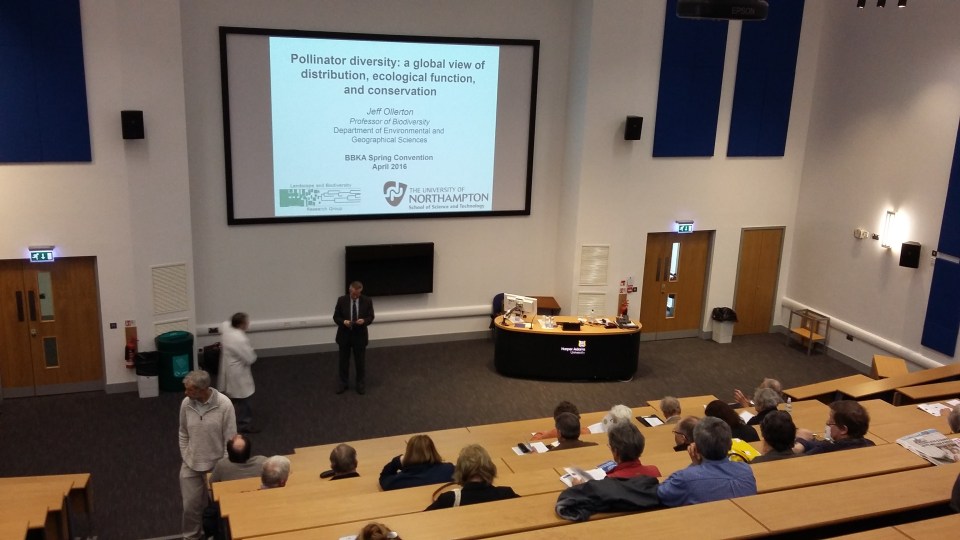
A number of people were tweeting from the event using the hashtag #BBWG16 – follow the link for more comments and some images, including a couple of yours truly in action – one of which I’ve stolen (below).

Jeff at BBWG 2016

“Progress in pollination and pollinator research” meeting – University of Reading – 20th April

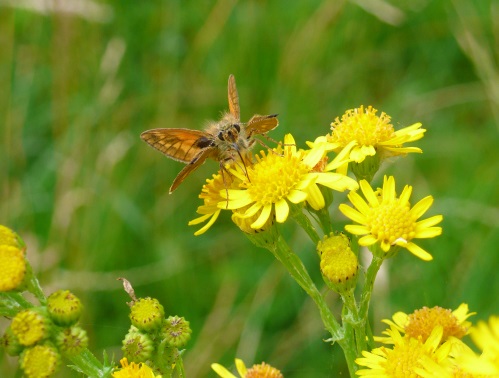
Skipper on ragwort - cropped

There is to be a joint meeting of the Royal Entomological Society’s Insect Pollination and Insects & Sustainable Agriculture Special Interest Groups on “Progress in pollination and pollinator research” at the University of Reading, 20th April 2016.  Unfortunately I can’t make it (I have meetings at the university all that day and need to get myself organised before heading off to Tenerife for field work on the 22nd) but I thought I’d advertise what looks like a very interesting one day conference.

The programme for the meeting is below and registration is open.  Please register before the meeting via The Royal Entomological Society using the form which can be downloaded from the RES website:

http://www.royensoc.co.uk/content/joint-meeting-insect-pollination-sustainable-agriculture-special-interest-groups-20-april-20

The registration fee will be £20 and includes lunch and all refreshments.

Convenors are Mike Garratt (Insect Pollination SIG) and John Holland (Insects & Sustainable Agriculture SIG) so please contact them if you’d like further information.

Programme

9.30-9.55 – Registration & Coffee

9.55-10.00 – Welcome

10.00-10.20 – Ecological intensification, pollinator diversity, and crop yield gaps in small- and large-holdings (Lucas Garibaldi, Instituto de Investigaciones en Recursos Naturales, Agroecología y Desarrollo Rural, Argentina)

10.20-10.40 – Welfare impact of pollinator decline on the international trade (Nicola Gallai, Ecole Nationale de Formation Agronomique, France)

10.40-11.00 – Conserving one beneficial at the cost of another; does success in promoting pollinators risk farmers ignoring other beneficial insects? (Mark Ramsden, ADAS)

11.00-11.20 – Coffee break

11.20-11.40 – Quantification of the floral landscape in agro-ecosystems and its effect on bumblebee colonies (Ellen Rotheray, University of Sussex)

11.40-12.00 – How many Bumblebees can our landscapes support? Using bumblebee colony models as a conservation management tool in agricultural landscapes (Grace Twiston-Davies, University of Exeter)

12.00-12.20 – Are current agri-environment schemes providing appropriate resources to the wider farmland bee community? (Thomas Wood, University of Sussex)

Short presentations:

12.20-12.25 – Pollination studies in the QuESSA Project (John Holland, Game & Wildlife Conservation Trust)
12.25-12.30 – Pollinator initiatives and research at the Royal Horticultural Society (Andrew Salisbury, RHS Garden Wisley)

12.30-12.35 – Collating evidence on plant traits and ecosystem services to inform multifunctional field margin design (Claire Blowers, Harper Adams University)

12.35-12.40 – Rare bee species and agriculture (Steven Falk, Freelance Entomologist)

12.40-12.45 – Fenland ditch banks as pollinator refuges: Environmental variable influence on pollination service measurements (Hilary Conlan, Anglia Ruskin University)

12.45-12.50 – What’s for dinner? Investigating the foraging preferences of honeybees using pollen DNA metabarcoding (Natasha de Vere, National Botanic Garden of Wales)

12.50-13.00 – Questions

13.00-13.45 – Lunch

13.45-13.50 – The National Pollinator and Pollination Monitoring Framework (Claire Carvell, Centre for Ecology and Hydrology)

13.50-13.55 – Impacts of climate change on plant-pollinator interactions in agro-ecosystems (Ellen Moss, Newcastle University)

13.55-14.00 – Reproductive resilience through outcrossing: pollen movement by insects is more important when plants are under stress (Jake Bishop, University of Reading)

14.00-14.05 – DNA metabarcoding reveals pollen transport by Eristalis hoverflies in grasslands (Andrew Lucas, National Botanic Garden of Wales)

14.05-14.10 – Raspberry pollination (Anders Nielsen, University of Oslo)

14.10-14.15 – Interaction between pollinators and pesticide use in agricultural crops: An ecological-economical modeling approach in South West France (Giorgos Kleftodimos, University of Toulouse)

14.15-14.20 – Estimating the net economic consequences of losing pollination services: evaluating contributions from single protected areas (Fabrizia Ratto, University of Southampton)

14.20-14.30 – Questions

14.30-14.50 – Insect pollinators: utilisation of resources through space and time in an intensive grassland landscape (Lorna Cole, SRUC)

14.50-15.10 – Insecticides and pollinators – Are they really incompatible? (Lin Field, Rothamsted Research)

15.00-15.20 – Monitoring the effects of chronic, larval exposure to neonicotinoids on the solitary bee Osmia bicornis (Beth Nicholls, University of Sussex)

15.20-15.30 – Discussion and close of meeting

Special issue of Leaf Litter devoted to pollinators

Leaf Litter

A short while ago I was interviewed by an American journalist as part of a special issue of the online newsletter Leaf Litter devoted to pollinators.  Produced by a conservation planning and ecological restoration organisation called Biohabitats, this special issue includes:

» Thoughts on Pollinators
» Expert Q&A: Jeff Ollerton
» Expert Q&A: Jerome Rozen
» Expert Q&A: Eugenie Regan
» Inspiration: Promising Progress With Pollinator Habitat
» Non-Profit Spotlight: The Xerces Society
» Video: An ecological planner walks into a cider mill…
» How Saving Pollinators Can Save Water and Fish Resources
» Biohabitats Projects, Places, and People

Here’s a link to Leaf Litter.

Bumblebee Working Group meeting – University of Sussex – 30th March

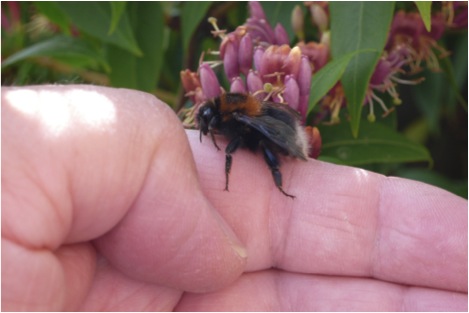
Bombus hypnorum

It’s been three years since the last meeting of the semi-formal Bumblebee Working Group, which I hosted at the University of Northampton, and British Bombus researchers  are eagerly looking forward to the next one which is being organised by Professor Dave Goulson at the University of Sussex on 30th March.  There is no charge and if anyone with an interest in bumblebees wishes to attend, please contact Dave.

Here’s the programme for the day, which starts at 10am and finishes at 4.30pm:

Goulson, Dave – Welcome

Williams, Paul  – Bumblebees of extreme environments

Alger, Samantha – RNA viruses in Vermont bumblebees

COFFEE BREAK

Baron, Gemma – Impacts of a neonicotinoid pesticide on colony founding bumblebee queens

Becher, Matthias Bumble – BEEHAVE: using bumblebee colony models as a conservation management tool in agricultural landscapes

Breeze, Tom – Knowledge gaps for effectively valuing pollination services

Cresswell, James – New European Union protocols for testing the toxicological impacts of agro-chemicals on bees

Crowther, Liam – Inferring invertebrate dispersal distances from biological records

LUNCH

Rotheray, Ellie – Quantification of the floral landscape in agro-ecosystems and its effect on bumblebee colonies

Nicholls, Beth – Pesticides in rural and urban bumblebee nests

Benton, Ted – Status of the BAP carders in Essex

Ollerton, Jeff – Exceptional urban nest density of the Tree Bumblebee Bombus hypnorum during summer 2014

SHORT BREAK

Raine, Katherine – Chernobyl bumblebees: Understanding fitness consequences of living in the exclusion zone

Jackson, Laurie  – B-lines

Gammans, Nikki – An update on the progress of reintroducing the short-haired bumblebee, Bombus subterraneus 

CLOSE

The integration of alien plants in mutualistic plant–hummingbird networks – a new study by Maruyama et al. (2016)

The collaborations with researchers in Brazil and Denmark in which I’ve been involved in recent years, focused particularly on hummingbirds and networks of plant pollinator interactions, have been very productive, most recently seen in a study of the effects of hummingbird feeders on diversity and abundance of the birds.

This collaboration continues with a new study that has just been published in the journal Diversity and Distributions which deals with the way in which non-native plant species are exploited by assemblages of hummingbirds in the New World.  Here’s the abstract:


Aim:  To investigate the role of alien plants in mutualistic plant–hummingbird networks, assessing the importance of species traits, floral abundance and insularity on alien plant integration.

Location: Mainland and insular Americas.

Methods: We used species-level network indices to assess the role of alien plants in 21 quantitative plant–hummingbird networks where alien plants occur. We then evaluated whether plant traits, including previous adaptations to bird pollination, and insularity predict these network roles. Additionally, for a subset of networks for which floral abundance data were available, we tested whether this relates to network roles. Finally, we tested the association between hummingbird traits and the probability of interaction with alien plants across the networks.

Results: Within the 21 networks, we identified 32 alien plant species and 352 native plant species. On average, alien plant species attracted more hummingbird species (i.e. aliens had a higher degree) and had a higher proportion of interactions across their hummingbird visitors than native plants (i.e. aliens had a higher species strength). At the same time, an average alien plant was visited more exclusively by certain hummingbird species (i.e. had a higher level of complementary specialization). Large alien plants and those occurring on islands had more evenly distributed interactions, thereby acting as connectors. Other evaluated plant traits and floral abundance were unimportant predictors of network roles. Short-billed hummingbirds had higher probability of including alien plants in their interactions than long-billed species.

Main conclusions: Once incorporated into plant-hummingbird networks, alien plants appear strongly integrated and, thus, may have a large influence on network dynamics. Plant traits and floral abundance were generally poor predictors of how well alien species are integrated. Short-billed hummingbirds, often characterized as functionally generalized pollinators, facilitate the integration of alien plants. Our results show that plant–hummingbird networks are open for invasion.


The full reference is: Maruyama, P.K. et al. (2016) The integration of alien plants in mutualistic plant–hummingbird networks across the Americas: the importance of species traits and insularity.  Diversity and Distributions (in press).

Happy to send a PDF to anyone who would like one.

Emerging threats to the Białowieża Forest, one of Europe’s last remaining wilderness areas

From various news sources and personal contacts I’m hearing about some emerging threats to the Białowieża Forest, which at 216,200 ha (2,162 km2 or 835 square miles) is one of Europe’s largest and most ancient forested wilderness areas, and one of the few places where you’ll still see European bison (Bison bonasus)roaming free.

Despite its designation as a World Heritage Site, in recent months the Polish government has revealed plans to increase the amount of logging in the forest, ostensibly as a tree disease control measure.  However Polish scientists dispute this and claim that the real motivation is commercial – see the commentary and letters in this week’s Nature.  Here’s a quote from that article which provides some context to the concerns:

“[the] Białowieża management plan limits logging in the forest to 48,000 cubic metres of wood per year — enough to allow locals to gather firewood. But on 10 November, the local forest administration proposed an amendment that would allow large-scale logging in sections outside the central 17% of the forest that is a national park. They cited an outbreak of the bark beetle pest (Ips typographus) in Białowieża’s Norway spruce (Picea abies). In one forest district where logging is currently limited to 6,000 cubic metres per year, the allowable yearly volume would increase to 53,000 cubic metres”.


Interestingly, both Ips typographus and Picea abies are native to these forests and any large-scale outbreak would probably constitute a disturbance that is part of the natural dynamics of the forest. A recent piece on the National Geographic site by conservation biologist Stuart Pimm is worth quoting from in this regard:

“To…scientists studying biodiversity, the main value of the Białowieża Forest is accumulated in a massive occurrence of large and old trees, high amounts of dead-wood and natural dynamics of forest stands all being very unique to this area and supporting thousands of different specialised species ranging from birds and mammals using cavities or building nests in the canopy to lichens, fungi and microbes dependent on different stages of tree life and its decomposition.  It is not surprising that Białowieża Forest has been an invaluable reference area for scientists studying natural characteristics of European forests.” [my emphasis]


This is not the first time that concerns have been raised about the Białowieża Forest – here’s an article from the Guardian newspaper from 2011:  http://www.theguardian.com/world/2011/apr/06/poland-environmentalists-foresters-primeval-forest

Is it too much to hope that the Polish government takes notice and strengthens, not weakens, the protection of its natural heritage?  And allows natural processes to determine what happens in this woodland, rather than trying to manage every aspect of its ecology.

Pollinators, Pollination and Food Production: IPBES gains momentum

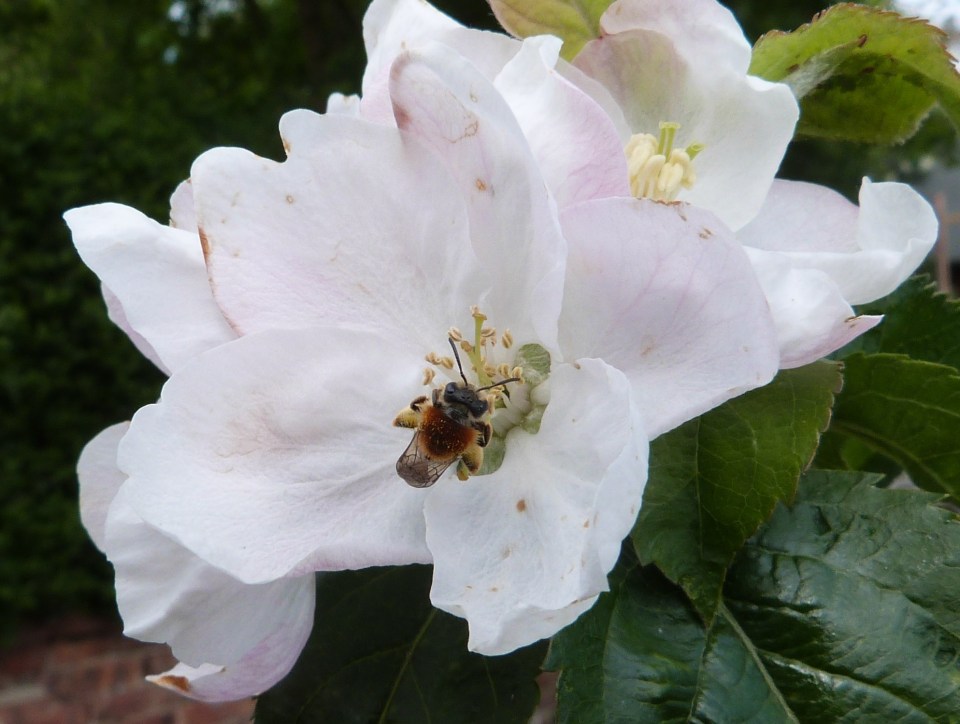
Bee on apple blossom - 1st May 2015

The over-arching themes of this blog have been about understanding biodiversity; the science behind its study; why it’s important; how it contributes to human well being, (including both intangible and economic benefits); and how policy informed by science can support the conservation of species and ecosystems.  These are all issues that have a global perspective beyond the bounds of my home country (the United Kingdom), or even my continent (Europe) because species, ecosystems and the threats to them do not respect political borders.

Enter IPBES – the Intergovernmental Science-Policy Platform on Biodiversity and Ecosystem Services (sometimes shortened to Intergovernmental Platform on Biodiversity and Ecosystem Services).

IPBES is a United Nations body established in 2012 that in many ways is a parallel entity to the IPCC ( Intergovernmental Panel on Climate Change), bringing together scientists, policy makers and stakeholders, with a mission:

to strengthen the science-policy interface for biodiversity and ecosystem services for the conservation and sustainable use of biodiversity, long-term human well-being and sustainable development

Which has got to be a good thing: science informing policy, what’s not to like?

The first output from IPBES will be a Thematic Assessment of Pollinators, Pollination and Food Production, and it’s just been discussed (today) at the 4th Plenary meeting of IPBES in Kuala Lumpur – here’s a link to the press release.

In the coming weeks I’ll talk more about IPBES and its Thematic Assessment (for which I acted as a reviewer), but for now I’ll just repeat some of the headline figures from the report:

  • 20,000 – Number of species of wild bees. There are also some species of butterflies, moths, wasps, beetles, birds, bats and other vertebrates that contribute to pollination.
  • 75% – Percentage of the world’s food crops that depend at least in part on pollination.
  • US$235 billion–US$577 billion – Annual value of global crops directly affected by pollinators.
  • 300% — Increase in volume of agricultural production dependent on animal pollination in the past 50 years.
  • Almost 90% — Percentage of wild flowering plants that depend to some extent on animal pollination*.
  • 1.6 million tonnes – Annual honey production from the western honeybee.
  • 16.5% — Percentage of vertebrate pollinators threatened with extinction globally.
  • +40% – Percentage of invertebrate pollinator species – particularly bees and butterflies – facing extinction.


*They are quoting a figure that I calculated, and very proud of it I am too 🙂

Tropical Zombies: Moles & Ollerton (2016) is now published

P1080615Back in March 2014 I reported about a guest blog that Angela Moles (University of New South Wales) and I had written for the Dynamic Ecology blog entitled “Are species interactions stronger and more specialized in the tropics?”  The post generated a lot of comments, not all of them supportive of what we were saying.  It also resulted in an invitation from the editor of the journal Biotropica to write up the post as a commentary.  This we did and duly submitted, it went through a couple of rounds of peer review, and has now finally been published.

The paper is currently open access on the Biotropica website as an early view item; here’s the reference hyperlinked to it:

Moles, A. & Ollerton, J. (2016) Is the notion that species interactions are stronger and more specialized in the tropics a zombie idea? Biotropica DOI: 10.1111/btp.12281 

Book review: A Veritable Eden – The Manchester Botanic Garden, a History by Ann Brooks (2011)

This is a book review that’s been in press for many months in the Manchester Region History Review, and I finally found out that it had appeared and I’d missed it!  Anyway I thought this would be a good opportunity to present the review to a wider audience who might be interested, and to correct a couple of typos in the printed version.

A Veritable Eden – The Manchester Botanic Garden, a History. Ann Brooks (2011). Windgather Press, Oxford. RRP – £25.

The plant kingdom globally contains an estimated diversity of 350,000 species. In the UK we can boast only some 1500 native species, a legacy of both our status as a collection of modestly sized, temperate zone islands, and the effect of the last ice age which scoured much of the land surface of its previously established flora. A depauperate flora, combined with plant envy of the botanical riches of other countries, may be one reason why British botanic gardens have been important in cataloguing and describing the world’s plant diversity, and in augmenting that flora by cramming our gardens with exotic specimens from overseas.

This long history of plant study and horticulture can be traced back to at least the mid 17th century, with the founding of what was to become Oxford Botanic Garden. Since that time, Britain’s botanic gardens have played a significant role in the economic development of both the country and its former Empire, and continue to be important in science and education, and in the leisure and recreation of the British people.

Previous work on the history of botanic gardens in Europe has tended to concentrate on the large metropolitan botanic gardens, particularly Kew, with their star botanists and international networks of contacts and collectors (e.g. Brockway 1979, Endersby 2010, Ollerton et al. 2012). The smaller provincial botanic gardens, in contrast, have been rather neglected by historians, despite the fact that almost every large British city possessed one, and that they have been an important part of local leisure and education. This is a tradition that stretches from the early 19th century and continues through to the more recent founding of the Eden Project and the National Botanic Garden of Wales.

The history and current utility of such spaces is, as their study reveals, a story that extends far beyond the horticultural and botanical realms, into social, political and economic history. In A Veritable Eden Ann Brooks introduces us to the “chequered history including national fame and financial disaster” of Manchester Botanic Garden, which existed from 1831 to 1908. This meticulously researched book explores not only the role of the Garden in local social life, but also the local political intrigues, personality clashes and mismanagement that ultimately doomed the garden. This is exemplified in the way that an un-Victorian attitude to financial prudence (commissioning ambitious building works when finances were in poor shape) collided with a very Victorian snobbery: by refusing to allow the paying general public entry to the Garden more than one afternoon a week, a funding stream that may have saved the Garden was effectively curtailed. To paraphrase the author, exclusivity was more important than income.

This was not the only policy that appears inexplicable to the modern reader. Early in its history the subscribing, largely middle class membership of the Garden made it clear that pleasurable perambulations around the site were all that they were interested in, and any pretence to education went when “in 1848 science was eliminated and the horticultural garden…was dismantled”. In this regard it was undoubtedly the people of Manchester, rather than botanical science per se, who were the principle losers, as the large botanic gardens of European capital cities dominated plant exploration and plant science up to the present day. Nonetheless the policy jars with Victorian notions of self-improvement.

A Veritable Eden originated as Dr Brooks’ PhD thesis and in general it is engagingly written, demonstrating the author’s fascination for her subject, and well illustrated with material from her personal collection and elsewhere. But there are some places where a firmer editorial hand would have made for a better book. It is clear that a few small sections have been replicated from the thesis out of context, for example a paragraph about the role of a “putter-out” on pp. 60-61. On p. 91, to give another example, we read that a Garden report concluded that “the Curator should be charged with ‘gross ignorance and mismanagement’ and that he should be replaced”; this is repeated, only three lines later, as “a charge of ‘gross ignorance and mismanagement’ should be brought against [the Curator]”. Finally, to anyone with a botanical, as opposed to historical, training the misspelling and misrendering of scientific names for some plants will jar, such as “Dickensonia” for Dicksonia and “Victoria Regia” for Victoria regia (itself an old synonym, the plant is now called Victoria amazonica).

Such editorial oversights detract only a little from the telling of the story of Manchester Botanic Garden and could easily be rectified if the book goes to a second edition. Which I hope it does; it’s a great contribution both to the local history of the city and to our understanding of the history of provincial botanic gardens.


References

Brockway, L.H. (1979) Science and Colonial Expansion: The Role of the British Royal Botanic Garden. Yale University Press.

Endersby, J. (2010) Imperial Nature: Joseph Hooker and the Practices of Victorian Science. University of Chicago Press.

Ollerton, J., Chancellor, G. & van Wyhe, J. (2012) John Tweedie and Charles Darwin in Buenos Aires. Notes and Records of the Royal Society 66: 115-124


Originally published as:  Ollerton, J. (2014) Book review of: “A Veritable Eden” by A. Brooks. Manchester Region History Review 25: 153-154


Ecosystem services survey – share your thoughts

Researchers at the University of the West of England (UWE) are carrying out a public survey on attitudes to the concept of ecosystem services, a subject that I’ve referred to many times on this blog, most recently last week.

The UWE researchers write:  “……give us your views on the term ‘ecosystem services’! Do you feel it is a valuable concept? How should it be used and communicated? Regardless of whether you work with the concept or not, we would like to hear your views. The survey closes 5th February 2016……survey takes 10 minutes or less!”

I’ve done is and they’re right, it’s very short, but well worth completing as it should generate some interesting data into how far the concept has penetrated into the public consciousness.  The link to the survey is:

https://uwe.onlinesurveys.ac.uk/ecosystem-services-sfep