Category Archives: Biodiversity

Is pollination really an ecosystem service?

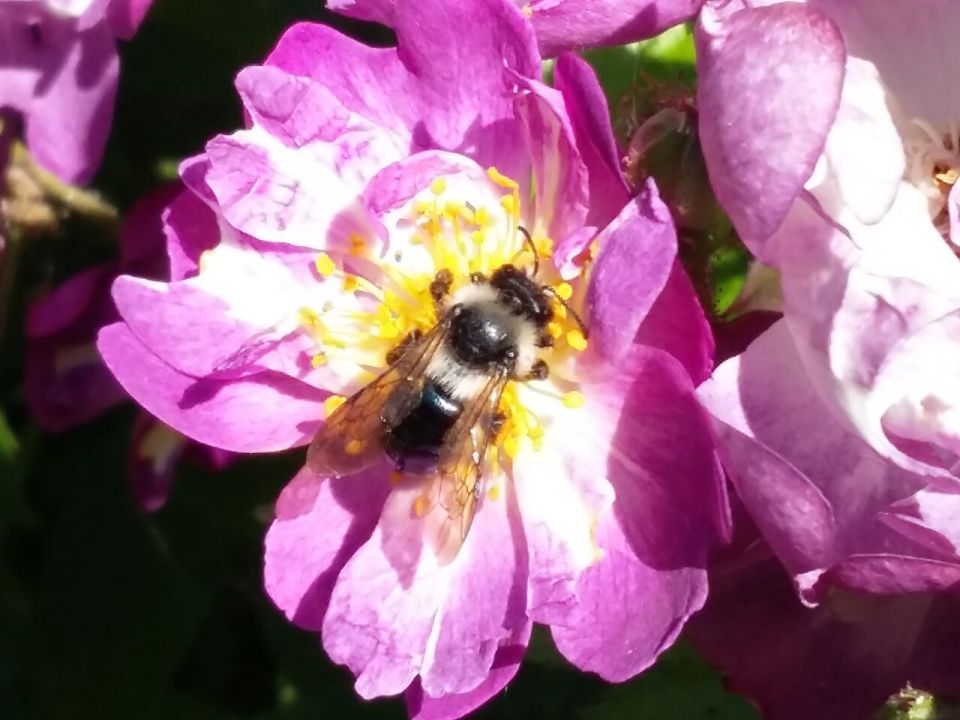
Ashy Mining Bee 2017-06-17 10.55.53

Yesterday on Twitter Prof. James Bullock from the Centre for Ecology and Hydrology posted a slightly provocative tweet asking: “why pollination is so often called an ecosystem service. To my mind it is an ecosystem process which can, in some circumstances (e.g. crop pollination), support services such as food provision”.

I confess to being a bit surprised to see this; I’d always referred to pollination (at least by animals) as an ecosystem service, and it’s classified in that way in large status-and-trend reports such as the Millennium Ecosystem Assessment and (more recently) the IPBES Assessment Report on Pollinators, Pollination and Food Production which describes animal pollination as “a regulating ecosystem service that underpins food production and its contribution to gene flows and restoration of ecosystems”.

The crux of James’s question is illustrated in this diagram from a paper by Prof. Georgina Mace and colleagues in 2012 entitled Biodiversity and ecosystem services: a multilayered relationship.  However note that even here, pollination straddles the line between ecosystem processes and services:

Mace ES image

My initial response to James’s tweet was that animal pollination is really a community process as the interaction, and its outcomes, between animal and crop plant is dependent mainly on species diversity and abundance.  Remember, an ecosystem is the sum of the biotic (i.e. community) plus abiotic (e.g. energy, water, mineral nutrients, etc.).  So as far as crop pollination is concerned, the abiotic components of an ecosystem don’t really come into it except in as much as they influence diversity and abundance of all life on Earth.  This is in contrast to more strictly ecosystem processes that link directly to the abiotic factors, such as primary productivity and soil formation, that then support ecosystem services.

It’s further complicated by the fact that many of the plants that perform ecosystem services, such as carbon capture by trees, are themselves dependent upon animal pollination to maintain their populations.  It’s the plants that are providing the ecosystem services but the animals are playing an important role in supporting that.

If you’d like to follow that discussion, which has some interesting contribution from a range of people, here’s the link:


But ultimately I feel that these are fairly arbitrary definitions across a continuum of causes and effects: we know what animal pollination of crops and wild plants is and why it’s important, so what we call it doesn’t really matter, does it?  Other things are much more concerning.  At the moment the UK is experiencing unprecedented weather: for the first time ever, earlier today, a temperature of in excess of 20 Centigrade has been recorded in winter.  It currently feels more like late April or early May than February.  I’m already seeing a lot of pollinator activity in the garden and beyond, and each day more plants come into flower, far earlier than expected.

The current and future effects of such changes in the climate are far more important than discussions of the semantics of processes versus services, however interesting that might be.

A poem for Valentine’s Day

20180926_121735

I have to confess that I forgot completely about Valentine’s Day, it’s not a celebration that I generally pay much attention to, as expressions of love are something that everyone should be doing all the time, surely?

Anyway, this bastardised version of “Roses are red” is for my wife Karin:

Some bees are red
Others are blue
There’s twenty thousand species
Of every hue

Some flies are yellow
Some wasps are cerise
Many of them pollinate
Better than bees


Recent reviews in pollination biology: an annotated list: UPDATED x 3

2019-02-09 13.47.49

As it’s my birthday today, I thought I’d reward myself by completing a blog post that I started just after Christmas and never got round to finishing.  Review articles that summarise recent developments in a field are an important contribution to the scientific literature that allow us to pause and reflect on where a topic has been and where it is headed.  Having recently (co)authored a couple of reviews I can attest that they are useful in this respect for both the writers and for the readers.

In the past couple of years quite a number of critical and timely reviews have been published which are proving very useful to me: I’m currently writing a book and these reviews have been invaluable in summarising aspects of a field that is currently publishing in excess of 1000 research papers per year. So I thought I’d bring them together into a single listing with a short commentary on each.  No doubt I have missed many other reviews so please feel free to point out any gaps and I will update the list as I go along.

Each review is hot linked to the source; a good proportion of the reviews are open access, notably those from the recent special issue of Annals of Botany devoted to the ecology and evolution of plant reproduction.  Some reviews are very focused, but most are quite broad.  Several of these complement one another.  I hope you find them interesting and useful.

Barrett, S. & Harder, L. (2017) The ecology of mating and its evolutionary consequences in seed plants. Annual Review of Ecology, Evolution and Systematics 48: 135-157

Mating systems, i.e. who breeds with whom, are just as complex in plants as they are in animals.  However some features of seed plants, such as the fact that they don’t move, that most species have both male and female functions, and that their growth is modular and often indeterminate, represent significant challenges that have been overcome in a bewildering variety of ways.


Braun, J. & Lortie, C.J. (2018)  Finding the bees knees: A conceptual framework and systematic review of the mechanisms of pollinator-mediated facilitation.  Perspectives in Plant Ecology, Evolution and Systematics 36: 33-40

In a community, if one plant species positively affects another, we term this “facilitation”.  It can occur at a variety of life stages, including reproduction whereby the presence of one species increase the likelihood of another species being pollinated.  This review shows that it occurs fairly frequently at a variety of spatial scales, but there are still significant gaps in our understanding of the phenomenon.


Fuster, F., Kaiser‐Bunbury, C., Olesen, J.M. & Traveset, A. (2018) Global patterns of the double mutualism phenomenon. Ecography https://doi.org/10.1111/ecog.04008

When species provide benefits to one another in two different ways, for example an animal is both a pollinator and a seed disperser of a plant species, we refer to it as a “double mutualism”.  As this fascinating review shows, double mutualisms are very uncommon, but they are widespread, and probably under-recorded.


Minnaar, C., Anderson, B., de Jager, M.L. & Karron, J.D. (2019) Plant–pollinator interactions along the pathway to paternity. Annals of Botany 123: 225-245 

The male aspect of plant reproduction, i.e. pollen donation, is often neglected when we consider how pollination systems evolve.  This review provides as up to date account of where we are in understanding how paternity influences floral characters such as shape and colour.


Ollerton, J. (2017) Pollinator diversity: distribution, ecological function, and conservation. Annual Review of Ecology, Evolution and Systematics 48: 353-376

A very broad over view of our current understanding of the biodiversity of pollinators, taking a deep time and a wide spatial perspective to put current concerns about loss of pollinators into a wider perspective.


Parachnowitsch, A.L., Manson, J.S. & Sletvold, N. (2019) Evolutionary ecology of nectar. Annals of Botany 123: 247–261 

We often take nectar for granted – it’s just sugar and water, isn’t it?  As this review shows, nectar is dynamic and complex, and affects a range of ecological functions beyond just providing pollinators with a reward.  However there’s still a huge amount we don’t understand about how nectar traits evolve.


Toledo-Hernández, M., Wangera, T.C. & Tscharntke, T. (2017) Neglected pollinators: Can enhanced pollination services improve cocoa yields? A review.  Agriculture, Ecosystems and Environment 247: 137-148

Chocolate is most people’s favourite confectionery and is famously pollinated only by small midges.  Or is it? As this review shows, lots of other insects visit cocoa flowers, but their role as pollinators has not been well studied.


Vizentin-Bugoni J, PKM Maruyama, CS Souza, J Ollerton, AR Rech, M Sazima. (2018) Plant-pollinator networks in the tropics: a review. pp 73-91 In Dáttilo W & V. Rico-Gray. Ecological networks in the Tropics. Springer.

This book chapter that I co-authored with some very energetic and creative young Brazilian researchers summarises what’s currently known about plant-pollinator interaction networks in tropical communities.  One of the conclusions is that they are really not so different to those in temperate and subtropical biomes.


Wright, G.A., Nicolson, S.W. & Shafir, S. (2018) Nutritional Physiology and Ecology of Honey Bees. Annual Review Entomology 63:327-344

A review of how bees use nectar and pollen at the level of both the individual and the colony, focused on the most widespread of pollinator species.

UPDATE 1:

As expected, several people have told me about reviews I’d missed, and in some cases ones that I had read but forgotten about!  I’ll list them below, though without annotations:

Bennett, J. et al. (2018) A review of European studies on pollination networks and pollen limitation, and a case study designed to fill in a gap, AoB Plants 10:  https://doi.org/10.1093/aobpla/ply068

Knight, T. et al. (2018) Reflections on, and visions for, the changing field of pollination ecology. Ecology Letters 21: 1282-1295

Vallejo-Marin, M. (2018) Buzz pollination: studying bee vibrations on flowers. New Phytologist https://doi.org/10.1111/nph.15666


UPDATE: 2

I had deliberately restricted the reviews to 2017 onwards, but via email David Inouye kindly sent a few older ones through which are equally useful:

Brosi, B. J. (2016) Pollinator specialization: from the individual to the community. New Phytologist: 210: 1190–1194

Hahn, M. and C. A. Brühl (2016) The secret pollinators: an overview of moth pollination with a focus on Europe and North America. Arthropod-Plant Interactions: 1-8

Inouye, D. W., et al. (2015) Flies and flowers III: Ecology of foraging and pollination. Journal of Pollination Ecology 16


UPDATE 3:

A more recent addition to this set of reviews was sent to me by Anne-Laure Jacquemart.  Although it’s focused just on one (rather variable) crop, I think it will be really useful for anyone interested in the pollination biology of crop plants:

Ouvrard, P. & Jacquemart, A.-L. (2019) Review of methods to investigate pollinator dependency in oilseed rape (Brassica napus).  Field Crops Research 231: 18-29


“I feel thin, sort of stretched, like butter scraped over too much bread” – Why scientists need to learn to say “no” to themselves

20190131_091055.jpg

Earlier this week I had to write an email to some potential collaborators that I really wasn’t looking forward to sending.  I’ve been doing some hard thinking since Christmas and had decided not to go ahead with a grant submission for a project that was my idea, that I had initiated.  I was now pulling back from that and feeling as though I was letting people down.

The fundamental reason is lack of time, of being really over-stretched at the moment.  Just before the Christmas break I received word that two grants that I’m involved with, one funded by NERC, the other by the Australian Research Council (ARC), were both successful. This is on top of four existing projects, funded by NERC, BBSRC, Heritage Lottery Fund and Butterfly Conservation. Plus the non-funded work I’m doing.  One of my tasks this week was to add a Current Projects and Collaborations page to this blog, so I can keep track of what I’m doing as much as anything!  Although I’m a minor partner in many of these projects, it’s still a lot of work to keep on top of everything, plus teaching,  the Research Excellence Framework for which I’m departmental lead, etc.  I’m also trying to complete a book which I’ve promised to deliver to the publisher soon.  And blogging of course….

There’s a line in the Lord of Rings in which Bilbo tells Gandalf that “I feel thin, sort of stretched, like butter scraped over too much bread.” Intellectually that’s how I’m feeling at the moment.

It’s my own fault, I say “yes” to things too readily, something which a lot of academics do and which is being widely discussed on Twitter and in other blogs.  Most of this discussion focuses on saying “no” to other people, to manuscript and grant reviews, to offers of collaborations, and so forth.

But I think it’s just as important that we learn to say “no” to ourselves.  We need to realise that, however great an idea that we’ve had is or however enthusiastic we are about a project or a paper or a book or organising a conference, if we don’t have the time and energy to follow through and do it properly, we are selling ourselves and our collaborators short.

Of course this is easy to say but not so easy to put into practice.  There are a lot of external pressures on academics to write more grant proposals and papers, to do more work on the impact of their research, to take on tasks within and without their institutions, and thus spread themselves too thin.  Being a scientist and teacher in a university is a great job and I feel very fortunate to be doing what I do.  But in the long term we’re doing no one any favours, not least our employers and our families, if we burn out early.

Tantalising evidence for a new type of pollination system in Madagascan Apocynaceae

cynanchum obovatum with wasp_madag -angavokely_meve 1

As I recounted in my post last summer, the plant family Apocynaceae contains species with a very wide diversity  of pollination systems – see:  The evolution of pollination systems in one of the largest plant families: a new study just published – download it for free.  Confirmed pollinators include bees, birds, moths, butterflies, flies, beetles, and wasps of a dizzying diversity.  So I was intrigued to receive an email earlier this week from my colleague Prof. Dr Ulrich “Ulli” Meve of the University of Bayreuth with the subject line “Wasp expert needed”.  Ulli is an authority on Apocynaceae taxonomy, also has an interest in their pollination biology, and is a co-author of the study last year.

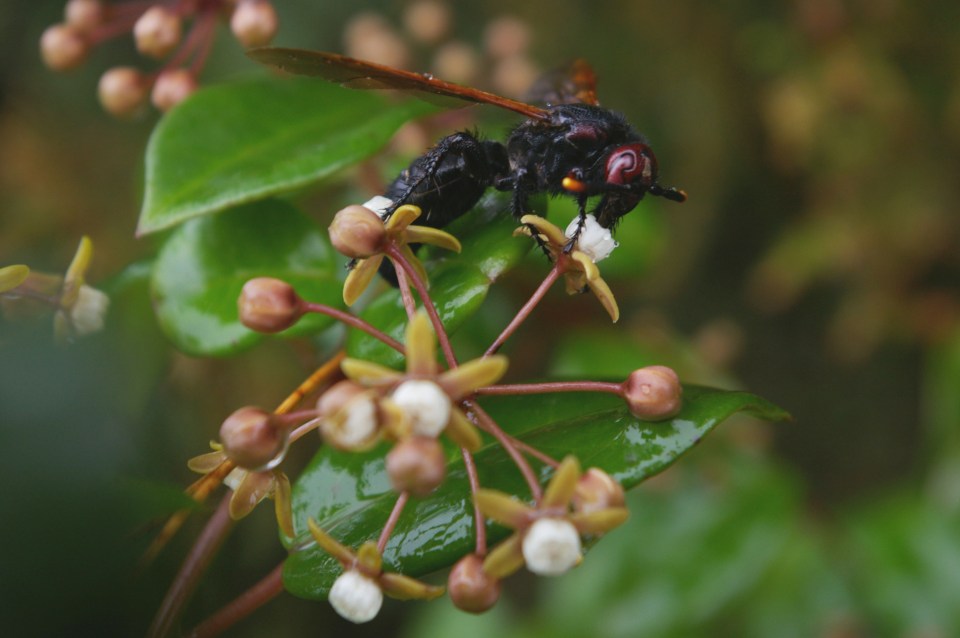
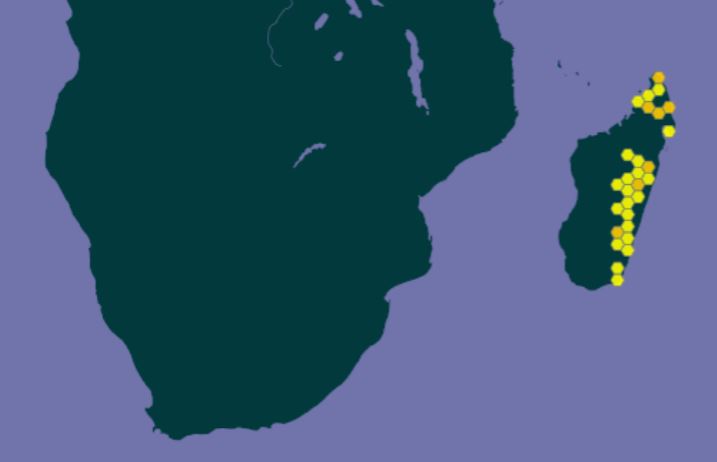
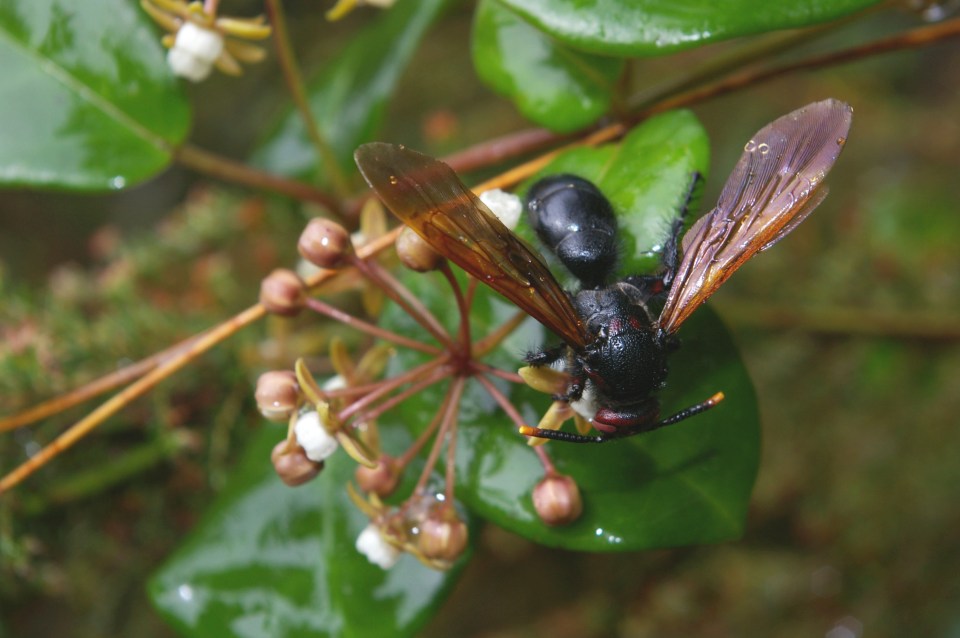
Attached to the email were a couple of images showing a wasp visiting flowers of Cynanchum obovatum, an endemic species of Apocynaceae from northern and eastern Madagascar.  Ulli had taken the photographs during field work there in preparation for the Flora of Madagascar project.  Here’s the global distribution of the species according to GBIF records:

cynanchum obovatum from gbif

I was excited because Madagascar has a very rich diversity of Apocynaceae (between 500 and 1000 species).  However we have flower visitor observations for only a small fraction of them, fewer than 20 species, and good evidence that the visitors are pollinators for only a couple of those.

I didn’t immediately recognise the family to which the wasp belonged: it didn’t look like either Vespidae or Pompilidae, two groups that are known pollinators of Apocynaceae.  So I uploaded the shots to the Hymenopterists Forum on Facebook and within minutes had received an answer:  it was a species of Scoliidae, commonly referred to as scoliid wasps.  The distinctive wing corrugation found in this family is clearly visible on this image:

cynanchum obovatum with wasp_madag -angavokely_meve 2

Scoliids are parasitoids of beetles and are some of the world’s largest wasps, but it’s not a very diverse family, with only about 560 described species, and only a single species in the UK (on the Channel Islands).  Compare that with the Pompilidae and Vespidae, both of which contain c. 5,000 species worldwide.

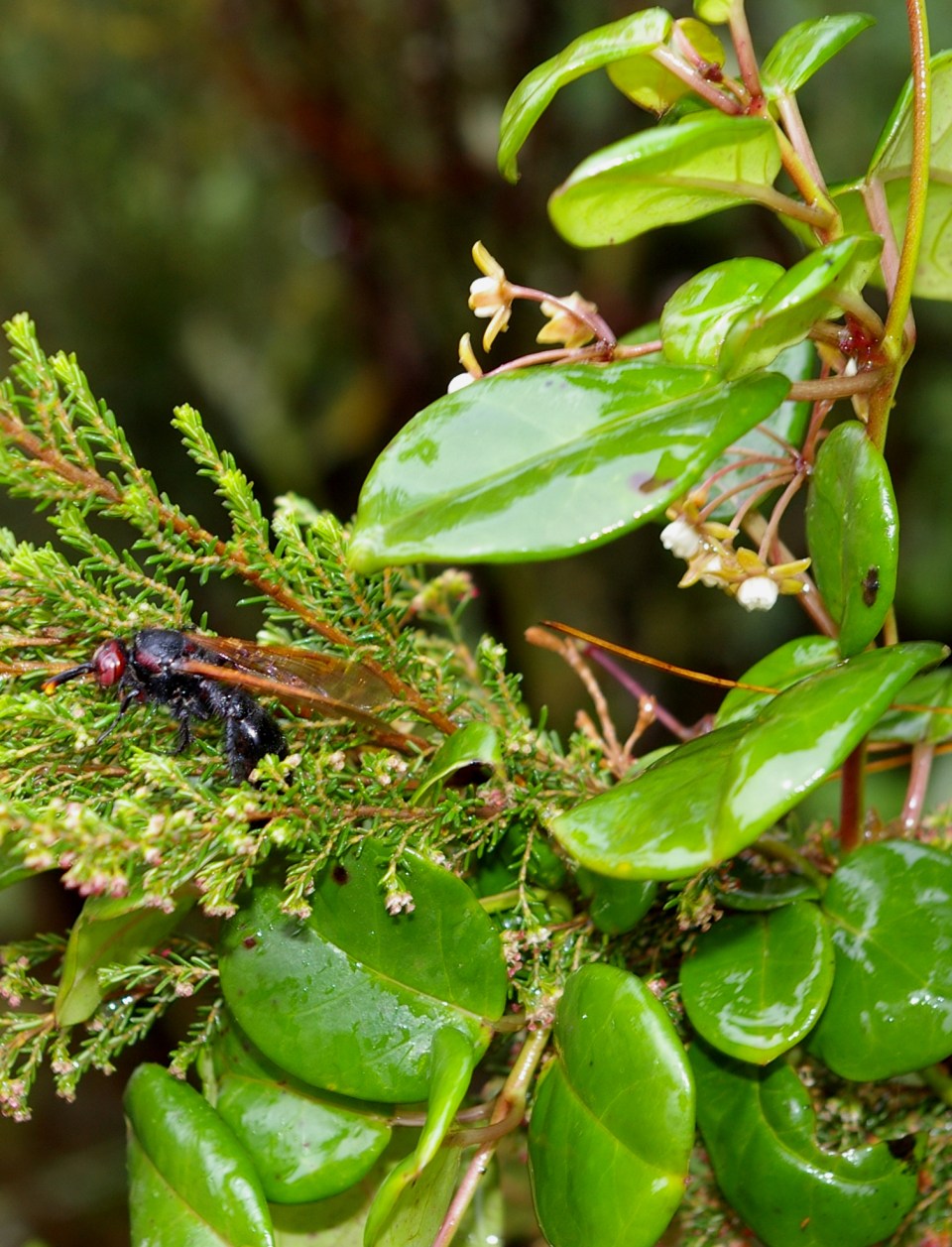
Ulli tells me that when he saw the scoliid on C. obovatum “the wasp knew what to do with the flowers”, something I’ve experienced with vespid and pompilid wasp pollinated species in Africa: these wasps are really familiar with the flowers, they know how to work them to get a reward as they are regular and committed visitors.  We believe that this is likely to be the legitimate pollinator of the plant, in which case it’s one of the few records for Scoliidae pollinating Apocynaceae, and the first for Madagascar.  Other examples are mainly in South America, India and South Africa, and usually as one of a broad set of other wasps and/or bees visiting generalist flowers.

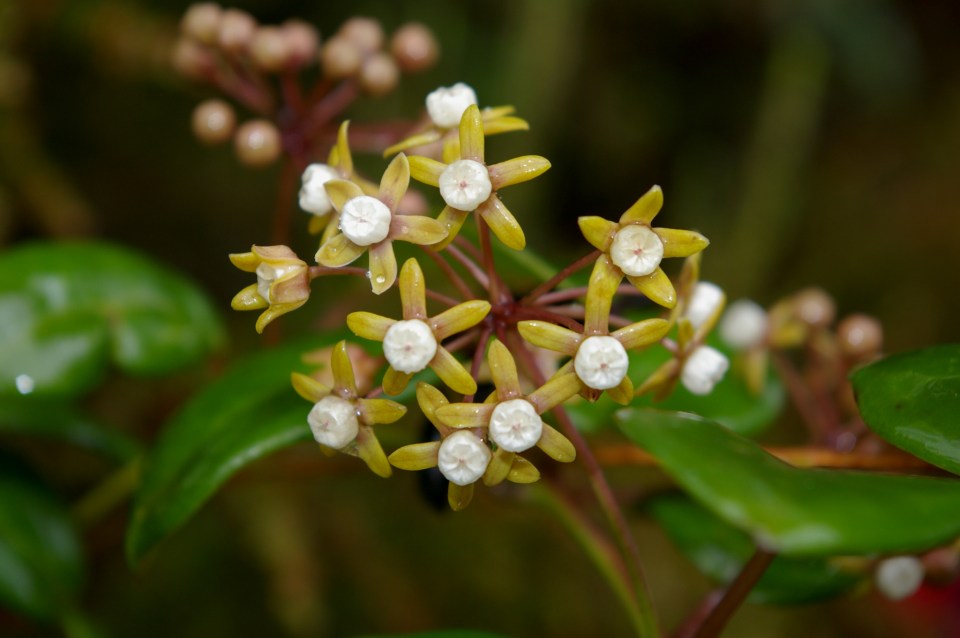
It’s interesting that this species of Cynanchum is one of the few in which the corona which covers the gynostegium (the fused sexual parts) is closed over:

cynanchum obovatum_madag - angavokely_meve

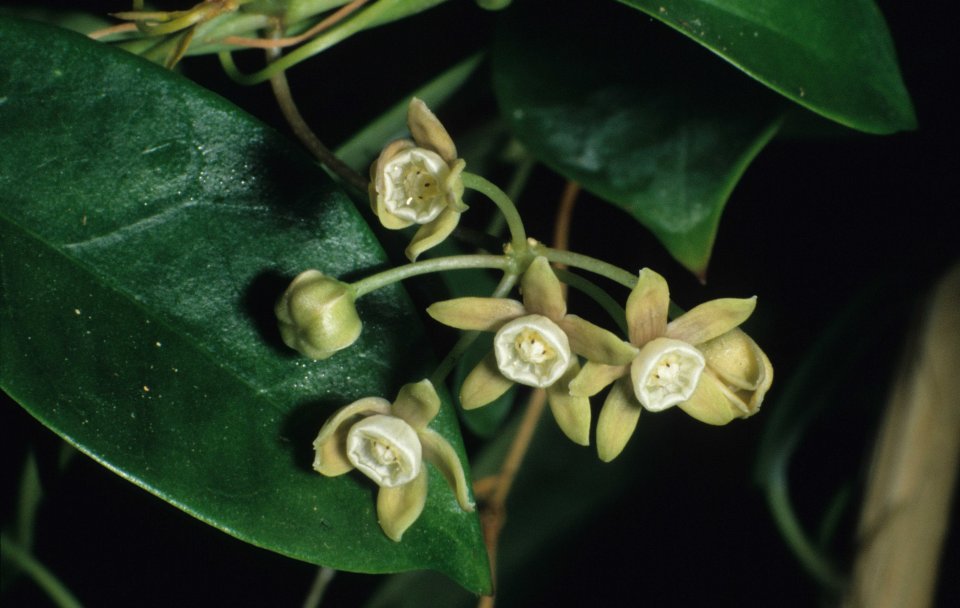
That means it requires quite a strong, large insect to get inside and access the nectar.  So the prediction is that the pollen masses (pollinaria) will be found on the mouthparts of these wasps.  Intriguingly, a very closely related species C. repandum has no such closed corona, begging the question of whether it might be pollinated by a different type of insect:

cynanchum repandum sl 2867_low

For now this record will go into the Pollinators of Apocynaceae database as pollinator unproven, but i would be great if someone working in Madagascar could confirm the status of this pollination system.

My grateful thanks to Ulli for sharing his pictures and allowing me to tell the story of what may be a whole new Madagascan pollination system for our favourite family.  Apocynaceae is full of surprises!

cynanchum obovatum with wasp_madag -angavokely_meve 3


Should environmentalists be optimistic in a time of uncertainty?

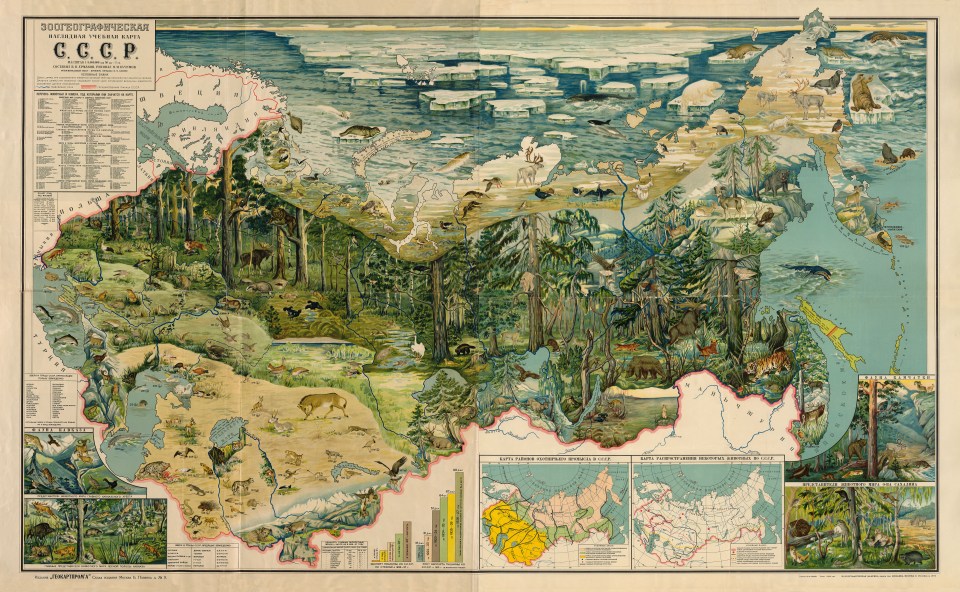
zoogeo-ussr

Over at the Ideas for Sustainability blog Joern Fischer posted a really interesting piece on 1st January called “A new kind of hope” about the current state of the world and whether, from an environmental perspective, there’s really anything to be optimistic about.  If environmental collapse via climate change and over-exploitation is inevitable, the collapse of civilization is not far behind.  Joern’s piece is well worth reading, lots to think about in there, and I highly recommend that you take a look.

I posted a comment there which I’m going to copy here and add to because I think it bears repeating.

Going back to at least my student days I always thought that there was only a slim chance of our civilization making it to the end of the 20th century without some kind of catastrophe wiping us out.   So it was a surprise to celebrate the millennium as December 1999 segued into January 2000. Since then, whilst I think there’s lots to be optimistic about such as the increase in renewable energy, large-scale habitat restoration in some regions, and a growing recognition of the environmental damage of biocides and plastics, there’s also the nagging fear that it’s too little, too late.

These days I alternate between wild optimism and deep depression over the fate of humanity and of the planet. It’s so easy to get sucked into the vortex of negative environmental narratives and ignore the positive ones. Especially so if you actively use social media.  So I try hard to be optimistic and resist the urge to just give up, but the political situation across much of the world makes that difficult. As I learn more about the natural world through my own research and that of others’, and as world events such as Brexit and the rise of the Far Right unfold, I realise how little any of us really know about anything at all. Thus I have a deep suspicion of anyone who spouts certainties, whether they be moral, philosophical, religious, scientific, political, or artistic. All we can do is feel our way into the future, cautiously.

With respect to the question that Joern poses of “If we have to re-build something after some kind of collapse … do we have ideas for what that something will be?”, this is the rationale behind the Dark Mountain Project, a loose collaboration of writers, artists, thinkers, etc., who are trying to look for new narratives for humanity and the planet we depend upon. I’ve written a couple of pieces for their journal, most recently for issue 10 where I discussed the role of poetry in science.  And although I don’t buy into their certainty that there will be a collapse, I think it’s an important project for understanding where we are now, where we’ve been, and where we might be going to.  Here’s a link to the project’s website.

The discussion over whether we should be optimistic about the future of the planet that supports us, and how that optimism will play out, is important for scientists, and society at large, to be having.  By coincidence as I was writing this post the map above started circulating on Twitter.  It’s a Russian teaching aid from 1928 showing the different biomes of the USSR and can be downloaded from this site.

What really struck me about this graphic was the certainty with which it represents the natural world, as if all of this could never change. There are polar bears on ice flows and a frozen tundra in the far north; water still fills the Aral Sea, hyenas feast in the steppe, snow leopards haunt the mountains, Siberian tigers prowl the pine forests.  And an optimistic looking whale heads towards Japan.  Some of this is gone, some will almost certainly change, but a lot of it we could save, if we want to, saving ourselves in the process.

When scientists get things wrong: is coffee the second most valuable global commodity?

2018-12-22 13.12.38

If this blog has a purpose beyond highlighting the importance of biodiversity, and recent developments in the field of pollination biology in particular, it’s to demystify science and the scientists who produce new knowledge.  Hopefully my posts over the past seven years have shown that scientists can have all kinds of backgrounds, even northern English working class, and need not have attended the most prestigious universities.  I’d also hope that what I write about my own research gives some insights into how new knowledge is generated and how it can be communicated to both specialist and non-specialist audiences.

Something should be clear from all of this: scientists are human just like everyone else, with the same foibles, foolish notions, prejudices, passions, and blind spots.  And they make errors.  Just like everyone else.

This is by way of an introduction to admitting that I made a mistake in one of my recent papers.  Not a massive mistake, and not one that requires me to retract the paper, but one which bugs me and which I need to correct for the sake of accuracy.  Hopefully it will stop others repeating the same error.

In “Pollinator Diversity: Distribution, Ecological Function and Conservation” (Annual Review of Ecology, Evolution and Systematics 2017) I stated that:

“Coffee…is second only to oil in terms of its value as a commodity”.

That’s a “fact” that I’ve heard repeated for years, in lots of different places, so I didn’t bother citing a source because, well, it’s just true, isn’t it?  Only trouble is, it’s not true.  It’s been debunked several times over the years, as discussed in this summary on the Politifact.com website:  No, coffee is not the second-most traded commodity after oil.

Mea culpa.  I should have done due diligence and checked my facts, especially as I’ve posted before about how many of the “facts” concerning bees as pollinators are incorrect – see Who is feeding the honey bee bullshit machine?   

But, we all get stuff wrong.  I’m sure I’ve made other errors in the past and not spotted them, and I bet there’s not a published scientist who hasn’t made some kind of mistake in their writing.  We may all be standing on the shoulders of giants, but even giants have their flaws….  That doesn’t make me feel any better though.

What are my most read blog posts of 2018? A short review of the year

2018-12-06 16.17.24

On this last day of 2018 I thought I’d review twelve months of blogging by highlighting the 10 posts that I published this year which have received the most reads, and the perennial favourites from previous years.

The most viewed post of 2018 was Should we stop using the term “PhD students”? with 1,743 views.  That’s perhaps not surprising as there is a huge appetite for information related to early career researchers.

More surprising, but very satisfying, with 1,081 views The evolution of pollination systems in one of the largest plant families: a new study just published – download it for free was the second most viewed post published this year.  The fact that the paper it relates to has gestated, in concept and in execution, for over 20 years, has 75 authors from almost 20 countries, with a roughly 50:50 gender split, made this my personal favourite of the year.

The guest post by Karin Blak, my wife, on How can academics help students with anxiety issues?  generated a lot of comments on Twitter and Facebook, and comes in third with 729 views.  If you’ve not read any of Karin’s posts on her own blog, which relate to all types of relationships, intimacy, and so forth, they are highly recommended.

Fourth most viewed was Is there really a “battle for the soul of biodiversity” going on at IPBES? (456 views) which I updated just this week to reflect the latest correspondence in Nature.

Number five is XI International Symposium on Pollination, Berlin, April 16th -20th, 2018 (424 views).  I’m pleased that this helped to generate a lot of interest in the conference as I was asked by the organisers to present the keynote lecture, initially agreed, but then had to pull out as the timing in relation to our undergraduate Tenerife Field Course was problematical.  I heard from those who attended that the symposium was great and I’m sure that David Inouye did a much better job than I could have done at delivering the keynote!

The impact of building a new university campus on urban bird diversity and abundance: a seven-year study is sixth with 407 views.  Expect an update on this in 2019 as we complete the final round of winter and spring surveys.

Being ill is good for blogging as demonstrated by the 406 views of the seventh-ranked The good and the bad in biodiversity.  It was also a useful example to use in my first year biodiversity class.

The weird weather of March last year clearly interested people:  Can pollinators survive sudden changes in the weather? (362 views) was the eighth most viewed.

And of course pollinators are always popular: There ain’t no b(ee) in Starbucks (356 views) came ninth, whilst Hunting the Chequered Skipper: an encounter with England’s latest species reintroduction project (296 views) was tenth.

Those are the statistics for posts that I published in 2018.  But all of these are exceeded by a post first published in 2016: How to deal with bumblebees in your roof received 6,395 views this year, six times as many as it has had in the previous two years.  Not sure what has gone on here: are bumblebees nesting in roofs becoming more frequent?  Perhaps so – the main roof nester is the Tree Bumblebee (Bombus hypnorum) which has become ever-more common since its arrival in the British Isles in 2001.

The second most viewed post overall was also published a while ago, in 2015: How does a scientist’s h-index change over time? was viewed 4,081 times.  This no doubt reflects an increasing focus on such easily measurable (but rather flawed) metrics for evaluation (self- and external-) of an individual’s progress as a scientist.

Interestingly these are also the two most viewed posts of all time on my blog, though the order is different: How does a scientist’s h-index change over time? has had 12,355 views and How to deal with bumblebees in your roof has had 7,549.  I suspect that posing a question in the title of a blog post has some influence on viewing figures – most of my all-time viewed posts are phrased as questions and people searching for information often google a question.  I just pitched that idea to Karin and she half agreed but suggested that it’s also because people want answers.  So they come looking for an answer to the question that is posed in the title, whereas having a bald statement in the title does not inspire them to look any further.  Would be interesting to devise a test to differentiate between these two effects.

So that’s my blogging year in summary.  What were your favourite posts of 2018, either from my blog or from other’s?

Happy New Year everyone, I hope that 2019 brings you things that make you happy!


Climate change at Christmas: did the hot, dry summer of 2018 cause the record-breaking prices of holly and mistletoe?

Over the past two festive seasons I have posted about the research we published assessing the auction prices of holly and mistletoe, two culturally important seasonal crops that are 100% pollinator dependent for berry production.  The first post was called Insect pollinators boost the market price of holly and mistletoe: a new study just published; the second was The holly, the mistletoe, and the pollinators: an update on an old story.

Follow those two links to get the full background to this research and a link to the original paper published in the Journal of Pollination Ecology.

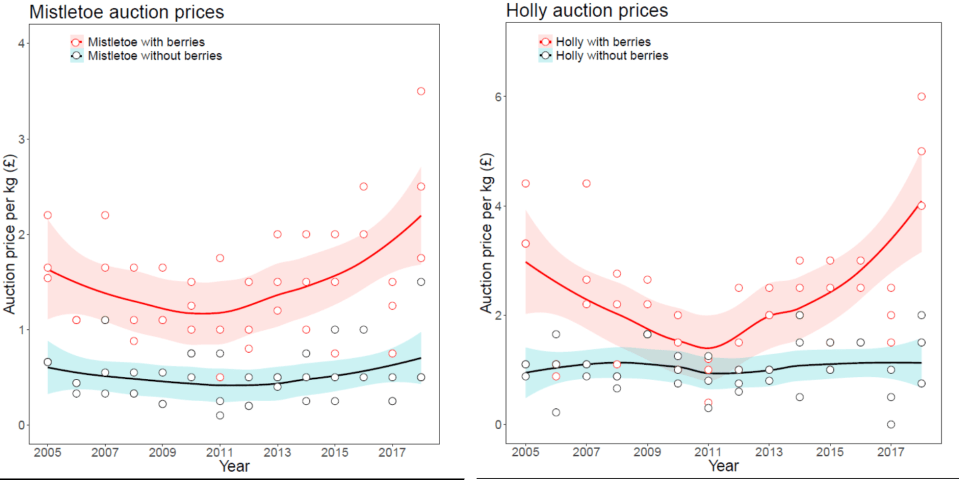
I’ve collated the auction prices for the 2018 season and added them to the time series data set, and it’s clear that something very interesting has occurred.  Both berried holly and mistletoe have achieved record-breaking average prices, whilst auction prices for material without berries have hardly changed at all.  Here are the updated graphs; each data point is the average price per kilo paid at an auction:

Holly and mistletoe prices 2018

So what’s gone on this year?  What could have affected the auction prices?  One interesting possibility is that the long, dry summer of 2018, a likely consequence of climate change, has negatively affected berry production in these two species.  This could come about if the holly or the mistletoe host trees are water stressed and shed part of their berry crops.  It’s unlikely to be a consequence of too few pollinators as these species flower too early in the year to have been affected by the dry weather.   We have more work planned in the future using these data and this will be an interesting question to address.

Yesterday I popped out to do some Christmas shopping and tried to buy mistletoe at a local garden centre.  That’s the second time I’ve tried this year (the first was at a nearby green grocer’s) and the second time that I’ve been told that they have none because it’s very expensive this year and not worth stocking.  That seems predictable from the wholesale auction results I’ve just described.  Has anyone else in the UK had similar experiences this year?

The British holly and mistletoe market is relatively small and clearly seasonal, and probably not worth more than a few millions of pounds each year.  However it seems to be very sensitive to external factors and may be a microcosm for how some crops, at least, might respond to future extreme weather brought about by climate change.  Brexit might also have an effect in the coming years as we import a large amount of mistletoe from northern France.  But then Brexit is going to have an effect on large areas of British society…..

On that sour note, Happy Christmas to all of my readers, however you voted in the referendum.  I hope you have a restful holiday, spending it as you wish, with the people you want to!  And if you, or someone you know, are spending the festive season on your own this year, take a look at Karin’s latest blog post:  Preparing a Christmas Just For You.

The biological mutualisms at the heart of sourdough bread

20181026_120748

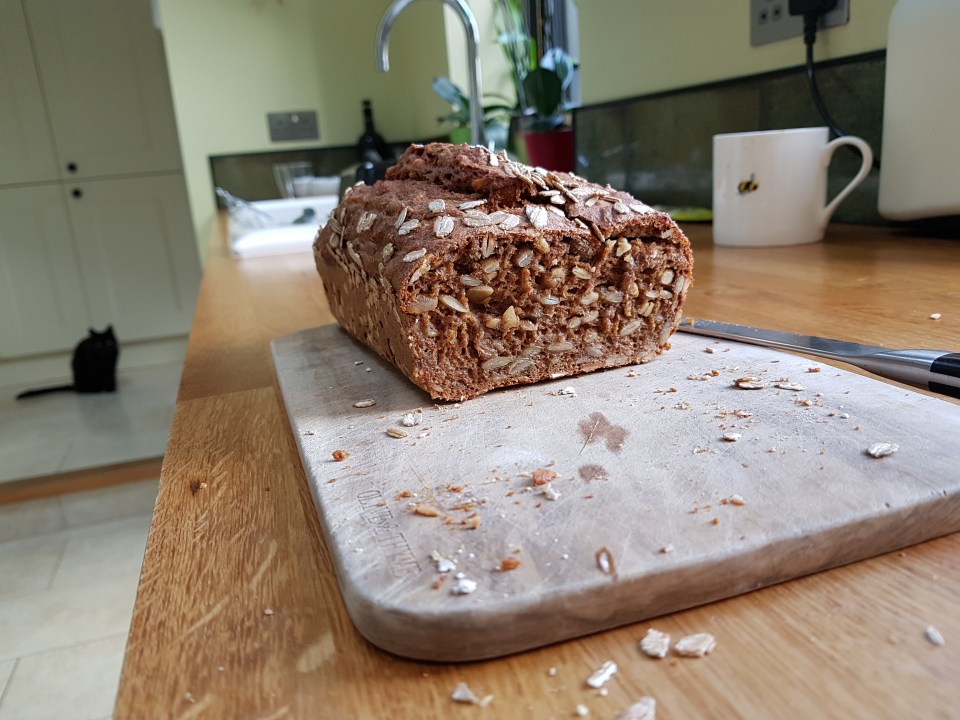
During the road trip to Denmark that I mentioned in a post back in September – see “There ain’t no b(ee) in Starbucks” – my wife Karin received a special gift from her sister Pia.  It was a small jar containing a starter culture for sourdough bread, a culture that Pia has been using since she received it from a friend, who long ago received it from another friend.  I didn’t know much about sourdough bread and did some reading. That Wikipedia link is a good introduction but don’t be put off by the complexities of “refreshment” – we’ve kept the starter culture in the fridge since early September and it’s been fine.  Karin used the culture for the first time this morning and made the rye bread you see above.

But on to the biology.  In essence the sourdough culture is a mix of wild lactic acid bacteria and wild yeasts, plus flour and water.  When added to the bread mix (which in our case contained water, salt, seeds and molasses, as well as rye flour) the yeasts feed on some of the sugars within the mix and the lactic acid bacteria feed on other sugars that the yeast cannot metabolise.  During that bacterial fermentation, byproducts are also produced on which the yeasts feed.  The yeasts in turn produce carbon dioxide which serves to leaven the dough, and the bacteria produce lactic acid as another byproduct, which gives the bread its slightly sour flavour.  This lactic acid also lowers the pH of the environment and, together with the production of anti-fungal chemicals, the lactic acid bacteria prevent the growth of other bacteria and moulds.  The yeasts, however, can tolerate these conditions and they thrive.

At least six species of yeast and 25 species of lactic acid bacteria have been shown to be  involved in this process, often as multi-species mixtures.  The exact biodiversity of the culture is dependent upon its source: micro-organisms vary a lot across the world.  But the heart of the relationship between yeasts and bacteria is always the same: they each facilitate the growth and reproduction of the other, and so the relationship is mutualistic, much like (most) relationships between plants and pollinators, birds and berries, and sea anemones and clownfish.

Of course there is a third organism involved in this mutualism: Homo sapiens.  By producing the resources on which these organisms feed, and then distributing the starter culture, we are providing the right conditions for the yeast and lactic acid bacteria to increase their populations.  In turn the yeast and bacteria play an important role in producing food for us, and in fact this way of making bread is thousands of years old.  Microorganisms and people all benefit: what could be more mutualistic than that?  Indeed, these interactions could be classified as a rare example of a ménage à trois mutualism.

There’s also a social-cultural dimension to all of this as the passing of gifts such as the starter culture binds friendships.  If any of our local friends are reading we’d be happy to share the sourdough culture once we’ve bulked it up.  The bread that it makes is delicious and from now on we’re going to try to give up buying the shop-bought kind.

If you want to read more about all of this, and have a try at making your own starter culture from scratch, there’s some great information and links on the Microbial Menagerie blog.

Many thanks to Pia for sharing the starter culture, and to Karin for baking the bread!