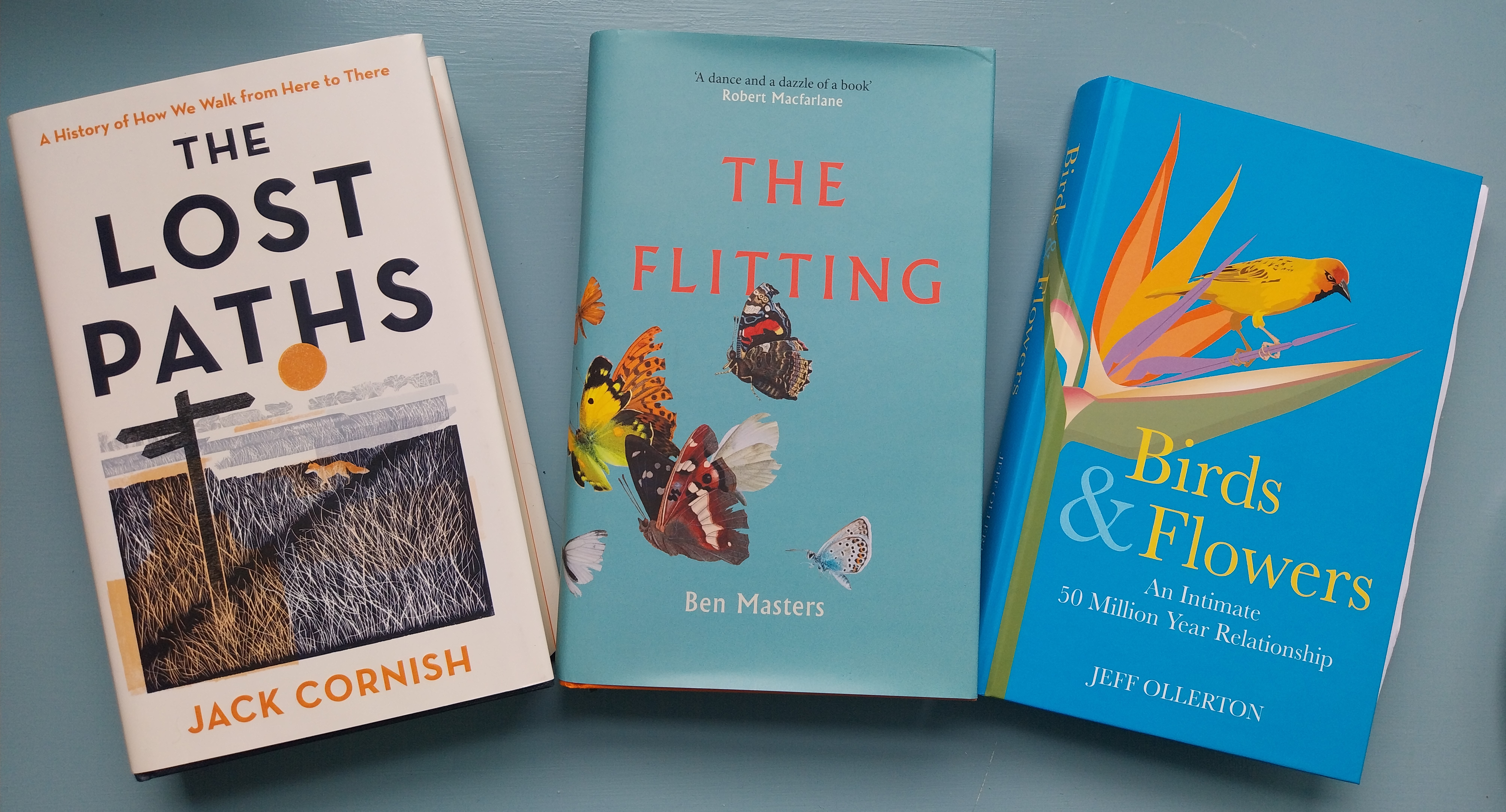
Why do authors write about ‘nature’? What are their motivations and how did they start their writing journey? Do they even recognise this label of ‘nature writer’?
These are just some of the questions I’ll be exploring with two other authors at the Market Harborough Book Festival on Saturday 5th October.
Jack Cornish is author of The Lost Paths, an exploration of the ancient pathways that have criss-crossed England and Wales since prehistoric times, the peoples who made them, and the landscapes through which they currently run. It’s a reminder of ‘just how precious these paths are, and have been, to the human story of this island’. I’ve only just started The Lost Paths, but what I’ve read so far is wonderful. Check out this recent review on The Great Outdoors site.
Ben Masters’ most recent book is The Flitting, an account of the final months of his relationship with his late father, a keen natural historian with a devotion to butterflies, and how they come to share ‘passions, lessons and regrets as they run out of time’. There’s a nice review of The Flitting by Mark Avery on his blog, and I have to agree with him, it’s a lovely book.
Coincidentally, earlier this year Mark wrote a review of the book that I will be discussing, my recent Birds & Flowers: An Intimate 50 Million Year Relationship, though I may also dip into Pollinators & Pollination: Nature and Society, because there’s at least one thing that unites the three of us as writers: a love of the poet John Clare! Ben discusses him at length in The Flitting, and indeed Clare provided the title of the book. Likewise, Jack name checks Clare in The Lost Paths, and I used the poet as the jumping off point for a couple of explorations of the importance and conservation of bees and other pollinators.
As well as discussing our roles as ‘nature writers’ we’ll be reading extracts from our books and answering audience questions. There will also be an opportunity to buy personally signed copies of our books. We look forward to seeing you there!
Later this month I’ve been invited by the Oxford Ornithological Society to give a talk about my new book Birds & Flowers: An Intimate 50 Million Year Relationship. The talk will summarise the main themes from the book, particularly the sheer diversity of birds that can act as pollinators, what it means for the ecology and evolution of flowers, why the conservation of such interactions matters, and the cultural significance of bird-flower interactions. I’ll also deal with the question of why Europe is so odd when it comes to the question of birds as pollinators.
The talk is on Wednesday 11th September at Exeter Hall, Kidlington, starting at 7.45 pm; it’s free to society members, and non-members are invited to make a donation. Do come along if you’re in the area!
The world of nature conservation is fast moving and complex. New opportunities for wildlife and threats to biodiversity seem to arrive almost daily, there are regular high-level meetings focused on conventions and policies, and an endless stream of scientific research being published in the world’s journals. Keeping up with all of this is impossible; trying to keep up with it is exhausting.
For this reason I’ve recently subscribed to Mike Shanahan’s newsletter The Nature Beat on Substack. Mike’s a writer with a background in science research. His PhD was on fig ecology and he wrote an excellent book about the ecological and cultural importance of these fascinating trees called Ladders to Heaven which was one of my five book choices on the Shepherd site.
The Nature Beat is described by Mike as being:
primarily aimed at journalists covering topics such as biodiversity, conservation, wildlife trade, ecological restoration and so on. Of course, non-journalists may also find it useful.
As a non-journalist trying to keep abreast of what’s happening in this complex and rapidly evolving arena, I find it extremely useful! For the past couple of months I’ve opted for the free subscription, but from today I’m going to pay. The kind of insights and expertise that Mike brings to his newsletter are invaluable for anyone interested in how our world is changing, for the worse and for the better. Please subscribe and if you find the content useful, and can afford it, consider upgrading to the paid version.
Books are never perfect. In the run-up to publication of Birds & Flowers: An Intimate 50 Million Year Relationship, I am all too aware that this is a truth that’s a cause of anxiety, and sometimes sleeplessness, for all authors. One category of imperfection is tipographical* errors have been introduced at some point in the process of writing and editing. In the past these were corrected in the first edition of a book by the inclusion of errata slips, and such errors are sometimes important in determining the true first editions of older books. On page 20 of the first edition of Darwin’s Origin of Species, for example, there is a misspelling of the word “species”**. This was corrected in the second edition but is an important marker of an extremely valuable book, intellectually and (now) commercially.
A second category involves errors of fact or interpretation or expression that, with hindsight and reader feedback, require correction, or at least acknowledgement, by the author. These are the ones that really make an author squirm inside, even though we know that they are inevitable: we are, after all only human.
It turns out that there are a few examples of both categories in the first edition of my 2021 book Pollinators & Pollination: Nature and Society. Some of them have been corrected in the second edition, but if you purchased the first edition then these are what you should look out for:
P22 – ‘Unmated queens and males (drones) are produced by the colony later in the season’ changes to: ‘Unmated queens and males (drones) are produced by the colony from spring onwards.’
P30, Fig 2.9 – Correct ‘Tabaernemontana’ to Tabernaemontana
P51, Figure 3.8 – title – it should read C. rhynchantha [there’s an h missing]
P57 – ‘The bank that Darwin was referring to is on his property at Down House in Kent, and it was one he observed many times during his walks through the garden.’ changes to ‘The bank that Darwin was referring to is near his property at Down House in Kent, and it was one he observed many times during his walks in the area.’***
P146 – ‘I’ve even see them attack and kill honey bees’ should read: ‘I’ve even seen them….’
P169 – in the title for Figure 10.5, Anon (2019) should be Anon (1919) [in some presentation copies of my book I have corrected this and initialed the change]
P259 – this reference: Klein, A.-M., Steffan-Dewenter, I. and Tscharntke, T. (2003) Fruit set of highland coffee increases with the diversity of pollinating bees. Proceedings of the Royal Society B 270: 955–961. doi: 10.1098/rspb.2002.2306.
Should be replaced by:
Klein, A.-M., Steffan-Dewenter, I. and Tscharntke, T. (2003) Bee pollination and fruit set of Coffea arabica and C. canephora (Rubiaceae). American Journal of Botany 90, 153– 157. doi: 10.1046/j.1365-2664.2003.00847.x
The last two have yet to be corrected and will need to wait for the third edition:
P119 – the Rader et al. study did not include birds and bats, just insects.
P262 – “Nabhan, G.P. and Buchmann, S.” should read “Buchmann, S. and Nabhan, G.P.”
That final error is really embarrassing because, as I point out in the chapter ‘The Politics of Pollination’, their book The Forgotten Pollinators was an inspirational one for stimulating research and action around pollinator conservation! I can offer no explanation for why the order of the authors got reversed in my head.
My sincere thanks to those readers who pointed out some of these errors. My hope is that Birds & Flowers has fewer, but I may be fooling myself…
*You see what I did there?
**Proof-reading is boring and soul-destroying for any author, but really Mr Darwin?!
***If there is an after-life, I’d like to think that Darwin’s now enjoying this error after my snarky comment in the second footnote. To which I’ll respond: watch out for a doozy of a footnote about a Darwin footnote in Birds & Flowers!
But just as when a movie director says “That’s a wrap” at the end of the final day of filming, the hard work does not stop here. Two people have read the full manuscript as I was producing chapters and their suggestions have been incorporated into this draft. The publisher will now send it to a third, independent beta reader and once their feedback has been acted on it will go to a copy editor who will suggest stylistic changes, check for logic and consistency, and so forth.
At the same time I will be choosing which plates to put in the book, which images to use on the back cover, writing their descriptions and deciding where to cite them; checking the sources and further reading sections for each chapter and formatting the references; and producing an appendix that lists the scientific names against the vernacular names that I am using in the book. I also need to finalise the acknowledgements section.
As an author, producing a book is a long process that doesn’t end with the actual writing of the manuscript. It’s incredibly satisfying, however, and working with Pelagic on my second book for them has been a great experience. All being well, Birds & Flowers should be out by early winter.
Now, I have three options for the next book that I’m writing….which one to choose…?
For the past year I’ve been keeping a secret from all but a few trusted confidantes: the subject and title of my next book! My publisher – Pelagic – has now announced it on their website and so it’s time to make it public. “Birds & Flowers: An Intimate 50 Million Year Relationship” will be the first book that covers bird pollination in its entirety, going beyond just hummingbirds, sunbirds and honeyeaters, to consider the more than 60 other bird families that interact with flowers, and the tens of thousands of plants that rely on them as pollinators. You can read more about it on Pelagic’s website.
The 3D mock-up of the cover shown above features an illustration by my good friend Stephen Valentine, a very talented artist who you may remember produced this painting of waxwings that Karin bought for my birthday a few years ago. I’m extremely pleased with how Pelagic have incorporated this into the design of the cover.
The book will be available by autumn I hope, if my writing schedule goes to plan!
Clearly that’s a very subjective question and everyone has their own view on which books about a particular subject they would recommend! So coming up with a list of just five for the Shepherd book recommendation site was not easy. My list features authors such as Brenda Z. Guiberson, Megan Lloyd, Steven Falk, Dave Goulson, Mike Shanahan and Stephen L. Buchmann, which will hopefully inspire you to read some of these books.
If you think that I’ve missed your favourite from the list, please do comment below. And if you’re an author, consider signing up for Shepherd and curating your own list, they’ve been really helpful and it’s a useful service for readers and authors.
It’s just over one year since I stepped down from my full time professorship at the University of Northampton in order to work independently as a consulting scientist and author. It was a move precipitated by a number of factors, not least that after 25 years at that institution I needed some new challenges. I was starting to feel stale, jaded, and not a little burned out.
Since making the decision to leave the university (where I still hold a Visiting Professorship) Karinand I have down-sized our lives by selling our house, disposing of possessions that we didn’t need (though there’s still a lot in storage in the UK) and moving to Denmark, where we are renting a small apartment for the time being. Karin is Danish and, yes, both Brexit and the pandemic have played a role in our decision making.
A few people have asked me recently how I’m managing to earn a living as an independent academic so I thought I’d share with you my experiences so far. I’ve looked at my various sources of income over the past year and put them into four broad categories: Conservation, Research, Education and Writing. Then I worked out the proportion of my income that can be attributed to each area, keeping in mind that there’s overlap between them. This is the result:
Conservation-related activities accounted for the largest fraction, about 46% of my income. This includes direct advisory and consulting, on pollinator-related projects but also on wider, biodiversity-related topics. For example I worked with the Stanwick Lakes nature reserve in Northamptonshire, advising on how best to enhance and manage the site for pollinators.
It’s a site that I know very well but which was set up mainly because it’s important bird habitat. Seeing it from a pollinator’s perspective allowed me to make suggestions for improving the amount and timing of floral resources, opportunities for ground nesting bees, and so forth.
I’ve also been working with the Centre for Ecology and Hydrology (Wallingford) on a biodiversity strategy for the European railway network which I’ll write more about later this year when the final report is published.
Also included in the Conservation category are the many, many talks (mainly online) that I’ve done for various natural history, gardening and beekeeping groups, plus training sessions that I’ve done with ecological consultancies, estates departments, and local government. There’s a list of those available on my training and public speaking page.
Research projects funded by UK and international agencies accounted for about 32% of my income. Some of these are projects that started when I was still employed at the University of Northampton and which are paying for my time (including completing the supervision of my remaining PhD students), others are new ones. You can find a list of present and past projects on this page of my website.
I am a partner on several funding applications that are in the process of being assessed and I’ll report back when we know if they have been successful.
As well as my own research I’m also reviewing grant applications for funding organisations, advising research groups and departments on their research strategies, and working with the Turkish Journal of Botany to promote the work it publishes to a wider international audience.
Education is the third, very broad category that includes things such as external examining (both taught and research degrees), assessing staff applications for promotion, and doing the occasional online lecture. It accounted for 11% of my income, less than I might have expected given that I’ve spent over 30 years teaching in higher education, educational consulting is quite a crowded field and unless you’re a high-profile specialist, it doesn’t pay well.
Writing accounted for about 11% of my income. As well as royalties from my book Pollinators & Pollination: Nature and Society, I earned money from writing for magazines such as BBC Gardeners’ World Magazine, New Scientist, British Wildlife, and Bees & Other Pollinators Quarterly.
In addition I’ve done some advisory work for publishers, including reviewing text and making suggestions for a forthcoming children’s book about bees and other pollinators, and some paid manuscript editing.
At the moment the balance of my work feels about right; I’ll never stop being a scientist so working on research projects is, and always will be, an important part of my life. I wish that it was possible to earn more from writing, but outside of the best-seller lists it’s difficult for authors to earn a decent living. However I’m working on my next book at the moment, as is Karin whose Essential Companion to Talking Therapy has been well received.
Working independently in this way, and putting together what amounts to a “portfolio career”, is not for everyone. It’s hard work and there are lots of uncertainties along the way, especially with regard to month-to-month consistency of one’s income. However a career as a university academic has prepared me for this in ways which I’m only just beginning to discover. Aside from the obvious subject expertise, familiarity with literature searching, and confidence when giving talks, the uncertainties associated with the high proportion of unsuccessful funding applications and navigating the (often contradictory) requirements of peer reviews has been extremely valuable experience. And of course I’ve established a large and diverse network of colleagues with whom I can collaborate and go to for advice. The diversity of paid work with which I’m engaged, plus the pro bono activities such as peer reviewing for journals, ensures that there’s never a dull day. I have absolutely no regrets about this latest step in my career!
If you’re interested in working with me or want to discuss any aspect of what I’ve written about, please do get in touch via my Contact page.
About 20 years ago I went through a very difficult relationship break up. At the time I had a young family and found the whole thing too overwhelming to deal with. No amount of talking with friends and family helped. The current fashionable advice – “getting out into nature” – also did not help. Interacting with nature by walking, gardening or getting involved in active conservation, is a wonderful panacea for some mental health conditions. But it cannot solve all of our problems, especially those that come out of the blue. So I turned to therapy and had a series of weekly sessions with a therapist who provided a safe, neutral space for me to explore my emotions, anxieties about the future, and concerns for my own mental health. It was an amazingly useful experience.
Fast forward two decades and, lo and behold, I am married to a therapist! Not the same therapist I hasten to add, it’s purely coincidental!! Having a relationship with one of your clients would be hugely unethical on the therapist’s part, and ethical behaviour is just one of the themes that is in my wife’s new book.
So this is the reason for today’s blog post: it’s publication day for The Essential Companion to Talking Therapy by Karin Blak.
It’s the first volume of its kind that explains what you can expect to experience before, during and after therapy takes places. The book also deals with the many questions that you may have, or didn’t know to ask, about the therapeutic journey. It’s an invaluable read for anyone considering or going through therapy or counselling for issues around mental health, relationships, family problems, and so forth. It’s also got a useful section for families and friends on how to support a loved one who is in therapy.
Most importantly it provides a clear and rational argument for why therapy works, something that I only discovered for myself by going through the process. I wish I’d had this book 20 years ago.
The Essential Companion to Talking Therapy is available from all online booksellers around the globe, as a paperback or e-book. There’s also an audiobook version in the works.
OK, I’m clearly biased, but it is great book: well done darling, I’m so proud of you!
The nice people at NHBS recently did a wide-ranging interview with me about my new book Pollinators & Pollination: Nature and Society and what led me to write it. It covers a lot of ground, including climate change, food security, the UK Pollinator Monitoring Scheme, and growing up in Sunderland.