Tag Archives: Orchids

Book review: ‘The Dales Slipper: Past-Present’ by Paul Redshaw

Tomorrow I head to China for two months of writing, field work, talks, and student discussions at the Kunming Institute of Botany in China, a follow-up to the work that I did last year. It feels appropriate, therefore, to be reviewing a book devoted to a western European outlier of a group of orchids (the ‘lady’s slippers’) that have one of their centers of diversity in that country.

In The Dales Slipper: Past-Present, author Paul Redshaw focuses on ‘the’ Lady’s Slipper (Cypripedium calceolus), an almost mythological species in British botany, due to its extreme rarity, the secrecy and protectiveness about where it grows, and its tendency to be dug up by unscrupulous orchid collectors. And a fascinating (if sometimes frustrating) read it is too!

The fascination of the book lies with Paul’s ability to sleuth previously unknown facts from local people who were witnesses to the rediscovery and subsequent protection of what was thought to be the last colony of the species in Britain. Protection was afforded by ‘The Guardians’ who (of course) met in a pub and were sworn to secrecy and (of course) fell out when personalities and priorities clashed. They were replaced (ousted?) by a more formal ‘Cypripedium Committee’ that still exists today, but who (if the author is to be believed) are even more secretive than The Guardians!

Drawing on newly uncovered archives, personal testimonies, and previously unseen images, the book details the decades-long efforts – marked by secrecy, dedication, and conflict – to protect the species from extinction. It stands as the first comprehensive and fully referenced account of this remarkable conservation journey

It makes a compelling story of the kind I can imagine being a successful comedy-drama for television – think Detectorists with hand lenses.

I mentioned that the book was a frustrating read, too. That’s partly because there’s a big cast of characters, some of whom have the same names, and it’s easy to lose track of who they are and what they did, and when. Paul does provide a helpful list of the protagonists but I found myself feeling a bit lost in places. That’s not helped by the fact that the book would have benefited from professional editing to smooth the rough edges.

These minor gripes aside, The Dales Slipper will interest anyone looking for a deep dive into British botanical history via the world of one of our rarest and most iconic wild plants.
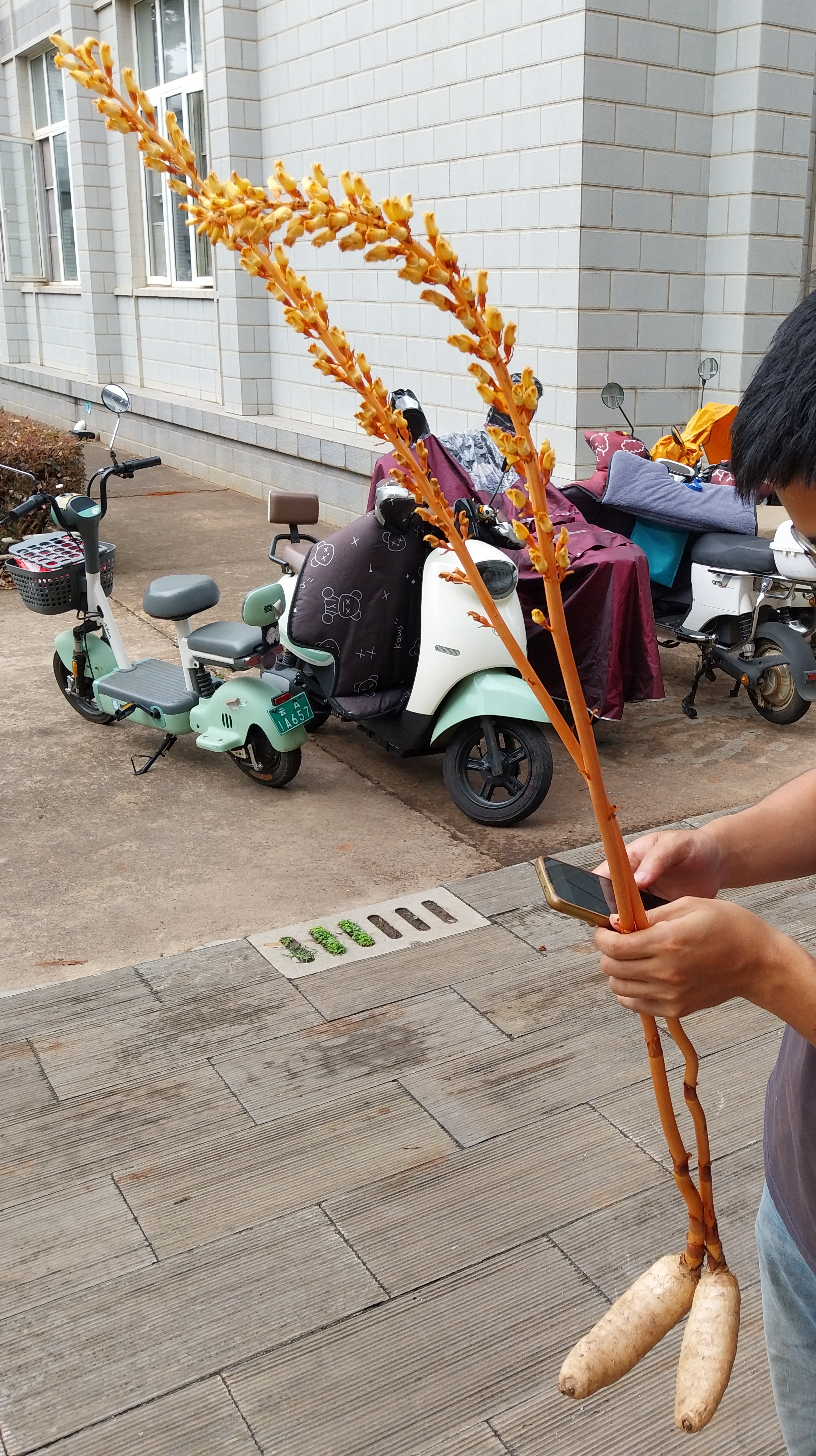
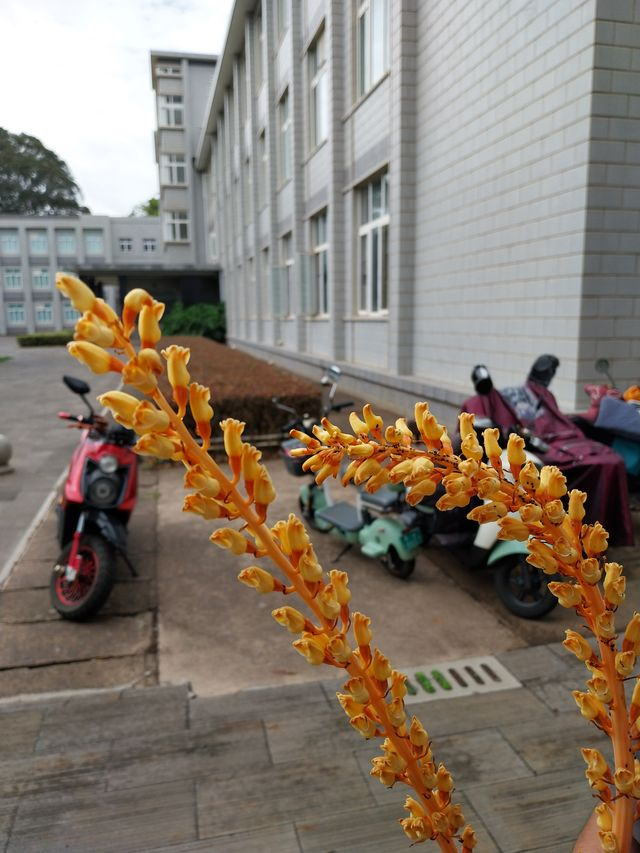
A doubly-parasitic orchid? – China Diary 5

Walking into Kunming Institute of Botany yesterday morning, I passed a young guy who was carrying what I initially thought was a species of Orobanchaceae. I’ve a long-standing interest in the pollination ecology of these intriguing parasitic plants, so I stopped to have a chat. Turns out they were in fact orchids! Specifically, they were specimens of Gastrodia elata, one of the “potato orchids“, so named because those fat tubers are edible. They are widely used in South China – where they are known as Tianma, 天麻 – both as a food and medicinally. The tubers are eaten before the flowers are produced, and originally they were collected from the wild. But in the 1960s a Chinese botanist named Xuan Zhou discovered how to cultivate them and they are now grown in specialist nurseries. A fascinating account of the life of Xuan Zhou – “The Father of Gastrodia” – was published in the journal Plant Diversity last year, shortly after he died.

These orchids do not produce green leaves or stems, therefore they cannot photosynthesise. Instead, they gain all of their energy from a parasitic symbiotic relationship with a fungus – they are what is termed “myco-heterotrophic“. Most myco-heterotrophic plants have evolved from ancestors that were involved in mutualistic mycorrhizal relationships with fungi, in which the plant provides sugars to the fungus in return for mineral nutrients and water. In the case of Gastrodia elata, the fungus concerned is the non-mycorrhizal, wood-rotting Armillaria mellea. In the west we know this as Honey Fungus, a disease of trees and shrubs and the bane of many a gardener. This is also edible, incidentally, but best dried before cooking (and some have an intolerance to it, so take care).

I tweeted the photograph in a short thread just after taking it, and Stewart Nicol pointed me to a study of the orchid’s floral biology and pollination ecology in Japan by Naoto Sugiura. Turns out that, at least in the population which Naoto studied, the plant produces no nectar and deceives its pollinators, which are small bees, into visiting the flowers.

That’s why I’ve used the phrase “doubly-parasitic*” in the title of this post – the plant, it appears, parasitically exploits both the fungus from which it gains energy and the pollinators that ensure its reproduction. It’s (almost, but not quite) the flip side of “double mutualism” in which species provide two benefits for one another, e.g. the same bird is both a pollinator and a seed disperser of a particular plant, a phenomenon that I discussed in my recent book Birds & Flowers: An Intimate 50 Million Year Relationship.

But note the question mark in the title of this post. There’s an enormous amount that we don’t know about these myco-heterotrophic interactions and how they remain stable over the evolutionary history of the plant and the fungus. In order to be considered a parasite, by definition, an organism must have a negative impact on the reproductive fitness of its host. Do these orchids negatively impact either the fungus or the bees that pollinate it? As yet we don’t know. And I was intrigued by this comment from a 2005 review of ‘The evolutionary ecology of myco-heterotrophy‘ by Martin Bidartondo:

“no successful plant lineage would be expected to cheat both mycorrhizal fungi (by failing to provide photosynthates) and deceive insect pollinators (by failing to provide nectar or other rewards) due to the evolutionary instability inherent to specializing on two lineages.”

At first glance it appears that Gastrodia elata is a plant lineage that has done just that, though I’d like to see more work carried out on this system. Specifically, are all populations of the orchid bee pollinated and are all rewardless? And does this orchid really provide no benefit to the fungus, perhaps by synthesising secondary compounds that protect the Armillaria from infection by bacteria or being eaten by invertebrates. So many questions to be answered about this fascinating species interaction!

*With thanks to my wife Karin Blak for inspiring that phrase.

Orchid pollen comes pre-packaged

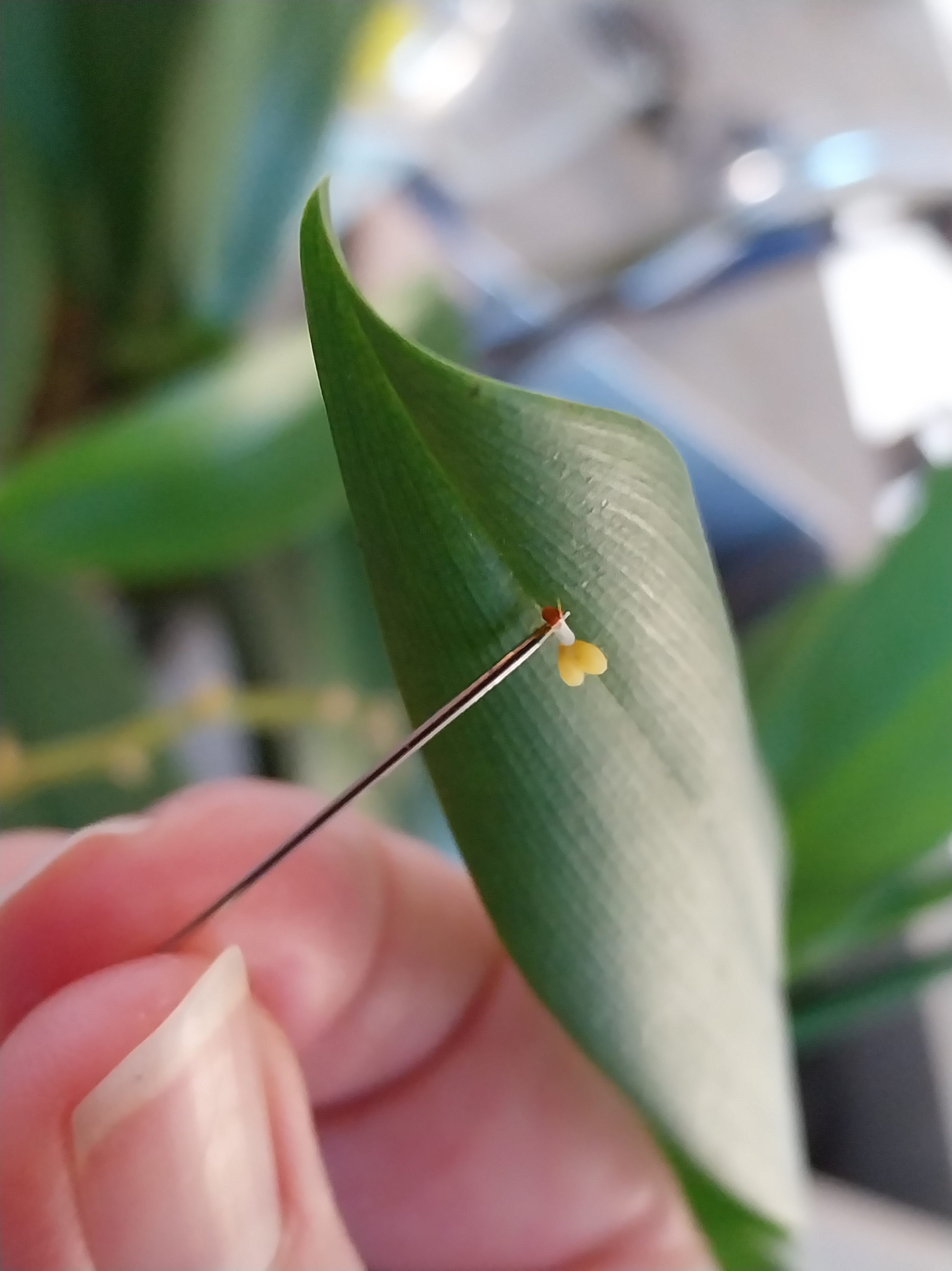
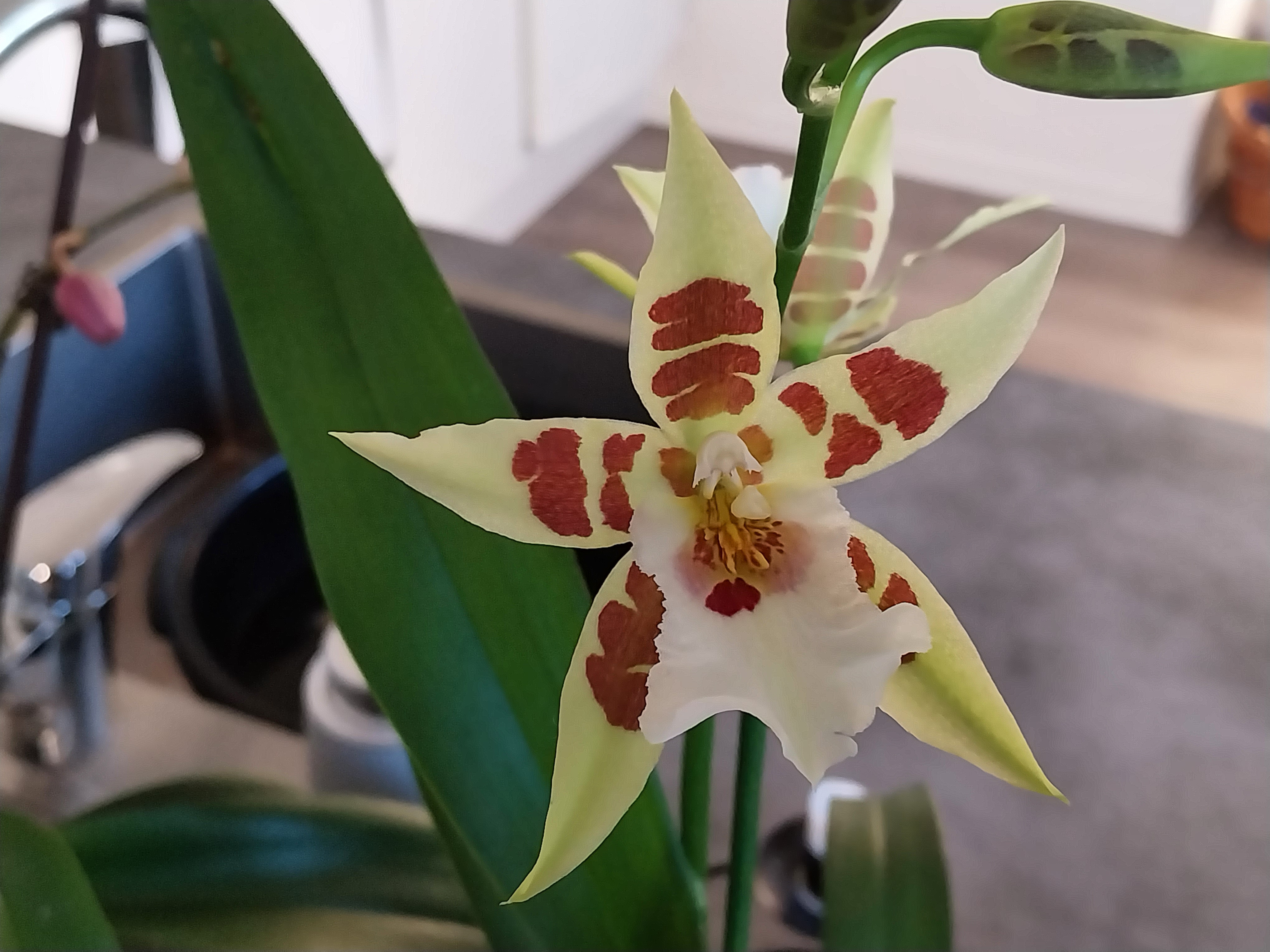
The other day Karin bought a Miltonia orchid to add to the ever-expanding collection of orchids she’s accumulating. It’s nowhere near as large as the collection she accumulated in our old place in the UK – part of it is pictured in this old post of mine – but it’s only a matter of time. This morning I showed her how to extract orchid pollen from the flower and her squeals of delight were something to hear!

As you can see in the image above, these orchids package their pollen into discrete structures that we term “pollinia” – two of them in this case, though the form and number of pollinia vary between different groups of orchids. The pollinia plus the sticky organ that attaches them to a pollinator is collectively termed a “pollinarium”. The only other plants that present their pollen in this way are my beloved asclepiads in the family Apocynaceae. The orchids and the asclepiads are only very distantly related to each other so this is a clear example of convergent evolution, where both plant groups have come up with the same solution to a problem. In this case, the problem is probably that bees collect a lot of pollen which has a reproductive cost for plants. Packaging the pollen in this way prevents bees from stealing it, amongst other advantages.

If you want to look at this yourself, you’ll find the pollinaria tucked under the front of the central “column” of the flower, which comprises the fused male and female reproductive parts. Just take a fine needle and gently stroke the underside of the column. In the image below, taken just after we extracted the pollinarium, you can see the “anther cap” which covered them lying just below the column.

It’s possible to learn a lot about botany from studying even common houseplants such as these!

Dispelling the myth that orchid species usually only have a single pollinator

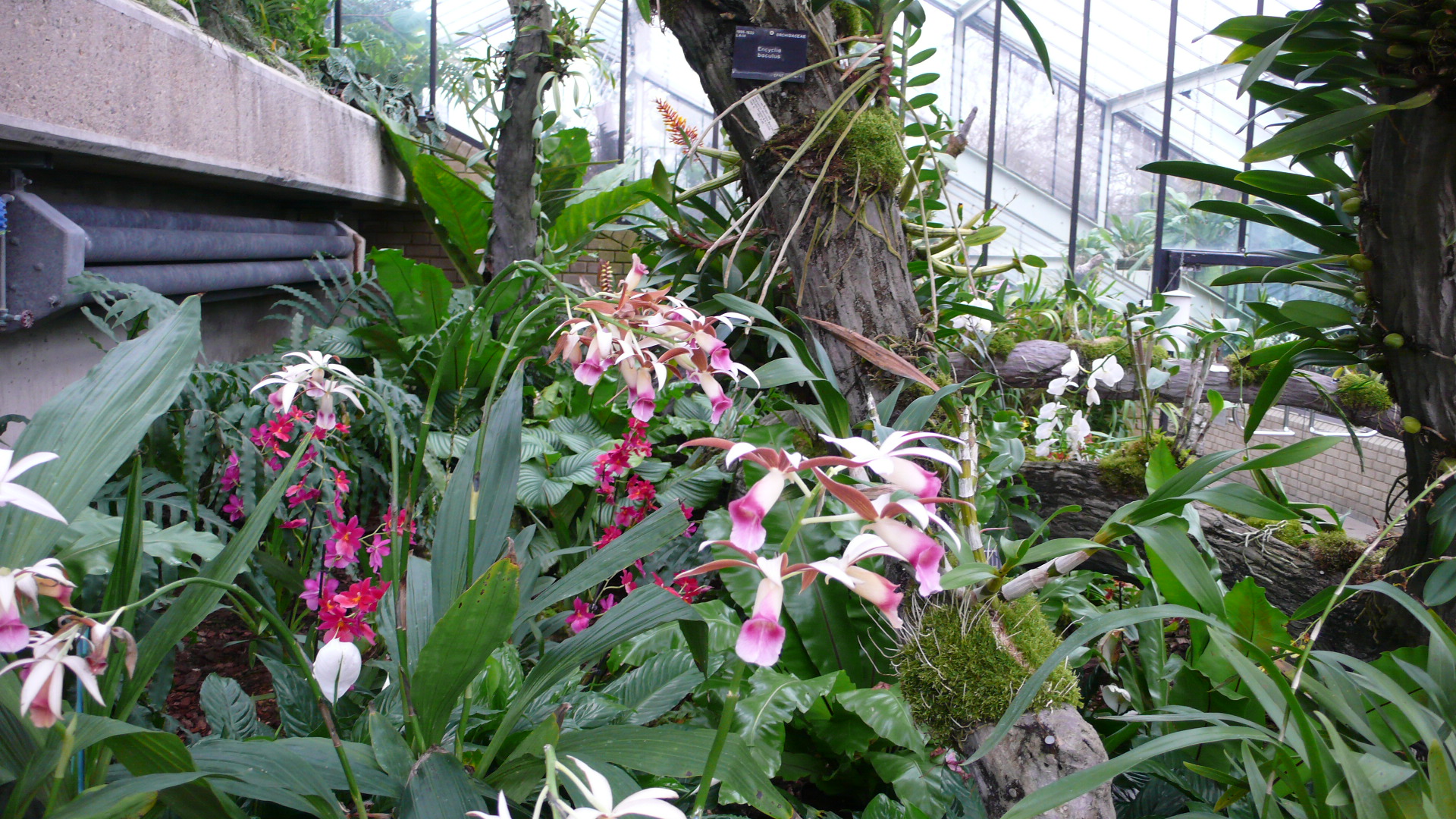
Orchids at Kew 2014-02-24 15.30.32

The idea that members of the plant family Orchidaceae (the orchids) “typically have exclusive relationships with their pollinators“, such that each orchid has only one pollinator, is a persistent one.  Recently I’ve encountered it on horticultural websites (follow that last link), in grant proposals, and on Wikipedia.

The problem is that it’s not true: it’s a myth that is perpetuated by people (often botanists or horticulturalists) who may know a lot about orchids but don’t know as much as they think they know about pollination ecology.

Orchids certainly have some fascinating and often quite intricate floral mechanisms to ensure pollination, but these have not necessarily evolved to attract and exploit just one species of pollinator.  Even in the case of sexually deceptive orchids that fool their (male) pollinating insects into believing that they are mating with a female of the same species, it is sometimes the case that more than one insect species is involved.  For example, in the well studied genus Ophrysflowers are pollinated by a narrow taxonomic range of pollinators, from a single species to up to five closely related species“.  As the authors of that last paper state, this is not the same as the mythological “extreme case of one orchid/one pollinator”.

Likewise different species of orchid bees may pollinate the same orchid flowers as they visit to collect scent compounds; for example in the Brazilian species Dichaea pendula, species from at least two different bee genera act as pollinators (Nunes et al. 2016).

The fact that “one orchid/one pollinator” is a myth is not new knowledge, it’s been widely discussed in the pollination ecology literature for decades.  For example, in our 1996 paper “Generalization in Pollination Systems, and Why it Matters” we showed data from the late 19th/early 20th centuries that clearly indicated a range of specialization in European orchids (follow that link and look at  Figure 3B).  Even earlier than this, in his 1992 paper “Trends in the pollination ecology of the Orchidaceae: evolution and systematics” Raymond Tremblay showed that only about 62% of species for which he could find data had a single pollinator, and that this varied considerably between different subfamilies of Orchidaceae, with some subfamilies being more specialized than others.

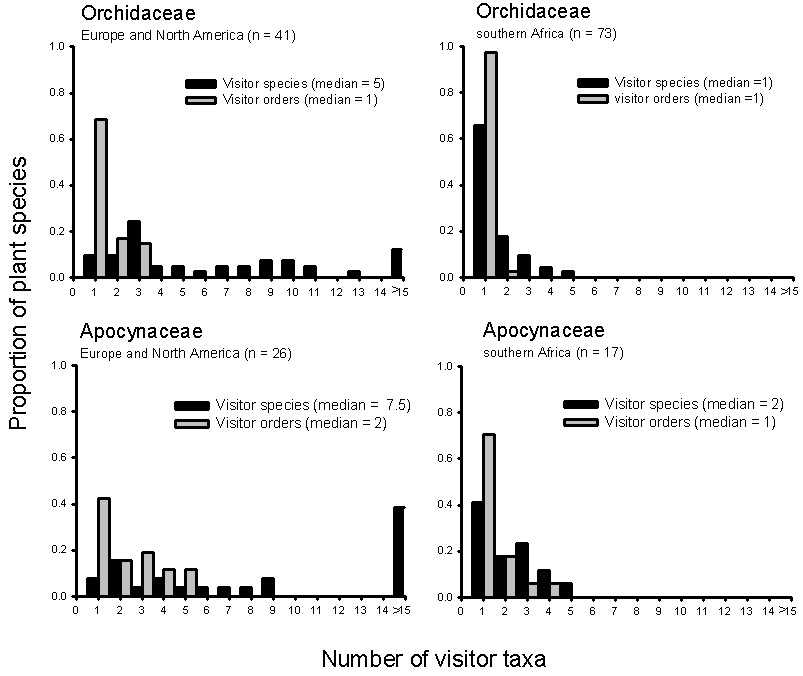
More recently, in a chapter in the 2006 book I co-edited with Nick Waser entitled “Geographical Variation in Diversity and Specificity of Pollination Systems” Steve Johnson, Andrew Hingston and myself looked at data from southern African compared to North American and European orchids; here’s the figure from that assessment:


Ollerton et al Figure 7 - JPEG

Orchids  are more specialized in southern Africa compared to Europe and North America (as are a number of other plant groups including the asclepiads, which we’re comparing them with here).  But even in southern Africa, only about 65% of the orchids studied have a single pollinator species.  It’s worth pointing out, though, that many of the species included in this analysis, and in Raymond Tremblay’s paper, have been studied only at single sites and often in single years, meaning that we have no idea if there is any spatio-temporal variation in the pollinators a particular orchid species exploits.

Why does this myth persist?  I think it’s for the same reason that myths are retold from generation to generation: they are great stories that fascinate the teller and the audience.  Indeed, orchids are very special plants with some amazing floral and vegetative adaptations, fascinating relationships with fungi, and incredible diversity.  But we don’t have to mythologise their relationships with their pollinators to try to make orchids more special than they already are.

Something for the weekend #8 – the microclimatic value of planting our cities, one Buddhist view of environmentalism, and orchids. Oh, and we got married.

The latest in a regular series of posts to biodiversity-related* items that have caught my attention recently:

  • One of the best environmental writers around at the moment, Paul Kingsnorth, had an interesting essay on how Buddhism is helping him to come to terms with the current environmental crisis.  It was published earlier this year but I’ve only just seen it.  Paul is one of the founders of the Dark Mountain project, which I’ve mentioned before.
  • Here’s a piece about a fascinating study of how different types of vegetation can alter the average temperatures of our cities.
  • Finally, regular readers of this blog know that I often mix some personal stories with my professional reflections, so the Big News of Summer 2015 is that, on the 15th of August, Karin and I were married at The Guildhall, Northampton, accompanied by our family and friends.  We had an incredibly happy day, and I wore a very biodiverse shirt, as you can see:

Karin&Jeff (73 of 477)

Feel free to recommend links that have caught your eye.

*Disclaimer: may sometimes contain non-biodiversity-related items.