Tag Archives: Nature

Ash on the beach, fire in the bush: Australia reflections part 1

2019-12-13 12.17.43

Although we’ve only been in Australia for less that two weeks, it feels as if we’ve been here forever; once we got over the jetlag and the weird sleeping patterns, Karin and I have easily settled into the life of a Southern Hemisphere summer.  It’s hard to believe that back home in the UK it’s cold, wet and (politically) miserable….

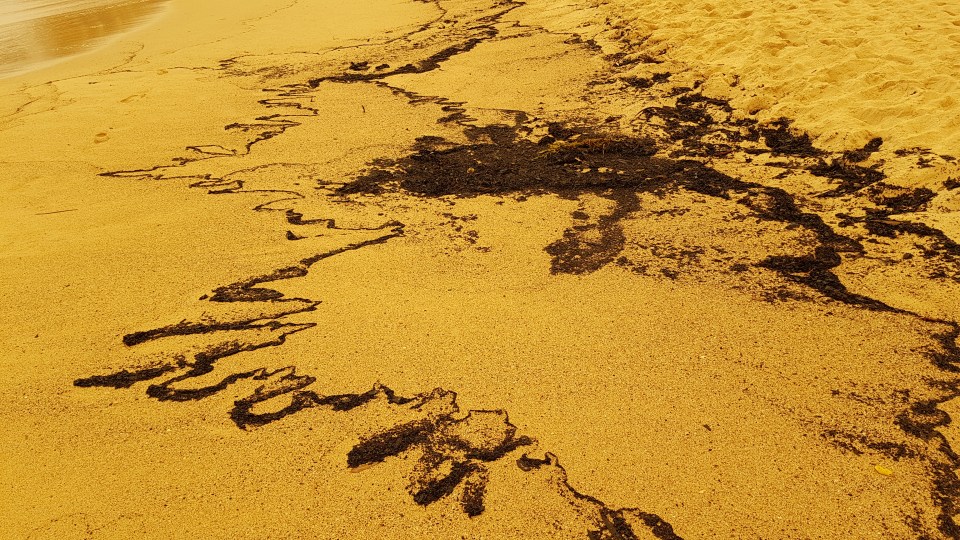
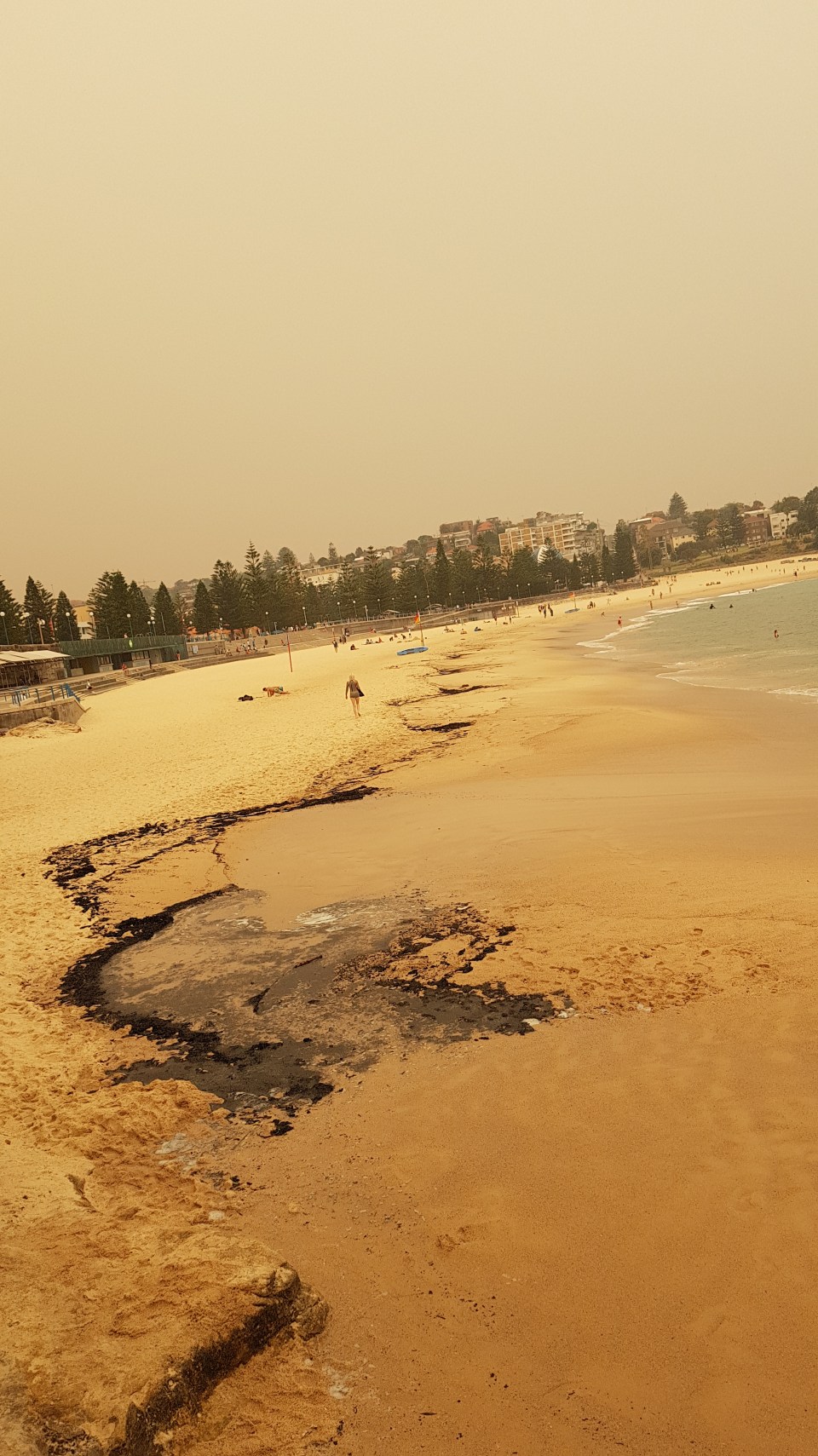
We’re based at Coogee Beach in the eastern suburbs of sprawling Sydney, just a short walk from the University of New South Wales (UNSW) where I’ve spent most of my time, and an even shorter walk from sand and surf.  It sounds idyllic but one of the recurring features of the past week has been the amount of ash and charred leaves washing up on the beaches from the bush fires that surround Sydney at the moment:
2019-12-06 17.53.21

2019-12-06 18.18.34

The region is in the midst of an extended drought and this has worsened the fire season.  The Australian Government seems intent on denying that it’s anything to do with climate change, though recently one of the state ministers has broken ranks.  That’s going to be little consolation this year but may mark the start of some changes in policies.  Let’s see.

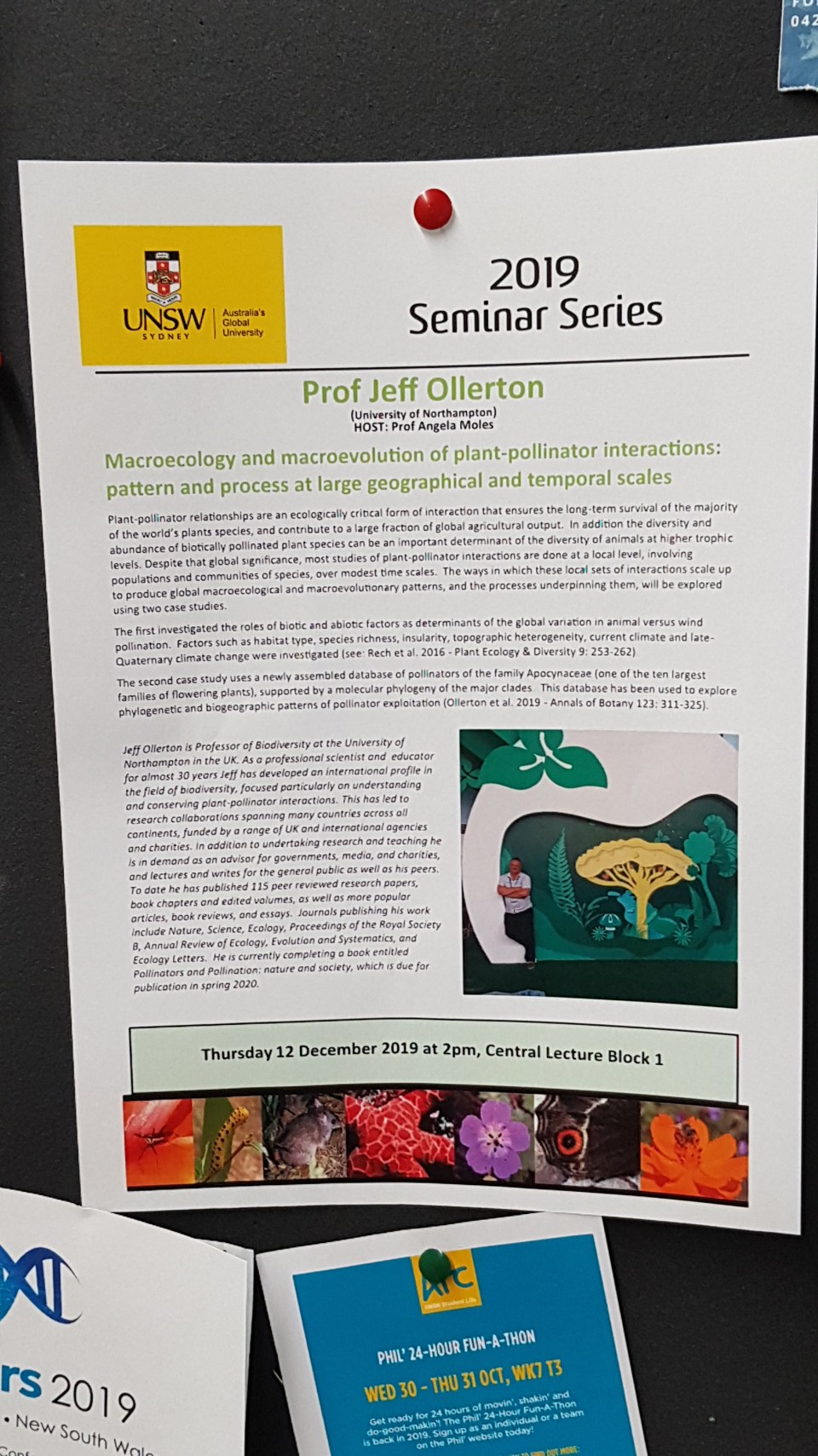
During our time here Karin and I have facilitated a workshop on “Writing for a non-academic audience” which was attended by 17 UNSW postgraduate researchers.  I’ve presented a lecture on “Macroecology and macroevolution of plant-pollinator interactions: pattern and process at large geographical and temporal scales”…..
2019-12-05 10.37.41

….and spent a lot of time chatting with staff and postgrads at UNSW.  In addition, Angela Moles, Stephen Bonser and I have made initial progress with a short paper that I’m hoping will be ready to submit before we head back to the UK in early February.

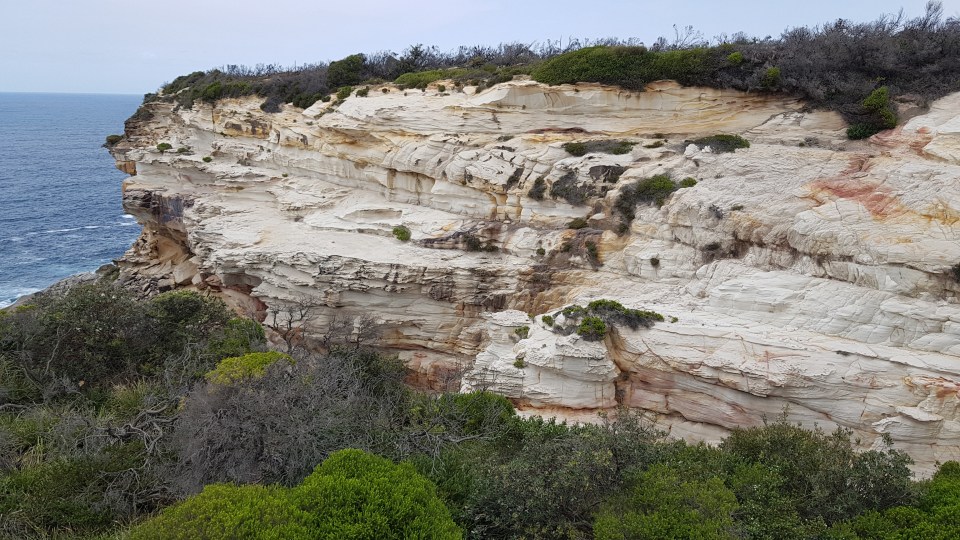
Time to actually get out and see some of the habitats and biodiversity of this part of Australia has been limited.  But we’ve done a couple of hikes north and south of Coogee Beach, along cliff-top trails and boardwalks through remnant coastal heathland habitat, enjoying the novelty of watching rainbow lorikeets visiting the inflorescences of native Banksia trees:
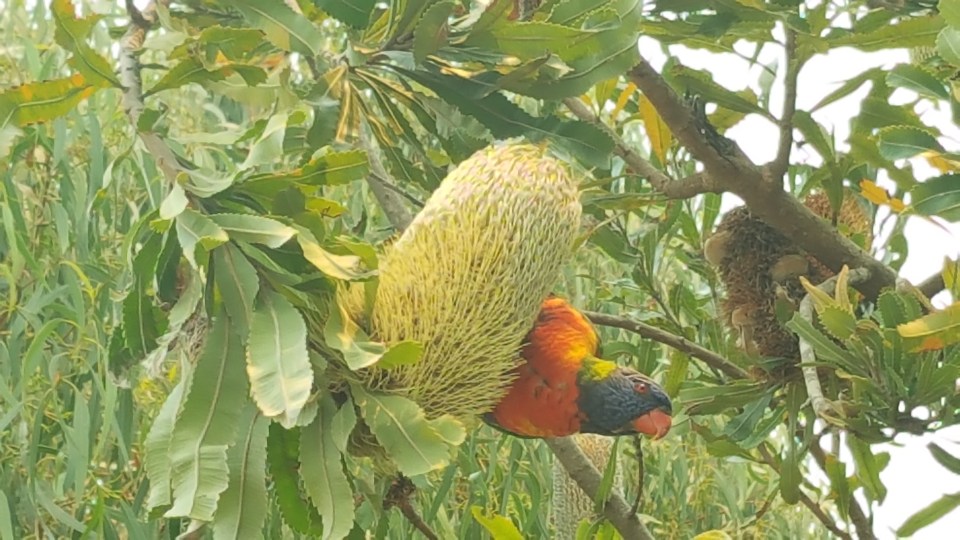
2019-12-04 12.56.12

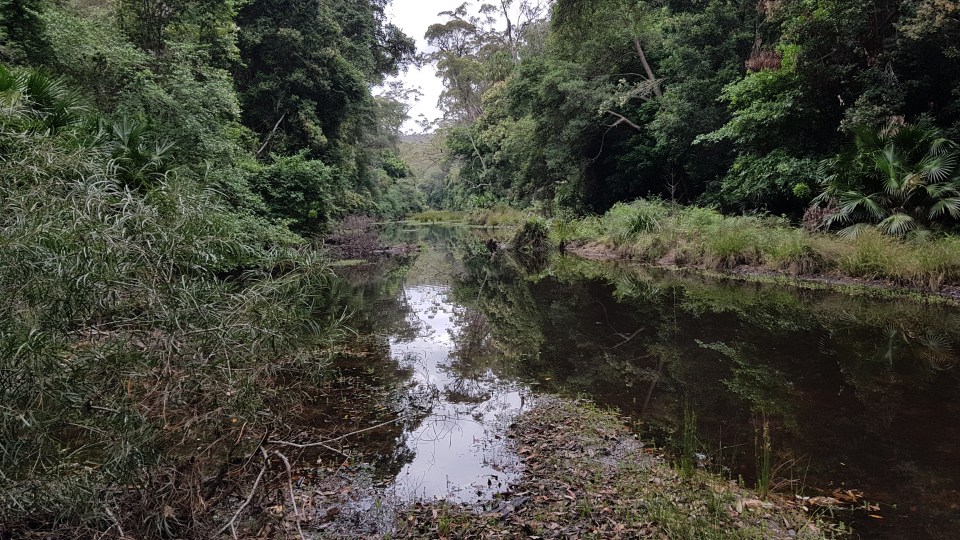
Yesterday we went further afield with a bird watching trip down to the Royal National Park (RNP) with Kew/NRI scientist Phil Stevenson (who is in the country for a couple of weeks on a flying visiting to speak at a conference and meet with colleagues); and Graham Pyke from Macquarie University, whose work on foraging behaviour of pollinators I’ve known for many years, but whom I’d never met.  Leading our trip was Steve Anyon-Smith, a professional bird guide who literally wrote the book on birding in the RNP.  Steve was great, highly knowledgeable, and a mine of information about the Australian environment.  As well as seeing about 67 bird species we encountered a host of other wildlife, and I collected data on wind and animal pollination for another set of species.  Here’s some images from that day:
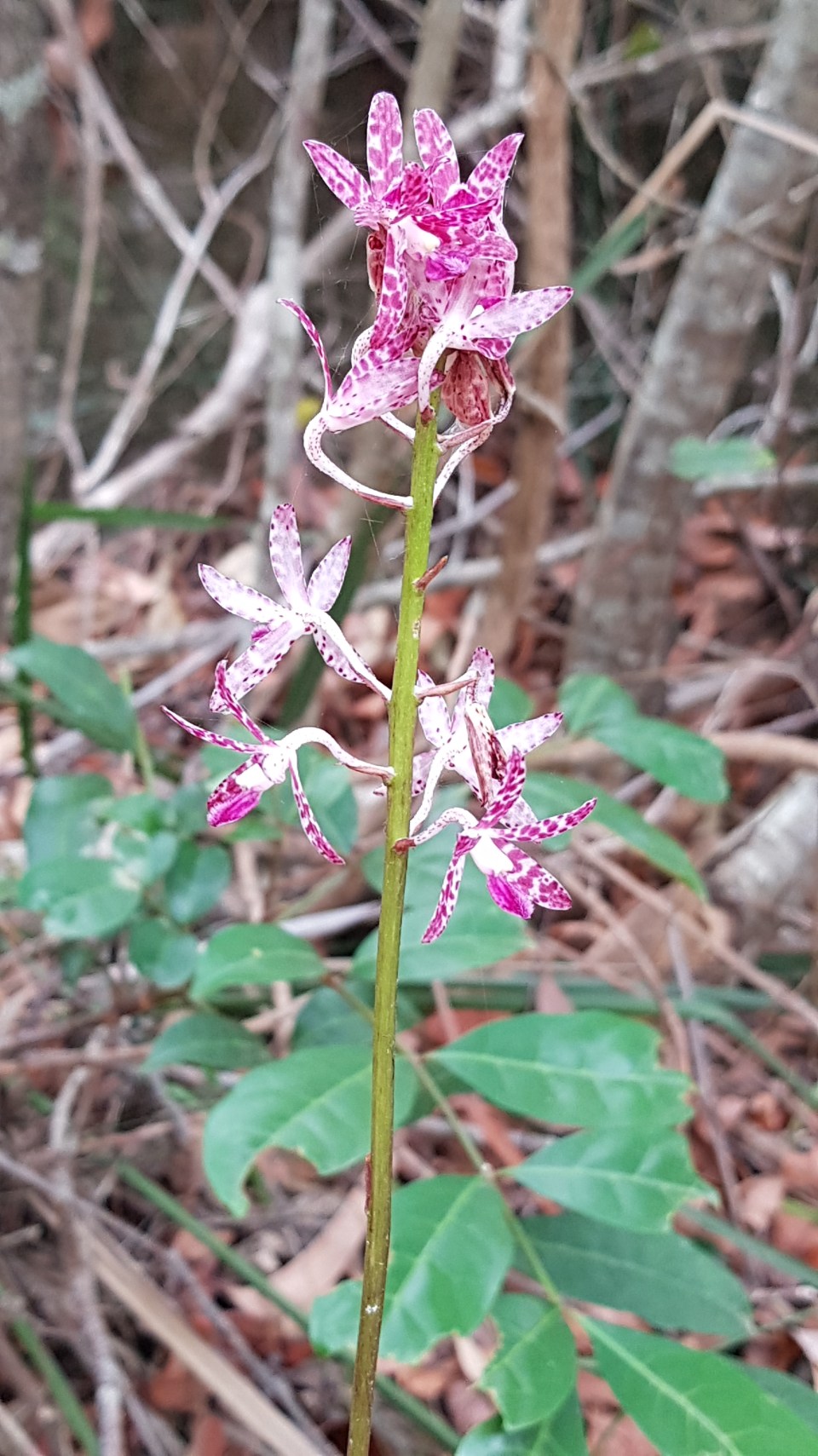
2019-12-13 10.41.43

An orchid – Dipodium punctatum.

2019-12-13 11.24.25

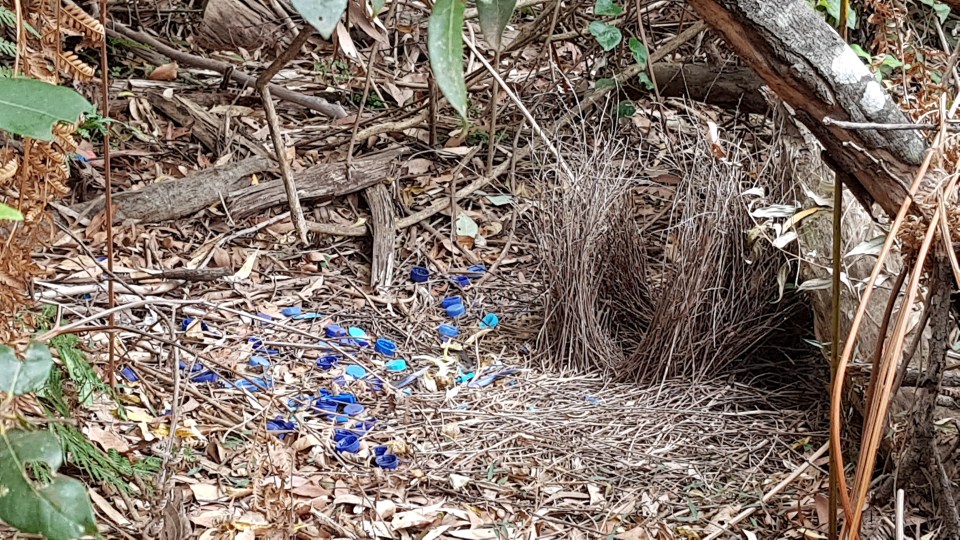
The bower of a male satin bower bird.
2019-12-13 09.17.10

2019-12-13 11.32.03

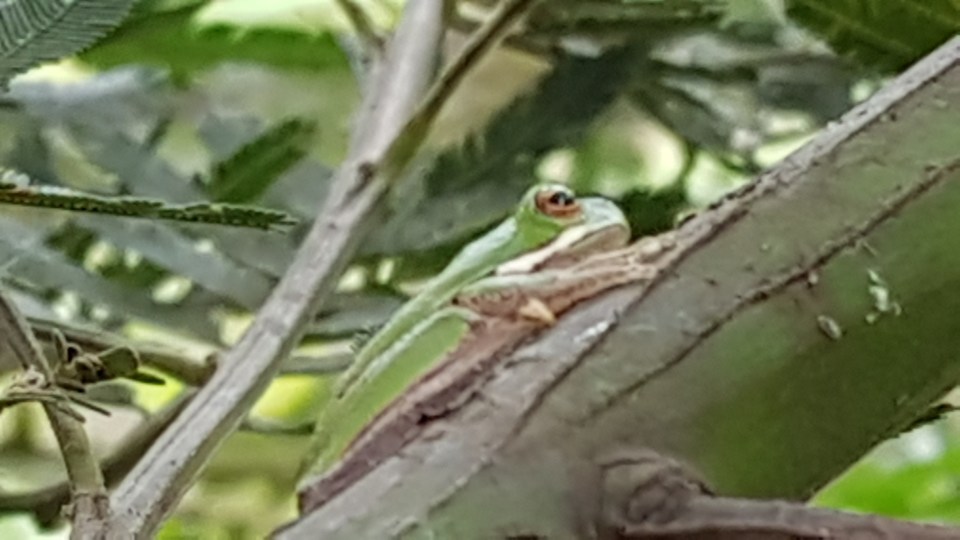
Not a great shot – it’s an Eastern dwarf tree frog.
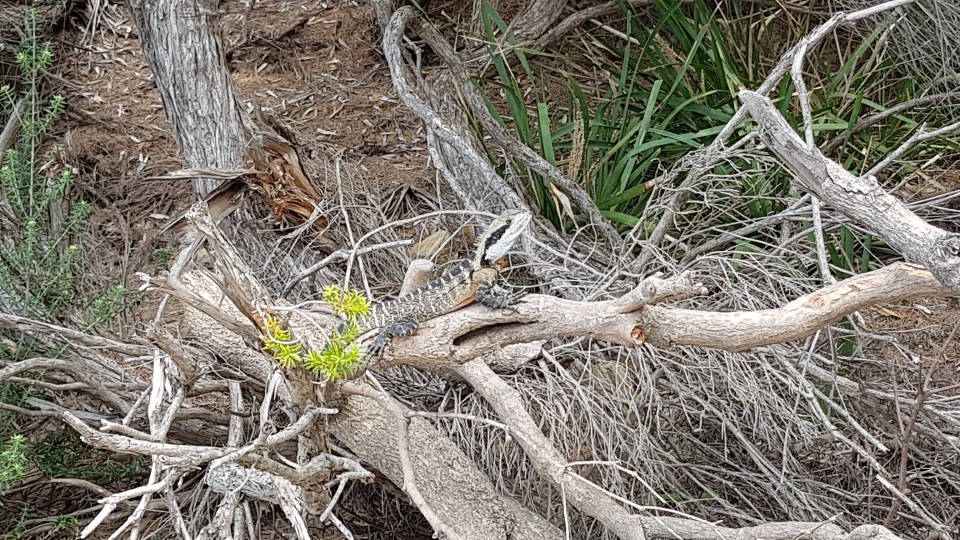
2019-12-13 13.14.41 This is better – a very confiding Eastern water dragon along a well-used coastal trail.

Along that trail we also saw two forms of Banksia serrata – an upright one and a prostrate form – growing quite close together:
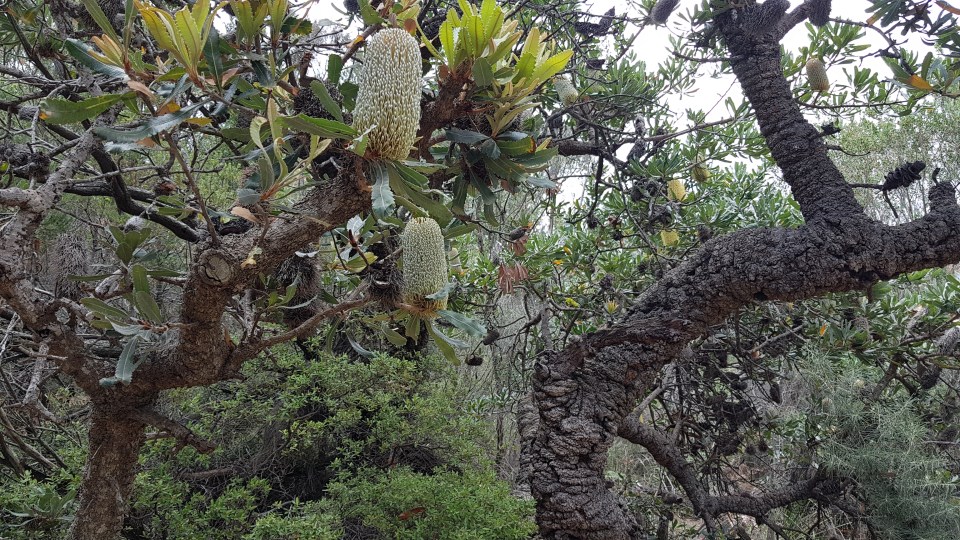
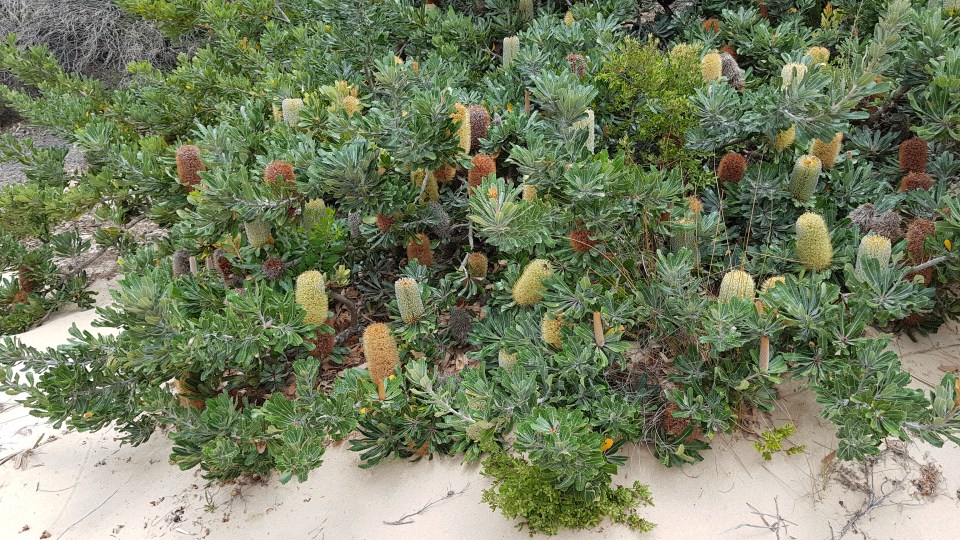
2019-12-13 13.17.162019-12-13 12.23.18

I’ve seen a lot of birds visiting the inflorescences of this species but it’s suggested that mammals might be the main pollinators – the flowers have a very thick, yeasty smell.  Perhaps it’s both?
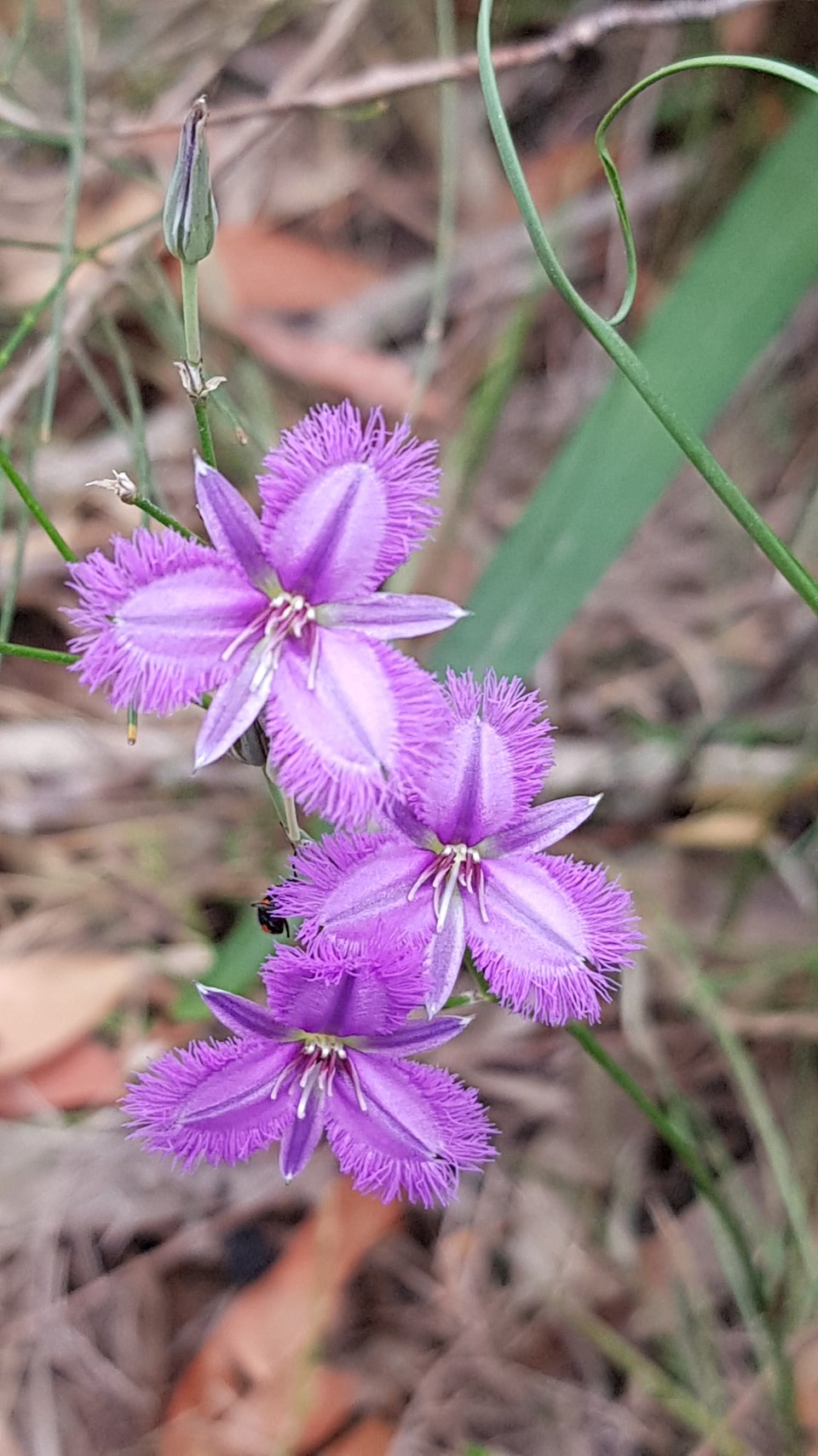
2019-12-13 11.02.52

An Australian fringe-lily.

2019-12-13 12.10.16

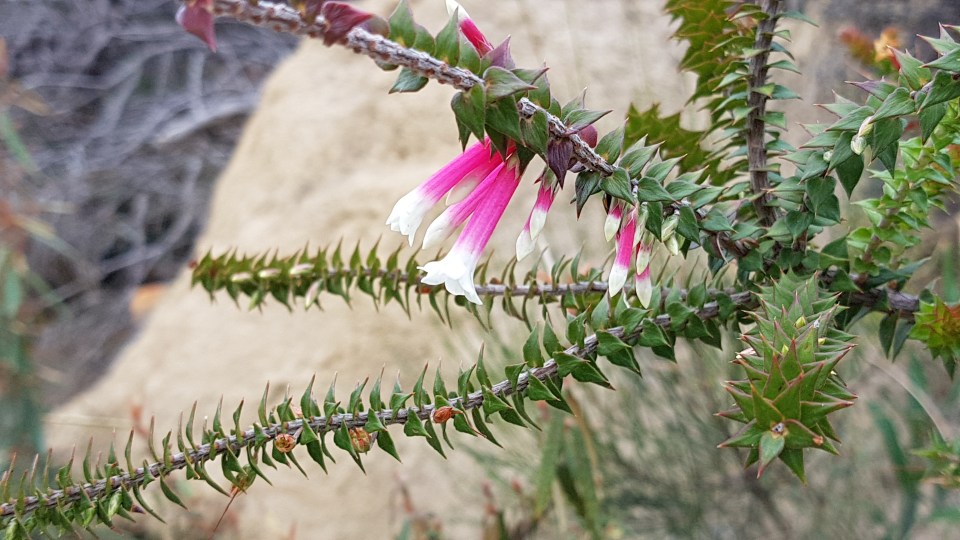
This is Epacris longiflora – thanks to Ryan O’Donnell for the identification.
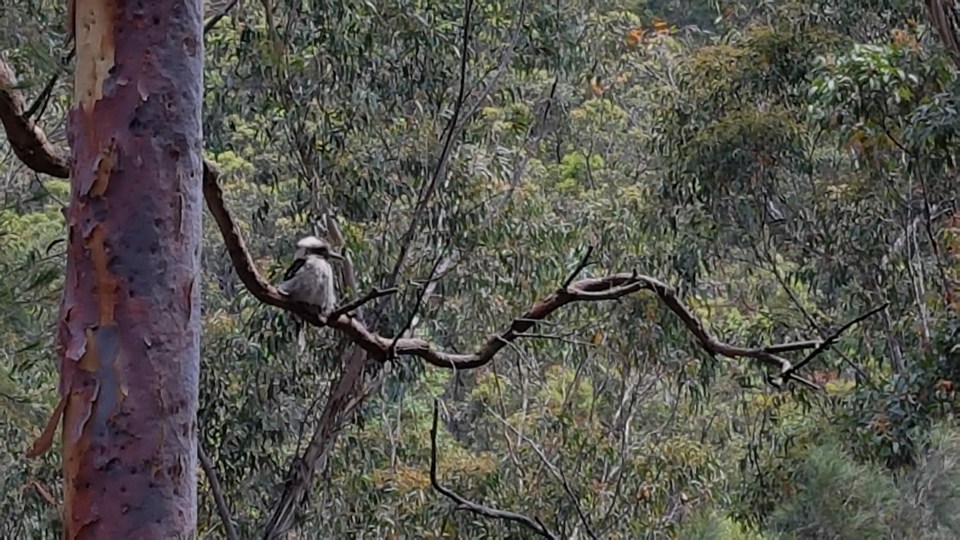
2019-12-13 14.58.35

And of course we saw a lot of the iconic laughing kookaburras.

Steve was really concerned that much of the forest and wildlife in the NPR may be destroyed over the summer.  None of it has yet burned and, with temperatures due to rise enormously by next week, much of this habitat could be lost to fire by summer’s end.  I sincerely hope not, it’s too precious and beautiful to lose.  Vegetation in relatively light burns can reestablish itself given time, as we encountered in one of the Coogee remnants that burned a few years ago:
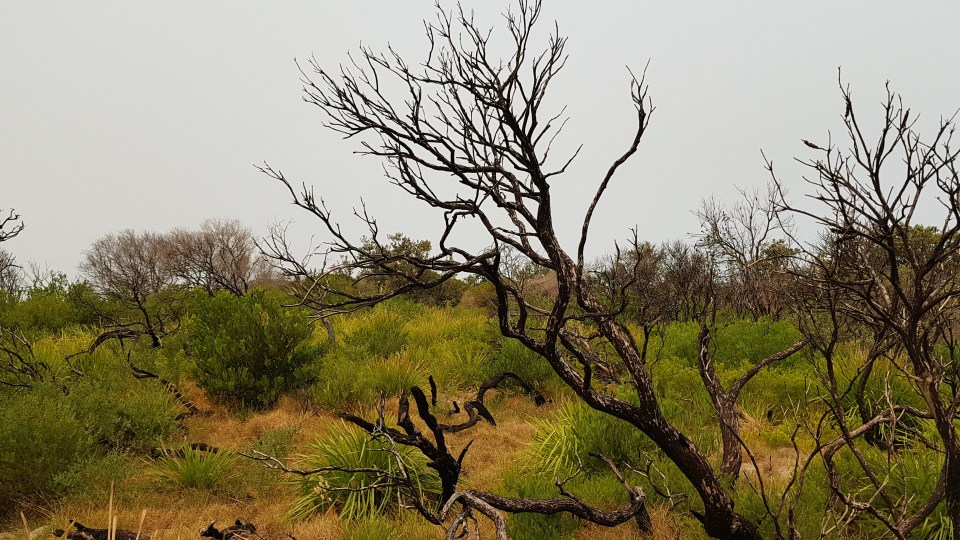
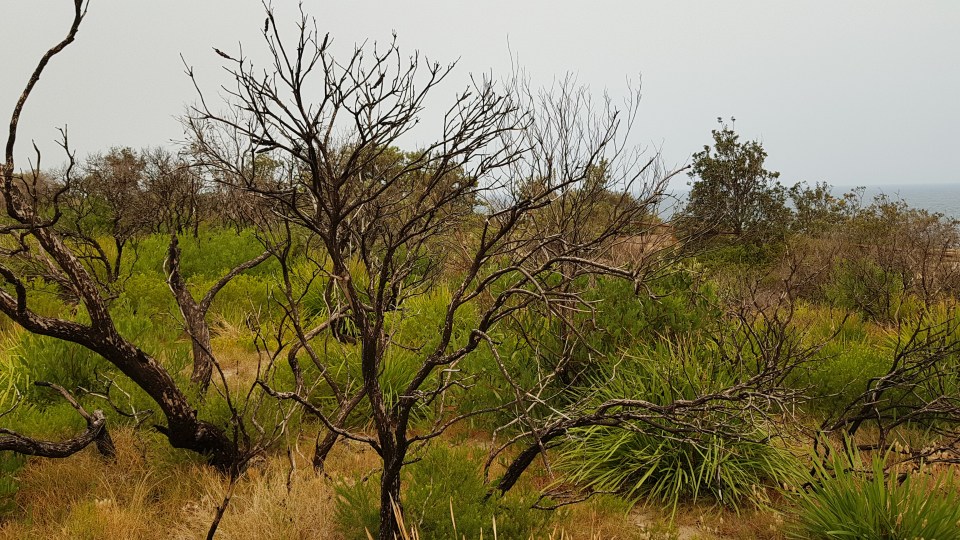
2019-12-07 15.12.472019-12-07 15.12.51 (1)

But the bigger, hotter, more intense fires that are currently sweeping the state are something else entirely, and are alien to these forests.  Aboriginal Australians carefully managed their environment using regular, small burns, a practice that has been lost in most areas.

Fire in Australia is a theme that I keep coming back to.  A few weeks ago, during one of my second-year undergraduate grassland ecology lectures, I was  discussing fire as a threat and a management tool in grasslands.  I mentioned the situation in Australia with respect to Aboriginal use of fire and I asked my students what the purpose of their burning the grasslands was.  Someone suggested that it might relate to their agriculture.  My response then was “no” because Australian Aborigines were nomadic hunter-gatherers who never developed agriculture, which is what the received wisdom has been for decades.  The answer I’d give now is: “yes, quite probably”.  As so often is the case in science, the received wisdom was wrong.

My colleague at the University of New South Wales, Angela Moles, has loaned me a book called Dark Emu which draws on early European settler accounts, Aboriginal oral tradition, and recent archaeological discoveries to turn our understanding of the ecology of pre-European Australia on its head.  In particular, it seems as though the (then) very large Aboriginal population was much more settled and had developed a sophisticated form of agriculture that included the creation and exploitation of huge areas of native grasses for their grains.  This was all destroyed by colonial European agriculture within a short time period, before it was fully understood.  One of the arguments in Dark Emu is that these native grasses are much more suitable to the Australian climate than wheat and may allow more sustainable agriculture in the future.

If you want to know more, here’s a link to a recent review and interview with the author, Bruce Pascoe:

https://www.theguardian.com/books/2019/may/24/dark-emus-infinite-potential-our-kids-have-grown-up-in-a-fog-about-the-history-of-the-land

Strange as it might sound for a professor to say, I was happy to be wrong on this (or indeed any) occasion: scientific understanding only progresses by people being wrong and incorrect ideas being superseded by new knowledge.  I made a point of sending my students an email telling them about what I’d discovered.  It may well form a question on the test they have to take next term…..

Bound for the Great Southern Land

cropped-tenerife-2008-080

Great Southern Land, in the sleeping sun
You walk alone with the ghost of time
They burned you black, black against the ground
And they make it work with rocks and sand

Great Southern Land by Icehouse

Today Karin and I are packing before heading to the airport for a flight tomorrow to Australia.  It will be Karin’s first trip to the Great Southern Land, and my second: I spent part of 1993 and 1994 there on a short postdoctoral research project.

We’ll be there for about two months. Karin will be writing (she’s working on a book and will be contributing further articles to Medium and other outlets).  I’ll be working with Angela Moles and Stephen Bonser at the University of New South Wales (UNSW) on an Australian Research Council-funded project looking at whether species interactions affect the invasibility of plants native to Europe that are running wild in Australia. So it’s test of the “enemy release hypothesis” (leaving behind the herbivores and parasites) but with the addition of a “making new friends” hypothesis, i.e. gaining pollinators and other mutualists. That grant, plus a Visiting Fellowship to UNSW, is funding the trip.

In a post back in May I mentioned the Australian PhD researcher, Zoe Xirocostas, who is also working on this project.  Zoe surveyed plant populations in the UK, Spain, France, Austria and Estonia over the summer. She is now back and in the middle of surveying in NSW, Victoria and Tasmania.

As well as that project I want to spend time finalising my forthcoming book, collecting some data on Apocynaceae pollination ecology (of course!) and do some community-level surveys of wind/animal pollination to add to a global data set I am compiling.  Karin and I are also running a workshop at UNSW on “Writing for non-academic audiences” and I’m also giving a research seminar there and at Western Sydney University.  In addition we are visiting friends and family over Christmas and the New Year.  We’re packing a lot into a trip of two months!  And of course work at the University of Northampton never goes away – I have project students and PhD researchers to advise and there’ll be the usual weekly blizzard of emails to clear…

Having not been back to Australia since 1994 it will be interesting to see how it’s changed – a lot drier and smokier I imagine…  I’ll be updating the blog as the work progresses; over and out until we land in Sydney.

Two bee species new to science named in honour of pollination ecologists

New Eucera species

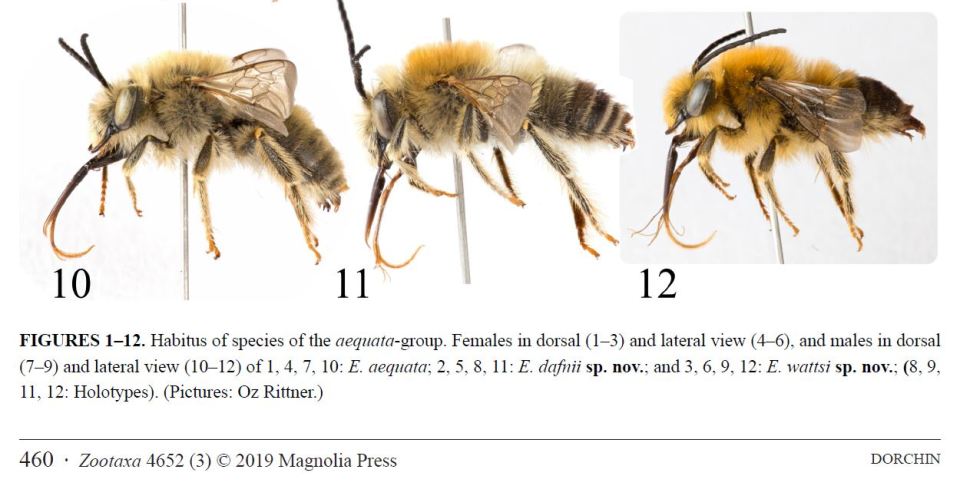
Last week the Israeli bee taxonomist Achik Dorchin published a new paper entitled “Taxonomic revision of the aequata-group of the subgenus Eucera s. str (Hymenoptera, Apidae, Eucerini)” .  The paper focuses on a little-known group of “longhorn” bees from the Eastern Mediterranean region, a part of the world with an extraordinarily high bee diversity.  In this taxonomic account, Achik has named two bees new to science in honour of two pollination biologists:

Eucera dafnii is named by Achik for Prof. Amots Dafni, whom he describes as his “teacher and friend…a pioneer pollination ecologist of the Mediterranean region, who has led the research project during which much of the type series was discovered”.  Amots is almost legendary in the field, he’s been conducting research on the flora, fauna, and pollination ecology of the region since the late 1960s, and remains a productive and influential scientist.

Eucera wattsi is named in honour of Dr Stella Watts, “a talented pollination ecologist, who collected much of the type series and contributed important floral observation and palynological data for this study”.  Stella completed her PhD at the University of Northampton in 2008, with a thesis on “Plant-flower visitor interactions in the Sacred Valley of Peru”, and then went on to do a post doc with Amots in Israel.

It’s fitting that these bees are named in their honour: congratulations Amots and Stella!

What exactly is a “pollination system”?

Pollination systems

This is a post I’ve been meaning to write for some time, but have never got round to.  What’s catalysed me is an email this morning from Casper van der Kooi asking me about how I define the term “pollination system”, as he’d had some discussions about its use with his colleagues in The Netherlands.

“Pollination system” is one of those terms that seems to mean different things to different people. The way I use it, and I think the way we meant it in the 1996 paper Generalization in pollination systems and why it matters, is that the pollination system = floral phenotype + pollinators.  That is to say, the colour, shape, size, odour, rewards, etc. produced by a flower (or an inflorescence functioning as a single reproductive unit) plus the animals that effectively transfer pollen.

To me this is distinct from a “pollination syndrome” which refers only to the floral phenotype, or “pollinator guild/functional group” which refers only to the flower visitors.  However I have seen “pollination syndrome” used to include floral phenotype + pollinators.  But to my mind they are distinct things.

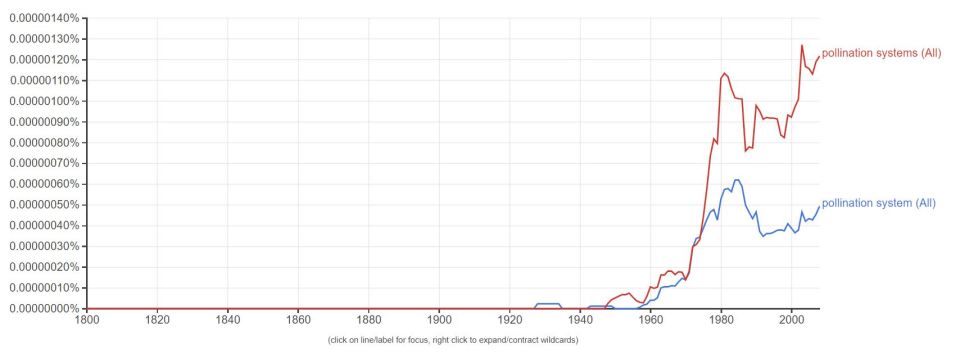
I have also seen other authors use “pollination system” to mean the community of plants and pollinators in an area, or as analogous to the breeding system, but neither of those are the way that I use it.  I decided to look at the history of the term on Web of Science and the earliest use on there is a paper by Levin & Berube (1972): Phlox and Colias – efficiency of a pollination system.  There were a few other papers from the same decade and all were using pollination system in the way I described above, i.e. floral phenotype + pollinators.

To look for earlier usage of pollination system I searched the Google Ngram Viewer; as you can see in the image above, I found examples of the term back as far as the 1940s in which the pollination system of grasses is referred to as being “cross pollination” (i.e. what we would now refer to as the breeding system).  There’s also texts from the 1950s referring to artificial wind pollination of date palms as a “helicopter pollination system”.

Does it matter how “pollination system” is used, or that it varies in meaning according to the author?  Probably not as long as the meaning is defined in the text.  Ecology is replete with terminology that has slightly different usage according to the researcher (“biodiversity” being an obvious example) and I don’t get a sense that this has held back the field.  Or is that too optimistic a conclusion?  Do you use the term in a different way to me?  As always, your comments are welcomed.

Auto-bee-ography – a new genre of writing?

20190904_134703

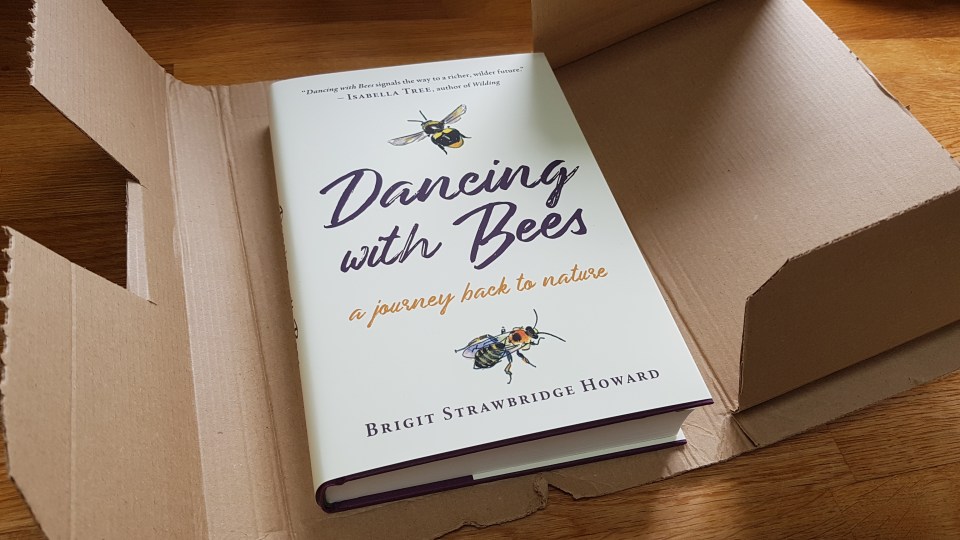
In the post today I was pleased to find a copy of Brigit Strawbridge Howard’s first book Dancing With Bees that she had kindly signed and sent after I reviewed some of the text.  It was great timing – I’ve just finished Mark Cocker’s Our Place, a really important historical and future road map of how Britain got to its present position of denuded and declining biodiversity, and what we can do to halt and reverse it. Highly recommended for anyone interested in environmental politics and action.  So Brigit’s book will be added to the pile on my bedside table and may be next in line, though I still haven’t finished Dave Goulson’s The Garden Jungle – perhaps I will do that before I start Dancing With Bees?

And thereby lies a problem – there’s just too many interesting books to read at the moment if you are interested in the environment, or indeed even just in pollinators.  Because a new genre of writing seems to be emerging that I call “auto-bee-ography”. A number of writers are using bees to frame their memoirs and anecdotes.  Dave’s trilogy of Buzz in the Meadow, Sting in the Tale, and Bee Quest is probably the best known. Then there’s Buzz by Thor Hanson; Following the Wild Bees by Thomas Seeley; Bees-at-Law byNoël Sweeney; Keeping the Bees by Laurence Packer; Bee Time by Mark Winston; Bees Make the Best Pets by Jack Mingo; Buzz: Urban Beekeeping and the Power of the Bee
by Lisa Jean Moore and Mary Kosut; The Secrets of Bees by Michael Weiler; and The Bumblebee Flies Anyway by Kate Bradbury.

All of these books fall more-or-less into the category of auto-bee-ography, and I’m sure there are others that I’ve missed (feel free to add to the list in the comments below).  They follow a strong tradition in natural history and environmental writing of using encounters with particular groups of organisms, for example birds and plants, as a way of exploring wider themes  Which is great, the more high profile we can make all of these organisms, including pollinators, the better in my opinion*.

However there’s not enough written about the other pollinators, that does seem to be a gap in the literature.  Mike Shanahan’s Ladders to Heaven has a lot about his encounters with figs and their pollinating wasps, but that’s about it, unless I’ve missed some?  Perhaps in the future I’ll write something auto-fly-ographical called No Flies on Me.  But before that, look out for Pollinators and Pollination: nature and society which I’m currently completing for Pelagic Publishing.  It should be out in Spring 2020.


*Though not in everyone’s – I had a very interesting discussion on Twitter with some other ecologists recently about whether pollinators had too high a profile compared to organisms that perform other functional roles in ecosystems such as seed dispersers.  You can follow the thread from here: https://twitter.com/JMBecologist/status/1165565465705496576


“Weighted” nestedness and “classical” nestedness analyses do not measure the same thing in species interaction networks

This post resulted from a question I posed on Twitter last week and hopefully summarises the issue as I see it and the results of the discussion with colleagues that followed.  Let me know if you disagree or if I have missed anything.


The use of network approaches to understanding how plants and their flower visitors interact has revolutionised the study of these and other mutualistic assemblages of species.  It’s a subject I’ve discussed on the blog before, highlighting some of the work we have published – for instance, see Plant-pollinator networks in the tropics: a new review just published and Local and regional specialization in plant–pollinator networks: a new study just published as two recent examples.

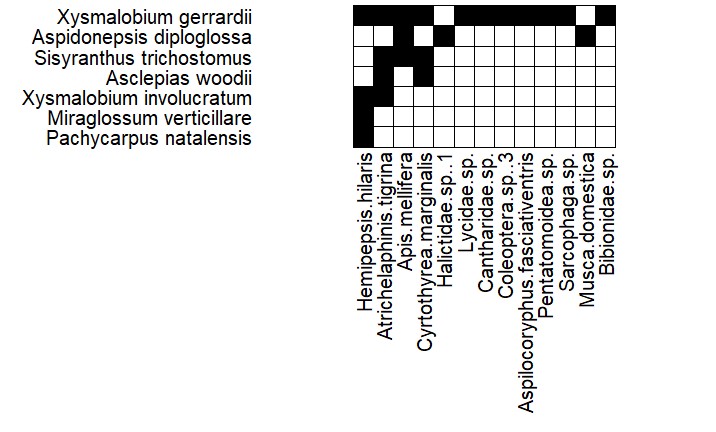
One of the recurring patterns that we see in mutualistic species networks (but not in antagonistic ones such as host-parasite and predator prey) is “nestedness”.  In a nested assemblage of species, generalists with lots of links to other species interact with other generalists and with specialists (those species which have few links to other species)Conversely, specialists tend only to link to generalists: specialist-specialist interactions are rare.  In nature, when we rank species in a network from most to least generalised, this sort of relationship looks like this:

South Africa nested

The rows are plants and the columns are pollinators, in this case from an assemblage of asclepiads and their pollinators we studied in South Africa.  A filled cell in the matrix indicates an interaction between that particular plant-pollinator combination.  It’s not perfectly nested by any means, but statistically this is not a random pattern and it comes out as nested when analysed.  There are a few ways of doing this but the most commonly used is the Nestedness metric based on Overlap and Decreasing Fill (NODF) developed by Almeida-Neto et al. (2008).

I first saw nestedness discussed in relation to plant-pollinator interactions in a presentation by Yoko Dupont of her PhD research at a SCAPE meeting in Sweden in 2001.  It was one of those “A-HA!” moments in science when the light bulb switches on and you realise that you are seeing an important new development which adds significant understanding to a field.  Yoko subsequently published her work as Structure of a plant–flower‐visitor network in the high‐altitude sub‐alpine desert of Tenerife, Canary Islands.

The nested pattern of interactions is conceptually derived from earlier work on island biogeography and species-area relationships and was initially developed to apply to interaction networks by Jordi Bascompte and colleagues in Spain and Denmark – see: The nested assembly of plant-animal mutualistic networks.

What was so exciting about this idea to me was that it provided a way to formally analyse what many of us had been observing and discussing for some time: that mutually specialised plant-pollinator interactions between species are rather rare, and that specialists tend to exploit generalists.  This makes perfect sense because specialist-specialist interactions may be more likely to go extinct, though why it does not also apply to host-parasite interactions is far from clear (and in fact the best known specialist-specialist interactions tend to derive from seed parasitism interactions such as fig-fig wasp and yucca-yucca moth relationships).

Fast forward 20 years and the plant-pollinator networks literature has exploded and our methods of analysis are much more sophisticated than they were in the late 1990s and early 2000s.  Every few months researchers are coming up with new ways in which to analyse these networks, mainly using the R environment for statistics and graphing.  Anyone entering the field would be forgiven for being bewildered as to which approaches to use: it’s bewildering enough for those of us who have been following it from the start!

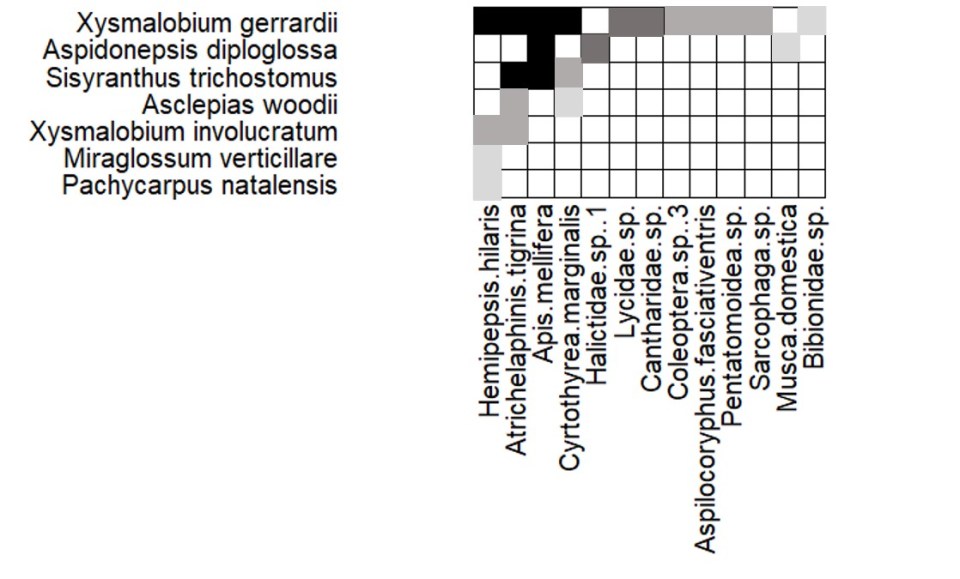
One thing has been particularly bewildering me for a few years now, and that’s the introduction of “weighted” nestedness.  “Weighted” in this sense means that the abundance or interaction frequencies of the species in the network is taken into account in the analyses.  Visually it could look something like this if we code the cells in the network above to represent abundance or frequency (the darker the cell, the more abundant or frequent):

South Africa nested weighted

I’ve just mocked up the network above, it’s not the actual data.  But quite often networks look like this when we weight them: generalist interactions and/or species tend to be more frequent than specialist.  So far, so obvious.  But here’s the thing: networks that are statistically significantly nested when analysed by NODF tend to be not significantly nested when analysed by a new set of weighted metrics such as wNODF or WINE – see the documentation for the bipartite package for details.   And I don’t understand why.  Or rather I don’t understand why we should be using weights in an analysis of nestedness which is, at its heart, an analysis of presence-absence.  Species are either there or they are not, they are either interacting or they are not.  Their frequency or abundance is immaterial to whether a network is nested.  Indeed, assessing frequency of interactions in plant-pollinator networks is fraught with difficulties because (a) there are so many ways in which to do it; and (b) interactions between plants and pollinators in a community can vary HUGELY between years and across the geographical ranges of the species involved.

This should concern the interaction network community because recently I’ve had reviewers and co-authors saying things like: “don’t analyse for nestedness using NODF because wNODF/WINE is The Latest Thing, use that instead”.  But as far as I and the colleagues who commented on Twitter can tell, nestedness and weighted nestedness are different concepts and are not inter-changeable.  Indeed, many of us are struggling to really define exactly what weighted nestedness analyses are actually measuring.  I can define nestedness in simple terms as a verbal concept, without using the word “nested”, as you saw above.  I can’t do that with weighted nestedness, and I have yet to encounter anyone who can.

So the consensus from the Twitter discussion seems to be that:

  • for any study we should use only those analyses that are relevant to the questions we are asking rather than simply running every available analysis because there are lots to choose from.
  • weighted interaction networks that include abundance or frequency are not necessarily superior to binary presence-absence networks.  Again, it depends on the question being asked.
  • we should not treat weighted nestedness as an upgraded or superior version of classical nestedness.  If you are interested in nestedness, use a binary analysis like NODF.

My thanks to the colleagues who contributed to the Twitter discussion:  Nacho Bartomeus, Pedro Jordano, Pedro Luna, Marco Mello, Chris Moore, Timothée Poisot, and Kit Prendergast.  If you want to follow the Twitter discussion, start here:  https://twitter.com/JeffOllerton/status/1159377089319047168


Websites about bees and other pollinators that are not in English – can you add to my list?

2019-05-20 15.22.16

The book I’m currently completing is going to have a list of useful websites with information about bees and other pollinators, and pollination itself, that are not written in English.  Following a shout-out on Twitter I’ve come up with the following list – can anyone add to it?  There’s a lot of countries/languages missing.  Please respond in the comments section or send me an email:


Belgian:

https://www.wildbnb.brussels/


Brazilian:

https://www.semabelhasemalimento.com.br/home/polinizacao/

https://abelha.org.br/


Chilean:

https://www.abejasdechile.com/


Dutch:

http://sapoll.eu/nl/  

http://www.bestuivers.nl/ 

https://www.nederlandzoemt.nl/


French:

https://www.pollinis.org/ 

http://www.florabeilles.org/


French Canadian:

http://m.espacepourlavie.ca/des-pollinisateurs


German:

http://wildbienen.info

http://wildbienen.de 

http://wildbiene.com


Norwegian:

https://snl.no/honningbie

https://www.lahumlasuse.no/humlens-liv/


Portuguese:  

http://www.cienciaviva.pt/aprenderforadasaladeaula/index.asp?accao=showobj&id_obj=1532


Spanish:

http://www.abejassilvestres.es/index2.html

http://apolo.entomologica.es/

http://www.rjb.csic.es/jardinbotanico/jardin/index.php?Pag=697&len=


With thanks to everyone on Twitter who responded.

Tantalising evidence for a new type of pollination system in Madagascan Apocynaceae

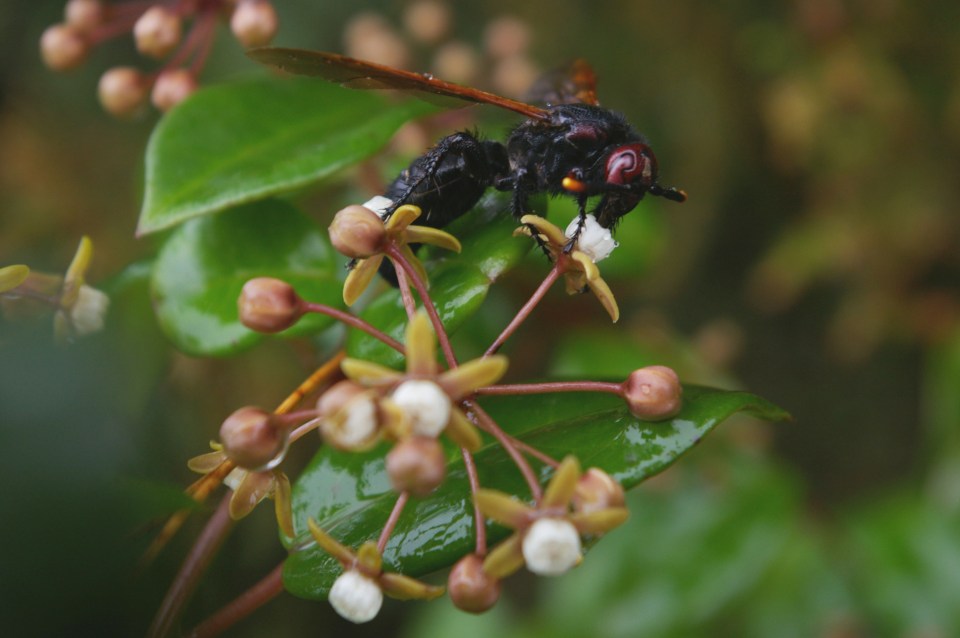
cynanchum obovatum with wasp_madag -angavokely_meve 1

As I recounted in my post last summer, the plant family Apocynaceae contains species with a very wide diversity  of pollination systems – see:  The evolution of pollination systems in one of the largest plant families: a new study just published – download it for free.  Confirmed pollinators include bees, birds, moths, butterflies, flies, beetles, and wasps of a dizzying diversity.  So I was intrigued to receive an email earlier this week from my colleague Prof. Dr Ulrich “Ulli” Meve of the University of Bayreuth with the subject line “Wasp expert needed”.  Ulli is an authority on Apocynaceae taxonomy, also has an interest in their pollination biology, and is a co-author of the study last year.

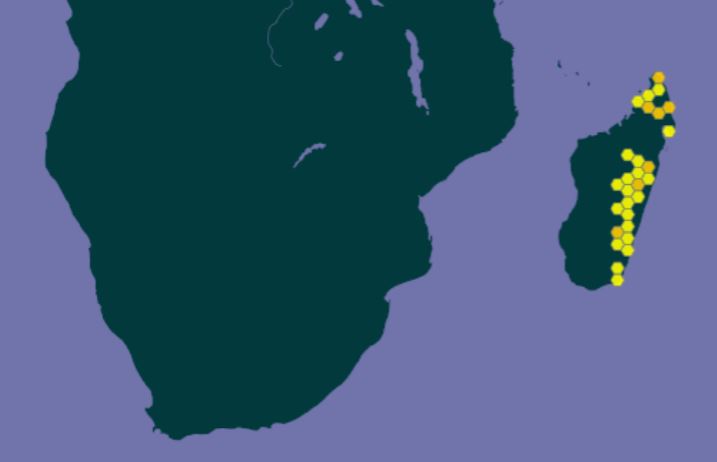
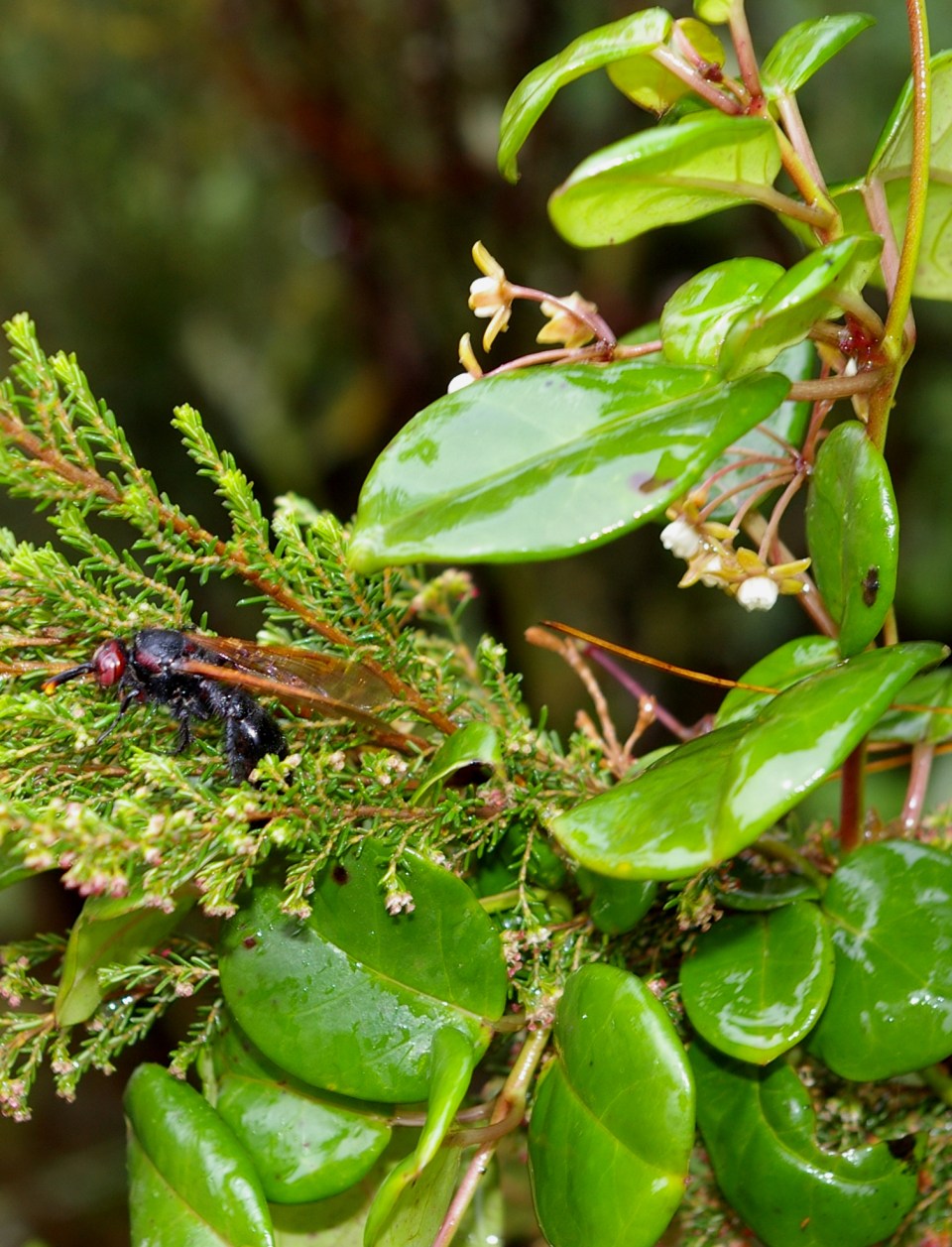
Attached to the email were a couple of images showing a wasp visiting flowers of Cynanchum obovatum, an endemic species of Apocynaceae from northern and eastern Madagascar.  Ulli had taken the photographs during field work there in preparation for the Flora of Madagascar project.  Here’s the global distribution of the species according to GBIF records:

cynanchum obovatum from gbif

I was excited because Madagascar has a very rich diversity of Apocynaceae (between 500 and 1000 species).  However we have flower visitor observations for only a small fraction of them, fewer than 20 species, and good evidence that the visitors are pollinators for only a couple of those.

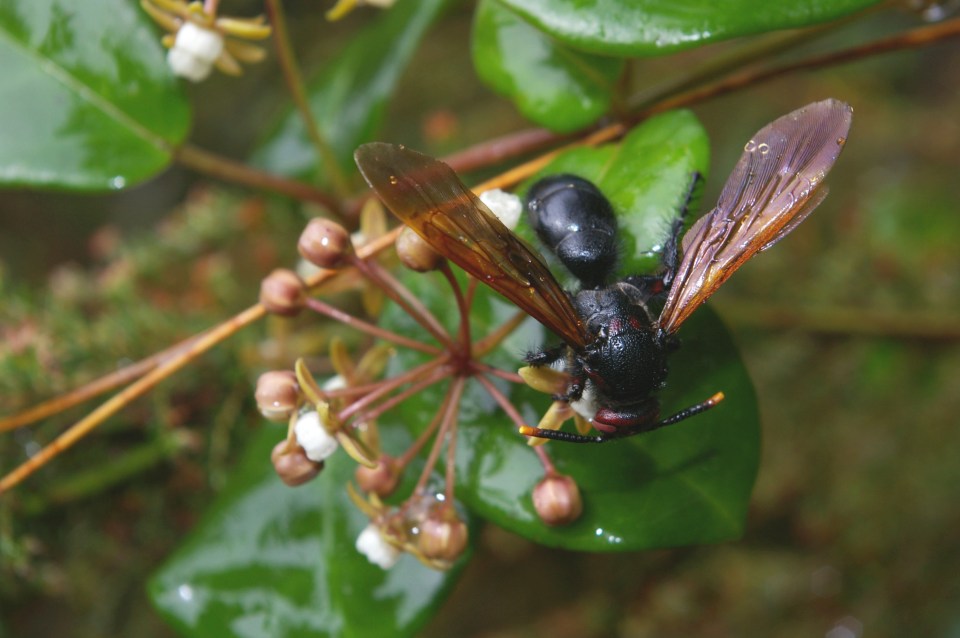
I didn’t immediately recognise the family to which the wasp belonged: it didn’t look like either Vespidae or Pompilidae, two groups that are known pollinators of Apocynaceae.  So I uploaded the shots to the Hymenopterists Forum on Facebook and within minutes had received an answer:  it was a species of Scoliidae, commonly referred to as scoliid wasps.  The distinctive wing corrugation found in this family is clearly visible on this image:

cynanchum obovatum with wasp_madag -angavokely_meve 2

Scoliids are parasitoids of beetles and are some of the world’s largest wasps, but it’s not a very diverse family, with only about 560 described species, and only a single species in the UK (on the Channel Islands).  Compare that with the Pompilidae and Vespidae, both of which contain c. 5,000 species worldwide.

Ulli tells me that when he saw the scoliid on C. obovatum “the wasp knew what to do with the flowers”, something I’ve experienced with vespid and pompilid wasp pollinated species in Africa: these wasps are really familiar with the flowers, they know how to work them to get a reward as they are regular and committed visitors.  We believe that this is likely to be the legitimate pollinator of the plant, in which case it’s one of the few records for Scoliidae pollinating Apocynaceae, and the first for Madagascar.  Other examples are mainly in South America, India and South Africa, and usually as one of a broad set of other wasps and/or bees visiting generalist flowers.

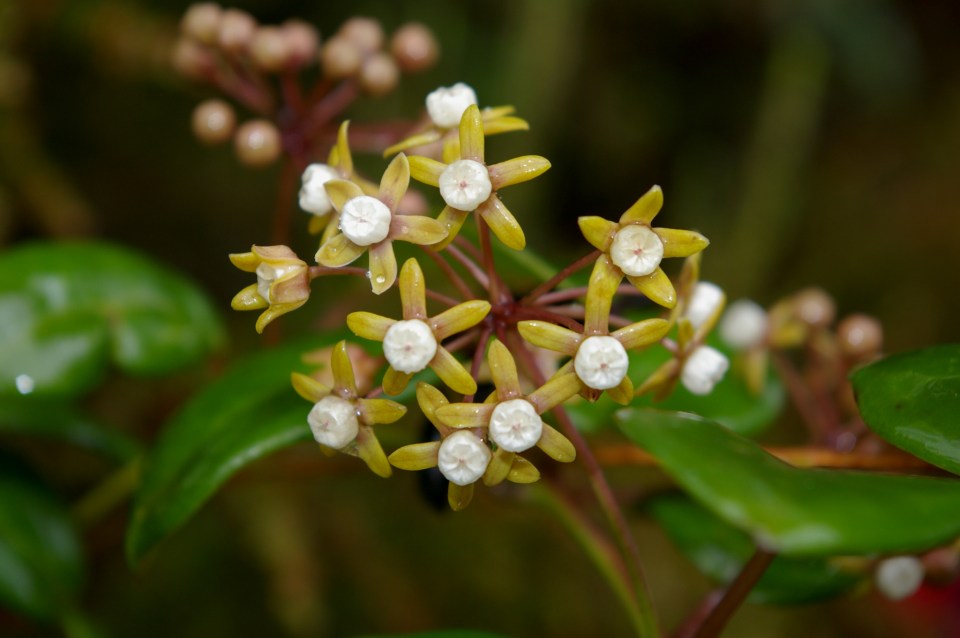
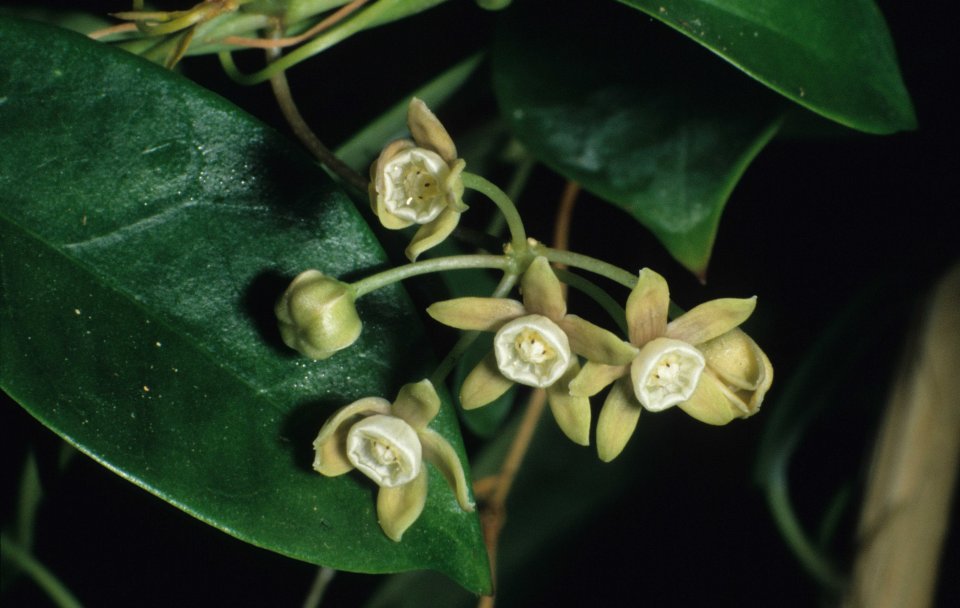
It’s interesting that this species of Cynanchum is one of the few in which the corona which covers the gynostegium (the fused sexual parts) is closed over:

cynanchum obovatum_madag - angavokely_meve

That means it requires quite a strong, large insect to get inside and access the nectar.  So the prediction is that the pollen masses (pollinaria) will be found on the mouthparts of these wasps.  Intriguingly, a very closely related species C. repandum has no such closed corona, begging the question of whether it might be pollinated by a different type of insect:

cynanchum repandum sl 2867_low

For now this record will go into the Pollinators of Apocynaceae database as pollinator unproven, but i would be great if someone working in Madagascar could confirm the status of this pollination system.

My grateful thanks to Ulli for sharing his pictures and allowing me to tell the story of what may be a whole new Madagascan pollination system for our favourite family.  Apocynaceae is full of surprises!

cynanchum obovatum with wasp_madag -angavokely_meve 3


Photograph and poem: the only alien here

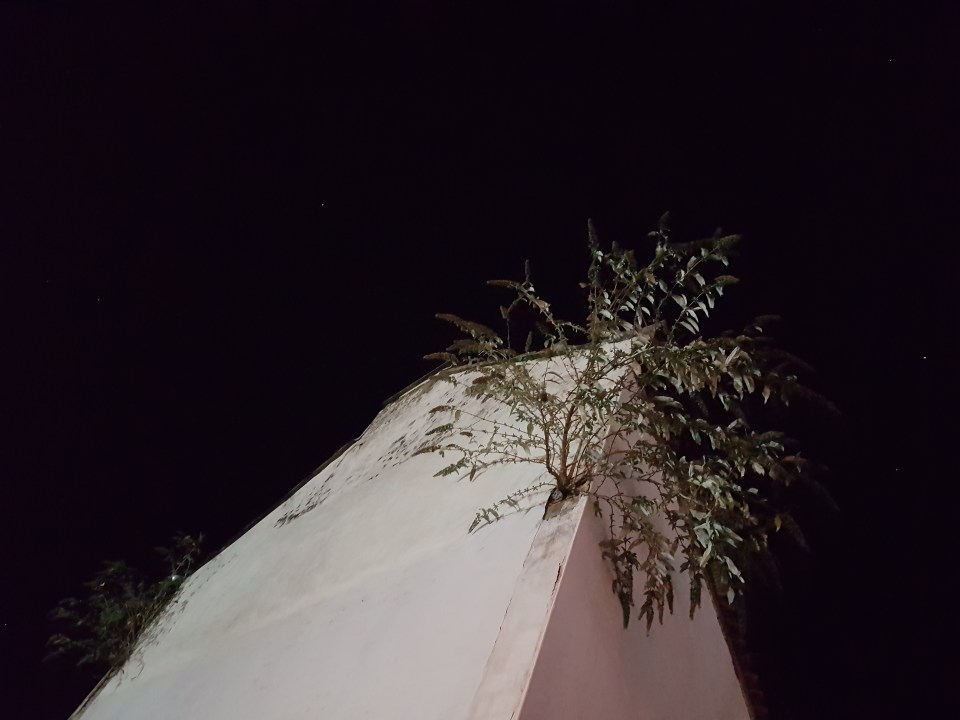
2018-11-01 23.21.44

Wind the propagator propels air-borne seeds

To urban refuge and new opportunity

Where they germinate, elongate, grow, and flower,

Roots seeking soil, making do with mortar and render,

As, persistent in its invader role,

Buddleia grips a gable cliff, dispensing offspring

From house wall warmth into frigid space

And a clear night of stars backdrops the only alien here.


Pollinator availability, mating system and variation in flower morphology in a tropical savanna tree – a new, open-access study

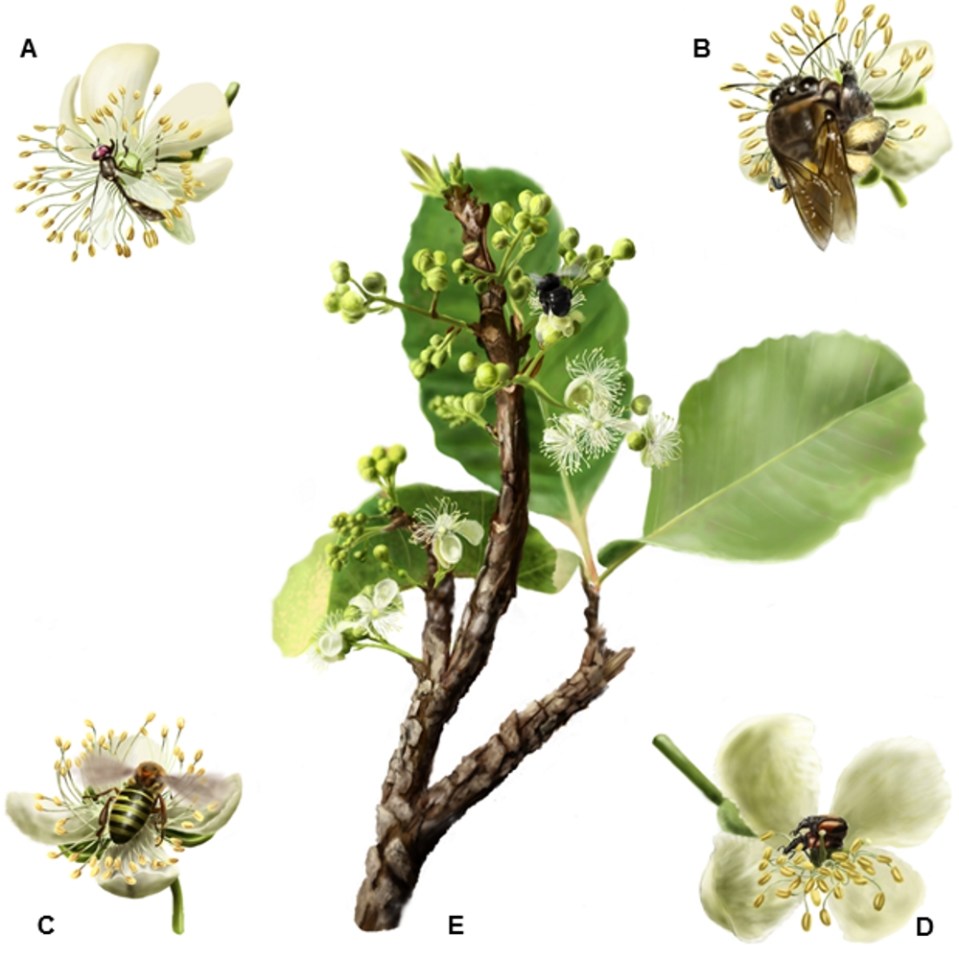
Curatella image by Pedro Lorenzo

Widespread plant species can encounter a variety of different pollinators across their distributional range.  This in turn can result in local adaptation of flowers to particular pollinators, or to an absence of pollinators that results in adaptations for more self pollination.   A newly published study by one of my former PhD students, André Rodrigo Rech in Brazil, has looked at this in the widespread South American savanna tree Curatella americana.  André studied 10 populations separated in space by thousands of kilometres, in cerrado vegetation, one of the most threatened habitat types in Brazil.  Here’s the abstract:

Widely distributed organisms face different ecological scenarios throughout their range, which can potentially lead to micro-evolutionary differentiation at specific localities. Mating systems of animal pollinated plants are supposed to evolve in response to the availability of local pollinators, with consequent changes in flower morphology. We tested the relationship among pollination , mating system, and flower morphology over a large spatial scale in Brazilian savannas using the tree Curatella americana (Dilleniaceae). We compared fruit set with and without pollinators in the field, and analyzed pollen tube growth from self- and cross-pollinated flowers in different populations. Populations with higher natural fruit set also had lower fruit set in bagged flowers, suggesting stronger barriers to self-fertilization. Furthermore, higher levels of autogamy in field experiments were associated with more pollen tubes reaching ovules in self-pollinated flowers. Morphometric studies of floral and leaf traits indicate closer-set reproductive organs, larger stigmas and smaller anthers in populations with more autogamy. We show that the spatial variation in mating system, flower morphology and pollination previously described for herbs also applies to long-lived, perennial tropical trees, thus reemphasizing that mating systems are a population-based attribute that vary according to the ecological scenario where the plants occur

Here’s the full citation with a link to the paper which is open access:

Rech, A.R., Ré Jorge, L., Ollerton, J. & Sazima, M. (2018) Pollinator availability, mating system and variation in flower morphology in a tropical savannah tree. Acta Botanica Brasilica (in press)

The illustration of Curatella americana  and its pollinators is by Pedro Lorenzo.

This paper is a contribution to a special issue of Acta Botanica Brasilica dedicated to floral biology and pollination biology in Brazil It’s all open access and if you follow that link you can download the papers.