The event takes place in the Wilkinson Room, St. John’s Church, Hills Road. Doors open at 7pm and the talk begins at 7.30pm. There’s a £2.00 charge for non-members – more details can be found by following this link.
What happens when you spend an entire year watching hummingbirds and the plants they visit in one of Brazil’s most unique ecosystems? You begin to unravel the complex, ever-changing relationships that tie together birds, flowers, and the environment they share.
In a new study jointly led by Steffani Queiroz and Marsal Amorim — and part of my ongoing collaboration with a brilliant team of Brazilian hummingbird researchers — we explored how plant–pollinator interactions shift over time in the Campo Rupestre, a montane tropical ecosystem rich in biodiversity and endemic species. Despite the region’s relatively stable climate, we found that the relationships between hummingbirds and flowers are anything but static.
Over the course of 624 hours of observation spread across a full year, we recorded over 9,000 hummingbird visits involving nine bird species and 47 plant species. Many of these plants — and one of the most frequent visitors, the stunning Hyacinth Visorbearer (Augastes scutatus) — are found nowhere else on Earth.
Our goal was to understand how the structure of this ecological network — which plants interact with which hummingbirds, and how often — changes over time, and what drives those changes. Are they shaped by morphological fit (the match between beak and flower shape)? By phenology (when plants bloom)? By nectar characteristics such as the amount produced and its sugar concentration?
What we discovered is that different factors dominate in different seasons. During the rainy season, when hummingbirds are more abundant, interactions were shaped mostly by morphological matching — suggesting that competition leads to greater niche partitioning. In contrast, during the dry season, the network became sparser and was more influenced by nectar sugar content and flowering patterns.
Interestingly, while the overall annual network wasn’t especially nested (a common pattern in mutualistic networks), it was highly modular — meaning that it contained distinct clusters of species that mostly interacted among themselves. This structure changed significantly across months, highlighting the dynamic nature of tropical plant-pollinator interactions, even in environments with relatively little climate variation.
This work highlights the importance of long-term, fine-scale studies in uncovering how interactions among species shift through time. It also underscores the remarkable biodiversity and ecological complexity of the Campo Rupestre — and the need to understand and protect it.
Here’s the reference – if anyone wants a copy, drop me a message via my Contact page:
Queiroz, S.N.P., Amorim, M.D., Lopes, S.A., Vizentin-Bugoni, J., Jorge, L.R., Ollerton, J., Santos, T. & Rech, A.R. (2025) Temporal dynamics of a Neotropical plant-hummingbird interaction network. Austral Ecology 50:e70089
And here’s the full abstract:
Species interaction networks are expected to vary following temporal changes in the environment and the composition of the local community. However, there are still gaps in our knowledge about temporal variation in networks in tropical areas, where less variable climates are expected to produce more stable community structures over time. Here we describe a plant-hummingbird network in the Brazilian Campo Rupestre ecosystem and investigate multiscale temporal variation of interactions in this community as well as the possible mechanisms underlying the frequencies of species interactions. Plants visited by hummingbirds were observed monthly for a year and each species had morphology, phenology and nectar traits measured. During 624 h of observation we recorded nine hummingbird species visiting 47 plant species, amounting to 9015 visits to flowers. Most plants (28 species) were endemic to the Campo Rupestre and mostly visited by the also endemic hummingbird Augastes scutatus (the Hyacinth Visorbearer). The annual network was not nested but presented high modularity and intermediate specialisation. While the overall (annual) frequencies of interaction were primarily defined by morphological matching and phenological overlap, we found a remarkable temporal change in community structure over the year, with different processes underlying interactions among plants and hummingbirds at different seasons. The interaction pattern during the rainy season was more similar to the annual network than the dry season (when nectar sugar content and plant phenology were also important), with more links per species and lower specialisation. The higher importance of morphology to predict interactions during the rainy season suggests higher niche partitioning when more hummingbird species are present in the community. Our results exemplify the importance of considering the temporal dynamics of the community to advance the understanding of the processes defining species interactions over time in the tropics.
My sincere thanks to Sinzinando Albuquerque-Lima for the photograph, which was taken in the Amazon, not where the research described above was conducted.
On Thursday 14th November at 7pm I’ll be giving an online presentation to the Countryside Regeneration Trust about UK pollinators and how farmers and other large landowners can help to conserve their populations – booking details are here.
This Thursday at 7pm I’ll be chatting online with David Lindo – the Urban Birder – who is an award-winning broadcaster, writer, speaker, tour leader and educator. According to David’s website,’his mission is to engage city folk around the world with the environment through the medium of birds’.
We will be talking about my recent book Birds & Flowers: An Intimate 50 Million Year Relationship, and the urban birding theme is very relevant as chapter 16 is called ‘Urban flowers for urban birds’. Our conversation will range much wider than that, however, to include the importance and diversity of birds as pollinators, threats to that diversity, habitat restoration schemes, and the cultural importance of flower-visiting birds.
David’s had some really stellar guests on his ‘In Conservation* With…’ series (which he describes as ‘Zoom interviews with some of the leading figures in the natural history sector’) including Kate Bradbury, Stephen Moss, Mark Cocker, Bella Lack, Ben Fogle, Caroline Lucas, Iolo Williams, and Margaret Atwood!
You can sign up for this free event by following this link. I’m really looking forward to it and I hope that you can join us.
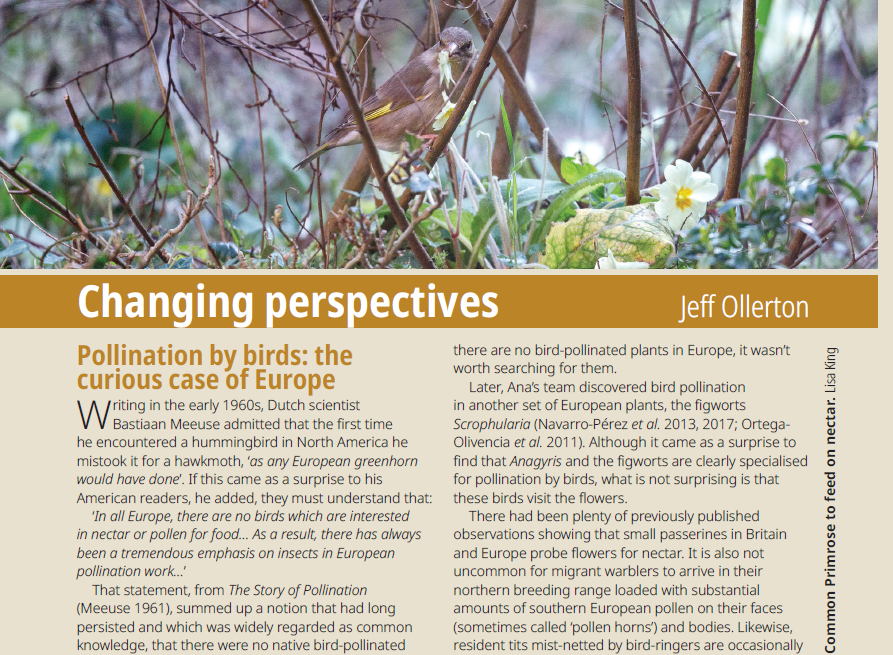
Earlier this year I was invited by the editor of British Wildlife magazine to write a piece for their Changing Perspectives section about how odd Europe is when it comes to bird pollination. It’s based on one of the chapters in my book Birds & Flowers: An Intimate 50 Million Year Relationship.
If you subscribe to the magazine, it will appear in the August issue, though I’m happy to send a PDF to anyone who doesn’t subscribe (or has not read the book) – use the Contact Page. The main accompanying photograph is by one of my former students, Lisa King, who kindly allowed me to use it.
In this delightful book, [Ollerton] describes the ways that birds and flowers interact. As in his previous book, Pollinators & Pollination: Nature and Society, [he] takes a deeply personal approach to the subject. He combines anecdotes from his research travels around the world, to mountains of Kenya and Tanzania, the Andes of Peru, Brazil, and Nepal, among other places, with his contributions to, and masterful knowledge of, the recent literature…
The review is free to read and download from Journal of Pollination Ecology. I’m so glad that people are enjoying the book – if you’ve bought or borrowed a copy, please do leave a comment and let me know what you think.
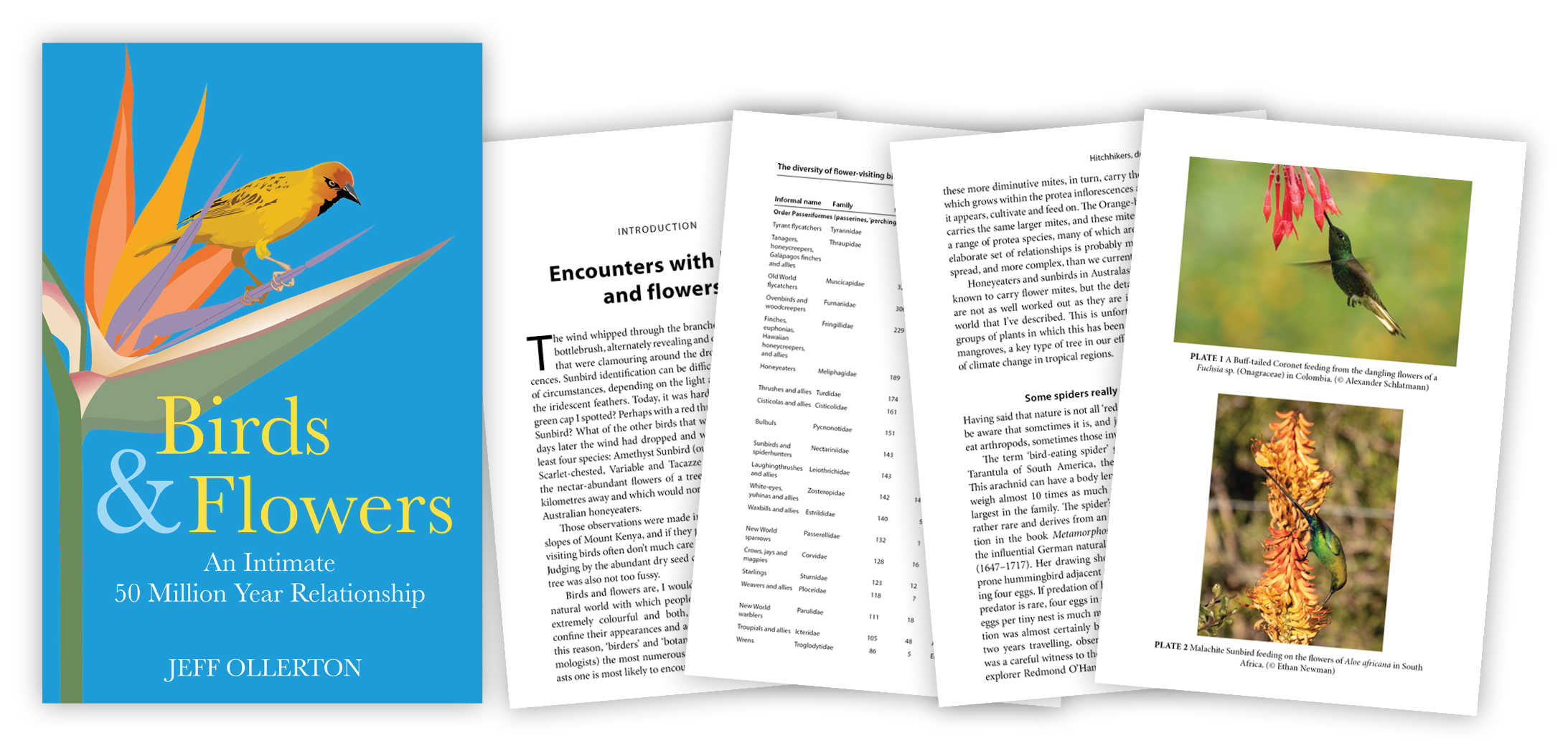
After what seems like a long wait, for me at least, today marks the official publication of Birds & Flowers: An Intimate 50 Million Year Relationship! I received my advance copies on Friday, an event that Karin commemorated with a short unboxing video:
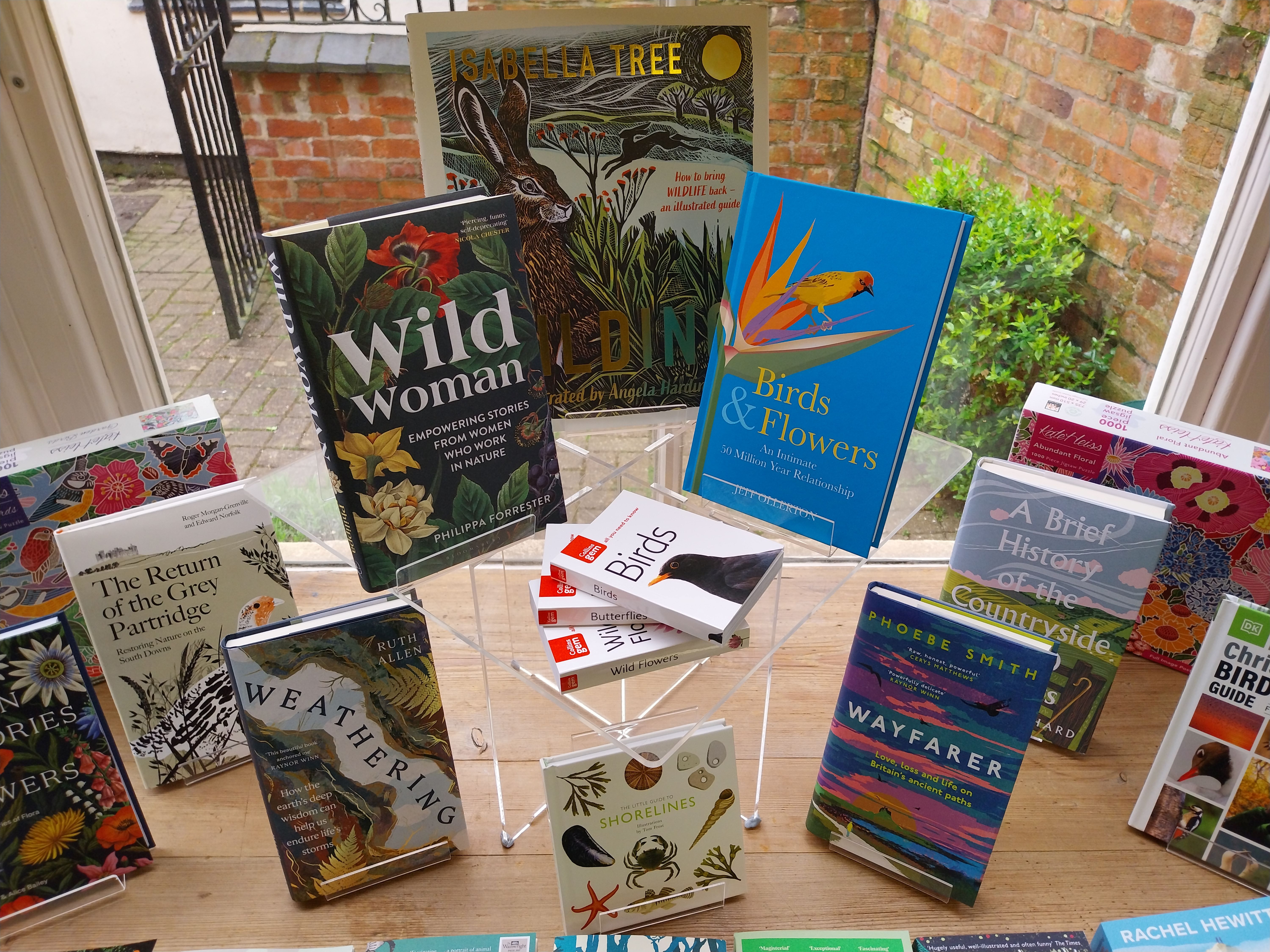
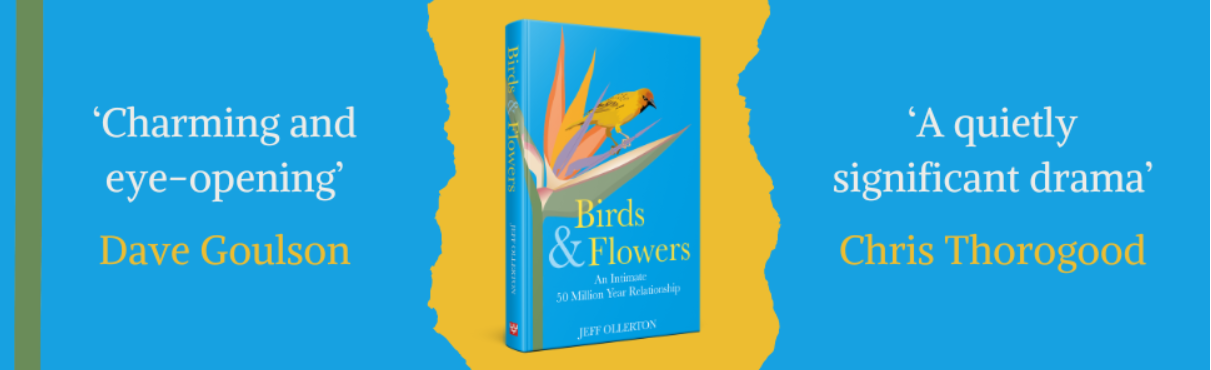
It’s been a long journey from pitching the initial idea to Pelagic Publishing back in early 2021, through the various drafts that have culminated in the finished book. As you can see from the images on this post and the endorsements on the publisher’s web site, Birds & Flowers has so far been warmly received. I hope that future reviews are as positive!
A few people have asked me what’s next. In fact I have definite plans (as in topics, provisional titles, the start of chapter structure, and even some initial writing) for three more books. The next one is actually about half written, but then I have been working at it, on and off, for 30 years! Watch this space for more details…
In the shorter term, Karin and I are returning (permanently) to the UK at the start of March. We’ve enjoyed our time in Denmark, it’s been a fun two and a half years, but we’re missing our immediate family plus we both have some interesting work possibilities to pursue. In mid-April I will be going to China for three months to work with my colleague Zong-Xin Ren at the Kunming Institute of Botany. I’ll be sure to blog about my adventures there!
In the meantime, if you buy my book or borrow it from the library or from a friend, please let me know what you think in the comments section below.
In the run up to release of my new book Birds & Flowers: An Intimate 50 Million Year Relationship, my publisher, Pelagic, has updated the book description and provided a preview of some of the pages and colour plates – follow this link to view them. On that page you can also pre-order the book direct from Pelagic Publishing, who will ship worldwide, or it’s available from many of the online book sellers.
I’m really excited to be sharing this with the readers of my blog and can’t wait for publication day! Early in 2024 I hope to do some talks, online and in person, to promote the book – so watch this space.
With best wishes to you all and hopes for a peaceful, and more sustainable, New Year.
Today I returned the final, edited files of the book manuscript to the publisher. It’s been a long summer of ‘fine distinctions and nice judgements’, to quote my editor, the inimitable Hugh Brazier. Now that’s all finalised, I thought that it was time to share the chapter titles with you – here goes:
Introduction: Encounters with birds and flowers
1 Origins of a partnership
Understanding 50 million years of bird and flower evolution
2 Surprising variety
The astounding diversity of pollinating birds
3 Keeping it in the family
Accounts of the different groups of bird pollinators
4 A flower’s point of view
How many plants are bird-pollinated, and where are they found?
5 In the eye of the beholder
What do bird flowers look like?
6 Goods and services
The enticements given to birds for pollinating flowers
7 Misaligned interests
The ongoing conflicts between flowers and birds
8 Senses and sensitivities
How bird brains shape the flowers that they pollinate
9 Codependent connections
Networks of interacting flowers and birds
10 Hitchhikers, drunks and killers
The other actors in the network and how they affect the main players
11 The limits to specialisation
How ‘specialised’ are the relationships between birds and flowers?
12 Islands in the sea, islands in the sky
Isolation, in oceans or in mountains, results in some remarkable interactions
13 The curious case of Europe
Why did we believe that Europe had no bird-pollinated flowers?
14 ‘After the Manner of Bees’
The origins of our understanding of birds as pollinators, and their cultural associations
15 Feathers and fruits
Birds as pollinators of edible wild plants and domesticated crops
16 Urban flowers for urban birds
Bird pollination in cities and gardens
17 Bad birds and feral flowers
The impact of invasive species
18 What escapes the eye
The decline and extinction of bird–flower relationships
19 The restoration of hope
People as conservationists of birds and their flowers
There you have it! I’m incredibly excited that the book is now just about finished (I still have to proof read the typeset text and produce an index) and I look forward to finally having a copy in my hands. Birds & Flowers: An Intimate 50 Million Year Relationship is available for pre-order from Pelagic Publishing, or via online bookshops.
But just as when a movie director says “That’s a wrap” at the end of the final day of filming, the hard work does not stop here. Two people have read the full manuscript as I was producing chapters and their suggestions have been incorporated into this draft. The publisher will now send it to a third, independent beta reader and once their feedback has been acted on it will go to a copy editor who will suggest stylistic changes, check for logic and consistency, and so forth.
At the same time I will be choosing which plates to put in the book, which images to use on the back cover, writing their descriptions and deciding where to cite them; checking the sources and further reading sections for each chapter and formatting the references; and producing an appendix that lists the scientific names against the vernacular names that I am using in the book. I also need to finalise the acknowledgements section.
As an author, producing a book is a long process that doesn’t end with the actual writing of the manuscript. It’s incredibly satisfying, however, and working with Pelagic on my second book for them has been a great experience. All being well, Birds & Flowers should be out by early winter.
Now, I have three options for the next book that I’m writing….which one to choose…?





 Prof. Jeff Ollerton - ecological scientist and author